Last call (for summer tomatoes)

But now those tomato plants look forlorn. They struggle to stay upright as the early autumn winds blow, their leaves turning yellow and brown. Gotta say it’s kind of sad. So instead of petering out, or going out in a gradual fade away, The Spartan Woman gathered all the ripe small tomatoes and a few larger ones, and put them in a bowl. We looked at that red tableau and decided that a late summer roast would end the season with a bang. But what to do with the roasted tomatoes? The dish is a traditional foil for a roasted and/or grilled leg of lamb. But no, we couldn’t. Not when we have little lambs from the neighbor visiting us every now and then and taunting the pup. We could have paired them with pasta and ricotta salata, but that seemed too ordinary a dish to salute their tomato-ness.

In the end, we decided on a risotto, one that would be finished with butter and mascarpone, an appropriate blowout to what had been a decent season.

The “Recipe”

I put the headline in quotes because this is a dish that you feel more than you quantify. The risotto itself should be rigorously orthodox, a blank canvas for the intense tomatoes. We decided not to use saffron, thinking that it would distract from the star attractions. For a risotto for two people, you’ll need a cup of carnaroli rice—arborio works, too—an onion, a liter+ of good vegetable stock (I added wine and water so I’d have enough liquid), enough olive oil and butter to sauté the onion and toast the rice, and a splash of white wine. It’s a two-part process that takes a couple of hours, half of it passive, but it’s worth it.

You first have to roast the tomatoes. This could take up to an hour, depending on your oven. Preheat your oven to 220 deg C., or 425 deg F.
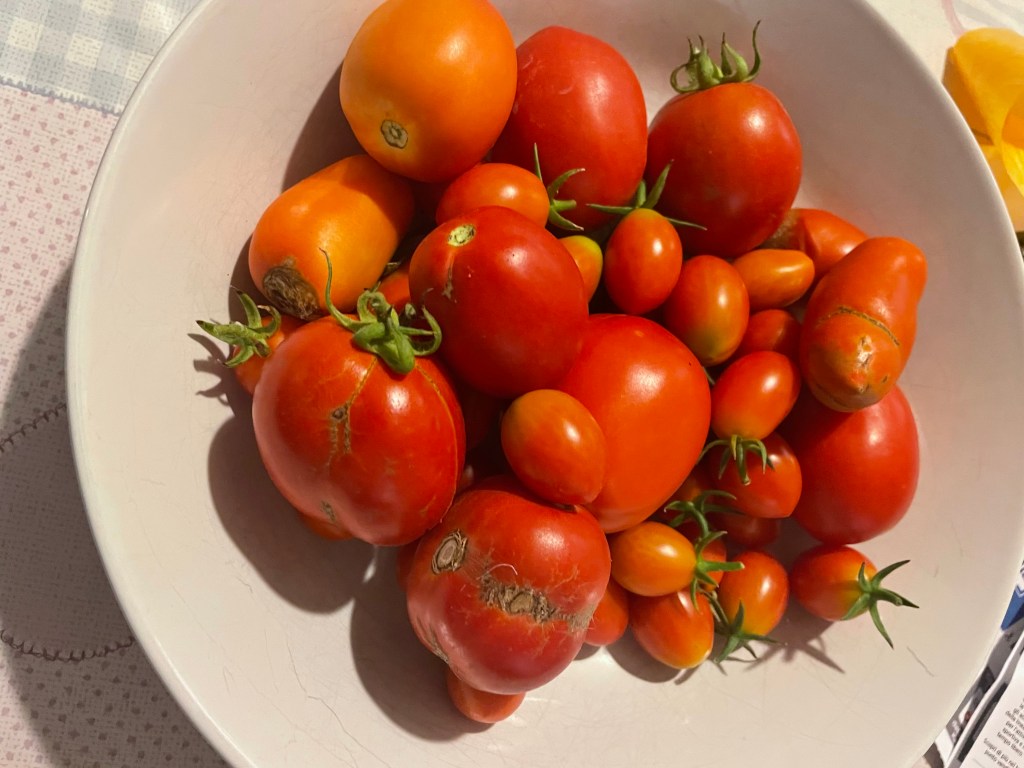
Halve or quarter the tomatoes and put them in a roasting pan. The quantity is up to you; the amount of the red stuff in the photo above was perfect for the two of us. Smash 2-3 garlic cloves and put them in the pan. Add a good amount of both olive oil and white wine. Sprinkly with salt and pepper, and if you’re into it, a bit of chili. Thyme goes really well with this, so a few sprigs. Rosemary sounds good in the abstract but will overpower the dish. Basil is fine, if not great looking when it roasts, and in a pinch you could add some herbes de Provence.

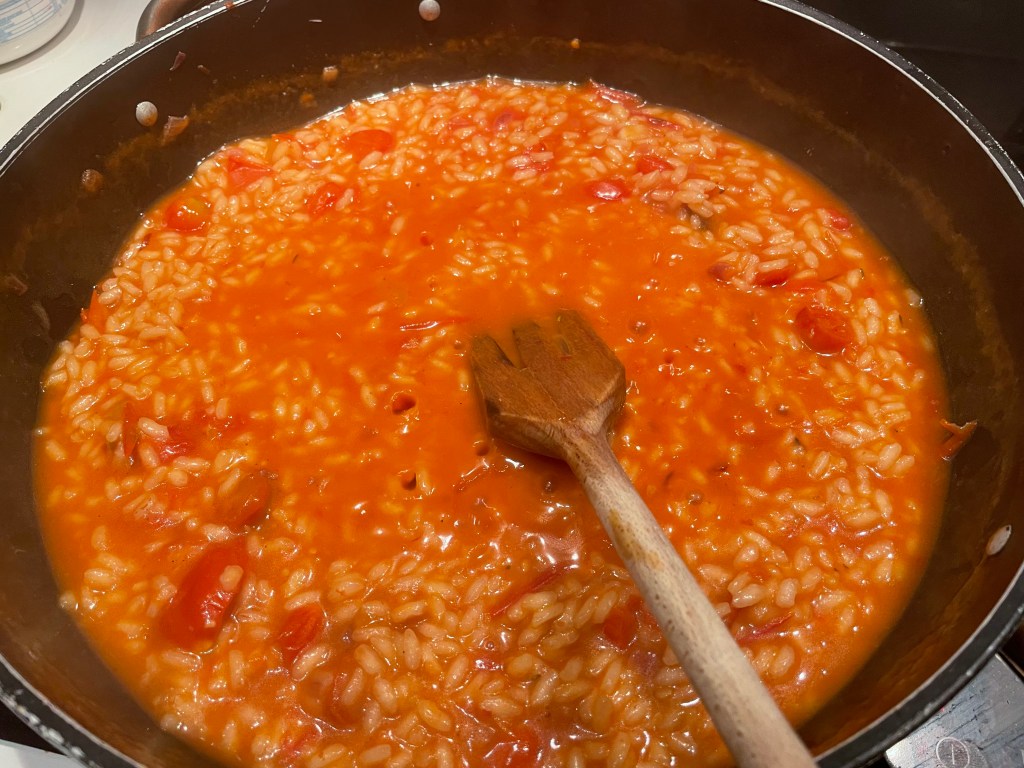
Check the tomatoes every 15-20 minutes. Stir them to judge doneness. When they look like those below, the tomatoes are done.
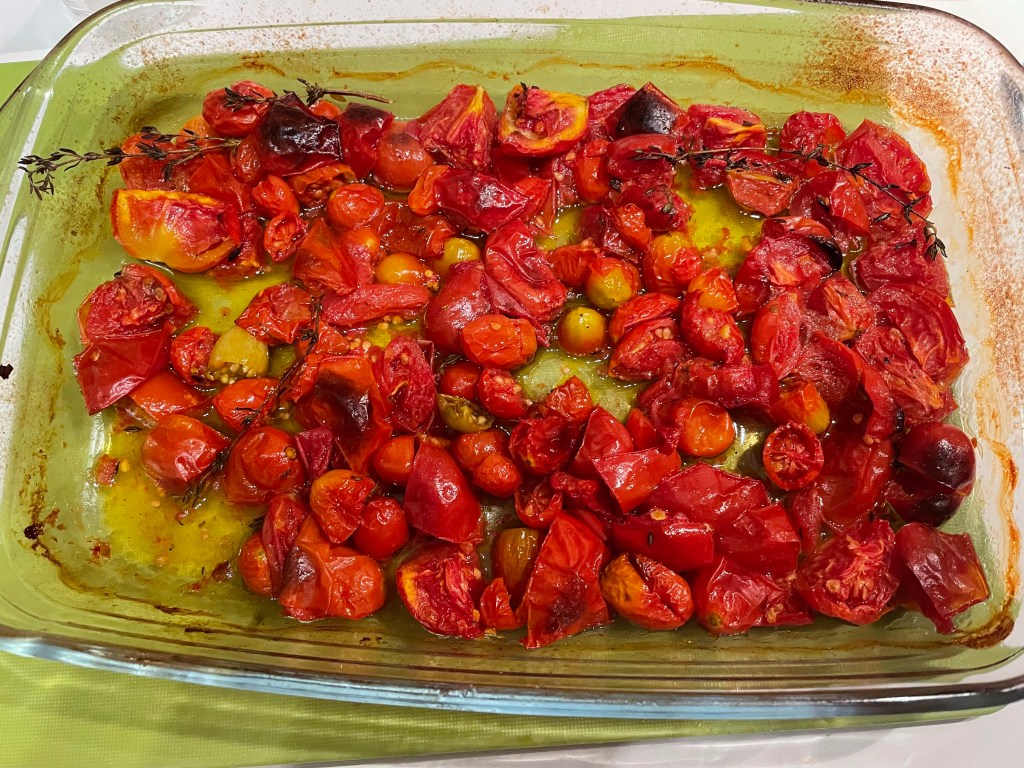
Set the tomatoes aside for now. It’s time to make risotto. I’m going to go quickly here. I’m assuming you know the basics; By now, you’ve got the stock simmering in a separate pot.

Saute the onion in some mixed olive oil and butter, then add the rice. Stir, toasting the rice. When the onion is translucent and no longer crunchy add a big splash of white wine.

Now, ladle by ladle, add stock and stir. A lot of people say that the regular stirring is unnecessary. I like to stand at the stove and stir. Plus, it gives me an excuse to drink some crisp white wine while laboring over a hot pan.

Somewhere in the middle of being done, which will take 25 minutes or so, start adding the tomatoes. You will notice the skins coming off. Some might look at this with horror; we don’t mind. Keep adding stock and tomatoes until the rice is al dente–soft around the edges but with a definite bite at its core.

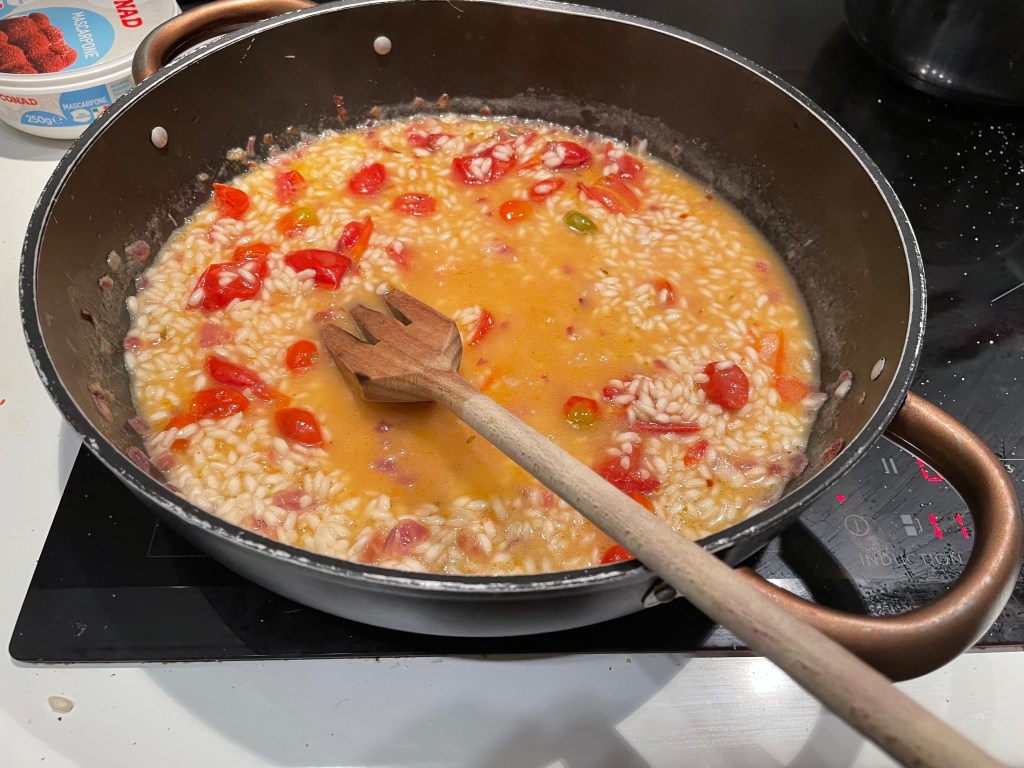
Now the fun part: Turn off the heat. Stir in a few dollops of mascarpone. The quantity is up to you and your gall bladder. I went for decadence, but that’s me. Stir and dissolve. Now add a nice handful of grated Parmigiano-Reggiano or Grana Padano. Stir some more. If you’re a really sick puppy, you can add a couple of knobs of butter, but that could be way over the top. I won’t tell.

Serve. A small mound per person to start. Seconds for the greedy and/or decadent. Buon appetito e arrivederci summer.
Face the music

Most of the time I’m pretty comfortable being here. I almost lost sight of that over the summer’s hot spells, which kept us literally in the dark for hours during the middle of the day, after which we’d try to cool off with a swim, or go somewhere for a drink in the shade. It felt isolated and more than once I started to think I didn’t have to move thousands of miles/kilometers to live this life. But when it cooled down some, we started taking walks again and our neighbors would stop and chat. It felt good to be babbling in Italian, setting up coffee or dinner dates with the sweet people who live along this road.

I can only imagine how my father felt when he moved to New York back in 1955. He had the support of my mother’s family, but he didn’t have decades of rehearsing for the move, like I did. For my dad the move was a sudden plunge into the unknown, and that showed. He never quite understood how his new country worked, and why Americans didn’t take to the streets for economic reasons.

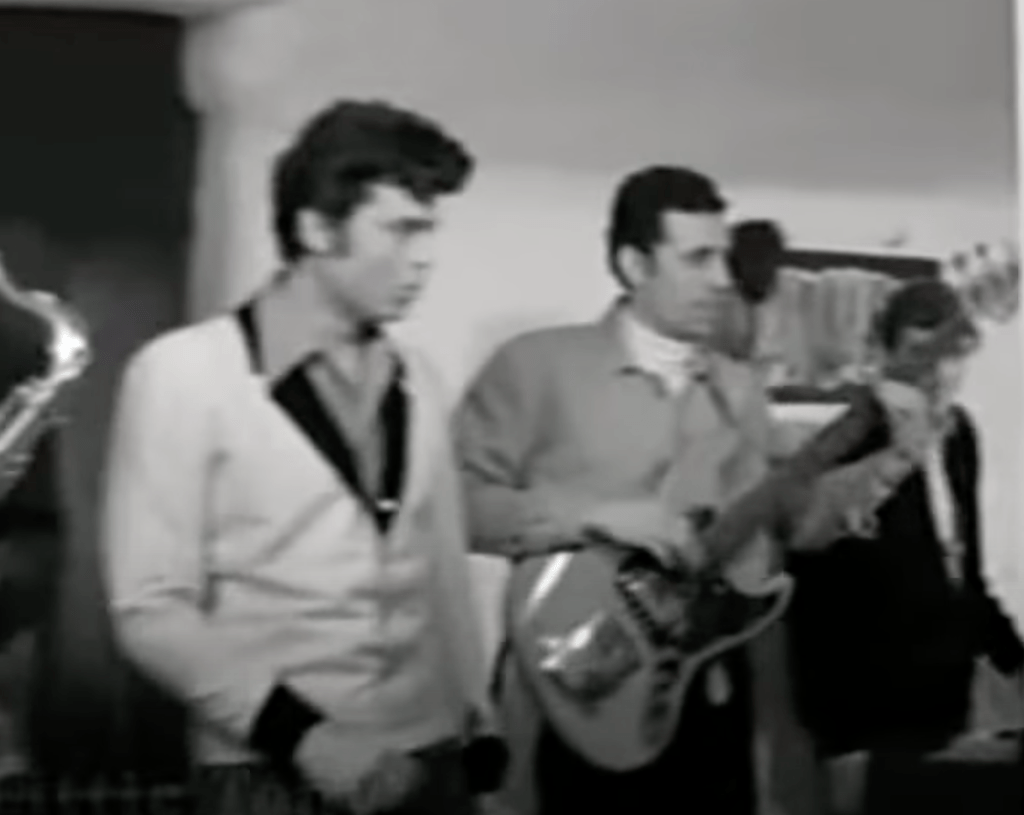
Little Tony at a swingin’ party

He clung to his culture. My sister and I would buy him Italian pop music albums for Father’s Day—one was a bunch of songs from Italy’s San Remo Festival, sort of a precursor to today’s Eurovision song contest. That album supplied my sister and me with a good sense of camp. Cynically teenagers brought up on The Beatles and Rolling Stones, we laughed at songs like this, by a character who called himself Little Tony. That bass line’s pretty catchy, though.

When my parents bought a decent stereo, my dad did what every respectable Italian in New York would do and bought some opera albums. Naturally, they were Italan operas: Cavalleria Rusticana, by Mascagni, about a Sicilian Easter Sunday that goes very badly, La Traviata by Verdi, a prostitute who dies alone without her client-lover; Aida,also by Verdi, two ancient Egyptians who meet a tragic end in a temple vault, and so on. (Hey, there seems to be a common thread here.)

The one exception to all of this was Dad’s unexpected love of the Supremes. When they came on The Ed Sullivan Show, he was under Diana Ross’s spell, uttering every so often, “She’s beauty.”

WHAT DOES THIS HAVE TO DO WITH me? Music. I’ve gone pretty native in most ways; it wasn’t that hard to do. I’m down on “Italian” food—hey it’s just food that people eat here. My accent’s gotten better; no one offers to switch to English or complement me on speaking the language, a sure sign that you’re not doing too well.

But the one time I feel almost totally American is when I listen to music. In particular, R&B and anything that’s got that on-the-1 thing going on. Think James Brown, Funkadelic, Prince. Sure, we listen to Italian pop music up on the hill here. But that’s in addition to our usual stuff. I started thinking about this the other day when I first heard the new song, Angry, by those old guys The Rolling Stones. They may be Brits, but they swing like Americans and have done so since they were kids. Take a listen:

It’s not that I dislike Italian stuff; still, it’s more “in addition to” rather than a substitute. American music is what I grew up with. Certain rhythms and chord progressions resonate with me. We grow up with the three-chord blues progression, and that Chuck Berry chunka chunka riff is almost embedded somewhere in our brain. Even younger artists who don’t know from blues progressions or the Beach Boys have the music as a cultural background. There’s a certain way Americans and their British followers sing and play and it’s definitely a part of anyone for whom music is a big part of his or her life.

Fandom enters into it, too. Even hipster fandom. The other day I was reading the coverage of the rerelease of the Talking Heads concert movie Stop Making Sense and noted the relieved tone that a lot of the articles were written in: Look! They’re talking to each other! Hey, I felt relieved, too. They were a big part of my youf.

We’re trying to catch up on cultural references and the like, but it is a learning curve. I also think there’s a difference in how Americans and Italians play their instruments. If you listen to the bands behind Italian singers like Eros Ramazzotti (shown here in a cool live performance with Tina Turner) or Laura Pausini, they’re terrific. Every note’s in place and their sense of drama and dynamics is spot on, But in some ways they’re almost too good. Americans, at least when machines aren’t taking over, have a wilder edge.

Of course, I’m talking in generalities. Italian rappers get it, and performers like Mamood definitely use rhythm more than melody to power their songs. And Matteo Paolillo has become a breakout rap/pop star because of the TV series Mare Fuori, and his moody, rap-singing in Neapolitan deserves to go international. And one older guy, Zucchero, might as well be a big star in the U.S.—he’s got a great band that’s really beat-friendly. (By the way, take a look at the show Mare Fuori, soon to appear on the U.S. streaming service Mhz Choice as The Sea Beyond.

But I’m talking about me and The Spartan Woman. We’re lucky in a way to be living here now. With streaming services at our voice command, we can listen to anything we want. And while we’re listening to more Italian stuff, sometimes you can’t beat Marvin Gaye, you know? We didn’t have to ship boxes of CDs over; in fact as of now we’d have nothing to play them with. We have smart speakers, and when the ‘net goes down as it does every so often,, we can stream cellular data from our phones to a couple of Bluetooth speakers.

The music thing may sound pretty minor, but I have a soundtrack going on much of the time. If I’m not listening to something, I’m playing or arranging songs in my mind. I wake up most days with a tune in mind and often, even before making coffee (Italian coffee culture may be one of the biggest reasons for being here), I’ll have to tell the speakers to play the song lest I go insane. I associate places with a certain kind of music. Montréal, for example, for moody French pop or that Franco-Mali music that you hear on the radio there; Palermo, Sicily, for a North African-Sicilian hybrid, and so on.

And what do I think of when I think of Perugia? Right now, it’s mainly one of the hits of the summer, bellississima by Alfa (see below). Radio here is pretty eclectic, our car’s screen describes most stations as “vari” or hit radio. Last year it was all about Dua Lipa. It’s harder to say what was big this year; probably a mixture of Paolillo and this song, which comes on the car radio pretty often.

I’m still working all this out. There’s a long history of people from English-speaking countries being expats in Latin-speaking ones. My experience and perspective is a little weird because I grew up somewhere over the Atlantic to begin with. Right now a big part of me just says enjoy and tell Siri to “play music that I like.” Maybe that’s the best approach.

I hear you had a nice time in Italy this summer. Next time come back to fill in the blanks

We have access to webcams, and the hot spots looked very crowded. And from personal experience, we know that touring Italy in the summer is not a good thing for those averse to extremely hot weather. And climate change only ramped up the heat. My phone was pinging me almost every hour about extremely hot temperatures, courtesy of the Italian Meteorological Service, a unit of the national air force (really). And that was here, where we’re surrounded by trees, shrubs, and other flora, and we are not surrounded by other people. I think I worked up a sweat just gazing at the Trevi Fountain crowd on my laptop screen.

You probably ate, too. With any luck, you ate fairly well, although in those tourist traps, I mean popular destinations, the food can be hit or miss. My cousins who didn’t come this way seem to have done pretty well for themselves, judging from their posts on “il social,” as we say ’round these parts. But sorry, I have to say, they were in cities, big cities and/or popular cities. You can only get so far. And restaurant workers in the touristy places have acquired bad habits, like expecting a tip from Americans and other non Italians. We don’t tip out here in the provinces.

I’ll get more serious now. It’s a different world here, with an entirely different culinary culture. In the United States, most decent restaurants are in big cities, which attract the best and most ambitious cooks and restaurateurs. Go outside New York or Boston or Chicago and you’ve got chain restaurants like Olive Garden, with the occasional brave indie that was featured on Guy Fieri’s Diners, Drive-Ins and Dives. I exaggerate, but you get the point. In Italy, sure there are great city restaurants like the Osteria Francescana (I haven’t been, but I’ve seen the YouTube videos). But the really good and funky stuff is in people’s kitchens, and out in the sticks and smaller urban places.

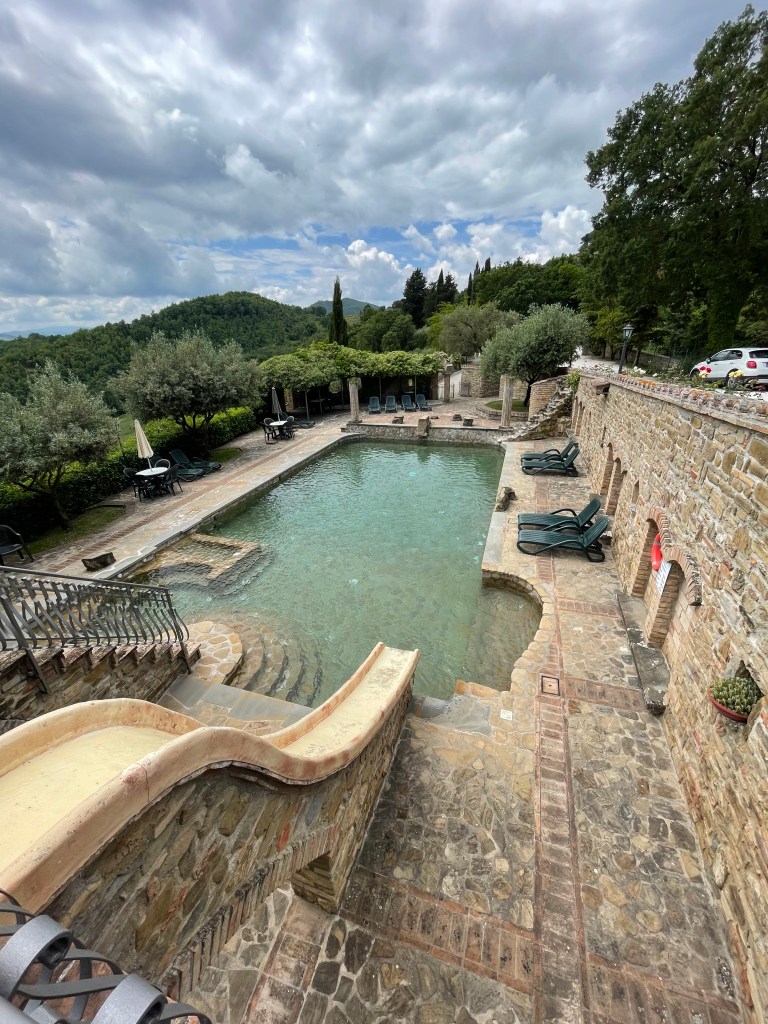
For instance, earlier this summer a friend and I went up a mountain above the town of Gualdo Tadino, just because. We walked around a sanctuary and admired the view. That sure worked up an appetite, so he suggested we go to Villa Dama, a nearby agriturismo his daughter’s in-laws go to for celebratory occasions. I called for a table (they had plenty that day) and 20 minutes later we were walking the place’s beautiful grounds. Nice lunch, too, multi-course with wine, for €40 apiece. And that’s relatively posh for this area (photos below).

Traveling outside the big centers doesn’t limit your tastebuds, either. You might think you’ll have to eat “Italian food.” The towns near us (the biggest being the small university city of Perugia) feature Greek, Japanese, Chinese, and African food, and even an ersatz American barbecue chain. (But us mostly vegetarian types haven’t tried it.)

I’M LUCKY. I KNOW THAT. I have family here, and chosen family, too. Most of my meals before we move to Umbria took place in their kitchens and dining rooms. The day my grandmother turned 90 we had a banquet at a country restaurant that night. The party meal was of a zillion courses and I thought it was pretty good, but the critics at home (one uncle was a chef) had issues. I’ve watched my brilliant Perugian mamma create simple delicious meals in a half hour in her small kitchen. When I started peeling a ripe pear she motioned for me to wait a sec and broke off a piece of Parmigiano-Reggiano to go with it. Simple. Perfect. My Venetian aunt invited us over once and she and her daughters created an amazing 10-dish array of cicchetti—think Venetian tapas. And so on.

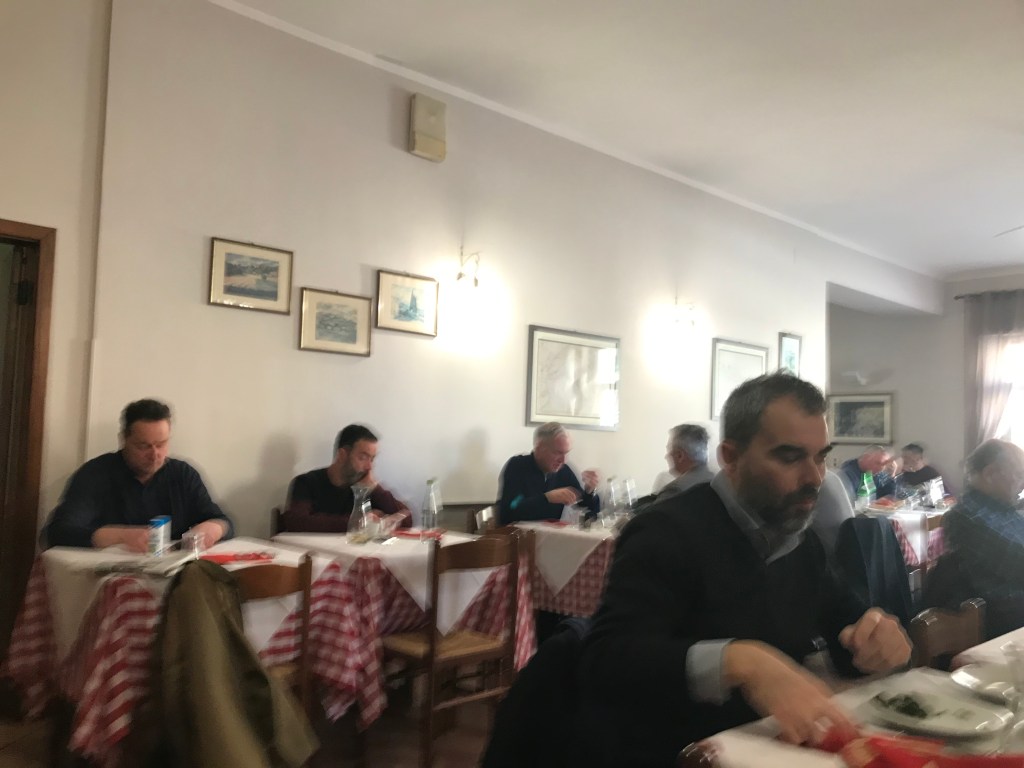
You don’t need a Venetian aunt, though. You do need to be a little adventurous. Get away from RFV. Get on a train or rent a car—it’s not scary driving out in the countryside, I promise. Find an agriturismo, a working farm that puts people up and feeds them. We’re surrounded by them here, and they aren’t hard to find. Go to the website With Locals and set up dinner or a cooking class with real live Italians. Even in restaurants, though, the feeling is different away from the aforementioned RFV. Service is casual and really friendly and the tab is a fraction of what it would be in RFV. You’ll find yourself chatting with the proprietor once they realize you’re from elsewhere. You might end up exchanging recipes, too.

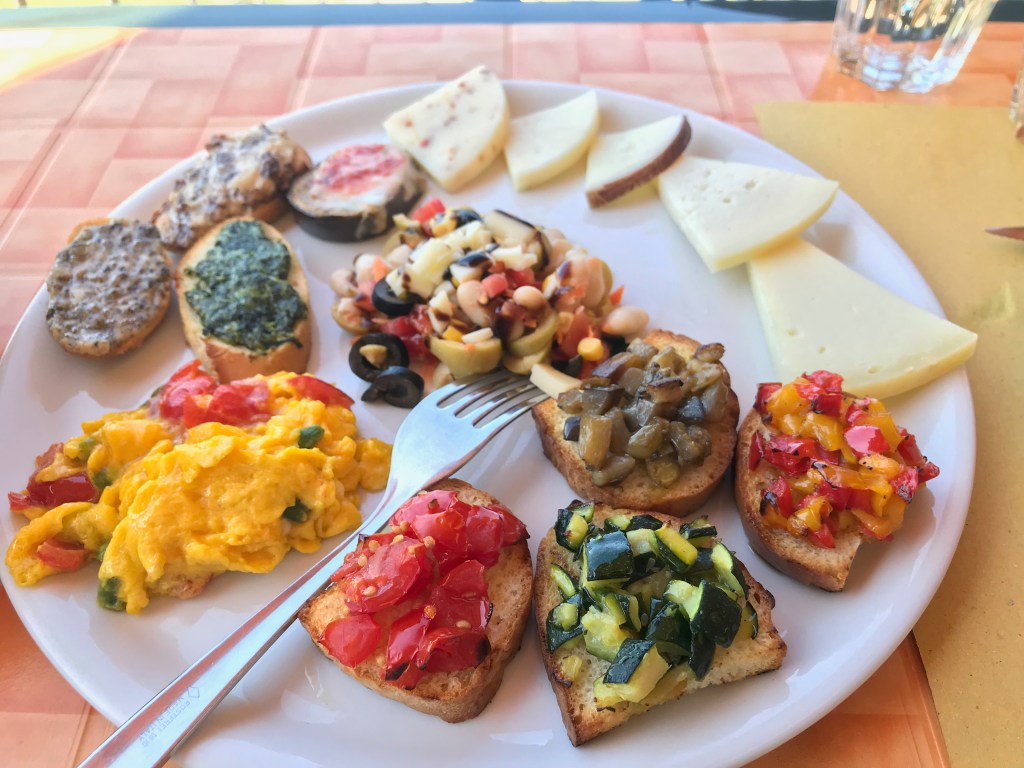
Above, the out in the sticks experience. Clockwise, the first two photos are at Osteria del Cambio in Palazzo di Assisi. And we had the antipasto plate and the truffle lasagne at La Terrazza di San Guido, a laid-back restaurant in the hills above the town of Gualdo Tadino.

For the ultimate in getting down with the peeps, seek out local sagras and festivals. You can get a good start here. I’ve written about them before, but to sum up, it’s how a town might raise money for the school’s gym, but in reality it’s a celebration of people’s towns, local culture and produce. The other night we went to the shindig in our town; the week before we went up in the mountains to a town that grows fantastic potatoes. Of course, almost every dish featured the spuds. (Text continues below photo.)

Waiting in line for the spuds fest

Here’s the thing. Travel like this and you’ll get to know what the real treasure of this country is. Not the Coliseum, not the Vatican or Florence’s art treasures. You’ll likely get to hang out with the people, who despite bad governments, annoying bureaucracy, and anemic economic growth somehow manage to be kind, generous of spirit, and a pleasure to be around.