We’re almost up to where we left off. In our daily life, that is. Hurricane Olivia was our terrific excuse. We may have abandoned (mostly) our birth country for now, but certain things, like checking accounts, language between us at home, and, oh, our adult kids and a grandkid keep us tethered. Naturally, we’d prefer that our favorite humans somehow are able to make the same leap. But stuff like regular employment and deep friendships get in the way. I wasn’t ready to turn my life upside down when I was 30, either.
So it’s great when a kid or two comes by for a visit. This time it was Liv a/k/a Olivia, our younger daughter, and her partner Al. We got their room ready and stocked some of the foods we knew they’d like or need. So, big bunch of small hot peppers? Check. Oat milk, ditto. Restock coffee supply? Done. We took mercy on them and picked them up at Rome’s Fiumicino Airport instead of making them take the train. It’s a haul from “Alta Umbria,” but for a Monday morning just after rush hour, we just breezed in.
A lot of any visitor’s stay naturally involves food. I don’t really have to say it, but it’s pretty incredible ’round these parts. A visit to a regular supermarket is like going to an Eataly in the U.S., except that everything is half price, if that much. Back in ‘Merica, our offspring have developed some food intollerances, or so they thought. In Liv’s case, U.S. market pasta and wheat products give her a stomach ache, so she thought she’s got that fashionable gluten problem. But no. She can eat pasta and bread and pizza here, no problem. And she’s not alone—an anecdotal survey of people who live here but go to the U.S. regularly brought out a lot of the same reactions. Anyone have an idea why?
Liv and Al took two weeks of their valuable time off, so instead of sitting at home admiring the view we had to put on our tour guide hats and see stuff around this splendid little region. Not that it’s their first time around this block. Al said to me “Being here is, like, what I do now. It’s my alternate reality life.” First they had to return to Perugia, Liv’s first love and where Al has developed certain rituals. I dropped them off so they could wander around without us old people slowing them down. Despite the nasty weather, they dropped into their favorite places, Al at the porchetta stand on Piazza Matteotti, and the two of them for artisanal gelato (with flavors like gorgonzola and honey) at Lick (closed for vacation until 7 December).
ONCE THEY GOT PERUGIA OUT OF THEIR SYSTEMS, we tried to get away from the too familiar. Last year we spent a rain-drenched day in Foligno. Until then that small city was just a railroad station where we had to change for the Perugia branch line. But we discovered it’s a lively place and unlike most towns in Umbria, flat and really walkable. The window shopping is terrific, and there are tons of cafés and restaurants, many of the latter looking as though they dropped in from Williamsburg.
Knowing that we were going to be in Foligno long enough to have lunch, I started to surf the Web for suggestions, and ran into the service The Fork. It’s like Open Table and Resy in the U.S., but it points to places off the main tourist squares and, if you reserve a table through the site, you often get a discount. I looked through the service and got us a table at Fish Easy (that’s really its name). You can leave a note for the restaurant when you reserve, and I asked if it was okay to bring our dog. Most restaurants here are dog-friendly, but it never hurts to ask. I got a quick reply—sure, we’ll be happy to have him around. (Below, lunch at Fish Easy, with Niko hoping something falls off the table.)
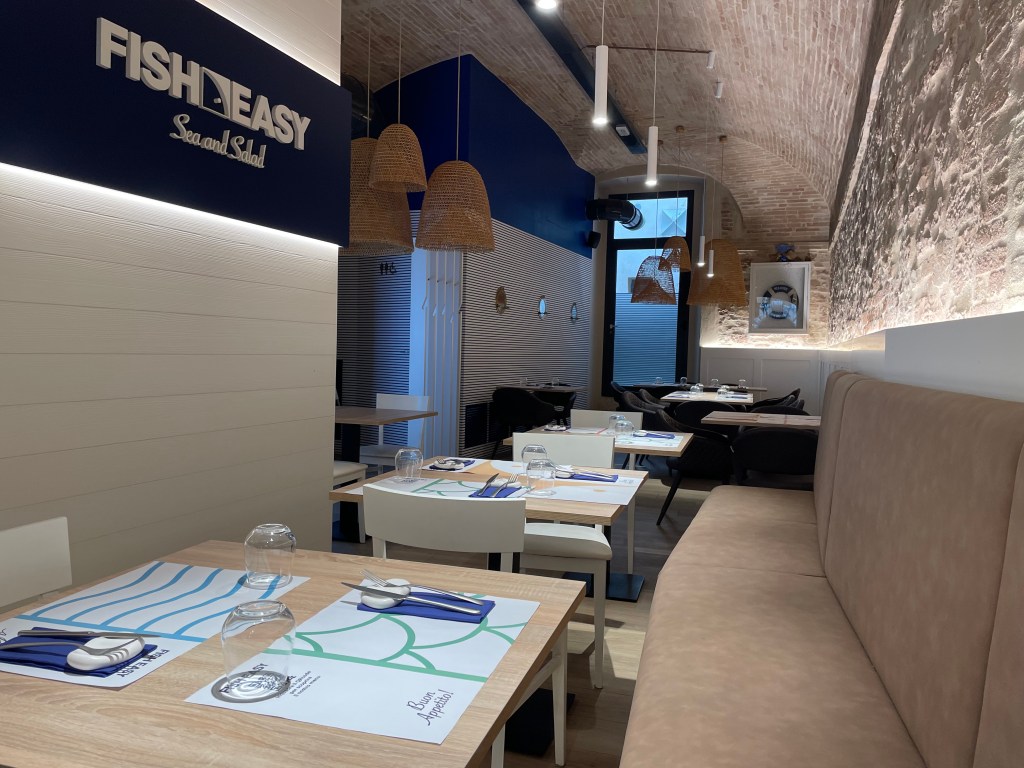


The proprietor made good on his promise. Niko was our calling card, and as soon as he saw Niko leading the way, he knew it was our party of four. The place, like a lot of Foligno eateries, didn’t trade on the Olde Worlde thing, the decor and the menu was sleek and up to date.
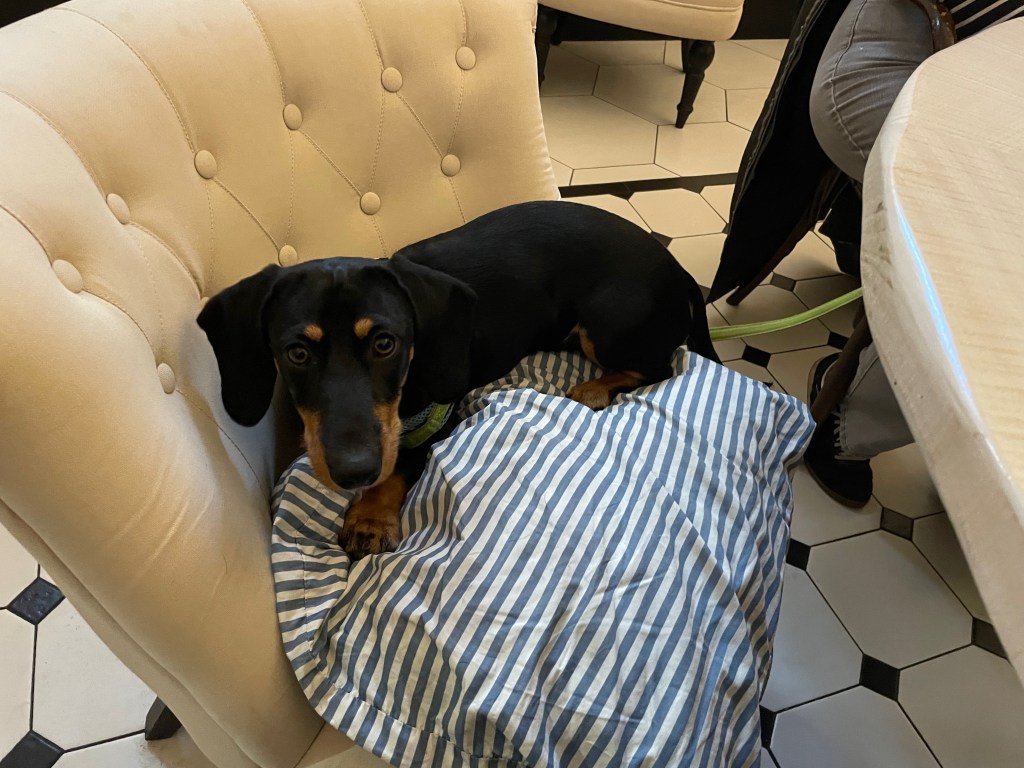
Another day, we took advantage of the fine weather and drove across the region to the city of Orvieto, famed for its delicious white wine and its incredible Italian Gothic cathedral. I used The Fork again to find a place to eat, and it led us to Caffè Ristorante Capitano del Popolo, on, logically enough, the piazza of that name. After a funicular ride up from the train station (with plenty of free parking), we admired the Duomo, including the stunning frescoes by Luca Signorelli, before walking a few minutes away from the tourist crowds to the piazza. The market there was shutting down as we walked between stalls to the restaurant. I’d warned them, too, that we had a dog and they not only let Niko in, but gave him a plush chair, pillow, and water bowl. (Below, the Signorelli panels and a modern capolavoro.)


Like more and more restaurants here, the menu was creative but rooted in Umbrian tradition. So some familiar dishes has interesting twists, like the addition of ginger. I usually don’t eat meat, but I was pasta-ed out and went with a vegetable-forward version of chicken alla cacciatore, while my stronger-willed wife and kid had trucioli (a short pasta) with artichoke cream and mint.
THE SPARTAN WOMAN AND I have this compulsion to show off “the real Umbria” to our guests. That usually means one of the sagras around the region. They’re usually held in the summer, when warm weather means long sultry nights, local food specialties, and kitschy line dancing to live music. Liv and Al were too late for those. But they weren’t too late for Montone’s fall festival. Plus, going there gave us an excuse to check out a different part of our area—after a few months of living here, it’s easy to get stuck in a rut of shopping, home maintenance and occasional hanging out with friends.
So, Montone. It’s said to be one of the most beautiful towns in Italy by the kinds of groups that keep track of that stuff. I can vouch that it’s awfully pretty, though I gotta say that it’s got lots of competition. The festival was fun because it got us out of the house and, with its emphasis on local foods and the chattiness of the vendors, we got an education in local foods. Really, really local foods. The hyperlocal food culture means that local towns have wineries, honey producers, and other local producers just beyond the town walls. For us that day, the nasty November weather broke and we strolled around and talked to people about cheese, pasta, and medicinal herbs and tinctures (the maker of the latter grabbed us for a good long chat).


So much for all that. The Spartan Woman, Niko the pup, and I have returned to everyday life, evading the wild boar hunters, looking at the view, and trying to decide every day what to have for lunch. And one of these days we’ll hang more pictures on the walls and make this place look more lived in—in a good way.







 (Not) A Year (Not) in tuscany