If you’ve been following this blog, you know that The Spartan Woman and I went back to New York for the holidays. It had been a few months since we saw Daughter No. 1 and her family and we still have some stuff to bring back with us. I can’t say that, other than family and friends, I missed anything else except for one thing: Asian takeout.
Staten Island, where we spent three weeks and some, has this image of being a sort of Sopranoland, its residents a larger version of the cast of Jersey Shore. That’s only partly true, and applies only to some neighborhoods. Our daughter lives on the North Shore, which is a multiethnic paradise. And after a few months of mostly “Italian food”—I dislike the term because there really is no unified cuisine here—we were craving the offerings of our former Japanese, Chinese, Mexican, Vietnamese, Sri Lankan, and Turkish haunts.
Maybe we overindulged. But our kid has a baby, and trying to be good guests, we thought we’d make it easier by ordering out. It was a nice change from Umbria, even if this area is increasingly cosmopolitan, with sushi and Chinese food fairly commonplace. But one thing we didn’t miss: American (or is it New York) price tags. For one Saturday lunch, we order four banh mi, three bubble teas, and a Vietnamese coffee. Total bill, $115. That would have bought a fancy meal here.
SO BACK IN OUR HILLTOP RETREAT, we prepare a lot of wintertime comfort food. That pretty much means soups and pasta. We don’t eat meat, but with such a huge variety of vegetables, legumes and grain products, that doesn’t cramp our style.
Note: The dishes described here are vegetarian, not vegan. If meat is a must, you can serve these dishes as first courses, or read another post and come back next week. I don’t give recipes per se, so you won’t see exact quantities or cooking times. Anyone who cooks regularly can probably come up with something good. I don’t usually follow recipes; I use techniques my mother taught me as a teenager when she broke her arm, and I had to step in to cook family dinners.
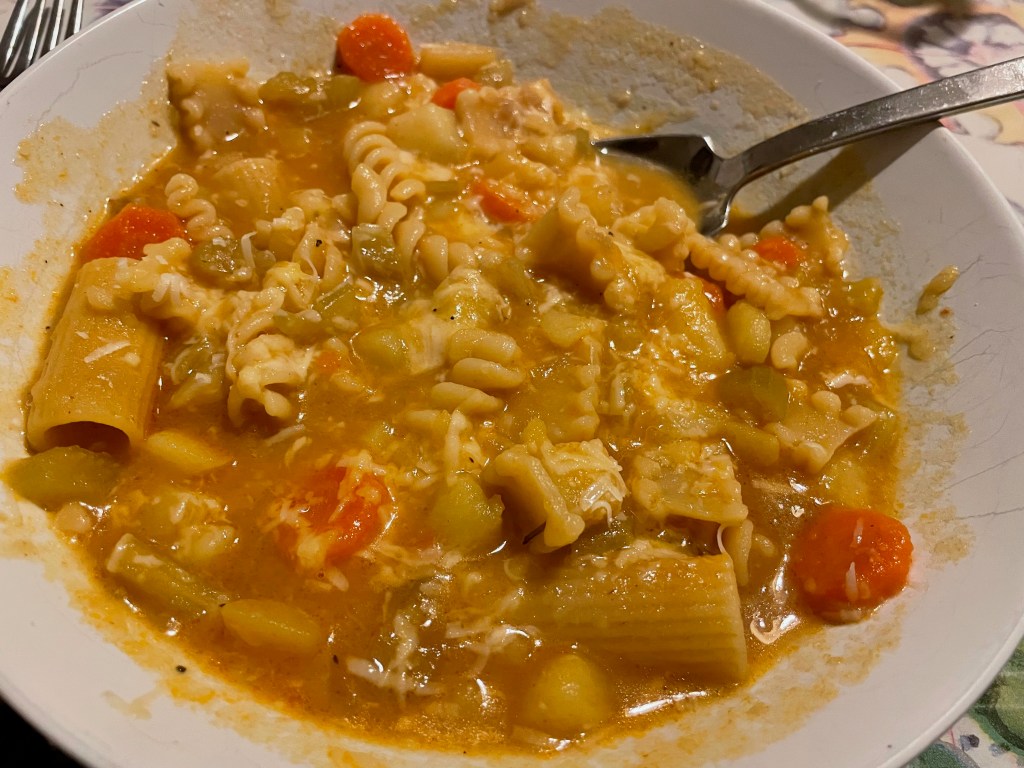
After years of propaganda about the superiority of “Northern Italian” food, the South here is rising again, at least when it comes to culture. Maybe it’s down to TV shows here like Mare Fuori (The Sea Beyond) which portrays the lives of a bunch of photogenic kids in juvenile detention in Naples. One of our favorite Neapolitan dishes is pasta e patate. Yes, you can mix starches.
You can look up recipes here and here. While there are various versions, you basically make a soffrito—onions, celery, carrots—and sauté it. Add diced potatoes. When they’re halfway soft, add water or vegetable broth and a squirt of tomato paste (a couple of canned tomatoes or some purée will work too). Let that cook awhile, and then, making sure there’s enough liquid to boil pasta, toss in a couple of good handfuls of mismatched pasta, all those odds and ends that you’ve accumulated when you haven’t cooked the whole package. Improvise if not. Then, at the end, add cubes of provola cheese. This last bit may be hard to come by in the U.S., so I’d suggest diced hard (not fresh) mozzarella.

Beans and greens might be an easier combo to get behind. We make lots of variants of this basic comfort dish. It’s easy. Take good beans, whether they’re borlotti (cranberry), cannelini, or ceci/chickpeas. Cooking them from scratch is best, but canned beans are fine, too. Sauté a clove of garlic and a little hot pepper flakes in olive oil. Add the beans, stir. Add cleaned and chopped greens, like escarole, kale, chard, or even spinach. Make what’s in the pot as dry or soupy as you wish. If there’s a fair amount of water or broth, cook some soup pasta (orzo, ditalini, small elbows, etc.) directly in that pot or cook the pasta separately and add for a drier dish.

It’s best to keep to the basics with this, but you can optionally add a Parmigiano rind to the cooking liquid, or mix the beans or add another grain like farro. Add grated cheese if you want, but the soup/pasta dish should be able to stand on its own.
A post like this wouldn’t be complete without lentils. They’re an Umbrian staple. For example, it’s traditional to cook lentils for New Year’s, the pot of lentils symbolizing the riches that you hope the new year brings. Umbrian lentils are really small and don’t break down into brown mush. When in New York, I found that Trader Joe’s vacuum-packed French lentils are a pretty good substitute.
This dish won’t break the bank and is really easy to prepare. Do that soffrito thing again. It’s onion, celery, carrots. Add about half a pound of raw and rinsed lentils after the vegetables are soft. Stir around then add about 500 ml/a pint of water. Add a squeeze from a tube of tomato paste, or a dollop from a can of paste. Let the lentils cook until they almost done. At this point check how much liquid is in the pot. You’ll be adding a cup of ditalini or similar pasta so, if necessary add some water, keeping things on the boil. Add the pasta and cook until al dente. Serve with grated Parmigiano, Grana Padana, or even Pecorino cheese. And this is the result:




 (Not) A Year (Not) in tuscany