I’m sitting in the kitchen of our house in New York. It’s been awhile since I posted from here, say, six months or so. We got here a week ago and I guess I could’ve posted some fluffy thing about our smooth voyage back to the land of the compulsory national anthem.
But then it happened.
We innocently took ourselves up the street to our friendly locally owned pharmacy for the latest Covid omnicron bi-whatever booster shot. We’d faithfully gotten every vaccine, every booster. In Italy, we stayed away from crowds. We wore masks when we weren’t obligated to. We got here via one long van ride piloted by our friend Angelo, one night in a beachside hotel, an early morning cab ride and two Lufthansa flights, the first from Rome to Munich, then Munich to JFK. The flights were jam-packed, so much so that we got alerts on our phones to check hand baggage if possible to leave enough space in the overheads.
So we masked on board, except for meals. Sorry kiddos, but these old peeps gotta eat and drink. Then, remasked, The Spartan Woman settled in for some movies, while I, the dissolute blogger, took advantage of some pharmaceuticals and the delicious bubbly Henkell Trocken supplied by Lufthansa to get some needed sleep. As far as I’m concerned, the best flight is the flight that I barely remember.
Immigration in NY was swift, lubricated by a nice conversation with an elderly lawyer and his charming wife while on line for Mr. Passport Man. “How long was your stay?” asked the passport guy. “Six months, more or less.” Welcome home. An Uber later and a frenzied Lola the Bassotto (dachshund in Italian) was doing circles and screaming at the top of her lungs when we saw her. It was nice to be back.
So fast forward…it’s Saturday. We take the pooch out for a walk and head for the Greenmarket. We’re always thinking of Sunday pranzo (midday meal, spiritually more than just lunch), so we buy mussels, some beautiful tuna and swordfish, chard, and apples. Corn, too. In other words, we’re back to our New Yawk life.
Snug Harbor: Where art and botany live together in perfect harmony
Or so we thought.
It started late Saturday. You know that intuition that something isn’t quite right? I felt hot. I felt cold. I felt hot and cold at the same time, I couldn’t tell the difference. Pressure built up in my head. I looked over to TSW. She seemed to be a bit ragged too. It got worse. We tested. Negative. Phew. It’s just a reaction to the booster.
It wasn’t. A day (or was it two? It’s all a blur) later, TSW tests positive. I took a few home rapid tests, still negative. Still, as of Monday morning I would’ve been happy to have been knocked unconscious. I put my hoodie on and wrapped myself up in a fleece blanket. Then took it all off and hung out in my T-shirt. Rinse. Repeat. Or something like that. In the back of my fevered brain (yes, I had a fever of 102 by this point) I knew I was on deadline for an actual, someone’s paying me article. In a mighty show of pitiful mind over matter, I sat up and banged out a draft. Then I collapsed in an easy chair. I don’t remember much else except that an hour before filing the piece the next day I decided that I wrote it backwards, and rearranged paragraphs. Good thing I had 30 years of editing experience, so doing that didn’t take much brainpower or patching around the moved pieces.
She had to rest after all the excitement of seeing us.
More tests for me. Same result. TSW and Dr. Joe said get thee to a PCR test. Did that. Still negative, while TSW, daughter no. 2 and BF of daughter no. 2 all positive This does not make sense. Nope. None.
So that’s where we are. We get a little better every day. The other three at least have a name for how rotten they feel. Trust me, I’m not having sympathy pains, though by now I’m a day or so ahead and can approximate a human being.
People come here to see old stuff. There’s Assisi, with the hundreds of years old basilica, with Giotto’s frescoes. Perugia has a still intact Etruscan gate and mysterious Etruscan tombs on its outskirts. Spoleto has a Roman amphitheater. For those of you who missed Ancient European History 101, the Etruscans predated those newcomers, the Romans. You can see more modern construction from, say, the 1500s. And apartment buildings that are 100 years old or more are considered to be kind of new.
Along comes Kid no.2 and her partner in art and life. We haven’t seen them in months. And the atrociously hot, then tropically rainy summer kept us from going out much. (So did our continued Covid vigilance) So when those two arrived, it gave us a chance to get out of the house, off the mountain, and play sightseeing guides for a week.
What do you want to see? we asked. “Al (the BF) wants to see some modern architecture. Well…. But it does exist. Umbrians don’t sit on their ancient marble doorstops. And to be honest, looking for modern works was a nice break from Olde Europe,
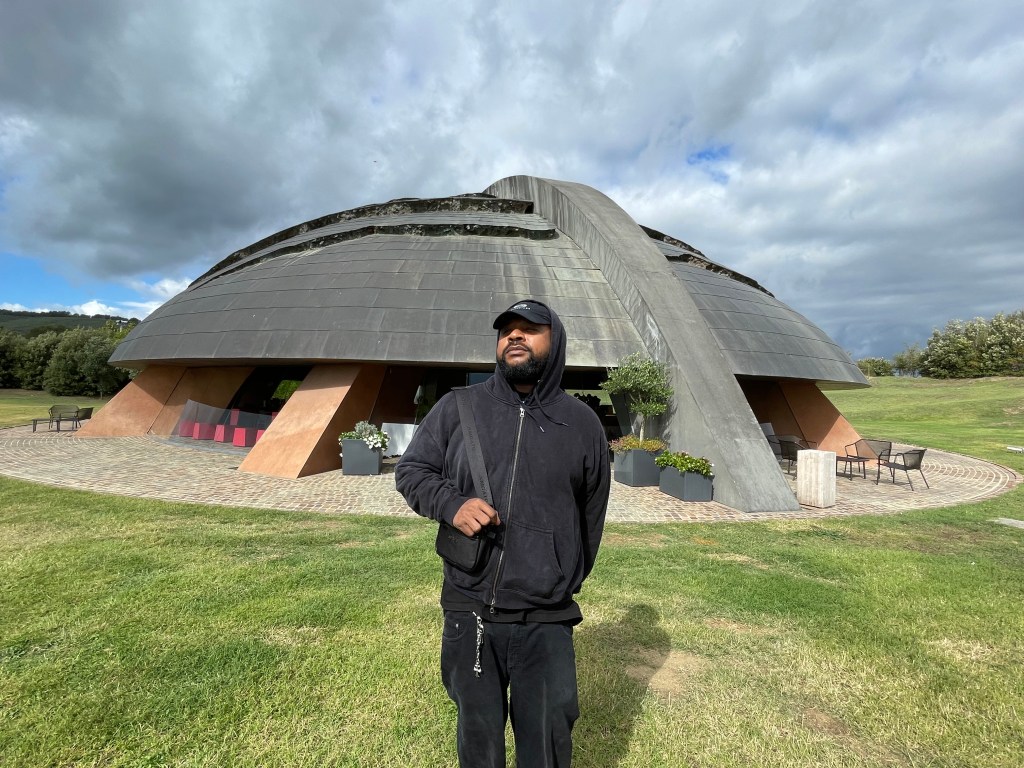
Friends told us about Il Carapace, a winery like no other. The name means shell—most commonly a turtle shell, but animals like shrimp and lobsters have them too, The producers of prestigious wines like Ferrari bubbly, Lunelli, decided that they wanted a statement canteen.in their Umbrian winery,Castelbuono. So they commissioned sculptor Arnaldo Pomodoro to build it.He’d done work for them before, but I have to say, this building came almost as a shock as we drove through sunflower fields and old-style vineyards. The Carapace rises out of the landscape like some alien space ship, a little menacing and a little humorous at the same time.
He asked for modern. He got it.
The surprises don’t end when you enter the belly of what could pass as a Klingon ship. The theme is copper, which clads the exterior, and whose paint adorns the inside. You feel like you’re in the belly of the beast, and a 360-degree view lets you meditate on the ancient vines. Castelbuono produces Sagrantino—Umbria’s most prestigious wine—and Rosso di Montefalco, a less intense, more easily quaffed red wine. If you need a Tuscan comparison, think Brunello to Rosso di Montalcino. The aging barrels sit in a huge underground space.
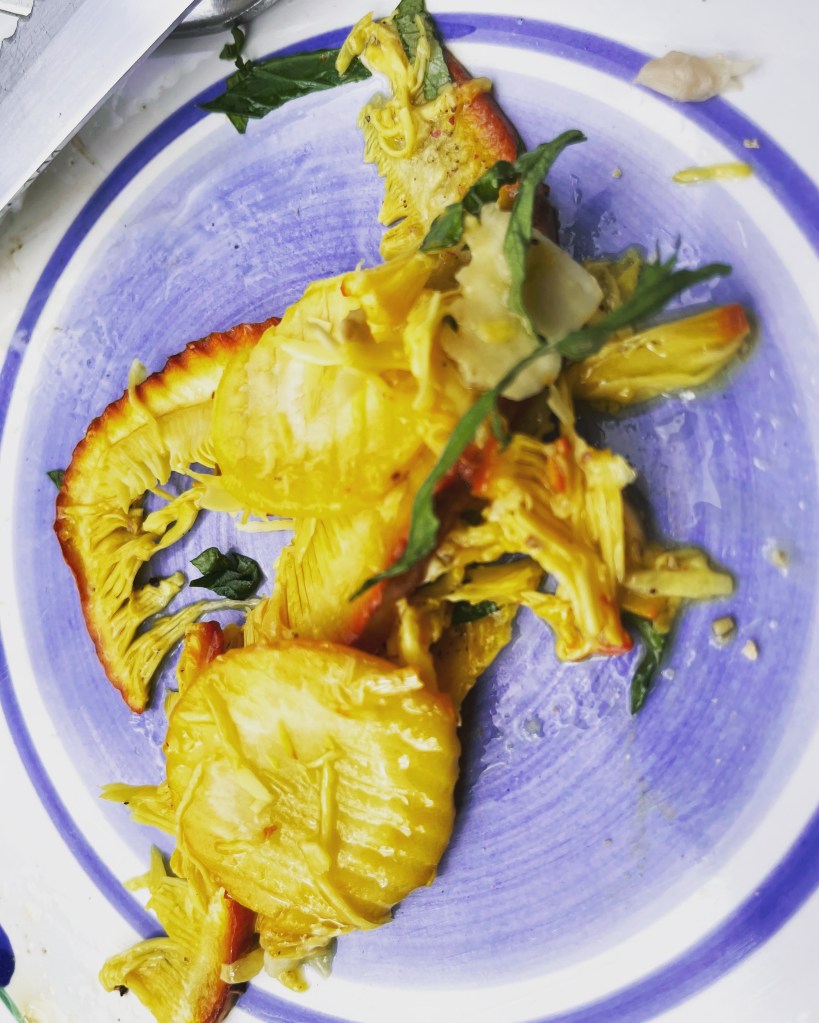
We had to eat, espcially after sampling three wines with a little nosh, so we left the Carapace to get lunch in nearby Bevagna. We were back in old Umbria, which has its abundant charms, not the least of which was a salad of raw ovoli mushrooms, which in their way looked as alien as the Carapace.
The mushrooms from another planet
A COUPLE OF DAYS LATER, we went to Foligno. We’d never been, except to the train station, which is a major transfer point for trains from the main Rome-Ancona line and the pokey local “regionale” to Perugia. The object? The modern art museum, the Centro Italiano Arte Contemporanea.
Foligno is unexpectedly interesting. On the outer rings of the small city, there are lots of Stile Liberty, or Art Moderne villas. There’s a long wide pedestrian street filled with porticos with bars and restaurants, and tons of shops and terrific window shopping. Who knew?
The modern art museum has one thing in common with the interior of the Carapace: a copper color. It basically looks like a copper box in the middle of a older neighborhood, and is instantly recognizable because of that. The permanent collection is pretty small and unfortunately they were between exhibits. But there’s more….
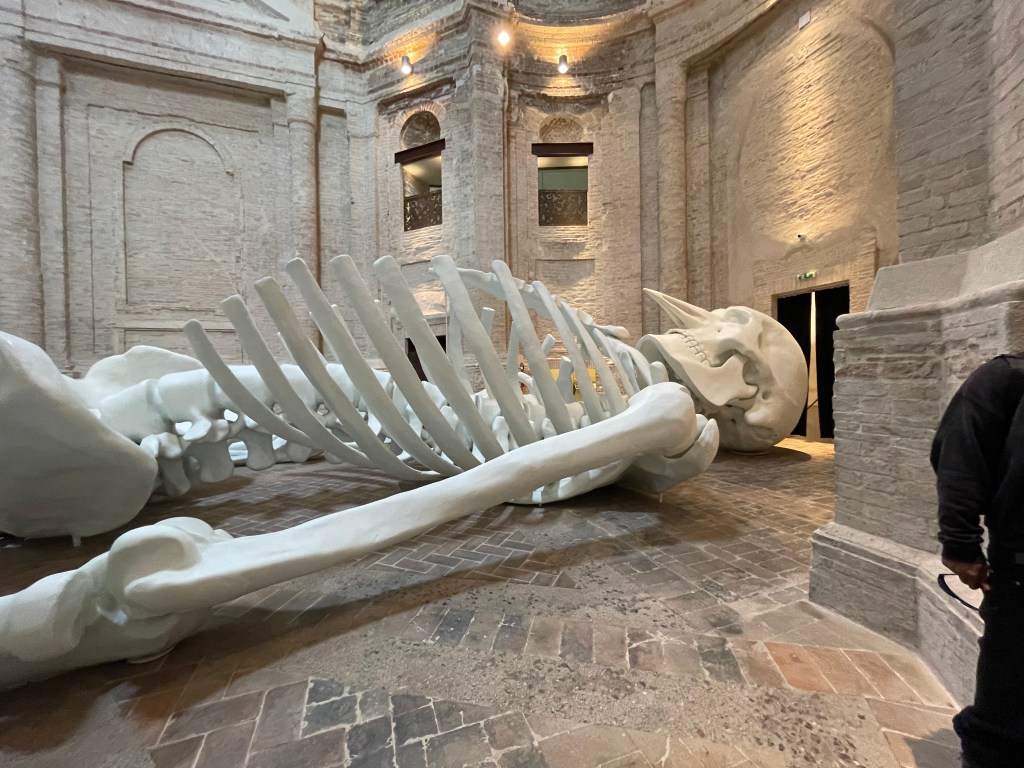
A 10-minute walk brought us to a deconsecreated church, the Chiesa della SS. Trinità in Annunziata. where, in the middle is a giant skeleton replica, by the secretive and subversive artist Gino de Dominicis. Its official name, “Calamita Cosmica,” or cosmic calamity. It’s pretty amazing, the kind of thing that held our attention as we walke around it. It’s not just the thing itself; it’s the context. De Domicis is described in the work’s website as “a controversial figure in modern postwar Italian art, with an eccentric personality, himself an endless work of art, original and full of secrets.” All I know is we just stared in wonder as we walked about the beast and tried to take photos that did it justice.
Well, why not?
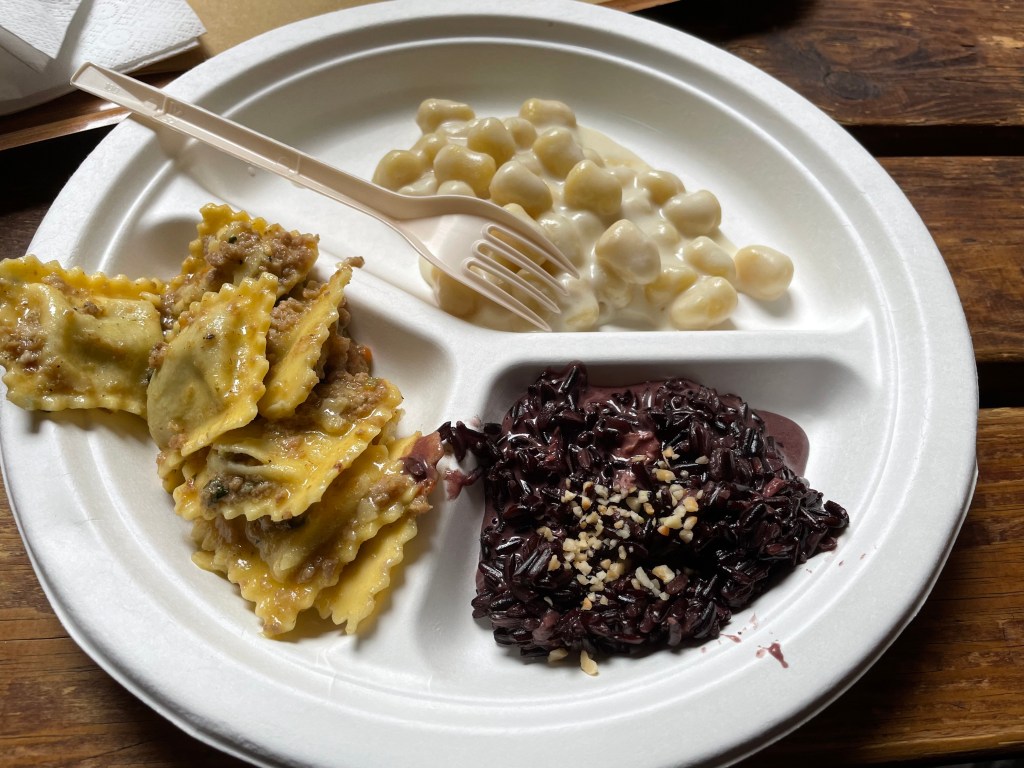
Of course, we worked up a powerful hunger after that expedition. Happily, Foligno was there for us, with a festival of first courses. In the progression of an Italian meal, the “primo,” or first course, is actually the second. It’s composed of pasta, soup, or rice. Note that it is not what Americans call a main course; to an Italian, a huge plate of overcooked spaghetti serving as the main meal is a travesty. The festival was terrific, even if it was a rainy day and we had to traipse all over the center of town. Big signs and a handout map guided us to various restaurants around town that served regional primi; it was fun to pick and choose, for a really good price of €5 (5 bucks) a plate, with cheap good wine to go with it.
A “tris” of primi
We’ll be going back to Foligno as soon as we can. The festival got us acquainted with what seemed to be dozens of cool bars, restaurants and shops. Can’t wait.
When I was 18 I was shipped off to my grandmother and aunt in Sicily. I didn’t have a summer job, it was in the middle of a bad recession, and my parents didn’t want me hanging around. It was terrific; my Italian cousin and I spent a good part of that summer hitchhiking around Palermo, going to the beach, getting a good buzz on in the local bars, and going to parties. Even as a 17-year-old, he was an excellent tour guide, and I got to know my father’s city.
Why am I telling you this? Back in 1975, Italy’s communist party typically got about a third of the vote in national elections, and the American press was sounding the alarm that the country “would go communist.” As I got ready to leave for Italy, people kept asking me if it was safe to go to a place that was really about to turn, you know, communist. I was a smarmy college kid then and dismissed all the talk. And when I got to Italy, I saw that things hadn’t changed much since the last time I’d been there, except that the developers’ rape of Palermo continued apace. And that was definitely not a commie plot.
In other words, after this last election, which will bring the right to power, don’t sweat it too much. I am not dismissing its importance, however. I am not a fan of Giorgia Meloni and her fascist-descended Fratelli d’Italia (Brothers of Italy) party. The tone of Italy will change. But life will go on, as it did a couple of years ago when the Matteo Salvini’s Lega right wing party dominated the news with its hostility toward refugees sailing across from Libya. The tone of the country will change in ways that matter most to foreigners in government and media, and locals who pay attention to government machinations. But you’ll be able to visit the Vatican, have an Aperol spritz at aperitivo time, and do the things that most people do when they visit Italy.
I’m not trying to trivialize things. But at my age, I’m trying to be less hysterical about everything, and definitely less hysterical than Americans tend to be. And I’ll try to explain why 40 percent of Italian voters (about a third didn’t bother to vote) chose the right wing coalition.
First of all, you can argue that the outgoing government headed by “SuperMario” Mario Draghi (left) was illegitimate—it’s a fact that he wasn’t elected. The outgoing parliament, elected in 2018, had two leading parties, the 5 Stelle (5 Star) rebel party and the right wing Lega. The first government (in parliamentary systems, the term “government” means administration featuring one or more parties) was a coalition between those uneasy partners. 5 Star is a weird, populist group composed of disaffected people, techies, environmentalists and libertarians that tries to evade the usual left-right definition. (When it comes down to it, it’s a volatile sort of left-ish party that doesn’t know how to effectively govern.) The Lega’s Salvini, who was interior minister in that administration, decided that he’d rather be prime minister and spent the summer playing DJ and flirting with the ladies on the beach. Campaigning, in other words.
Salvini brought down that coalition of convenience, but got fucked: The Democratic Party (PD) and 5 Stelle got together and did an end run around him. He and his party were cast out of government, while the previous losers (the PD) became part of a governing coalition. (When I say cast out of government, I mean the ruling coalition. They stay on as members of parliament.) After a PD-5 Stelle coalition fell, Italy’s president during the Covid pandemia got most major parties to play nice and unite under Draghi; Meloni kept her party out of it.
SO, WAS “DEMOCRACY” SERVED by this? The end run pissed a lot of people off—a lot of conservatives, but also people who thought that the will of the people, as expressed in the election, had been subverted. And it wasn’t the first time; back about 10 years ago during the Euro crisis, investor speculation led to the fall of Silvio Berlusconi’s regime and the installation of a technocratic administration. And the dissatisfaction wasn’t just among people on the right. A lot of people who might have voted for the center-left felt that the PD left them out in the cold, that, basically, the PD and its allies were basically supporting governments that were more anxious to satisfy institutional investors rather than people. (This all begs a bigger question: What does the left stand for anyway? That’s another blog post. Or ten,)
So where are we now? First of all there’s none of the weird histrionics that characterized American transitions of late. The winning coalition partners are jockeying for position. Meloni and her male partners are negotiating and probably arguing over cabinet posts. Given the bad showing of Salivini’s Lega, you can probably bet that he isn’t going to call the shots in her government.
What won’t and will change? Unfortunately, they’ll be restrictions on immigration and probably more rhetoric directed at preserving the traditional family. A lot of the latter will fall on deaf ears. Lots of Italian couples don’t bother to get married, even after they’ve had kids. Unlike what happens in the U.S., I don’t think the incoming government will dismantle Italy’s terrific public healthcare system and other features of this fairly modern welfare state. We’ll still have fast trains, a decent amount of public transit and most of what makes Italy’s quality of life so good. We’ll also probably see more demonstrations as unpopular programs are introduced. Meloni now owns whatever happens and won’t be able to stand in opposition.
A word about the democratic process. Much of the press coverage of the election asked, through an American filter, whether Meloni and her crew are “a danger to democracy.” It’s really too early to tell but I have a couple of thoughts on that score: First of all, Hitler was elected. Both George W Bush, first term, and Trump were “elected” despite having lost the popular vote. And both U.S. presidents ruled as though they’d been given a mandate. I think we as Americans confuse procedure with substance. There’s more to governments and nations than whether people voted or not—there’s substantive issues, and whether governments are responsive to what their citizens need.
The U.S., even before this recent crisis of democracy, has pretty much screwed its populace for the past 40 years. Workers lost most protections, healthcare still remains a pay as you play game, as does most of politics. Millions of jobs were shipped overseas, and Americans aren’t guaranteed paid time off, as are Italians and citizens of the European Union. So ask yourself whether Americans can really say that before the advent of a wannabe strongman like Trump, that their democracy was really working anyway.
Image credit for chart at the top: CC-by-SA 4.0 (Wikicommons)
Meloni photo: Vox España, CCO, via Wikimedia Commons
Let’s talk about food, shall we? And where you consumed said food? (Sorry if the headline led you to think I was going to write about that other obsession.) I’m thinking about food in Italy these days, since I’m here. It really is an obsession, and not just with “sovrappeso” [overweight] me. I’ve overheard chic saleswomen talk about what they were going to have for lunch in tones that were, well, erotic. And if you happen to be in Italy and happen to get onto YouTube, your feed will soon be blitzed with food videos. I don’t think it’s just mine.
First off, most Americans without the good luck (or misfortune. It depends.) of having relatives living in Italy don’t get the full-on experience. They–you?–have to go to restaurants. And that’s a shame, especially if you’re in the big tourist cities. Why? Because restaurant food may be ok, but eating in an urban restaurant in Italy doesn’t come close to the real deal, and in big cities and touristy locations, many restaurants serve a kind of national “Italian” food that doesn’t reflect what people really eat in this intensely regional country. Plus they miss the vibe, where people loosen up and sit with friends, family, lovers, kids, dogs, whatever, just enjoying the moment. Or a town festival. Or, in the case of our town, any excuse to get together. Any.
First, friends and/or family. One of my most memorable “meals” here, if you can call it that, happened before we had a place of our own. My magazine astoundingly let me come to Italy on a reporting trip. My assignment was to make the rounds of lawyers and business analysts and give American lawyers an idea of what to expect if their companies or clients tried to buy an Italian company. I cannily scheduled interviews for the latter part of the week in Milan, and the early part of the week in Rome. Oh, dear, what to do in between? Live in a lonely hotel room? Eat meals by myself?
Nope.
I visited friends who happened to live in Perugia, about two-thirds of the way south to Rome. After a couple of train rides, my Italian papà Franco picked me up at the station. “We have to hurry,” he said. “Giovanna’s in the middle of a surprise for you.” Franco, never a quiet pensive kinda guy, gunned it, shouting at anyone who dared to drive any slower. “Figlio di puttana! Bastardo!” he shouted. After holding on for dear life—Perugia doesn’t know from straightaways—we got to their house. “Hurry! Just leave your bag. You can keep you jacket on. We have to do this NOW!” Franco told me.
What was the fuss all about? Artichokes. Glorious crunchy salty hot just from the fryer pieces of artichoke. “I’m squeezing lemon on these, ok?” said Giovanna in Italian (these two didn’t speak English; this is all translated), more as a statement of purpose than a question. “Eat with your fingers.” She had put the freshly fried artichokes in a paper lined basket and shoved it at me. “Eat with your fingers.” The three of us didn’t even sit; we just stood there eating, blowing on our fingers between bites.” When we weren’t wolfing down the artichokes, we were drinking and smiling at each other. It was one of the best food events I’ve ever been at. I know we sat down to a regular lunch after that, but for the life of me, I can’t remember it. Can you blame me?
If you don’t have an Italian friend or relative, the next best thing is probably eating at an agriturismo, or at least a country restaurant. If it’s the right season, eat outside. Yeah, there’s an Under the Tuscan Sun thing going at these places. But you’ll see what makes it all worth it. Some years before that reporting trip, we’d gone to an agriturismo high above Lago Trasimeno, the big almost ocean-like lake around here. I can still taste the pasta course, with an eggplant purée (no tomatoes) and bits of sausage. But what I really remember was the vibe. There we were, our family, plus our Perugian surrogate parents and their dog, just relaxing around a table with a view of the lake below for the whole afternoon. And it cost maybe a half of what a city restaurant would’ve charged. Maybe less.
ANOTHER WAY TO ENJOY NON-RESTAURANT food is at a sagra or a festival. They’re held all over Italy, and here in Umbria there seems to be one every day or so somewhere. They serve as fundraisers for the town’s pro-loco associations, which support soccer teams, after school activities for working parents, and the like. But they’re also a way to get the whole town involved in something—and, for people to connect with their history. Local volunteer cooks take care of the food, sometimes, but only sometime, under the guidance of professional chefs. Of course, doing so often involves getting done up in medieval drag, which seems to happen for any excuse, but I digress.
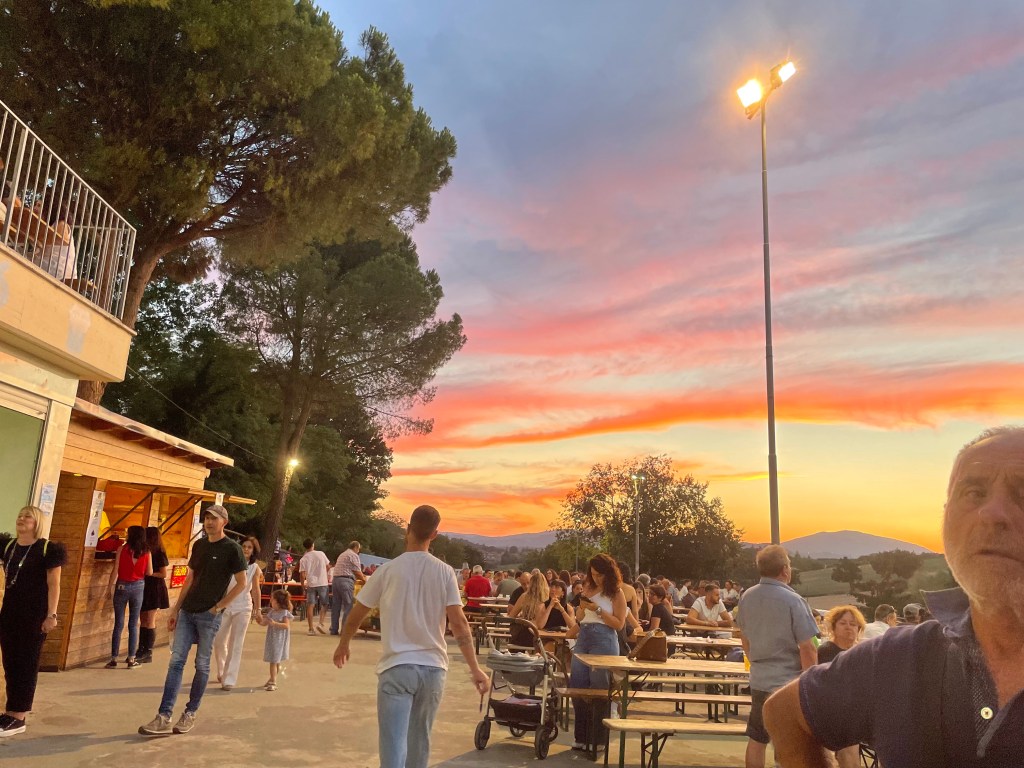
After the Covid shutdown, the region came alive this year. We’ve been to a few. The first was for the food, in Ripa, two towns down the main road here. The town itself is a tiny hamlet, with a circular historic center, and various memorials to Gino Bartoli. He was a heroic figure, a Tour de France bicyclist who smuggled citizenship documents for Jews during World War II by stuffing them in his bike’s tubes and delivering them. Ripa holds a truffle sagra, and the food’s pretty good if you’re a fan of the underground fungus. (We are; Ripa sagra shown below.)
There’s a biggie around here, too. The small town of Cannara, near Assisi, is known for its onions. They’re sold in all the grocery stores and to be honest, we’re spoiled. I won’t say you haven’t lived until you’ve had a really fresh onion—but like a lot of produce, being grown locally makes a real difference. Cannara puts on a pretty big show, with various “stands” (yes, in English), really kitchens/outdoor restaurants, with each producing dishes that feature, yes, onions. Cipollamisu, anyone? It was a lot better than you’d think, with the typical tiramisu ingredients topped with a compote of sweet onions.,
Valfabbrica, where we live, goes all out. It’s bigger than Ripa, as far as towns and hamlets go around here, but smaller (population around 3,400) than the surrounding towns. There’s a week-plus celebration of being a valfabbricheso, with pageants, jousting tournaments, and, of course, food. The town’s historic center turns into a restaurant, and the town has a communal kitchen that churns out tons of dishes based on local produce and history. Gotta say, it was pretty good.
But the most charming event involving food was last weekend. Our town likes its parties, and the old medieval tower was restored recently. Most places would have the mayor cut the ribbon and leave it at that. Valfabbrica? Uh-uh. It got Italy’s only all-female jazz marching band to escort the mayor to the tower, playing Stevie Wonder’s Sir Duke and The Beatles A Hard Day’s Night. The women walked up the tower with Enrico (we’re all on a first-name basis here)
We don’t have dull ribbon-cutting ceremonies in Valfabbrica.
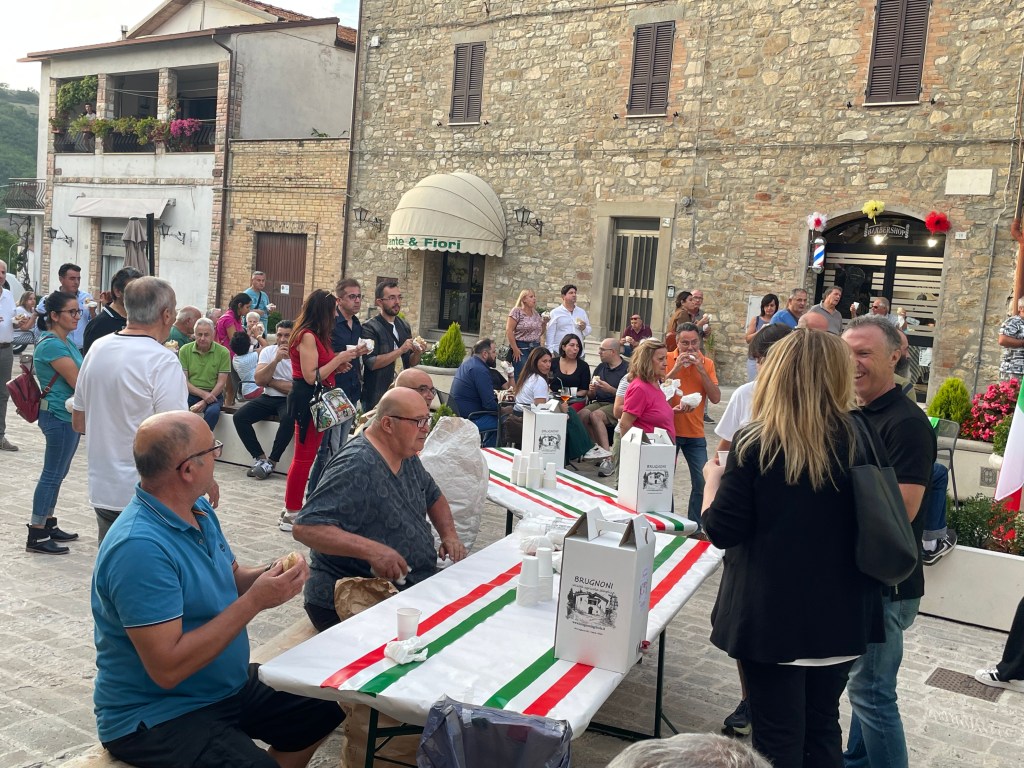
I know, this is supposed to be about food. Sure enough, after the music and the ribbon-cutting and the speeches about the historic importance of the tower, there was a free aperitivo* in the piazza. Older guys sat behind tables with loaded with decent boxed local red wine and porchettapanini* and doled it all out. I haven’t eaten much meat in a decade, but one of the guys shoved a panino at me after I poured myself a healthy glass. It seemed churlish to say no—and it was great to be hanging out in the main piazza on a beautiful late summer night with our fellow townspeople.
Vino and a panino, anyone?
*”Aperitivo” refers not only to a pre-dinner drink, but food to go with it. Places like Milan and even good bars elsewhere elevate it to the point where it can substitute for dinner. At that point you can all the meal an apericena—aperitivo and cena, which is what the nighttime meal is called.
* The word is “panino” for a single sandwich. “Panini” is plural. More than 1 sandwich. Ok? I get a little nuts when I hear “I’ll have a panini .” It’s like nails on a blackboard.
I came back the other day from the pharmacy in town with a new haul of inhalers and antibiotics. And there was another little box in my medicinal cocktail: a cough serum in droplet form called Levotuss. Sure, I was able to decode what the name means—get rid of the cough, basically. But that wasn’t my immediate reaction. Instead, I heard my father’s voice saying something that sounds like “leva mind.” It’s how he used to say “never mind.”
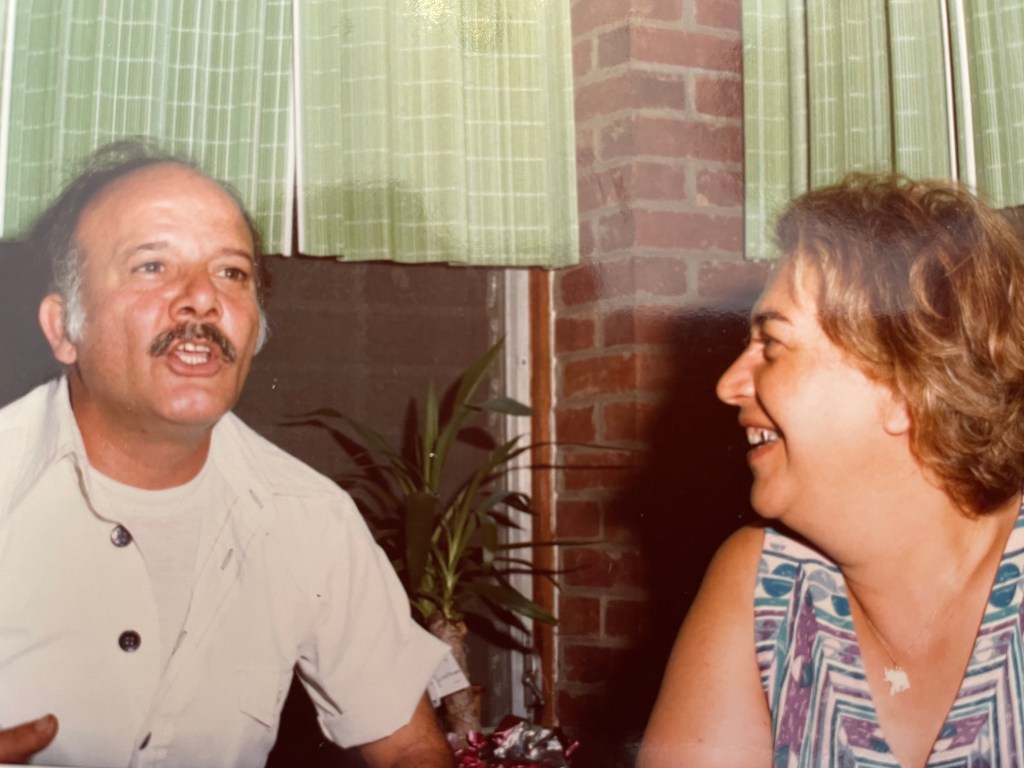
This wasn’t anything new, though. Nuccio/Tony, my dad, has been gone from this plane of existence about eight months. And all these months later, his less than masterful command of the English language still pops up all the time in my head and while talking to The Spartan Woman and my sister. (Behind the two names: My father’s name was Antonino. One diminutive of that is Nuccio. And in the U.S., he anglicized his name to Anthony, and most people called him Tony.) It’s kind of comforting; my mom used to say that you weren’t truly dead until no one remembered you. Well, pop, as far as I can tell, you’re still around.
We used to call his malapropisms “Nuccio-isms.” Sometimes they took the form of weird mistakes in colloquial expressions. My favorite was “you ‘affa to [have to] cry the consequences.” It always made me think that Patsy Cline would’ve had a hit with that title. Other times he’d conflate a brand name with the product—cars were “oldsmobiles” and refrigerators “frigidase” (this is a common mistake in New York City immigrant dialect).
You have to be an Italian speaker, or at least be acquainted with the language, to figure out where other mistakes came from. He could not pronounce the consonant combo “ct” to save his life—the combination isn’t common in Italian, if it exists at all. Hence, “dottor” (doctor) and “fatt” (fact). Other times he left out personal pronouns. So instead of saying “He’s a good guy,” Nuccio would simply say “Ees a good guy.” Why? In Italian, you don’t have to say personal pronouns like “I” and “she” and “we”—they’re understood from the verb conjugation that you use.
The Spartan Woman and I are always uttering these Nuccio-isms, and most of the time it’s with a fond laugh. But it also reminds me of how much I miss him, and how in some ways my siblings and I had a slightly zany and interesting time growing up. My sister and I in particular viewed what we called “normal families”—i.e., with two native born, English as a mother tongue speaking parents—as somewhat dull. My sister called them “Americans” and I went along with that.
On the other hand, Nuccio gave me a leg up when we decided to live here in Italy part-time. For one thing, when I was born he was an Italian citizen, which meant I got an Italian passport and could stay here as long as I want without having to worry about bureaucratic stuff like residence visas. An even better gift, though, was cultural and linguistic. I didn’t learn to speak Italian until I was in college, though I understood it fairly well before then (and didn’t let on). But languages have another dimension, expressions that are almost nonverbal but can say whole sentences. Here’s an example: I thought everyone understood that when someone slightly raises his or her head and say “buh” (pronounced, sort of, like “boo”) it meant “I don’t know.” I did that once in the U.S. and got a really funny look. Here in Italy, everyone knows what it means.
Nonno (grandpa) and me
I WISH THAT MY parents had started early speaking to me in both English and Italian. I think I was at least partly bilingual when I was 5 years old because my Sicilian grandfather lived with us and we took long walks together, talking all the while—and he didn’t speak English. Then again, maybe not. I have some cousins who, like me, grew up in the United States. But both of their parents emigrated from Italy, so Italian was the language spoken at home. Those who kept it up may have better accents than I do, but they got lazy later and didn’t follow up with formal instruction, so their written Italian and comprehension isn’t great.
I may have started later in life, but grew up hearing that other language, so it was relatively easy to pick up, especially after five years of middle and high school French. (Yeah, they’re the same language with different accents. Tell me what’s the difference between J’ai besoin d’un autre divan/Ho bisogno di un altro divano?—okay, I cherrypicked the words for “I need another sofa,” but you get the idea.) It didn’t hurt that I worked for an Italian media outlet for a couple of years and had to write articles in both English and Italian.
As young first-time parents a zillion years ago, we tried getting Kid No. 1 to speak Italian. We bought a BBC language series for kids. It consisted of a bunch of VHS cartoon tapes and was pretty funny, relying on repetition and a good story line. Martina really got into it and the cartoons were on a regular rotation. That summer, we took a three-week trip to Italy, with a slight detour onto France’s Côte d’Azur. We stayed with friends here in Perugia, and one day left our daughter with our friend while we did errands. When we returned, our friend intercepted us and asked us to tiptoe in and watch Martina and our friend through the slight door opening. Our little one was, at least temporarily, fluent, talking to our friend about the Barbie doll clothes they were making. And we were astonished.
It’s much harder later. Linguists say that age 15 might be the cutoff point where you can learn a language and have it sound like your mother tongue. I believe it; I’m watching a brave friend here, who moved to Italy in July from Florida, take lessons and it’s a struggle. (He’s getting better every day, though, and you just have to admire him.) On the other hand, I have a friend who moved to the U.S. from Romania when he was 15. He’s completely fluent in English. Years ago he had a slight intonation of something else, but that’s faded.
People here say that they can tell I grew up elsewhere but my accent doesn’t tell them from where. Each time I’m here, I pick up more vocabulary and more connective tissue: In Italian you use a lot of words like however/therefore/practically. (I think I speak Italian with a slight New York accent, personally.) I don’t need to concentrate on song lyrics or TV news any more, and ignore subtitles in TV shows.
Still, it’s one thing to learn the rules and the grammar and the vocabulary. Ask the American dude in the video below.
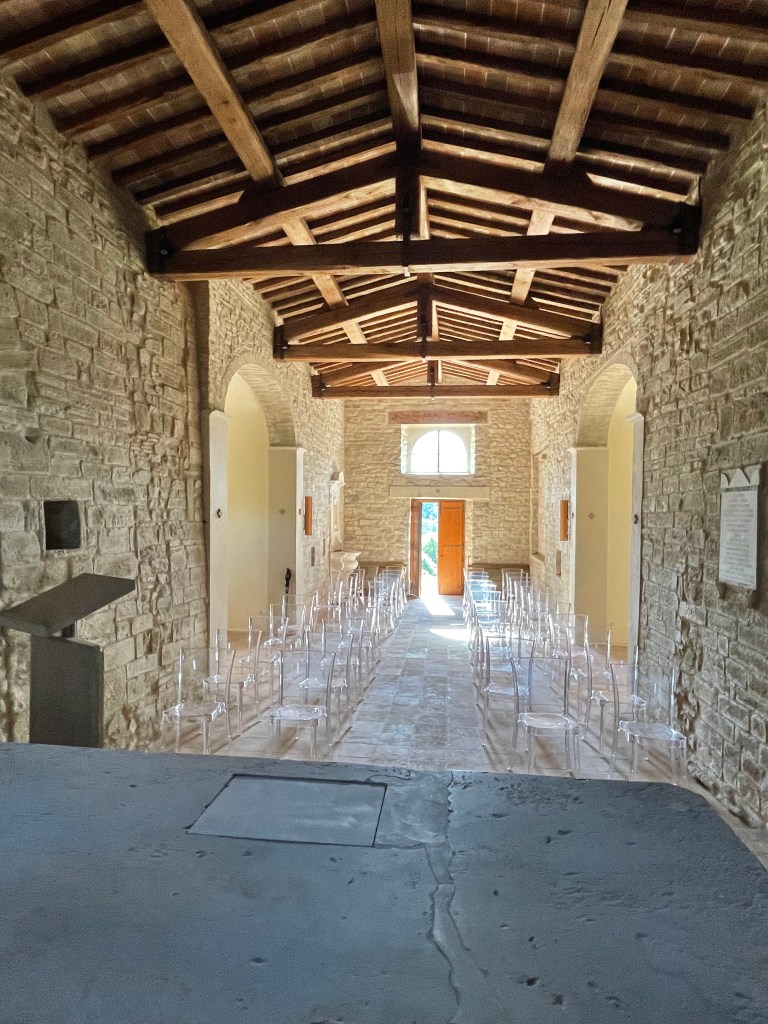
OUR TOWN OPENED THE little chapel down the road for the holidays. Here’s a look at what they built some 1200 years ago, as part of a long-gone castle. The chapel is St. Antimo and the locality, Coccorano, part of our comune, Valfabbrica. It was sensitively and beautifully restored under the supervision of our architect and friend Marco Ferramosche. Enjoy.
The exterior. Look closely on the left and you can see the remains of one of the castle walls.
We’ll leave you with this: traffic jam in Valfabbrica. Buon ferragosto!
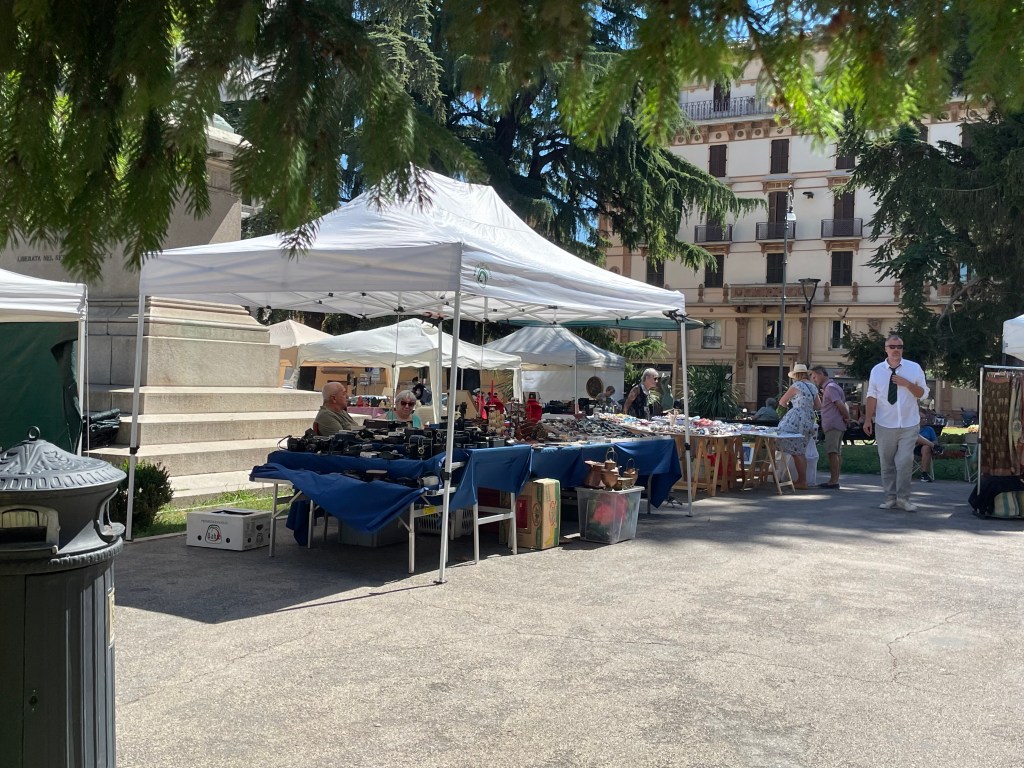
We went antiquing the other day. You might say, “meh, so what?” But this was an unusual event for us. Well, okay, not the venue: Our nearest big city, Perugia, hosts an antiques market in one of the big piazzas on the last weekend of every month and we’ve been there before. Still, this was kind of a big deal. The heat, and still-widespread Covid cases, kept us on our mountain most of the time. But we got antsy and needed to go out. And in the process, with the heat abating somewhat, we’ve rediscovered our old love: Perugia.
There’s an amazing amount of both good stuff and kitsch. In particular, I have a thing for old magazines from the 1950s and ’60s, artifacts of “La Dolce Vita” Italy, the Italy that my sister and I reveled in as kids, when our relatives from abroad came to visit, or when we listened to the pop songs of the time. The Spartan Woman and I have even bought little stuff at the market, like an antique corkscrew or some prints.
Looking for artifacts of a former civilization
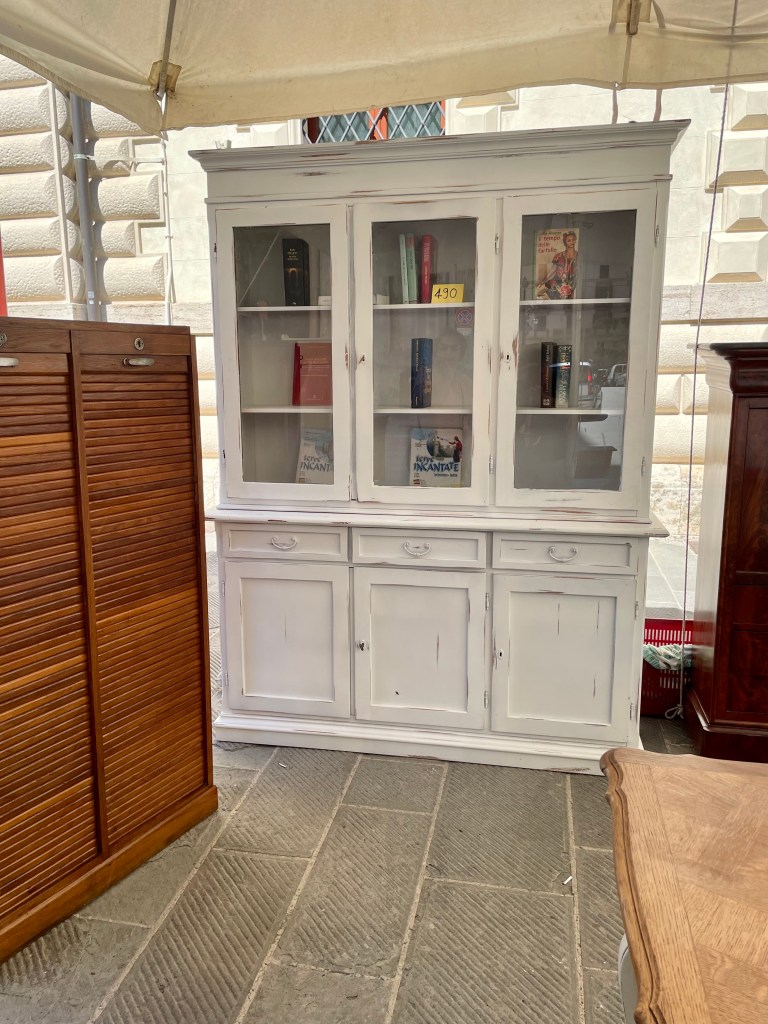
This time was different. We actually bought a large piece of furniture. The seller called it a libreria—a bookshelf. But it looked like the perfect breakfront for our kitchen in the country. The top part had glass doors, while the bottom doors were wooden. It looked like it came from nonna’s (grandma’s) house. The seller probably sanded it down and painted, then distressed the wood to give it that old country house feeling. Whatever. We liked it. The price tag was €490, which comes to about the same amount in dollars. We were just looking and the seller blurted out €300. Sold!
What happened afterward is what made the deal special. We told him we lived in the country, about 20 kilometers away. Does he ship? He said he did. It would take a few days, which was fine by us. We gave him our address, with some directions, and my mobile phone number. Did we want to leave a deposit? he asked. He quickly added, it’s not necessary. Would this happen anywhere else I wondered? At the time, it seemed to me that at this point he had no incentive to get the piece to us, but hey, it’s not as though we were going to lose out if he didn’t deliver.
After breakfast at a nearby café (coffee and pastries), we headed to our car. My phone rings. “Antonio, this is the antiques guy,” the voice on the other end said in Italian. “Are you going to be home soon? We can deliver the piece today if you want.” Sure, I said, we’re on our way. Give us an hour or so—the actual trip is 25 minutes, but we had to clear out a space for the piece. A couple of hours later, a delivery van arrives, I help the guy carry the heavy load into the kitchen. Delivery guy drinks three glasses of cold water after he complained that the ghost town next to ours didn’t even have an open bar. We give him the cash and now the piece sits nicely in the kitchen.
On the street……and in our kitchen
I know, this is not extraordinary. People buy stuff like this all the time. But what got to me, and what I love about living here, is the element of trust. The seller didn’t take a deposit, and yet he delivered the piece based on our word. Maybe I’m wrong, but I can’t imagine that happening in New York. Or much of the U.S.
ON THAT SAME WEEKEND AS THE ANTIQUES MARKET, we had another terrific reason to go into town. Blame, or credit Laura. She’s part of the Santucci clan, which adopted The Spartan Woman back in the day, and which has become our chosen family here. In fact, the connection with Laura is where our Kid No. 2 was baptized. It’s a Romanesque church that dates to the 6th century, give or take, and was built using the columns of a Roman temple that previously stood on the site. Laura co-authored a book on the church, grandly called, at least officially, the Tempio di San Michele Arcangelo. But most perugini just called it the Tempietto di Sant’Angelo.
Meet the neighbors……at the tempietto….…for a monumental dinner.
Perugia’s archeological museum hosted a presentation on the book and a general lecture about this extraordinary structure. It’s round, and set on a hill surrounded by lawns, with the neighborhood’s guard tower nearby. It’s such a tranquil and beautiful place that it’s got a waiting list of couples throughout Italy who want to be married there.
Laura Santucci, right, laughs at a co-panelist’s comment.
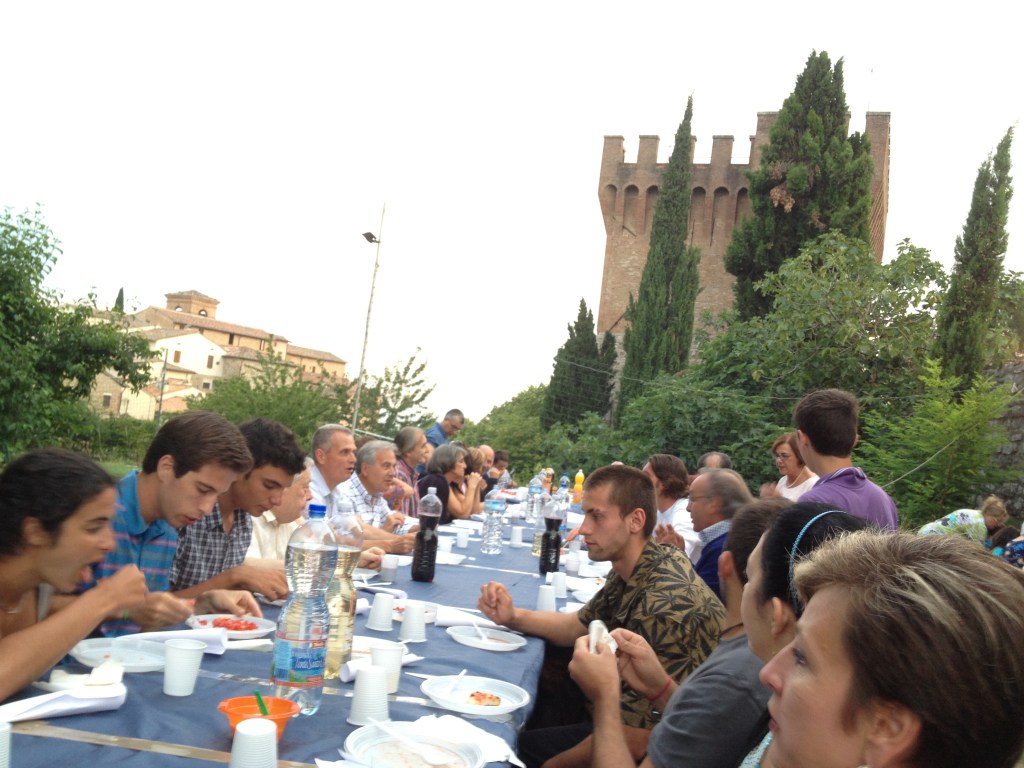
Besides its fame, it’s the local parish church, and hosts such activities as after-school recreation for latchkey kids in the neighborhood. And before Covid, its yard was the venue for an evening that Laura, her family, and friends organized called “Mangiamo Insieme,” or “Let’s Eat Together.” For a nominal sum, I think €10 or €15 a head (about the same in dollars), people in the neighborhood got together in long long tables for a full dinner. Some 200 people attended the one we were at; it was a beautiful night, bringing together just about everything that makes living in Umbria a pleasure.
After Laura’s presentation, we had a real need for some adult beverages and people watching. Perugia’s main drag, the Corso Vannucci, is a pedestrian island full of bars, cafes, restaurants, and shops. It’s also way too touristy for us, at least in Perugian terms—this city is decidedly not like the Holy Trinity of Italian tourist sites, RomeFlorenceVenice. You can spot the tourists easily: They’re the ones having dinner at 18:30 on the Corso.
So, avoiding the early dinner crowd, we went to a hipster bar, Mercato Vianova, on a side street. You can get sushi at this bar, if that’s your thing. But we were just into a drink and snacks.
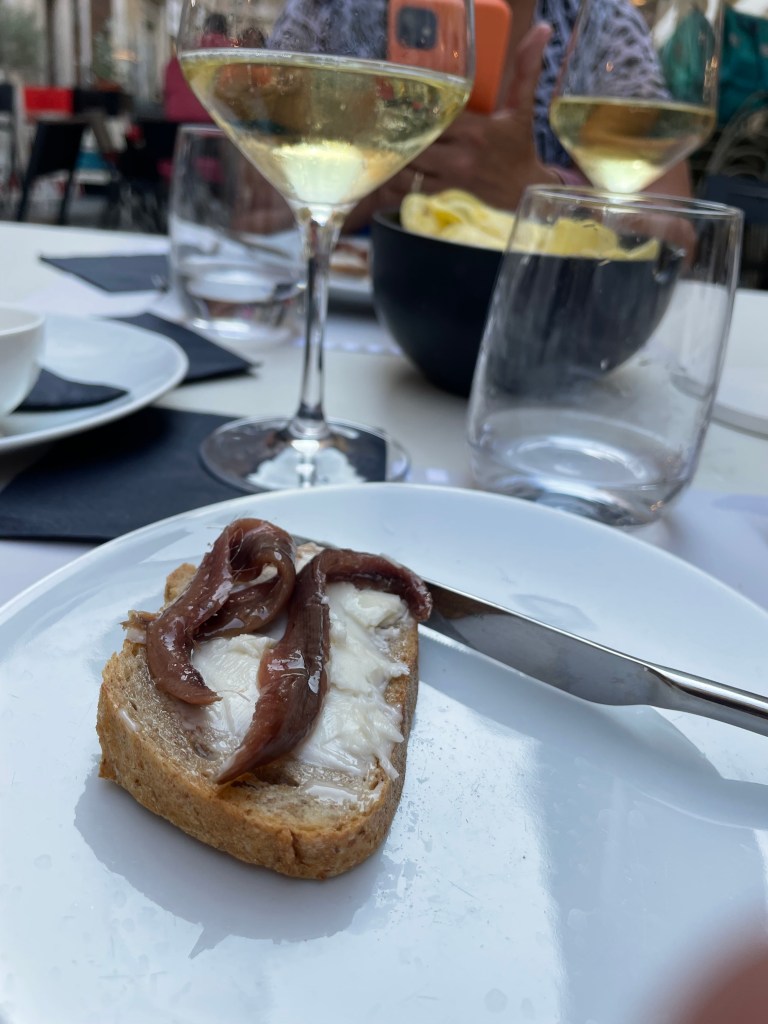
I usually go for a spritz of some kind, but after seeing a glass of Franciacorta on the drinks list (like a lot of restaurants post-Covid here, you scan a QR code for the menu), we decided to have our bubbly unadulterated. (If you’re wondering, Franciacorta is Prosecco’s more grownup cousin. It’s aged and develops bubbles in the bottle, just like Champagne, and is usually drier than Prosecco.) Some house-made potato chips and toast with butter and anchovies, add some great people watching, and we fell in love again with the city that took TSW’s heart decades ago.
Let us go back in time. Way back. It’s around 1980 and we’re in a once-grand, now shabby student apartment on Manhattan’s Upper West Side. Right near Columbia University, in fact. We’re at a party with a bunch of grad students from the neighborhood; I forgot whether it was for any special occasion. Did anyone need one back then?
We’d been invited by a good friend of ours who back then went by the name of Drew. One of his roommates brandished some newspaper put out by Albania’s Communist Party (remember, this is the Upper Left Side, ground zero for left wing intelligentsia back then). “Pig iron production is up by 10 percent! All praise to our leader Enver Hoxha!” the roommates exclaimed before collapsing in laughter.
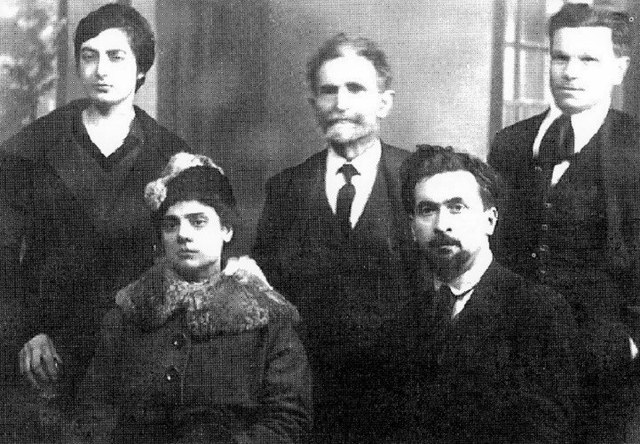
Meanwhile, there’s a cluster of women surrounding a guy looking, if I squinted, somewhat like the young Trotsky. They’re hanging onto every word of his. “I decided that I’d write my dissertation on the Italian anarchists,” Trotsky-alike said in a thick, somewhat plummy British accent. “That’s Carl,” I’m told. “He just got back from the London School of Economics.” The crowd surrounding him nodded in unison. I can be bad and say they looked like groupies surrounding Eddie Van Halen, but maybe they’re as fascinated by the Italian anarchists as Carl is.
Carl’s kind of people
I catch bits and pieces of Carl’s monologue. To my admittedly uneducated, bachelor degree at the time-only ears, the Italians that he’s describing—we’re talking post World War I and pre-Mussolini—sound like noble savages, selfless, instinctual in their generosity and class consciousness. Carl avers that Italians even now (well, in 1980) aren’t all that different. Then he utters the sentence that to him says everything: “The housewives like fresh vegetables.”
Did I mention that Carl grew up in Massapequa? As in Massapequa, Long Island? New York? Somehow I doubt that he spoke with that accent before he attended the hallowed LSE.
I’m writing about Carl, wherever he is now, because he was one of many people I met, and writers I’ve read, who look at Italians in this sort of folklore-y condescending way. Italians are passionate, they’re disorganized, they love their families, they’re Catholic, they drive fast, they have great food, they do funny things that we just can’t understand, but it’s so much fun to go there on vacation. This simplistic portrayal of a complex, modern society goes back to the days of the Grand Tour, when Brits of a certain class traveled south to learn about Art and gaze wistfully at the Tuscan landscape. Think of the E.M. Forster novel and film adaption of A Room With a View, and you’ll know what I mean.
I remember as a high school kid stopping in at a friend’s house, a friend whose family can trace itself back to the American Revolution. White Anglo-Saxon Protestants, in other words. Father (he was called that by his wife, who naturally was “Mother”) would greet me and then, knowing that I’m an American with Italian relatives, ask me about recipes for various Italian-American dishes. I’m sure he was just trying to make conversation, but I remember thinking, JH Christ, get real, as if every Italian-American kid has in his genes the ability to cook veal scaloppini.
The British press is prone to this sort of thing, too. A Modern Languages Open paper examines British attitudes, arguing that most British narratives toward countries like Italy start from the viewpoint that British culture is superior. And a lot of Brits fully believe in the usual stereotypes: sunny Italy, sunset with a glass of Chianti, anarchic drivers, etc.
ABOVE: Image, meet reality
And as in Britain, so its anglophile cousins across the pond. And fairly recently. The New York Times, long a bastion of proper WASP snobbism, pointedly ignored last year’s bankruptcy and shutdown of the Italian airline Alitalia, which by most measures, was a huge business news story on the continent. At some point, someone must have noticed that Alitalia—once the official Vatican airline—had ceased operations and finally, the Grey Lady ran a silly oped, er, sorry, guest essay, by Christopher Buckley.
I’M NOT A NAIVE CHAMPION OF MY other country. The bureaucracy can drive you nuts, the voting pool is divided about 50-50, which makes it easy for weak coalition governments to be patched together and then fall after only a few months. (Just last week, Italian politicians, led by the feckless Cinque Stelle leader Giuseppe Conte, jettisoned a national unity coalition, handing Putin and the right wing a gift.) But if you look past the stereotypes, you’ll see that Italian society is actually a rules-based, established culture. The rules, however, take a while to learn, and are mostly unspoken and certainly, unwritten. They’re woven into everyday conduct. And once you’re used to them, going back to the Wild West of the U.S. can be a jarring experience in reverse culture shock.
To give a concrete example, walk into a shop of any size. Even a huge hypermarket. You make eye contact with the cashier or salesperson and you had better exchange greetings. There’s none of the sullen get right down to it business exchange that you’ll see in any American mall. If you walk into a clothing shop and start with “do you have a white shirt in a 42 size?” the clerk will immediately peg you as a rude lout and will often ignore you until you approach him or her correctly.
Another example: Days are structured here in ways that may not seem immediately obvious, except for the general lull in the middle of the day. For us retired people, it’s a structure that helps us avoid the feeling that we’re drifting through time aimlessly, like people in an old age home watching TV all day and seeing friends carted off periodically. And it’s a general structure that everyone pretty much follows.
You get up pretty early. Have coffee or whatever you need to wake up. Eat a little something. If you’re employed. you go off to the office/construction site/shop/whatever. If not, this is a perfect time to run errands. Then lunch, a pause of an hour or three. Then things pick up until either the aperitivo hour—time to meet friends for a drink. Then a light dinner and off to the finish line. I once made a lunch date with a source, a prominent lawyer for a large company here. Silly me, I asked him what time should we meet at the restaurant. He laughed, saying, “do I really need to tell you?”
I could go into the zillions of food rules, but others have it covered, especially on YouTube, where scores of videos tell you what not to do. Over and over again. So much so that you could be faulted for thinking you’re watching the same video on an endless loop. Here and here are examples. And best of all, for a video review of the rules we live by here, is Marco in a Box:
But the main rule? Enjoy yourself, try to greet people in Italian and get with the flow. And eat fresh vegetables whenever you can.
So, it’s 2022 and Covid’s behind us and everything is just like the old days. Except that Italy reports more than 100,000 new cases on an average day. The United States records around 130,000 new infections daily. But hey, it’s just a bad cold, right? Let’s fly maskless, let’s go out to eat indoors, forget all those nasty restrictions.
At least that’s what it’s feeling like around here. Italians, who braved lockdowns and some of the most restrictive rules regarding vaccinations and gathering in public spaces, are partying like it’s 2019. It’s weirdly disconcerting, because while mass masking is clearly out, you still see bottles of sanitizer and plexiglass barriers everywhere. And don’t try getting on public transport without a mask. The local mall, er, centro commerciale is another thing…
We’ve been living with this strange situation the past couple of months. So basically we keep to ourselves and vaccinated/tested negative friends for the most part. But even given how fascinating we are to ourselves, sometimes you gotta get off the mountain, you know? And our region tempts us every day with festivals, places to hike (and people to do it with) and, bigly, as what’s-his-name once said, sagras.
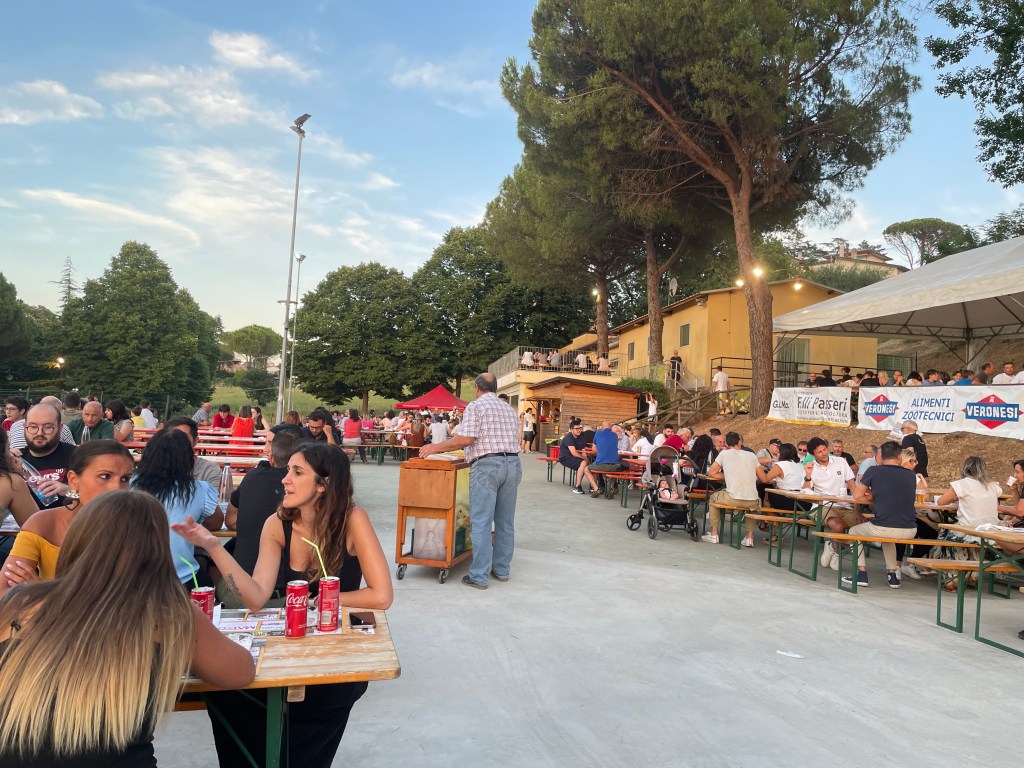
What? You don’t know what a sagra is? Think of it as a big church supper, but without the church. (I’ve written about them before, but without Covid looming over them.) Substitute a town sponsor instead and add a single ingredient or dish as the star attraction. Add some cheesy merchandising, a band playing covers of everything from the Eagles (ugh) to Dua Lipa (!), not to mention gentle line-dancing for the elders. Enlist a platoon of locals to run the thing—the kids busing and waiting tables are especially adorable. And place said event (which usually lasts a few days to a week) in the local soccer pitch and you’ve got a sagra. The closest U.S. event I’ve been to is Staten Island’s Greek Festival, hosted by St. Nicholas orthodox church there.
Add fine china, a white tablecloth and a New York address and this would cost $40.
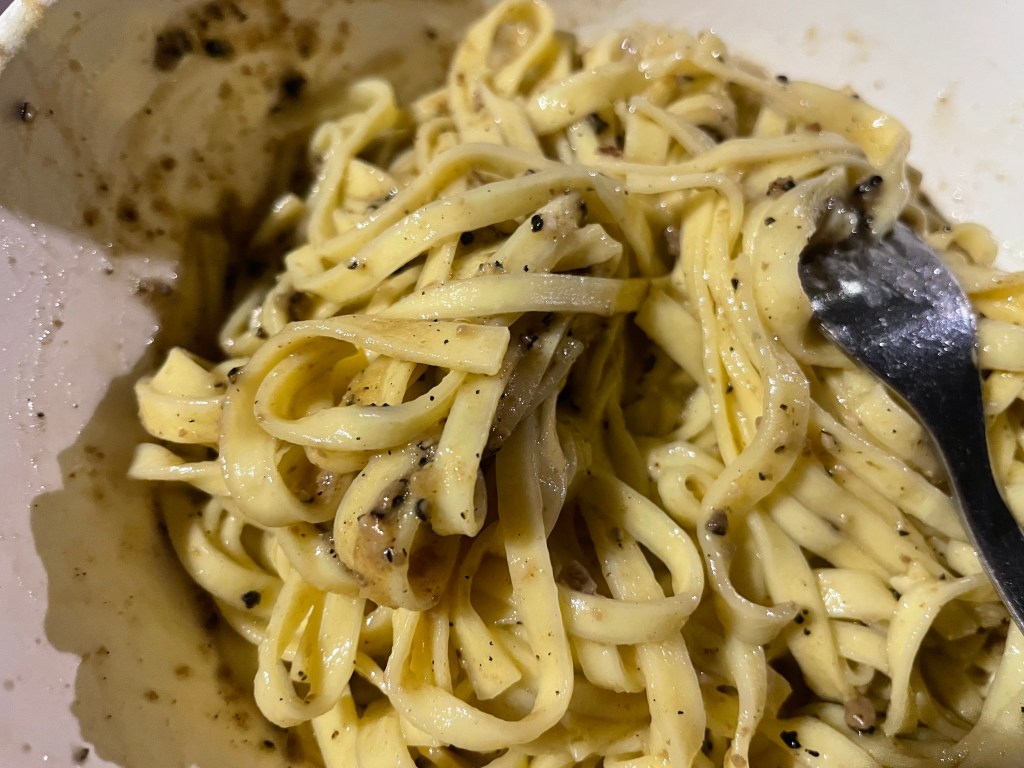
There’s one nearby that we can’t resist. It’s in Ripa, a hamlet two towns away from us. And it features truffles. Not the chocolate kind your mom got for Valentine’s Day, but the black, luscious, pungent, mysterious fungus that grows near oak trees. And the black tuber is on everything from toasts to pasta. It’s good, decadent fun on a budget. Similar food at a New York Temple of Gastronomy ™ would cost ya plenty, but a few dishes, a bottle of decent local wine and fizzy water set three of us back a whole €56, or $57.
Brits, especially, like to rank on Italians for being chaotic. (They should talk.) Go to a sagra, and you’ll see that the stereotype is just wrong. It’s all a matter of priorities. So while Roman traffic may be a free for all, food preparation and service at these sagre (*plural of sagra) is efficient and friendly. You wait in line while dispatching a friend or relative to find a table. That person texts the person on line which table number. Line person gives the order to the person in the booth and pays for it, and finds the table. Then table finder/sitter ventures out for drinks. You start on the wine and water and soon enough, an adorable 10-year-old kid delivers the food.
It’s more than the food. The people watching (and listening) can’t be beat. It’s great to see groups of family and friends out on a sultry night simply enjoying themselves and their place in the world. I like to see how the tribe organizes itself, and which combination of people are hanging out. Basically, the groups come in four models: the mixed generation family, usually three generations; the friends with or without kids and dogs; the elderly couples, either alone or in pairs. And us, a couple and an old friend who’s just moved here and we were showing him one of the glories of rural Umbria in the summer.
ANOTHER SUMMER HIGHLIGHT AROUND HERE is the Umbria Jazz festival. Only Covid stopped and then sharply curtailed it the past couple of years. But this year, for better or worse, the festival was back in its full glory, with free concerts in the streets and parks, an outdoor restaurant, paid big concerts in a soccer stadium—and lots of crowds jamming the small historic center of Perugia. The video below shows what the good old days (2017 here) were like.
We were leery and determined to stay up on the mountain and avoid the crowd. But I’d casually mentioned to a friend that The Spartan Woman would like to see the Canadian singer/pianist Diana Krall. I’d completely forgotten that I mentioned it until I got a text from my friend, saying “here’s a little gift.” Enclosed with the text were two free tickets, given to friends and family of the festival organizers.
Krall fits the “jazz” billing of the festival. But let’s say that the festival transcends labels. In the past we’ve seen artists as diverse as Caetano Veloso, REM on its last tour, Beach Boy genius Brian Wilson, and George Clinton and the P-Funk Allstars. We saw that we had reserved seats, so, unlike at the REM show it would be unlikely that a standing crowd would be jammed in right by the stage. We were right—our fellow concertgoers were a decorous bunch and we were able to socially distance from most of them.
All in all, it was a terrific way to spend a balmy summer evening. To avoid the typical Perugian parking, we drove to the end of the city’s MiniMetrò line, where there’s a huge and free parking lot. The metro itself normally shuts down at a ridiculous 21:30 every night, but they extended it to 1:45 for the festival. We zipped in and out, masked as required. You could say that the line is gently used most of the time, but it was crammed; lots of people had the same idea.
We’re keeping our fingers crossed and stay masked in public places. It was great to get out and pretend life was back to normal for a couple of hours. But for the time being, it’ll always be a little fraught to do that, so we’ll be choosy about where to go and how to do it.
I was thinking about my other country this morning. I started to write this post on the morning of the Fourth of July, which in Italy doesn’t mean anything. But I was seeing holiday memes pop up in my social media feeds, stuff like “salute those who paid the ultimate price for your freedom.”
Really, folks, does it always have to default to saluting the military for the way we live? How about the dudes who started the whole thing by brandishing words, not muskets?
Sorry, I can’t resist. The country of my birth, the United States of America, has not distinguished itself lately. The supreme court rulings, the attempted coup by Trump and his thugs, the endless shootings of kids by the insane and of unarmed civilians by cops paints a picture of a country that’s falling into violent chaos with no good end in sight. Our friends here are puzzled and even distressed, because they grew up with American culture and the romance of the open west.
Then again, daily life for most people is not affected that much by what happens in the news. Society changes on its own, often without much intervention by government or what the press tells people to do. And it’s in the little things, the day-to-day living, where the U.S. is falling behind, too. I honestly don’t think that’s entered the consciousness of my fellow citizens, who are fed pep talks since birth about how great a nation it is. And when people talk about what ordinary citizens of other advanced nation have, the pundits and Republicans immediately denounce “socialism,” whatever that is. And that people there drive funny little cars.
So I’m going to go micro. Let me recount a few details about what it’s like to get healthcare here in Central Italy, and leave it up to you to decide whether you still want to settle for what the U.S. grudgingly grants its people.
Romantic types rhapsodize about the sweet Italian way of life, la so-called dolce vita. It’s a little different living here than being on vacation. But bureaucratic stuff aside, it is less of a hassle here to do certain ordinary things than it is in the U.S., or at least in New York. Like, for instance, seeing a doctor. I once posted about the aftermath of a car accident here, which featured a doctor visit to ensure that my parts were still in the right place.
THIS TIME, HOWEVER, A LONG-STANDING condition came to a head. Every now and then, after inhaling mold or mildew, I develop a chronic cough. It’s been enough to scare fellow subway riders, who think that I have tuberculosis. The cough ranges from annoying to debilitating, and this time it became the latter. But my New York doctor dismisses it when I mention it or break into a coughing spell. He tells me to take Claritin if it’s bothering me. Like a lot of American doctors, he’d rather I go to the standard Medicare-paid tests for people my age, rather than address a really annoying problem right in front of him, as though I’m asking for a prescription for heroin.
I asked a friend here in town for the name of a good doctor. He gave me a name and phone numbers of a physician he said knows his stuff. I put off calling for a while—I’m great at avoiding new situations. I didn’t know how I’d have to negotiate the process of getting an appointment here after years of dealing with American medical office assistants, who act as though their primary responsibility is to keep people from seeing the doctor.
I didn’t have to worry. Our exchange went like this (translated from the original Italian):
Me: Hi, my friend M gave me the doctor’s name. I live in town and have a chronic cough and I’d like to see the doctor.
Nurse/assistant: Can you wait a minute?
Me: Sure
Man’s voice: Hi, I’m Doctor C. What’s the problem?
Me: I explain while coughing throughout.
Doctor: It sounds like allergic asthma. Can you come visit this afternoon at 18:30?
Me: Sure, thanks.
Doctor: I’m right off the piazza. I’ll be waiting for you.
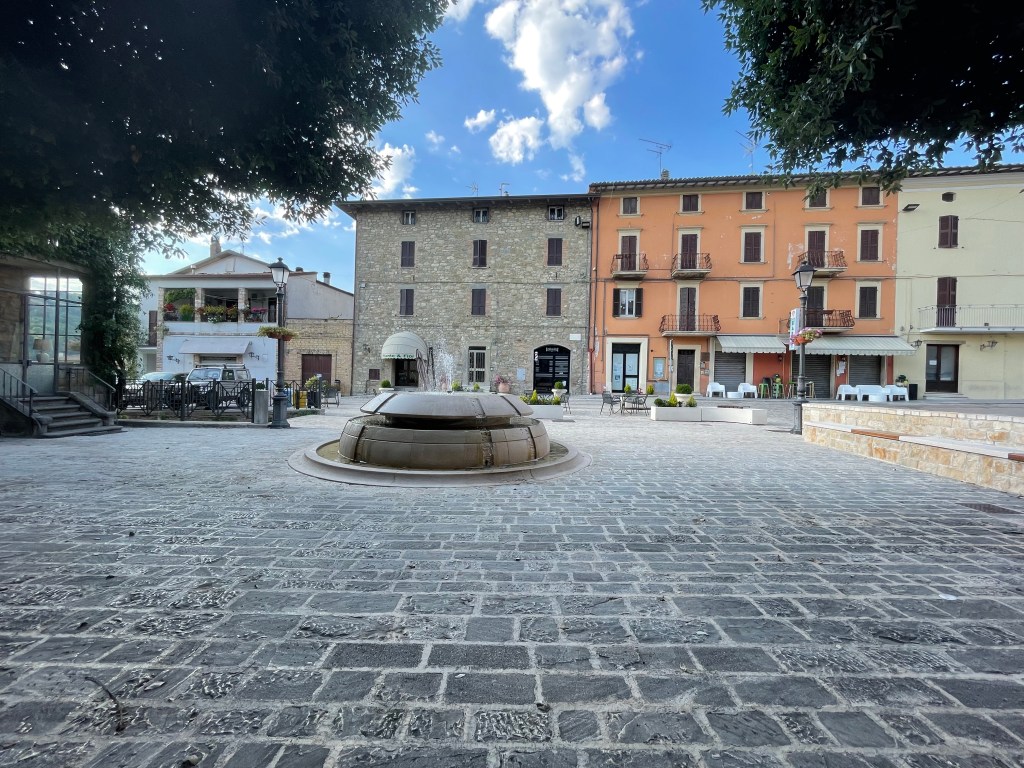
The piazza, the center of life Valfabbrica stylee, seen from Dr. C’s office
I hung up in a semi-daze, just amazed that A DOCTOR I DON’T KNOW GOT ON THE PHONE TO TALK TO ME AND TOLD ME TO COME VISIT THAT VERY DAY. I’m used to calling my doctor’s office in New York, being put on hold, then a distracted office person tries to find me an appointment six months out for that date. And after that hanging out in the waiting room a couple of hours. I’ve left doctors because of that. Once during one of the cough emergencies i was shunted off to a PA in a clinic near a hospital because my own doctor (who really is not a bad guy at all) couldn’t see me for months.
To make a long story short, I saw doctor C. He listened to my cough, checked my blood pressure, sat at his desk and typed up a page of notes and three prescriptions. He demonstrated how to use the inhaler and told me to come back in….two weeks. Not six months. Since I’m not yet enrolled in the state healthcare system, he charged me €60 for the visit, or about USD $61. I’ll be reinbursed by private insurance I have here, which costs less than the typical Medicare deduction and much, much less than individual health insurance in the U.S.
The dude’s a little more buff
I took the prescription to our local pharmacy. It’s in a small modern shopping center just outside the center of our little town. There’s a supermarket, a bar (what we call a café in Italy), a garden shop, and a clothing boutique. The pharmacy is not a chain; offhand I don’t even know if chains like CVS exist here. I went in with my prescriptions, which were typed on the doctor’s letterhead along with detailed instructions on when and how to take the meds. The pharmacist took a look at one of the inhalers. “Do you have a tessera sanitaria (medical card)”? I don’t; I’m not a full time resident, so I’m not yet in the state-run medical system. “It’s expensive,” she told me. I told her that I needed it anyway. And the damage? Just under €22, or about $23. I traded meds info with my daughter in New York, who also has asthma. We looked up the equivalent inhaler in the U.S., and it costs, wait for it, $350 retail.
(Can I put in a plug for locally owned pharmacies here? The CVS near our NY house treats people with prescriptions like applicants at the welfare office, forcing them to stand in line and then wait for hours or even to return in a few days. They bought up all the good family owned ones in the area, except the one owned by our friend Nick.)
Doctor C, unfortunately, had a little problem. He tested positive for Covid, and posted on Facebook, knowing that he’s friends with his patients on Zuckerberg’s platform. I did call the office after two weeks, and his assistant told me that as soon as he tested negative, they’d get in touch. They did—actually, he did, a few days later, and told me to come in. I did, he did the usual checks and adjusted the meds. Plus he told me to see a lung specialist, who’s semi retired after heading the pulmonary department in Perugia’s hospital, but still sees patients. I thought, whoa, this is going to add another layer. But no. So, same drill, I called a mobile number, the good doc answers and tells me to come in in a few days. He tells me to send a text on WhatsApp, and he responds with his address and driving directions.
Dr. D’s office. Note packed waiting room.
I won’t bore you with the details; it was a typical asthma/allergy bunch of tests. I found the place easily; it’s a huge medical center that houses the clinics for the area. You go in and a color coded sign guides you to the right office. Dr. D answered the door himself. He was reserved at first but then became conversational as we spent a whole hour together. And—The Spartan Woman tells me this unheard of in New York—he did the breathing test and allergy prick tests himself. (In addition to mold and household dust, I have mild allergies to olive trees, cypress trees, and the nasty thorny weeds that populate our lawn.) The cost for a specialist visit? €190, or USD $194,also reimbursable.
And so there we are. Dr. D told me to text him periodically over the summer to let him know how I’m doing, and to see him next month. I’ll try to be a good patient, because these people seem to be concerned and less arrogant than a lot of the masters of the universe doctors I’ve seen in New York.
A few caveats: We live in a small town with about 3,300 people, so Dr. C probably has it easier than a lot of his counterparts in bigger cities. And our region, Umbria, is in Central Italy, and is known for its relative efficiency and medical services. (People here like to complain about everything, but trust me, it’s easier to do these everyday chores than in New York, which also presents its own set of challenges.)
[Inhaler photo and asthma diagram courtesy Wikipedia Commons]





















 (Not) A Year (Not) in tuscany