A modern way to get around an old town (and walk like an Egyptian)

One of my problems with the concept of “innovation” is that Americans tend to think of computers as the only area where it takes place. And, maybe, biotech. I’m oversimplifying, but you get the drift. And a lot of them devalue how other societies come up with solutions to everyday challenges. One of the ways the rest of the world is innovating is how people move around. Not just the big voyages, like airports and railroads, but in their towns and cities.

We live in a mountainous area, and a lot, if not most, of our cities and towns are on hills. And that posits a couple of problems that lead to interesting solutions. Hilltowns tend to have narrow streets—some are just alleyways and staircases. And they are not car-friendly. They’ve tried to adapt, but for example our regional capital, Perugia, after letting cars go everywhere, severely curtailed their use in the historic center. And that’s led to problems with commerce and convenience, but it also means that you can walk past nicely scrubbed buildings without be afraid of being run over. It’s a paradox and hopefully planners and urban officials will come to a good balance.

All of this brings me to Spoleto, where we spent a recent Saturday wandering with one of our kids and her boyfriend. Outwardly, it’s a typical Umbrian hilltown or small city. It once was a powerful local force, and traces of that power still exist here and there, like in the splendid duomo (main cathedral) and fortress overlooking the city. You can usually tell how powerful a town was during the pre-Papal States era by the size of its piazzas, and Spoleto doesn’t disappoint. Its piazza del Duomo is majestic and Piazza del Market (Market Square) is a nice big comfortable urban living room.

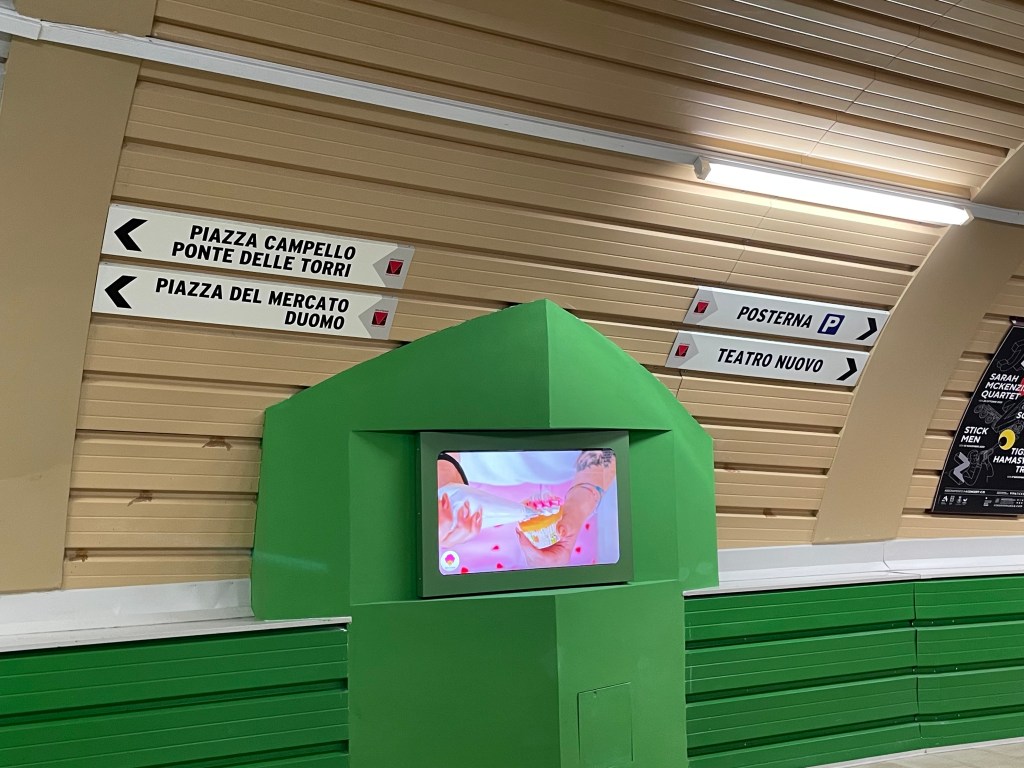
Now this is station art.

These days, Spoleto exercises its power via culture. It’s the site of the Festival dei Due Mondi, more commonly called the Spoleto Festival. Classical music musicians, dancers, and their fans from the around the world gather every summer at venues throughout the city. Because of this preeminence, artists have decorated the city’s public spaces; for example, an Alexander Calder sculpture stands watch over the train station.

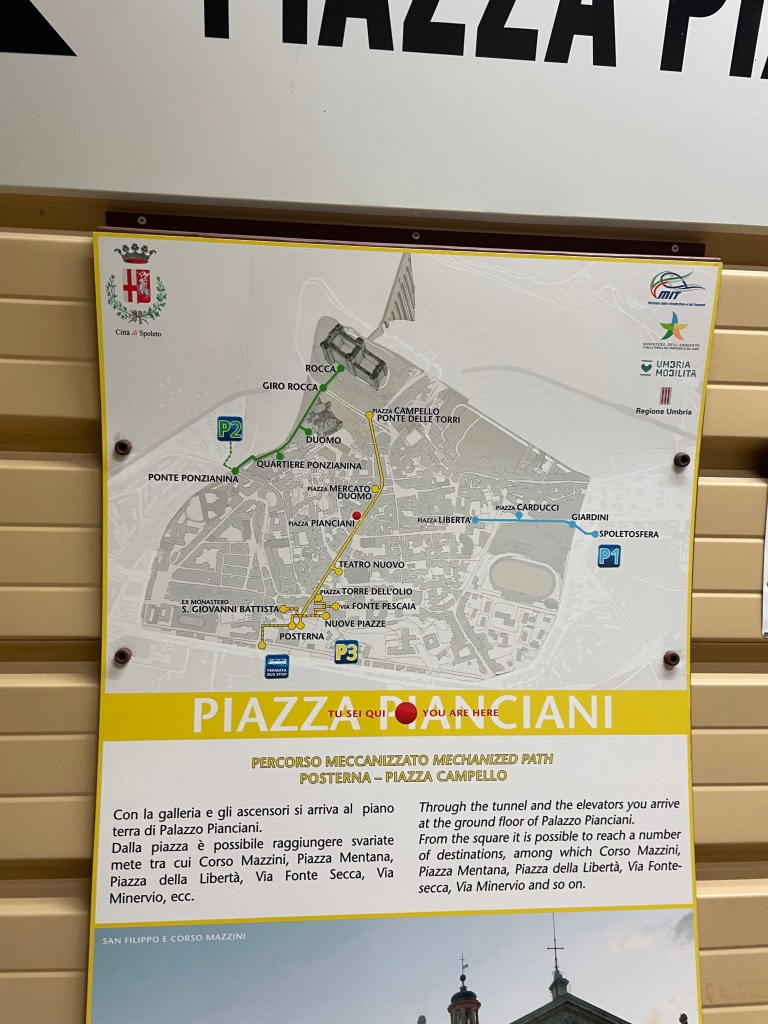
ONE THING YOU CAN’T SEE in Spoleto lies literally below the surface. Spoleto’s government has over the years built a system of tunnels that get you around the historic center and out to parking lots outside the old city walls. It’s pretty amazing. At first I thought the tunnel we used between the parking lot where we stashed our car and the edge of the center city was the only one, and pretty impressive by itself. But a few months ago we walked past what looked like an entrance to another one. With my obsession with urban transport and tunnels I just had to explore. It resembles a subway or metro without trains, but with kilometers of moving sidewalks that actually work (take that, JFK airport). The tunnel leading from the SpoletoSfera lot is decorated with large photos of festival participants and guests, so you know exactly what this former city-state stands for these days. (We can argue over whether festivals are a cure-all for urban woes another time.)

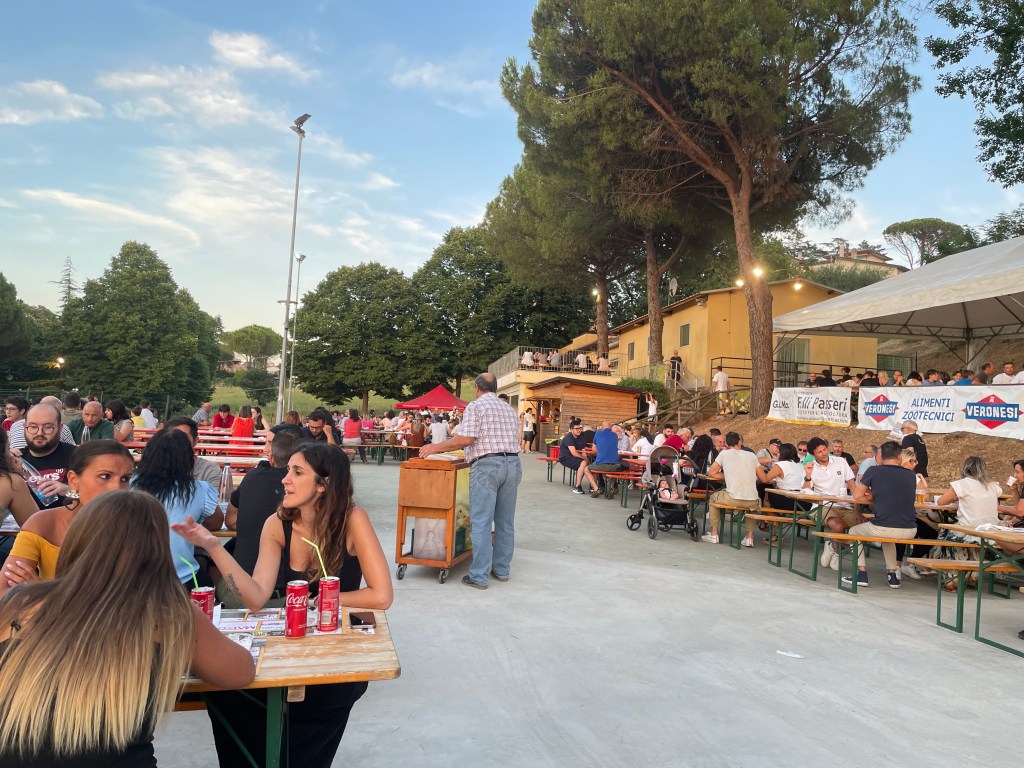
For some reason, every time we go there—and we’ll just go to hang out, feel the vibe and check out the restaurants—something serendipitously terrific happens. This past weekend, we stumbled into a street food happening and we bought enough good stuff to have dinner that night. (BTW street food is all the rage here in Italy, perhaps a reaction to the old days of formal dining in the country’s eateries.)

But a winter Sunday a few years ago topped every trip there. We drove there with two friends from New York, Wendy and Vicky. We walked around the town and when we got to the Duomo, we saw that some kind of mass baptism ceremony was in progress. Outside the church were plaques with the names of the kids. We thought, ok, cool, but there was more. We took the nearby elevator up to the old fort, which has an incredible view over the town and surrounding countryside. All of a sudden, dozens of helium balloons took off from the piazza in front of the cathedral, a riot of pink and blue, one for each baby.

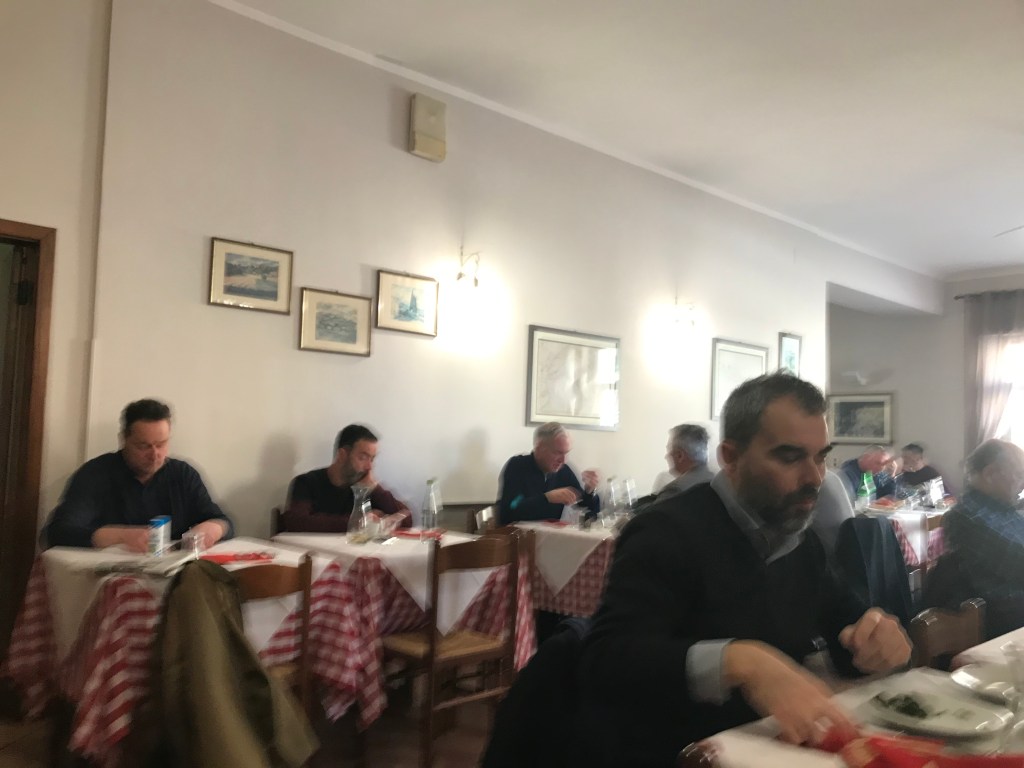
That wasn’t all. We had a really good Sunday lunch at one of our favorite places, Apollinare (right). As we left and turned up the street, we stumbled in the crowd watching an exuberant Carnevale parade. Every participant wore a whimsical costumes, and a lot of them cheerfuly sprayed us all with confetti, sparkles, and silly string. DJs kept the beat going as people dressed as ancient Egyptians shimmied their way down the street.

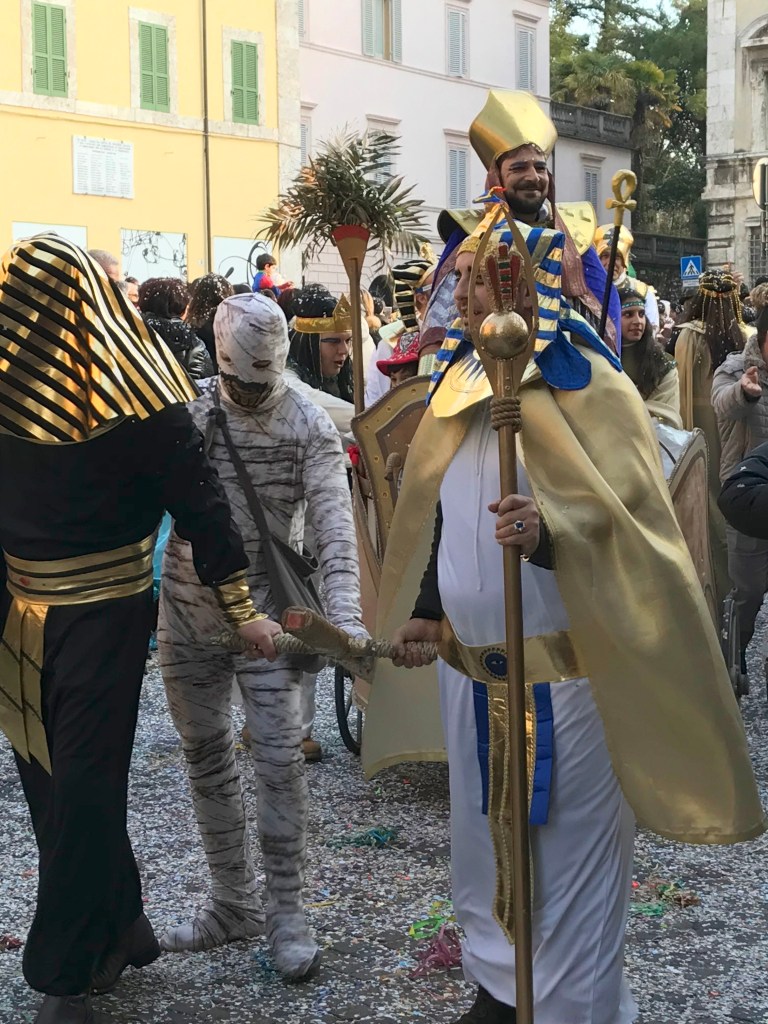
And one of paraders, in the photo below, posed gracefully as I took my shot.

Oh, nothing really.

But that wasn’t the exciting part. We were chatting away when suddenly I hear the twang of an American accent outside in the piazza. You don’t hear it that much around here. I looked out, without my glasses and saw out of focus figures wearing what looked like identical T-shirts and helmets. Francesco was intrigued, too.

—How do you know they’re American?

—The accent.

—There are different accents [I’m guessing he meant in English] ?

—Lots. [translated from the Italian]

He sent me out to interview some of them. The group was on a bike tour from an outfit called Backroads, and came from all over the U.S. One guy was practically my homeboy, coming from New Jersey, right across the Outerbridge. They were all on their way to Gubbio, about 30 km/18 miles away. Up and down big hills away, that is. “Wow, you guys must all be in pretty good shape,” I asked New Jersey. He responded, a little sheepishly, that some tour members had e-bikes to help.

The pause in piazza that refreshes

Okay, so this is not bigly exciting. But it’s all part of the everyday pleasures of life here, and it took me awhile to think like that. When we first arrived in May, I was restless. I felt that I was in this candy store and limited to Skittles. Or something like that. In other words, I was still in this-is-a-long-vacation mode and wanted to wander and even sightsee, and I wasn’t dealing realistically with the fact that we moved here. Like, to live.

And what do you do when you live somewhere? I’ll answer that: You do everyday stuff.

Since the last time we met over roasted tomato risotto, we’ve been in recovery mode, trying to get our lives back on track. August and part of September were like this giant hot blanket pulled over everything. This summer’s blazing heat kept us indoors for hours. Once it broke–somewhat—we had to think ahead. And hot though it was, we have to prepare for the winter.

Alternate fuel? Check.

Doing so is not a big deal if you live in a city—just start wearing sweaters and jackets. And turn on the heat. Here on the mountains, though, we have to lay in supplies and get stuff cleaned out to do that. We have gas heat, but the gas doesn’t come via a convenient pipeline; we have to get a delivery and fill a big underground tank, and take a big hit on our credit card balance. Because of the expense, we have a “termocamino,” or a thermal fireplace that’s hooked into the heating system. It pumps water through the fireplace and once the water reaches 50 degrees C/122 degrees F, we’ve got blaring heat circulating through the radiators. But we’ve also got choking smoke if we don’t call in the chimney cleaner. Hopefully someone will show up in a few days.

Speaking of our lives, 36 boxes of reminders of a former life came the other day. Luckily we have a whole downstairs floor to host them temporarily. And that’s a constant reminder that we’ve got to tell the authorities that we’re living here full-time and thus qualify for the national health service. Then there’s the dog registry and….and…and. Hey, this retirement thing is hard work.

BUT THERE ARE THE PLEASURES of everyday life here to compensate. We walk up the road and see this amazing view. We never get tired of it:

Valhalla, or the Umbrian equivalent

Besides the view, we’ve got neighbors. We can’t actually see them; we’re all spread along this winding road. But a simple 2 or 3 km walk means waving to cars passing by, and someone’s bound to stop and chat and invite us for coffee. A couple of weeks ago, we were doing our walk when a car pulls up. Usually it’s people lost and needing to find one of the nearby hamlets. A guy in accented Italian asks us if we’re the people in the yelllow house. We respond in English, we’ve been anxious to meet you. Seems we’ve got a famous lutenist living in a small house up the road, a fellow refugee from the U.S. If you’re into Renaissance music, look up this name: Crawford Young.

And have you ever had the experience of having a shop, a restaurant, a, I don’t know, a shrine nearby, and you tell yourself you’ve got to go there but you always forget or take it for granted that it’ll be there? Such was the case with the pretty recent addition to our town, Bottiglieria Barbarossa, a terrific enoteca right in the historic center. It opened about a year ago, and it’s a great place to try out local wines and artisanal gins and the like. And the owner Massimiliano is really passionate about his wares and the industry in general. We had a long chat about “natural” wines (he’s not a fan; I’m inclined to agree), the sacrifices restaurant owners make and our careers and life trajectories. The place has the additional benefit of big windows out onto the piazza so you can see the street action without the town’s resident old dudes staring back at you.

Just add wine=the perfect snack

There are other good bits of Italian small town life. We’re looking forward to a fish and seafood lunch this weekend. The menu looks incredible–appetizers, two “primi,” a fried seafood course, dessert, wine, water, and coffee. All of this in our friend’s hamlet for €35 a head, or about $37. It’s not just the food, of course. It’s the communal spirit of it all.

Our town, though, has got that communal thing licked. There are way too many events, walks, lectures, dinners, concerts going on to even start to list them. For a town of maybe 3500 souls, give or take, it’s a lot. And the town fathers and mothers are anxious to promote what we’ve got. Far be it from me to spoil the fun, so I’ll leave you with this video (in Italian), which gives you a good idea of what I’m saying:

I hear you had a nice time in Italy this summer. Next time come back to fill in the blanks

We have access to webcams, and the hot spots looked very crowded. And from personal experience, we know that touring Italy in the summer is not a good thing for those averse to extremely hot weather. And climate change only ramped up the heat. My phone was pinging me almost every hour about extremely hot temperatures, courtesy of the Italian Meteorological Service, a unit of the national air force (really). And that was here, where we’re surrounded by trees, shrubs, and other flora, and we are not surrounded by other people. I think I worked up a sweat just gazing at the Trevi Fountain crowd on my laptop screen.

You probably ate, too. With any luck, you ate fairly well, although in those tourist traps, I mean popular destinations, the food can be hit or miss. My cousins who didn’t come this way seem to have done pretty well for themselves, judging from their posts on “il social,” as we say ’round these parts. But sorry, I have to say, they were in cities, big cities and/or popular cities. You can only get so far. And restaurant workers in the touristy places have acquired bad habits, like expecting a tip from Americans and other non Italians. We don’t tip out here in the provinces.

I’ll get more serious now. It’s a different world here, with an entirely different culinary culture. In the United States, most decent restaurants are in big cities, which attract the best and most ambitious cooks and restaurateurs. Go outside New York or Boston or Chicago and you’ve got chain restaurants like Olive Garden, with the occasional brave indie that was featured on Guy Fieri’s Diners, Drive-Ins and Dives. I exaggerate, but you get the point. In Italy, sure there are great city restaurants like the Osteria Francescana (I haven’t been, but I’ve seen the YouTube videos). But the really good and funky stuff is in people’s kitchens, and out in the sticks and smaller urban places.

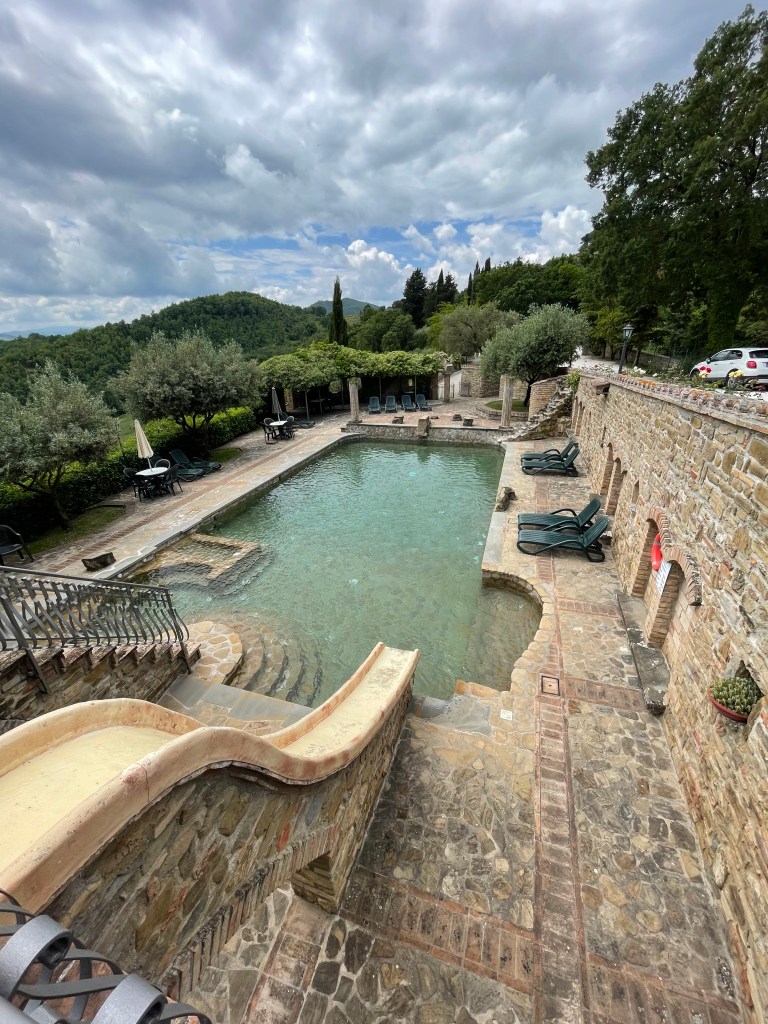
For instance, earlier this summer a friend and I went up a mountain above the town of Gualdo Tadino, just because. We walked around a sanctuary and admired the view. That sure worked up an appetite, so he suggested we go to Villa Dama, a nearby agriturismo his daughter’s in-laws go to for celebratory occasions. I called for a table (they had plenty that day) and 20 minutes later we were walking the place’s beautiful grounds. Nice lunch, too, multi-course with wine, for €40 apiece. And that’s relatively posh for this area (photos below).

Traveling outside the big centers doesn’t limit your tastebuds, either. You might think you’ll have to eat “Italian food.” The towns near us (the biggest being the small university city of Perugia) feature Greek, Japanese, Chinese, and African food, and even an ersatz American barbecue chain. (But us mostly vegetarian types haven’t tried it.)

I’M LUCKY. I KNOW THAT. I have family here, and chosen family, too. Most of my meals before we move to Umbria took place in their kitchens and dining rooms. The day my grandmother turned 90 we had a banquet at a country restaurant that night. The party meal was of a zillion courses and I thought it was pretty good, but the critics at home (one uncle was a chef) had issues. I’ve watched my brilliant Perugian mamma create simple delicious meals in a half hour in her small kitchen. When I started peeling a ripe pear she motioned for me to wait a sec and broke off a piece of Parmigiano-Reggiano to go with it. Simple. Perfect. My Venetian aunt invited us over once and she and her daughters created an amazing 10-dish array of cicchetti—think Venetian tapas. And so on.

You don’t need a Venetian aunt, though. You do need to be a little adventurous. Get away from RFV. Get on a train or rent a car—it’s not scary driving out in the countryside, I promise. Find an agriturismo, a working farm that puts people up and feeds them. We’re surrounded by them here, and they aren’t hard to find. Go to the website With Locals and set up dinner or a cooking class with real live Italians. Even in restaurants, though, the feeling is different away from the aforementioned RFV. Service is casual and really friendly and the tab is a fraction of what it would be in RFV. You’ll find yourself chatting with the proprietor once they realize you’re from elsewhere. You might end up exchanging recipes, too.

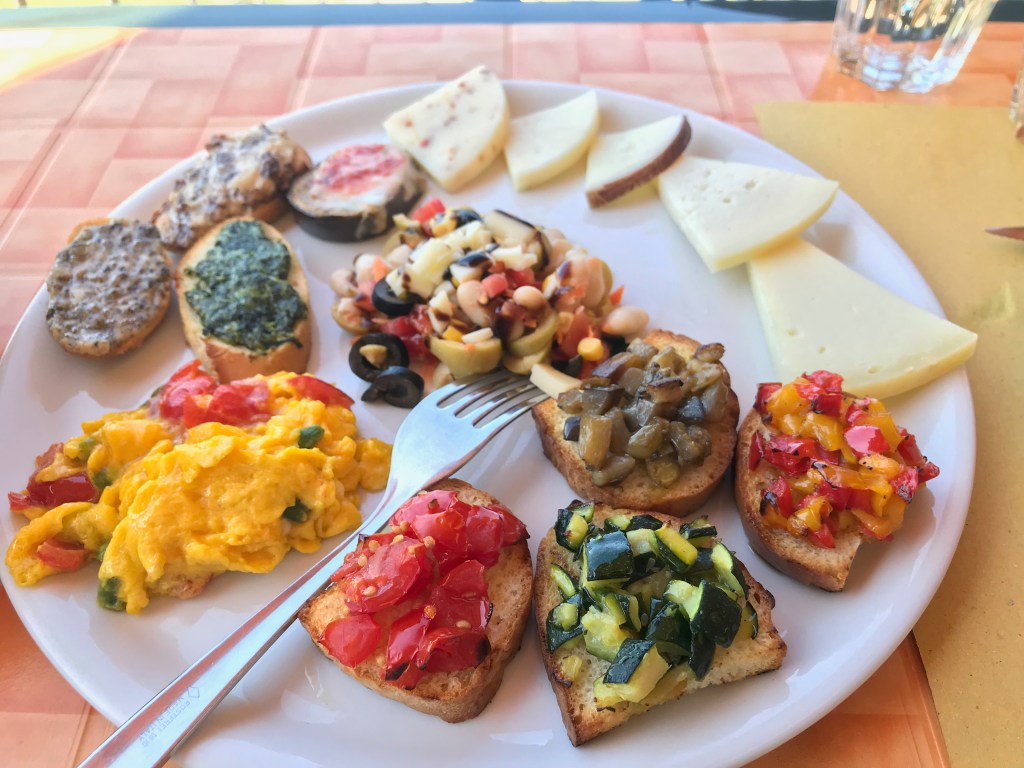
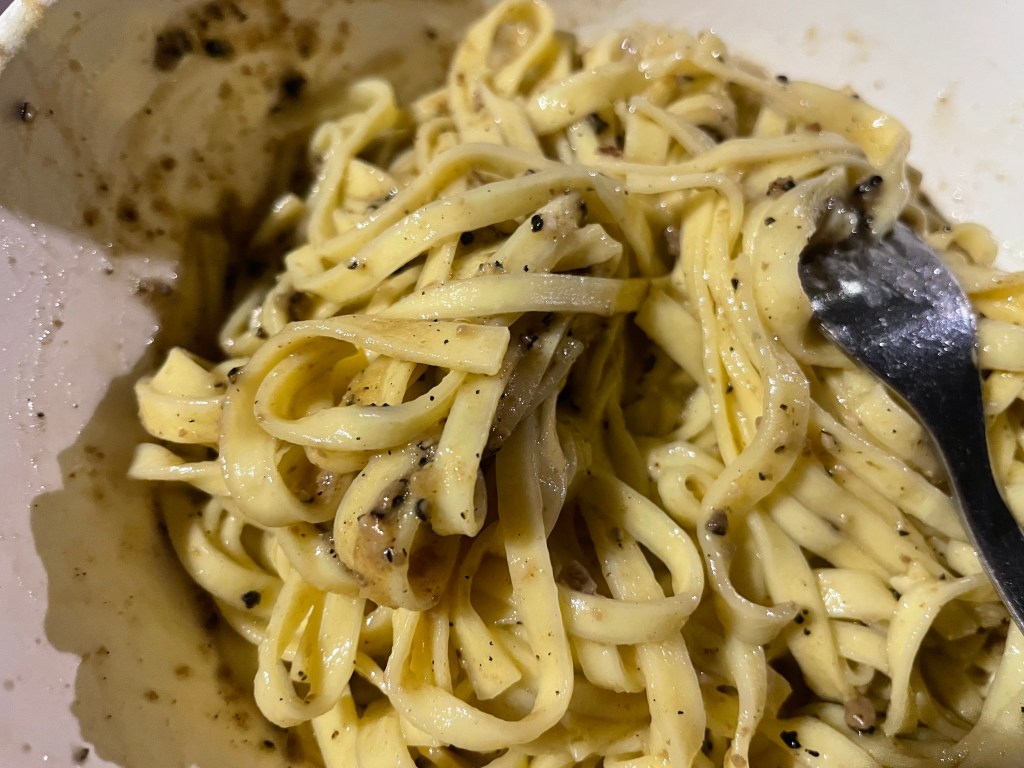
Above, the out in the sticks experience. Clockwise, the first two photos are at Osteria del Cambio in Palazzo di Assisi. And we had the antipasto plate and the truffle lasagne at La Terrazza di San Guido, a laid-back restaurant in the hills above the town of Gualdo Tadino.

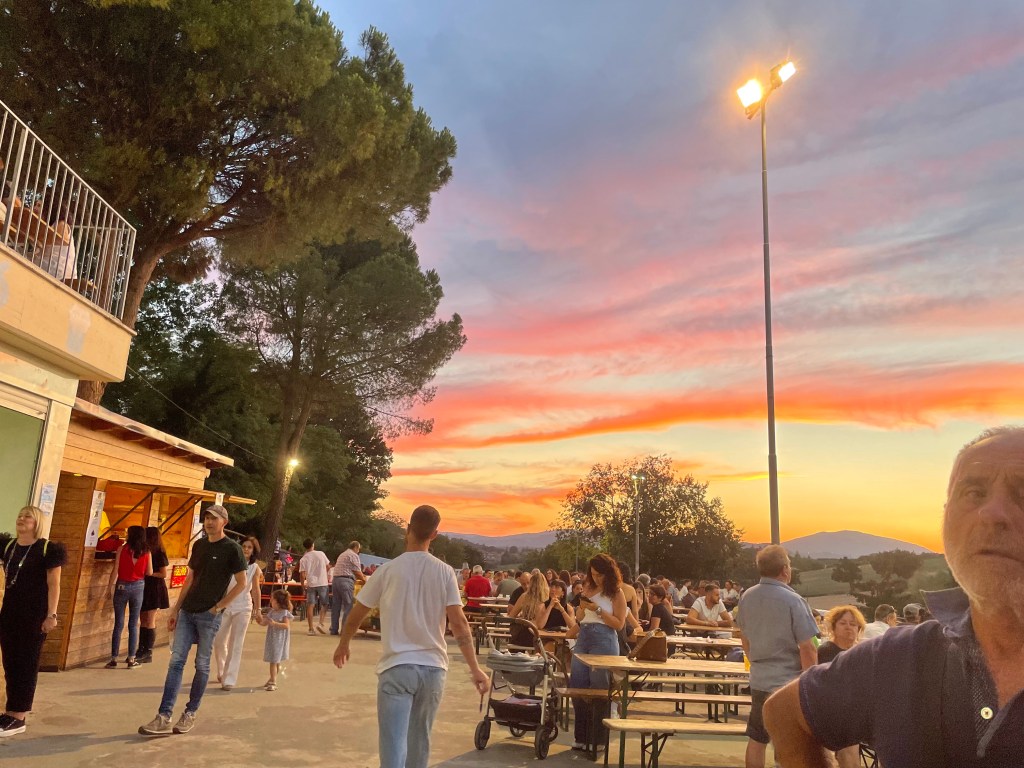
For the ultimate in getting down with the peeps, seek out local sagras and festivals. You can get a good start here. I’ve written about them before, but to sum up, it’s how a town might raise money for the school’s gym, but in reality it’s a celebration of people’s towns, local culture and produce. The other night we went to the shindig in our town; the week before we went up in the mountains to a town that grows fantastic potatoes. Of course, almost every dish featured the spuds. (Text continues below photo.)

Waiting in line for the spuds fest

Here’s the thing. Travel like this and you’ll get to know what the real treasure of this country is. Not the Coliseum, not the Vatican or Florence’s art treasures. You’ll likely get to hang out with the people, who despite bad governments, annoying bureaucracy, and anemic economic growth somehow manage to be kind, generous of spirit, and a pleasure to be around.

We went to a truffle dinner and ended up getting to know a dentist

Summer in Umbria: festivals, swallows putting on an air show for us, cool hikes in the mountains, and dinners with friends, old and new. Hey I know it sounds impossibly idyllic, but hey, after commuting to a packed newsroom for 30 years and pretending to care what corporate lawyers do, I deserve it.

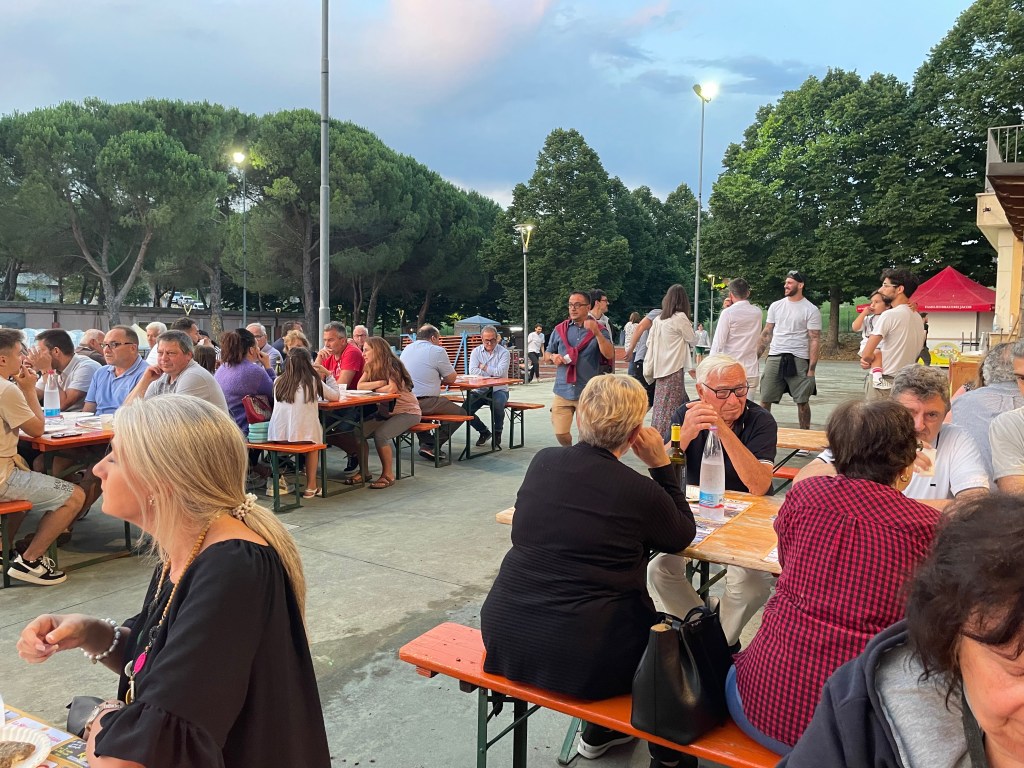
I’ve written before about the sagra (think of a town festival, usually featuring an ingredient the town is or would like to be known for) of truffles in Ripa, two towns down the road from us. Ripa has a tiny circular fortified historic center and otherwise sprawls across some suburban development and farms. The sagra is going on as I type, but a few nights ago the town held a preview dinner with a few of the dishes that would later be served to the crowd.

We figured what the hell, let’s try the dinner. At €20 each, or about $22, it seemed a bargain, with four courses and water and a coffee included (wine was extra, but at prices that beat retail in the U.S.). Besides, it’s always great to go to these communal dinners. Our town holds them every so often, and they’re terrific, with good food, interesting tablemates, and, often, a DJ.

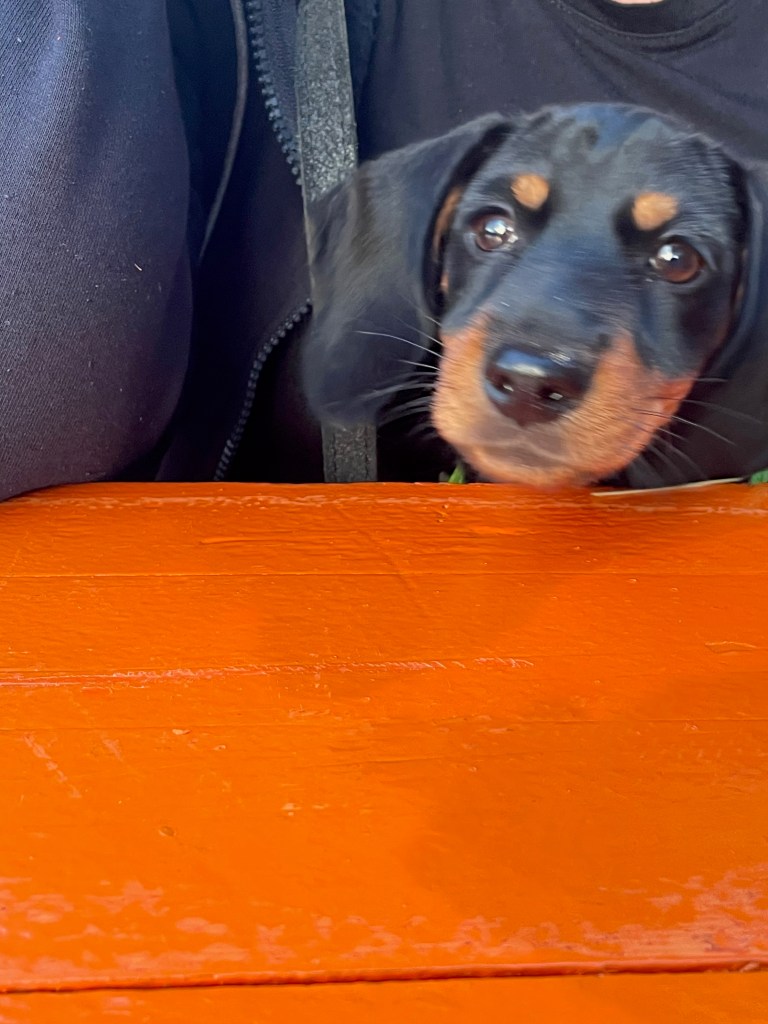
Niko gets a seat at the table.

We had a big life event in between reserving our places and the dinner itself: the addition to our family of a scrappy dachshund puppy we named Niko. Dogs go everywhere with their people here in Italy. We’ve eaten at Michelin-mentioned places and seen big dogs sitting placidly under the table. Should we take Niko? In just a few short days he’d grown attached to us, so we gave it a try.

We shouldn’t have even debated it. Niko turned out to be our passport to conversation. While waiting on line to pay at the start of the evening, he obligingly looked cute for the people around us. And he was pretty mellow as the crowd around our table got louder and more boisterous as food was served by Ripa’s kids and teenagers.

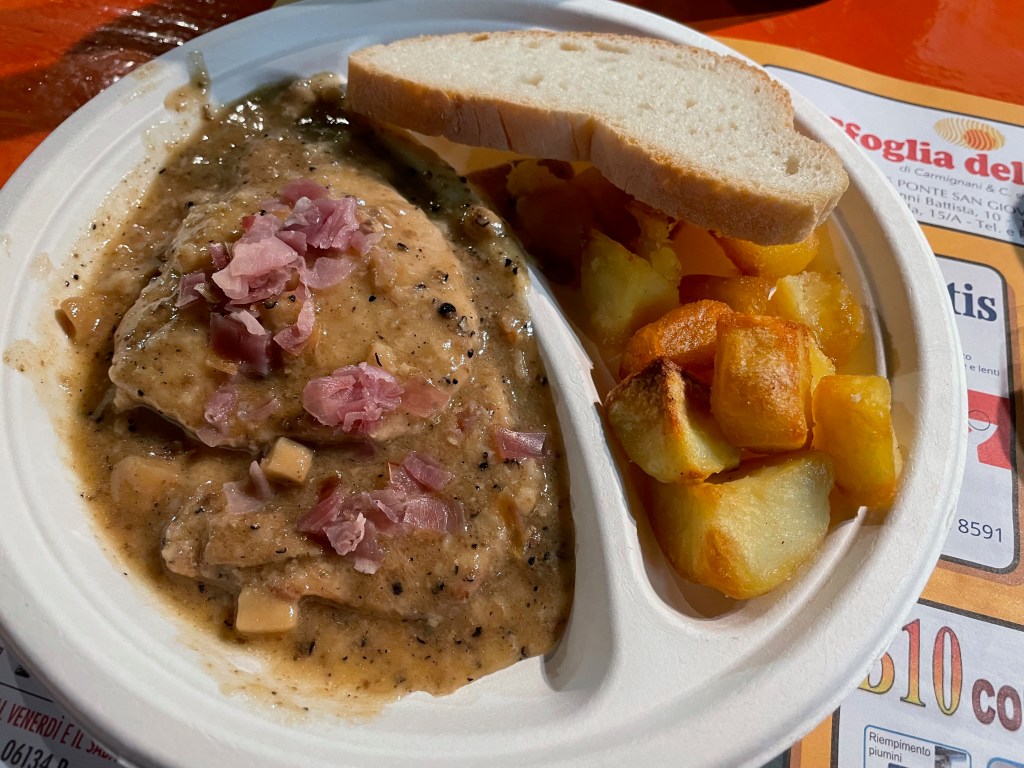
Foodies, here’s what we got for our €49 (2 x 20 + €9 for a bottle of local white Grechetto wine): Truffle bruschetta, gnocchetti (little gnocchi) with truffle sauce, tagliatelle with truffles (a bit too salty we told someone who asked on behalf of the town), pork scallops with truffles nd roast potatoes, and chocolate gelato with truffles [see photo gallery below].

Dinners like this are pretty rustic, even if the star is the local black truffle. Plates are biodegradable plastic, as are drinking cups for both water and wine. You sit at picnic tables and if you don’t fill the table, you’re going to get to know others who find seats at the table.

The good people of Ripa served about 300 dinners that night.

Or not. At least at first. We sat alone for awhile, one of the few couples not part of a jolly family or friends group. It was okay, because the people watching is always good. But then a couple came up to ask if there were empty seats at our table. There were.

The two couples, us and them, sat for awhile mostly ignorning each other. They apparently know everyone because most people passing the table stopped to greet them. We were happy just to sit and enjoy the warm summer night, and eavesdrop every now and then on people’s conversations.

Enter Niko once again. He wanted to see who dared to sit near us, so we held him up and predictably, our tablemates asked us about him in a way that would be familiar to parents of cute babies. They picked up on our New York-inflected Italian. Where are we from? We gave our town here, which usually elicits a chuckle. Then we came clean. Why here? We like it. We’re Italian, too, we add. We tell them about NYC’s high prices, which always comes as a shock to those who haven’t been. Within a few moments, they knew our life story.

I had to turn the tables and get them to tell us who they are. As it turns out, he’s a local dentist. Being nosy and needy, I asked him how much implants cost. (It’s less than a third what a NY dentist would charge.) The wife gave us his business card. We talked about different towns, schools, etc. Then dessert came—a Dixie cup of chocolate gelato with truffle shavings. It was getting chilly, so we all decided to leave, another communal event under our belt.

Who knows, if I have a toothache….

Gone fishin’

Hey friends, I’m taking a short break and using the Fourth of July as a convenient excuse. I’ll leave you with this, one of my favorite Paul Simon songs.

I got (minor) beef with the dude, but damn, he’s a good songwriter. I once covered a post- 9/11 benefit where he was the star performer, and he wouldn’t let me interview him. Feh.

Simon wrote and recorded this song as the Vietnam War wound down, the draft was ending, and Nixon’s dirty tricks dominated the news. I can’t think of a song, other than his own “Peace Like a River,” that better expressed the weariness and sadness of the era. It’s ageless, really, and sounds current 50 years later. Plus, the tune itself is beautiful and his acoustic guitar playing is exemplary, as always.

There are better clips of a younger Simon singing this song out there, but YouTube in its strange wisdom makes you go to the site rather than play it here. You can track them down, or just enjoy this before you head out to the barbecue. Stay safe and enjoy the fireworks.

[Image top of page, A. Paonita as we left JFK Airport for Europe, May 2023]

Some terrific photos, the “larky life,” and a clown parade

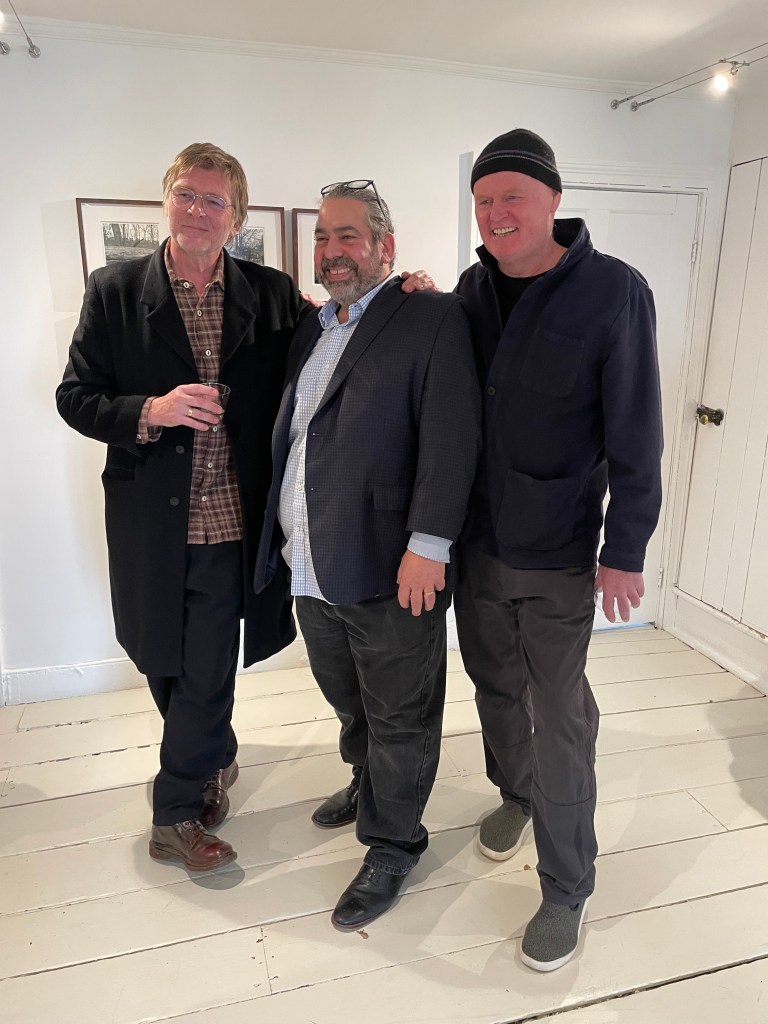
We aren’t the only weirdos in our neighborhood who live abroad for part of the year. I present Gerard, who lives down the hill from The Spartan Woman’s and my Staten Island home. He’s a photographer who has a business making beautiful photographic prints. If you’ve been to any photo exhibit in the recent past, most likely you’ve seen his exhibition prints.

Gerard, a first generation American of Italian parents, also has a family home in the hills south of Rome and north of Naples. He and his father bought the house back; it had been out of the family for some time. So he and his wife and family spend some time there each year. It was fun a couple of years ago to see Gerard in Perugia. He and his wife Toni Ann were driving around Central Italy and for a few hours, Perugia had a contingent of Randall Manor residents wandering around—we’re good tour guides—and having a terrific lunch at Il Cantinone.

Last weekend, Gerard’s photos featured in an opening of an exhibit of local photographers. His photos depict the woods in our neighborhood. I’m still amazed after nearly 30 years of moving here that we have a forest in the middle of what is a fairly dense North Shore Staten Island neighborhood. For an hour or so, you can wander past a pond and into the forest, following trails that scale a couple of hills and wind up at another pond. You’d never know that you’re in New York City.

But back to the exhibit. It was held, appropriately enough, at the Alice Austen House. Now a museum, the gracious estate was once the home of one of Staten Island’s stars, the photographer Alice Austen. When she lived there, the place was called Clear Comfort, and it’s in a beautiful spot right at the edge of New York Harbor. From the rolling lawn that descends to the bay, you can see Brooklyn, the Verrazano-Narrows Bridge, Manhattan, and New Jersey.

Austen, who died in 1952, was an intriguing character. A member of Staten Island’s upper class, she got a camera from her uncle and was immediately hooked. She photographed her friends and family playing tennis, mugging for her on the beach, and attending fashionable parties. She also ventured into Manhattan and photographed people on the streets, many of them poor immigrants scrambling to make a living. Try to imagine a young woman more than 100 years ago hauling cumbersome cameras around and the heavy glass plates that she used as film. (Remember film?)

She and her friends called their doings “the larky life.” And there was something else about Austen that until recently, the prissy Staten Island Advance (the only local daily in New York) never mentioned: Austen was gay. She had a long relationship with another woman and because of her social standing and personal wealth, she broke free of the constraints that women of her time had to live under.

I WAS THINKING OF Alice earlier this week when Staten Island’s St. Patrick’s Day parade took place. It’s earlier than the bigger city parade, presumably so underage alcohol abusers could have an extra day to get wasted. The parade is notorious for another reason: It’s the only St. Pat’s parade that every single damn year bars the local Pride Center and the police gay group from marching as groups. It’s straight out of the Taliban’s playbook. Every year our friend Carol Bullock, the genial and all-around cool head of the Pride Center applies to march in the parade. And every year, parade committee chief Larry Cummings turns her down.

Carol Bullock of the Pride Center of Staten Island

Cummings hides behind what he maintains are Catholic teachings about homosexuality. Yet his boss in religious matters, Pope Francesco, in an interview in January with The Associate Press said: “Being homosexual isn’t a crime.” Noting that some prominent clergy back anti-gay laws, he added, “These bishops have to have a process of conversion,” and they should apply “tenderness, please, as God has for each one of us.”

The situation reached a head this year. When Carol tried to submit her application, there was a physical altercation at a church where Cummings was taking parade applications, with that brave man Cummings shoving a press photographer. The police had to be called to calm things down, and Cummings remained a bigoted little soul who kept those nasty LGBTQ people out of his ever-shrinking parade.

Because of his stance, the island’s public high school marching bands won’t participate, and their youthful exuberance made the parade fun to watch. It seems that most of this year’s participants were motorcycling groups and guys with old cars. We can’t forget three local Republican politicians, including the borough president Vito Fossella, who achieved notoriety when, as a U.S. congressman, he kept another family in the D.C. area and it emerged only when he was arrested for DWI. Cummings is in great company.

I’m sure Austen would have appreciated, if not actually relished, the irony of how she became, as a fairly open gay woman, a Staten Island icon as a few 21st century Staten Islanders tarnish the reputation of her beloved hometown.

Enough of that old stuff. Let’s see some modern architecture

People come here to see old stuff. There’s Assisi, with the hundreds of years old basilica, with Giotto’s frescoes. Perugia has a still intact Etruscan gate and mysterious Etruscan tombs on its outskirts. Spoleto has a Roman amphitheater. For those of you who missed Ancient European History 101, the Etruscans predated those newcomers, the Romans. You can see more modern construction from, say, the 1500s. And apartment buildings that are 100 years old or more are considered to be kind of new.

Along comes Kid no.2 and her partner in art and life. We haven’t seen them in months. And the atrociously hot, then tropically rainy summer kept us from going out much. (So did our continued Covid vigilance) So when those two arrived, it gave us a chance to get out of the house, off the mountain, and play sightseeing guides for a week.

What do you want to see? we asked. “Al (the BF) wants to see some modern architecture. Well…. But it does exist. Umbrians don’t sit on their ancient marble doorstops. And to be honest, looking for modern works was a nice break from Olde Europe,

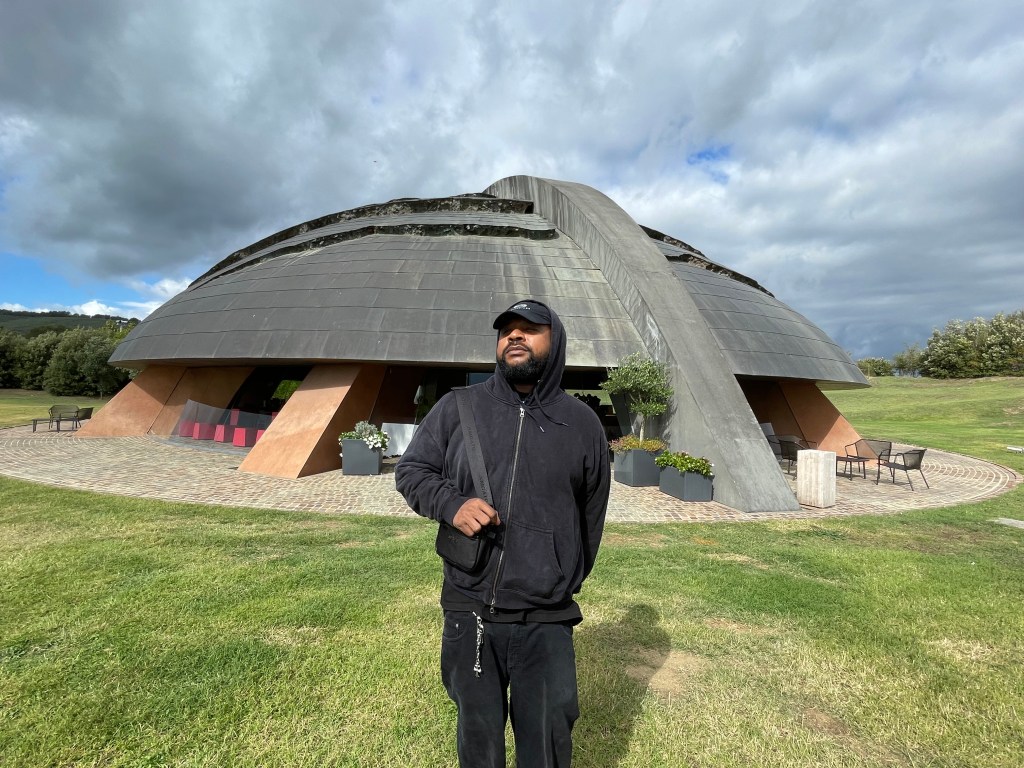
Friends told us about Il Carapace, a winery like no other. The name means shell—most commonly a turtle shell, but animals like shrimp and lobsters have them too, The producers of prestigious wines like Ferrari bubbly, Lunelli, decided that they wanted a statement canteen.in their Umbrian winery, Castelbuono. So they commissioned sculptor Arnaldo Pomodoro to build it.He’d done work for them before, but I have to say, this building came almost as a shock as we drove through sunflower fields and old-style vineyards. The Carapace rises out of the landscape like some alien space ship, a little menacing and a little humorous at the same time.

He asked for modern. He got it.

The surprises don’t end when you enter the belly of what could pass as a Klingon ship. The theme is copper, which clads the exterior, and whose paint adorns the inside. You feel like you’re in the belly of the beast, and a 360-degree view lets you meditate on the ancient vines. Castelbuono produces Sagrantino—Umbria’s most prestigious wine—and Rosso di Montefalco, a less intense, more easily quaffed red wine. If you need a Tuscan comparison, think Brunello to Rosso di Montalcino. The aging barrels sit in a huge underground space.

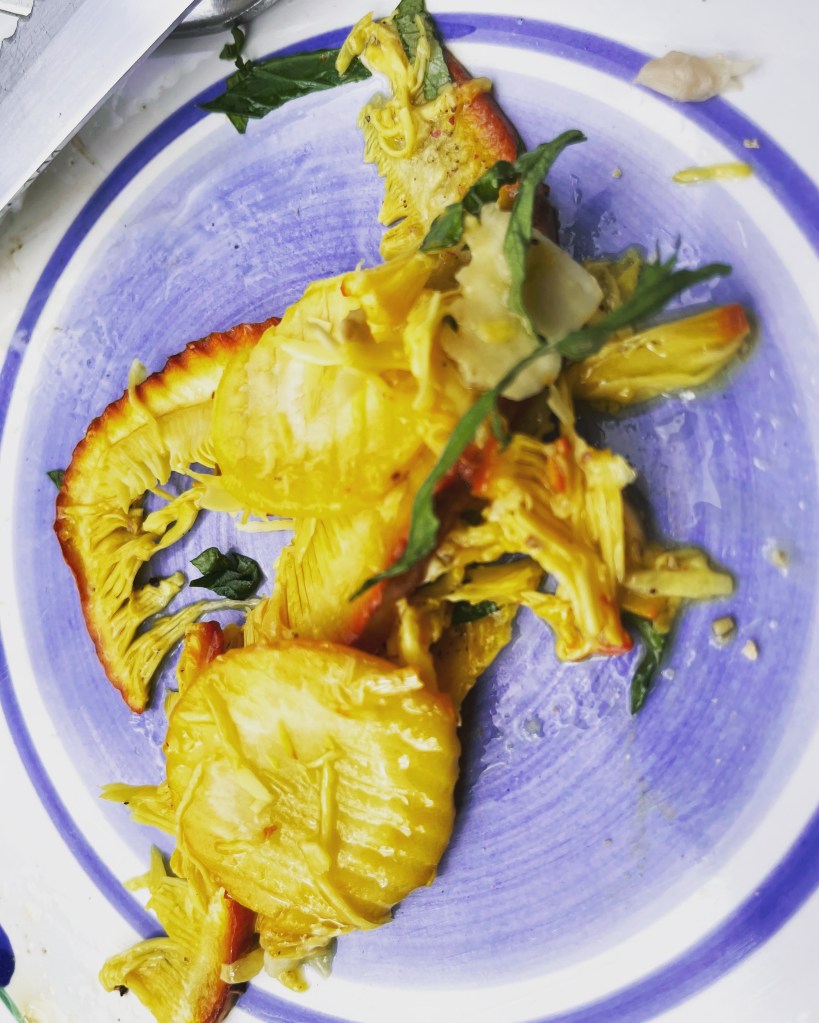
We had to eat, espcially after sampling three wines with a little nosh, so we left the Carapace to get lunch in nearby Bevagna. We were back in old Umbria, which has its abundant charms, not the least of which was a salad of raw ovoli mushrooms, which in their way looked as alien as the Carapace.

The mushrooms from another planet

A COUPLE OF DAYS LATER, we went to Foligno. We’d never been, except to the train station, which is a major transfer point for trains from the main Rome-Ancona line and the pokey local “regionale” to Perugia. The object? The modern art museum, the Centro Italiano Arte Contemporanea.

Foligno is unexpectedly interesting. On the outer rings of the small city, there are lots of Stile Liberty, or Art Moderne villas. There’s a long wide pedestrian street filled with porticos with bars and restaurants, and tons of shops and terrific window shopping. Who knew?

The modern art museum has one thing in common with the interior of the Carapace: a copper color. It basically looks like a copper box in the middle of a older neighborhood, and is instantly recognizable because of that. The permanent collection is pretty small and unfortunately they were between exhibits. But there’s more….

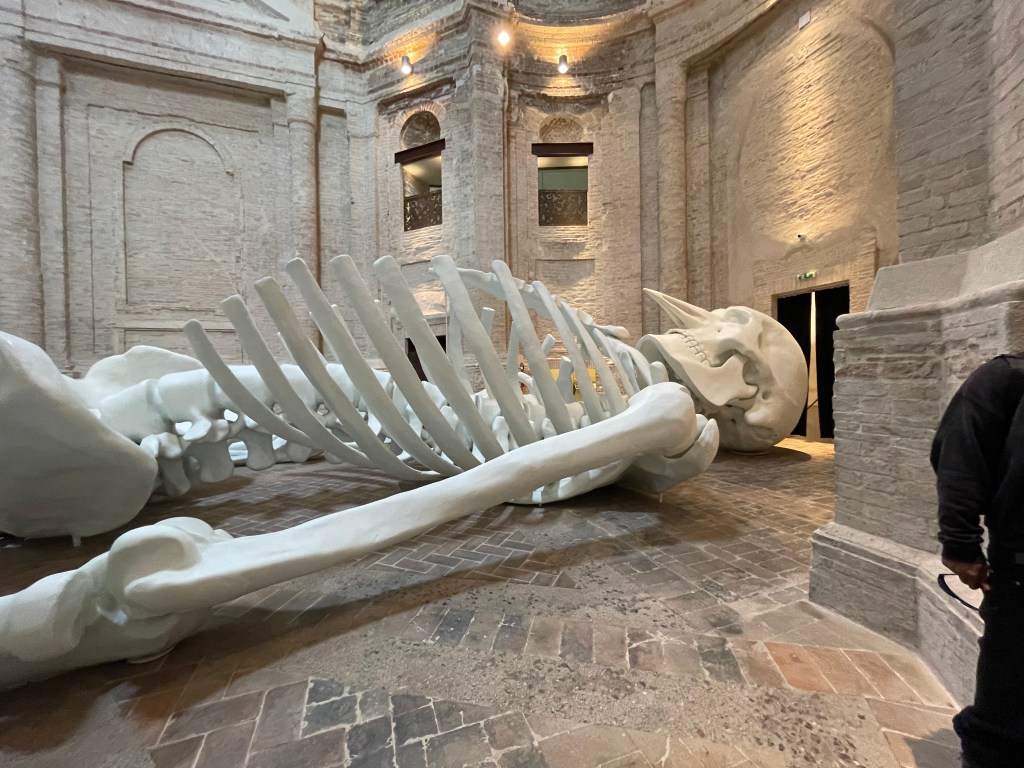
A 10-minute walk brought us to a deconsecreated church, the Chiesa della SS. Trinità in Annunziata. where, in the middle is a giant skeleton replica, by the secretive and subversive artist Gino de Dominicis. Its official name, “Calamita Cosmica,” or cosmic calamity. It’s pretty amazing, the kind of thing that held our attention as we walke around it. It’s not just the thing itself; it’s the context. De Domicis is described in the work’s website as “a controversial figure in modern postwar Italian art, with an eccentric personality, himself an endless work of art, original and full of secrets.” All I know is we just stared in wonder as we walked about the beast and tried to take photos that did it justice.

Well, why not?

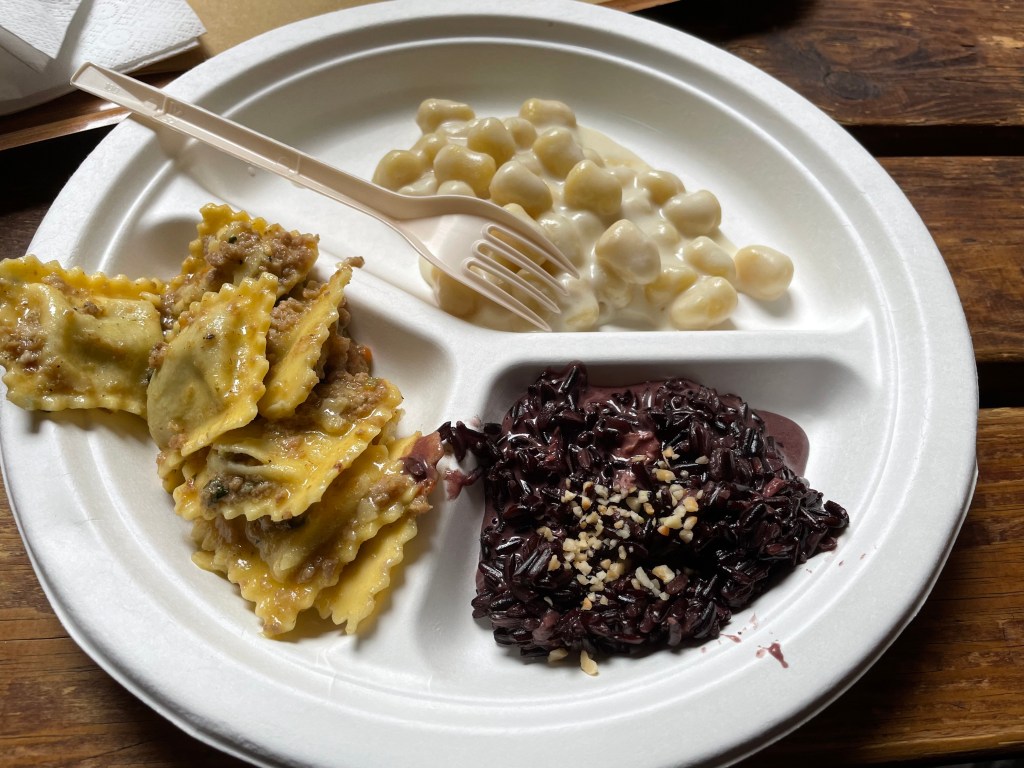
Of course, we worked up a powerful hunger after that expedition. Happily, Foligno was there for us, with a festival of first courses. In the progression of an Italian meal, the “primo,” or first course, is actually the second. It’s composed of pasta, soup, or rice. Note that it is not what Americans call a main course; to an Italian, a huge plate of overcooked spaghetti serving as the main meal is a travesty. The festival was terrific, even if it was a rainy day and we had to traipse all over the center of town. Big signs and a handout map guided us to various restaurants around town that served regional primi; it was fun to pick and choose, for a really good price of €5 (5 bucks) a plate, with cheap good wine to go with it.

A “tris” of primi

We’ll be going back to Foligno as soon as we can. The festival got us acquainted with what seemed to be dozens of cool bars, restaurants and shops. Can’t wait.

It’s something we think about all the time here

Let’s talk about food, shall we? And where you consumed said food? (Sorry if the headline led you to think I was going to write about that other obsession.) I’m thinking about food in Italy these days, since I’m here. It really is an obsession, and not just with “sovrappeso” [overweight] me. I’ve overheard chic saleswomen talk about what they were going to have for lunch in tones that were, well, erotic. And if you happen to be in Italy and happen to get onto YouTube, your feed will soon be blitzed with food videos. I don’t think it’s just mine.

First off, most Americans without the good luck (or misfortune. It depends.) of having relatives living in Italy don’t get the full-on experience. They–you?–have to go to restaurants. And that’s a shame, especially if you’re in the big tourist cities. Why? Because restaurant food may be ok, but eating in an urban restaurant in Italy doesn’t come close to the real deal, and in big cities and touristy locations, many restaurants serve a kind of national “Italian” food that doesn’t reflect what people really eat in this intensely regional country. Plus they miss the vibe, where people loosen up and sit with friends, family, lovers, kids, dogs, whatever, just enjoying the moment. Or a town festival. Or, in the case of our town, any excuse to get together. Any.

First, friends and/or family. One of my most memorable “meals” here, if you can call it that, happened before we had a place of our own. My magazine astoundingly let me come to Italy on a reporting trip. My assignment was to make the rounds of lawyers and business analysts and give American lawyers an idea of what to expect if their companies or clients tried to buy an Italian company. I cannily scheduled interviews for the latter part of the week in Milan, and the early part of the week in Rome. Oh, dear, what to do in between? Live in a lonely hotel room? Eat meals by myself?

Nope.

I visited friends who happened to live in Perugia, about two-thirds of the way south to Rome. After a couple of train rides, my Italian papà Franco picked me up at the station. “We have to hurry,” he said. “Giovanna’s in the middle of a surprise for you.” Franco, never a quiet pensive kinda guy, gunned it, shouting at anyone who dared to drive any slower. “Figlio di puttana! Bastardo!” he shouted. After holding on for dear life—Perugia doesn’t know from straightaways—we got to their house. “Hurry! Just leave your bag. You can keep you jacket on. We have to do this NOW!” Franco told me.

What was the fuss all about? Artichokes. Glorious crunchy salty hot just from the fryer pieces of artichoke. “I’m squeezing lemon on these, ok?” said Giovanna in Italian (these two didn’t speak English; this is all translated), more as a statement of purpose than a question. “Eat with your fingers.” She had put the freshly fried artichokes in a paper lined basket and shoved it at me. “Eat with your fingers.” The three of us didn’t even sit; we just stood there eating, blowing on our fingers between bites.” When we weren’t wolfing down the artichokes, we were drinking and smiling at each other. It was one of the best food events I’ve ever been at. I know we sat down to a regular lunch after that, but for the life of me, I can’t remember it. Can you blame me?

If you don’t have an Italian friend or relative, the next best thing is probably eating at an agriturismo, or at least a country restaurant. If it’s the right season, eat outside. Yeah, there’s an Under the Tuscan Sun thing going at these places. But you’ll see what makes it all worth it. Some years before that reporting trip, we’d gone to an agriturismo high above Lago Trasimeno, the big almost ocean-like lake around here. I can still taste the pasta course, with an eggplant purée (no tomatoes) and bits of sausage. But what I really remember was the vibe. There we were, our family, plus our Perugian surrogate parents and their dog, just relaxing around a table with a view of the lake below for the whole afternoon. And it cost maybe a half of what a city restaurant would’ve charged. Maybe less.

ANOTHER WAY TO ENJOY NON-RESTAURANT food is at a sagra or a festival. They’re held all over Italy, and here in Umbria there seems to be one every day or so somewhere. They serve as fundraisers for the town’s pro-loco associations, which support soccer teams, after school activities for working parents, and the like. But they’re also a way to get the whole town involved in something—and, for people to connect with their history. Local volunteer cooks take care of the food, sometimes, but only sometime, under the guidance of professional chefs. Of course, doing so often involves getting done up in medieval drag, which seems to happen for any excuse, but I digress.

After the Covid shutdown, the region came alive this year. We’ve been to a few. The first was for the food, in Ripa, two towns down the main road here. The town itself is a tiny hamlet, with a circular historic center, and various memorials to Gino Bartoli. He was a heroic figure, a Tour de France bicyclist who smuggled citizenship documents for Jews during World War II by stuffing them in his bike’s tubes and delivering them. Ripa holds a truffle sagra, and the food’s pretty good if you’re a fan of the underground fungus. (We are; Ripa sagra shown below.)

There’s a biggie around here, too. The small town of Cannara, near Assisi, is known for its onions. They’re sold in all the grocery stores and to be honest, we’re spoiled. I won’t say you haven’t lived until you’ve had a really fresh onion—but like a lot of produce, being grown locally makes a real difference. Cannara puts on a pretty big show, with various “stands” (yes, in English), really kitchens/outdoor restaurants, with each producing dishes that feature, yes, onions. Cipollamisu, anyone? It was a lot better than you’d think, with the typical tiramisu ingredients topped with a compote of sweet onions.,

Valfabbrica, where we live, goes all out. It’s bigger than Ripa, as far as towns and hamlets go around here, but smaller (population around 3,400) than the surrounding towns. There’s a week-plus celebration of being a valfabbricheso, with pageants, jousting tournaments, and, of course, food. The town’s historic center turns into a restaurant, and the town has a communal kitchen that churns out tons of dishes based on local produce and history. Gotta say, it was pretty good.

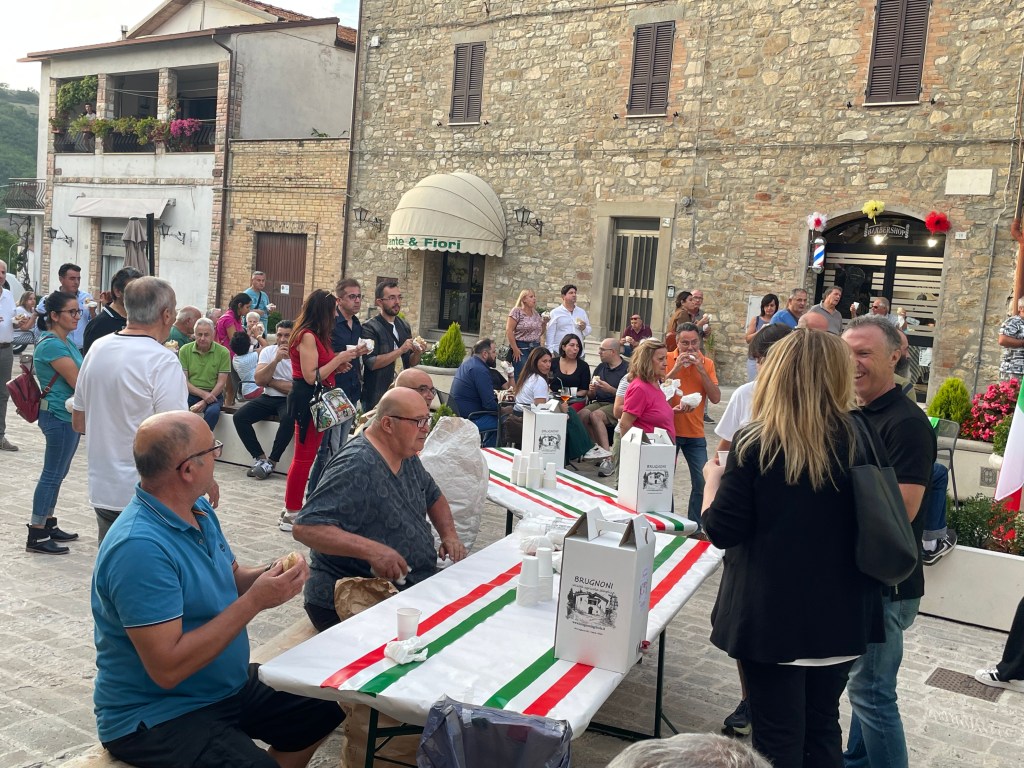
But the most charming event involving food was last weekend. Our town likes its parties, and the old medieval tower was restored recently. Most places would have the mayor cut the ribbon and leave it at that. Valfabbrica? Uh-uh. It got Italy’s only all-female jazz marching band to escort the mayor to the tower, playing Stevie Wonder’s Sir Duke and The Beatles A Hard Day’s Night. The women walked up the tower with Enrico (we’re all on a first-name basis here)

We don’t have dull ribbon-cutting ceremonies in Valfabbrica.

I know, this is supposed to be about food. Sure enough, after the music and the ribbon-cutting and the speeches about the historic importance of the tower, there was a free aperitivo* in the piazza. Older guys sat behind tables with loaded with decent boxed local red wine and porchetta panini* and doled it all out. I haven’t eaten much meat in a decade, but one of the guys shoved a panino at me after I poured myself a healthy glass. It seemed churlish to say no—and it was great to be hanging out in the main piazza on a beautiful late summer night with our fellow townspeople.

Vino and a panino, anyone?

*”Aperitivo” refers not only to a pre-dinner drink, but food to go with it. Places like Milan and even good bars elsewhere elevate it to the point where it can substitute for dinner. At that point you can all the meal an apericena—aperitivo and cena, which is what the nighttime meal is called.

* The word is “panino” for a single sandwich. “Panini” is plural. More than 1 sandwich. Ok? I get a little nuts when I hear “I’ll have a panini .” It’s like nails on a blackboard.

Perugia, mon amour

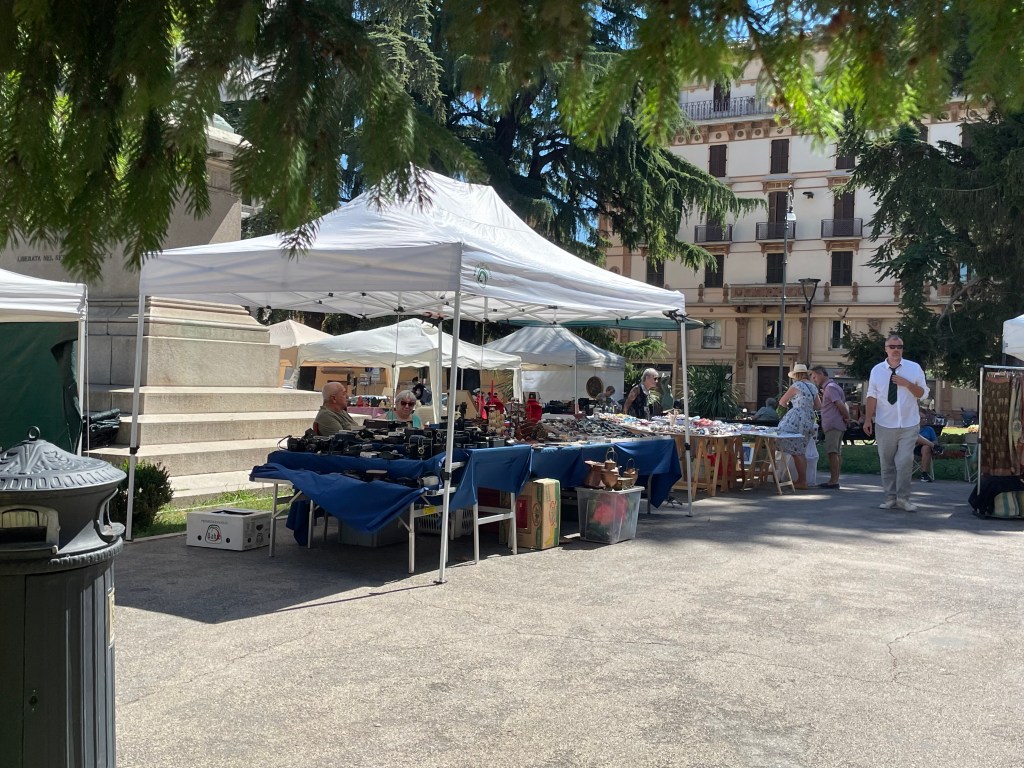
We went antiquing the other day. You might say, “meh, so what?” But this was an unusual event for us. Well, okay, not the venue: Our nearest big city, Perugia, hosts an antiques market in one of the big piazzas on the last weekend of every month and we’ve been there before. Still, this was kind of a big deal. The heat, and still-widespread Covid cases, kept us on our mountain most of the time. But we got antsy and needed to go out. And in the process, with the heat abating somewhat, we’ve rediscovered our old love: Perugia.

There’s an amazing amount of both good stuff and kitsch. In particular, I have a thing for old magazines from the 1950s and ’60s, artifacts of “La Dolce Vita” Italy, the Italy that my sister and I reveled in as kids, when our relatives from abroad came to visit, or when we listened to the pop songs of the time. The Spartan Woman and I have even bought little stuff at the market, like an antique corkscrew or some prints.

Looking for artifacts of a former civilization

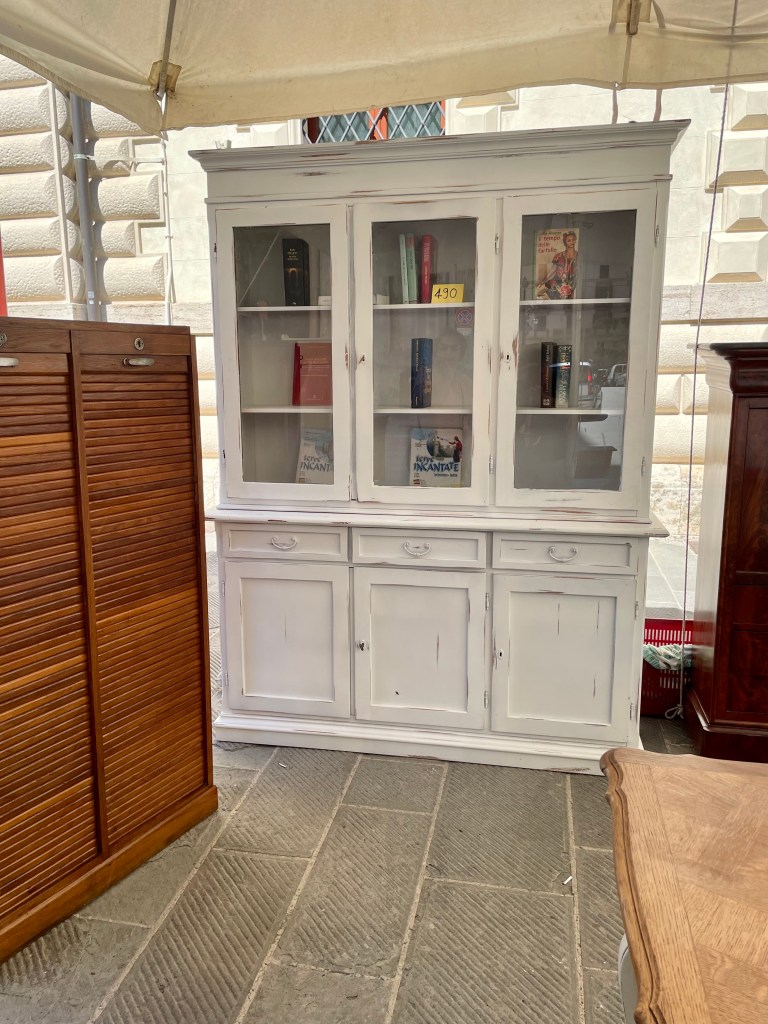
This time was different. We actually bought a large piece of furniture. The seller called it a libreria—a bookshelf. But it looked like the perfect breakfront for our kitchen in the country. The top part had glass doors, while the bottom doors were wooden. It looked like it came from nonna’s (grandma’s) house. The seller probably sanded it down and painted, then distressed the wood to give it that old country house feeling. Whatever. We liked it. The price tag was €490, which comes to about the same amount in dollars. We were just looking and the seller blurted out €300. Sold!

What happened afterward is what made the deal special. We told him we lived in the country, about 20 kilometers away. Does he ship? He said he did. It would take a few days, which was fine by us. We gave him our address, with some directions, and my mobile phone number. Did we want to leave a deposit? he asked. He quickly added, it’s not necessary. Would this happen anywhere else I wondered? At the time, it seemed to me that at this point he had no incentive to get the piece to us, but hey, it’s not as though we were going to lose out if he didn’t deliver.

After breakfast at a nearby café (coffee and pastries), we headed to our car. My phone rings. “Antonio, this is the antiques guy,” the voice on the other end said in Italian. “Are you going to be home soon? We can deliver the piece today if you want.” Sure, I said, we’re on our way. Give us an hour or so—the actual trip is 25 minutes, but we had to clear out a space for the piece. A couple of hours later, a delivery van arrives, I help the guy carry the heavy load into the kitchen. Delivery guy drinks three glasses of cold water after he complained that the ghost town next to ours didn’t even have an open bar. We give him the cash and now the piece sits nicely in the kitchen.

I know, this is not extraordinary. People buy stuff like this all the time. But what got to me, and what I love about living here, is the element of trust. The seller didn’t take a deposit, and yet he delivered the piece based on our word. Maybe I’m wrong, but I can’t imagine that happening in New York. Or much of the U.S.

ON THAT SAME WEEKEND AS THE ANTIQUES MARKET, we had another terrific reason to go into town. Blame, or credit Laura. She’s part of the Santucci clan, which adopted The Spartan Woman back in the day, and which has become our chosen family here. In fact, the connection with Laura is where our Kid No. 2 was baptized. It’s a Romanesque church that dates to the 6th century, give or take, and was built using the columns of a Roman temple that previously stood on the site. Laura co-authored a book on the church, grandly called, at least officially, the Tempio di San Michele Arcangelo. But most perugini just called it the Tempietto di Sant’Angelo.

Perugia’s archeological museum hosted a presentation on the book and a general lecture about this extraordinary structure. It’s round, and set on a hill surrounded by lawns, with the neighborhood’s guard tower nearby. It’s such a tranquil and beautiful place that it’s got a waiting list of couples throughout Italy who want to be married there.

Laura Santucci, right, laughs at a co-panelist’s comment.

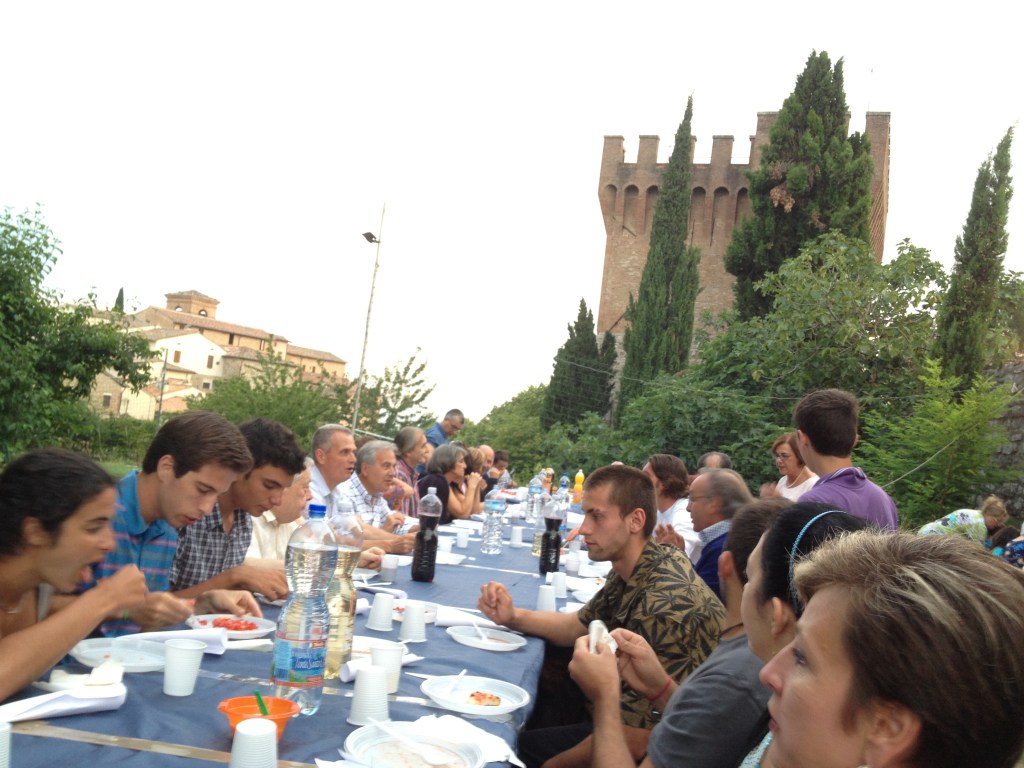
Besides its fame, it’s the local parish church, and hosts such activities as after-school recreation for latchkey kids in the neighborhood. And before Covid, its yard was the venue for an evening that Laura, her family, and friends organized called “Mangiamo Insieme,” or “Let’s Eat Together.” For a nominal sum, I think €10 or €15 a head (about the same in dollars), people in the neighborhood got together in long long tables for a full dinner. Some 200 people attended the one we were at; it was a beautiful night, bringing together just about everything that makes living in Umbria a pleasure.

After Laura’s presentation, we had a real need for some adult beverages and people watching. Perugia’s main drag, the Corso Vannucci, is a pedestrian island full of bars, cafes, restaurants, and shops. It’s also way too touristy for us, at least in Perugian terms—this city is decidedly not like the Holy Trinity of Italian tourist sites, RomeFlorenceVenice. You can spot the tourists easily: They’re the ones having dinner at 18:30 on the Corso.

So, avoiding the early dinner crowd, we went to a hipster bar, Mercato Vianova, on a side street. You can get sushi at this bar, if that’s your thing. But we were just into a drink and snacks.

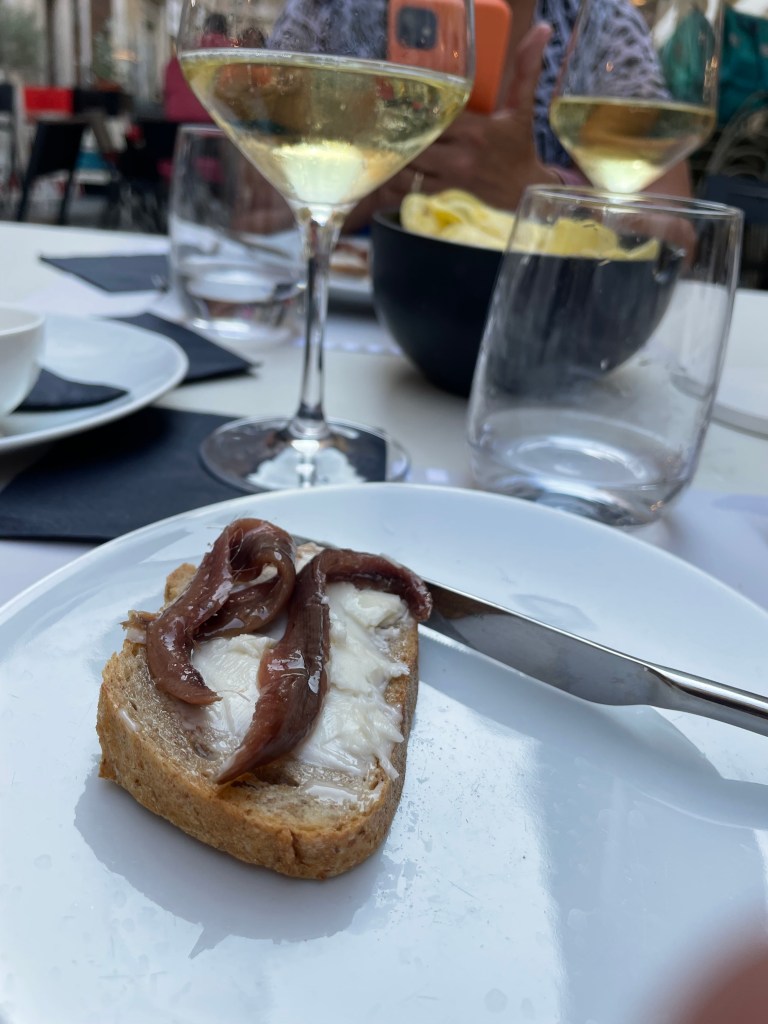
I usually go for a spritz of some kind, but after seeing a glass of Franciacorta on the drinks list (like a lot of restaurants post-Covid here, you scan a QR code for the menu), we decided to have our bubbly unadulterated. (If you’re wondering, Franciacorta is Prosecco’s more grownup cousin. It’s aged and develops bubbles in the bottle, just like Champagne, and is usually drier than Prosecco.) Some house-made potato chips and toast with butter and anchovies, add some great people watching, and we fell in love again with the city that took TSW’s heart decades ago.

Come together?

So, it’s 2022 and Covid’s behind us and everything is just like the old days. Except that Italy reports more than 100,000 new cases on an average day. The United States records around 130,000 new infections daily. But hey, it’s just a bad cold, right? Let’s fly maskless, let’s go out to eat indoors, forget all those nasty restrictions.

At least that’s what it’s feeling like around here. Italians, who braved lockdowns and some of the most restrictive rules regarding vaccinations and gathering in public spaces, are partying like it’s 2019. It’s weirdly disconcerting, because while mass masking is clearly out, you still see bottles of sanitizer and plexiglass barriers everywhere. And don’t try getting on public transport without a mask. The local mall, er, centro commerciale is another thing…

We’ve been living with this strange situation the past couple of months. So basically we keep to ourselves and vaccinated/tested negative friends for the most part. But even given how fascinating we are to ourselves, sometimes you gotta get off the mountain, you know? And our region tempts us every day with festivals, places to hike (and people to do it with) and, bigly, as what’s-his-name once said, sagras.

What? You don’t know what a sagra is? Think of it as a big church supper, but without the church. (I’ve written about them before, but without Covid looming over them.) Substitute a town sponsor instead and add a single ingredient or dish as the star attraction. Add some cheesy merchandising, a band playing covers of everything from the Eagles (ugh) to Dua Lipa (!), not to mention gentle line-dancing for the elders. Enlist a platoon of locals to run the thing—the kids busing and waiting tables are especially adorable. And place said event (which usually lasts a few days to a week) in the local soccer pitch and you’ve got a sagra. The closest U.S. event I’ve been to is Staten Island’s Greek Festival, hosted by St. Nicholas orthodox church there.

Add fine china, a white tablecloth and a New York address and this would cost $40.

There’s one nearby that we can’t resist. It’s in Ripa, a hamlet two towns away from us. And it features truffles. Not the chocolate kind your mom got for Valentine’s Day, but the black, luscious, pungent, mysterious fungus that grows near oak trees. And the black tuber is on everything from toasts to pasta. It’s good, decadent fun on a budget. Similar food at a New York Temple of Gastronomy ™ would cost ya plenty, but a few dishes, a bottle of decent local wine and fizzy water set three of us back a whole €56, or $57.

Brits, especially, like to rank on Italians for being chaotic. (They should talk.) Go to a sagra, and you’ll see that the stereotype is just wrong. It’s all a matter of priorities. So while Roman traffic may be a free for all, food preparation and service at these sagre (*plural of sagra) is efficient and friendly. You wait in line while dispatching a friend or relative to find a table. That person texts the person on line which table number. Line person gives the order to the person in the booth and pays for it, and finds the table. Then table finder/sitter ventures out for drinks. You start on the wine and water and soon enough, an adorable 10-year-old kid delivers the food.

It’s more than the food. The people watching (and listening) can’t be beat. It’s great to see groups of family and friends out on a sultry night simply enjoying themselves and their place in the world. I like to see how the tribe organizes itself, and which combination of people are hanging out. Basically, the groups come in four models: the mixed generation family, usually three generations; the friends with or without kids and dogs; the elderly couples, either alone or in pairs. And us, a couple and an old friend who’s just moved here and we were showing him one of the glories of rural Umbria in the summer.

ANOTHER SUMMER HIGHLIGHT AROUND HERE is the Umbria Jazz festival. Only Covid stopped and then sharply curtailed it the past couple of years. But this year, for better or worse, the festival was back in its full glory, with free concerts in the streets and parks, an outdoor restaurant, paid big concerts in a soccer stadium—and lots of crowds jamming the small historic center of Perugia. The video below shows what the good old days (2017 here) were like.

We were leery and determined to stay up on the mountain and avoid the crowd. But I’d casually mentioned to a friend that The Spartan Woman would like to see the Canadian singer/pianist Diana Krall. I’d completely forgotten that I mentioned it until I got a text from my friend, saying “here’s a little gift.” Enclosed with the text were two free tickets, given to friends and family of the festival organizers.

Krall fits the “jazz” billing of the festival. But let’s say that the festival transcends labels. In the past we’ve seen artists as diverse as Caetano Veloso, REM on its last tour, Beach Boy genius Brian Wilson, and George Clinton and the P-Funk Allstars. We saw that we had reserved seats, so, unlike at the REM show it would be unlikely that a standing crowd would be jammed in right by the stage. We were right—our fellow concertgoers were a decorous bunch and we were able to socially distance from most of them.

All in all, it was a terrific way to spend a balmy summer evening. To avoid the typical Perugian parking, we drove to the end of the city’s MiniMetrò line, where there’s a huge and free parking lot. The metro itself normally shuts down at a ridiculous 21:30 every night, but they extended it to 1:45 for the festival. We zipped in and out, masked as required. You could say that the line is gently used most of the time, but it was crammed; lots of people had the same idea.

We’re keeping our fingers crossed and stay masked in public places. It was great to get out and pretend life was back to normal for a couple of hours. But for the time being, it’ll always be a little fraught to do that, so we’ll be choosy about where to go and how to do it.