We went to a truffle dinner and ended up getting to know a dentist

Summer in Umbria: festivals, swallows putting on an air show for us, cool hikes in the mountains, and dinners with friends, old and new. Hey I know it sounds impossibly idyllic, but hey, after commuting to a packed newsroom for 30 years and pretending to care what corporate lawyers do, I deserve it.

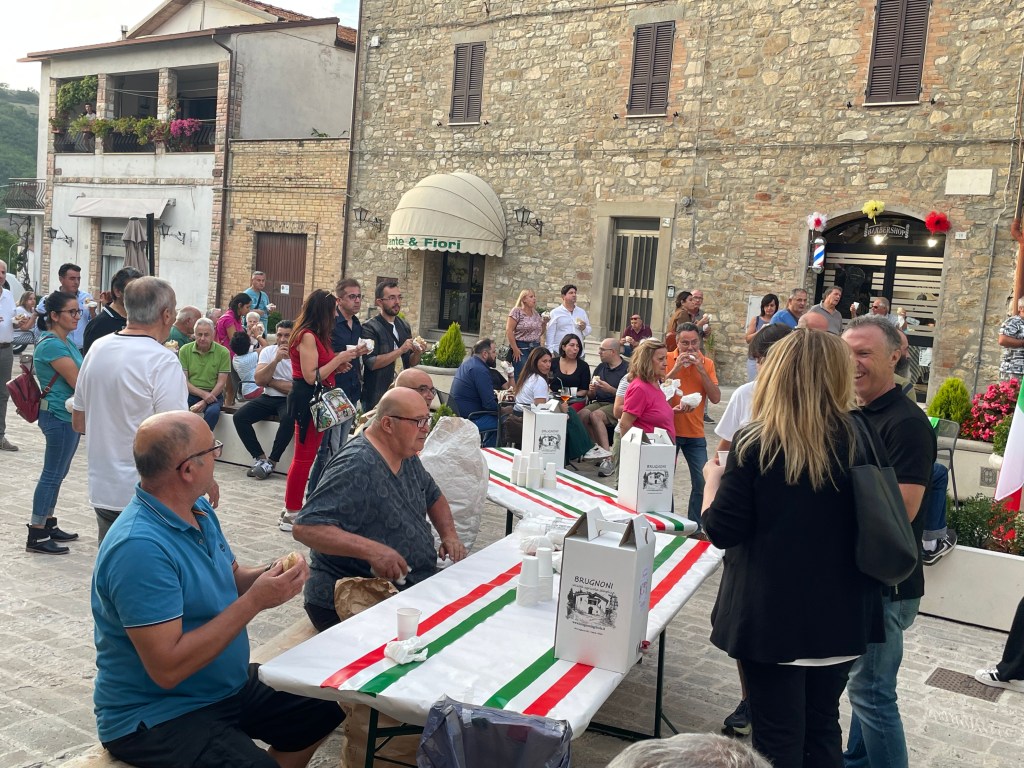
I’ve written before about the sagra (think of a town festival, usually featuring an ingredient the town is or would like to be known for) of truffles in Ripa, two towns down the road from us. Ripa has a tiny circular fortified historic center and otherwise sprawls across some suburban development and farms. The sagra is going on as I type, but a few nights ago the town held a preview dinner with a few of the dishes that would later be served to the crowd.

We figured what the hell, let’s try the dinner. At €20 each, or about $22, it seemed a bargain, with four courses and water and a coffee included (wine was extra, but at prices that beat retail in the U.S.). Besides, it’s always great to go to these communal dinners. Our town holds them every so often, and they’re terrific, with good food, interesting tablemates, and, often, a DJ.
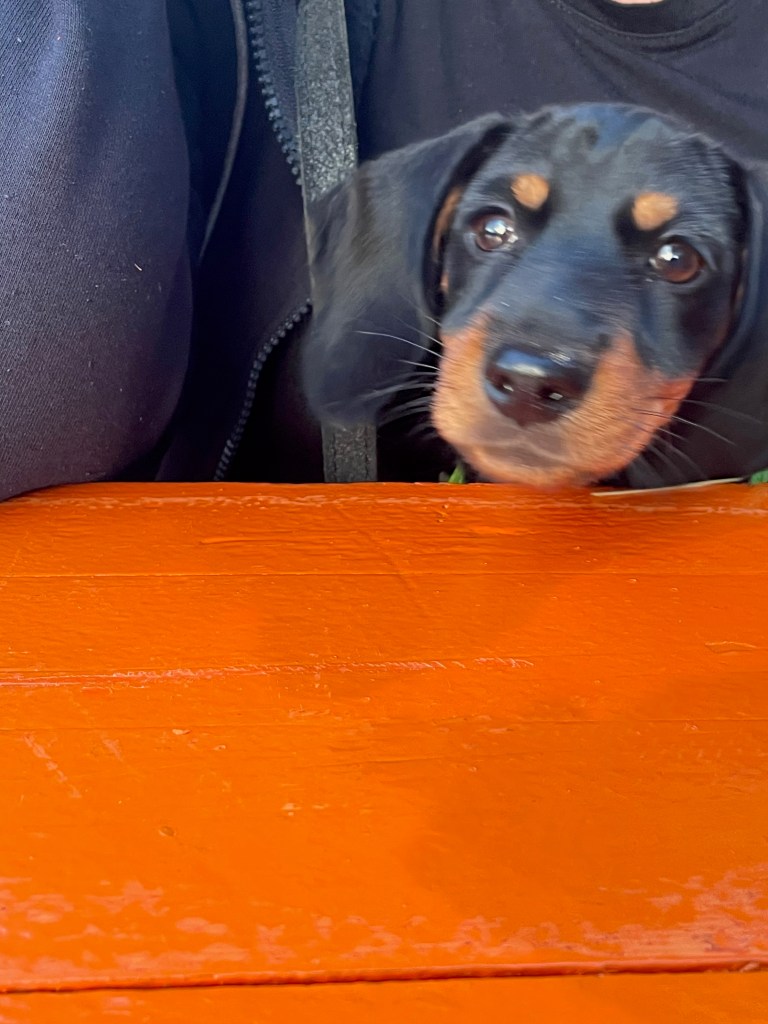
Niko gets a seat at the table.

We had a big life event in between reserving our places and the dinner itself: the addition to our family of a scrappy dachshund puppy we named Niko. Dogs go everywhere with their people here in Italy. We’ve eaten at Michelin-mentioned places and seen big dogs sitting placidly under the table. Should we take Niko? In just a few short days he’d grown attached to us, so we gave it a try.

We shouldn’t have even debated it. Niko turned out to be our passport to conversation. While waiting on line to pay at the start of the evening, he obligingly looked cute for the people around us. And he was pretty mellow as the crowd around our table got louder and more boisterous as food was served by Ripa’s kids and teenagers.

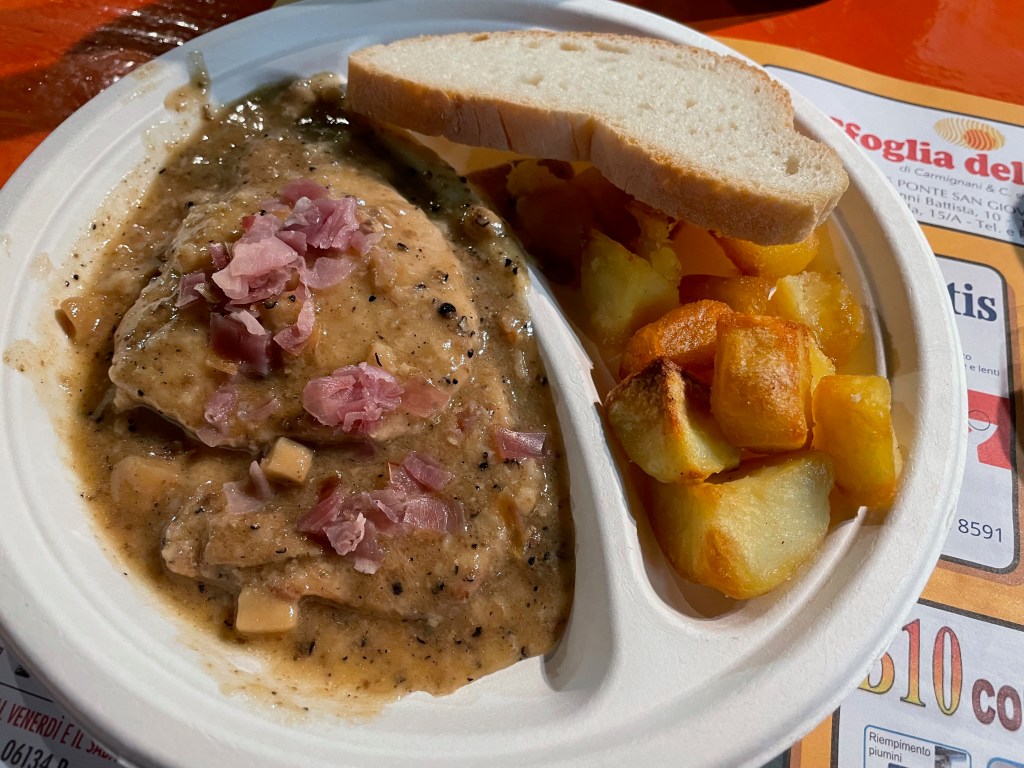
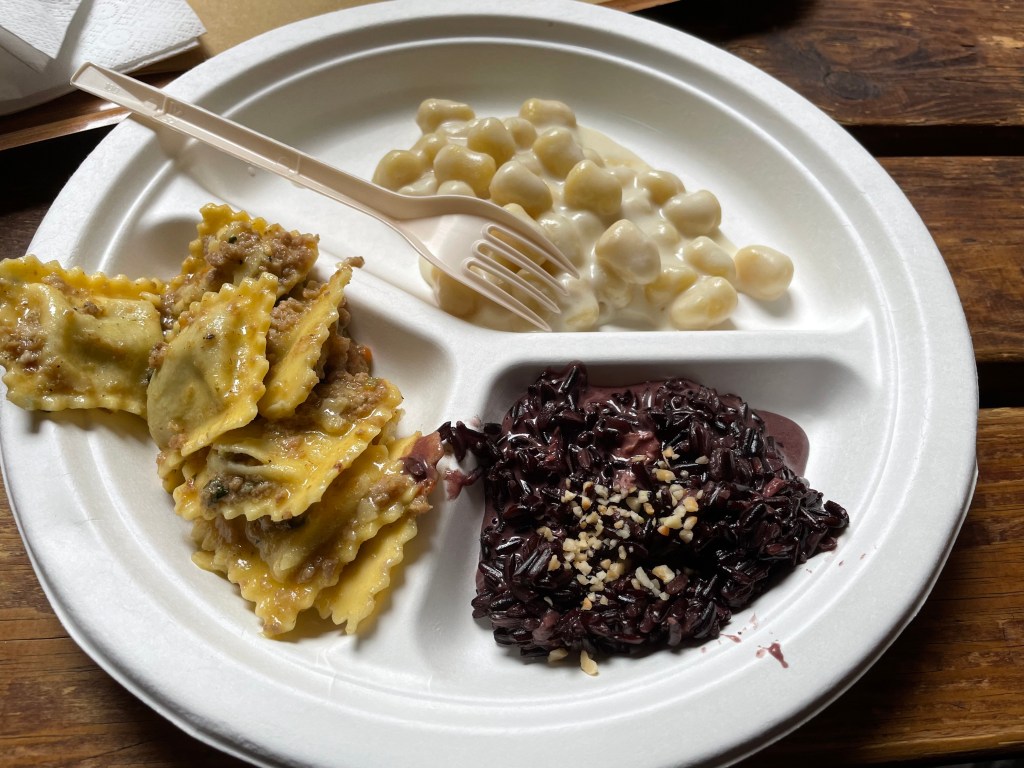
Foodies, here’s what we got for our €49 (2 x 20 + €9 for a bottle of local white Grechetto wine): Truffle bruschetta, gnocchetti (little gnocchi) with truffle sauce, tagliatelle with truffles (a bit too salty we told someone who asked on behalf of the town), pork scallops with truffles nd roast potatoes, and chocolate gelato with truffles [see photo gallery below].

Dinners like this are pretty rustic, even if the star is the local black truffle. Plates are biodegradable plastic, as are drinking cups for both water and wine. You sit at picnic tables and if you don’t fill the table, you’re going to get to know others who find seats at the table.
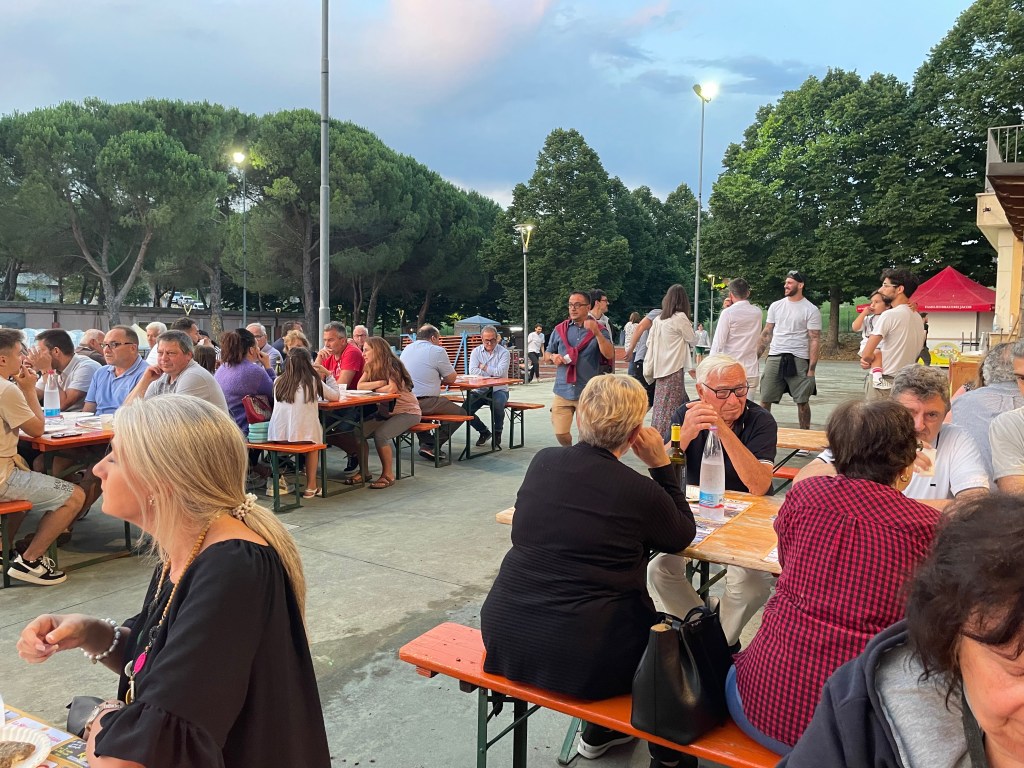
The good people of Ripa served about 300 dinners that night.

Or not. At least at first. We sat alone for awhile, one of the few couples not part of a jolly family or friends group. It was okay, because the people watching is always good. But then a couple came up to ask if there were empty seats at our table. There were.

The two couples, us and them, sat for awhile mostly ignorning each other. They apparently know everyone because most people passing the table stopped to greet them. We were happy just to sit and enjoy the warm summer night, and eavesdrop every now and then on people’s conversations.

Enter Niko once again. He wanted to see who dared to sit near us, so we held him up and predictably, our tablemates asked us about him in a way that would be familiar to parents of cute babies. They picked up on our New York-inflected Italian. Where are we from? We gave our town here, which usually elicits a chuckle. Then we came clean. Why here? We like it. We’re Italian, too, we add. We tell them about NYC’s high prices, which always comes as a shock to those who haven’t been. Within a few moments, they knew our life story.

I had to turn the tables and get them to tell us who they are. As it turns out, he’s a local dentist. Being nosy and needy, I asked him how much implants cost. (It’s less than a third what a NY dentist would charge.) The wife gave us his business card. We talked about different towns, schools, etc. Then dessert came—a Dixie cup of chocolate gelato with truffle shavings. It was getting chilly, so we all decided to leave, another communal event under our belt.

Who knows, if I have a toothache….
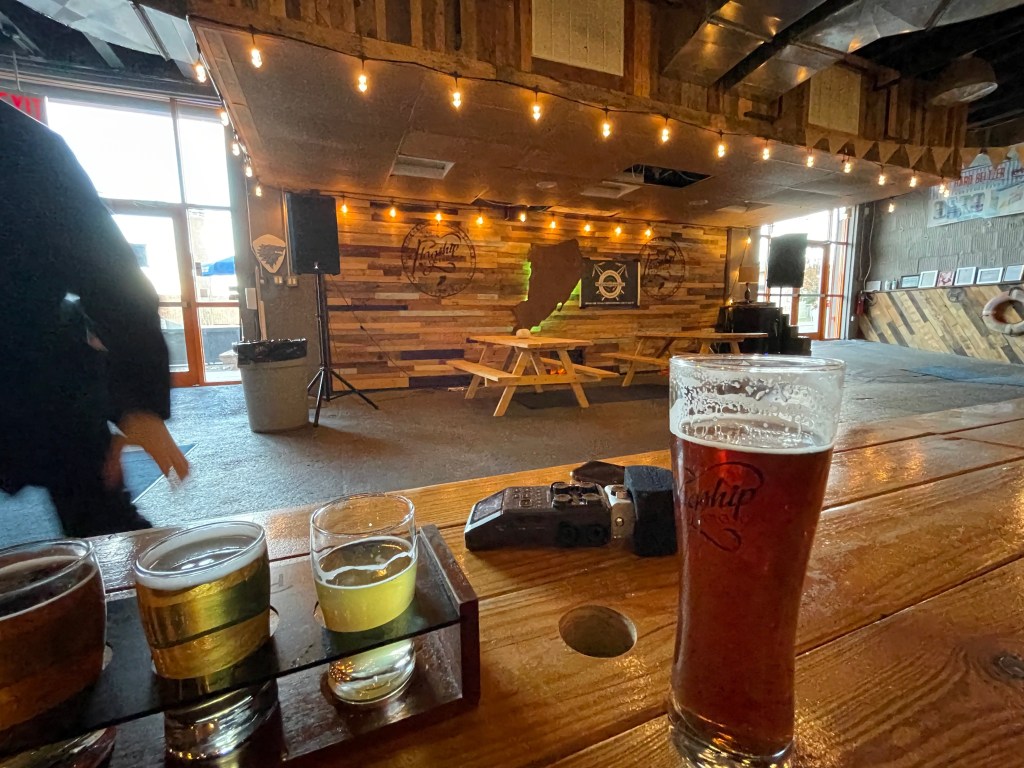
It’s not just a glass of Chianti in the sunset

Quick! When you think of Italy and its food and drink, what springs to mind? Pasta, sure. Pizza, definitely. Maybe gelato, and of course, a glass of wine to go with the meal. In fact, Italy is the biggest wine producer in the world, flooding shops and supermarkets globally with gallons of Prosecco, mass market Pinot Grigio, and fine reds and minerally whites.

But Italians are also beer drinkers. It’s not to the extent that Germans, Brits or Americans are—you don’t see Italians having keggers, and they tend not to wander around the cities in a beer-drunk haze. But historically, people here drink beer when it’s hot, or if they’re having a pizza night out.

Up until recently, mass market beers ruled Italian supermarket shelves and restaurant menus. But the micro/artisanal brew trend came to Italy too, and people appreciative of good beer have a wide selection of often local, interesting brews to choose from. Restaurateurs have picked up on the trend, too. Not from our house is a place called Umami Beer, whose owner has scanned the world for interesting brews for his patrons. The menu is eclectic too, with a wide selection of snacks, burgers and more traditional local dishes. It’s all part of the general loosening up of the culture, as more Italians travel abroad and acquire a taste for a wider palette of flavors.

The taproom of Staten Island’s finest

Before leaving New York, I paid a visit to one of Staten Island’s two local small breweries, Flagship. The good people there like to name their brews after local places and people. The island’s population is about 37 percent Italian-American, so in recognition of that, they named a Pilsener-style beer (popular here) Birra Locale. (You should be able to figure it out, but if not, it means “local beer.”) My slightly perverse mind thought it would be fun to bring that Birra Locale to an Italian artisanal brewery.

My target: the brewers of Birra Flea. In this case, “flea” is not the pesky little bug infesting the cat and your carpets. The name derives from a local river. I thought it might refer to a family, but no. I took minutes—minutes, I tell you!—of intense online research to learn this. The beer is definitely one of the shining lights of artisanal brews. The big Coop supermarket here places it in its cantina of good wines and small-producer beer, and Roman celebrity chef Max Mariola drinks it regularly as he shows his YouTube following another recipe. Flea comes from Gualdo Tadino, a town about a half-hour from our house that nestles in the foothills of the Apennine Mountain chain.

OFF I WENT THIS MORNING. Flea’s headquarters and brewery is located outside Gualdo on an isolated road. I had serious doubts that anything except a farm might can exist there. But I asked a couple on the road if I was on the right track and they assured me that the brewery was, in fact, down the road. Of course, it ended up being hard to miss, a modern charcoal gray-to-black edifice dominating the area. To emphasize its importance, the outside sign reads “Universo Flea.” I thought, well, this is more than a folksy little brewery.

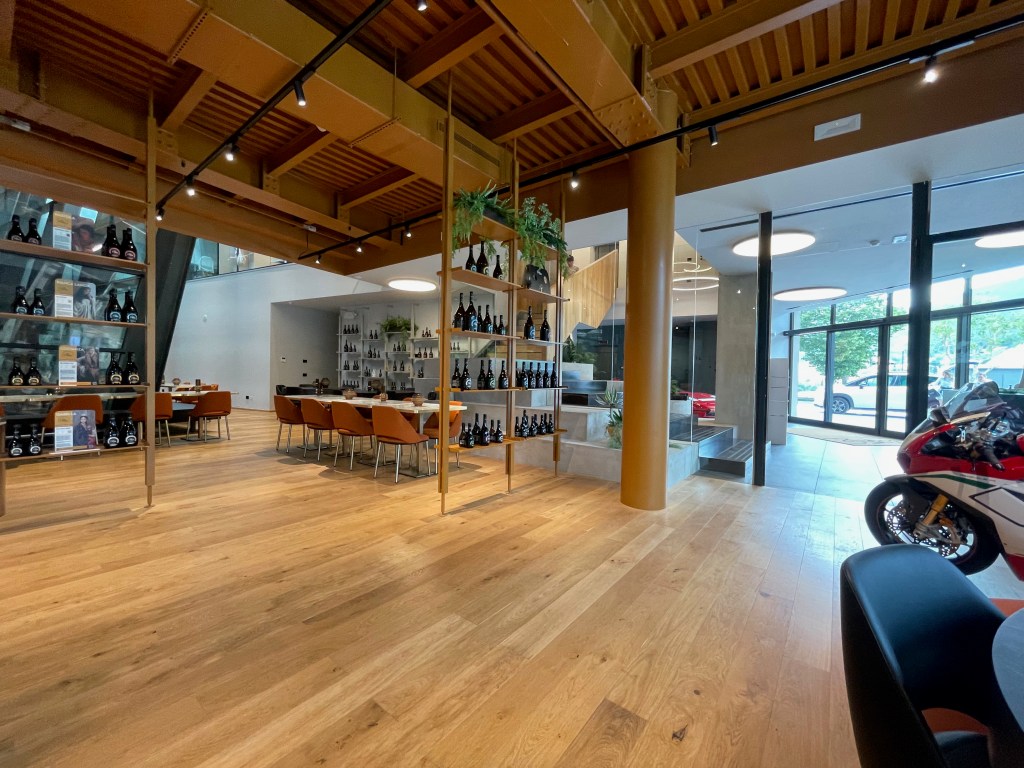
However imposing the building is, the reception was the typical friendly greeting that’s pretty universal in this part of Italy. As soon as I stepped through the doors, they knew who I was and why I was there. (It wasn’t a mystery; you reserve a tour and sampling on Flea’s website.) The decor is modern yet warm. And for some reason, they have a historic red (what else?) Ferrari parked near the reception desk.

Sara poses with a birra that is definitely not locale.

My handler Sara soon greeted me. I won’t bore you with the details of brewing, but I can say that I was impressed by the tranquil atmosphere, not to mention the huge fermentation tanks. Trashing a stereotype a lot of people have about Italy and artisans, Flea’s operation is decidedly high tech and as sustainable as it can be. They grow a lot of their own malt at a farm not far from where I live. The farm animals that came with the land supply them with milk, which they’ve turned into a cheesemaking operation. I’ve been fascinated by production lines ever since I was a little kid, and the bottling, tapping and packing machinery gave me tons to stare at and admire.

I’ll confess that I love conscientious food and drink producers. And breweries have a special scent, the sweet malt that perfumes the place. It kind of humanizes the assembly lines and the high-tech fermentation tanks. Beer, like wine, has a long history. Sara told me stuff I had no idea about, like how hops isn’t there just for flavor, but also acts as a natural preservative. And centuries ago, nuns figured out how it preserves but also balances the flavor. Before then, most beer was sweet, a natural result of the yeast reacting with the malt or other grain used to brew the beer.

By now, you probably realize that Flea may make artisanal beer, but it’s not a hole in the wall operation. They’re looking toward the future. Much of their electricity comes from solar panels. (In fact Italy leads Europe in solar-derived energy.) And now they’re going to try to brew beer from the air; they’re experimenting with a technology that pulls humidity from the air. They’ll pilot test that water for brewing.

Who needs lunch when you’ve got this to go with the tasting?

At the end, I had a taste test. I chose three beers from their list; I tried to pick different colors and strengths. “Margherita,” a wheat beer, was crisp, not too hoppy, and just right for a hot summer day, or a nightcap. Their golden ale, dubbed Federico II, was fruity and just assertive enough. And a Belgian style ale named Violante was, just as the label said, powerful and just right for a cold night and stew. Because we’re in Italy, food soon appeared in front of me, so I didn’t have to think about lunch—the cheeses on the tray come from their cheesemaking operation.

Flea turns a decade old this weekend. If the next decade resembles the past ten years, they may have to reassess that artisanal tag. In any event, this afternoon was a great way to see a bunch of mostly young people making a terrific product in a beautiful space.

Where everybody knows your name

Way back, late in August between my freshman and sophomore college years, I felt devastated. I’d come home after spending most of the summer in Sicily with my extended family. And there were no bars where I lived in New York. Okay sure, there were lots of places where you could get drunk and maybe, get lucky. But no bars in the Italian sense, and that made me feel lonely. I could joke about how most of my life since then has been a way to get back to the local bar.

But maybe it’s not a joke. So allow me to offer a tribute to the Italian bar. For those who haven’t been here, or haven’t paid much attention, a bar here isn’t like the American kind. Maybe in spirit like a British pub? Whatever. It’s sort of like a café, except that that word doesn’t quite capture the bar’s essence. Maybe, in the American context, it’s like the old small-town diners or cafés, where locals would gather, hang out, get anything from coffee to a meal, and share local gossip.

Bars are everywhere in Italy, from the big cities to small hamlets like Casacastalda, a 20-minute drive from Casa Sconita up a twisty country road. That bar has an amazing location overlooking northern Umbria’s hill-mountains. But they can be on a residential street, on a piazza, or even in the parking lot of a gas station. The toll roads through Italy, the autostrade, have amazing bars, some of them inside buildings that look like retro ’60s spaceships straddling the highway. The thing is, if it’s Italy, there’s a bar nearby.

You can get everything you want at the Autogrill—including an espresso or drink at the bar.

Basically, the bar serves most of your needs throughout the day. In the morning it’s the place for a cappuccino and a cornetto, or mid-morning, for office workers to have a booster shot of coffee (espresso mostly) before tackling some more emails. One of our friends here never makes coffee at home—he gets dressed and heads out to his favorite bar for breakfast, which here is usually coffee and a pastry. (His is the place in the gas station parking lot.) If you aren’t into sweet, there are little panini—my favorite is tuna and artichoke. Later in the day people stop for another pick me up, and around 6, an aperitif or cocktail, always served with a little snack, because here in the land of La Bella Figura, being obviously drunk in public is a faux pas.

It doesn’t take much to be a local. If you’re renting an apartment in Italy, even for a few days on vacation, one of the first things you should do is visit the local bar. Go two or three days in a row and you’re a regular. One barista in Perugia remembered us from getting coffee with our daughters in the morning. When we returned a few months later, he asked us why the girls weren’t with us.

We live in a small town here, yet I can think of at least five bars within a 20 minute drive. Three of them are down the hill from us. They all have their own style. The bar on our local piazza looks like it’s from the 1980s, but the real deal is to sit outside in the morning or late afternoon and soak up the sun and the murmur of the fountain combining with the sound of the local accent. And they serve addictive fried sage leaves with your Aperol spritz in the afternoon. Another, housed in a local shopping strip along with the main pharmacy and town supermarket, is Italian sleek modern. Even the spoons look like no spoons you’ve ever seen, and it takes a few seconds to figure out how to use them. Still, if I’ve been away, on my first visit we have to catch up with the barista and show pictures of the grandchild.

Breakfast in the piazza post-hike
Vian contemplates the view.

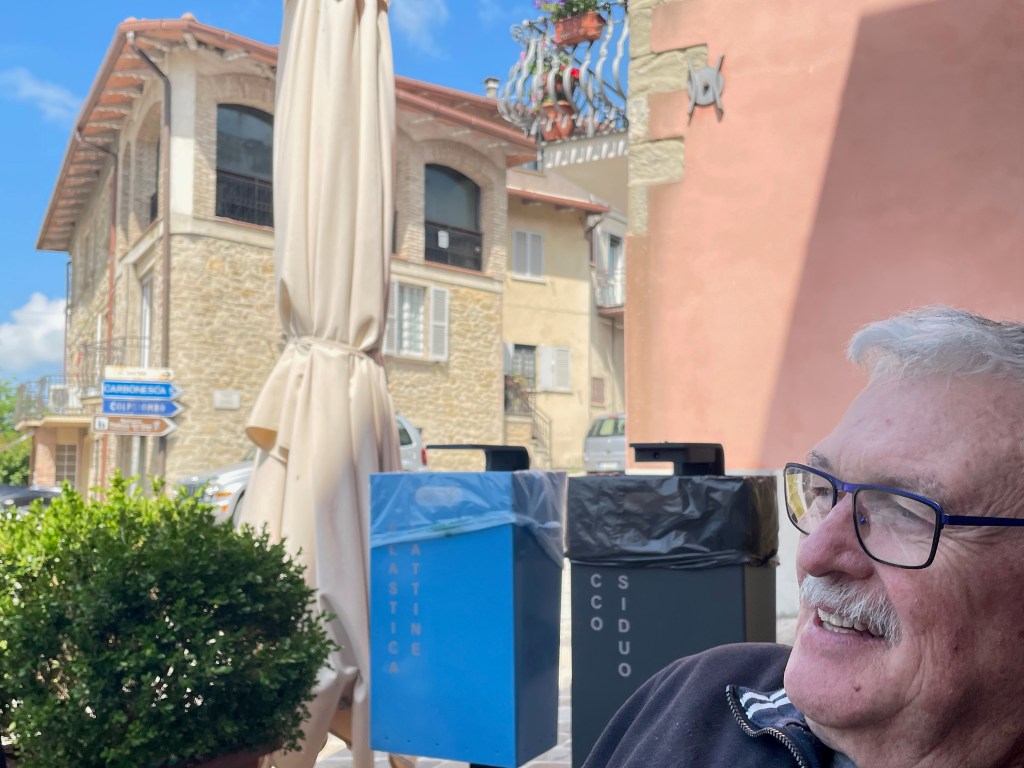
Come to think of it, we assign these watering holes to different occasions and frequent them with different sets of friends. Yesterday, for example, I met my friend Vian, a transplanted Canadian who moved to Umbria with his wife so that they could be near their daughter and grandchildren. He lives outside a town called Gualdo Tadino, a place with eccentric architecture that snuggles up against the Apennine Mountains. Vian and I like to meet for a mid-morning coffee and pastry, and we do it midway between our houses—that bar in the hamlet of Casacastalda. The place has a great view, and Vian, a sociable guy whose Italian improves every time I see him, is besties with the owner and always has conversations going with some old guy who hangs out there.

Uncle Ignazio’s hangout in Palermo

My Uncle Ignazio probably frequented his local bar every morning until he was taken to the hospital for the final call (he was in his nineties). A few blocks from his apartment, the bar was the focus for the pensioners, people on their way to work, parents taking their kids to school, and even groups of motorcyclists headed to western Sicily—his place was on the ring road around Palermo. A visit with him almost invariably involved a stop at the bar. He smoked (if outside) argued politics with his cronies, argued politics with his cronies, and did I mention that he argued politics?

I could go into coffee etiquette, what to order, when to pay and when to wait (Ok, big cities and the road stops are pay first, go to counter and get your stuff; here in the sticks, it’s whenever you feel like it.). But that’s for another morning. Right now, it’s about 23:00—11 p.m. in US-speak—and I’m thinking about this little bar in Perugia that whips its own cream and fills pastries with it for breakfast. Sweet dreams….

[Update: I went to that little bar.]

Finally, a great maritozzo at the Antica Latteria in Perugia

Credit for Autogrill photo: qwesy qwesy, CC BY 3.0 https://creativecommons.org/licenses/by/3.0, via Wikimedia Commons

Welcome to the real New York: Take a walk with me around one of its few nongentrified neighborhoods

This city is insane. It really is. If you aren’t rich, or a trustafarian, good luck finding a place to live. It’s not just regular folks who are having trouble. Even elected government officials are complaining that they can’t find a decent apartment at a decent price.

And it’s not just housing. Food, both in stores and in restaurants, is absurdly expensive. Have a car? Insurance alone becomes a major expense. I know wah-wah-wah. I can’t help it. Maybe I’m just building my case for being on the precipice of leaving New York, except for regular visits because I’ve become the nonno of the Cutest Baby the World Has Ever Seen ™. Yeah, I’m prejudiced.

But really. One of our kids spent the past couple of months visiting prospective apartments. Real estate agents have apparently gotten really good at using their phone’s ultra-wide camera lenses to make closets look somewhat habitable. Or in some cases, they don’t care about presentation and leave an array of roach traps on the kitchen counter. Yeah, that’s where I want to cook dinner every night. Even more than the crappy apartments, long a New York tradition, are the sky-high prices. Thousands a month for what’s basically a tenement, in the kind of building that had its heyday around 1938. And an application process that makes candidate vetting for the CIA seem lackadaisical.

So it’s been a nice break spending a couple of days a week with daughter number 1, who gave birth to a baby boy last month. The kid’s adorable and loves to boogie around his basinet—he’s going to be a handful. And said daughter lives in one of the few neighborhoods in Brooklyn that’s proudly non-gentrified. This is not to say it’s cheap; a typical rowhouse goes for a couple of million. But it hasn’t yet caught the precious disease. You know the symptoms: Curated coffee, whatever that is, little restos owned by recent and hipper than you French or Italian arrivals. Lots of twentysomethings from Ohio subsidized by mom and pop, the kind of people who sit around curated hipster coffee bars with no apparent means of support.

Boy am I sounding like a grouch. I am a grouch. Sue me.

What’s made me less of a grouch, other than the perfect grandson, is that old-timey feeling you get from walking around Bay Ridge. It looks more or less the same as it did when I was growing up; I traveled through the neighborhood on my way to high school eons ago. But that’s not to say it’s stayed the same. Back then it was inhabited mainly by recent immigrants from Italy and Greece, and had large Irish-American and Scandinavian-American presences. The mix has changed now and there are lots of people from Asia and the Middle East.

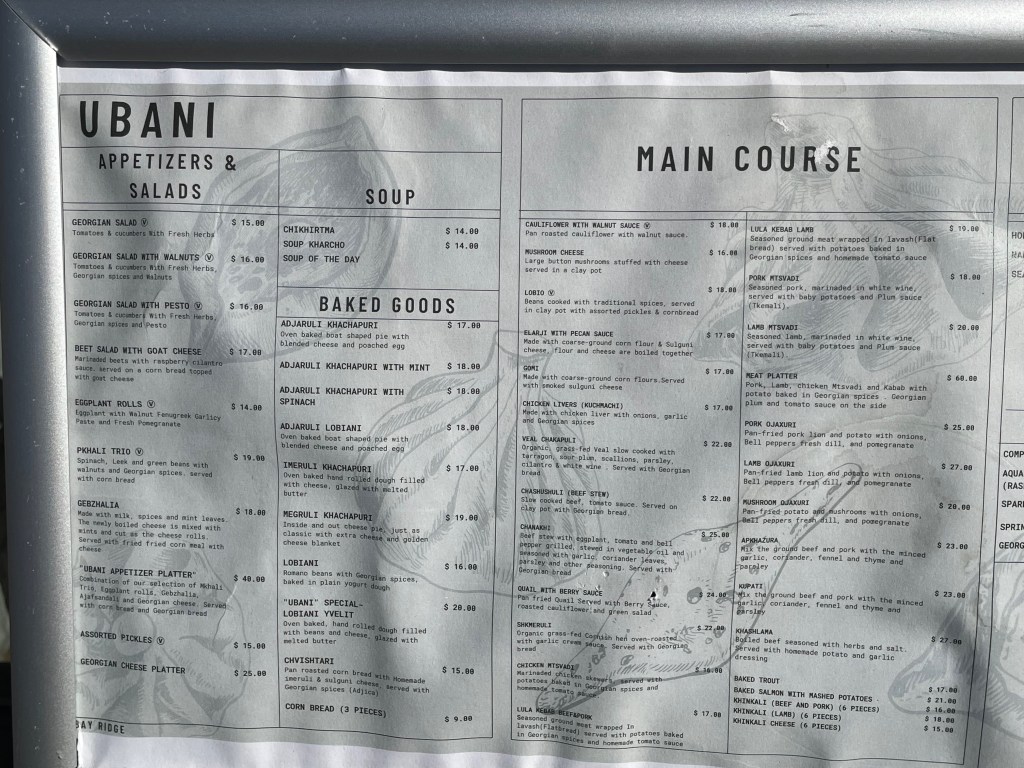
What all that means is that walking up and down Bay Ridge’s avenues (like Manhattan’s, they run north-south), you’ll pass Italian, Greek, Palestinian, Georgian, Japanese, Chinese, Thai, and Mexican restaurants. I’m sure I left something out, but you get the idea. Often the places are cheek by jowl, with interesting juxtapositions. And while some might be a little upscale, most of them exist for their fellow immigrants. They aren’t fashion shows boiled down to eateries, they’re part of the New York tradition of local immigrant-owned businesses serving their communities, rather than competing for a New York Times restaurant review and a Michelin star. This Georgian restaurant’s menu looks really good to me right now:

So let’s take a look. First up, when Italians talk about how similar they are to Greeks, they often use the phrase “stessa razza, stessa faccia.” Get past the imperfect rhyme and it means “same race, same face.” And while Italy and Greece are separated by the Adriatic and Ionian seas, in Bay Ridge their people live cheek by jowl, especially when it comes to restaurants.

Over in the Middle East, the Palestinians and Israelis are mixing it up again, with the Lebanese sometimes getting in the mix, In Bay Ridge? Jewish delis and Middle Eastern restaurants coexist, no problem.

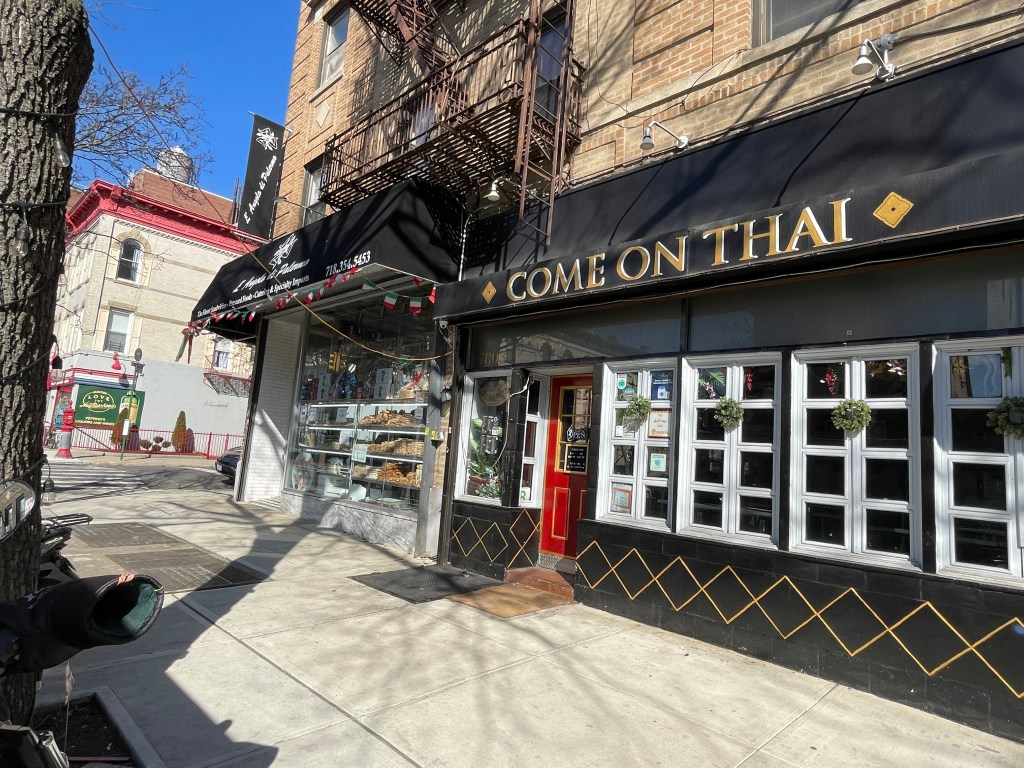
Elsewhere in the neighborhood, you’ll find combinations of ethnic shops and restaurants that you would never see on a map, or maybe anywhere else in the world. Thai and Sicilian, anyone?

Let’s pay tribute to the newer establishments, whose owners are from Central America and the Middle East:

Of course Bay Ridge wouldn’t be Bay Ridge without an Irish pub with an pun name:

Winter sucks. But it sucks a little less here

Brrr. It’s a little chilly here in Studio AP, where I put together these little dispatches from Italy’s version of Vermont. I could blame Vladimir Putin for the lack of heat, but that’s too easy. Besides, we have lots of propane right now. But the fact is, this is Europe in the Italyland province, and houses were built more to shield us from the heat of summer than the cold of winter.

I shouldn’t complain anyway. It’s January, and this month has been fairly benign. And it’s leagues better than the typical New York January, which I hear and my iPhone’s weather app tells me hasn’t been so bad this month for a change. And how’s this for role reversal? We had a real, actual, white, wet snowstorm earlier this week. It gave us lazy sods an even better excuse to build a fire and drink hot liquids and not do much else except for reading and finding good cooking videos on YouTube.

When people hear that you’re going to Italy, that usually conjures up a whole bunch of images. Golden sun, sports cars roaring along a curvy beach road, high fashion, great wine, and pasta. So much for high fashion: Most of the young and cool this week seemed to be wearing sweats, NorthFace puffy jackets, and Timberland boots. Yes, Timberland. The brand is huge here and there are Timberland stores everywhere, from the local upscale mall, er, sorry, centro commerciale to the main street in town where everyone walks up and down between 18:00 and 20:00 (6 pm-8 pm to you nord americani) to window shop, meet friends, and have a drink before dinner.

You might notice that there isn’t much of that here. Despite an app that told me it was almost springlike in Perugia, it was blustery and freezing and no one was lingering over anything, much less a cold alcoholic libation. In warmer weather, this pedestrian street is filled with tables and chairs and 20-somethings hoping to get lucky.

And how about the main piazza? Ditto.

We had to run a couple of errands in town. That usually means the aforementioned drinks while lingering at an outdoor table—a table set in the middle of the Corso Vannucci, for example, where that first picture was taken. We might meet friends walking around. And we like to go to the end of the street where there’s a nice cool green spot with a view of the Tiber Valley below. Instead, we rushed up the escalators from the Minimetrò (we parked the car in the big parking lot at the base of the hill) and headed straight to a clothing store to look for gifts. I was bundled up, but it didn’t keep me from looking longingly at some warm hats, I remembered that my coat has a down-lined hood and resisted temptation.

Then we ran to another shop. I can’t say anything about that because the thing we bought will be someone’s surprise. And we don’t want to spoil that, do we?

All good boys and girls get a treat at the end of this. I’d been jonesing for some Italian hot chocolate, and yesterday was the perfect time for it. We found our favorite bar to have it, and found a table. The waiter smiled when we told him yes please, with whipped cream on top. Italian panna, or whipped cream, isn’t sweet at all but it’s intensely milky. It balanced the luscious deep chocolate, which really is more like molten dark chocolate pudding. How could we not?

Otherwise, it goes. After a brief bureaucratic tussle over a supposedly unpaid bill for propane, we got a delivery. So now we old folks don’t have to build a fire if we want to stay warm. Turning on the gas will cost us, but when you stumble out of bed and need coffee and to stare at the walls and/or the scenery, the last thing we need is to empty out the fireplace, stack some wood in it again and set it on fire.

I will dance on Noma’s grave

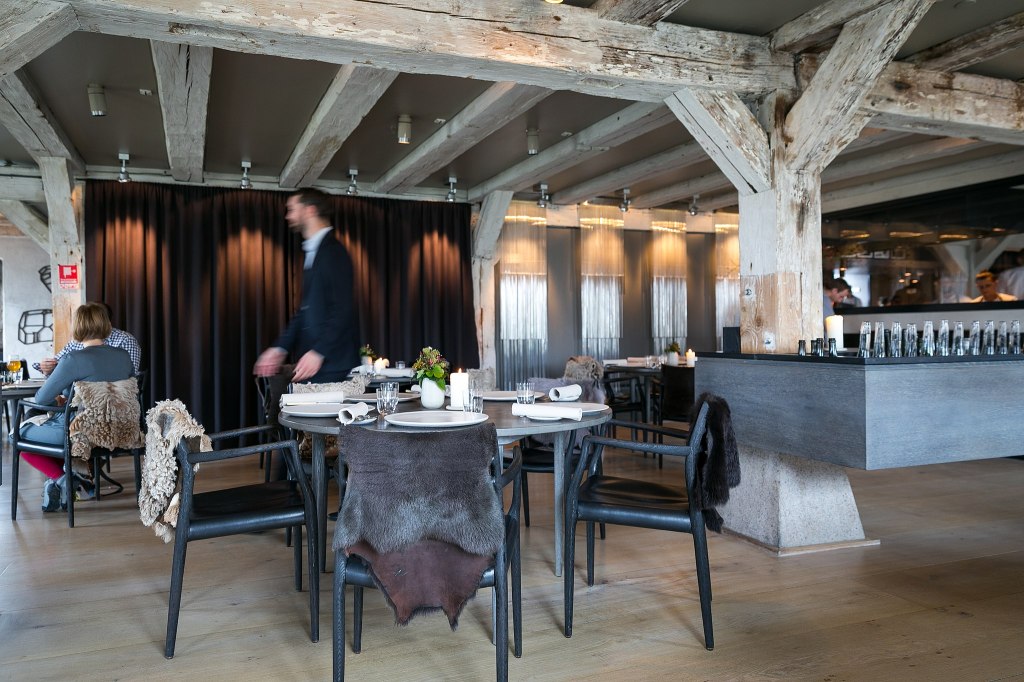
This being January with pretty lousy, cloudy, I don’t go out much weather, I’ve had a lot of time to read the early obituaries of Noma, which is closing late next year. In case you don’t follow “fine dining,” Noma is a restaurant in Copenhagen that appears on every best-restaurants-of-the-world list. The place and its owner/genius chef René Redzepi have inspired a whole bunch of creative chefs who go out and pick odd plants in the forest or in tide pools, do something transformative with the stuff, and then charge scenester diners a few hundred bucks for the privilege of ingesting what they foraged and tortured. A night at Noma, for example, costs around $500 a person.

Noma will follow El Bulli and Del Posto to the big food court in the sky. To which I say: no great loss. It’s not jealousy—I was a part-time restaurant critic back in the 1990s, when the big deal restaurant scene hadn’t yet metastasized into the monster it has become. Still, there were previews of what was to come in multi-course tasting menus in a breed of French restaurants that, looking back, served as a bridge between the snooty old French establishments and brave rich-hippie vibe of Noma. Not to put too fine a point on it, you can think of a Noma fan as the foodie equivalent of an investment banker who collects Grateful Dead concert tapes.

The rustic charm of Noma for an elite few. Courtesy of Wiki Commons

I’m not going to lie. I thoroughly enjoyed my decade of dining at my newspaper’s expense. It made me really popular, because The Spartan Woman and I usually invited a couple of friends to come along so that we could sample enough dishes. We ate at the new wave of Spanish/Catalan restaurants, fancy French eateries, aristocratic Italian establishments, as well as the occasional Hong Kong style of Chinatown palaces that were just beginning to establish a beachhead in New York. The review pace was gentle—I was on the hook every four weeks for a review, so it was just enough to be fun and not enough to be routine and boring. And when our girls were old enough, we often took them along. (They were tougher critics than our friends, who were just thrilled to have a free meal at a hot restaurant.)

After 10 years, though, we’d had enough. By then we just wanted to hang out with friends and family, either at home or in a local ethnic restaurant where we’d like the food but wouldn’t have to pay homage to it. I remember a colleague once went to El Bulli, the restaurant in the Catalan region of Spain, which had pioneered “molecular” cuisine. I asked him how it was. “Tiring,” he said. I’m paraphrase, but he said something like, “It was so exhausting. Open this lid, inhale the fumes three times, then pour the contents onto this plate and stir counterclockwise 4.5 times, then eat using these tweezers.” Sorry, that ain’t food, that’s entertainment for a very small cult audience.

Move over stove, we’re making foam—from a Barcelona exhibit about El Bullì and its owner. Kippelboy, CC BY-SA 3.0 https://creativecommons.org/licenses/by-sa/3.0, via Wikimedia Commons Ferran Adri

And then there was Del Posto in New York. Its owner sought to elevate (so they thought) Italian food to the same rarified altitude of classic French cuisine. Talk about flawed concepts from the get-go—”Italian” food (a term I have trouble with because this country’s eating habits are hyper-regional) isn’t supposed to be the snobby refuge of the wealthy. My neighbors on our hill, who tend sheep and have an organic farm, make ricotta that would make you cry it’s so good. But there are a lot of people like them here and they’ll insist that good food is their birthright, not just a boasting point for the bourgeoisie.

EATING IN ITALY ENCOURAGED my move away from culinary preciousness. For one thing, the dominant characteristic of food here is to find really good ingredients and prepare them in a way that lets them shine. There’s little torturing of plants or animal bits to make them something else. And with the exception of a few Michelin-starred places, there are fewer celebrity chefs lording over everyone. Hey, this is Italy, where everybody is a star, and no one cooks better than Nonna (grandma) or your mother.

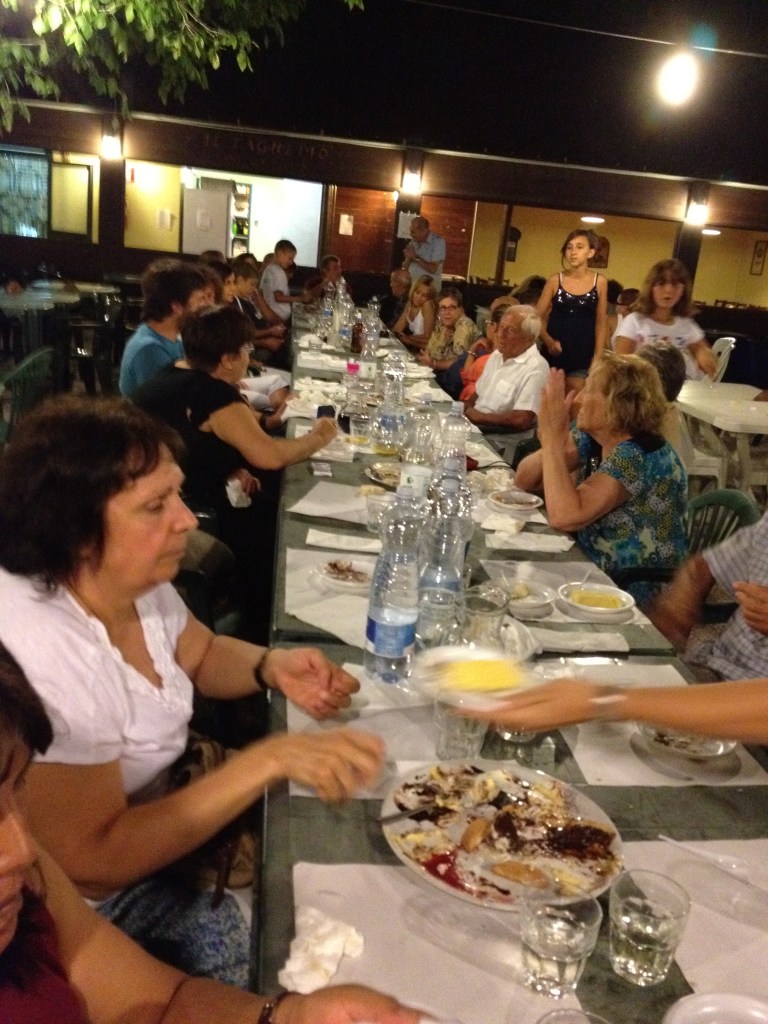
A clan gets together outdoors at a popular restaurant. Twenty-eight wouldn’t fit in the kitchen.

I know I’m lucky; as a teenager I stayed with relatives my first times in this country. I had a front-row seat to the food culture, which basically was just as my mom cooked back in New York, although mom, being a native New Yorker, pretended to be a normal American every so often and would give us steak and potatoes or peanut butter sandwiches in our lunchboxes.

But it’s interesting to see the differences between the cultures of my two countries when it comes to eating out. In cities like New York, Boston, and San Francisco, it’s become a high-stakes scene (and is bouncing back post-pandemic). Rents are high, food and liquor and wine prices are through the roof, so in an attempt to squeeze some profit restaurateurs pay their staff peanuts. Noma’s Redzepi himself said that fine dining has become economically unfeasible, and his complaints mirror what thoughtful American restaurant chefs and owners have been saying. In the U.S., the handful of successful celebrity chefs expand their operations into empires. The Bastianich group, headed by matriarch Lidia Bastianich and run by her son, has 30 eateries spread across the world. Thirty!

This craziness is fueled by a media and PR machine that glorifies celebrity cooks and runs competitions on TV instead of showing people how to cook. And there’s a definite high/low culture thing going on. The well-heeled eat at one of the Bastianich or Jean-Georges Vongerichten restaurants; normal people eat at the Olive Garden, which cuts corners by not salting pasta water in an attempt to cut down on spending for pots. The well-heeled use their experiences as conversations starters, and they love to spend big.

It’s different here. Sure there are TV competitions; in fact Joe Bastianich is one of the stars of MasterChef Italia. But beyond that things tend to be more democratic. One of the biggest complements Italians give to a restaurant is “si mangia bene e si spende poco” (you eat well but spend a little). Restaurants are basically extensions of the small kitchens that many Italians have (most of the country lives in apartments; think of New York but better designed). Often, clans or groups of friends will go out because they can’t fit everyone into the kitchen or day room, but they know that their outing will lead to a great meal that won’t wreck their bank account.

It’ll be interesting to see what Redzepi comes up with next. He says he’s turn Noma into a “food lab” and try to figure out new models for feeding people creatively. El Bullï’s Ferran Adria said the same thing when he closed his legendary restaurant more than a decade ago. Maybe I haven’t been paying attention, but I haven’t heard much of what his lab has done. I’ve subscribed to his newsletter to see what’s up there. In the meantime, buon appetito, enjoy what you eat, and don’t think about it too much.

Illustration at top of page courtesy WikiCommons

In with the old, in with the new

I’ve been lazy. Uninspired? Bored? Had writer’s block? Nah. It’s just that living in an outer borough of New York and not going out much can be, well, not the stuff I want to write about. So I didn’t. I was struggling to do something profound, either about differences between Europeople and Americans. Or maybe about technology, or taking a quick road trip. I could show you the unfinished drafts in my queue. But that way you’d see my tortured thought process.

At one point, I even got a bot—the now famous ChatGPT—to write about driving from New York to the Boston suburbs. Then I thought maybe I’d critique what the bot did. Okay, I’ll give you a peek:

On a chilly weekend, we took a 400 km ride to the Boston suburbs in our Volkswagen Golf. Four of us traveled comfortably in the spacious car, but we had to make a couple of stops along the way for our pregnant daughter, who is in her last trimester. Despite the stops, the ride was generally smooth and we were able to make good time. One thing that struck us on the American highways was the lack of lane discipline. People would frequently pass us on the right and zig zag dangerously through traffic.

Kind of workmanlike, no? I gave the bot no instructions as to style or my attitude. I wonder how it decided that the car is spacious—in Europe it’s a midsize thing, in the U.S., the land of SUVs, like a matchbox. I’ve read worse copy in my way too long editing career, but at this point I’m not exactly scared that it’s going to take my place.

The Matalas coven takes over the living room.

Anyhow, then Christmas came, and three days later, we transferred to our Umbrian hill, so, yes! I have something to write about. First of all, the holiday. We’re not really subscribers to religion, but we’re culturally a tiny bit Catholic, and for years we’ve had The Spartan Woman’s Jewish cousins over for the day, as well as her parents and sister, etc. This year’s get-together was bittersweet for a couple of reasons. It was the first one post-Covid onset. And it could be the last one we do, because we may not be living in the U.S. this time next year.

All the same, it was terrific to see our kids and their second cousins hanging out together. We jokingly call them the coven; for years, hardly anyone in TSW’s extended family gave birth to males. I’m not the only one calling them a bunch of witches, they themselves encourage it and, well, it’s just funny. But in the next couple of months, that should end. Our number 1 kid, who got married this past March, is expected to actually bring a male infant into this world. “I don’t know what to do with a little boy,” TSW said at one point. I think she’ll manage somehow, she seems to have no trouble with grownup boys.

AFTER THE HOLIDAY, we had to scurry and clean up and get ready to spend a few weeks in Italy. Obviously, this isn’t our first time around the block for this. Still, we have to make sure stuff is taken care of there and that we remember to take what we need in terms of tech stuff and meds, weird food substances we use in the U.S. but impossible to find in Italy. [Tip: Cheddar cheese powder is really, really good on popcorn.]

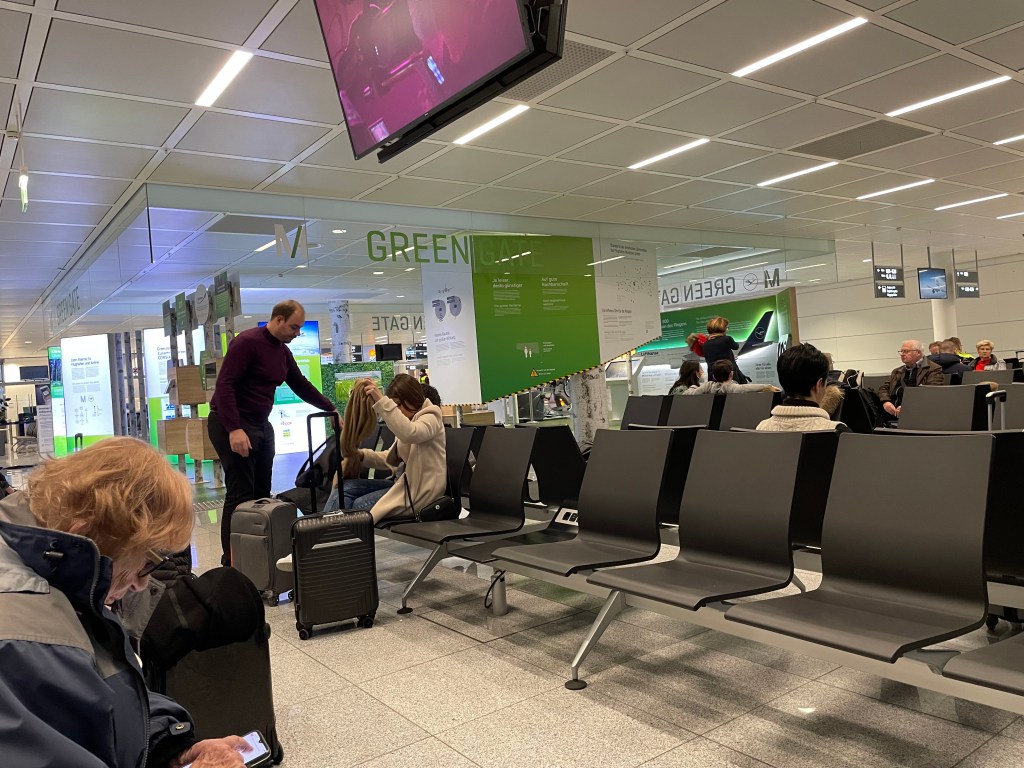
The trip over was something else. Not that we were delayed or anything, like thousands of holiday travelers in the U.S. But for the first time since early 2020 airports and flights were jammed. I never saw so many people crowding JFK Airport’s bars/restaurants/shops. It was hard to find a place to sit at the gate. When I went to the least-crowded bar to get my by-now traditional preflight Martini, the bartender apologized for having to use a plastic glass because all the Martini glasses were being used.

The flights, first to Munich, then to Rome, were similarly jammed. Lufthansa kept texting us begging us to check our carryon bags (for free even!). We had huge bags anyway, and only knapsacks as carryons. Lufthansa in general is one of my favorite airlines. Its staff treat people like humans, the food and entertainment are halfway decent, as are drinks, and the Airbuses are pretty comfortable, at least in premium economy (and upward, though I can’t shell out for that).

I’d nervously been looking at flight stats; we had 1.5 hours between flights and with the chaos in the United States, our first flight was late on the days leading up to our departure. That had me looking at how often Lufthansa and affiliates flew between Munich and Rome. Happily, it didn’t come to pass. We left on time and arrived early. Since we’re EU citizens, we breezed through passport control. And somehow we landed at a different terminal, the same one as our second flight, so we even had time for a cappuccino and snack.

I’ve crossed the Atlantic countless times and I usually sleep through most flights. But I was so happy to be traveling that I pretended to be a tourist from my window seat. Long Island looked colorful and even a little glamorous as night had fallen. Germany looked tiny and modern, at least from the buildings I could see. And the Alps? Mozzafiati! (Breathtaking in Italian)

I never get tired of flying over the Alps.

So here we are. And yeah, it’s a nice place. But it’s more than liking the place and having nice scenery and food. Our friend Angelo picked us up at the airport and knowing that we didn’t have much fresh food at the house, gave us a big bag of fantastic oranges (there is nothing like Italian citrus). This morning, I walked next door to our neighbors Marjatta and Pasquale at the agriturismo Ca’ Mazzetto to pick up our car; they’d been car-sitting while we were away. They used it every now and then and returned it with a full tank and cleaned inside and our. Later, Pasquale dropped by to say hi and give us a tin of their fantastic organic olive oil. It’s great to be home.

We’re getting ready for a quiet and decadent New Year’s Eve dinner here with our old friend Doug and his trusty sidekick Georgia the dog. Shopping for it was like being at JFK, way too crowded but instead of making me crabby, the IperCoop near Perugia had a party vibe, with sales of good Champagne and Franciacorta (Prosecco’s upscale cousin, fermented in the bottle like Champagne). Since this is Italy, we’ll take Franciacorta—to go with some scallops in the shell from France.

Thanks for reading this year, and happy New Year! See you here after the holidays.

Bean there, done that

My mother was endlessly inventive in the kitchen. Married to a guy from Palermo, Sicily, she had to come up with a “primo” for dinner most nights. We didn’t have the traditional meat and two sides on one plate. My dad insisted on our following the typical Italian meal progression: a “primo,” either pasta asciutta (with sauce), soup, or rarely, rice. The meat or fish or frittata (omelette, Italian-style) followed. At the end of dinner, my father peeled and cut up pieces of fruit, which he doled out to us on the tip of his paring knife.

Those primi stick in my mind the most. I always preferred pasta to the second course. Twice a week we had spaghetti or some other pasta with tomato sauce—what most people back then thought was the only way to eat “macaroni.” But in between were pastas with broccoli or cauliflower, either in dry form or as a soup, escarole soup, spaghetti with clams…the list goes on. Having this first course made us less ravenous when the secondo came around, and I’m sure that it helped stretch the food budget, too. And at least once every couple of weeks, pasta e fagioli, which on the U.S. is often rendered in some obsolete dialect as “pasta fazool.”

Pasta e fagioli is the star of this post. It’s cheap, nutritious and can be fun to cook, and is delicious too. The variations can make your head explode. I’m going to tell you how to make my favorite version, which is an adaptation of what I first had one long afternoon, way too long ago.

Some culinary history: Mom usually used kidney beans, specifically canned kidney beans, for pasta e fagioli, because back in the dark ages of American grocery stores, kidney beans were everywhere, mostly to the exclusion of every other bean. Sure there might be navy beans, which are almost tasteless and resemble the canellini bean’s little brother. And you could buy lentils and split peas. But back then, there wasn’t much choice. Angie/Mom made it palatable by injecting a fair amount of garlic and some tomato broth to the mix. If she had some lying around, she’d chop parsley.

You can all them cranberry beans or borlotti. Either way they’re creamy and sfiziosi.

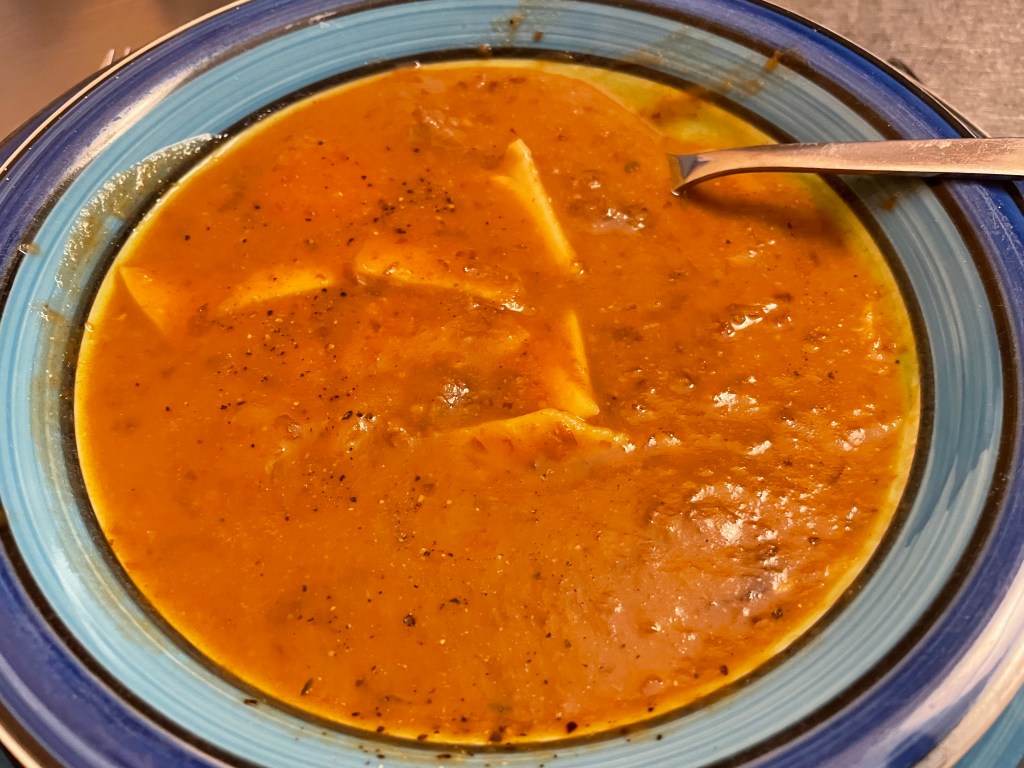
Years later, Perugian friends took us to an agriturismo (working farm with restaurant and/or rooms) over the border in foreign Toscana—Tuscany in English. The folks at the Castello di Sorci supplied a multicourse meal with two primi, one of which was an amazing puréed bean soup with homemade tagliolini, or thin homemade egg noodles. This was new to me; I’d never thought to purée the beans for the soup. Back home in New York, I made my own versions, one of which stuck. I love fennel and will sneak it in wherever I can. I did it with the bean soup and found that the addition of the fennel mellowed the soup out. At the same time, you wouldn’t know it was there if you didn’t look for it—just like chefs now use anchovies to increase the umami in a dish.

The supporting star

We’re starting to make soups like this as the weather turns cooler. So far this November it hasn’t cooled that much, but with the long nights this soup feels right somehow. You can put it together in 40 minutes or so using canned beans, or plan ahead, soak some good beans overnight and cook them before making soup out of them.

HERE’S THE NON-RECIPE RECIPE. I don’t measure anything, and this soup has endless variations in quantity and what you put into it. The orthodox version is pretty straightforward, though I have no idea whether anyone in Umbria ever purees fennel along with the beans.

You’ll need a package of canellini or borlotti beans. If you can’t find them, navy or kidney beans of whatever color will work. If you’re using dry beans, you’ll need to soak them overnight and cook them ahead of time. Otherwise, a couple of cans of white or borlotti (cranberry) beans will work.

A bulb of fennel—if you can’t find or don’t like fennel, you can use celery

One onion

2-4 cloves of garlic

One carrot

Tomato paste or a couple of peeled canned whole tomatoes (mainly for color adjustment; otherwise the soup can be way too beige)

Wine to deglaze. Or white vermouth.

Short soup pasta, or broken up spaghetti, or sheets of egg pasta cut into strips or irregular shapes. Quantity is up to you. About a cup works but it really depends on how soupy or solid you want the final version to be.

How to start:

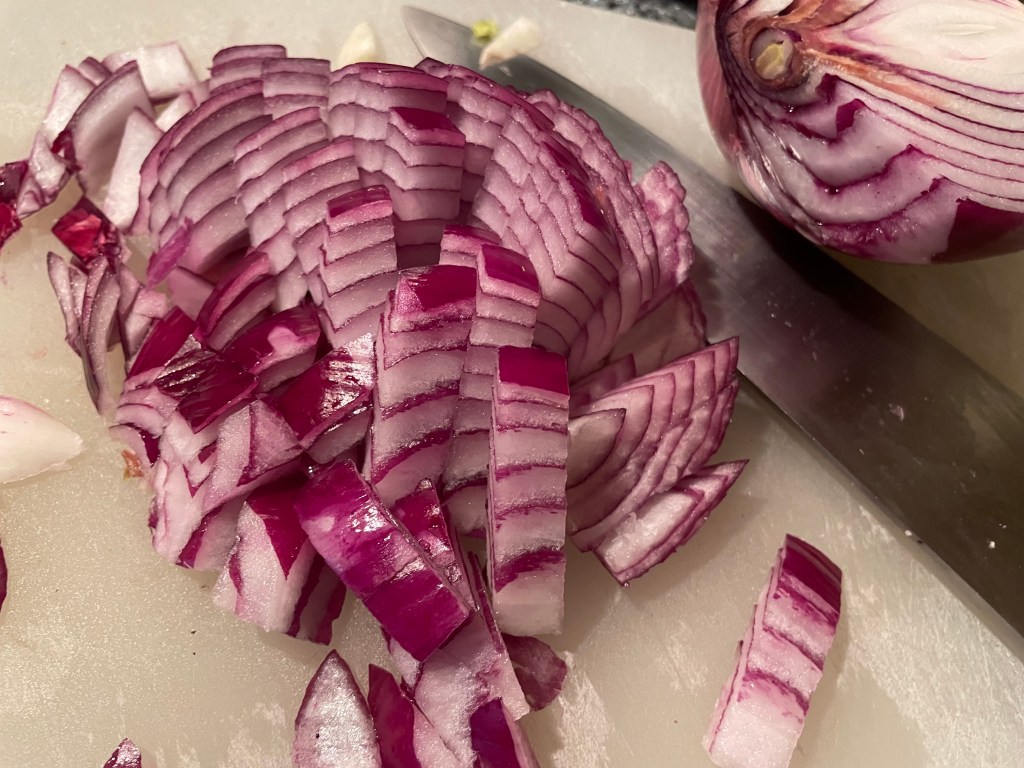
Dice a small head of fennel, saute in good olive oil. Add a diced onion (red, yellow, or white, it doesn’t really matter). Dice a carrot. All of this doesn’t have to be perfect; you’re going to purée this toward the end. Add 2-4 smashed garlic cloves, and, optional, a pinch of hot pepper flakes or a little hot pepper—what we call “peperoncino” in Italian. Get the vegetables past soft and translucent; you’ll want a bit of golden color because it will taste better.

Add a splash of white wine or dry vermouth and get all the toasty bits off the pot. Add a squeeze of tomato paste or a peeled tomato or two. Add two liters/quarts of low salt vegetable stock or water. Add the cooked/canned beans. Bring to a boil and then let it settle into a simmer. At this point you’ll want the flavors to come together, so let it simmer for about 30 minutes.

Take the soup off the heat. Using an immersion blender, purée until smooth. You can keep some beans out and leave them whole if you want. It’s your soup. If you don’t have an immersion blender, a normal standalone blender or even a food processor will work.

Turn the heat back on. Add pasta. There are two schools of thought here. I’ll usually cook the pasta in the soup, but a lot of people will cook it separately and then bring the pasta and soup together just before serving. Cook the pasta until just before being al dente–it will continue cooking as you serve it.

The finished product

Serve the soup in bowls, drizzle good olive oil on top.

Variations

Possible additions: Greens. You can even just tear some rucola (arugula) up and it will wilt in the bowl and give the soup a peppery note. Finely chopped Tuscan (black) kale, escarole, or chicory are good additions.A pinch of red pepper flakes or chili oil will satisfy those who like things spicy.

You can also choose not to purée the soup. In that case, make sure you dice the supporting cast of vegetables finely and uniformly; it’s all got to fit on a spoon. Or you can ease up on the water or broth and make the dish semi-solid.

Photo at top of page: Jeremy Keith from Brighton & Hove, United Kingdom

Enough of that old stuff. Let’s see some modern architecture

People come here to see old stuff. There’s Assisi, with the hundreds of years old basilica, with Giotto’s frescoes. Perugia has a still intact Etruscan gate and mysterious Etruscan tombs on its outskirts. Spoleto has a Roman amphitheater. For those of you who missed Ancient European History 101, the Etruscans predated those newcomers, the Romans. You can see more modern construction from, say, the 1500s. And apartment buildings that are 100 years old or more are considered to be kind of new.

Along comes Kid no.2 and her partner in art and life. We haven’t seen them in months. And the atrociously hot, then tropically rainy summer kept us from going out much. (So did our continued Covid vigilance) So when those two arrived, it gave us a chance to get out of the house, off the mountain, and play sightseeing guides for a week.

What do you want to see? we asked. “Al (the BF) wants to see some modern architecture. Well…. But it does exist. Umbrians don’t sit on their ancient marble doorstops. And to be honest, looking for modern works was a nice break from Olde Europe,

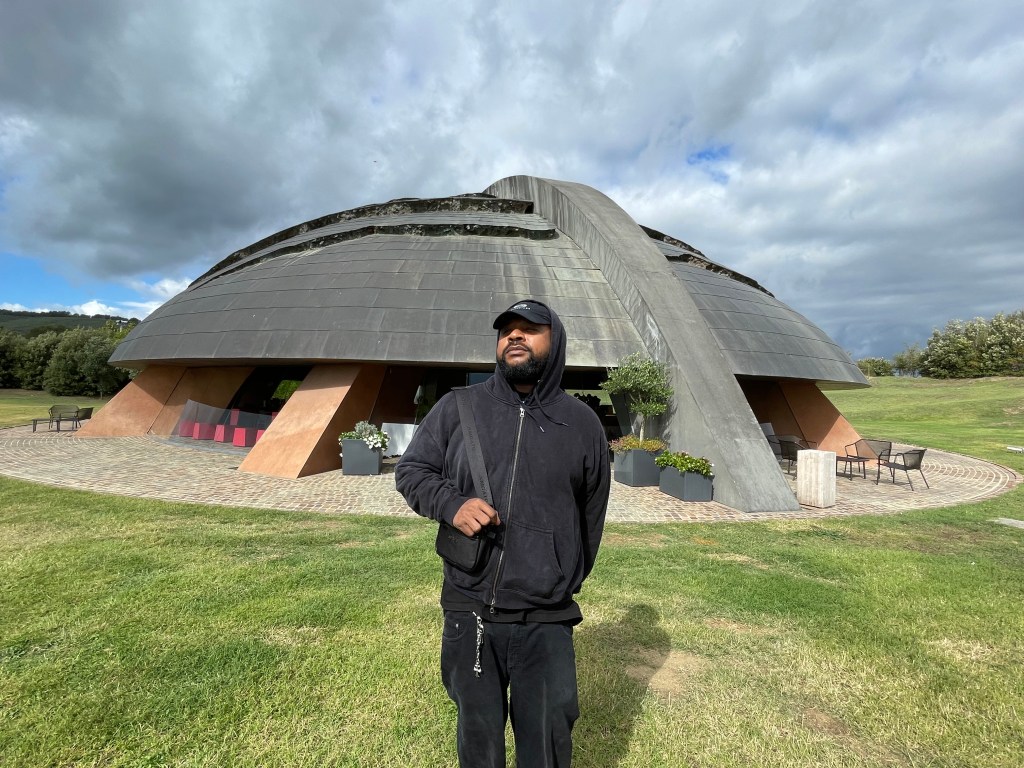
Friends told us about Il Carapace, a winery like no other. The name means shell—most commonly a turtle shell, but animals like shrimp and lobsters have them too, The producers of prestigious wines like Ferrari bubbly, Lunelli, decided that they wanted a statement canteen.in their Umbrian winery, Castelbuono. So they commissioned sculptor Arnaldo Pomodoro to build it.He’d done work for them before, but I have to say, this building came almost as a shock as we drove through sunflower fields and old-style vineyards. The Carapace rises out of the landscape like some alien space ship, a little menacing and a little humorous at the same time.

He asked for modern. He got it.

The surprises don’t end when you enter the belly of what could pass as a Klingon ship. The theme is copper, which clads the exterior, and whose paint adorns the inside. You feel like you’re in the belly of the beast, and a 360-degree view lets you meditate on the ancient vines. Castelbuono produces Sagrantino—Umbria’s most prestigious wine—and Rosso di Montefalco, a less intense, more easily quaffed red wine. If you need a Tuscan comparison, think Brunello to Rosso di Montalcino. The aging barrels sit in a huge underground space.

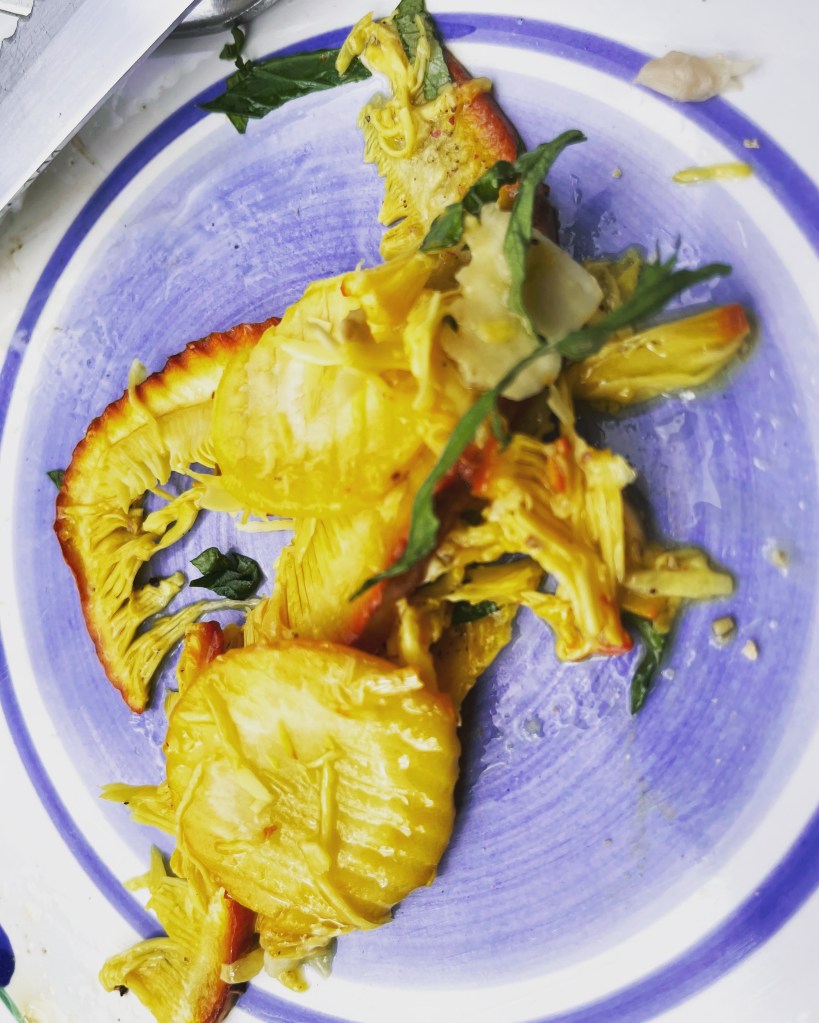
We had to eat, espcially after sampling three wines with a little nosh, so we left the Carapace to get lunch in nearby Bevagna. We were back in old Umbria, which has its abundant charms, not the least of which was a salad of raw ovoli mushrooms, which in their way looked as alien as the Carapace.

The mushrooms from another planet

A COUPLE OF DAYS LATER, we went to Foligno. We’d never been, except to the train station, which is a major transfer point for trains from the main Rome-Ancona line and the pokey local “regionale” to Perugia. The object? The modern art museum, the Centro Italiano Arte Contemporanea.

Foligno is unexpectedly interesting. On the outer rings of the small city, there are lots of Stile Liberty, or Art Moderne villas. There’s a long wide pedestrian street filled with porticos with bars and restaurants, and tons of shops and terrific window shopping. Who knew?

The modern art museum has one thing in common with the interior of the Carapace: a copper color. It basically looks like a copper box in the middle of a older neighborhood, and is instantly recognizable because of that. The permanent collection is pretty small and unfortunately they were between exhibits. But there’s more….
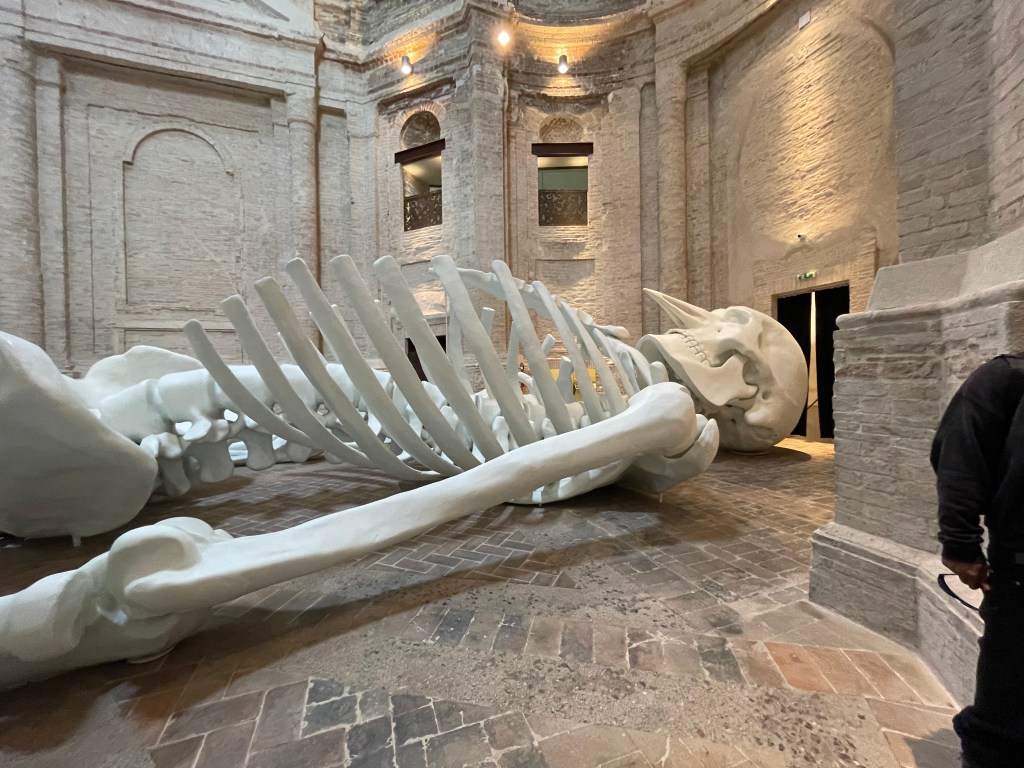
A 10-minute walk brought us to a deconsecreated church, the Chiesa della SS. Trinità in Annunziata. where, in the middle is a giant skeleton replica, by the secretive and subversive artist Gino de Dominicis. Its official name, “Calamita Cosmica,” or cosmic calamity. It’s pretty amazing, the kind of thing that held our attention as we walke around it. It’s not just the thing itself; it’s the context. De Domicis is described in the work’s website as “a controversial figure in modern postwar Italian art, with an eccentric personality, himself an endless work of art, original and full of secrets.” All I know is we just stared in wonder as we walked about the beast and tried to take photos that did it justice.

Well, why not?

Of course, we worked up a powerful hunger after that expedition. Happily, Foligno was there for us, with a festival of first courses. In the progression of an Italian meal, the “primo,” or first course, is actually the second. It’s composed of pasta, soup, or rice. Note that it is not what Americans call a main course; to an Italian, a huge plate of overcooked spaghetti serving as the main meal is a travesty. The festival was terrific, even if it was a rainy day and we had to traipse all over the center of town. Big signs and a handout map guided us to various restaurants around town that served regional primi; it was fun to pick and choose, for a really good price of €5 (5 bucks) a plate, with cheap good wine to go with it.

A “tris” of primi

We’ll be going back to Foligno as soon as we can. The festival got us acquainted with what seemed to be dozens of cool bars, restaurants and shops. Can’t wait.

It’s something we think about all the time here

Let’s talk about food, shall we? And where you consumed said food? (Sorry if the headline led you to think I was going to write about that other obsession.) I’m thinking about food in Italy these days, since I’m here. It really is an obsession, and not just with “sovrappeso” [overweight] me. I’ve overheard chic saleswomen talk about what they were going to have for lunch in tones that were, well, erotic. And if you happen to be in Italy and happen to get onto YouTube, your feed will soon be blitzed with food videos. I don’t think it’s just mine.

First off, most Americans without the good luck (or misfortune. It depends.) of having relatives living in Italy don’t get the full-on experience. They–you?–have to go to restaurants. And that’s a shame, especially if you’re in the big tourist cities. Why? Because restaurant food may be ok, but eating in an urban restaurant in Italy doesn’t come close to the real deal, and in big cities and touristy locations, many restaurants serve a kind of national “Italian” food that doesn’t reflect what people really eat in this intensely regional country. Plus they miss the vibe, where people loosen up and sit with friends, family, lovers, kids, dogs, whatever, just enjoying the moment. Or a town festival. Or, in the case of our town, any excuse to get together. Any.

First, friends and/or family. One of my most memorable “meals” here, if you can call it that, happened before we had a place of our own. My magazine astoundingly let me come to Italy on a reporting trip. My assignment was to make the rounds of lawyers and business analysts and give American lawyers an idea of what to expect if their companies or clients tried to buy an Italian company. I cannily scheduled interviews for the latter part of the week in Milan, and the early part of the week in Rome. Oh, dear, what to do in between? Live in a lonely hotel room? Eat meals by myself?

Nope.

I visited friends who happened to live in Perugia, about two-thirds of the way south to Rome. After a couple of train rides, my Italian papà Franco picked me up at the station. “We have to hurry,” he said. “Giovanna’s in the middle of a surprise for you.” Franco, never a quiet pensive kinda guy, gunned it, shouting at anyone who dared to drive any slower. “Figlio di puttana! Bastardo!” he shouted. After holding on for dear life—Perugia doesn’t know from straightaways—we got to their house. “Hurry! Just leave your bag. You can keep you jacket on. We have to do this NOW!” Franco told me.

What was the fuss all about? Artichokes. Glorious crunchy salty hot just from the fryer pieces of artichoke. “I’m squeezing lemon on these, ok?” said Giovanna in Italian (these two didn’t speak English; this is all translated), more as a statement of purpose than a question. “Eat with your fingers.” She had put the freshly fried artichokes in a paper lined basket and shoved it at me. “Eat with your fingers.” The three of us didn’t even sit; we just stood there eating, blowing on our fingers between bites.” When we weren’t wolfing down the artichokes, we were drinking and smiling at each other. It was one of the best food events I’ve ever been at. I know we sat down to a regular lunch after that, but for the life of me, I can’t remember it. Can you blame me?

If you don’t have an Italian friend or relative, the next best thing is probably eating at an agriturismo, or at least a country restaurant. If it’s the right season, eat outside. Yeah, there’s an Under the Tuscan Sun thing going at these places. But you’ll see what makes it all worth it. Some years before that reporting trip, we’d gone to an agriturismo high above Lago Trasimeno, the big almost ocean-like lake around here. I can still taste the pasta course, with an eggplant purée (no tomatoes) and bits of sausage. But what I really remember was the vibe. There we were, our family, plus our Perugian surrogate parents and their dog, just relaxing around a table with a view of the lake below for the whole afternoon. And it cost maybe a half of what a city restaurant would’ve charged. Maybe less.

ANOTHER WAY TO ENJOY NON-RESTAURANT food is at a sagra or a festival. They’re held all over Italy, and here in Umbria there seems to be one every day or so somewhere. They serve as fundraisers for the town’s pro-loco associations, which support soccer teams, after school activities for working parents, and the like. But they’re also a way to get the whole town involved in something—and, for people to connect with their history. Local volunteer cooks take care of the food, sometimes, but only sometime, under the guidance of professional chefs. Of course, doing so often involves getting done up in medieval drag, which seems to happen for any excuse, but I digress.

After the Covid shutdown, the region came alive this year. We’ve been to a few. The first was for the food, in Ripa, two towns down the main road here. The town itself is a tiny hamlet, with a circular historic center, and various memorials to Gino Bartoli. He was a heroic figure, a Tour de France bicyclist who smuggled citizenship documents for Jews during World War II by stuffing them in his bike’s tubes and delivering them. Ripa holds a truffle sagra, and the food’s pretty good if you’re a fan of the underground fungus. (We are; Ripa sagra shown below.)

There’s a biggie around here, too. The small town of Cannara, near Assisi, is known for its onions. They’re sold in all the grocery stores and to be honest, we’re spoiled. I won’t say you haven’t lived until you’ve had a really fresh onion—but like a lot of produce, being grown locally makes a real difference. Cannara puts on a pretty big show, with various “stands” (yes, in English), really kitchens/outdoor restaurants, with each producing dishes that feature, yes, onions. Cipollamisu, anyone? It was a lot better than you’d think, with the typical tiramisu ingredients topped with a compote of sweet onions.,

Valfabbrica, where we live, goes all out. It’s bigger than Ripa, as far as towns and hamlets go around here, but smaller (population around 3,400) than the surrounding towns. There’s a week-plus celebration of being a valfabbricheso, with pageants, jousting tournaments, and, of course, food. The town’s historic center turns into a restaurant, and the town has a communal kitchen that churns out tons of dishes based on local produce and history. Gotta say, it was pretty good.

But the most charming event involving food was last weekend. Our town likes its parties, and the old medieval tower was restored recently. Most places would have the mayor cut the ribbon and leave it at that. Valfabbrica? Uh-uh. It got Italy’s only all-female jazz marching band to escort the mayor to the tower, playing Stevie Wonder’s Sir Duke and The Beatles A Hard Day’s Night. The women walked up the tower with Enrico (we’re all on a first-name basis here)

We don’t have dull ribbon-cutting ceremonies in Valfabbrica.

I know, this is supposed to be about food. Sure enough, after the music and the ribbon-cutting and the speeches about the historic importance of the tower, there was a free aperitivo* in the piazza. Older guys sat behind tables with loaded with decent boxed local red wine and porchetta panini* and doled it all out. I haven’t eaten much meat in a decade, but one of the guys shoved a panino at me after I poured myself a healthy glass. It seemed churlish to say no—and it was great to be hanging out in the main piazza on a beautiful late summer night with our fellow townspeople.

Vino and a panino, anyone?

*”Aperitivo” refers not only to a pre-dinner drink, but food to go with it. Places like Milan and even good bars elsewhere elevate it to the point where it can substitute for dinner. At that point you can all the meal an apericena—aperitivo and cena, which is what the nighttime meal is called.

* The word is “panino” for a single sandwich. “Panini” is plural. More than 1 sandwich. Ok? I get a little nuts when I hear “I’ll have a panini .” It’s like nails on a blackboard.