Good eats, beauty, and heartache

It’s been a hectic couple of weeks. In fact, we got here two weeks ago to the day. We’ve had to do stuff to open the house, lay in groceries, buy a weed whacker (the grounds looked like a jungle and the electric mower just wasn’t going to cut it, literally). And as if all that weren’t enough, there was work and we bought a used car, because rental rates in the summer are ruinous.

But last week Liv and her guy were around. Being young and not yet ready for country life, they stayed in the big city (Perugia; population 170,000) and got to know the restaurants, bars and museums. Plus, where to go for aperitivi, or Italian happy hour. The better places have a buffet; if you’re in Perugia, head to Umbro near Sant’ Ercolano right away.

It was fun playing tour guide. It was Al’s first time in Europe. We got him used to being called Alberto, and he got to see a side of Italy that most first-time tourists never see. As part of his education, we headed to the hills. Actually, the mountains. You go south toward Spoleto and turn left and up, up, up. Our first stop: Norcia. It’s a little walled town high up in the approach to the Apennines, and is known for its gastronomy.  It’s the land of skilled pork butchers, cheesemakers, and black truffle hunters.

We stopped first at an agriturismo outside the town. I’d heard that the earthquake of 2016 inflicted a fair amount of damage on the town, and a lot of places were closed. So we drove up into the hills above to the felicitously named Il Casale degli Amici (The House of Friends). We first timers certainly felt the warmth of instant friendship. It’s a seriously nice place, and the staff couldn’t be friendlier. And, as you say in Italian, si mangia bene—you eat well. We took full advantage of Norcina cooking, and had truffles, great cheeses, and even some salumi. I don’t usually eat meat, but this place led me into temptation.

Then we climbed—we took the tortuously curving road up to Piano Grande di Castelluccio. It’s stupendous, a giant glacial plain high up in the mountains. It could be New Zealand, or the American West. Well, except for the wrinkles of Italian life on the road. Motorcycle gangs road up and down the road, but these weren’t exactly Hell’s Angels. Just normal people going for a Sunday ride. Can’t forget the porchetta truck or the stand selling local beans and other foods.

IMG_4010.jpg

The road was harder to navigate than usual. The earthquake made it impassible for awhile, and we could see where chunks of it just fell down into the valley. At numerous points, you had to stop at a light to let the other direction proceed, because only one lane had been reconstructed so far.

The heartbreak came after we spent some time traipsing around the mountain paths and the plain. We went up to the hamlet of Castelluccio, which up until almost two years ago was a perfect little isolated jewel of a place. The earthquake leveled much of the town. The locals set up business as best they could, but destruction and fencing is everywhere, and soldiers guarded the entrances to the zona rosa, the parts off-limits.

IMG_4019.jpg

Danger! Do not enter!

We must reduce

If you have a native-born American, English-as-a-mother-tongue father, you have my sympathy. It’s so boring. Having an Italian-born dad has its advantages. An outsider’s perspective on a bewildering country? Check. Interesting friends and relatives? Check. A place to stay in other countries? Ditto. Better food? Yup. Mangled but humorous colloquialisms in English? You got it.

This last couple of bits gave me the idea for this post. Nuccio, my dad, sometimes gets English expressions just a little wrong. “You must cry the consequences,” he once told me. I honestly don’t remember why he said that, but boy would it make a great country or Elvis Costello song title. And, “you must reduce.” He meant diet. And he’s right.

I never realized how active an office job could be. Or, at least, one based in Manhattan. And how not going to the office can affect your wellbeing. I walked a lot when I had a day job. To get there, I took a ferry, most often with friends, after which I took a .6 mile, or the more sexy 1 kilometer walk to the newsroom. The building was huge and occupied an entire city block. You had to walk a block to get to the bathrooms. When I got bored or sleepy in bad weather, I’d just take a walk around the block indoors. At lunchtime I did eat most often at my desk, but that was to save time for a brisk walk around lower Manhattan. And my web editor and I often took a mid-afternoon coffee break that involved a few blocks’ walk.

Now, not so much. I work out of my home office. My commute to my home office involves taking a few steps from the espresso machine and fridge in the kitchen. Slowly but surely, even when I managed to get out for exercise, I was packing on the pounds. It was like the proverbial frog in a pot of water. I didn’t notice I was cooked until it was too late. Almost.

Enter The Spartan Woman. She’d seen a similar gain, partly from stress, partly from an ear infection that kept her from her aquacise class. So she looked around, found the Weight Watchers app on her iPhone, updated it, and we were off. Only we’re talking about The Spartan Woman. She is decidedly not into plain steamed broccoli and tofu. We’re talking about someone who all her life has tried to game the system. (Don’t play cards with her if you aren’t a card shark. You will lose. Trust me.) Rather than limiting our diet, the regime brought forth an explosion of creativity. We usually split cooking duties, but for this, I was all too happy to just watch (and eat). She probably didn’t trust me anyway to use a light hand with the olive oil…

Can I share some of what she’s come up with? All of this is legit according to WW, and low in points. (I’m sure some of you know what I’m talking about.) And it’s working pretty well. (Downsides? I miss having wine with dinner every night, or having to earn it. But if it’s made the local liquor store sad, it’s had a good effect on our checking account balance, and I manage to be more alert most of the time. I’m not sure yet whether that’s a good thing.)

Here’s a lighter version of the Turkish classic imam bayildi. It’s slow cooked eggplant stuffed with tomatoes, onions and mint. The classic is cooked in lots of olive oil. This one isn’t, but manages to be pretty sensual.

IMG_3652

Next up is a riff on ramen. This version has tofu, lots of vegetables and a soft-boiled egg.

IMG_3584.jpg

Here we’ve gone for something a bit Brit (and something I put together): cold spring pea and leek soup with lemon and a dollop of (light) sour cream:

IMG_3711.jpg

Next up, baked cod with sort of an Italian version of succotash—fava beans, corn, peppers, and I forgot what else. But it looks good, and it tasted good, too.

IMG_3650.jpg

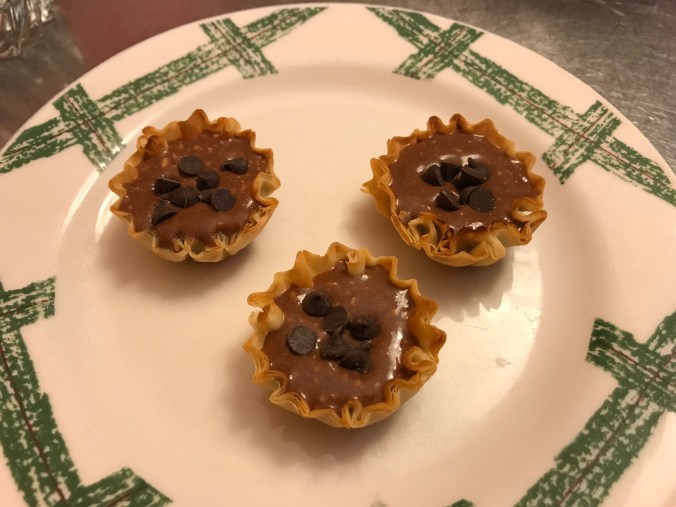
Gotta have dessert. Phyllo cups filled with chocolate flavored ricotta and chocolate chips.

IMG_3678.jpg

Not bad, huh? I’ll keep this going. It’ll be a challenge over the summer to do it in Umbria, where temptations are everywhere. Gelato, anyone? And then there’s the aperitivo hour….

Sex Change Operations, Zucchine/i, and Lasagne. Or Lasagna?

IMG_3363.jpg

A friend of mine moved to Spain some years ago. She and I used to speak Italian to each other every so often, but once she was getting ready to head over, she forbade any Italian. “Please,” she said, “learning Spanish is confusing enough. I can’t have the two languages blending together in my head.”

So let’s talk about Englitalian. Or Italish? The mashups occurred to me as we got Sunday dinner together today. First, let me describe the day. It’s gross. We thought we’d escaped the New York winter, and we did for the most part. But today into Tuesday, we’re facing il gran gelo (deep freeze to Anglos). It’s been snowing in a half-ass way, not really piling up but with the wind blowing, it stings your face and makes for general misery. Looking out my studio window, I can barely see beyond the fruit trees outside the house.

IMG_3366.jpg

It’s starting to stick and look like an outtake from an early R.E.M. album cover photo.

That means we’re housebound, at least today. And dinner—we do the Italian or French thing on Sundays and the midday meal is the star. I thought I’d try to replicate the flavors of a pizza that the terrific pizzeria Ribalta in Manhattan puts together. It’s got the usual mozzarella, but they add what I’d call zucchini cream, and grilled zucchini. It’s sweet and nutty and creamy at the same time. Only this time I thought it would make a terrific lasagne. Or lasagna, if you prefer, but Italian Italian style, with thin layers and béchamel on top with some crispy bits.

Lasagne. Lasagna. Zucchine. Zucchini. That’s where my linguistic confusion comes in. There are a lot of words, mostly food related, that differ in the Italian spoken in Italy, and the supposedly Italian words, or names of dishes, in the U.S. “Lasagna” is one of them. In the Italian-American (and, I guess, the Olive Garden) canon, it’s a layered pasta dish with tons of ricotta, mozzarella, meat sauce. In Italian, “lasagna” means one single, solitary noodle. Hence “lasagne,” or the plural. The feminine plural, to be precise.

“Zucchini” is another odd duck. When this green summer squash crosses the ocean, it gets treated to a sex-change operation from the original plural feminine “zucchine.” To say “squash” in Italian, it’s “zucca”—feminine singular. The -ina or -ina suffix means a little one.

Don’t get me started on the poor panino, masculine singular. One sandwich, and it doesn’t have to have melted cheese and squished in a sandwich press. “Panino” means a little bread, or a roll. In the U.S. and other English-speaking countries, you hear people saying “I’ll have a prosciutto and mozzarell’ panini” and I cringe.

So the dilemma: When in Rome, so to speak? It just sounds weird to say “zucchini lasagna.” The poor dish gets one gender wrong, and one quantity wrong, leaving us with a transgendered vegetable accompanying a singular noodle. Or something like that. But if I did go around saying the proper Italian pronunciation to an English speaker it would come across as possibly confusing and definitely pretentious.


The Non-Recipe Recipe

In any event, here’s how to put it together. However you say it, it’s delicious. We managed to transfer the flavors of Ribalta’s pizza to a gooey, decadent, perfect-for-a-snowy day pasta dish. Disclaimer: I am not a professional recipe writer, and this presupposes you have some cooking chops and can figure it out where I’ve messed up.

Preheat oven to 375F/200C. Take 7 or 8 medium zucchine/i. Slice fairly thin lengthwise. Place on oiled baking sheet. Season with salt and pepper, sprinkle liberally with olive oil. Roast for about 40 minutes, until they’ve given up all their liquid and some may be a little browned.

Take 1/3 of the squash (gotcha!) and place in a blender or food process. Zap with about 250 ml or a cup of heavy cream or Italian cooking cream (panna). Add a good handful of grated parmigiano or grana cheese. Do NOT use pecorino; it’s too sharp for this dish.

Have some ricotta and béchamel lying around. If you’re lucky enough to be near an Italian gourmet shop, you can get prepared béchamel. Otherwise, make it yourself.  You’ll also need no-cook lasagna sheets.

IMG_3365

In a baking pan, spread béchamel on the bottom. Add some milk. Layer the first pasta sheets. Spread with ricotta and grated cheese, and a layer of squash.

Layer 2: pasta sheets, your zucchini cream.

Layer 3: Like layer 1.

Layer 4: Pasta sheets, bechamel, grated cheese, and some bread crumbs.

Cover with foil, place in hot oven for 30 minutes. After that, remove the foil and let it brown. Remove from oven, let it rest for 15 minutes. It’ll be easier to cut and portion out., Serve with a green salad.