Oh, nothing really.

But that wasn’t the exciting part. We were chatting away when suddenly I hear the twang of an American accent outside in the piazza. You don’t hear it that much around here. I looked out, without my glasses and saw out of focus figures wearing what looked like identical T-shirts and helmets. Francesco was intrigued, too.

—How do you know they’re American?

—The accent.

—There are different accents [I’m guessing he meant in English] ?

—Lots. [translated from the Italian]

He sent me out to interview some of them. The group was on a bike tour from an outfit called Backroads, and came from all over the U.S. One guy was practically my homeboy, coming from New Jersey, right across the Outerbridge. They were all on their way to Gubbio, about 30 km/18 miles away. Up and down big hills away, that is. “Wow, you guys must all be in pretty good shape,” I asked New Jersey. He responded, a little sheepishly, that some tour members had e-bikes to help.

The pause in piazza that refreshes

Okay, so this is not bigly exciting. But it’s all part of the everyday pleasures of life here, and it took me awhile to think like that. When we first arrived in May, I was restless. I felt that I was in this candy store and limited to Skittles. Or something like that. In other words, I was still in this-is-a-long-vacation mode and wanted to wander and even sightsee, and I wasn’t dealing realistically with the fact that we moved here. Like, to live.

And what do you do when you live somewhere? I’ll answer that: You do everyday stuff.

Since the last time we met over roasted tomato risotto, we’ve been in recovery mode, trying to get our lives back on track. August and part of September were like this giant hot blanket pulled over everything. This summer’s blazing heat kept us indoors for hours. Once it broke–somewhat—we had to think ahead. And hot though it was, we have to prepare for the winter.

Alternate fuel? Check.

Doing so is not a big deal if you live in a city—just start wearing sweaters and jackets. And turn on the heat. Here on the mountains, though, we have to lay in supplies and get stuff cleaned out to do that. We have gas heat, but the gas doesn’t come via a convenient pipeline; we have to get a delivery and fill a big underground tank, and take a big hit on our credit card balance. Because of the expense, we have a “termocamino,” or a thermal fireplace that’s hooked into the heating system. It pumps water through the fireplace and once the water reaches 50 degrees C/122 degrees F, we’ve got blaring heat circulating through the radiators. But we’ve also got choking smoke if we don’t call in the chimney cleaner. Hopefully someone will show up in a few days.

Speaking of our lives, 36 boxes of reminders of a former life came the other day. Luckily we have a whole downstairs floor to host them temporarily. And that’s a constant reminder that we’ve got to tell the authorities that we’re living here full-time and thus qualify for the national health service. Then there’s the dog registry and….and…and. Hey, this retirement thing is hard work.

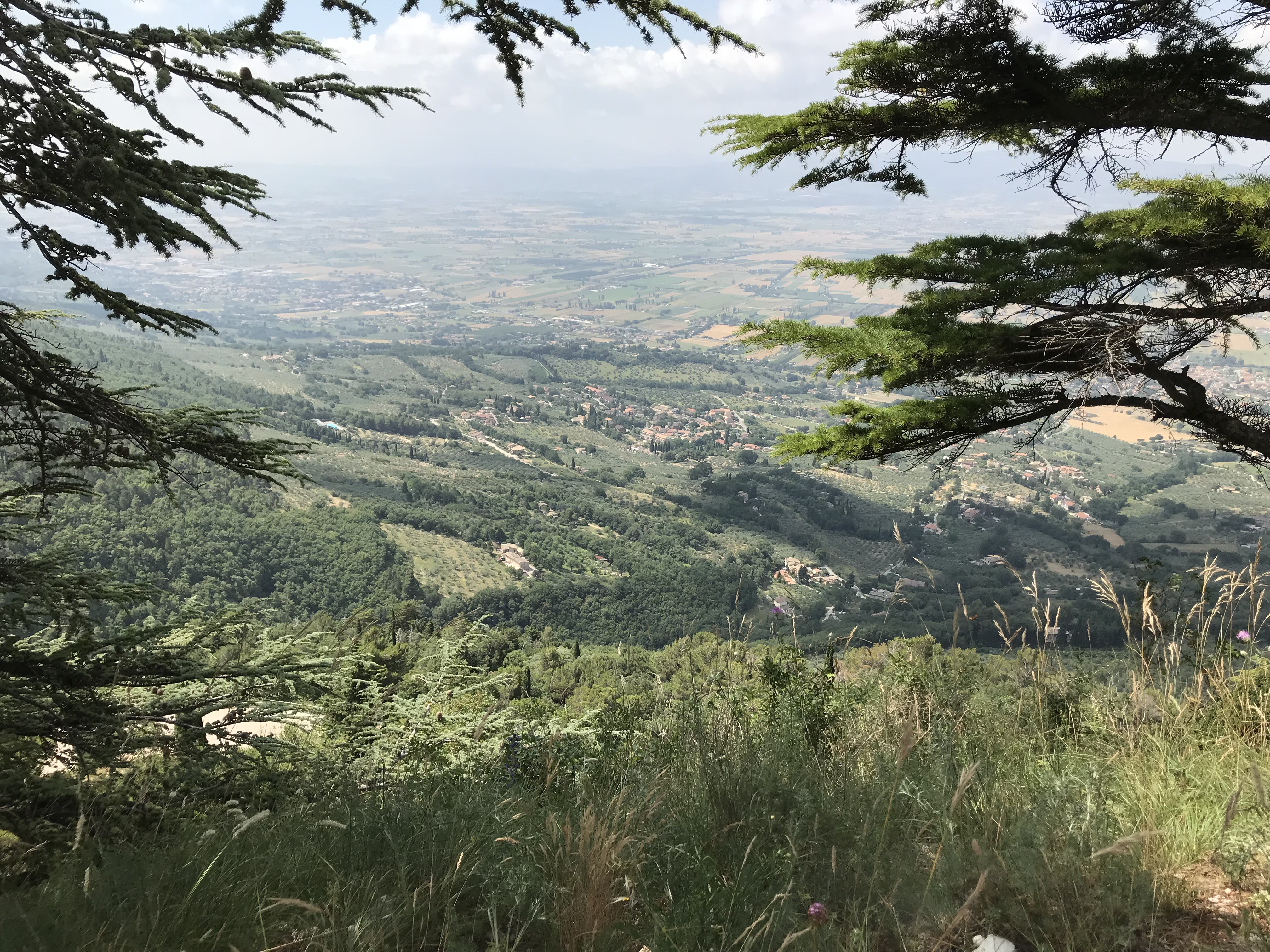
BUT THERE ARE THE PLEASURES of everyday life here to compensate. We walk up the road and see this amazing view. We never get tired of it:

Valhalla, or the Umbrian equivalent

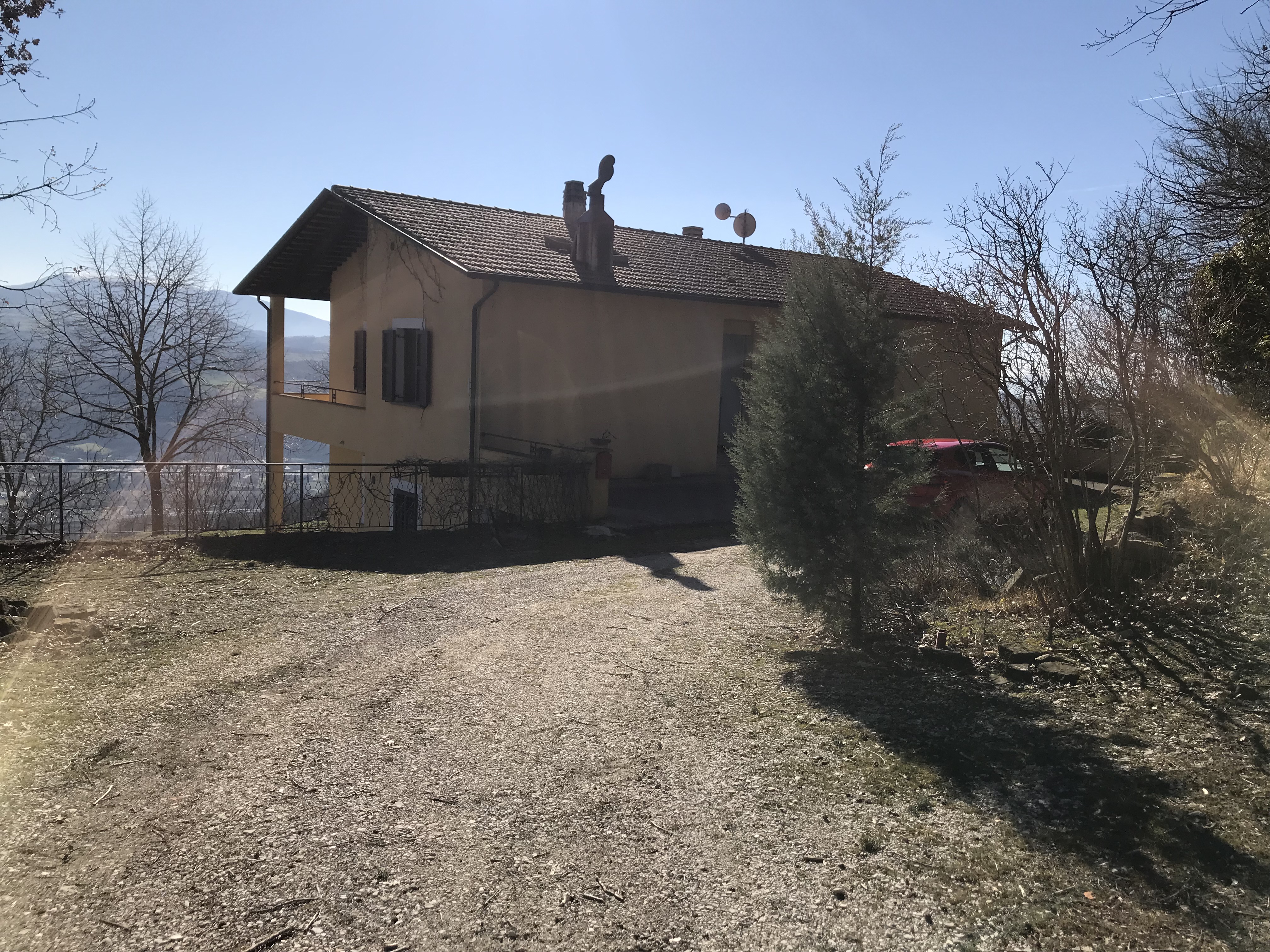
Besides the view, we’ve got neighbors. We can’t actually see them; we’re all spread along this winding road. But a simple 2 or 3 km walk means waving to cars passing by, and someone’s bound to stop and chat and invite us for coffee. A couple of weeks ago, we were doing our walk when a car pulls up. Usually it’s people lost and needing to find one of the nearby hamlets. A guy in accented Italian asks us if we’re the people in the yelllow house. We respond in English, we’ve been anxious to meet you. Seems we’ve got a famous lutenist living in a small house up the road, a fellow refugee from the U.S. If you’re into Renaissance music, look up this name: Crawford Young.

And have you ever had the experience of having a shop, a restaurant, a, I don’t know, a shrine nearby, and you tell yourself you’ve got to go there but you always forget or take it for granted that it’ll be there? Such was the case with the pretty recent addition to our town, Bottiglieria Barbarossa, a terrific enoteca right in the historic center. It opened about a year ago, and it’s a great place to try out local wines and artisanal gins and the like. And the owner Massimiliano is really passionate about his wares and the industry in general. We had a long chat about “natural” wines (he’s not a fan; I’m inclined to agree), the sacrifices restaurant owners make and our careers and life trajectories. The place has the additional benefit of big windows out onto the piazza so you can see the street action without the town’s resident old dudes staring back at you.

Just add wine=the perfect snack

There are other good bits of Italian small town life. We’re looking forward to a fish and seafood lunch this weekend. The menu looks incredible–appetizers, two “primi,” a fried seafood course, dessert, wine, water, and coffee. All of this in our friend’s hamlet for €35 a head, or about $37. It’s not just the food, of course. It’s the communal spirit of it all.

Our town, though, has got that communal thing licked. There are way too many events, walks, lectures, dinners, concerts going on to even start to list them. For a town of maybe 3500 souls, give or take, it’s a lot. And the town fathers and mothers are anxious to promote what we’ve got. Far be it from me to spoil the fun, so I’ll leave you with this video (in Italian), which gives you a good idea of what I’m saying:

We had no power, so we went out for coffee. And to look for castles, run an errand, and eat lunch.

It was awfully nice of the power company to warn us of upcoming work and an outage this time. Power outages here in the country are usually of the unplanned kind. The last time it went out, we got back home to a dark house, and a phone call to report the problem let me know that they were working on it and we’d be back online in a few hours. This time, for planned work, the power company posted notices up and down the road and stuffed our mailbox with one.

So we woke up early enough to use the espresso machine and to make sure our devices were charged. We sat around wondering if they really were going to cut the juice at 8:30 because it was a rainy morning. And at 8:32 the music stopped and the wifi cut out. We started to read novels but after awhile thought instead of waiting around, we’d go check out the borgos in the area that we always see from the road and say “we’ll have to check out XX one of these days.” Finally, it was one of those days.

If you’re new to this blog, a brief explanation. This region is called the mystical heart of Italy for a good reason. It’s densely wooded, hilly and mountainous, depending on where you are, and it’s dotted with castles, both adapted for modern use or abandoned, lonely testaments to the days of chivalry and bloody battles between city-states.

But first up was coffee. We had some at home, but we needed booster shots. And we had all the time in the world. We have a bunch to choose from and this morning we went to the next town, which has a sweet bar with lots of outdoor seating—perfect for a pandemic. Unlike bars (cafes in the U.S.) in touristy areas, in these local spots you don’t pay extra to hang around. Sure, you can grab a quick one standing at the bar, but in this area you tell the barista what you want and bring it to a couch or table and hang out until you need to go. First stop, then, was the Bar Dolce Vita in Pianello, behind a gas station. So what if it’s not romantically located? Good coffee, terrific outdoor seating, friendly baristas—it’s a genuine neighborhood hangout.

The first borgo on the list was Castel d’Arno (apologies for the outdate and weird-looking website). It’s a hamlet that’s part of Perugia and is up a narrow winding road. Yeah, you can describe most of the roads around here that way. We saw some workmen, and a guy supervising their work told us he rented out apartments in the hamlet. He told us to walk under an arch to an overlook and wow, even on a day full of threatening clouds and mists, the view was pretty fantastic.

It was raining down there, but not at Castel d’Arno.

Next up? Sterpetto, another tiny borgo, this time part of neighboring Assisi. Sterpetto is bigger than Castel d’Arno and looked in better shape. In general, Assisi seems to maintain its outlying hamlets better than Perugia, whose “frazioni” often seem to suffer in favor of the jewel-like historic center. Sterpetto has a working church and buildings that people actually live in. Its site is comparable in that wow factor, but Sterpetto just feels less like the 21st century has passed it by. Our gardener told me a funny story involving the borgo. A local businessman, a big man in every way, decided he’d lose weight by walking from the neighboring Pianello up the hill to Sterpetto and back. Sounds like a plan, right? Problem is, a guy works up an appetite on a long walk like that, and this man ate a couple of pizzas on the way back. Pizzas in Italy are individually sized, but still….

Would The New York Times call Sterpeto “tidy and well-kept”?
New desk lamp, meet old worry beads.

Speaking of the 21st Century, we next dropped into it by stopping at the megastore Leroy Merlin. It’s a French chain of big box stores that’s sort of like Lowe’s or Home Depot. Only L-M, or as The Spartan Woman pronounces it, “Lee-Roy,” is more stylish. With time to waste until pranzo (lunch), we looked at the light fixtures—I needed a new desklamp—and the tiles. We picked up some strong brackets to hang an amazing poster a friend sent us of the Spolete “Due Mondi” music festival, and took mental notes for a not-happening bathroom renovation.

Finally, lunch. We figured we still had some time to waste before the juice came on. We debated most of the morning off and on where to go. We could have gone north, back to our area to, perhaps, Il Panaro near Gubbio. Terrific torta al testo and rootsy homemade food. But there’s a strange waiter who may or may not pretend that he doesn’t understand our order and who once offended a diminutive but not too small friend of our kid’s by giving her a tiny wine glass.

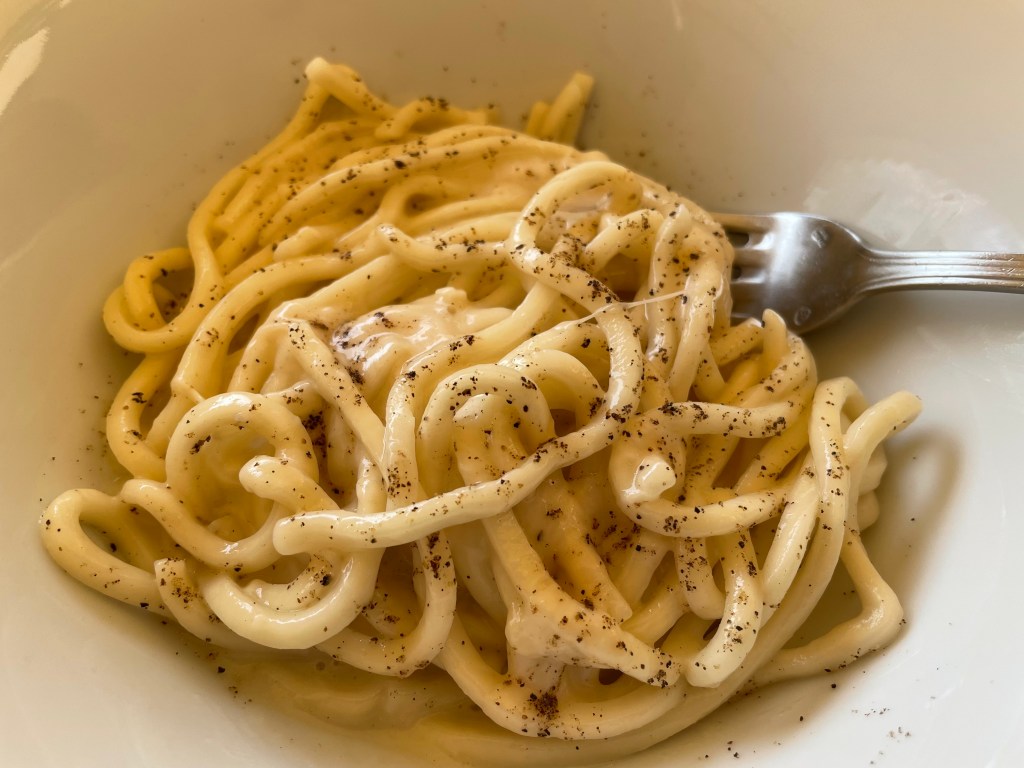
We were almost in Assisi anyway. We normally avoid the place during the day, especially in summer, because it’s crawling with tourists and pilgrims and nuns and monks and souvenir vendors and….you get the idea. But on the off season and at night, it’s just a really pretty hilltown. The Spartan Woman remembered having really good stringozzi cacio e pepe at a restaurant right on the main piazza, the Taverna dei Consoli, which sounded good to me. We had equally decadent antipasti, little onion tartlets with a creamy truffle sauce for me, and a fonduta of pecorino and truffle for her. We spent a bit more than we normally would for an impromptu lunch, but it was worth it. Besides, we took the really long way back to the car, so we worked it off.

Even better, the lights came on an hour before they promised.

Image up top: the piazza outside the Basilica di San Francesco in Assisi, as seen from above and in black & white

50 minutes to paradise and back

It’s been awhile since we’ve done anything to further the St. Francis brand. So as good, upstanding part-time Umbrians, we scoured our social media feeds (yes, they know where we are) and saw an organized walk to the Bosco di San Francesco (St. You-Know-Who’s Forest) this past Sunday.

Well, scratch that. We don’t do organized things, and in the morning? On Sunday? Still, the place is intriguing, and I’d seen photos of the sylvan woods with a stream running through it, and I’m a sucker for a good walk. So off we went toward Assisi. This place has the added advantage of being outside the city walls, so I didn’t have to deal with parking and other hassles of going into a town’s historic center.

There’s a cool reception center, and there’s a suggested donation of €5 a person. The woods are administered by the Fondo Ambiente Italiano (FAI), the Italian Environmental Fund. The acronym’s pretty neat; it means “do”–and they, indeed, do throughout the country, cleaning up sites and opening big natural areas to casual walkers and serious hikers alike.

The Bosco has two main hikes. One takes you up, up, up to the Basilica di San Francesco, the towering cathedral that dominates Assisi’s skyline and features frescoes by Giotto, among others. The art inside is breathtaking, as can be some of the crowds. We didn’t take this hike. By the time we got there, the relatively benign September sun was shining ruthlessly. And did I mention that it’s a steep uphill climb?

So, wimps that we are, we took the “Terzo Paradiso” or Third Paradise walk. Hey, how could we resist it with a name like that? The paradise in question is a “land art” work by Michelangelo Pistoletto. It’s in a clearing in the woods and is overlooked by Assisi’s fortress. The artist used oxen to inscribe three circles, a large one in the middle surrounded by two smaller ones. The length is infinite since they’re interconnected. Then FAI and the artist planted a double row of 121 olive trees, and there’s a steel shaft in the middle that symbolizes the meeting of heaven and earth. (Now this is a real olive garden.)

Paradise, found

I know this sounds awfully conceptual and, like, deep. But to experience is both awe-inspiring and fun. First off, it’s a beautiful place. Walking around it is just plain enjoyable. If you haven’t been near olive trees, they’re silvery green and reflect sunlight in a particular way. So when you’re walking around the circles, the trees shimmer around you.

Olive trees and cypresses up there, where we didn’t climb
Water, water, nowhere, except in a plastic bottle

Third Paradise isn’t the only attraction. The woods themselves are beautiful, with outcroppings and the usual central Italian mix of vegetation. Despite the four or five (I lost count) heatwaves we had this summer, everything is still amazingly green. FAI has thoughtfully put benches throughout, so you can take a break and, like the F-man did, contemplate the universe, or the bug circling your head.

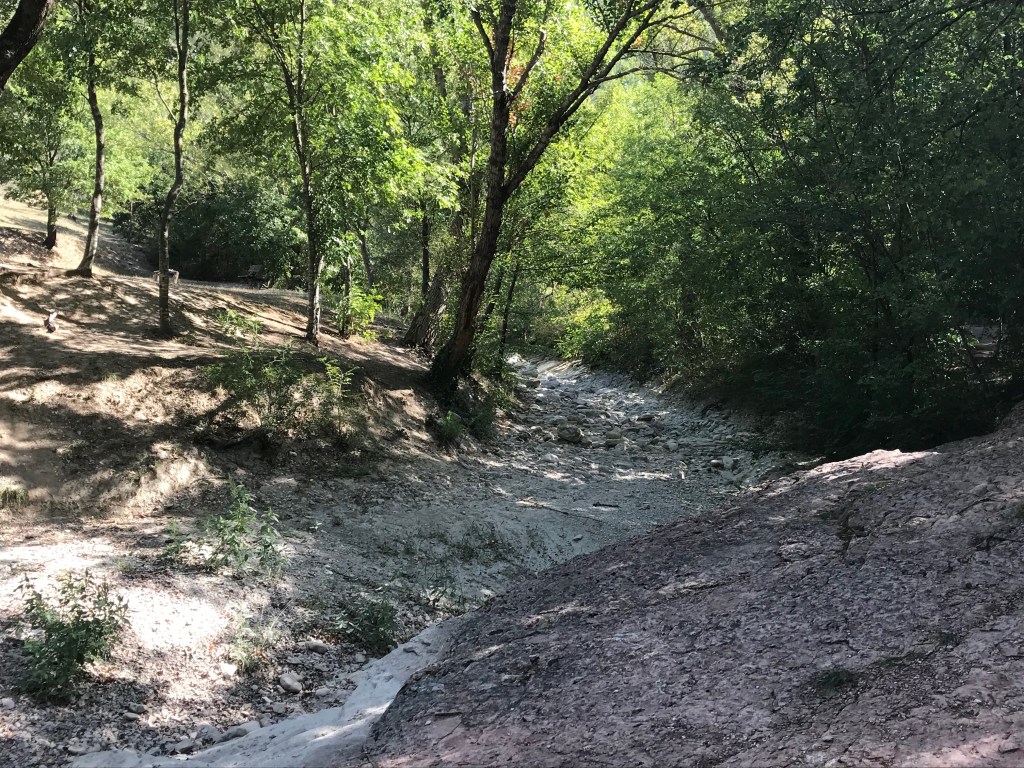
The only thing is the stream that runs through these woods, is, to paraphrase Monty Python, a former stream. A stream that is no longer. It has ceased to be a stream, at least for now. We’ll come back after the fall rains to see if that’s changed. And just maybe we’ll scale the hill to the Basilica. Hey, the parking’s free down by the woods.

If you’re around and want to walk where Francis walked—or one of the places—just look up on your sat-nav or phone “Bosco di San Francesco.” FAI also has directions on its site. And there’s what looked like a nice restaurant adjacent to the site, but we didn’t try it out.

The road taken

A few days ago, we were doing our usual morning walk up the road when we bumped into a neighbor, who introduced himself as Claudio. He was out for a walk, too, telling us that he just retired. He told us about his walk, which involves walking down the road and making a turn into a “strada sterrata,” which is an unpaved road. He said that he makes a loop and comes around after being on the Sentiero Francescano. This trail is a series of trails that trace the steps of St. Francis of Assisi when he left his family home and riches, and walked to Gubbio through the woods. A mystical, rebirth ritual walk, in other words.

Curious, we wanted to see if we could replicate Claudio’s walk. (Francesco’s walk is well-marked and in warmer weather, sees waves of pilgrims.) A few days ago, we walked on some of the Franciscan path, and I was looking at the map on my iPhone. I saw as we were walking back down the hill another road that, if you looked uphill, veered left. Hmm, we didn’t remember that. But as we descended, we saw an opening and yes, a path that was carved into the side of the hill. That’s one of winter’s advantages; without the overgrowth and weeds, it’s easier to make out the paths that wind all around here. We took it and saw that it followed a higher trajectory than the Sentiero and then sort of curved around the hill. That must be Claudio’s route, we figured, and made plans to come back the next day.

The turnoff, not that you’d know it. Apple Maps showed it; Google didn’t. But for some other stuff, Google shows details Apple doesn’t. Guess you need both.

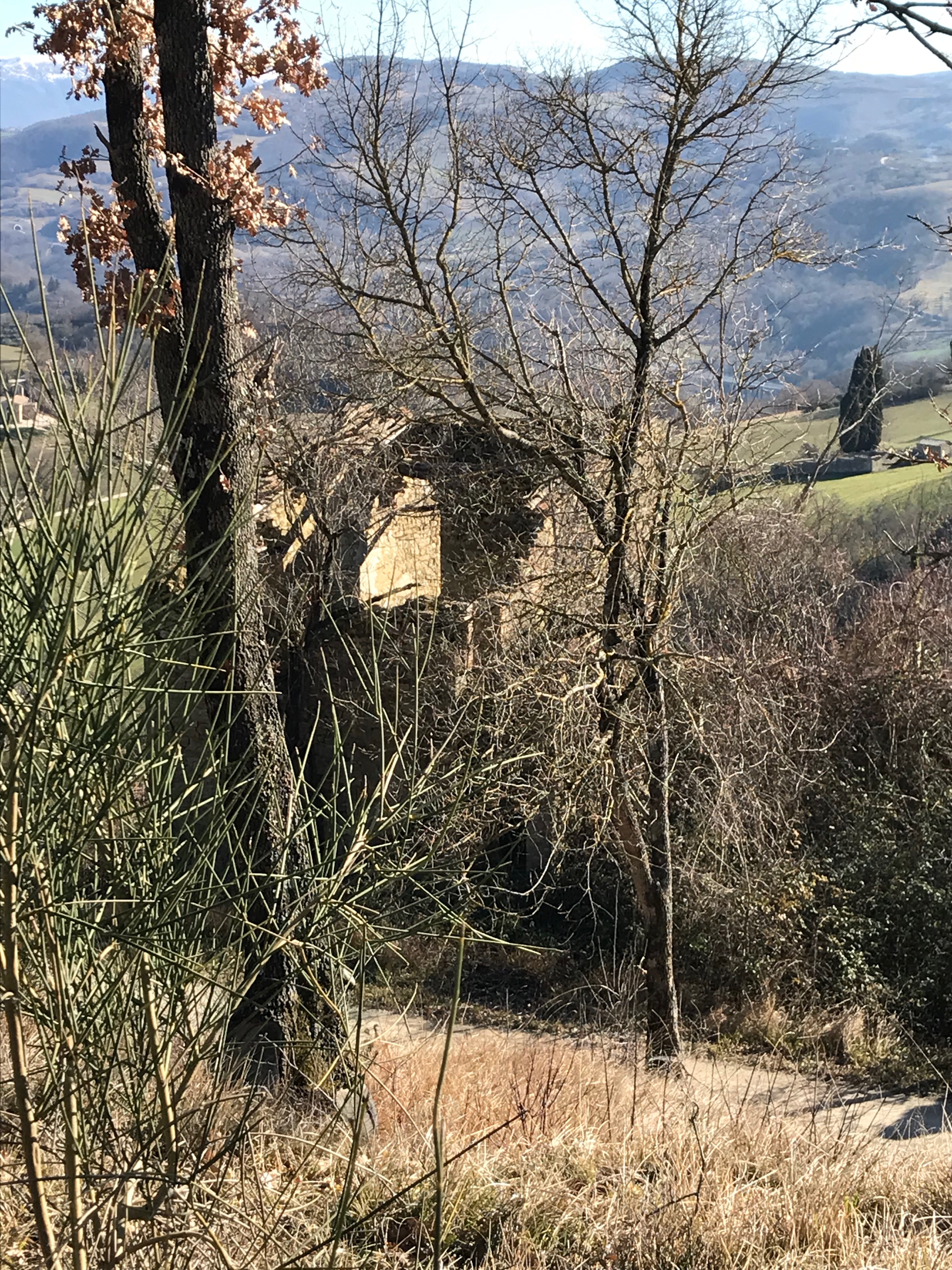
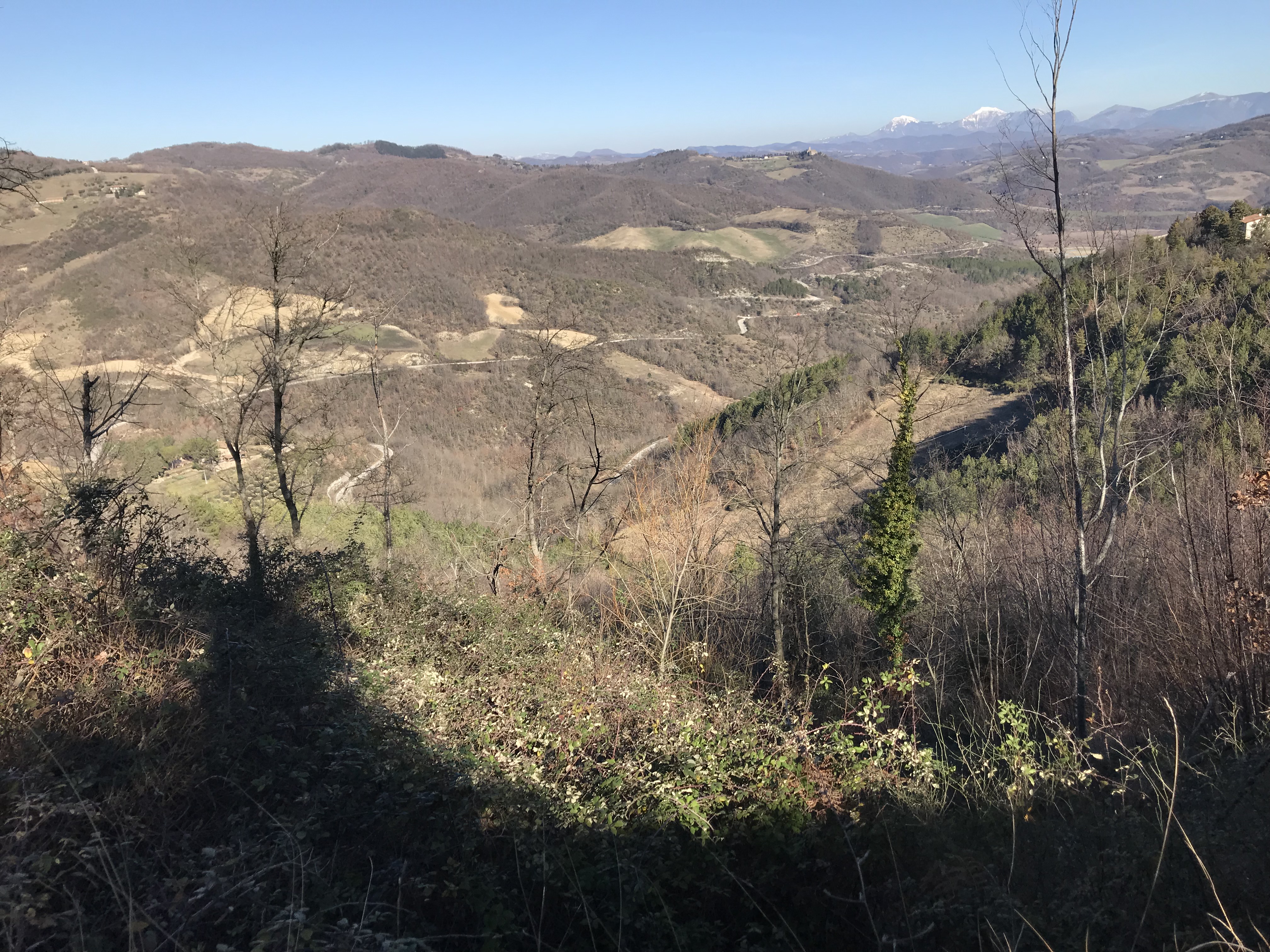
So we did. And O.M.G. We’re suckers for a good view and on this path, they just kept coming. Unlike on the Sentiero, you don’t really plunge into deep woods. The path—it must have been a road of some kind at some point—just hugs the hill, carved into it as it follows the basic path of the Sentiero, but about a tree higher. So we got to look into the ruin that we’ve passed many times (we hear that it’s for sale, if anyone out there is interested). As the path curves to the left and westward, the views are pretty stupendous.

Looking into the ruins of a farmhouse. An old timer neighbor told us that the family that lived there farmed the area until the 1960s. Their olive trees are nearby, still producing fruit.
On top of the world! Those are the snow-capped Apennines in the distance.

And then, we thought we hit a road block. Or, at least, a gate shutting us off from the rest of it. Luckily, though, as we got closer, we saw that the path veered left then curved around a large house with a pool and gardens that we soon realized was the Agriturismo Val di Marco. An agriturismo is supposed to be a working farm that welcomes guests, but this one does not look remotely farm-like. It’s just a big comfortable house in the Umbrian tradition that happens to be in the country.

Agriturismo Val di Marco, waiting for summer’s guests

Enough fun, though. What went down had to go back up. Our road, which we knew was south, or to the left, follows a high ridge. And the path did indeed go up. And up. And up. We were panting, okay, I was panting as we neared the top.

There was a payoff, though. We were met at the crest by our usual canine welcoming and escort service. But we disappointed them–The Spartan Woman had forgotten to pack the doggie biscuits. I guess they forgave us, though, and followed us most of the way home.

Casa, dolce casa (home sweet home)


A pax on all your houses

Pax: noun, Ecclesiastical. kiss of peace. [from dictionary.com]

This is the second Fourth of July in a row that I’ve been out of the U.S. I have to admit that I miss it. In our neighborhood on Staten Island, it begins with a good-natured race between the two parks in the area, with us cheering the runners on. Then there’s the usual barbecue.

The part I always liked the most, though, is the fireworks. I like gathering with zillions of New Yorkers on a hot summer night, everyone trying to get a good look at the big show on the East River. There’s nothing like the mix of people in my native city, their good humor, their wisecracks, and how all of a sudden people who’ve been trained all their lives to be hard and cynical look like kids on Christmas morning.

So The Spartan Woman and I were up on the mountaintop in Umbria this Fourth. We had to celebrate somehow, but to our friends here, it’s just another workday. I’ve been wanting to go to a place I think is incredibly beautiful, and it’s full of meaning, too. It’s especially true in this turbulent year, as “leaders” around the world foment discord, hatred, fear, and bigotry.

The place is the Eremo delle Carcere. “Eremo” means “hermitage,” and “carcere” can mean “jail” or “cell.” In this case, it refers to a monk’s cell, and also in this case, the monk is St. Francis of Assisi, known around here as San Francesco. It is on the mountain called Subasio, which rises behind Assisi. We can see Subasio across the valley from our house.

IMG_4360.jpg

Francesco used to go up to the Eremo to pray and to meditate. The site is just beautiful, seemingly carved into a wooded mountainside, with a commanding view of the Tiber Valley. I can’t fully convey the feeling of peace and tranquillity that surrounds it. The surrounding woods themselves act as a sort of cathedral space, with their tall trees, some of them with roots that cling to stone walls. The tourists and pilgrims visiting the site don’t diminish the serenity. (And typical of such sites in Italy, there are discreet signs everywhere urging silence. )IMG_4373.jpg

Why the Eremo, why Francesco? The dude was a rich spoiled kid who gave it all away to lead a life of poverty and to preach peace and love, both of his God, but also of our fellow souls and nature. His values and wishes seemed like a good antidote to the bellicosity we see, hear, and read coming from a certain failed Queens casino owner. (Okay, I can take the peace and love thing only so far.)

I’ll admit, it’s easy to be cynical about the Francesco schtick. Assisi, a beautiful little city near Perugia, has its share of what we like to call Catholic supermarkets, tacky souvenir shops peddling statuettes of fat happy Franciscan monks. And the region we call home for part of the year, Umbria, has seized upon Francesco as a marketing tool. Officials here took the airport from one saint (Sant’Egidio) and renamed it Aeroporto San Francesco. The Sentiero Francescano della Pace passes near our house, and there’s a little tourism industry built around people who want to trace the saint’s steps as he walked from his native Assisi to Gubbio, some 50 kilometers away. It’s as though they’ve had to come up with something to position the region and to distinguish it from (cue Umbrian eye roll here) the flashy neighbor Toscana.

IMG_4357.jpg

But as far as marketing tools go, it’s pretty benign. And it fits—this region does have a gentle, mystical feel to it, especially if you walk through the woods and peer over hills to see the mists and fogs of the cooler months of the year.

So as my friends in the United States celebrate the country’s birth, I’m wishing I could be there at least for the fireworks and some beer. But I’m not there, and the distance has been good, for a few reasons. The stress induced by the constant ranting and braying by some of our fellow United Statesers (in Italian, you can say “statunitense” instead of “American”) has just fallen away. At least until I go web surfing. So let’s just take a deep breath, feel the love of our friends and family, and try not to be obsessed with the dark forces running around. Francesco would want it that way.

\