A modern way to get around an old town (and walk like an Egyptian)

One of my problems with the concept of “innovation” is that Americans tend to think of computers as the only area where it takes place. And, maybe, biotech. I’m oversimplifying, but you get the drift. And a lot of them devalue how other societies come up with solutions to everyday challenges. One of the ways the rest of the world is innovating is how people move around. Not just the big voyages, like airports and railroads, but in their towns and cities.

We live in a mountainous area, and a lot, if not most, of our cities and towns are on hills. And that posits a couple of problems that lead to interesting solutions. Hilltowns tend to have narrow streets—some are just alleyways and staircases. And they are not car-friendly. They’ve tried to adapt, but for example our regional capital, Perugia, after letting cars go everywhere, severely curtailed their use in the historic center. And that’s led to problems with commerce and convenience, but it also means that you can walk past nicely scrubbed buildings without be afraid of being run over. It’s a paradox and hopefully planners and urban officials will come to a good balance.

All of this brings me to Spoleto, where we spent a recent Saturday wandering with one of our kids and her boyfriend. Outwardly, it’s a typical Umbrian hilltown or small city. It once was a powerful local force, and traces of that power still exist here and there, like in the splendid duomo (main cathedral) and fortress overlooking the city. You can usually tell how powerful a town was during the pre-Papal States era by the size of its piazzas, and Spoleto doesn’t disappoint. Its piazza del Duomo is majestic and Piazza del Market (Market Square) is a nice big comfortable urban living room.

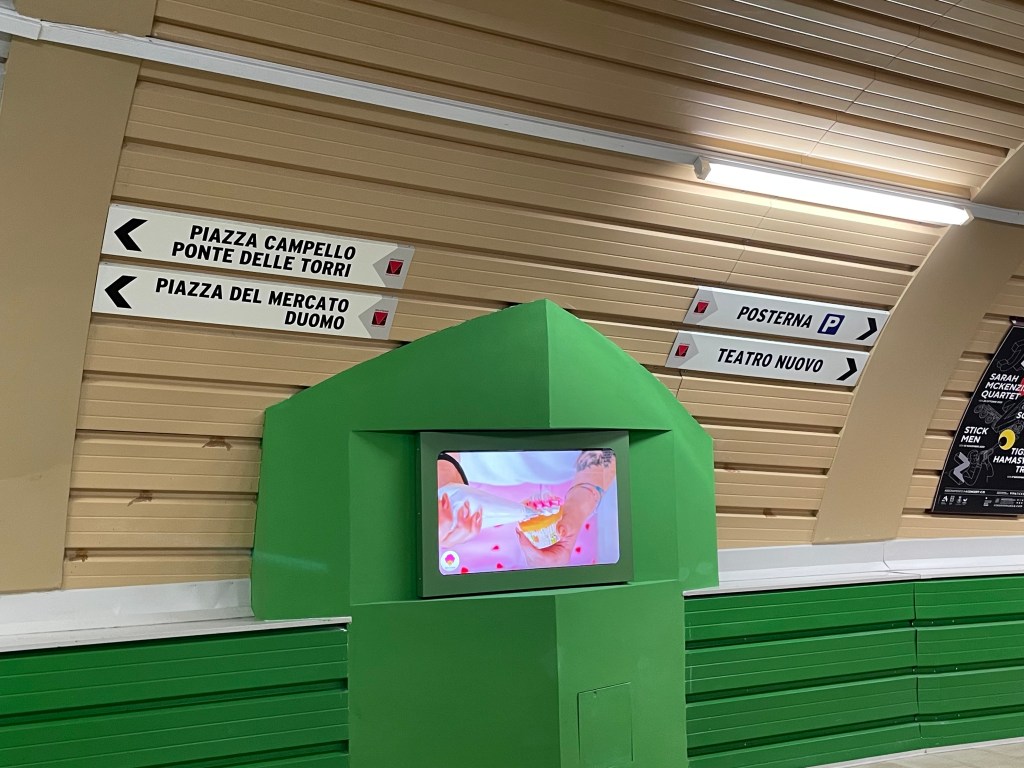
Now this is station art.

These days, Spoleto exercises its power via culture. It’s the site of the Festival dei Due Mondi, more commonly called the Spoleto Festival. Classical music musicians, dancers, and their fans from the around the world gather every summer at venues throughout the city. Because of this preeminence, artists have decorated the city’s public spaces; for example, an Alexander Calder sculpture stands watch over the train station.

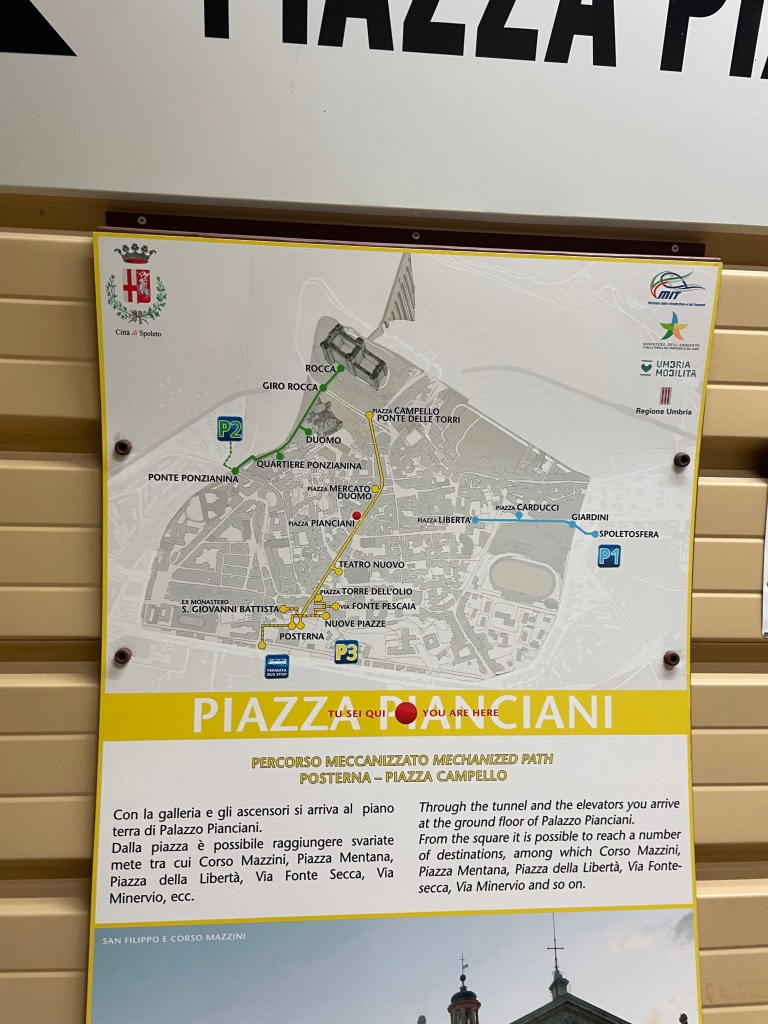
ONE THING YOU CAN’T SEE in Spoleto lies literally below the surface. Spoleto’s government has over the years built a system of tunnels that get you around the historic center and out to parking lots outside the old city walls. It’s pretty amazing. At first I thought the tunnel we used between the parking lot where we stashed our car and the edge of the center city was the only one, and pretty impressive by itself. But a few months ago we walked past what looked like an entrance to another one. With my obsession with urban transport and tunnels I just had to explore. It resembles a subway or metro without trains, but with kilometers of moving sidewalks that actually work (take that, JFK airport). The tunnel leading from the SpoletoSfera lot is decorated with large photos of festival participants and guests, so you know exactly what this former city-state stands for these days. (We can argue over whether festivals are a cure-all for urban woes another time.)

For some reason, every time we go there—and we’ll just go to hang out, feel the vibe and check out the restaurants—something serendipitously terrific happens. This past weekend, we stumbled into a street food happening and we bought enough good stuff to have dinner that night. (BTW street food is all the rage here in Italy, perhaps a reaction to the old days of formal dining in the country’s eateries.)

But a winter Sunday a few years ago topped every trip there. We drove there with two friends from New York, Wendy and Vicky. We walked around the town and when we got to the Duomo, we saw that some kind of mass baptism ceremony was in progress. Outside the church were plaques with the names of the kids. We thought, ok, cool, but there was more. We took the nearby elevator up to the old fort, which has an incredible view over the town and surrounding countryside. All of a sudden, dozens of helium balloons took off from the piazza in front of the cathedral, a riot of pink and blue, one for each baby.

That wasn’t all. We had a really good Sunday lunch at one of our favorite places, Apollinare (right). As we left and turned up the street, we stumbled in the crowd watching an exuberant Carnevale parade. Every participant wore a whimsical costumes, and a lot of them cheerfuly sprayed us all with confetti, sparkles, and silly string. DJs kept the beat going as people dressed as ancient Egyptians shimmied their way down the street.

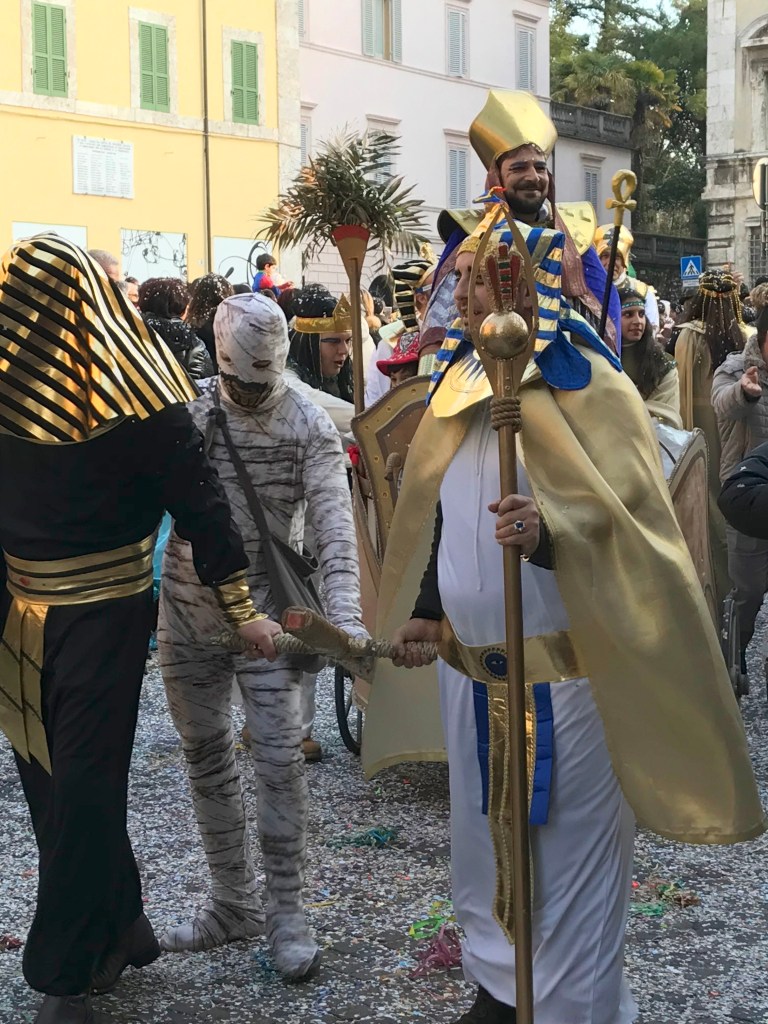
And one of paraders, in the photo below, posed gracefully as I took my shot.

Oh, nothing really.

But that wasn’t the exciting part. We were chatting away when suddenly I hear the twang of an American accent outside in the piazza. You don’t hear it that much around here. I looked out, without my glasses and saw out of focus figures wearing what looked like identical T-shirts and helmets. Francesco was intrigued, too.

—How do you know they’re American?

—The accent.

—There are different accents [I’m guessing he meant in English] ?

—Lots. [translated from the Italian]

He sent me out to interview some of them. The group was on a bike tour from an outfit called Backroads, and came from all over the U.S. One guy was practically my homeboy, coming from New Jersey, right across the Outerbridge. They were all on their way to Gubbio, about 30 km/18 miles away. Up and down big hills away, that is. “Wow, you guys must all be in pretty good shape,” I asked New Jersey. He responded, a little sheepishly, that some tour members had e-bikes to help.

The pause in piazza that refreshes

Okay, so this is not bigly exciting. But it’s all part of the everyday pleasures of life here, and it took me awhile to think like that. When we first arrived in May, I was restless. I felt that I was in this candy store and limited to Skittles. Or something like that. In other words, I was still in this-is-a-long-vacation mode and wanted to wander and even sightsee, and I wasn’t dealing realistically with the fact that we moved here. Like, to live.

And what do you do when you live somewhere? I’ll answer that: You do everyday stuff.

Since the last time we met over roasted tomato risotto, we’ve been in recovery mode, trying to get our lives back on track. August and part of September were like this giant hot blanket pulled over everything. This summer’s blazing heat kept us indoors for hours. Once it broke–somewhat—we had to think ahead. And hot though it was, we have to prepare for the winter.

Alternate fuel? Check.

Doing so is not a big deal if you live in a city—just start wearing sweaters and jackets. And turn on the heat. Here on the mountains, though, we have to lay in supplies and get stuff cleaned out to do that. We have gas heat, but the gas doesn’t come via a convenient pipeline; we have to get a delivery and fill a big underground tank, and take a big hit on our credit card balance. Because of the expense, we have a “termocamino,” or a thermal fireplace that’s hooked into the heating system. It pumps water through the fireplace and once the water reaches 50 degrees C/122 degrees F, we’ve got blaring heat circulating through the radiators. But we’ve also got choking smoke if we don’t call in the chimney cleaner. Hopefully someone will show up in a few days.

Speaking of our lives, 36 boxes of reminders of a former life came the other day. Luckily we have a whole downstairs floor to host them temporarily. And that’s a constant reminder that we’ve got to tell the authorities that we’re living here full-time and thus qualify for the national health service. Then there’s the dog registry and….and…and. Hey, this retirement thing is hard work.

BUT THERE ARE THE PLEASURES of everyday life here to compensate. We walk up the road and see this amazing view. We never get tired of it:

Valhalla, or the Umbrian equivalent

Besides the view, we’ve got neighbors. We can’t actually see them; we’re all spread along this winding road. But a simple 2 or 3 km walk means waving to cars passing by, and someone’s bound to stop and chat and invite us for coffee. A couple of weeks ago, we were doing our walk when a car pulls up. Usually it’s people lost and needing to find one of the nearby hamlets. A guy in accented Italian asks us if we’re the people in the yelllow house. We respond in English, we’ve been anxious to meet you. Seems we’ve got a famous lutenist living in a small house up the road, a fellow refugee from the U.S. If you’re into Renaissance music, look up this name: Crawford Young.

And have you ever had the experience of having a shop, a restaurant, a, I don’t know, a shrine nearby, and you tell yourself you’ve got to go there but you always forget or take it for granted that it’ll be there? Such was the case with the pretty recent addition to our town, Bottiglieria Barbarossa, a terrific enoteca right in the historic center. It opened about a year ago, and it’s a great place to try out local wines and artisanal gins and the like. And the owner Massimiliano is really passionate about his wares and the industry in general. We had a long chat about “natural” wines (he’s not a fan; I’m inclined to agree), the sacrifices restaurant owners make and our careers and life trajectories. The place has the additional benefit of big windows out onto the piazza so you can see the street action without the town’s resident old dudes staring back at you.

Just add wine=the perfect snack

There are other good bits of Italian small town life. We’re looking forward to a fish and seafood lunch this weekend. The menu looks incredible–appetizers, two “primi,” a fried seafood course, dessert, wine, water, and coffee. All of this in our friend’s hamlet for €35 a head, or about $37. It’s not just the food, of course. It’s the communal spirit of it all.

Our town, though, has got that communal thing licked. There are way too many events, walks, lectures, dinners, concerts going on to even start to list them. For a town of maybe 3500 souls, give or take, it’s a lot. And the town fathers and mothers are anxious to promote what we’ve got. Far be it from me to spoil the fun, so I’ll leave you with this video (in Italian), which gives you a good idea of what I’m saying:

Well, this definitely feels different

After years of slowly, glacially, indecisively moving over, we’re finally doing it. The old house in New York is mostly empty and being renovated by its soon-to-be occupants (we’re keeping it in the family), while a few dozen boxes of personal effects are somewhere in a warehouse awaiting shipment to us here. This house has been ready for years, even if there are features here and there that we’d like to put in. My ex-editor used to tease me about my commitment issues, so take that, boss.

This old (by American standards) house will soon have new occupants.

Call it procrastination, call it circumstance, call it Covid-19, whatever. Up to now our stays here on the Umbrian hilltop have felt like really long vacations, even if we had to do everyday stuff like renewing the car registration. Not to mention taking the garbage and recyclables to the “tip,” as Brits would say. (We’re talking about a few plastic bins down the road. More on this last bit later.)

All that’s left is some bureaucratic stuff It also means that we’ll be back in the U.S. less, and in some ways that’s a relief.

Let me explain. I don’t usually like to do the we have this, they have that game, but to understand something, or a place, you often have to stand outside of it. Such is the case with the country of my birth. Our four- or five-month stays away have given me some perspective. And I gotta say I don’t like what I’ve been seeing. After one absence a few years ago, for example, we suddenly saw monster gas-guzzling pickup trucks everywhere. In New York City. Driven to the supermarket and on the school run. Really?

Relax, it’s just an induction cooktop, not a culture war. And water boils real fast.

More recently, and especially after Covid, there’s a palpable feeling of anger on the streets. Maybe we’ve gotten too used to the easy sociability here in Italy, where every encounter is a potential long conversation, but our fellow Americans seem sullen and angry. You feel it even when driving, when every SUV and pickup surrounding us seems to be driven by a lunatic. People do stuff that Americans used to accuse Italians of doing, ignoring stop signs, passing on the right only to make a left turn, driving at ridiculous speeds on local streets. No wonder there are speed cameras everywhere. It’s not just driving; shop clerks are nasty and ‘net bulletin boards are full of snarky comments.

What makes me really sad, though, is how the U.S. seems stuck in the past. Sure, this Mac I’m writing this on is up to date, and companies are always updating products and services. But every single change, even trivial ones like cooktops, has become a political and cultural minefield. Meanwhile, the Old Continent moves on. Not everyone likes it, I’m sure. But the feeling that this is 2020-something and we have to deal with climate change is palpable, even here where a right-wing government was elected last fall. (Never mind that the prime minister is a relatively young woman, who isn’t married to her partner, the father of her child.)

LET’S GO FOOD SHOPPING, just to make a few points. Here we are at the garbage bins. We drove here with our pint-sized Renault, which is due to be replaced by an electric model in a couple of years. You can argue about the ultimate merits of recycling, but for now we have to sort our garbage. One bin gets plastic, and almost everything plastic counts. Another is for paper, another for regular garbage. And the final, smelly one is for organic food waste. There’s a glass bin down the hill; we love the sound, as Nick Lowe once wrote, of breaking glass.

The Clio encounters some garbage bins on the way down the hill.

I’ll cop to the fact that we shouldn’t have driven so long to get to a supermarket. But in landlocked Umbria, just the occasional store has fresh fish, and these former seaside people gotta get our fix. Notice that there’s something different about the parking lot. Those panels shading the cars aren’t just pieces of plastic and steel; they’re solar panels. And these panels supply a big part of the shopping center’s electricity.

Those panels aren’t just there for the shade.

A lot of people, and especially Italians, criticize this country for being fossilized. And I can see that when it comes to some bureaucrats (let me tell you about the woman at the water board…). At the same time, we have a decent infrastructure, fiber Internet is being rolled out across this region, and, especially since Covid, most people just tap their phones or cards to pay everything from a coffee at the bar to induction cooktops at the Italian version of Best Buy.

And our prime minister and the opposition leader are both women.

It’s not just a glass of Chianti in the sunset

Quick! When you think of Italy and its food and drink, what springs to mind? Pasta, sure. Pizza, definitely. Maybe gelato, and of course, a glass of wine to go with the meal. In fact, Italy is the biggest wine producer in the world, flooding shops and supermarkets globally with gallons of Prosecco, mass market Pinot Grigio, and fine reds and minerally whites.

But Italians are also beer drinkers. It’s not to the extent that Germans, Brits or Americans are—you don’t see Italians having keggers, and they tend not to wander around the cities in a beer-drunk haze. But historically, people here drink beer when it’s hot, or if they’re having a pizza night out.

Up until recently, mass market beers ruled Italian supermarket shelves and restaurant menus. But the micro/artisanal brew trend came to Italy too, and people appreciative of good beer have a wide selection of often local, interesting brews to choose from. Restaurateurs have picked up on the trend, too. Not from our house is a place called Umami Beer, whose owner has scanned the world for interesting brews for his patrons. The menu is eclectic too, with a wide selection of snacks, burgers and more traditional local dishes. It’s all part of the general loosening up of the culture, as more Italians travel abroad and acquire a taste for a wider palette of flavors.

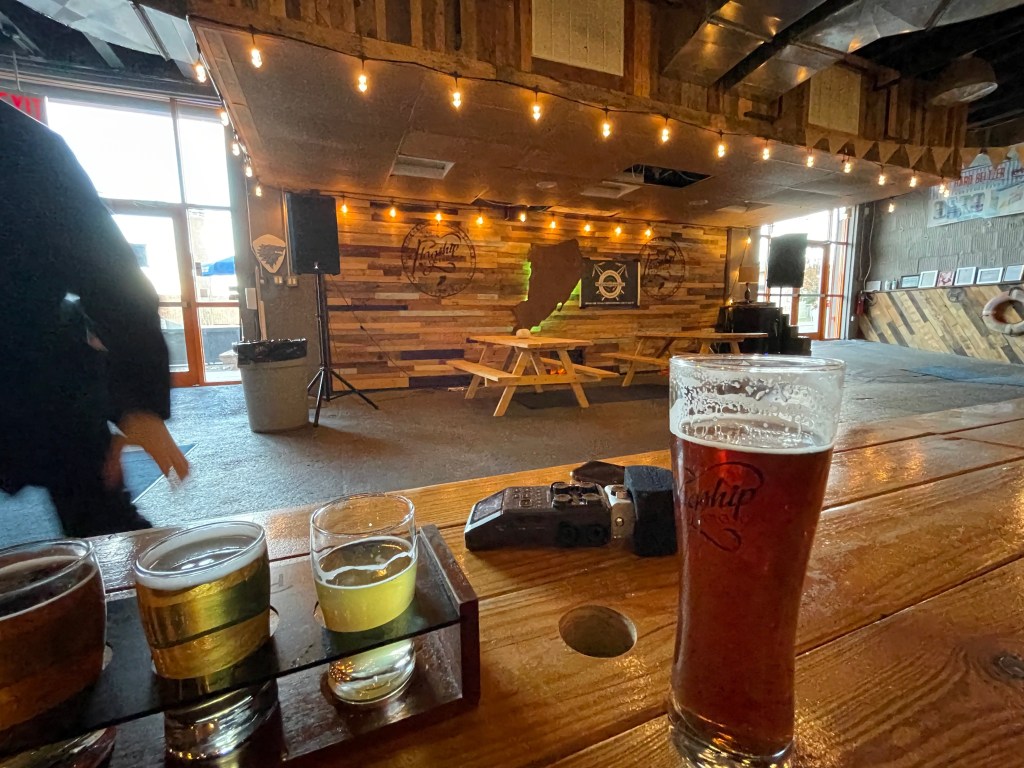
The taproom of Staten Island’s finest

Before leaving New York, I paid a visit to one of Staten Island’s two local small breweries, Flagship. The good people there like to name their brews after local places and people. The island’s population is about 37 percent Italian-American, so in recognition of that, they named a Pilsener-style beer (popular here) Birra Locale. (You should be able to figure it out, but if not, it means “local beer.”) My slightly perverse mind thought it would be fun to bring that Birra Locale to an Italian artisanal brewery.

My target: the brewers of Birra Flea. In this case, “flea” is not the pesky little bug infesting the cat and your carpets. The name derives from a local river. I thought it might refer to a family, but no. I took minutes—minutes, I tell you!—of intense online research to learn this. The beer is definitely one of the shining lights of artisanal brews. The big Coop supermarket here places it in its cantina of good wines and small-producer beer, and Roman celebrity chef Max Mariola drinks it regularly as he shows his YouTube following another recipe. Flea comes from Gualdo Tadino, a town about a half-hour from our house that nestles in the foothills of the Apennine Mountain chain.

OFF I WENT THIS MORNING. Flea’s headquarters and brewery is located outside Gualdo on an isolated road. I had serious doubts that anything except a farm might can exist there. But I asked a couple on the road if I was on the right track and they assured me that the brewery was, in fact, down the road. Of course, it ended up being hard to miss, a modern charcoal gray-to-black edifice dominating the area. To emphasize its importance, the outside sign reads “Universo Flea.” I thought, well, this is more than a folksy little brewery.

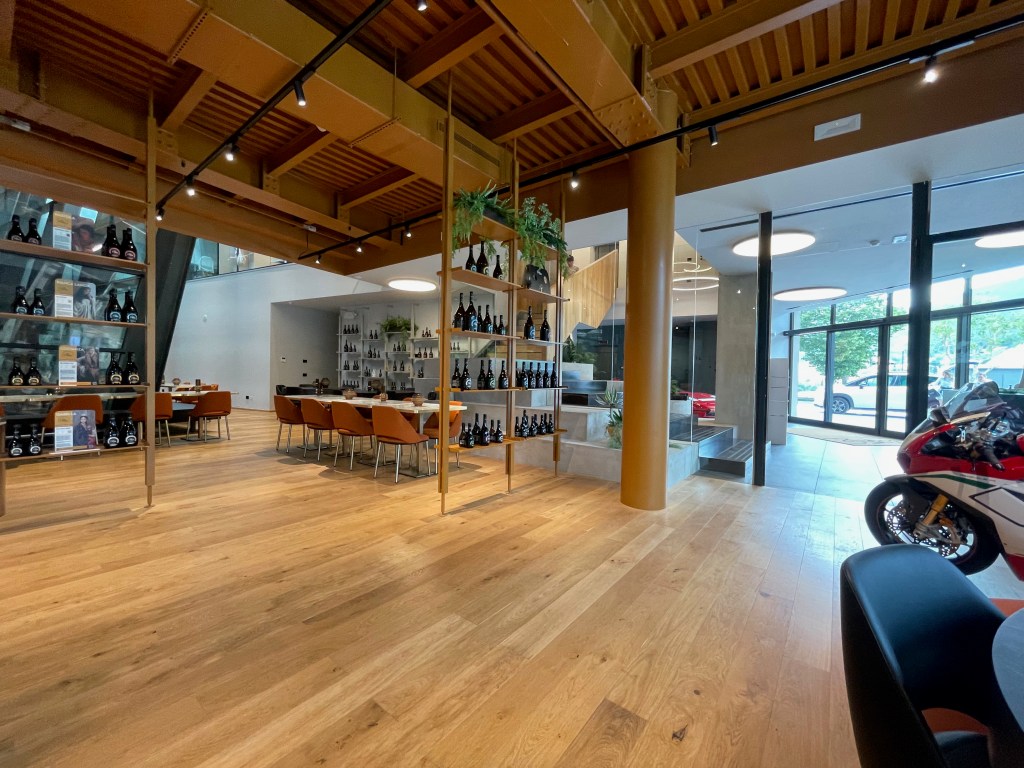
However imposing the building is, the reception was the typical friendly greeting that’s pretty universal in this part of Italy. As soon as I stepped through the doors, they knew who I was and why I was there. (It wasn’t a mystery; you reserve a tour and sampling on Flea’s website.) The decor is modern yet warm. And for some reason, they have a historic red (what else?) Ferrari parked near the reception desk.

Sara poses with a birra that is definitely not locale.

My handler Sara soon greeted me. I won’t bore you with the details of brewing, but I can say that I was impressed by the tranquil atmosphere, not to mention the huge fermentation tanks. Trashing a stereotype a lot of people have about Italy and artisans, Flea’s operation is decidedly high tech and as sustainable as it can be. They grow a lot of their own malt at a farm not far from where I live. The farm animals that came with the land supply them with milk, which they’ve turned into a cheesemaking operation. I’ve been fascinated by production lines ever since I was a little kid, and the bottling, tapping and packing machinery gave me tons to stare at and admire.

I’ll confess that I love conscientious food and drink producers. And breweries have a special scent, the sweet malt that perfumes the place. It kind of humanizes the assembly lines and the high-tech fermentation tanks. Beer, like wine, has a long history. Sara told me stuff I had no idea about, like how hops isn’t there just for flavor, but also acts as a natural preservative. And centuries ago, nuns figured out how it preserves but also balances the flavor. Before then, most beer was sweet, a natural result of the yeast reacting with the malt or other grain used to brew the beer.

By now, you probably realize that Flea may make artisanal beer, but it’s not a hole in the wall operation. They’re looking toward the future. Much of their electricity comes from solar panels. (In fact Italy leads Europe in solar-derived energy.) And now they’re going to try to brew beer from the air; they’re experimenting with a technology that pulls humidity from the air. They’ll pilot test that water for brewing.

Who needs lunch when you’ve got this to go with the tasting?

At the end, I had a taste test. I chose three beers from their list; I tried to pick different colors and strengths. “Margherita,” a wheat beer, was crisp, not too hoppy, and just right for a hot summer day, or a nightcap. Their golden ale, dubbed Federico II, was fruity and just assertive enough. And a Belgian style ale named Violante was, just as the label said, powerful and just right for a cold night and stew. Because we’re in Italy, food soon appeared in front of me, so I didn’t have to think about lunch—the cheeses on the tray come from their cheesemaking operation.

Flea turns a decade old this weekend. If the next decade resembles the past ten years, they may have to reassess that artisanal tag. In any event, this afternoon was a great way to see a bunch of mostly young people making a terrific product in a beautiful space.

No, Big Tech isn’t going to save the world. But it’s made our little world a little easier

If you’ve ever worked with me, you’ll know that I have distinct geek tendencies. Back in the late 1990s I took a break from being a full-time editor to play with machines. The project involved bringing a few newsrooms up to modern standards. One newsroom went from an archaic and incredibly strange Windows PC and Mac setup with no way to track files, to what was then the standard for publishing, the Quark Publishing system. But it was pretty no-frills at the time, with the first project not having direct Internet access until a year or two after the system was in use.

I think about technology a lot, although at this point I don’t earn a living by sharing those thoughts. But with our weird one foot in each place life, I have to say that tech has smoothed the way, making it easier to stay in touch with family and friends, and—sometimes I’m not completely convinced this is a good thing—it’s made it easier to live similar lives on both sides of the pond when it comes to music and video. I guess that I’m writing this because I get tired of the constant drone of negativism about where we are in 2022 when it comes to humans and machines. Yeah social media can be a menace. But the emphasis is on “can.” It doesn’t have to be and the fact that it’s easy to misuse makes it more important for us to be vigilant.

I’ll come clean right away: We’re in the Apple ecosystem; we trade a little more expense for fewer complications. The Spartan Woman started it years ago when she brought a Mac home from school one summer. Her school’s principal figured that the computers would be safer living with teachers than stored in the school over the long holiday. Back then I was taken immediately by how easy the Mac made it to do stuff like move files around, rename them, duplicate them, etc. I was a convert, and the following year, we bought our first Mac. I actually used it to gather wire copy and send it into the publishing system at work.

SO WHERE DOES TODAY, AND THIS BLOG come in? Well, when you think about it, we’ve got the digital equivalent of an RV—we carry our media home around, as long as we’ve got an internet connection. Only it weighs a little less and uses a lot less energy.

Our approach: We only buy laptops as computers, and we have iPhones; they like to work with each other. iPads are optional. We have little HomePod mini speakers, so we can have our music in both places without carrying around CDs (remember them?). All of our devices work with both U.S. and European voltages. I bought some Apple plugs that fit right into the AC adapters, so there’s no bulky and problematic adapters. We’ve laid in a supply of European rechargers, too, so that we don’t have to cart everything around. The only time things get complicated is when we aren’t going from one home to another directly. In that case, we need a couple of rechargers with Euro or American plugs to work in hotels and rented apartments.

Casa, dolce casa, discreetly high tech

In Italy, we don’t watch broadcast TV; we have a smart TV with an Apple TV. I know that’s redundant, but the Apple TV interface is much easier to use, and it gives us access to more services. The setup gives us Italian public TV stations via the app RAI Play, plus all the streaming services that we use, like Netflix and Mhz Choice. By the way, the latter is terrific, featuring European programming with subtitles, just in case you’re challenged by, say, Icelandic.

I guess that I wouldn’t be writing this post if we just vacationed for a week or two. Back then, we somehow managed to live without our music collection for a couple of weeks. But we’re older and spend a lot of time at home, especially in the winter, when Umbria is usually dark, cold, and wet. And thinking back further, The Spartan Woman and I wrote each other nearly every day that we were apart. Yeah, it was sweet.

Now, though, I can do remote work when it happens. Our hilltop Italian ‘net connection isn’t the fastest, but it gets the job done. And when it wigs out, we use our phones as hot spots. So what if a video chat is grainy or freezes every so often? It’s better than paying through the nose for a 3-minute phone call, like in the old days.

Some practical tips:

• You’ll need a lot of rechargers, recharging cables, adapters, dongles, etc. Put them all in a big Ziploc bag and carry that bag in hand luggage. Make sure your devices are fully charged; USB ports on planes aren’t the most powerful. Buy a portable battery pack or two just in case. (My bag of tricks on the right.)

• Put your laptop in a padded case. Because of airport security, make sure it isn’t a pain to haul it out and open the case. The faster you can get stuff in and out, the faster you’ll get through security. European airports seem to have more sophisticated scanners and the more polite security folks don’t make you take everything out of a knapsack or computer bag.

• If you have a choice, buy what you can in the U.S. Italian value-added tax (sales tax in Amurrican) is 22 percent, versus 8.something in New York. The weakening Euro means higher prices in Europe in general. There are negligible differences between U.S. and Euro models, but you might be disoriented by the laptop keyboards on European models. They typically have a bigger “return” key, and have keys for letters with accents, such as è and á.

• Don’t expect to find wifi everywhere. In fact, if you’re a frequent traveler, you might notice fewer hotspots than before. Why? European mobile plans cost a lot less than plans in the U.S., and typically have tons of high-speed data included. So Europeans these days have less of a need to hook up to a wifi network when what the speeds they get on cellular networks is perfectly adequate.

Enough of that old stuff. Let’s see some modern architecture

People come here to see old stuff. There’s Assisi, with the hundreds of years old basilica, with Giotto’s frescoes. Perugia has a still intact Etruscan gate and mysterious Etruscan tombs on its outskirts. Spoleto has a Roman amphitheater. For those of you who missed Ancient European History 101, the Etruscans predated those newcomers, the Romans. You can see more modern construction from, say, the 1500s. And apartment buildings that are 100 years old or more are considered to be kind of new.

Along comes Kid no.2 and her partner in art and life. We haven’t seen them in months. And the atrociously hot, then tropically rainy summer kept us from going out much. (So did our continued Covid vigilance) So when those two arrived, it gave us a chance to get out of the house, off the mountain, and play sightseeing guides for a week.

What do you want to see? we asked. “Al (the BF) wants to see some modern architecture. Well…. But it does exist. Umbrians don’t sit on their ancient marble doorstops. And to be honest, looking for modern works was a nice break from Olde Europe,

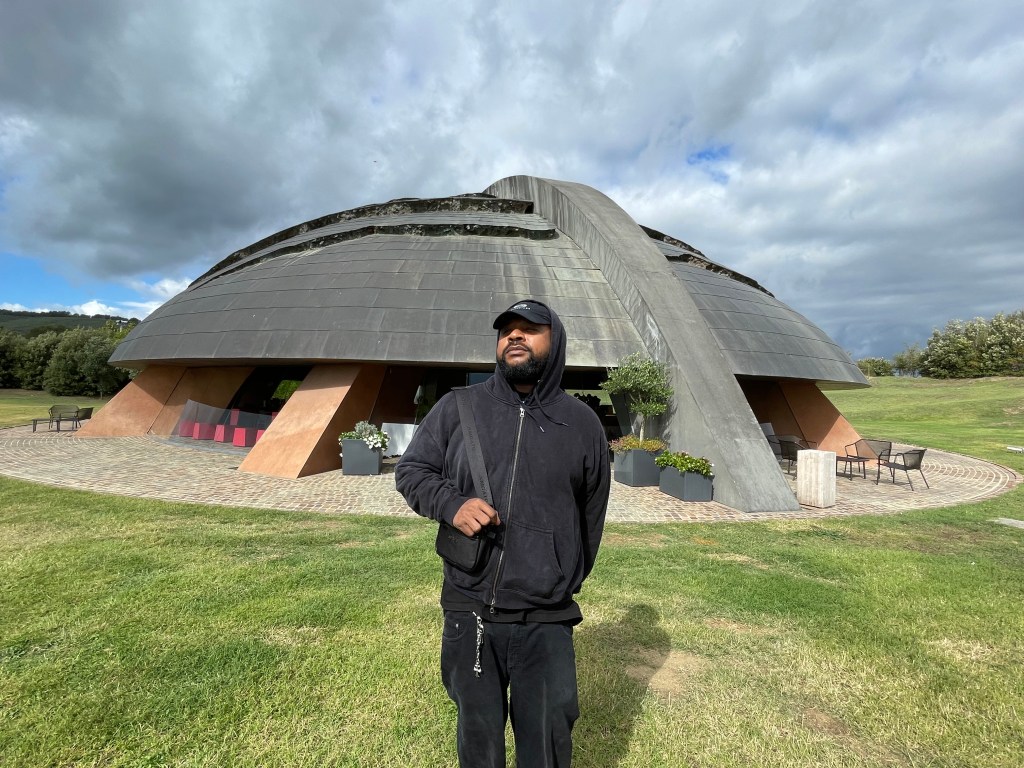
Friends told us about Il Carapace, a winery like no other. The name means shell—most commonly a turtle shell, but animals like shrimp and lobsters have them too, The producers of prestigious wines like Ferrari bubbly, Lunelli, decided that they wanted a statement canteen.in their Umbrian winery, Castelbuono. So they commissioned sculptor Arnaldo Pomodoro to build it.He’d done work for them before, but I have to say, this building came almost as a shock as we drove through sunflower fields and old-style vineyards. The Carapace rises out of the landscape like some alien space ship, a little menacing and a little humorous at the same time.

He asked for modern. He got it.

The surprises don’t end when you enter the belly of what could pass as a Klingon ship. The theme is copper, which clads the exterior, and whose paint adorns the inside. You feel like you’re in the belly of the beast, and a 360-degree view lets you meditate on the ancient vines. Castelbuono produces Sagrantino—Umbria’s most prestigious wine—and Rosso di Montefalco, a less intense, more easily quaffed red wine. If you need a Tuscan comparison, think Brunello to Rosso di Montalcino. The aging barrels sit in a huge underground space.

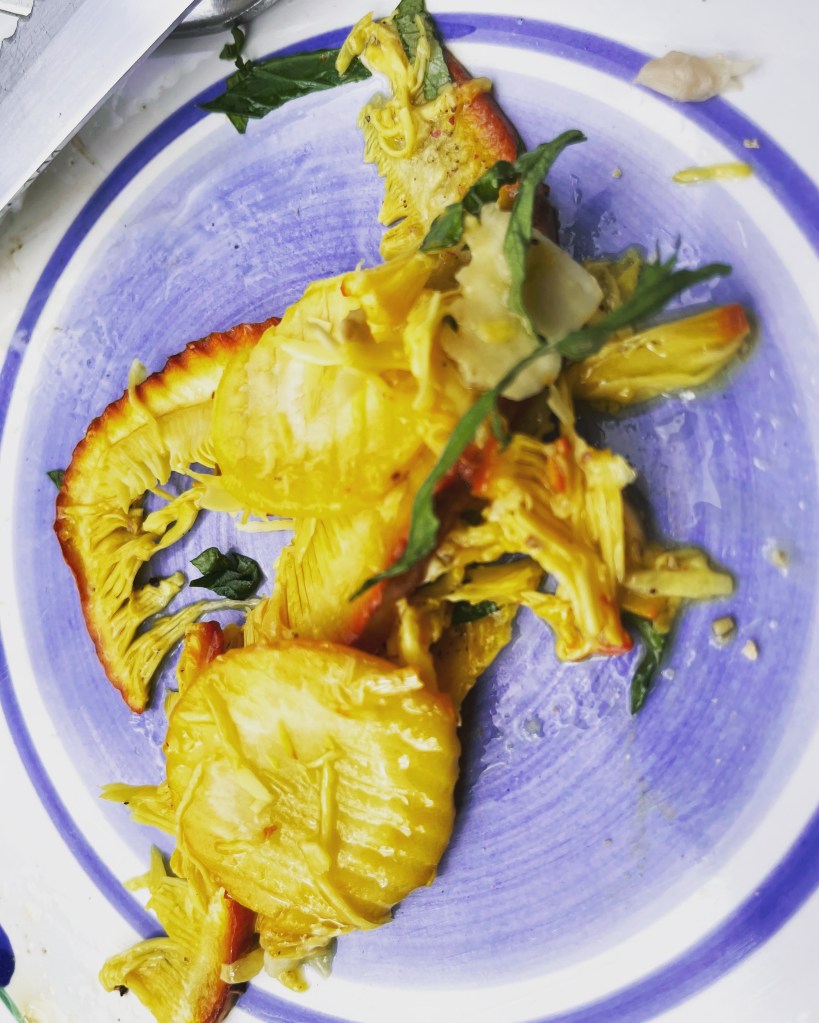
We had to eat, espcially after sampling three wines with a little nosh, so we left the Carapace to get lunch in nearby Bevagna. We were back in old Umbria, which has its abundant charms, not the least of which was a salad of raw ovoli mushrooms, which in their way looked as alien as the Carapace.

The mushrooms from another planet

A COUPLE OF DAYS LATER, we went to Foligno. We’d never been, except to the train station, which is a major transfer point for trains from the main Rome-Ancona line and the pokey local “regionale” to Perugia. The object? The modern art museum, the Centro Italiano Arte Contemporanea.

Foligno is unexpectedly interesting. On the outer rings of the small city, there are lots of Stile Liberty, or Art Moderne villas. There’s a long wide pedestrian street filled with porticos with bars and restaurants, and tons of shops and terrific window shopping. Who knew?

The modern art museum has one thing in common with the interior of the Carapace: a copper color. It basically looks like a copper box in the middle of a older neighborhood, and is instantly recognizable because of that. The permanent collection is pretty small and unfortunately they were between exhibits. But there’s more….

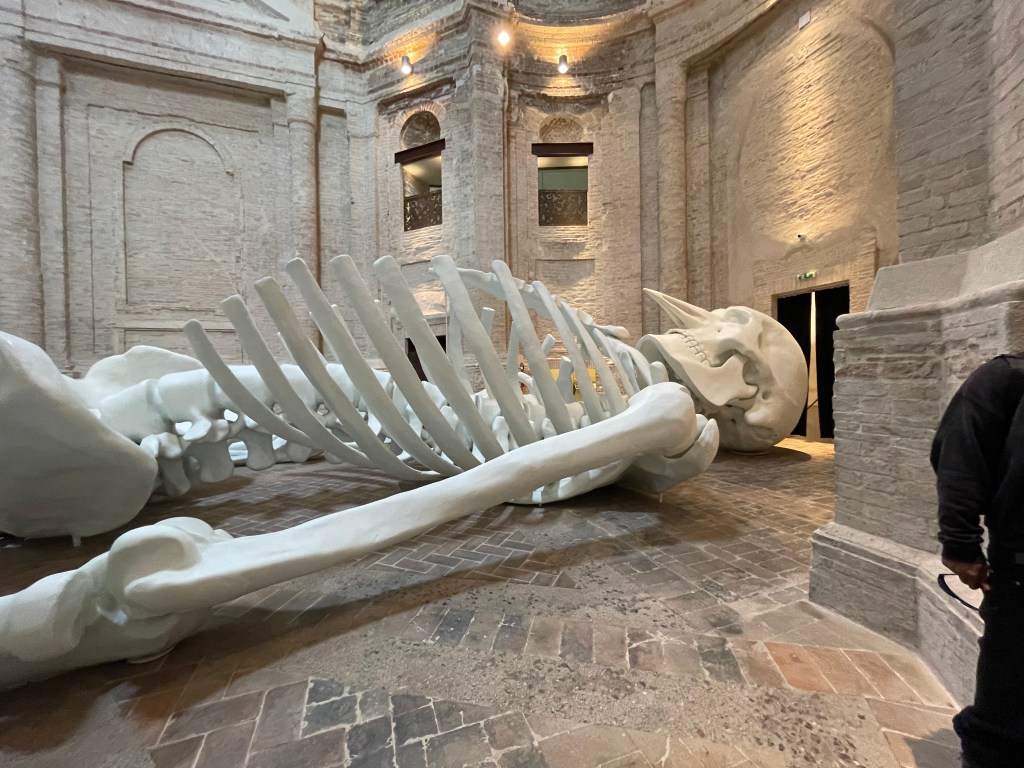
A 10-minute walk brought us to a deconsecreated church, the Chiesa della SS. Trinità in Annunziata. where, in the middle is a giant skeleton replica, by the secretive and subversive artist Gino de Dominicis. Its official name, “Calamita Cosmica,” or cosmic calamity. It’s pretty amazing, the kind of thing that held our attention as we walke around it. It’s not just the thing itself; it’s the context. De Domicis is described in the work’s website as “a controversial figure in modern postwar Italian art, with an eccentric personality, himself an endless work of art, original and full of secrets.” All I know is we just stared in wonder as we walked about the beast and tried to take photos that did it justice.

Well, why not?

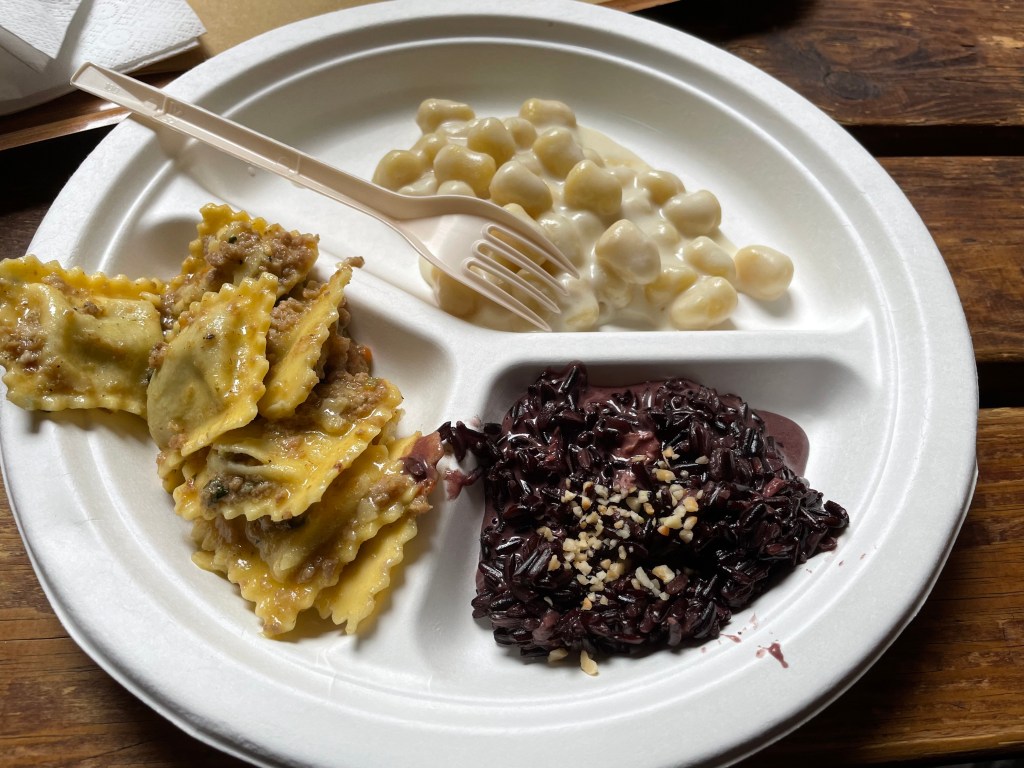
Of course, we worked up a powerful hunger after that expedition. Happily, Foligno was there for us, with a festival of first courses. In the progression of an Italian meal, the “primo,” or first course, is actually the second. It’s composed of pasta, soup, or rice. Note that it is not what Americans call a main course; to an Italian, a huge plate of overcooked spaghetti serving as the main meal is a travesty. The festival was terrific, even if it was a rainy day and we had to traipse all over the center of town. Big signs and a handout map guided us to various restaurants around town that served regional primi; it was fun to pick and choose, for a really good price of €5 (5 bucks) a plate, with cheap good wine to go with it.

A “tris” of primi

We’ll be going back to Foligno as soon as we can. The festival got us acquainted with what seemed to be dozens of cool bars, restaurants and shops. Can’t wait.

How do you live like that?

We’re hiding out in the dark. It’s a bright sunny hot day out there. Beautiful, in fact. But you know what they say about mad dogs and Englishmen.

We get asked a lot by our American friends about, for example, the lack of air conditioning in our mountain retreat here. We love to say that we don’t need it about 99 percent of the time. Yeah, even when the Mediterranean sun is beating pitilessly down on us mortals, when you need sunglasses just to step outside, etc etc. What do we do? We conform to the local custom and hide out. In fact, I just had a wonderful short nap, after which I stared at the one open shutter looking at how the breeze swayed the tree branch. Hey, after years of working in busy newsrooms and tending to computer systems, this is not a bad thing.

It’s bright and hot out there, so I write in the dark.

In fact, our friends from across the pond are often amazed at this and the dozens of other small differences between the continents. In the old days those differences might have meant a lower standard of living for Europeans, but these days it’s often the U.S. that feels behind the times.

For us, it’s all about adaptation. We’re lucky in a couple of ways. First, culturally: I grew up in a Sicilian household that just happened to be in New York City. So the language wasn’t hard to pick up; when i was 5 years old my nonno (grandfather) from Palermo lived with us. He and I took walks almost every afternoon. He didn’t speak English and I don’t remember speaking Italian. But we had pretty involved conversations, so maybe I did, or at least understood enough of what he was saying. My first experience here in Italy wasn’t as a tourist; we stayed with family for half the summer. Likewise, The Spartan Woman lived in Perugia while attending the university there.

Nonno and me, a few years ago

As for climate, so far we’ve been blessed with only slightly strange weather and nothing like the craziness up in Germany. It’s been hot for the most part, but not too—around 30-31 degrees C, or 86-88 Fahrenheit. We get breezes up here since we’re at the crest of a hill. And our house, like every house around here, is made of stone, thick, meter/yard thick stone, which does a good job of keeping things cool during the summer. All we have to do is close the shutters along the sun’s path, which is why we sit in the dark at lunchtime.

Thinking about this stuff makes me remember last summer, during the darkest days of the Covid-19 pandemic. TSW and I (and our trusty dachshund Lola) basically stayed indoors most of the time, except for dog walks. We stayed in the shade too, but that’s because our Staten Island home is on a lushly tree-lined street. It being New York, though, it was humid as well as hot. So we kept the air conditioners running almost all the time, and the television was usually tuned to MSNBC or, for relief, HGTV. We sent out for food and wine, and I took naps out of sheer boredom. Our electric bills were through the roof; luckily we didn’t have huge gasoline bills because 1-we didn’t go anywhere, and if we did 2–we’re bad Americans and have a small European hatchback instead of a monster SUV or pickup like lots of our neighbors.

In fact, I gassed up last week here as we set out for a town in the mountains, Casteluccio di Norcia, and the vast glacial plain around it. One of my cousins from Sicily is driving around Italy on her wedding trip and she and her husband stopped by for a few days. So we were four adults in our Renault Clio, what the industry calls a B-segment hatchback (in U.S. terms, think Ford Fiesta or Honda Fit). Part of the way involved highway driving, but most of the route consisted of one lane in each direction, steep uphills and switchbacks, and lots of gear changing (as well as passing slow trucks, which means revving the small engine to the max). It’s a diesel, the kind of car that will be extinct in Europe in a decade along with all internal combustion engines. We filled up yesterday and for 338 kilometers, we bought about 15 liters, or nearly four gallons of fuel. It works out to about 52 miles per gallon—and that’s pretty normal here. Yet the four of us fit into the car fine and, yes, the a/c was on. I hate wind noise, especially when driving on a highway.

Meet Clio, who doesn’t drink very much.

Perversely, Covid-19 has brought some changes that have updated the way people here live. Cash was king not so long ago, and it wasn’t unusual to see someone pay for a load of groceries with a wad of cash. But now, most stores not only accept contactless debit or credit cards, but the same machines mean you can use Apple or Google pay on your phone. I’d guess that it’s more common here than in New York, where local merchants are still amazed when I pull my iPhone out of my pocket to pay.

We shared “the best beer in the world” at Umami Beer.

Speaking of Covid-19, WTF? We look at the vaccination maps back in the U.S. with a mixture of wonder and horror. Sure, there are some antivax crazies here, but it’s not a big thing. If there’s any criticism of the vaccination program it’s that it took awhile to gather steam. But now Italians are among the best-vaccinated people in Europe, and probably the world. After a slow start it seems like everyone we know has gotten both jabs, and the tend to be Pfizer. So we were less nervous when we got together with a few local friends here for, um, for burgers and beer. There’s a laid-back place near Assisi called Umami Beer, and it’s one of the favorite places for our friend Letizia Mattiacci, who runs the cooking school La Madonna del Piatto. I don’t feel sheepish at all plugging her and her classes; she’s warm, fluent in English, and her cooking pays homage to Umbria while having a fresher, more veg-friendly take on familiar foods. (By the way, she and her Dutch husband Ruurd also have a B&B there and can put you up between classes.) Umami’s no simple burger joint; owner Roberto sources high-quality ingredients and tracks down great beers from around the globe.

The Delta Covid-19 variant is beginning to be felt here, too, and it’s put a little damper on things. We don’t go out as much, and we’re still supposed to wear masks in indoor public spaces. The government says that it may tighten some rules in a few regions. But following public health rules here seems less fraught and less of a statement. Everyone does it and there’s no stigma or weirdness. If it’s one thing Italians are really good at, it’s self-preservation.

Davy Brooks is wrong just about everything

Some of you may know about my on-again, off-again obsession with New York Times columnist David Brooks. You might even wonder why, other than his sheer laziness and obviousness. I’ll let you in on my eternal shame: I once shared a byline with him, in the now-defunct women’s magazine More. The piece was a feature about “Alpha Women.” Brooks wrote the intro; I did the write-ups of the women themselves. We never spoke to each other.

But I have another reason for the headline. It’s about Brooks’ periodic praise for American innovation, or what he sees as innovation. The narrative goes like this: The United States is a tougher place to live than Europe, where people enjoy things like universal healthcare, long vacations, and a decent safety net. But the United States gives us something that they can’t—the freedom to dream and innovate and be like Steve Jobs and Elon Musk. All this cool stuff like iPhones and Amazon’s Echo comes from the U.S., not those sclerotic old soft countries across the pond.

Sigh. I’ve been trying to figure out what’s wrong with this way of looking at the world, and The Spartan Woman and I have been batting around ideas. Living in both the dynamic, young inventive USA and tired old Europe, I try to resist the kinds of comparisons a lot of people do. I hear it all the time; Sentences that begin with “We have xxx,” or “Ours are different” or “How come they….” You get the drift. Both regions are what they are.

Then again, let’s talk about innovation. In American terms, it’s almost always a synonym for “technology.” When Brooks and his brethren (they’re almost always guys) gloat about American inventiveness, they invariably bring up the iPhone, or Google, etc., and boast about how they dominate the world. Okay, fine. But are they everything? Is computer-related technology the only way people can innovate, or think of new or more useful ways to live?

I’d say no. Let’s talk about how people move around in their environment. The U.S., for all the buzz about autonomous cars, is way behind the rest of the world. Stubbornly and proudly dumb about it. Highways are jammed, in the older cities, public transport is falling apart; here in New York it’s a battle to keep the subways and trains in any kind of working order. New York is still struggling to start building a new rail tunnel to link it to the rest of the country as the one in use crumbles and soon will be dangerous to use. Smaller cities are car-only, with maybe a rudimentary bus system. (Those cities out west that are building and expanding light rail systems are a noble exception.) In a way, the autonomous car thing is a perfect metaphor for the U.S.—high tech will come to the rescue of a way of life that’s stubbornly holding on and killing the planet.

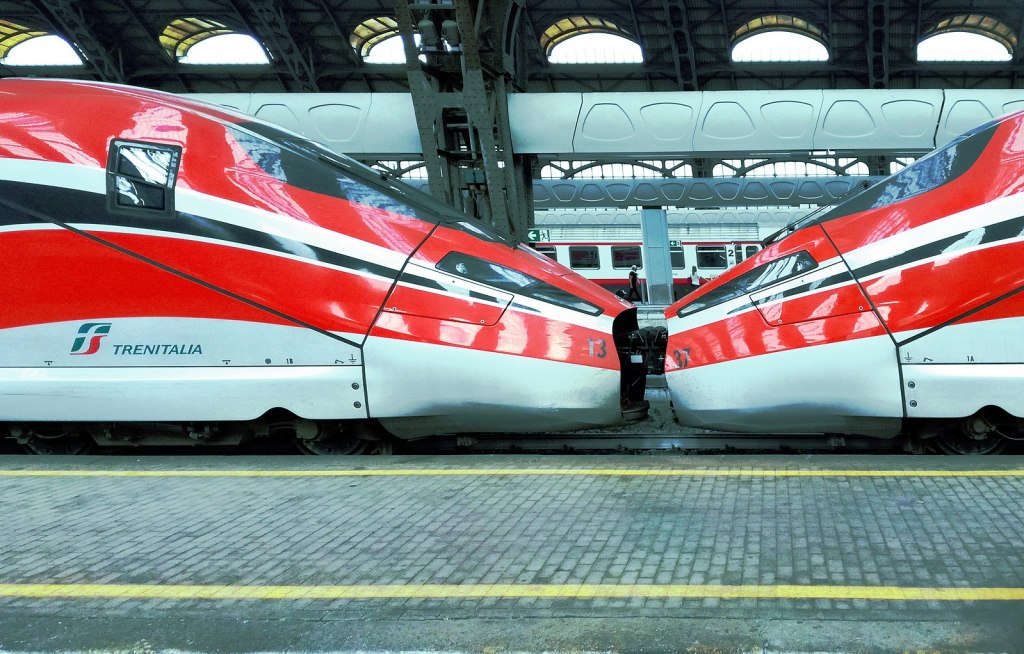
Way faster than the Acela

In Europe–and even in Italy, which isn’t usually thought of being ahead of anything modern–you can zip around on fast trains. It takes just an hour and a half to go from Florence to Milan; the Rome-Milan trip, which is about 500 km or about 300 miles, takes under 3 hours.

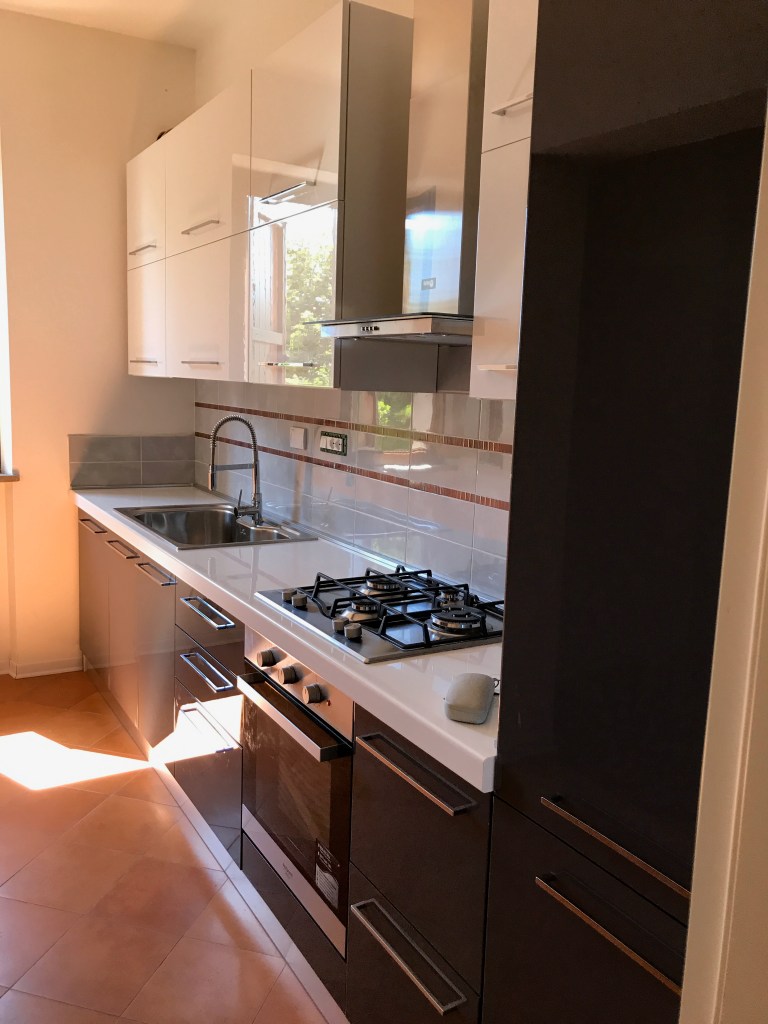
There are lots of other examples where “innovation” doesn’t necessarily mean computers or online anything. As an American, have you remodeled a kitchen recently? How long did it take, and how much did it cost? We put in a kitchen in our Italian mountain house, with sleek white and grey laminate cabinets and the usual appliances. It took a couple of visits to a store, a little plumbing and electrical work, and then the kitchen was done in a day. The innovation came in the form of design; the manufacturer has a bunch of modules, with some custom work. It sends a “geometra,” someone who measures everything, looks at where the outlets and gas lines are, etc. Two guys and a truck later, it was all there. (And it came to about $5,000.)

All in less than a day’s work

And then there’s the espresso machine. At least for me, it’s improved my life more than, say, digital internet (sorry FIOS, you’re not my first love). So, once again, my usual disclaimer: I’m not saying that one place is necessarily better than the other–well, okay, in nonmaterial quality of life, one is better, but you might not agree. It’s just that there are other ways of looking at what’s important, and how life should be lived. We as Americans should look around some more.

And, er, Davy’s wrong.

Photo of the semi-hidden visage of Brooks at the top: By PBS Newshour – Flickr, CC BY 2.0, 0