Eat like a peasant—and enjoy it

Staten Island, where we spent three weeks and some, has this image of being a sort of Sopranoland, its residents a larger version of the cast of Jersey Shore. That’s only partly true, and applies only to some neighborhoods. Our daughter lives on the North Shore, which is a multiethnic paradise. And after a few months of mostly “Italian food”—I dislike the term because there really is no unified cuisine here—we were craving the offerings of our former Japanese, Chinese, Mexican, Vietnamese, Sri Lankan, and Turkish haunts.

Maybe we overindulged. But our kid has a baby, and trying to be good guests, we thought we’d make it easier by ordering out. It was a nice change from Umbria, even if this area is increasingly cosmopolitan, with sushi and Chinese food fairly commonplace. But one thing we didn’t miss: American (or is it New York) price tags. For one Saturday lunch, we order four banh mi, three bubble teas, and a Vietnamese coffee. Total bill, $115. That would have bought a fancy meal here.

SO BACK IN OUR HILLTOP RETREAT, we prepare a lot of wintertime comfort food. That pretty much means soups and pasta. We don’t eat meat, but with such a huge variety of vegetables, legumes and grain products, that doesn’t cramp our style.

Note: The dishes described here are vegetarian, not vegan. If meat is a must, you can serve these dishes as first courses, or read another post and come back next week. I don’t give recipes per se, so you won’t see exact quantities or cooking times. Anyone who cooks regularly can probably come up with something good. I don’t usually follow recipes; I use techniques my mother taught me as a teenager when she broke her arm, and I had to step in to cook family dinners.

After years of propaganda about the superiority of “Northern Italian” food, the South here is rising again, at least when it comes to culture. Maybe it’s down to TV shows here like Mare Fuori (The Sea Beyond) which portrays the lives of a bunch of photogenic kids in juvenile detention in Naples. One of our favorite Neapolitan dishes is pasta e patate. Yes, you can mix starches.

You can look up recipes here and here. While there are various versions, you basically make a soffrito—onions, celery, carrots—and sauté it. Add diced potatoes. When they’re halfway soft, add water or vegetable broth and a squirt of tomato paste (a couple of canned tomatoes or some purée will work too). Let that cook awhile, and then, making sure there’s enough liquid to boil pasta, toss in a couple of good handfuls of mismatched pasta, all those odds and ends that you’ve accumulated when you haven’t cooked the whole package. Improvise if not. Then, at the end, add cubes of provola cheese. This last bit may be hard to come by in the U.S., so I’d suggest diced hard (not fresh) mozzarella.

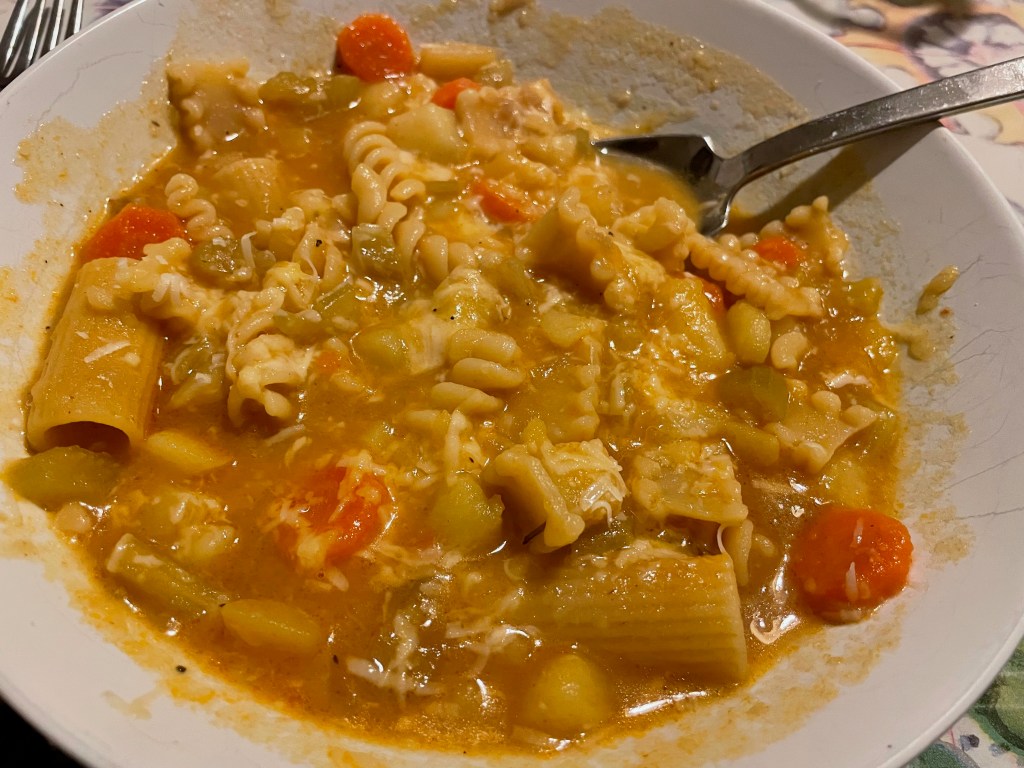
Beans and greens might be an easier combo to get behind. We make lots of variants of this basic comfort dish. It’s easy. Take good beans, whether they’re borlotti (cranberry), cannelini, or ceci/chickpeas. Cooking them from scratch is best, but canned beans are fine, too. Sauté a clove of garlic and a little hot pepper flakes in olive oil. Add the beans, stir. Add cleaned and chopped greens, like escarole, kale, chard, or even spinach. Make what’s in the pot as dry or soupy as you wish. If there’s a fair amount of water or broth, cook some soup pasta (orzo, ditalini, small elbows, etc.) directly in that pot or cook the pasta separately and add for a drier dish.

It’s best to keep to the basics with this, but you can optionally add a Parmigiano rind to the cooking liquid, or mix the beans or add another grain like farro. Add grated cheese if you want, but the soup/pasta dish should be able to stand on its own.

A post like this wouldn’t be complete without lentils. They’re an Umbrian staple. For example, it’s traditional to cook lentils for New Year’s, the pot of lentils symbolizing the riches that you hope the new year brings. Umbrian lentils are really small and don’t break down into brown mush. When in New York, I found that Trader Joe’s vacuum-packed French lentils are a pretty good substitute.

This dish won’t break the bank and is really easy to prepare. Do that soffrito thing again. It’s onion, celery, carrots. Add about half a pound of raw and rinsed lentils after the vegetables are soft. Stir around then add about 500 ml/a pint of water. Add a squeeze from a tube of tomato paste, or a dollop from a can of paste. Let the lentils cook until they almost done. At this point check how much liquid is in the pot. You’ll be adding a cup of ditalini or similar pasta so, if necessary add some water, keeping things on the boil. Add the pasta and cook until al dente. Serve with grated Parmigiano, Grana Padana, or even Pecorino cheese. And this is the result:

A stranger at home for the holidays

I’m still finding it a little astonishing that I took my first vacation in my native New York. We’ve been buying round trip flights from here for awhile, ever since the airline Alitalia folded its wings. But then we stayed back in NY for a few months. This time it was for a scant few weeks and we definitely were visitors this time, staying at a relative’s home and borrowing a car we’d given up. 

One of the things that happens during the holiday season (and pre-trip) is that you have to eliminate items from your to-do list. We started out with an ambitious to-do-before departure list and had to cull as we went along. I’ll get into that later, but the process led to our spending more time getting stuff done in New York. Unpleasant but necessary tasks, that is. 

With all that in mind, I’ve been trying to figure out how to organize this so it’s not just a rant about reverse cultural shock. There’s too much of that floating around online. (Hey, I’ve had feet planted in two places for so long I’m immune.) The Spartan Woman suggested the following approach:

THE GOOD

REMEMBER WHEN PASSPORT agents were surly and acted as though you were a criminal for daring to leave the country? That’s changed, at least in our experience. Maybe it’s down to our being old? I don’t know, but suddenly ICE is hiring friendly people. Or, just maybe, we’re of a certain age now and don’t look like the kind of people US immigration wants to keep out.

In any event, it was a good way to ease into the U.S. Better still was seeing our grownup kids again. Daughter no. 1 gave us a new addition to the family, a bouncing (literally) baby boy. No pictures, sorry. We’re keeping the child out of social media, at least for now. I may be a proud nonno (grandpa), but The Boy is objectively really good looking, and appears to have inherited some of his mom’s impishness. You’ll have to take my biased word for it. And though we moved, it was good to see some neighbors, and comical to see others, like the wild turkeys that have taken over the island.

One thing we miss when we’re in our Umbrian mountain retreat is multiethnic food delivery. Even on Staten Island, which is often depicted as a bigoted white people hellscape. The truth is more subtle than that, and the island’s North Shore is a paradise of ethnic restaurants. In our short time there, we ordered from Chinese, Vietnamese, Turkish, Thai, and Mexican places. We didn’t have time to have the Sri Lankan food we love.

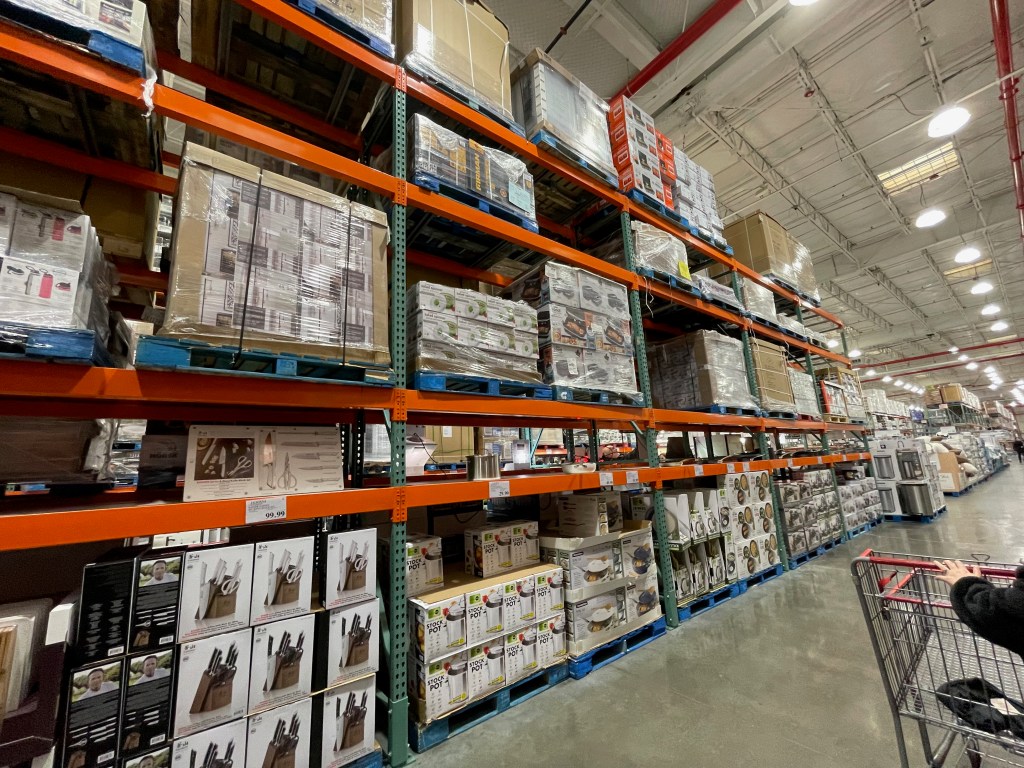
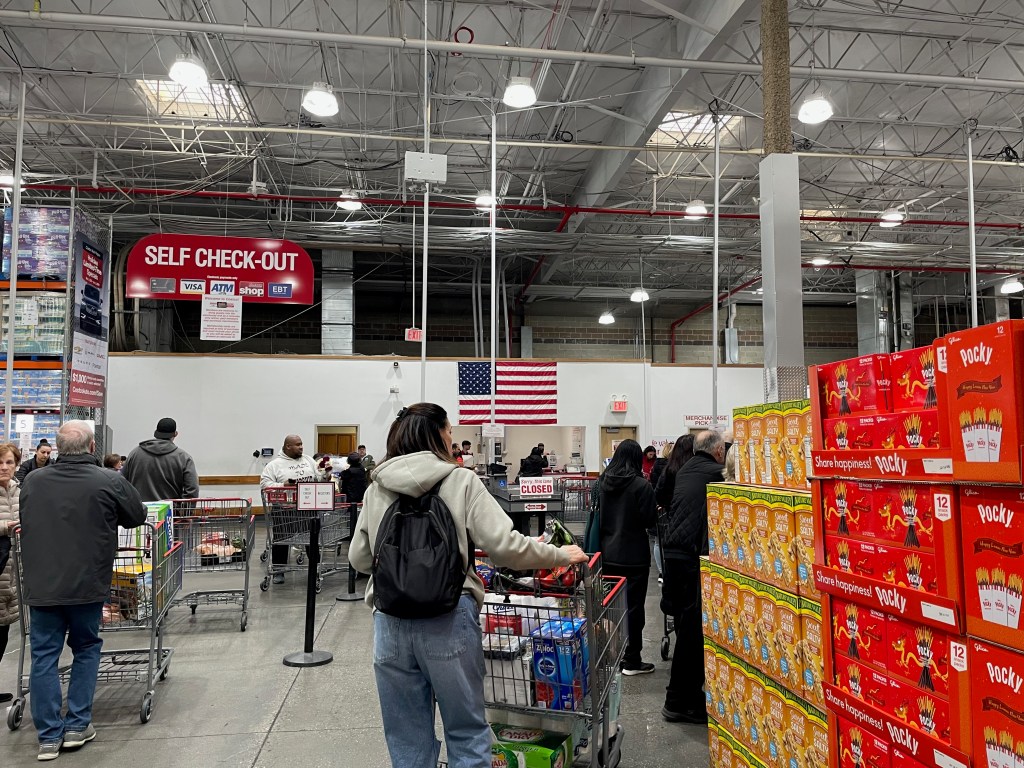
While we’re on the subject of crazy choice, Costco? I know, I know, where have I been? I finally was initiated into the cult by Daughter No. 1, just for one visit. I was overwhelmed. Not that we bought that much—we had specific goals. It wasn’t so much the crazy amount of merch for sale, even though I saw everything from espresso machines to solar panels to yoga pants to flats of every household item imaginable. But wow, in the space of less than hour I heard at least half a dozen non-English languages. That the company is fairly humane in its personnel practices compared to other giants of commerce added to my not hating it. Buon lavoro, Costco. 

I did notice one other thing immediately. As soon as we cleared customs and were in a taxi headed to our kid’s home, I pulled out my phone and wow, this 5G thing. I’d forgotten how fast it is, at least the T-Mobile version of it, and later tested it to be, in some places, a 600 mb/s download. That’s fast. And our kid has, like we did, 1 gigabyte/second fiber. Fast fiber internet has made it to Italy in general, and our town of Valfabbrica specifically. But not in the rural areas. We use a local provider here, which gives us download speeds of around 30 mb/s, which isn’t bad considering it’s wireless. But a guy can get spoiled. Still, I wouldn’t trade my life for fast downloads. Yet.

THE BAD

OH BOY, THIS. Before we left for New York, we’d wanted to get a Covid booster shot, since the latest one covers the latest known variants. Here in Umbria, you go onto the public health website and look for a location and convenient time and hit the send button and show up for the shot. But we ran out of time and figured we’d get the shot at our former local pharmacy in New York.Unfortunately, Nick up the street wasn’t handling the vaccine. So we had to look at the local megaeverythingwithpharmacy places like CVS and Walgreen.

The closest CVS told us they were out of the stuff and maybe were getting some in the future. But Walgreen’s website said make that appointment. I went through the online scheduler and completed the online medical history/consent forms for the two of us.

The day arrives, we drive a couple of miles. There’s a woman ahead of us in the vaccine line. She’s filling out the history form. “We did ours online,” I said. “I did too but they want me to fill it out here again.” The staff behind the counter is obviously overwhelmed, answering phone calls, taking in prescriptions and giving out meds to other customers. We wait and wait and wait. The nice woman in front of us was finally frustrated and disappears. They call her name, finally, to get her shot, and no one answers.

Finally, the harried clerk asks us to fill out the damn history/consent form. “I did it online,” I respond. “We’re asking people to do it here,” she says without giving me a reason. I refuse. “Sorry, I did it online and I’m not going to fill it out again. Look in your system.” There’s a standoff. Finally the overworked pharmacist tells her to dig it out of the computer. More waiting–at this point we’d been there an hour past our appointment time. We weren’t giving up. At last, the pharmacist come out and administers the shot: 75 minutes after our appointment time. We note that they have lots of people restocking the shelves with stuff like Doritos and deodorant, while the pharmacy workers look like hunted animals. American free enterprise at work.

As for this little pharmacy item (left), really?

 Finally we drive back. The main drag through that part of the island is a two lane road that was built in the 1920s and ’30s, with small shops and converted houses hosting insurance agencies and the like lining the street. But something’s out of whack. Big hulking SUVs and pickup trucks like Ford F150s dominate. It’s like the hippo dance in the Disney movie Fantasia. If the giants aren’t being driven like drunken Romans are behind the wheel, they’re creeping along because I’m sure their drivers can’t see out of them. Why do Americans need a tank to go to the drug store?

Another time I stop at a traffic light to make a left turn. One of the misplace macho drivers doesn’t think I’m moving fast enough (I am not a slow driver) and charges over on the right and without caring makes the left, causing oncoming drivers to hit their brakes. This happens over and over. All of a sudden driving in Italy seems sane.

THE MEH

LET’S TALK ABOUT prices, okay people? The U.S., once you’re been away, just seems like a giant machine designed to drain its people of their money. For instance, we buy Royal Canin dog food for our little prince Niko. It’s produced in plants around the world, but it’s a French subsidiary of the giant Mars Inc. In the U.S., a little over one kilo costs $21. The same food, but almost double the quantity, costs €21 in Italy, or about $23. The common excuse, er, rationalization is that wages are higher in the U.S. and so are fixed costs. But double? If you know, tell me why.

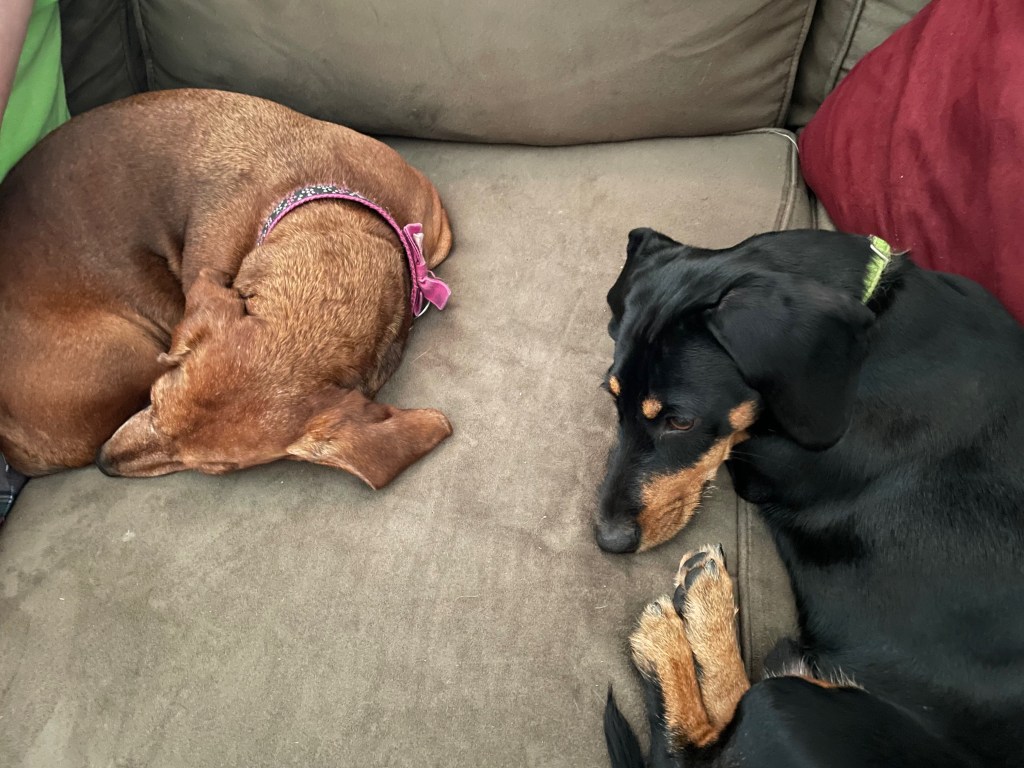
Gratuitous puppy picture: It costs twice as much to keep Lola from the U.S. (left) in Royal Canin than it does our little Niko from the suburbs of Rome.

While I’m on the subject of allocating funds….I get it. New York is constantly being rebuilt. But sorry, what’s there can be so crappy. I traipsed about the Financial District for the best part of a day to take care of a bureaucratic matter. An Italian matter. (Don’t ask.) I used to work in the neighborhood and didn’t really notice before, but the streets are in crappy condition. Sidewalks are broken up, there are shoddy barricades everywhere and in general the place doesn’t look like one of the financial and media capitals of the world. I guess I’d taken the crappiness for granted before.

/rantover. Back to Italy after this.

Well, this definitely feels different

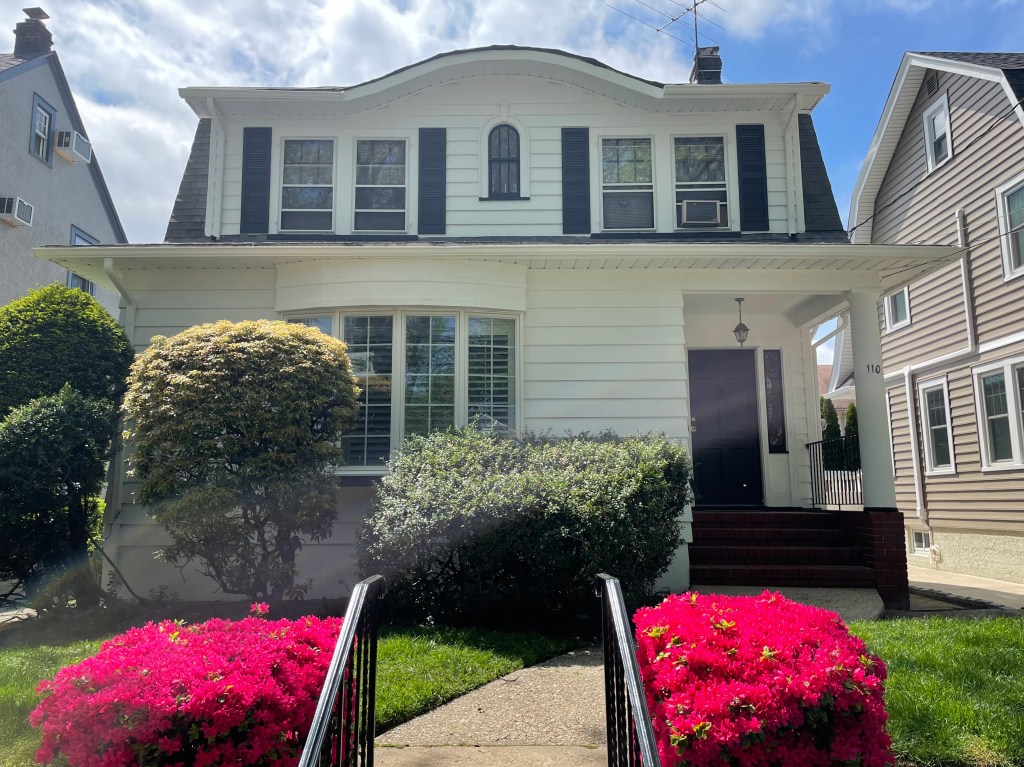
After years of slowly, glacially, indecisively moving over, we’re finally doing it. The old house in New York is mostly empty and being renovated by its soon-to-be occupants (we’re keeping it in the family), while a few dozen boxes of personal effects are somewhere in a warehouse awaiting shipment to us here. This house has been ready for years, even if there are features here and there that we’d like to put in. My ex-editor used to tease me about my commitment issues, so take that, boss.

This old (by American standards) house will soon have new occupants.

Call it procrastination, call it circumstance, call it Covid-19, whatever. Up to now our stays here on the Umbrian hilltop have felt like really long vacations, even if we had to do everyday stuff like renewing the car registration. Not to mention taking the garbage and recyclables to the “tip,” as Brits would say. (We’re talking about a few plastic bins down the road. More on this last bit later.)

All that’s left is some bureaucratic stuff It also means that we’ll be back in the U.S. less, and in some ways that’s a relief.

Let me explain. I don’t usually like to do the we have this, they have that game, but to understand something, or a place, you often have to stand outside of it. Such is the case with the country of my birth. Our four- or five-month stays away have given me some perspective. And I gotta say I don’t like what I’ve been seeing. After one absence a few years ago, for example, we suddenly saw monster gas-guzzling pickup trucks everywhere. In New York City. Driven to the supermarket and on the school run. Really?

Relax, it’s just an induction cooktop, not a culture war. And water boils real fast.

More recently, and especially after Covid, there’s a palpable feeling of anger on the streets. Maybe we’ve gotten too used to the easy sociability here in Italy, where every encounter is a potential long conversation, but our fellow Americans seem sullen and angry. You feel it even when driving, when every SUV and pickup surrounding us seems to be driven by a lunatic. People do stuff that Americans used to accuse Italians of doing, ignoring stop signs, passing on the right only to make a left turn, driving at ridiculous speeds on local streets. No wonder there are speed cameras everywhere. It’s not just driving; shop clerks are nasty and ‘net bulletin boards are full of snarky comments.

What makes me really sad, though, is how the U.S. seems stuck in the past. Sure, this Mac I’m writing this on is up to date, and companies are always updating products and services. But every single change, even trivial ones like cooktops, has become a political and cultural minefield. Meanwhile, the Old Continent moves on. Not everyone likes it, I’m sure. But the feeling that this is 2020-something and we have to deal with climate change is palpable, even here where a right-wing government was elected last fall. (Never mind that the prime minister is a relatively young woman, who isn’t married to her partner, the father of her child.)

LET’S GO FOOD SHOPPING, just to make a few points. Here we are at the garbage bins. We drove here with our pint-sized Renault, which is due to be replaced by an electric model in a couple of years. You can argue about the ultimate merits of recycling, but for now we have to sort our garbage. One bin gets plastic, and almost everything plastic counts. Another is for paper, another for regular garbage. And the final, smelly one is for organic food waste. There’s a glass bin down the hill; we love the sound, as Nick Lowe once wrote, of breaking glass.

The Clio encounters some garbage bins on the way down the hill.

I’ll cop to the fact that we shouldn’t have driven so long to get to a supermarket. But in landlocked Umbria, just the occasional store has fresh fish, and these former seaside people gotta get our fix. Notice that there’s something different about the parking lot. Those panels shading the cars aren’t just pieces of plastic and steel; they’re solar panels. And these panels supply a big part of the shopping center’s electricity.

Those panels aren’t just there for the shade.

A lot of people, and especially Italians, criticize this country for being fossilized. And I can see that when it comes to some bureaucrats (let me tell you about the woman at the water board…). At the same time, we have a decent infrastructure, fiber Internet is being rolled out across this region, and, especially since Covid, most people just tap their phones or cards to pay everything from a coffee at the bar to induction cooktops at the Italian version of Best Buy.

And our prime minister and the opposition leader are both women.

Some terrific photos, the “larky life,” and a clown parade

We aren’t the only weirdos in our neighborhood who live abroad for part of the year. I present Gerard, who lives down the hill from The Spartan Woman’s and my Staten Island home. He’s a photographer who has a business making beautiful photographic prints. If you’ve been to any photo exhibit in the recent past, most likely you’ve seen his exhibition prints.

Gerard, a first generation American of Italian parents, also has a family home in the hills south of Rome and north of Naples. He and his father bought the house back; it had been out of the family for some time. So he and his wife and family spend some time there each year. It was fun a couple of years ago to see Gerard in Perugia. He and his wife Toni Ann were driving around Central Italy and for a few hours, Perugia had a contingent of Randall Manor residents wandering around—we’re good tour guides—and having a terrific lunch at Il Cantinone.

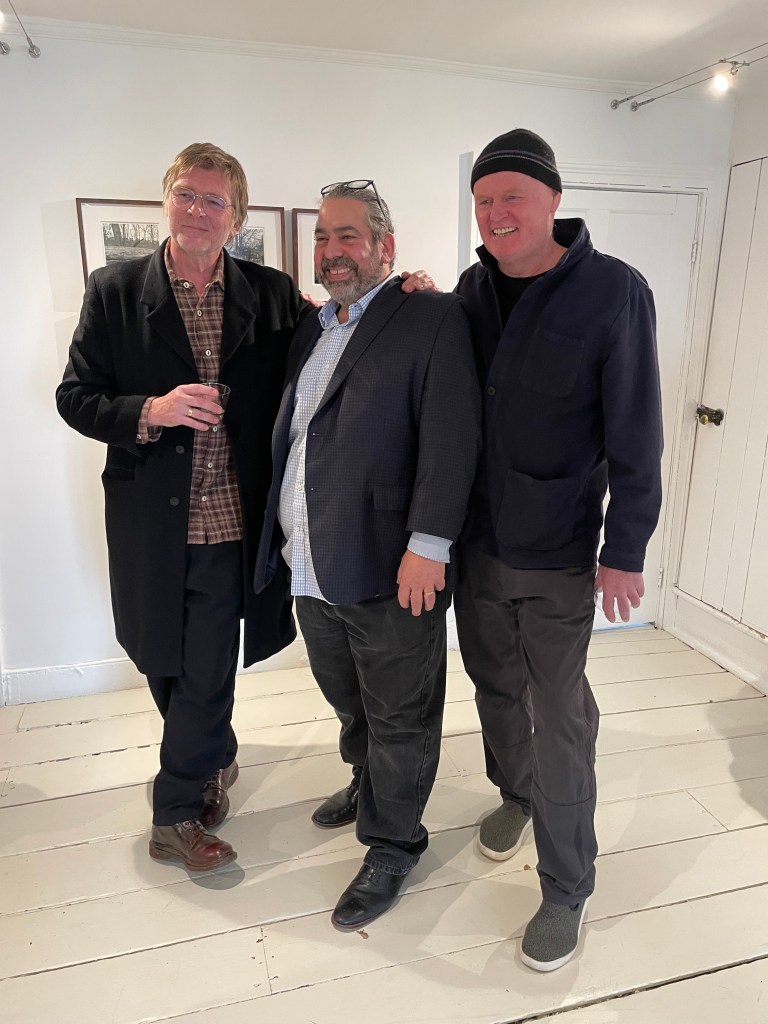
Last weekend, Gerard’s photos featured in an opening of an exhibit of local photographers. His photos depict the woods in our neighborhood. I’m still amazed after nearly 30 years of moving here that we have a forest in the middle of what is a fairly dense North Shore Staten Island neighborhood. For an hour or so, you can wander past a pond and into the forest, following trails that scale a couple of hills and wind up at another pond. You’d never know that you’re in New York City.

But back to the exhibit. It was held, appropriately enough, at the Alice Austen House. Now a museum, the gracious estate was once the home of one of Staten Island’s stars, the photographer Alice Austen. When she lived there, the place was called Clear Comfort, and it’s in a beautiful spot right at the edge of New York Harbor. From the rolling lawn that descends to the bay, you can see Brooklyn, the Verrazano-Narrows Bridge, Manhattan, and New Jersey.

Austen, who died in 1952, was an intriguing character. A member of Staten Island’s upper class, she got a camera from her uncle and was immediately hooked. She photographed her friends and family playing tennis, mugging for her on the beach, and attending fashionable parties. She also ventured into Manhattan and photographed people on the streets, many of them poor immigrants scrambling to make a living. Try to imagine a young woman more than 100 years ago hauling cumbersome cameras around and the heavy glass plates that she used as film. (Remember film?)

She and her friends called their doings “the larky life.” And there was something else about Austen that until recently, the prissy Staten Island Advance (the only local daily in New York) never mentioned: Austen was gay. She had a long relationship with another woman and because of her social standing and personal wealth, she broke free of the constraints that women of her time had to live under.

I WAS THINKING OF Alice earlier this week when Staten Island’s St. Patrick’s Day parade took place. It’s earlier than the bigger city parade, presumably so underage alcohol abusers could have an extra day to get wasted. The parade is notorious for another reason: It’s the only St. Pat’s parade that every single damn year bars the local Pride Center and the police gay group from marching as groups. It’s straight out of the Taliban’s playbook. Every year our friend Carol Bullock, the genial and all-around cool head of the Pride Center applies to march in the parade. And every year, parade committee chief Larry Cummings turns her down.

Carol Bullock of the Pride Center of Staten Island

Cummings hides behind what he maintains are Catholic teachings about homosexuality. Yet his boss in religious matters, Pope Francesco, in an interview in January with The Associate Press said: “Being homosexual isn’t a crime.” Noting that some prominent clergy back anti-gay laws, he added, “These bishops have to have a process of conversion,” and they should apply “tenderness, please, as God has for each one of us.”

The situation reached a head this year. When Carol tried to submit her application, there was a physical altercation at a church where Cummings was taking parade applications, with that brave man Cummings shoving a press photographer. The police had to be called to calm things down, and Cummings remained a bigoted little soul who kept those nasty LGBTQ people out of his ever-shrinking parade.

Because of his stance, the island’s public high school marching bands won’t participate, and their youthful exuberance made the parade fun to watch. It seems that most of this year’s participants were motorcycling groups and guys with old cars. We can’t forget three local Republican politicians, including the borough president Vito Fossella, who achieved notoriety when, as a U.S. congressman, he kept another family in the D.C. area and it emerged only when he was arrested for DWI. Cummings is in great company.

I’m sure Austen would have appreciated, if not actually relished, the irony of how she became, as a fairly open gay woman, a Staten Island icon as a few 21st century Staten Islanders tarnish the reputation of her beloved hometown.

Dismantling a life that’s fading in memory

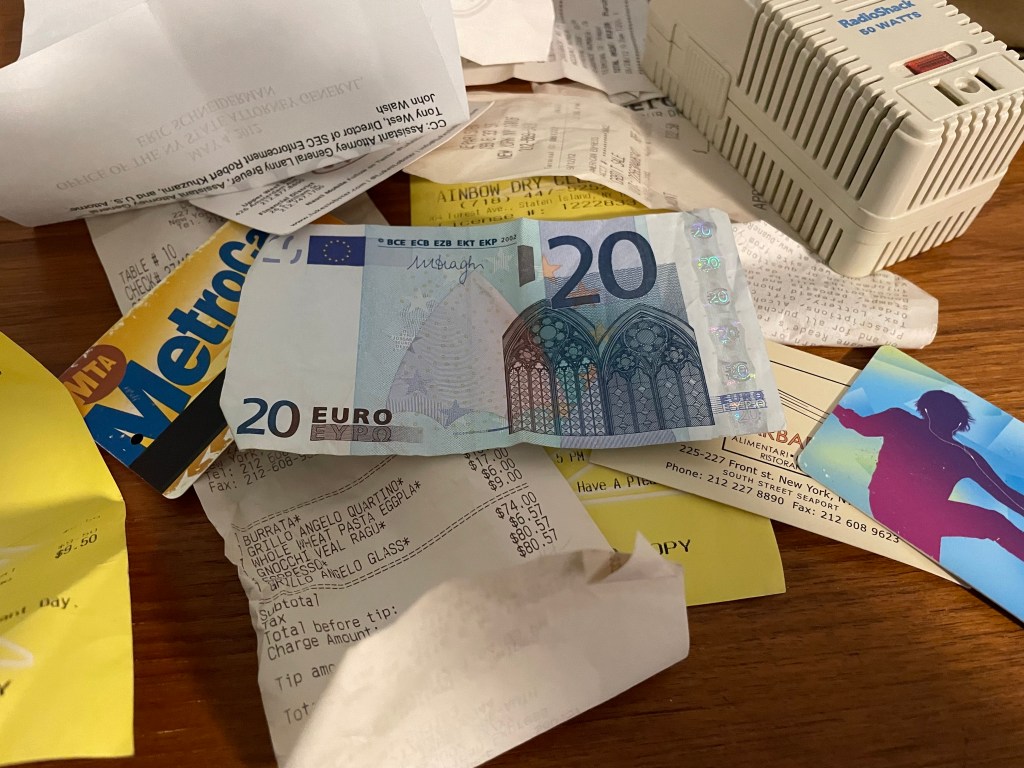
Yesterday I went upstairs to our bedroom to do a task I’d neglected to do for years. Every time I went to get a pair of socks they’d be staring at me: Piles of paper, mostly receipts, with some notes, business cards, and post-its. Finally, as part of our emptying out the house we’ve lived in since 1994, I was tackling the Scary Sock Drawer. And in the process, I filled in some blanks in my memory that lasted for years. (For those of you just catching up, we’re doing a reverse immigration thing and moving to Italy soon,)

I’ll admit that I’ve got a weird memory. I’m good at images, and I remember strange facts, maps, pieces of music. And most of it is pretty recent stuff, unless it’s a childhood memory. I can replay images I saw as a baby—in one vignette, I was in my playpen in the Brooklyn apartment that was my first home. I was looking toward the window and a shaft of sunlight that came in through the blinds, illuminating the dust particles in the air. I can see, even now, how I blew on those particles to watch them dance, and then giggled at how clever I was. (This probably explains a lot about my later habits.)

There are huge gaps, though. I tend to remember the last year or so, maybe because I’ve taken more than 30,000 photos on my phones and various digital cameras But for awhile my recollections had a huge void in the 1990s, probably because I was too busy working, trying to get rid of evil bosses, and playing with the kids while keeping my marriage with The Spartan Woman going. It’s only when I started to digitize our hard-copy photo collection that I was able to fill in some details

But why did I save so many receipts from Rainbow Cleaners? And receipts for non-expense account meals? And boarding passes?

We’re not talking about recent garbage. The meals dated from 2013-14. Oh look, the Oyster Bar from 10 years ago. Now I remember, it was with Josephine, my ex-colleague. She and I had a great lunch—I think I was off that day—and we spent way too much on a plate of raw oysters on the half shell and some ice cold flinty white wine. Josephine was in from living in Barcelona, after she’d been cashiered along with a bunch of my former co-workers, and had lately discovered the joys of day drinking. She probably followed that with a nap when she was in Barcelona, but New York doesn’t encourage such things.

What amazed me was how many times I was taken to the cleaners. Ok, I walked, it’s only two blocks away. I kept coming across yellow receipts from Rainbow Cleaners, and I didn’t realize how much dry cleaning we had. Why so many receipts? Who needed them? The guy who owns Rainbow is young and tech-savvy, typical of his Korean-American cohort, so naturally he had both an up to date client database on his laptop and a keen memory. I’d walk in and he’d already located my suit or jacket, so I learned that I never had to give him a receipt.

Not that I wore suits that often in my former life. It’s now more than six years since I left one of the most boring newsrooms on earth (it wasn’t always boring, but once the company brass took over and hired consultants…), and even then I rarely had to dress up. I confess that every now and then I’d don a suit and take a long lunch break uptown just to make it look like I was leaving. Rummaging through the sock drawer, I found receipts for the black suits that I favored, and even tuxedo rental receipts for the one time a year where I had to get on stage and present an award to some corporate lawyer type. I hated those award nights, had bigly stage fright having to speak to 500 Masters and Mistresses of the Universe, plus the food mostly sucked. (One shining exception: the Parmigiano Reggiano chunks sitting in those big cheese wheels at Cipriani.)

I found at least two things in there that are useful: a €5 note, a €20 note, and two Greenmarket tokens worth $10. I plan to celebrate the last one by pairing them with some others we’ve found to get a couple of dozen oysters from the fisherman guy.

THIS WHOLE PROCESS IS both tedious and fascinating. And a little sobering. For one thing, in cleaning out the media wall in the living room, we’ve had to decide what to do with a couple of decades of technology. We stashed everything away, usually in a panicked last minute cleanup if someone was coming over for dinner. So….let’s see: A white Macbook; two MacBook/PowerBook chargers; various USB cables for iPhones long gone (I got my first one in 2008); albums on tape cassettes; empty cassette boxes; blank CDs; blank DVDs; SCSI cables (why there and not in the office-graveyard?); photographic slide film (!); a huge flash attachment for a camera that used said slide film, probably last used in the mid-1990s. And so on.

We’re almost done with the living room, bar the furniture and the electronics in use or too big to deal with right now. Our son-in-law looks wantingly at the decent Advent speakers I bought years ago when I used something called a “stereo system” to play CDs and vinyl “records.” He can have them. I’m not sure about the garden variety DVD player, last used…? I can’t remember. Or the receiver. Does anyone still use those?

Next up: the dining room. We don’t have much in the way of family china and silver. But we do want to pack up some Italian pottery and take it back home. We also have a buffet-top full of bottles of liquor that we never drink. Maybe we should have a party?

In with the old, in with the new

I’ve been lazy. Uninspired? Bored? Had writer’s block? Nah. It’s just that living in an outer borough of New York and not going out much can be, well, not the stuff I want to write about. So I didn’t. I was struggling to do something profound, either about differences between Europeople and Americans. Or maybe about technology, or taking a quick road trip. I could show you the unfinished drafts in my queue. But that way you’d see my tortured thought process.

At one point, I even got a bot—the now famous ChatGPT—to write about driving from New York to the Boston suburbs. Then I thought maybe I’d critique what the bot did. Okay, I’ll give you a peek:

On a chilly weekend, we took a 400 km ride to the Boston suburbs in our Volkswagen Golf. Four of us traveled comfortably in the spacious car, but we had to make a couple of stops along the way for our pregnant daughter, who is in her last trimester. Despite the stops, the ride was generally smooth and we were able to make good time. One thing that struck us on the American highways was the lack of lane discipline. People would frequently pass us on the right and zig zag dangerously through traffic.

Kind of workmanlike, no? I gave the bot no instructions as to style or my attitude. I wonder how it decided that the car is spacious—in Europe it’s a midsize thing, in the U.S., the land of SUVs, like a matchbox. I’ve read worse copy in my way too long editing career, but at this point I’m not exactly scared that it’s going to take my place.

The Matalas coven takes over the living room.

Anyhow, then Christmas came, and three days later, we transferred to our Umbrian hill, so, yes! I have something to write about. First of all, the holiday. We’re not really subscribers to religion, but we’re culturally a tiny bit Catholic, and for years we’ve had The Spartan Woman’s Jewish cousins over for the day, as well as her parents and sister, etc. This year’s get-together was bittersweet for a couple of reasons. It was the first one post-Covid onset. And it could be the last one we do, because we may not be living in the U.S. this time next year.

All the same, it was terrific to see our kids and their second cousins hanging out together. We jokingly call them the coven; for years, hardly anyone in TSW’s extended family gave birth to males. I’m not the only one calling them a bunch of witches, they themselves encourage it and, well, it’s just funny. But in the next couple of months, that should end. Our number 1 kid, who got married this past March, is expected to actually bring a male infant into this world. “I don’t know what to do with a little boy,” TSW said at one point. I think she’ll manage somehow, she seems to have no trouble with grownup boys.

AFTER THE HOLIDAY, we had to scurry and clean up and get ready to spend a few weeks in Italy. Obviously, this isn’t our first time around the block for this. Still, we have to make sure stuff is taken care of there and that we remember to take what we need in terms of tech stuff and meds, weird food substances we use in the U.S. but impossible to find in Italy. [Tip: Cheddar cheese powder is really, really good on popcorn.]

The trip over was something else. Not that we were delayed or anything, like thousands of holiday travelers in the U.S. But for the first time since early 2020 airports and flights were jammed. I never saw so many people crowding JFK Airport’s bars/restaurants/shops. It was hard to find a place to sit at the gate. When I went to the least-crowded bar to get my by-now traditional preflight Martini, the bartender apologized for having to use a plastic glass because all the Martini glasses were being used.

The flights, first to Munich, then to Rome, were similarly jammed. Lufthansa kept texting us begging us to check our carryon bags (for free even!). We had huge bags anyway, and only knapsacks as carryons. Lufthansa in general is one of my favorite airlines. Its staff treat people like humans, the food and entertainment are halfway decent, as are drinks, and the Airbuses are pretty comfortable, at least in premium economy (and upward, though I can’t shell out for that).

I’d nervously been looking at flight stats; we had 1.5 hours between flights and with the chaos in the United States, our first flight was late on the days leading up to our departure. That had me looking at how often Lufthansa and affiliates flew between Munich and Rome. Happily, it didn’t come to pass. We left on time and arrived early. Since we’re EU citizens, we breezed through passport control. And somehow we landed at a different terminal, the same one as our second flight, so we even had time for a cappuccino and snack.

I’ve crossed the Atlantic countless times and I usually sleep through most flights. But I was so happy to be traveling that I pretended to be a tourist from my window seat. Long Island looked colorful and even a little glamorous as night had fallen. Germany looked tiny and modern, at least from the buildings I could see. And the Alps? Mozzafiati! (Breathtaking in Italian)

I never get tired of flying over the Alps.

So here we are. And yeah, it’s a nice place. But it’s more than liking the place and having nice scenery and food. Our friend Angelo picked us up at the airport and knowing that we didn’t have much fresh food at the house, gave us a big bag of fantastic oranges (there is nothing like Italian citrus). This morning, I walked next door to our neighbors Marjatta and Pasquale at the agriturismo Ca’ Mazzetto to pick up our car; they’d been car-sitting while we were away. They used it every now and then and returned it with a full tank and cleaned inside and our. Later, Pasquale dropped by to say hi and give us a tin of their fantastic organic olive oil. It’s great to be home.

We’re getting ready for a quiet and decadent New Year’s Eve dinner here with our old friend Doug and his trusty sidekick Georgia the dog. Shopping for it was like being at JFK, way too crowded but instead of making me crabby, the IperCoop near Perugia had a party vibe, with sales of good Champagne and Franciacorta (Prosecco’s upscale cousin, fermented in the bottle like Champagne). Since this is Italy, we’ll take Franciacorta—to go with some scallops in the shell from France.

Thanks for reading this year, and happy New Year! See you here after the holidays.

Act like you fit in

On my friend Mick’s first day of kindergarten, his father gave him some good advice: “Act like you fit in.” I guess even back then, his dad knew that Mick was an artist and a gentle sweet soul who’d have a rough time navigating a sometimes hostile world. Funny how his advice seems really valid now to us. I’m looking at boxes and stacks of books and a guitar case, thinking about how we’re finally close to reversing the moves made by my father and my mother’s parents decades ago to the United States.

The Spartan Woman and I were driving around the other day doing some errands, and we talking about people we know who’ve become expatriates in Italy. And in a way we felt a little, I don’t know, pleased with ourselves that we were raised in New York in immigrant families and communities. “If I had to pin down my nationality,” said TSW, “I’d say New Yorker.”

But that’s almost too easy. After being in Italy almost six months, and after two years of pandemic-driven isolation, we’re realizing that our New York doesn’t exist any more, except in pockets where recent immigrants live and work. Still, whether New York has morphed into something different, we’re still a different breed from Those People Out There and we’re proud of it. Growing up in New York makes you—us—citizens of the world. And that has prepared us for our little adventure in reverse immigration.

Here’s how. I’ve told you about Holly Street before, where I grew up. The street was populated by a mix of recent European immigrants (Italian, German, Irish, Scottish) and old-time Staten Islanders. The Spartan Woman has an immigrant past, too—all four grandparents were born elsewhere, her paternal grandparents from in and around Palermo, Sicily, and her maternal grandparents from Sparta in Greece. Combine that with the local dialect, where Yiddish syntax influences how we speak English, and you get a native New Yorker of a certain age. Our certain age.

And while the immigrants’ native lands change, it’s heartening to know that our kids had similar experiences. Their friends from childhood into adulthood either came from or are the first generation of people who came from Argentina, Slovakia, Chile, and the Caribbean. Oh, Italy too—it’s Italy’s lasting shame that each generation seemed to send some of their best people away.

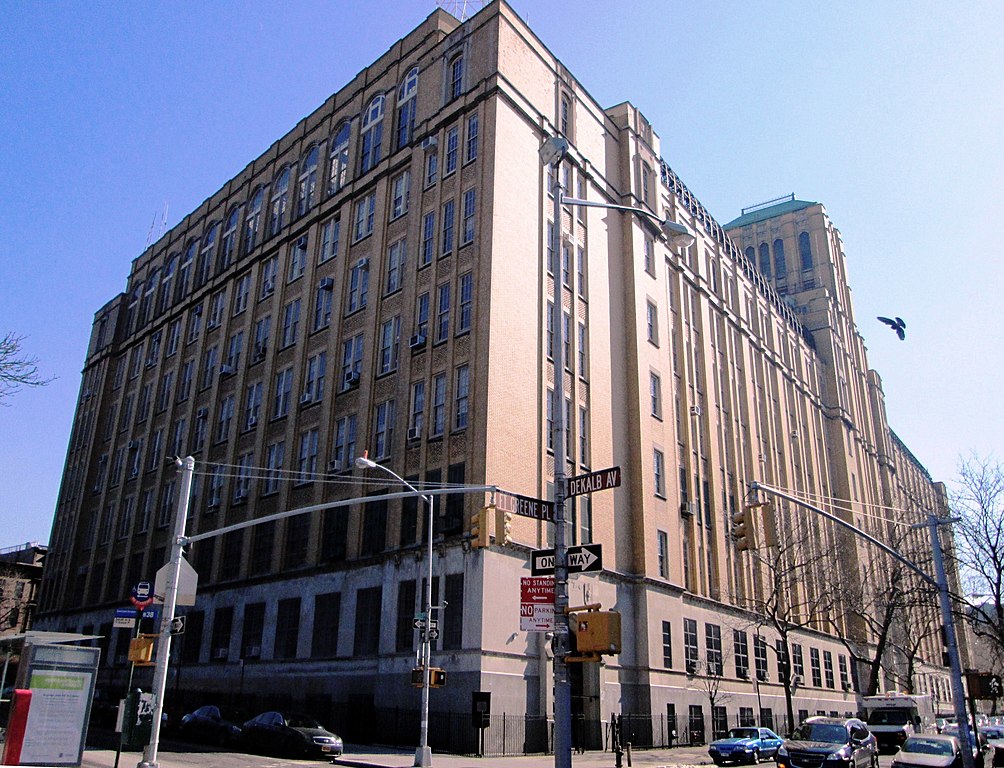
I could bore you with an autobiography here—my high school, Brooklyn Tech (left), for example, was a hotbed of recent immigrant kids from around the world. But it’s enough to say that growing up around here meant we literally had the world at our feet. (Please let me be snarky here—these trustafarians that we saw colonizing Brooklyn pre-pandemic. Can they please go home now? Gentrification is bad enough, but do they have to turn this city into the suburbs they crawled out of?) I knew Polish, Dominican, Greek, Russian, Chinese, and Jamaican kids, among others.

But I won’t. Back to fitting in and if we do or not. When I think of a permanent or long-term move to Italy, I’m grateful for the good training I had for the jump across the pond. One side of my family was made up of recent immigrants who hadn’t yet been assimilated into America. And TSW grew up hearing Greek and eating the Greek-inflected food her mom cooked. We both were used to a tight family structure and traditions that carried over.

The result? We’ve had it easier than the classic expat with no Italian background or citizenship. But even for us, it’s not always smooth sailing to become integrated into a country where you didn’t grow up though. I may be fluent in the language and get most of the social norms, but I didn’t go to Italian schools. I didn’t serve in the Italian military, for which there was a draft when I was of draftable age. So I’m missing the backstory, as journalists like to put it. (The guy on the right—my dad—had the opposite experience. He went to Italian schools and served in the army, and moved to the U.S.)

Whatever. We made our choice, now we have to live with—through?—it. I don’t know if I’m trying to convince myself or not, but being here temporarily in my native city feels strange these days, as though those five months here and there made me miss some development and it’s impossible to catch up. I can’t wrap my head around $30 cocktails, bad espresso in expensive restaurants, and the crazy drivers in unstable trucks.

Plus, the pleasures of living in Italy are undeniable, especially if you’re semi-retired and don’t have to deal with actually going to a workplace. Cheap, delicious food, the aperitivo hour (happy hour on steroids), easy access to kilometers of breathtaking hiking trails, good friends. Okay the bureaucracy sucks, but tell me where it doesn’t.

Cheap drinks may not be enough to convince someone to move to Italy. But they make dealing with the bureaucracy less painful.

I just wish I could take with me my fast Internet connection, Flushing’s Asian food courts, and my daughter’s dachshund, which we raised from puppyhood while Liv was in school. Hope she’s not reading this in case I plan a dognapping…

Our pre-Thanksgiving country life in the big, big city

I could whine, but I won’t. I was driving to a Trader Joe’s one recent morning. It’s on the other side of Staten Island—just another boring day in New York’s outer boroughs, right? As I approached a traffic light, the light turned yellow, then red. A law abiding guy, I came to a stop. But in my rear view mirror, I saw that a Honda Accord was tailgating. Thankfully, the driver didn’t smash into my car, but he or she plainly objected to my stopping, so the car whipped around my car and charged through the light. Luckily, no one was coming through the intersection.

But I avoid most of that by not going out much, or at least not to that side of the island much. Instead, we’ve stuck to our neighborhood. Unlike whole swathes of this island and New York City in general, it’s just beautiful. We’re surrounded by parks and woods and, a little further away, the harbor and a historic fort. So we can take walks that resemble those sun-dappled pharmaceutical commercials.

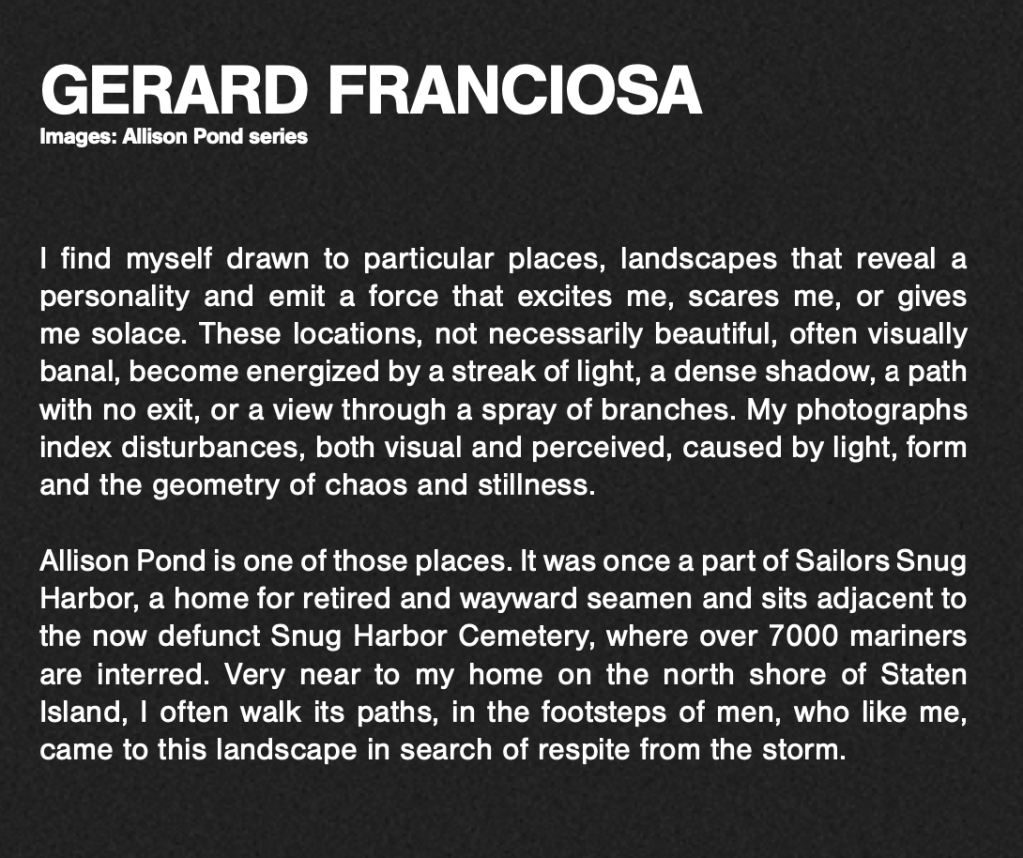
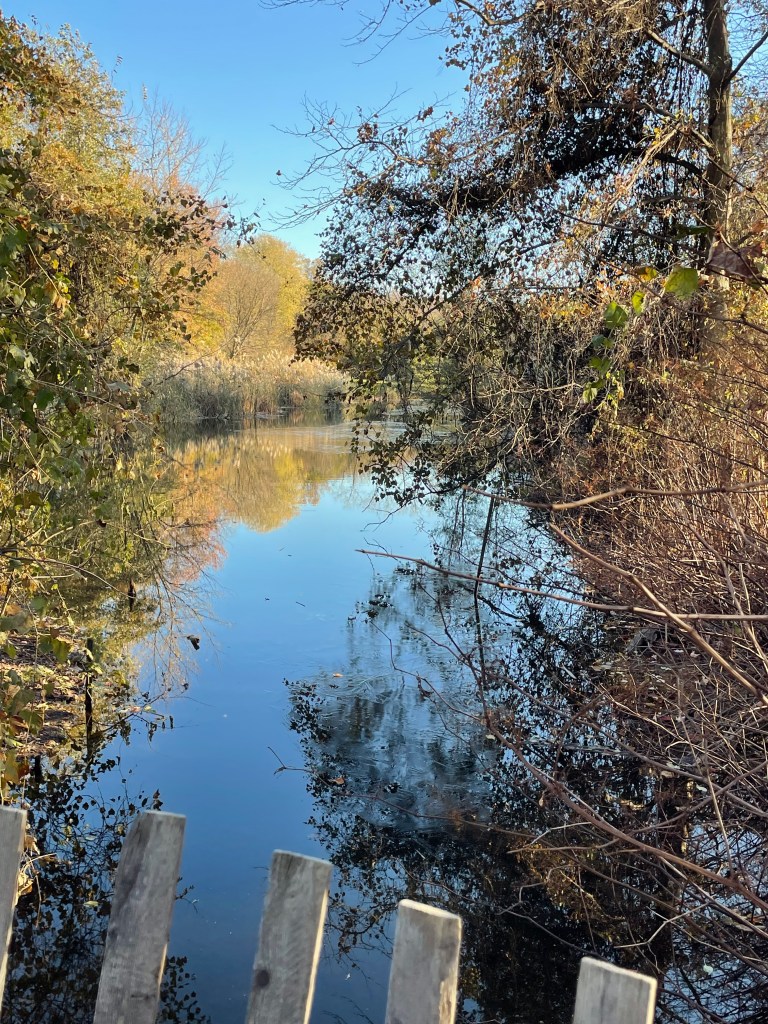
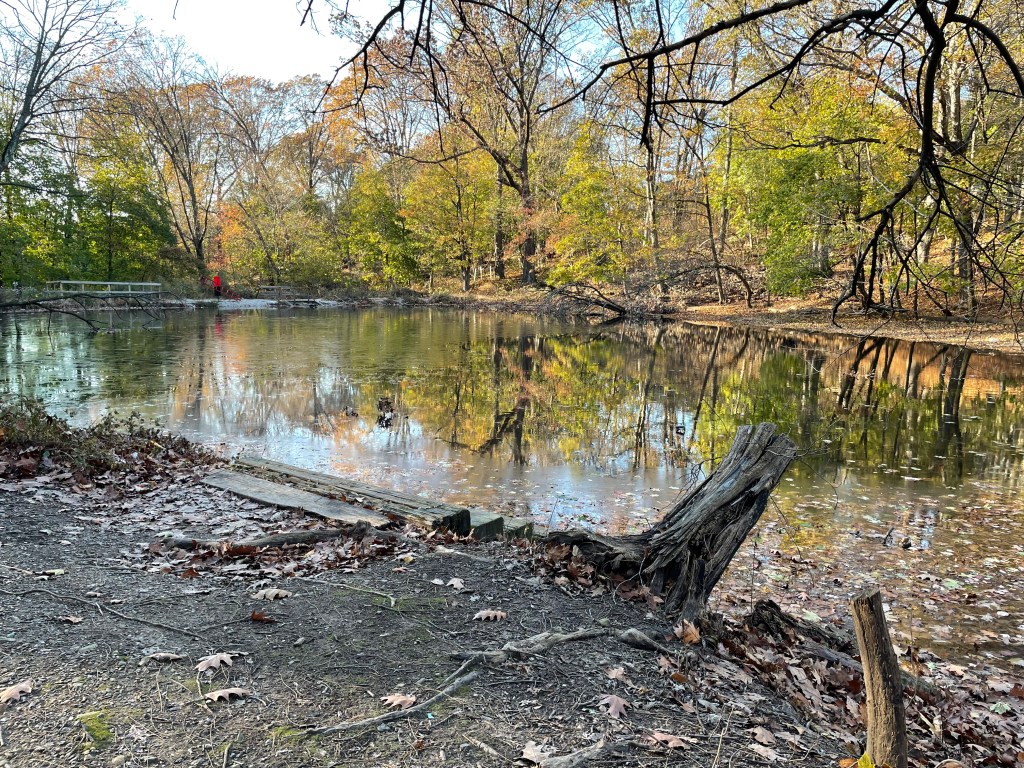
Today we went for a hike. Being a little lazy and wanting to maximize the pup’s off leash (shhh!) time, we drove to Allison Pond down the hill. There’s a pond, no surprise. But behind it are acres of woods. The pond was named after the daughter of George A. Outerbridge, an engineer who owned the property and designed the Outerbridge Crossing that connects Staten Island with Perth Amboy, New Jersey. One of the many Staten Island oddities is the bridge’s name. Looking at a map you might think that the bridge is so named because it’s out there, near the southern tip of Staten Island and, really, New York State. But no. It was named after its designer, Outerbridge, and instead of calling it the Outerbridge Bridge they had to use the word “Crossing,” a word that about 10-15 years ago came into vogue in the names of shopping malls.

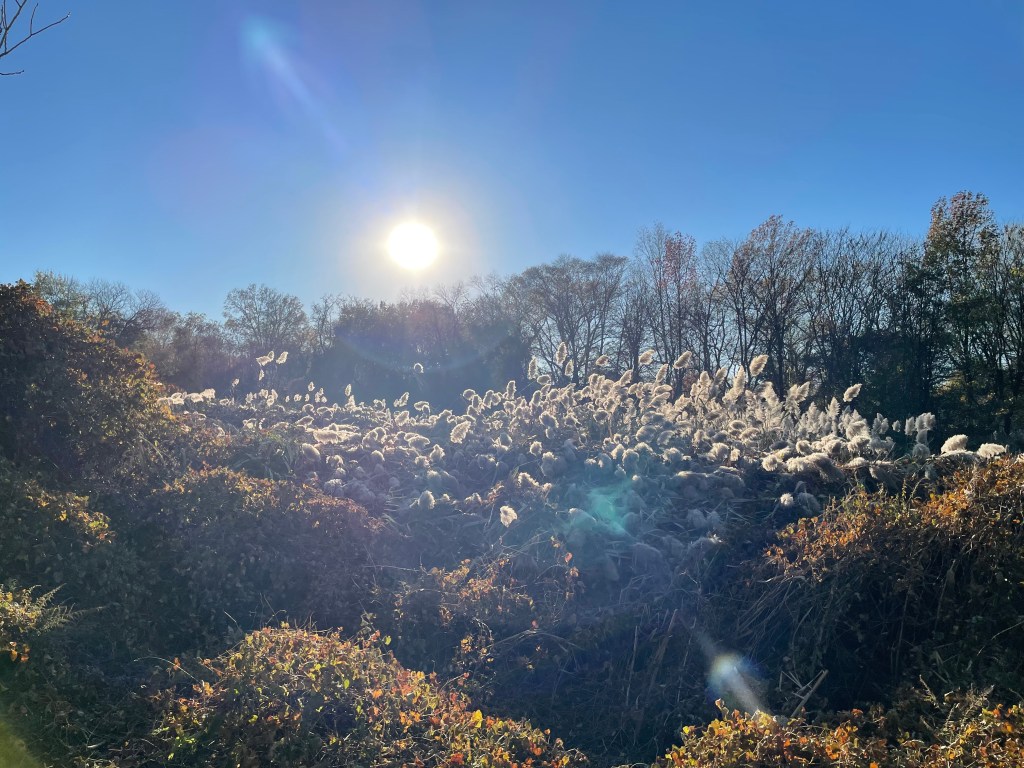
But I digress. Take a look at the gallery below. This is November, and the light on sunny days is beautiful and golden. It’s such a contrast to what I usually think of November, gross windy rainy days and the only outdoor colors seem to be black, brown, and gray.

Here and below, click on photos to enlarge.

YESTERDAY’S AFTERNOON WALK WAS slightly more urban. We took Lola to her usual morning place, the Snug Harbor Cultural Center. I’ve probably posted dozens of photos of the place to Instagram/Facebook and bored everyone I know. But the place is really special. And it’s where our neighborhood here began. Trader Robert Randall traded what became the area around Washington Square for acres of land on Staten Island’s north shore. He established a home for retired seamen on the land fronting the Kill Van Kull, the strait that separates Staten Island from Bayonne, New Jersey. He built a beautiful campus full of Greek Revival buildings, and the establishment was self-sufficient, with its own farm, livestock, chapel and cathedral, dormitories, and sadly, a cemetery. The land uphill of the home became Randall Manor in the 1920s—where we live in New York.

The old guys were shipped to South Carolina some decades ago, and hungry developers wanted the land for condos and the usual horrors visited on this island. But Jackie Kennedy Onassis, among others, campaigned to save the historic buildings and beautiful grounds.

Today, it’s a art center that boasts studios for artists, museum spaces, and a gorgeous botanical garden that includes one of the few Chinese scholar’s gardens in North America.The administration does what it can with a severely limited budget. A few years ago a visiting cousin from Switzerland was shocked at what she saw as neglect of a beautiful place. It’s better now, if not up to Swiss standards, and Greg, the botanical garden’s chief, does an incredible job of rotating plants through the year.

So most mornings we walk Lola through the grounds. We have dog friends, and so does Lola. The Harbor in general has a low-key hippie vibe that fits in perfectly with that part of the island, which boasts a historic district and scores of gracious 18th and 19th century homes. It’s been cold the past few mornings, so we’ve waited until the sun warms things up a bit. The reward has been this golden light that makes me look like a better photographer than I am.

A tale of two siblings

I’VE BEEN WATCHING A social science experiment unfold over the past few decades. Yeah, I’m old. But the subjects of this experiment were older and have recently passed away. I’m writing about my father, Nuccio (formal name Antonino) and his slightly older brother Ignazio. It’s heartbreaking that we lost these two wonderful souls in the space of just a couple of months, but it’s given me a chance to don my political scientist hat and reflect on the lives they led. [Post continues below the photo.]

Versione italiana, clicca qui.

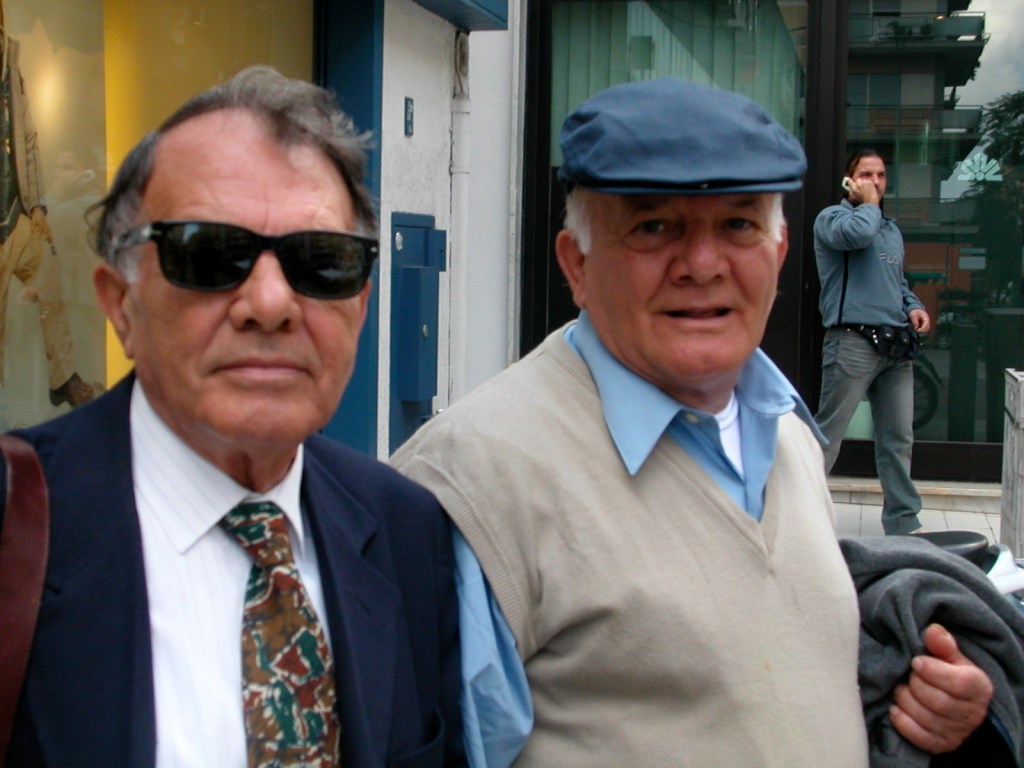
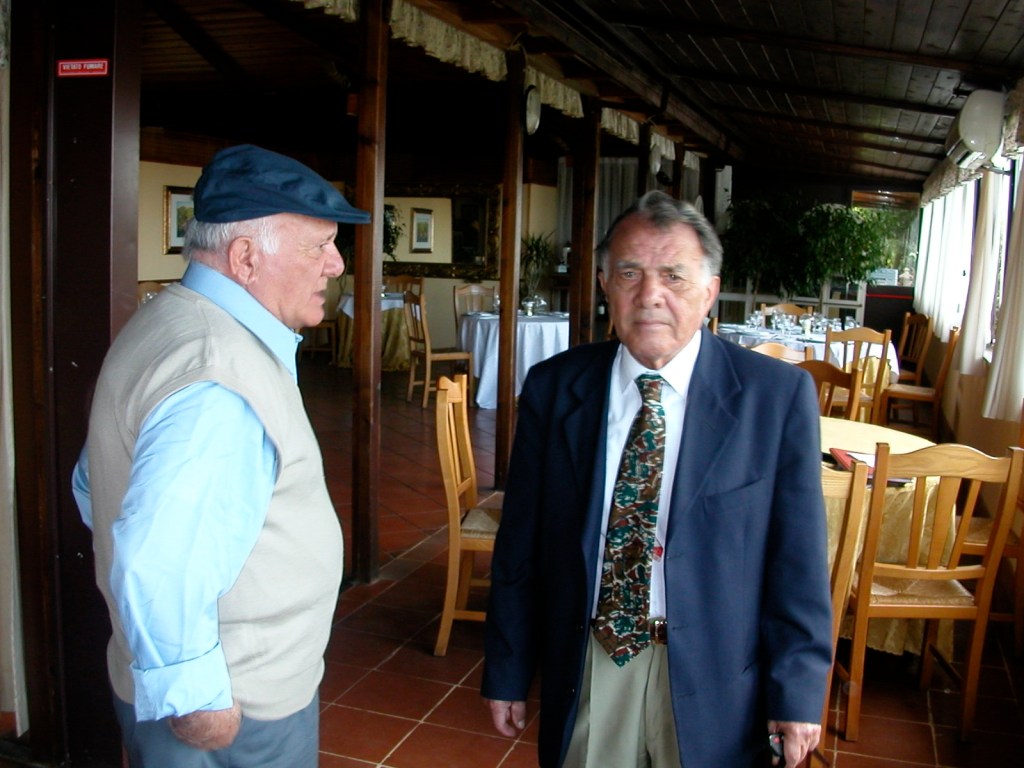
Two bros, on the street where they grew up, Corso Calatafimi Palermo, 2003

FIRST, THE CVs. Ignazio, born October 1928 in Palermo, Sicily, and a resident until his recent death. He was a widower, married to a great woman named Elena Beghin, who came from Treviso in the Veneto, within bike riding distance of Venice. The other was my father, Nuccio, born March 1930, also in Palermo. He emigrated to the United States in 1955 and was also widowed, married to my mom, Angelina Ancona, born on the Lower East Side of New York City. Nuccio lived in Brooklyn, then Staten Island, and finally moved to Eastern Pennsylvania when he retired. Ignazio lived in the same neighborhood all his life, bar a stint in the Italian army.

The two brothers might as well have been twins. Looking at photos of them from the mid-’50s, Elena told me she couldn’t tell them apart. (I can; Ignazio had angled eyebrows while Nuccio were rounded.) Ignazio was studious and high-strung. Nuccio was a party animal, not so studious. As a boy, he was tasked with guiding his brother back to bed when he sleep-walied around their apartment . As a result, my father was always a light sleeper. Their voices were almost identical—Ignazio, who was an army radio operator, spoke passable English, making the voice resemblance even stronger.

The two brothers each had three children. You can almost say that we kids came in pairs. So, my cousin Giorgio and I are only a little more than a year apart. My sister and Giorgio’s sister Assunta were born the same year, as were my brother Chuck and our cousin Loredana. Both brothers worked in electronic factories, too, serving in various foreman/supervisory capacities. They made enough to support their families, and weren’t rich but never were hungry. Both families lived a middle-class existence.

I’ve established that these dudes were remarkably alike. So how were they different? Simple: Ignazio stayed in Italy, and Nuccio left. And it’s fascinating to see how that affected just about everything in their lives. I’ve been tracking these two over the decades, as first unconsciously, but in the past couple of decades I thought more methodically of their parallel lives as a sort of horse race. Who led a more comfortable, spiritually richer life? Was there a winner? Can you even call the race?

I’ll get to the verdict straight away. Ignazio started out in a more precarious place materially, but all things equal, he ended up ahead. And it’s entirely due to how the United States and Europe treated their populations over the year. In fact, I’ll go further and say that Nuccio was far ahead early on, but the lack of worker protections and a comprehensive healthcare scheme in the U.S. eroded his lead decades ago.

LET’S START AT THE BEGINNING of the race. Both brothers served in the Italian army in the 1950s, but my father was discharged in 1955. That will serve as our opening shot.

Nuccio married my American mother and moved to New York. I was born shortly after, and we lived at first in the same neighborhood my mother called home, Brooklyn’s East New York. My father first worked in a shoe factory, and then, happily for me, found a job at a small, family owned toymaker. After obtaining U.S. citizenship in 1960, we moved to a little Cape Cod house on Staten Island. My sister had come along by then. The house was what was called a starter home, with an unfinished basement and attic. My parents were constant home improvers. The attic became terrific big bedrooms for my sister and me Patios were built and expanded. A huge garden supplied a lot of our vegetables.

Nuccio in sunglasses, with his brothers-in-law and my maternal grandfather on the right, sometime in the 1950s

Materially, we weren’t deprived of anything. My mother was really good at controlling the budget and my father got a better job after the toy company. (I was proud of him, but at the same time hated that I wouldn’t be a test subject for the toymaker’s new products.) The used cars eventually gave way to new, bigger models. And our backyard kiddie pool turned into a bigger one that we could actually swim in, so our childhood summers were basically spent in water and outdoors in general. It was a good life, and my father, while working hard, was living a version of the American Dream throughout the 1960s, into the early and 1970s.

Meanwhile in Italy, Ignazio was still in the army and he and Elena were a number, They had a kid but kept it on the down low because he wanted to stay in the army; Palermo at that time wasn’t a good place for a young guy to find a good job, In fact, the early 1960s, once he hung up the uniform, was a time of writing letters to employers and friends of friends who might help him get a job. The young family lived with my grandparents, which was not an easy situation for my aunt, who was used to the personal freedoms enjoyed by young women up north. Finally, at some point Ignazio got a job at a factory run by the Italian state telephone monopoly, and the family moved to apartments of their own, not far from where the two brothers grew up,

The two brothers during the last time they saw each other in person, November 2003

At this point, for my American friends, I should describe apartment living in Italy, Most Italians don’t live in freestanding houses; they live in apartments in cities and towns. But the dwellings aren’t transient places where young adults live while they save up for a house in the ‘burbs. They tend to be bigger than most New York apartments, which multiple bedrooms, baths, and terraces. A lot of them have doormen and gardens. Italians tend to be more social in their daily lives in general, with outdoor bars and spaces frequented as an integral part of daily life. You can almost say it’s the Italian Dream, except Italians are too realistic to think of everyday life as a dream; they believe that they’re fully entitled to what they have.

So at this point, the brothers are evenly matched. But not for long. Ignazio’s wife worked for some years too as the kids got older. They had family living in the same apartment complex who could keep an eye on them. They bought their apartment when it went up for sale; they accrued a nest egg. Regular raises and a new national healthcare system solidified these gains. One of Ignazio’s kids went to the local university, which was free to attend, except for fees and living expenses. He got a degree. In Italy, homeowners don’t pay real estate taxes on their primary dwelling. In general, Ignazio and his family were part of the general rise in the standard of living for most Europeans. He retired with most of his pre-retirement income, and was able to help his kids out.

My uncle Ignazio and his wife Elena, Palermo, 2003

Meanwhile, Nuccio saw his wages stagnate, like a lot of American workers did. The new cars became nearly unaffordable. My sister and I did go to college, but we went to the city university because our parents couldn’t afford to send us away Nuccio actually was subjected to a salary cut while the family-owned company he worked for sold its Soho headquarters for millions; he was eventually forced out and retired on Social Security with a small nest egg. It was a humiliating end to a lifetime of work. My parents sold their house in Staten Island and moved to a much cheaper one in the Poconos. Still, they had to pay hefty real estate taxes, largely because of the decentralized way schools are funded in the U.S. Life for my parents was much more of a struggle than it was for his brother, in general.

My father and me during a FaceTime session last year

Ignazio was part of Italy’s highly rated national healthcare system. Nuccio and his wife got Medicare, which they had to supplement with Part B insurance. My father, dutiful as always, was left paying a huge hospital bill for my mother’s terminal stay,

Every now and then my father would express regrets that he left his homeland. His English was never great, and I think that, along with a general fear of new environments, held him back. He did tell me once, “Maybe I would’ve lived better over there. But I made my choice with you and your mother, and I did my best to make sure we had a good life.”

You can make your own judgment about this tale of two siblings. There are lots of variables, and the big one is how being an immigrant in the U.S. shapes the life you lead. But I also believe that it says a lot, and nothing great, about how a guy who worked hard all his life and did all the right things, found himself in much worse shape as he got older. He had to leave the home he raised his family in, and ended up living in a much harsher environment just to make ends meet.

A Seinfeld kind of life

First off, thanks everyone for getting in touch. I’m okay, even if I was in the COVID-19 infested Italy only three weeks ago as I write this. And I was even in the terrific city of Milan while in Italy, visiting colleagues and getting a dose of big-city life. It seems so long ago now. Because of my possible exposure to the virus, I’ve stayed home for the most part this month, doing so before it became the thing to do. Even when I was in Umbria I stayed home a lot because 1-it was winter and didn’t exactly encourage wandering and 2-it’s just a nice place to hang out in.

Number 2 is what I’ve been thinking about a lot. The European Union has closed its borders to non-EU citizens, and the U.S. State Department put out a notice discouraging Americans from going abroad. But hey, I’m an EU citizen, too, and a big part of me would rather be there than in New York. Nicer weather, for one thing.

But I’m not. And instead of views out to Monte Subasio, I’ve been looking at way too much TV. One of the things I’ve caught, besides the perpetual “reno” of HGTV, are reruns of Seinfeld. Remember that? The joke was that nothing ever really happened. They just talked and obsessed about themselves. People popped into Jerry’s apartment, they said funny things, and occasionally they went to the diner to say funny things. It’s just like us under this kind of house arrest. Only we don’t say much that’s funny and the local diner only does delivery now.

So, like millions around the world, on s’amuse, as Judy might say. We had a cocktail hour the other night. A virtual one, with my ferry posse. Back when I was a respectable citizen with a day job, I rode the Staten Island Ferry to work every day, usually taking either the 8:30 or 8:45 boat from St. George. A bunch of us met in roughly the same place nearly every day, breaking the peace of the unsuccessful silent zone. Our ringleader was John Ficarra, former editor of Mad magazine. Besides him, we had a recording engineer at an advertising shop (The Romantics’ “What I Like About You” is one of the songs he engineered), a lawyer, one of John’s editors, a video advertising guy, a couple of social workers, and an HR woman at a publishing company. That was the core, anyway—others dropped in and out as our work schedules changed.

Anyway, we’ve had a text chain going for awhile. Sometimes it’s a can-you-top-this of witticisms, but it’s a good way to stay in touch. Peter found out that you can take an Apple Messages multi-person text thread and convert it temporarily to a FaceTime video session. Since we all have iPhones—no Android bottom-dwellers among us—we could have a virtual cocktail hour, almost, but not quite as good as the in person one we have every few months.

Here’s the evidence. Props to Lenny for the most glam drink, a blood orange martini. Do this: squeeze a bunch of blood oranges. Combine the juice with vodka and a dash of limoncello. I want one now.

Today is particularly grim, being the first day of a stricter lockdown in New York, and a nasty day outside, rainy and cold, so no solitary outside exercise walk.

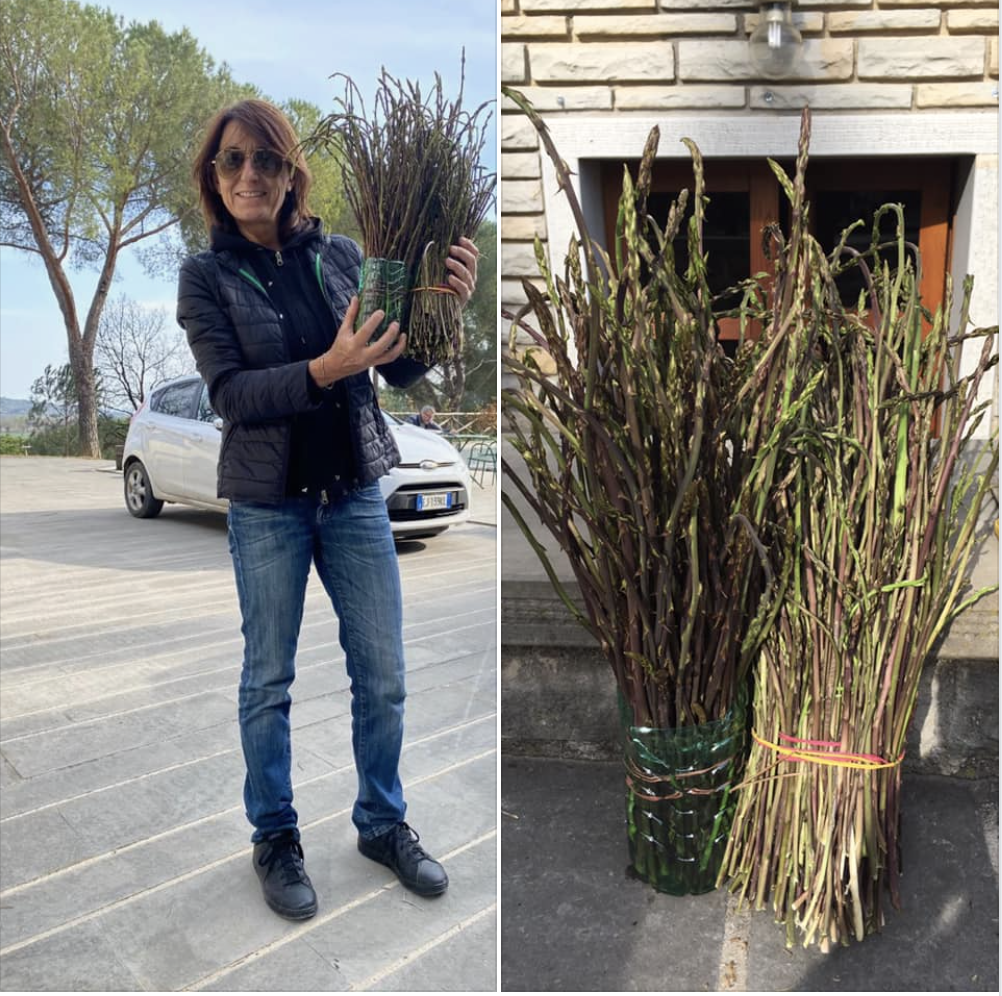
Italian doctors predict that people under lockdown will, at the end of it (should that ever happen), gain between 4 and. 8 kilos, or about 9 to 18 pounds. Lord knows we’re just as guilty as any. But first let me show you what we’re missing by being here. This is a photo of our Umbrian friend Angela, who’s just picked a huge bunch of wild asparagus in the hills outside her parents’ home:

We’ve been indulging in less wholesome food experiences. One type, and I know this will bother a couple of our friends, is to experiment with fake meat. We haven’t been eating meat for about 10 years now (though I confess that I stray when I’ve had a few glasses of wine or I’m at a friend’s house). It feels a little odd, to take some ingredients and torture them into something they’re not. The Spartan Woman has become pretty good at taking gluten, nutritious yeast, and jackfruit and turning them into a fair approximation of boneless pork ribs. Basically, she’s making seitan, whose use, according to Wikipedia, has been documented to the sixth century. Here’s the result:

Meanwhile, we’ve been looking at what modern technology has been up to. We’ve had Beyond Meat hamburgers, which are scarily like real hamburgers. You can also get “sausages” and the hamburger “meat” in bulk. Have nothing better to do for Sunday dinner, I decided to attempt what we call Giovanna’s roulé, an Umbrian meatloaf our dear departed Perugian mama used to cook for us when she was with us and we were staying with her. She’s take ground beef and sausage meat and make a dense round loaf, and braise it with onions, wine, and broth. I used the Beyond products, and came up with this:
It was good, but I’m wondering: Are these gateway drugs back to being carnivores?

[Image at the top: The Spartan Woman’s bread, baked just because she could]