Adventures in repurposing

Day 3,756 of the Great Lockdown. We’ve ground the last of our backyard winter wheat to use for pasta, and bartered hothouse tomatoes for Lenny L’s eggs. We still have some zucchini and beans from the last rationing quarter. Queen Ivanka says that the virus should disappear on its own by the summer solstice; so far, average winter temperatures of 37 degrees C/98.6 degrees F haven’t had an effect on its spread. But we’re not allowed to say that.

Sorry about that. But it’s feeling endless, no? We alternate between days trying To Do Things, and crashing all day in the living room eating peanut butter and mango preserves on graham crackers while HGTV shows preach the virtues of family time in open concept homes.

On Sunday, one of our busy days, we made umbricelli—Tuscans call them pici (pronounced “peachy”). You make a basic pasta dough, with or without eggs depending on who you ask, then take little bits and stretch them out by hand. It can take a long time to do. But then again, do I have anything better to do?
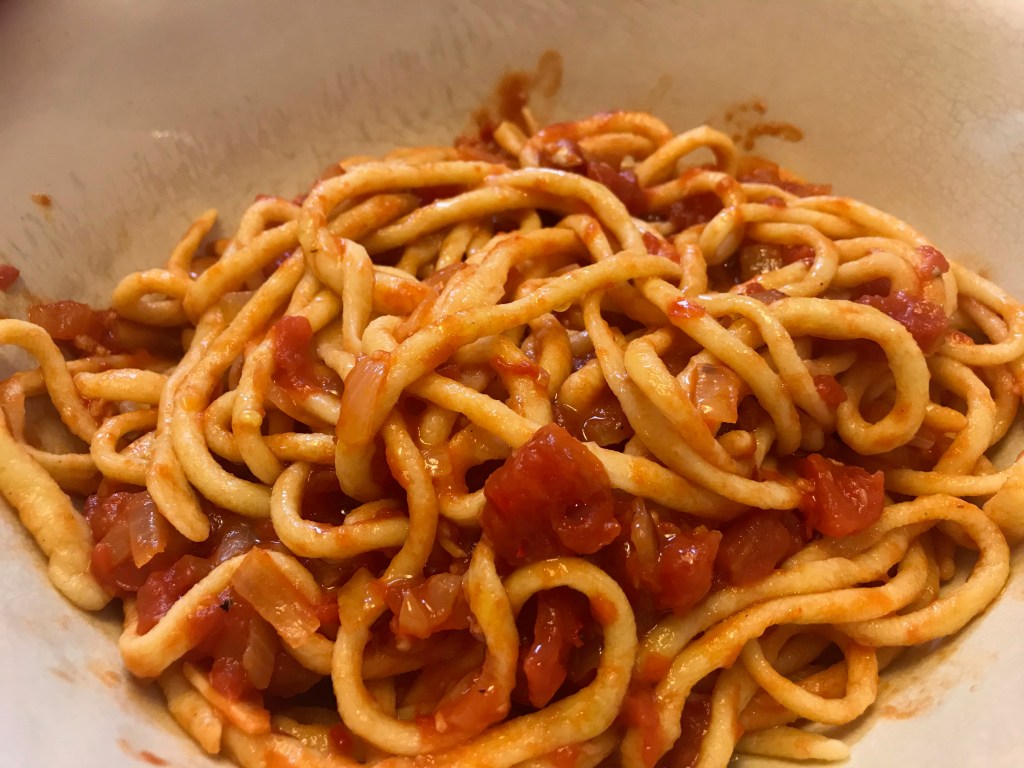
Version 1: Umbricelli with a spicy “arrabbiata” sauce

I had some pasta dough left, so the same lump turned into tagliatelle. Only Daughter No. 2 had our pasta machine, Fair’s fair: We’re holding her dog hostage. So I got out The Spartan Woman’s heavy, really heavy, marble rolling pin. The thing could be a murder weapon in a Hitchcock film. And I cut off pieces from the lump of dough and rolled them really thin, the old-fashioned way. Gotta say, it worked pretty well. We took the thin sheets and cut them into tagliatelle. I will confess that the first batch ventured into wider, pappardelle territory.

I could have used some truffle purée that we’ve got in the cupboard to go with the pasta. But there were a half-dozen zucchine/zucchini (see my screed about sex-changed food here) in the fridge, and if we didn’t use them soon, they’d go bad. Problem is, tagliatelle and sautéed zucchini aren’t a natural pairing. Plus, we had some cooked navy beans that had to be eaten soon.

Tagliatelle with too much sauce

So, never to pass up an opportunity to be decadent, I realized that I could concoct a zucchini cream, and the beans would love to come for the ride. I sautéed all of the squash, then added the navy beans. On the side, I put together a quick béchamel. Then I took the béchamel and about two-thirds of the zucchini/bean mixture and threw them in the blender. With some seasoning and a little nutmeg, we had a smooth, creamy, and decadent sauce to go with the fresh tagliatelle.


Need a recipe? You’re in the wrong place; this boy cooks by instinct. But okay, I’ll try. You don’t have to make the pasta; you can buy tagliatelle or fettuccine or even pappardelle. If you do want to make your own, you’ll need, for two servings, 2 cups of Italian “00” flour, or low-gluten cake flour, 2 extra large eggs plus a yolk, and a little pour of olive oil. Double the recipe for four people.

Make a well in the flour and crack your eggs and egg yolk. With a fork, work the flour and egg together. And pour a tablespoon of olive oil into it. Work the dough for about 10-15 minutes into a smooth ball. You can also throw it all into a food processor or mixer and let the machine do the work.

Then, using either a pasta rolling machine or a rolling pin, roll the dough in batches into this sheets. Bolognese grandmothers say they should be translucent; paper thin is what you’re aiming for. A “4” setting on your pasta machine should be enough. Then fold and, either using a sharp knife or a pizza cutter, cut into strips.

For the sauce: Dice 4 zucchine/I into 1/2 inch cubes. Sautéed with good olive oil and a pat of butter. I added two smashed but whole cloves of garlic and a splash of white wine. When the squash is almost cooked, add a can of navy beans, or a cup of beans that you’ve cooked.

On the side, make a cup of béchamel. Or avoid it by heating a cup of heavy cream; your choice. The usual formula is one tablespoon of butter, one of flour, and a cup of milk. Cook the flour in the melted butter, then add milk slowly, whisking all this time. Bring nearly to boil. Turn the heat off when it’s thickened and season with salt, pepper, and nutmeg if you like that.

Blend most of the squash/beans with the béchamel. Cook the pasta, add the zucchini cream, toss, serve. Drink lots of wine.
Hello again

It’s Sunday night, and I am drinking a Bronx cocktail. Gotta support the outer boroughs, even if my support takes the form of getting slightly drunk. Really, what else is there to do?

I took a month off from writing. A big gig ended and a little one paused, so it was time to stop doing what I’d been doing for some 35 years. I kept thinking of stuff I wanted to write, but never did anything about it, and I left a couple of more political drafts for the blog incomplete. I have to say, it felt great not to have any work deadlines, and not to either edit someone else or deal with an editor’s comments.

So, it’s been more than a month since the last post. What’s happened? The curve in New York flattened, and this week in Italy, some of the restraints on gathering and movement begin to be phased out. It’s a gradual thing. You can visit relatives, but not friends. You have to wear a mask. Stores open in a couple of weeks, restaurants and bars in June. Maybe. Speriamo (let’s hope). And perhaps we’ll get to Italy eventually.

Meanwhile, here at HQ, we try to keep to some kind of semblance of normalcy. We can’t go lap swimming or acquasizing, so we bought a cheap exercise bike. We take walks, mostly early in the day so that we don’t run into too many people. Otherwise, we don’t go out. I draw—I treated myself to an Apple Pencil that works with my iPad. And now I know how rusty my guitar playing has gotten. I have to get those calluses back, pronto.

Like some of you, we’ve been cooking. The Spartan Woman and I have our own zones of expertise. She bakes, I don’t. She produces bread, this addictive muffin-y thing made from beans and oatmeal, and brownies. I am the risotto king of Staten Island, and besides my own repertoire, I’m really impressionable and cop ideas from others. For our Sunday afternoon dinner today, for example, I copied Lidia Bastianich after seeing her PBS show and put together a risotto of pears, Grana Padano (it’s like Parmigiano-Reggiano, but a little milder and from north of the Po River), and leeks. What do you think?

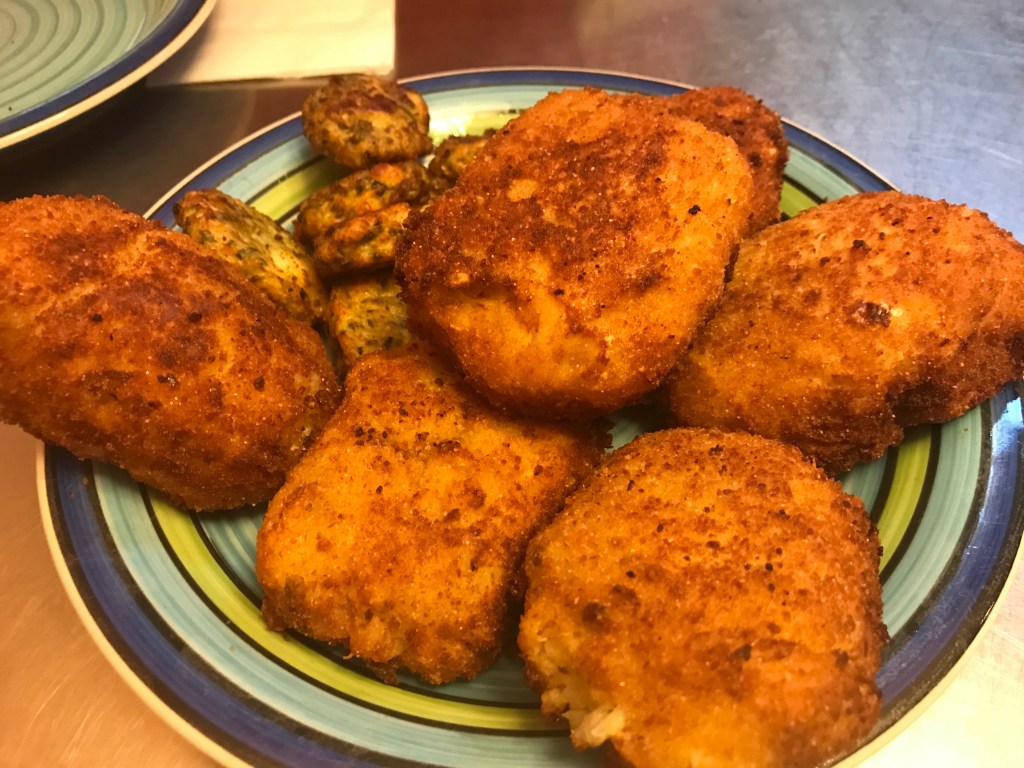
I’m too tired to write out a recipe, but do this. Peel, halve and grate the pear. Clean and chop the leeks. Proceed as normal with the risotto—I used vegetable stock and didn’t add saffron, because I thought that the pears and leeks would get lost. I added the pears halfway into the cooking, which takes about 25 minutes of stirring and adding hot stock. At the end, some butter and Grana Padano, and a swirl of balsamic glaze. If you don’t have that last ingredient, either skip it, or put some balsamic vinegar in a pan and reduce by half. But do it before you start on the risotto; risotto does not like to wait around. The leftovers, by the way, became terrific arancini, or rice balls, the next day.

Risotto–>arancini

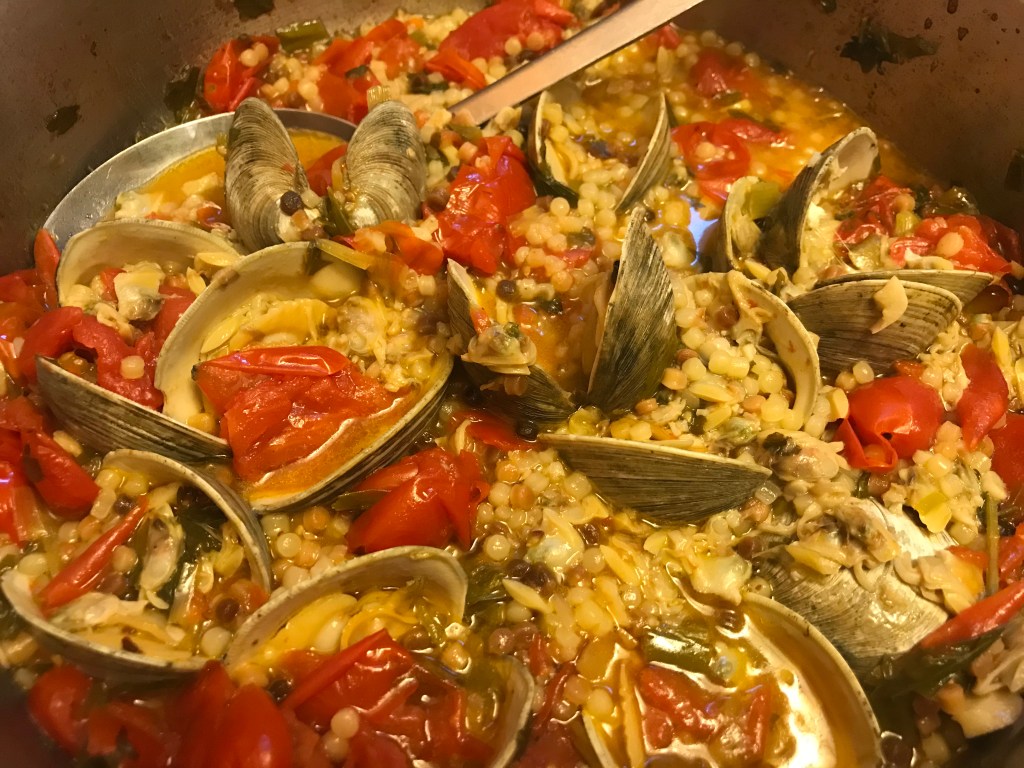
We went to Sardegna (or Sardinia, if you insist) last night. Not physically, but with food and wine. Our neighbors in Umbria came from that island a few decades ago, so we figured if we can’t be around them, we can channel some Sardinian food. I made a seafood dish, fregola with clams. Fregola are toasted beads of pasta that look like pearl couscous, or acini di pepe pasta. But toasted. I made a loose tomato and herb clam stew, and cooked the fregola right in the clam broth. Some of The Spartan Woman’s homemade sourdough, a chilled bottle of Vermentino from Sardinia, and we had Saturday night dinner. To mix Italian regions, we watched some of the series Gomorrah on Netflix. If you haven’t seen it, put it on your list. It’s good; it’s a gritty drama about the Neapolitan Camorra crime cartel. The series is based on a book by the same name by the great and courageous writer Roberto Saviano. He’s under police guard as a reward for his efforts to uncover corruption in Italy.

Some fregola and a bunch of clams

Speaking of wine, where would we be without Honor Wines? I’m really trying to minimize in-person shopping, like everyone else. I could get online to one of the bigger liquor services, but Staten Island’s North Shore has become a sort of laid-back hipster heaven lately and I like to use local merchants. We have cool restaurants, brew pubs, breweries, and wine boutiques. Honor isn’t far from my neighborhood, and a friend of mine has been praising them for a few years. So I gave them a call, and it’s like calling on an understanding therapist. The first time was a little formal, with me asking “do you have…” and “how about something with more body?” This month I let Lorie pick for me, besides the wines I liked from the last batch. Here’s the result; I’ll report back soon, but she sent whites from Catalunya, the Languedoc and the Italian province of Friuli, which borders Slovenia. The Vermentino is the bomb, gotta say. It’s unusual. A touch salty, with some body, and it feels like a wine whose grapes hung out in the hot sun. Sorry–I reviewed restaurants for a decade and never mastered the wine writers’ vocabulary.

Happiness in a box

Otherwise, we’ve been doing what y’all are doing. I bother people with FaceTime sessions because I get tired of texting. We watch Andrew Cuomo every day—his updates have become our version of FDR’s fireside chats. My former ferry crew got together for a FaceTime cocktail hour, and The Spartan Woman’s side of the family got together for a virtual reunion.

For now, I’ll spare you my thoughts on The Thing, and how the U.S. has dealt with it.

This one’s for you, Pamela

During this lockdown, I have a couple of daily routines: walking the dachshund in Snug Harbor in the morning (maintaining social distance, of course), Gov. Andrew Cuomo’s briefing, and Staten Island Advance food writer Pamela Silvestri‘s morning Facebook video. Pamela speaks from her kitchen just up the street from us, and talks about grocery shopping, which stores have what and which ones have early morning shopping for old people, and what Staten Island’s restaurants are doing to survive. She’s full of good, local information, and for us shut-ins, it’s a lifeline—that’s her in the screenshot.

Pamela also grew up in the same neighborhood I did, so we have that bond. It was an interesting place, and almost everyone I know of a certain age went on to have an interesting, non-mainstream for SI life. I bumped into Pamela a couple of times recently (six feet or more apart, it almost goes without saying), and both times she’s put in a request. She wants me to write about Holly Street and our immediate ‘hood. Pamela’s childhood home was on this little curvy road that snaked up the hill that Holly Street crossed, but I’ll grant her honorary citizenship.

So, Pamela, here you go. I’ll try to remember some interesting bits without getting too encyclopedic.

My first memories of the street and our house were as a three-year-old. My parents bought the as-yet-unfinished house, and my dad drove us in the old Pontiac to the construction site. It may have been raining; it’s unclear. I remember being impressed by all the trees—I was a Brooklyn baby at this time—and I can picture the wooden skeleton of what was to be a small Cape Cod style home. It was surrounded by woods and the street was a narrow patchwork through the woods. There were some older houses, but I don’t remember them.

As it looks now, gentrified, with the little Cape Cods the victims of terrible expansion/renovation.

We moved into the house in March 1960; the sale price was $16,500. It was a rainy day; my nervous young parents, both 30 years old with two kids, loaded the car. My baby sister, three months old, had a car seat. I was piled onto the back seat with all the groceries. I probably whined a lot; I remember resenting having to sit surrounded by cans and bags and Ronzoni spaghetti and macaroni boxes.

The next day was sunny. I have a distinct memory of taking a stick and stirring what looked like smooth brown melted chocolate—there was no garden yet and the house was surrounded by clay-like mud. It was paradise.

I’m guessing this is about a year after we moved in. My mother Angela with her two young kids (kid number 3 would follow in a couple of years).

I’ll go faster now. We became part of the place; grass and trees were planted; flowers and tomato plants bloomed. Holly Street was a big steep hill and probably because of that, seemed like a self-contained universe. We ran free as kids, with no supervision. We hiked through the woods, we had elaborate tag/hide and seek games, we rode our bikes everywhere. There was no traffic so we got good as scooting down hills at automotive speeds. My dad put a speedometer on my bike, and it was normal to go down the hill at 30 mph. No helmet. I survived.

Remember, this was in New York City. An outer borough, to be sure, and it shows how rural the island was back then, with about half its current population.

Right: My mom and Noodles the wonder dog out in front, 1970s

One of the things that made the block special, besides the geography, were its residents. I don’t know how typical it was of Staten Island or the city at the time, but there were lots of recent, postwar European immigrants. My dad, for one, from Palermo, Sicily, the year before I was born. Mr. and Mrs. Tait across the street hailed from Scotland. Marie Mastroianni two houses away came from Naples. Sultry, with huge eyes, she was our version of Sophia Loren. There was Mr. Young, our neighbor’s father from Ireland. He had a strong brogue and would chase us with a stick if we wandered into his yard. That’s all I remember of him (anything to add if you’re reading this, Barbara? ) All of this meant that what might have been exotic to others was normal to us. And you can throw any accent my way and I’ll understand what the person is saying. (It also gave my sister and me a good feel for mid-1960s European camp, and I got a ride in a fast BMW long before they became luxury SUVs for people who don’t know how to drive.)

A later entrant was Paul Guglielmetti, a builder. He constructed four houses on a huge plot that were shockingly modern at the time. He came from Lombardia in Italy, the region that’s been hardest hit by Covid-19, and in his own house dictated a strict aesthetic. No crystal anything. Straight lines, modern lighting fixtures. I remember lots of big circles. I liked to babysit for their kids because the house was fun to be in for a kid used to less of a, um, refined sense of design.

Nonno and me. My aunt Pia tells me that he discovered that he liked Scotch that day.

About that big plot: We got our first taste of 1960s environmental activism with that chunk of land. It was forest for the first few years that we lived there. There were paths through the woods that probably dated from pre-European days, when the locals called the island Aquehonga. We played in those woods and knew every tree, every twist in the path. There was an old derelict well and it was our meeting place when we played hide and seek.

Sometime in…1964? 1965? a builder bought the site and filed plans to build garden apartments. The neighborhood was shocked. Was it zoned for them? Back then, a builder could probably get away with it even if it was. Men of honor, you know? The grownups had frantic meetings. They managed to get a restraining order but it expired. Fierce men showed up in trucks. A bulldozer appeared. It was summer, I think, and our mothers gathered up the kids. We were instructed to go block the tractor. We ran down the street. Some of us threw rocks at the tractor. The guy threatened to call the cops. We spread out so he couldn’t move. Some of us, probably aping what we saw on TV news accounts of civil rights demonstrations, threw ourselves on the ground. “Now come on, kid, you don’t want to be arrested.” We were all between 7 and 10 years old. Someone threw a rock. They left, vowing to return.

They did, and destroyed the woods, mowing down every tree. We continued to harass the construction guys. They laid down some foundations before a final court order stopped them, but the damage was done. The land stayed that way for a few years, weeds growing everywhere until Paul G built his mini-Lombardia.

Back to the people (and thanks for sticking around if you’ve come this far). I’ve written about Joe across the street. His full name is Josef Irlinger, and he comes from Berchtesgaden in Bavaria. Joe has converted what was Mr. Murphy’s colonial house into a cozy piece of his native land. He’s retired and still lives there, and being retired means he’s had more time to turn the place into a great hangout. Joe kept up other European habits; every night at about dinner time, he made the rounds, visiting a bunch of families. For us, it usually meant offering Joe a glass of wine and maybe a taste of what we were having for dinner. We called him Seppe (everyone who visited our house was made an honorary Sicilian). If I’m driving near the old place I’ll drive down Holly Street, hoping to see Joe. (We have a VW, and he usually looks at the car and says, “I approve.”)

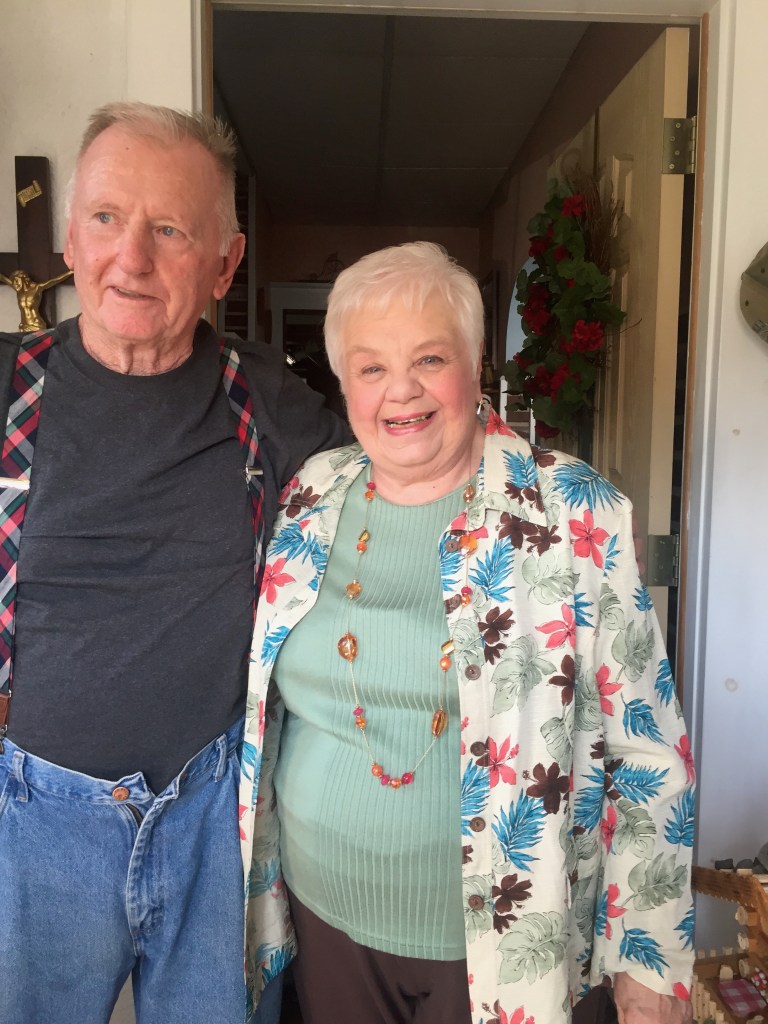
Back before the city paved the street, eliminating its patchwork quilt of asphalt and dirt, it barely bothered to plow it after a snowstorm. That meant sledding during the day for us kids (my dog would leap onto my back and ride down the hill but he never deigned to pull the sled up the street). At night, though, it turned into the Alps. Joe (left, with his wife Louise, or Luisa, as he calls her) would ski or pull out his toboggan; someone would distribute hot toddies. We’d be inside, sometimes in bed, listening to the chatter and laughter as these hard-working people finally got to enjoy themselves.

I’ll leave you with that. This has gone on long enough. I’ll scare up some more memories for another post, ok, Pamela?

I come from the future

[I wrote this a couple of days ago and it already seems dated. I thought I’d post it anyway to show how quickly events have overtaken us.]

I got home a couple of weeks ago, ending the popular series “500 hours of solitude (give or take).” My blogpost output in New York falls drastically, not because it’s a less interesting place, but because, I will admit, I lead a boring life here. Call it the uneventful life of the New York native who didn’t move to the city to live out some fantasy of a glamorous life.

So, first off, I’ll come out and say it. I’m a klutz. Call me butterfingers. Remember when people said that? I was reading something on my dear sweet iPad Air 2, a model that first saw the light of day in 2014, when I dropped it onto a hard tile floor. It wasn’t the first time that I’d dropped either a phone or iPad, but this time it was serious. At first things seemed to be ok, but then the screen turned into a series of gray stripes. Once the icons flashed and I thought, great, it’ll self-heal. But the was only a momentary letup in its slide to oblivion.

I’m also a geek, and when I’m here, I tend to obsess over stuff like computers, iPhones, TV streaming services and the like. I suppose it’s just another way to fill these boring days. Sure, I’ve had work to do, but I am a master of procrastination.

Okay, you say, why not go out and do something? Good question. Since I did return from the walled country of Italy, I’ve been trying to do the right thing and self-isolate as much as I can. Screening while traveling back was nonexistent other than being asked if I’d been to China. But I was in Milan for a couple of days, traveling back and forth from Perugia on crowded trains. So I figured I’d do the right thing and lay low. Plus, jet lag hit me hard and I’ve been semi-narcoleptic, waking up at 4 a.m. and needing a nap by lunchtime.

The Italy I left was about a month ahead of the U.S. in terms of Covid-19 craziness. Whole areas of the north were under lockdown and it was only days before all of the north, then all of the country was ordered to stay home just a few days after I got back to New York. It was all people talked about, and I was unnerved by how unaware people in New York seemed to be about what was going to unfold.

I almost wish I hadn’t left. As a journalist, you want to be where the action is, and a whole country of 60 million people basically staying home is definitely the kind of phenomenon you want to witness. Thanks to social media and everyone having a smartphone, though, it’s been easy to see what’s going on there. Italians have adapted with some sadness and, as you might expect, with a fair amount of style and humor.

Some of our friends are lucky enough to live in the country. Angela and Debora, for example, live across the Chiascio valley from us, in a hamlet of Valfabbrica called Poggio S. Dionisio. Their incredible off-the-grid new house abuts some woods, and Angela, who grew up surrounded by forest, is an expert forager. The first days of staying home found her wandering around to pick wild asparagus, which, after a warm winter, is now in season. Here’s one day’s harvest:

Others have taken refuge in books, cooking, drinking. They’re allowed to take walks, but have to maintain a 1 meter/1 yard distance from others. At first restaurants and bars (more like all-purpose cafés in the American context) were at first allowed to be open from 6 am to 6 pm, but they’re all shut down now. Italians can buy food and medicine, but there are rules. Angela tells me that at the local supermarket, only 1 person per family is allowed in, and there’s a limit of 25 people in the store at any one time. The writer Beppe Severgnini has a piece in The New York Times that describes things pretty well.

Our friend Federico works in an appliance/computer shop. Computer stuff has been deemed essential, so he continues to go to work.

More, later….

500 hours of solitude (give or take): People everywhere! Some with masks!

Did anyone notice that I’d changed what’s in parenthesis in the headline? I didn’t, only realizing the change when I scrolled through the blog. Both phrases say the same thing—give or take, versus, more or less—but the change was completely accidental. Hey, where’s my copyeditor?

Anyhow, so much for solitude. After a drive to another town, then Angelo driving me to Perugia, then a bus trip to Rome’s airport, then a 10 hour flight and 40 minutes to our house and a few hours’ sleep, I’m sitting across the table from The Spartan Woman with cappuccinos and her homemade bean-oatmeal muffins. [Update: I’m finishing this up a couple of days later, jet lag having temporarily eaten my brain,]

I didn’t see any signs of coronavirus worries until I hit Rome’s airport, where every now and then you’d see someone with a mask. When I got in line to check into my flight, an airline rep came up to me to ask me if I’d recently been to China; presumably if I’d said yes I would’ve been tested. I was preoccupied anyway, my periodic allergic cough having returned at a most inconvenient time. Luckily a visit to a pharmacist took care of that; he gave me this great cough suppressant in lozenge form, so I wasn’t hacking all the way to JFK.

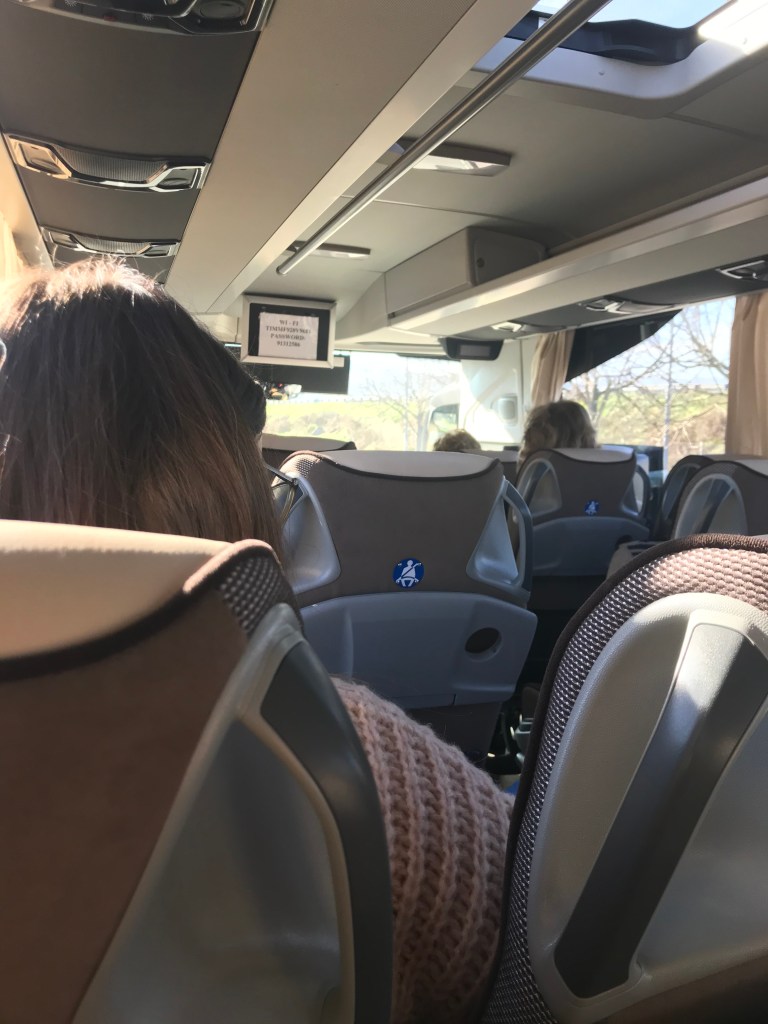
The ride home, stage 2: the Perugia-Rome airport Sulga bus

The scare is already seriously changing how we live. American Airlines has cancelled flights to Milan, while Perugia’s terrific Journalism Festival has been cancelled. Also cancelled is Geneva’s auto show, one of Europe’s big industry get-togethers. In AA’s case, a flight from New York to Milan never took off because the flight crew refused to board the aircraft.

Back in Italy, at least for me, the last couple of days were such a whirlwind that it didn’t occur to me that I was alone most of the time. I realized at some point that our home insurance had expired, so a few WhatsApp exchanges led to my attacking the bancomat (ATM) in town and running off to our agent to pay in cash. Okay, so, cash, old-fashioned, right? Then the policy is called “Generali Sei a Casa Digital” (Generali–the company–you’re at home, digital). I had to sign a half dozen times on an iPad. Go figure.

Then I rushed home to change and take the organic Prosecco from the fridge to go over the hill to our friends Letizia and Ruurd for dinner. Letizia runs a cooking school, her specialty being updated Umbrian classics made with the best ingredients. The couple also run a bed and breakfast, the classes and inn both bearing the name Alla Madonna del Piatto. Both trained entomologists and former academics, they tossed it aside for life in the hills outside Assisi. In one way, it wasn’t a big stretch; Letizia grew up in nearby Perugia. Ruurd’s from the Netherlands and is a multi-talented guy; among other things, he took all the photos in Letizia’s cookbook Kitchen With a View. You should buy it.

We finally called it a night with Ruurd and Letizia

It was an adventure getting to their place at night. Being a city boy, it’s taken me awhile to get used to driving around the Umbrian hills, especially when it’s dark. We native New Yorkers orient ourselves by buildings and by knowing where our islands end and the water begins. You can’t really get lost, plus, you know, streetlights. Letizia’s place is way up a winding road, and it took awhile to figure out how to get there with the car’s navigation. Now I can do it easily in the daytime. But at night, without those cues, not to mention streetlights, I had to keep checking my onboard map, which has been known to lead me through fields.

It was a terrific night, with a couple they know, Augustino and Rossella, who live not too far away in the countryside outside Foligno. We talked about food, families, where we live, ingredients, how to make polenta properly (there are actually pots with motors that stir the stuff for you), beer and the incredible dessert wine we were Letizia’s biscotti into—Passito di Sagrantino.

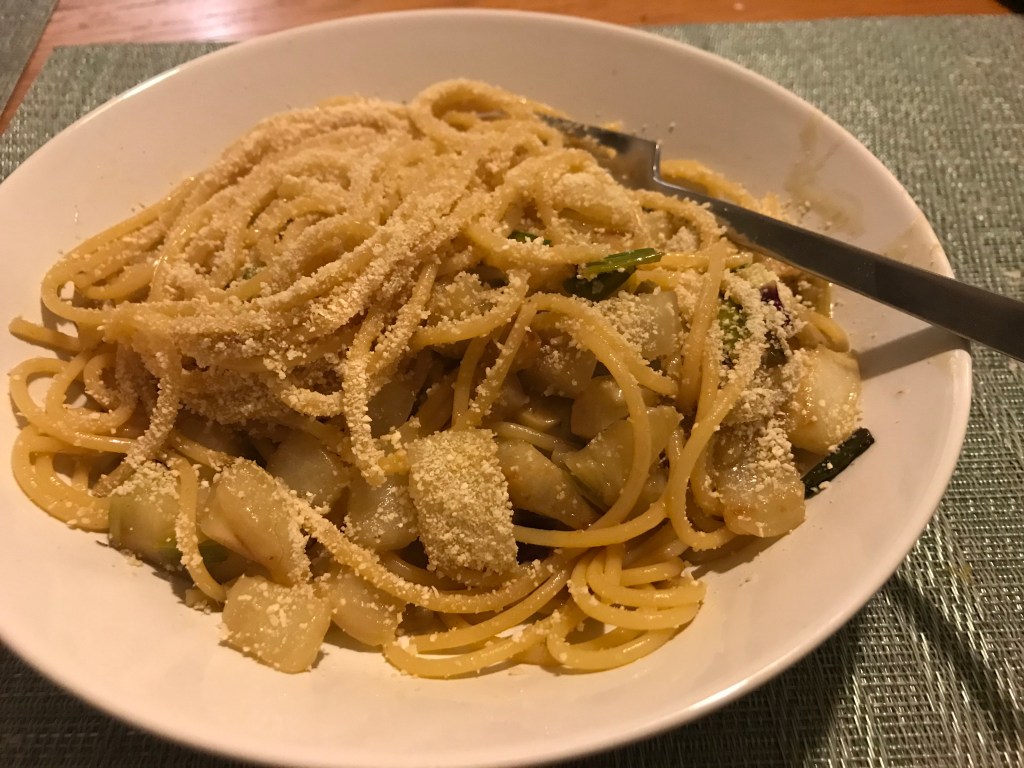
All good things end, and I woke up the next day at 8:30, late for me, with a whole bunch of things to do. Closing the house is more involved, plus I had to pick up a couple of things at the supermarket for friends. And, er, I wanted a bottle of that Sagrantino dessert wine. That night I had my final solitary bachelor’s dinner—farro spaghetti with fennel, spring onions, chili-spiked anchovies, and bread crumbs. Basically, it’s what was left in the fridge.

I scrounged in the fridge to put this together. In a New York restaurant, you might get charged $30 for it.

So…yes, I survived 23 days mostly alone. I spent far less time by myself than I thought I would. Living in Italy means that you have a lot of interactions with people—neighbors, shopkeepers, friends, barristas, etc. I’d get into conversations just walking up the road to get some exercise. We have neighbors up and down the road, and if they’re driving, they’ll usually stop to say hi. Then there’s that inter webs thing. I used FaceTime a lot, probably bothering The Spartan Woman, and we’d just go about our business chatting over an open connection. “Phone calls,” if you can call them that, are free with an Internet connection now.

We’ll be here for awhile. I just hope we can get there from here later this year…

500 hours of solitude (more or less): I have often walked down these streets before…

…but they never quite looked like this.

It was Sunday afternoon into evening. I had some stuff to do in the city, including laundry, so I loaded the clothes in the car and off I went, beseeching my late father-in-law, the patron saint of parking, for a spot up the street. Joey came through, So I loaded the machine (it’s a combo washer-dryer, felicitously called a “lavasciuga” in Italian–say “la-va-SHOO-gah) and then decided to take a walk,

I was really hoping to do something bad, like have a drink or a hot chocolate, which here is more like downing a warm slightly more liquid dark chocolate mousse. But I didn’t, and maybe because I was distracted. The sky seemed a little more dramatic than usual. I snapped a shot to catch that, and went on my way.

I did the obligatory back and forth—su e giù in Italian—on the Corso Vannucci, watching some Carnival silliness. When I reached the end of the Corso, things were looking fine, as you can see below.

Soon it was time to walk back, maybe see some friends in the ‘hood. Now the sky went from interesting to wow, it that for real? I never saw the buildings turn quite that color, either. Usually they get golden, then sorta brown, then black.

And then, it was breathtaking—another favorite Italian word of mine: mozzafiato,

I wasn’t the only one who noticed. I looked around and people were stopping everywhere to take pictures, selfies, or just look around. It was one of those collective moments of appreciating beauty, on a late Sunday afternoon as a warm winter draws to the end.

P.S. I checked out Facebook when I got home, and it seems like everyone I know who’s on it posted a shot or talked about the sunset.

500 hours of solitude (more or less): Hands across the ocean

These weeks here are definitely turning out to be less than solitary. Yesterday my new friend Angelo and I went to Norcia, which was hard hit by a fierce earthquake more than three years ago. Angelo’s a driver; he’s got a Mercedes van and he takes groups around Italy and into Austria, Switzerland, Spain and Portugal. He lives in a church building in the next town over with his constant companion, a sweet little dog name Titi.

Angelo and his sidekick

After days of blazing sunshine, yesterday showed Umbria’s moody, foggy winter side. We climbed into the van, with the dog happily riding between us and headed south. Perugia’s commercial suburbs gave way to mountains. Somewhere near Spoleto you go left and into a 4 km (roughly 2.5 miles) tunnel. When you emerge, you’re in the Valnerina district.

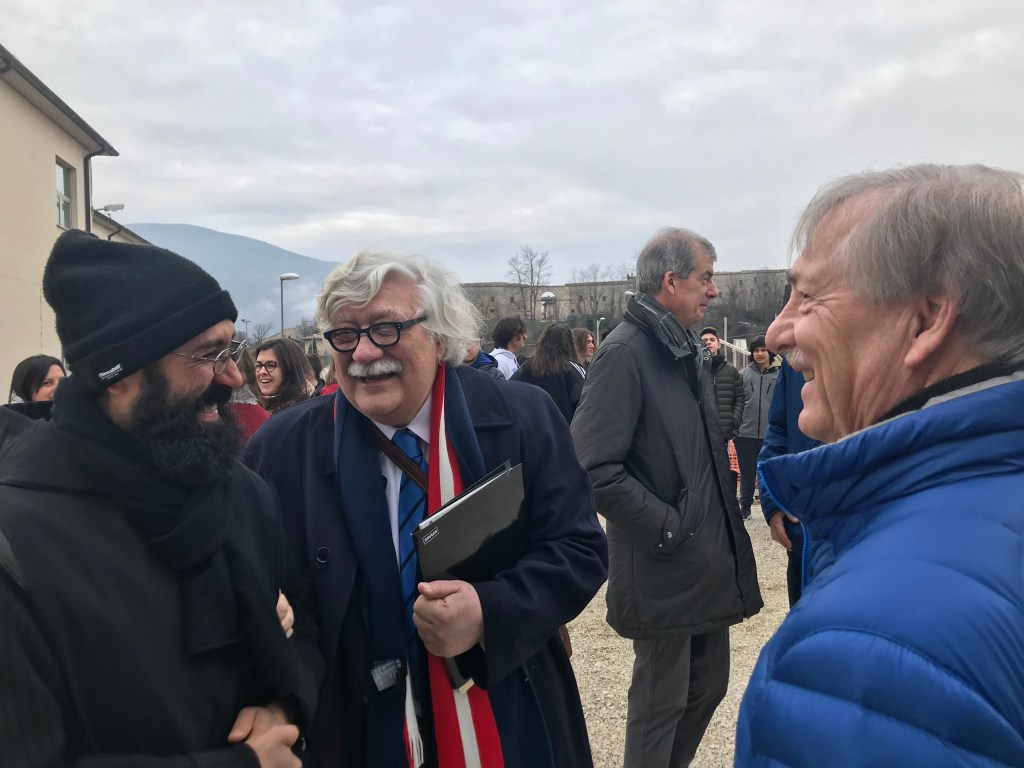
It wasn’t an idle trip. Angelo knew some people who helped build the first new structure in Norcia since the earthquake—a lab and public rooms for Norcia’s kids. The building’s nice enough. What was remarkable about it was how it came together—a unique collaboration between Benedictine monks, Harvard Medical School psychiatrists, and the National Italian-American Foundation (NIAF). The Harvard guys are Richard Mollica, Director of the Harvard Program in Refugee Trauma and Eugene Augusterfer, of Harvard’s Global Mental Health Center, and they specialize in helping traumatized people deal with the aftermath.,

After the quake, the foundation sent the Harvard-NIAF team to the area. But how would they connect with the traumatized locals? They found a connection in Padre Basil, a Benedictine originally from Arizona, who moved to Umbria and immersed himself fully the community. The three men met and the Americans got to know the Norcia community. It’s a proud little city with a long gastronomic heritage. Its pork products are famous throughout Italy, so much so that a slang term for a pork butcher from these parts is “norcino.”

Padre Basil, Richard Mollica and Eugene Augusterfer (in the blue jacket)

Eventually, the Harvard people, Padre Basil and NIAF decided to build the center, with the foundation kicking in $450,000 from its earthquake relief fund. The town’s high school was damaged by the quake and the kids attend classes in borrowed spaces. They needed labs for their science classes, a space for gatherings, and spaces for counseling. That’s where the Italian Trauma Center came in and helped coordinate the efforts to build it.

The three men share a few characteristics: They’re lively, extremely friendly and just ooze kindness and concern. Those traits were on full display as people gathered for the ribbon cutting. Officials, local cops, disaster recovery people, and the curious milled around beforehand. The project’s architect, Mario Solinas from Perugia smiled wanly as he looked around and told me, “Can you imagine? This is the first new building in Norcia since the earthquake and it took private funds and initiative to build it.” Others nodded and compared the slack recent government efforts to the aftermaths of previous tremors.

Architect Mario Solinas (left) in front of his work

The pre-inaugural gathering soon got a big energy injection as high school kids trooped up the road, their boisterous voices carrying far as they enjoyed a morning off from classes. Soon we were all rounded up as the school principal, the architect, local officials, and the Harvard and Trauma Center teams gathered to cut the ribbon.

Both national anthems were played, the Italians telling one another, “it’s the American one. No, we don’t have to know the words.” When the Italian anthem, officially called “Il Canto degli Italiani” came on, the kids and their teachers sang along boisterously, cheering one another on and challenging themselves on sheer volume.

Finally, the speeches, which were mercifully short, and short of boasts. If anything, the theme was community, cooperation, and survival. Fun fact: After disappearing for years, the local river reappeared after the quake. The speakers took it as a sign of rebirth.

They aren’t out of the woods yet. Behind the center is a still-incomplete new school. The kids may be able to use it next academic year. Or not. Here’s hoping. I have a feeling Padre Basil won’t ease up on his efforts to get it finished.

500 hours of solitude (give or take): Let’s talk about global elites, baby

After a couple of days getting over jet lag, dealing with cobwebs, and laying in supplies, it was time to come down from the mountaintop. I got an invitation on Facebook from my Franco-Italian friend Gilles to attend a talk in the French consolate in Perugia on the roots of anti-European populism. Policy geek that I am (it comes and goes), I hit the “attending” button and got an e-ticket to the event. Yes, a ticket—I was thinking, was this really that popular a thing?

It was. Perugia is a big college town, after all.

But I’ll back up a little. We bought a little apartment in Perugia’s historic center some years ago. We spent a lot of summer vacations based there. I say “based there” because we’d move in, have meals and sleep there, but every chance we got we’d go out, either to the next hill to hang out at a café, or we’d hop in the rental car to go exploring.

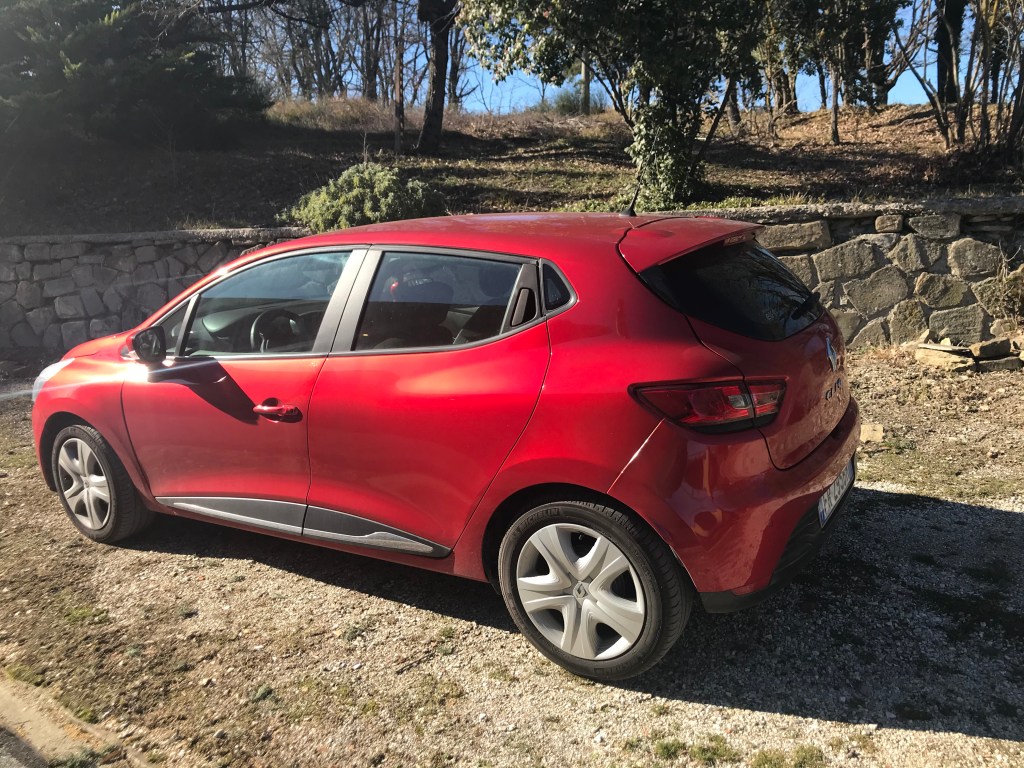
So off I went, down the winding road, onto another winding road that eventually took me to my secret parking spot. I purposely avoided the highway that would’ve taken me faster into Perugia. It was nice to be driving a stick shift car again; in fact it was the car that got smashed up last summer, now looking good as new. I had fun downshifting through a few hairpin turns, and less fun being tailgated by sociopaths. I was driving fast enough.

Looking better than on a certain July afternoon

In about 20 minutes, I was back in the old ‘hood, which happens to be the university student quarter of the city. Yeah, you can go back home again. I walked down our street and checked the apartment. All was ok, except for the recalcitrant heater. I’ll have to take some time later to sort it out. I headed out again, aiming for Perugia’s main drag, looking for our bank’s bancomat (ATM to English speakers) and my favorite place to get an espresso standing up at the bar. It was all very very quiet—I realized that I headed out just before the afternoon break was over.

Soon I was joined by people walking around talking, enjoying the springlike weather. It was around 15 degrees C, or 60 degrees in Amurrican, and I window shopped, looked for any changes, because it had been four months. It all looked pretty much the same. I had some time to kill, so I found a park bench and took in some sun, while eavesdropping on the conversation going on at the next bench. The three, including a woman of a certain age wearing a hat that looked like peacock feathers, were psychoanalyzing a common acquaintance. Soon, Ms. Feathers got out her phone, called said acquaintance, and started shouting into it. Mostly she was saying, in Italian, “can you hear me?” (mi senti?). If he couldn’t, everyone within 10 meters could.

Then it was time to head to the French consulate. The building, off of Piazza Morlacchi, looks disconsolate, down on its luck, and the stairway up a flight didn’t change that impression. But when I got in the room, O…M….G. The room was already half full, and we had to sign in. The crowd was a mixture of students, professorial types, and the Italian equivalent of people who might go to a lecture at the 92nd Street Y.

The talk itself featured Corriere della Sera editor Federico Fubini and Bocconi University Prof. Gianmarco Ottaviano, and was entitled “Unione Europa, Perché Odiarla? Alle Radici del Sovranismo Antieuropeista.” That translates as “European Union, Why the Hate? Seeking the roots of anti-european nationalism.” That last word is problematic to me—”sovranismo” is more than just nationalism, and the speakers made a distinction. It refers specifically to the actions of governments like that of Trump and Johnson in the UK, or to what Salvini in Italy preaches. It’s more than an appeal to God, Tradition, and Country in the old days; it’s coupled with anti-immigrant actions like imposing punitive tariffs and withdrawing from international treaties. Anyone out there have anything to add?

In any event, the roots have been out there for us all to see. The EU, they said, is a perfect vehicle for the world that existed in the 1990s, the somewhat fuzzy promises of globalization, a mobile, educated populace, speaking English and tech-talk, seamlessly moving around doing important Internet stuff. Problem is, the world the Eurocrats set up led to wide dislocations as people from Southern Europe moved north for jobs. At the same time, stupid decisions like the US invading Iraq led to the refugee crisis, with thousands braving the sea to reach European shores. Italy in general feels hollowed out, its once huge auto industry, for example, rushing into a marriage with the French Peugeot. And that’s just one big example.

So yeah, there’s a reason for people who aren’t English speaking tech savvy consumers of iPhones and Camembert to feel left out of it. The speakers were charming, yet a lot of what they were saying seemed obvious, at least to me. What we need, if we want to avoid the ranting, racist appeals of Trump and Johnson, are policies that make angry people feel like they’ve been invited to the party. And mealy-mouthed, fiscally prudent centrist policies ain’t gonna do it. Seems to me that we’re at one of those historic junctures that demand structural change, much like FDR did to save US capitalism back in the 1930s. And it doesn’t look like the current crew is going to do it. Are there any grownups out there?

500 hours of solitude (give or take): Day 1, alone with the neighbor’s sheep

This was the deal: The house in Umbria was unoccupied for a few months, and this is not a good idea. It’s one thing to leave an apartment—you just close up, turn the gas off, make sure the espresso machine’s emptied of water, lock the door, and you’re good to go. It’s rather different with a country house, especially one that’s pretty visible. Our red car wasn’t in front, and a close viewer would notice the lack of activity.

Only both of us couldn’t get here this winter. The Spartan Woman has a bunch of things to do, and she’s more successful at doing them if I’m not around. And it doesn’t matter where I am to do my work. So here I am, up on the mountain with the sheep. Someone had to do it.

I’ve never been alone up here for more than a few hours. So this is an experiment. Can I live here and do what I need to do without turning into a crazy man talking to myself? Oh, wait, I do that anyway. Can I do it without turning into a sloth in sweats, a hermit with the sheep and if I’m lucky, the neighbor’s sheepdog as company?

We’ll see. So far, things are fine. I got here yesterday via a smooth and nearly frill-free but comfy Alitalia flight (premium economy is almost civilized.) The airline’s perpetually bankrupt, but it keeps up a good face and premium economy comes with a better, more spacious seat and priority check-in and boarding. Then a friend of a friend picked me up at Rome’s Fiumicino Airport. That saved me from either a combination of trains and then begging for a ride, or a slow bus and begging for that ride from Perugia. Plus, the guy was great to talk to—total Italian immersion—and his sweet little dog fell asleep on my lap.

When I got here, the poor house felt neglected, with cobwebs in the corners, a fridge with some scary items in it, and the wind howling from the north. Luckily, though, the Internet connection still worked and a friend turned the heat on before I got here. It’s still chilly but not frigid in here.

The house still stands. The old shed is missing the summer’s pool toys.

I’ve had back again stuff to do–get in some groceries, fill up the car, and some work. And being alone means I get control of the TV remote and, as usual the few times I did, I got lost down the YouTube rabbit hole.

The town’s still there.

I’m going to try to blog more often as a way of chronicling my adventures. Or document my going insane. If I can’t think of anything halfway interesting to write, I’ll post photos.

This winter I went swimming

(with apologies to Loudon Wainwright III)

This winter I went swimming 
This winter I wouldn’t have drowned 
I held my breath and I kicked my feet 
And I moved my arms around
I moved my arms around

We’ve been back in New York for a few months, which has been bad for the waistline. And so it was time to get back into some kind of shape. The holiday season was blissfully over. No more béchamel, truffles, cocktails, cookies, pies, wine, more cocktails, more wine. No more avoiding the pool because, you know, I had things to do—like visiting a friend on the Upper West Side for cocktails and seeing friends who were holed up in a Times Square hotel for, you guessed it, cocktails.

I’ve had a YMCA membership before Kid no. 1 was born, some 35 years ago. I used to hit the pool at 9:30 pm every weeknight. I was in my twenties and super fast. The pool, in fact, was filled with people who were super duper extra fast, all young like me. We’d goad each other to go faster. I learned how to do flip turns. “You should make it snap more,” one of my partners counseled. I did. I kept it up for years, which was relatively easy to do when you’re young and didn’t have to get to the office until 10 or so. And as the kids grew up, I started going less and less, in spurts more than a steady routine.

I love the water. Unlike the experience of some friends of mine, for whom swimming was a structured, oppressive series of lessons in an indoor pool, swimming for me always meant freedom and escape. I learned to swim at the beach. My father was a really strong swimmer, and when I was only four or five, he’d sit me on the beach and tell me not to move. Then he’d swim way out, waving to me and calling me. Then it was my turn. I learned by riding the waves, and soon being buoyant was as natural as breathing.

Later, we had a backyard pool and my siblings and our friends spent most of our summers in it. We played elaborate hide and seek games that involved swimming stealthily underwater to evade who was “it.” In high school, I took swimming instead of gym a couple of times. Mostly it was to avoid the Marine drill-sergeant gym teachers and the stupid militaristic calisthenics. But it soon turned into a soothing respite from Brooklyn Tech classes. Most of the class (gym classes were single-gender) would play pool volleyball unless the swimming coach decided to actually teach a lesson. But I was nearsighted and hated games like that. And I realized that I could just be a loner, and float around the deep end. I’d make sure to get high before class and spend a very pleasant hour mostly underwater pretending to fly.

As a college kid, I’d go upstate with friends to explore swimming holes. We’d jump from cliffs into ice-cold pools of water. One drop was about 35 feet and, well, you can’t slow down once you step off the ledge. Didn’t stop us though. Those beautiful swimming holes—I barely remember where they were—were a great foil to a series of boring summer jobs.

So it was back to the Y pool this month. Only now, not having a regular office job means I can go to the 11 am lap swimming session, where I’m actually one of the younger people in the pool.

I’m sometimes alone in the lane, which is great. But more often than not, I split the lane with Chris, a retired fire captain about my age. Chris is tall and lanky, and he gets to the deep end with what seems like five strokes. He’s just so quick and quiet about it. He told me he was a high school swimmer and has been swimming in the Y pool since he was three years old.

I was inclined to hate Chris. Early on, I heard him talking with someone about how Trump was driving liberals crazy. They were giggling like little boys who snuck a frog into a girl’s lunchbox. I avoided talking to him or even really acknowledging his presence. Eventually, though, we got to talking, starting with the usual “want to split the lane?” question. And I found out that he’s a curious and smart guy and somewhat of an amateur historian. We still avoid politics, and that’s okay. Can you say “cognitive dissonance”?

Going back and forth in an indoor water tank does get tired, but I do things to make it interesting. The Spartan Woman gave me an Apple Watch a couple of years ago and I can wear it in the pool. It’s got a workout tracker for swimming in a pool, so I’m always tracking how much I swim in how many minutes. My baseline distance is 1,000 meters; I figure that that’s pretty good for an old guy. If I can do it in a half hour, so much the better. Besides, with the watch, I don’t have to count laps, which always tripped me up. I always lost count before.

It’s pretty amazing what swimming a few times a week will do. I have muscles again; they seemed to go into hiding once the summer swimming season ended. I’m incredibly relaxed post-swim, especially if I spend some time in the sauna afterward. And it gives me an excuse to get out of this little prison of a home office.

I can’t wait for the summer.