Landing, Culture Shock, Dueling Populisms, and Puppies

First of all, we’re back in the U.S. of A. So buy me lunch, those of you with the few remaining expense accounts. My calendar is pretty open right now.

This song always goes through my head as we approach JFK or Newark:

I’ve never been more mindful than now of the gap between Cool America (rock ‘n’ roll, R&B, rap, Kerouac, Georgia O’Keefe, Brooklyn, Yo La Tengo, etc.), and weird uncool America (a certain combover artist with a fake tan, Branson, Missouri, the NRA, Paul Ryan, The WSJ editorial board, Fox News,). It’s always been this way, but folks, we’ve reached the point where we’re living in different universes.

Our departure from the mostly cool country of the Repubblica Italiana was sad and a little painful., Okay, quite painful, literally. I succumbed to the flu, despite having gotten the vaccine a few months ago. I guess it didn’t cover the Italian variety. I spent days on a recliner—the bed was too horizontal and I felt as though I were drowning—and prone to freezing and then being overheated within a 15-minute timespan. We delayed our departure, only to worry about a strike the day we left in honor of International Women’s Day. Luckily, the strikers provided for a few hours for safe passage and we took off more or less on time.

But then…after a terrific flight on Norwegian—good prices, good premium economy cabins, decent food and drink and legroom—we landed in Newark. In one way, it trumped JFK; no one was shouting at us as we went through passport control. On the other hand, no one guided us, either, and the time savings allegedly granted by using the app Mobile Passport proved illusory, except at the end when our keepers decided to let users through, like they should’ve at the start. Note to self: Sign up for Global Entry.

We left an Italy with a caretaker government following indecisive elections that split the vote basically 3 ways, between the “populist” Movimento 5 Stelle, the center-right (including the inflammatory Lega) and what’s left of the Left. None of those by themselves got enough votes to form a government and nearly two weeks later, the jockeying and negotiations drag on.

The results are being compared to the fuck-you Trump vote in the U.S. And yeah, a lot of people who voted for M5S and the Lega were motivated by the same reasons otherwise nice Americans voted for the odious Trump. The establishment parties haven’t exactly done right by the peeps and haven’t really offered a compelling vision of life with them other than to say, hey we’re not crazy.

But there’s a big gap between the continents. In the U.S., with the Republicans controlling the legislature, executive, and probably the courts, there’s been a rollback of everything that makes a country civilized. These Ayn Rand acolytes have tried to kill the Affordable Care Act, enacted the most regressive tax regime in decades, and have killed off scores of environmental rules. They aren’t even trying to give lofty reasons for their actions. It’s just Obama did this, so we’re undoing it.

Looking at the victorious parties in the Italian elections shows a different story. None of them talked about reverting to a free-for-all health care market. In fact, they criticized some of the erosion demanded by the European Union budget masters. And both the Lega and M5S plan to implement a minimum income for citizens; they differ in the amount (either around €800 or €1000 monthly). Where they do resemble the Trumpistas is in their contempt for immigration. But there, they’ve got some facts on their side. Italy has taken up a disproportionate burden of rescuing thousands of refugees at sea. And like Greece, it’s taken a budgetary and a social toll on the country as Italy’s Euro partners look the other way. It’s a bit different from the non story that is the U.S. being overrun by Mexicans, when in fact since the Great Recession, traffic has gone the other way.

It’s a sign of how far to the right political discourse has gotten in the U.S. And also a sign that to some extent, Europe right now is still more open, more tolerant and more equitable than its old partner across the Atlantic.

There’s one unambiguous, wonderful thing about being back. We’re back with our kids. And knowing that the InterWeb loves the doggies, this little creature is back cuddling, begging for food, and stomping around Snug Harbor Cultural Center like she owns it.
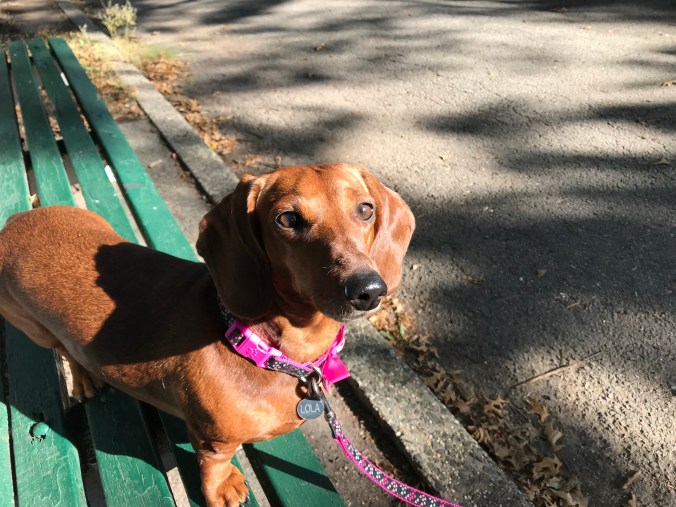
IMG_2302.jpg

The Rick Steves Contradiction

I’ll admit it. I have strange habits. I know I should be serious and maybe even care about POTUS’ SOTUS, or whatever the acronyms are. But no. I shoot videos of sheep circling the pool and marvel at how the fog seems to hang out midair. This luxury won’t last long. I’m being bad right now, writing this instead of a travel piece. I like to think of this as practice for that article, though. Yeah, practice. Y’all are my test subjects.

Screen Shot 2018-01-31 at 15.09.24.png

So, expert procrastinator that I am, I looked at Rick Steves’ website. If you don’t know Steves, he’s the hugely popular host of travel shows on PBS. The guy is unthreatening; a Salon writer called him the Mr. Rodgers of travel. He schleps a backpack around Europe and urges people to have genuine experiences instead of the if-it’s-Tuesday-it-must-be-Belgium kind of snapshot-dominated travel. He seems to have friends everywhere, so he gets to have dinner, or take a hike with charming locals that he’s known for years.

I read an interview with him some time ago. Behind the nonthreatening facade is a guy with an agenda, one that I pretty much agree with. He’s actually deeply subversive, at least these days of Trumpian triumphalism and over the top “patriotism.” He wants Americans to realize that they’re just ordinary people, part of the 7 billion or so souls on the planet. His shows emphasize personal connections. As part of that, he takes a lot of public transport (Republicans like George Will consider trains to be socialist), stays in B&Bs and eats in popular locals places rather than temples to haut cuisine.

Here’s the thing that fascinates me, though. He’s made what seems to be a thriving business from it. And that’s great, at least for him and his employees. But in seeming contradiction to his advocacy of self-reliance and independent discovery, his company runs guided tours. I’m still wrapping my mind around this—anyone else have a problem with it? I get the rest of it, the blogs of advice, the guidebooks, podcasts, whatever helps get you from Barcelona to Berlin. But the tours make my head explode, as does the almost religious adherence that his followers seem to have to the routes he pushes in his guidebooks.

And the forums. People ask others about the tours, or run itineraries around for inspection. You see over and over again that a lot of people don’t stray from the cities and towns Steves goes to. And most of the shared itineraries are exhausting. I’d kill myself before I’d visit six cities in seven days. Then again, I’m rediscovering my true, incredibly lazy self. It’s not that I’m opposed to learning about a place—for specific sites, or meals, it’s sometimes good to have a guide. I’m lucky that here we’ve had a community that’s embraced us and helped us get settled.

Maybe I’m just jealous. I truly respect the guy and what he’s accomplished. I wouldn’t mind having a thriving business. And if he’s helped someone get over his or her fear about mixing it up with the locals, that’s great. But he also seems to be enabling that kind of fear of the other by running these tours. And, judging by the forum posts, he gets repeat customers, to the different tours. So you have to wonder if they’re even picking up on Steves’ message. Maybe at some point, he should say, two tours and you’re done with the training wheels, go off on your own.

The Year of Living Differently

“THE YEAR OF LIVING DIFFERENTLY” HEADLINE CAME TO ME as I was swimming laps in the local Y pool. Thinking of a phrase there wasn’t odd by itself—I always came up with decent headlines and story ideas while walking, running, or swimming. But I was swimming late morning, right in the middle of the workday.

Other people’s workdays.

For almost a year, I haven’t had a day job. For some 33 years I did, but right after New Year’s Day, I and a bunch of my colleagues were reorganized into other endeavors.

My first reaction? Relief. I was tired of the routine, even though I had work that I enjoyed most of the time. But I’m not going to go on about this. I guess if I want to be pompous, I can say that my not being beholden to a regular job is the leitmotif of this post. But like the other media I used to sneer at, I’d like to look back semi-fondly at an incredibly weird year. Not as a political or reported article, but a personal look.

For one thing, our family lost a couple of souls this year that were precious to us. First off was our pal, no, our brother by a different mother Mick, lost to ALS. Mick was a romantic, a sweetheart, a truly funny guy with (and I say this with love and admiration) a twisted and original sense of humor. In his later years, he suppressed that side of him in favor of genuineness—I guess arch humor loses its appeal after awhile. But here’s a sample of his work for The Multiethnic Foundation, a guerrilla art group that he and er, I and The Spartan Woman had back in prehistory (ok, the early 1980s).

2013 multiethnic calendar.jpg

Happy Fascism!We actually put together a ‘zine once. Riffing off of an idea in Borges’ Ficciones, we put together a magazine of magazine covers. They’re the best part, aren’t they? Here are a few samples that Mick lovingly put together in a calendar for us a few years ago. (Keep in mind that he did this stuff with an X-acto knife and press-on type, cutting and pasting the rest.) Looking at some of this stuff, it was oddly prescient.

Sigh. We’ll miss him.


DSCN4607.jpg

Henry Aldridge Scozzare, Mt. Desert Island, Maine, 2005

We also lost a couple of members of the Villa Sconita family, sweet Pete the cat, and  Henry the Lab. Everyone thinks his or her pet is special, but Henry was something else. He was so keyed into our moods. He understood every language we could throw at him. So for the first time in years, we had a mostly animal-free house in New York.

You know that feeling that you’re standing on the precipice of something? That change is inevitable, so get used to it? 2017 has been that year. The lack of a day job freed me up from having to physically be in the U.S. We’d recently bought a country house in Italy, and we actually got to spend some time there. In the spring, we went for just a couple of weeks,  We scheduled the trip before my life was reorg’d.

IMG_1798

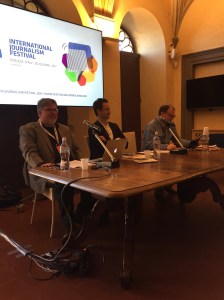
It isn’t every day that you do a panel discussion in a palazzo.

But it was good, anyway. For one thing, I got to do a panel discussion at the International Journalism Festival with my friend and former colleague, Fabio Bertoni. We talked about the dangers of the EU ruling on the right to be forgotten online. (And The Spartan Woman and I bought kitchens and ordered furniture. To be honest, the whole two weeks is a blur.)

Even better, we spent two months in Umbria over the summer.  (Our neighbors, the sheep of Agriturismo Ca’Mazzetto, are wandering around in the photo up top.) I hadn’t spent that much time abroad since I was a teenager. And that was with my extended Paonita family and just a tad less free. I didn’t have to beg for the time off, or work around others’ schedules, or get the disapproving looks of certain execs about daring to take more than a week off at a time. (Honestly, Americans are idiots when it comes to such things. Flame me if you want, but it’s true.)

I wondered before flying out how it would be, whether two months away would leave me yearning for, I don’t know, American TV or the language. And no, we passed the test. First of all, The Spartan Woman and I speak English to one another; every now and then we’ll say a phrase or two in Italian, but it’s not how we communicate most of the time. So we didn’t feel alienated. At the same time, interacting every day with shopkeepers and waiters and workmen did wonders for my Italian fluency.

Lest you get the wrong idea, we didn’t spend our days Looking at Art and aping the British Grand Tour. We were more like general contractors, overseeing a few platoons of plumbers, electricians, stonemasons and others getting the house in order. And I worked through a good chunk of it, sitting at the only table we had at the time, in the kitchen, looking wistfully out the door at the garden. Freelancing does has its benefits (but don’t ask me to praise the art of nagging for payment).

Ever notice how things go at once? Besides the pets, we said goodbye to a car, a washing machine, an iPhone, a MacBook Air…it goes on. I’m not saying there’s a conspiracy, but a guy can feel pretty paranoid about these coincidences.

Enough musing. It’s time to charge head first into 2018. Happy New Year/Buon Anno/Bonne Année everyone. My resolution: To keep on connecting with you, and to battle the darkness out there. Or on my Facebook feed—hint, let’s try not to let them drive us crazy.


Mr. Bickham, Joan, and Us

Version 2

Dennis and Joan posed outside the IFC Center, 11 November 2017

I haven’t written in awhile, not since we got back late this summer. Call it a combination of work, routine stuff, and not having any deep thoughts about what I did on my summer semi-vacation, or how I felt about returning from it.

But an outing this Saturday got me wanting to write here again. My old colleague-comrade Joan Cheever and her husband Dennis Quinn invited us to a screening of a mini-documentary they helped produce, Seven Dates With Death. It was part of the Doc NYC festival, said to be the largest documentary film festival in the world.  Seven Days riffs off part of Joan’s book Back From the Dead: One Woman’s Search for the Men Who Walked Off America’s Death Row. In one chapter, she describes the life and case of Moreese Bickham. (You should buy the book; Amazon’s selling it in digital form, too, and it’s an engrossing, thought-provoking read about capital punishment and redemption.)

Bickham lived in Mississippi and Louisiana for most of his nearly 100 years. He’d gotten into an argument with sheriff’s deputies in a bar back in 1958. Later that night, the deputies, without shields, and who many in the area said were Ku Klux Klan members, approached his house and opened fire. Bickham fired back, killing the two men. He was convicted of the murders and spent over a decade on Louisiana’s death row. He won seven stays of his execution date. In 1972, the U.S. Supreme Court ruled in Furman vs. Georgia that capital punishment was cruel and unusual punishment; from that moment all capital murder sentences were commuted to prison terms, usually for life.

In Seven Dates, Bickham talks about the incident, and his life in prison and out. The guy (who died last year at the age of 98) talks without guile, and without bitterness. Sure, he takes blame for the two men’s deaths, but he’s cleared eyed about the bigotry and mistreatment of African-Americans that led to his spending decades on death row.

Joan and I worked together as editors at The National Law Journal, back then a scrappy print weekly. We worked out of a cramped and ugly newsroom in what is now Google’s New York base. Regular old-fashioned metal desks were pushed together, although there were rudimentary partitions for some reporters. Joan and I sat without partitions at the entrance of the main part of the newsroom, sort of like Tibetan temple guards. In that little, crowded space, we committed some terrific journalism—and we heard everything that went on.

IMG_2487

Three of the Florent Four: Rose Olander, Joan Cheever, and Anthony Paonita

Joan’s a lawyer, and through a friend was representing a death row inmate who eventually lost all appeals and was executed. She was getting into the capital punishment issue with the enthusiasm that is typical of her, and soon she was reporting and writing a book about the death row inmates whose sentences had been commuted by the Supreme Court’s Furman decision.

Suffice it to say, Bickham became our friend. I should really say “Mr. Bickham,” because that’s how Joan referred to him over the years, and that’s how I sort of know him. We heard all the updates about Mr. Bickham’s life, and in a way, everyone in the newsroom felt like we were part of Joan’s journey. Years later we were attending a memorial in the Bay Area for the spouse of an NLJ reporter, and Bickham lived in Oakland, and Joan and I went to the farmer’s market, where Joan bought Mr. Bickham a gift, wind chimes. I never got to meet him, though. At some point in the weekend, a friend took me on a whirlwind tour of San Francisco and the woods north of the city while Joan brought Mr. Bickham his gift.

The Seven Dates screening was pretty early for a Saturday, 10 a.m. We approached the theater and saw Joan and Dennis outside. We hugged like the old friends that we are, and I turned around to see Rosemary Olander-Beach, who was our copy editor at the paper way back when. It might have been awhile since I’d seen either of them, but we fell into conversation and laughs as though we’d seen each other the day before, at our then-regular Friday lunch spot, Florent. Soon afterward, another former colleague dropped by, ex-copy editor Joe Phalon. It was great to have part of the old gang together again.

Reunion016

The Florent Four, with Flo (left), at the infamous Table 8, during a 2002 reunion.

Why am I writing this? For a couple of reasons. First, I’m pushing Joan’s book and documentary short. But it also got me thinking about journalism, how people working in the profession formed long-lasting bonds—and how the business has changed, and not for the better. A lot of my best friends come from that era; we worked closely, and there’s something about that editor-reporter bond. It’s almost like a doctor/patient relationship. The reporter supplies the work for the editor, and places his or her life—the painstakingly crafted or even tossed off story—into the editor’s hands, hoping the editor will make it better.

Version 2

Joe Phalon came, too.

Newsrooms until sometime earlier this century, or maybe even back into the 1990s, were full of brilliant and eccentric people. The so-called grownups, the editors, tolerated a lot of what would be deviant workplace behavior elsewhere from the reporters and from one another. It was more than tolerance, actually—we wanted it, cultivated it. We knew that people somewhat on the edge were sensitive and driven enough to connect with sources and really draw something great out of a conversation. Truly curious people tend not to be drones. We derisively called normal work environments “insurance companies.” (Apologies if you’re in that fine, fine trade.)

If we worked hard, we played hard, too, and not just in the approved way of meeting after work for drinks. We often drank on deadline nights; it helped with the headline writing. And we had a tradition of ducking out after the paper went out at lunchtime to a diner-turned-into-24-hour sanctuary for the weird and creative, Florent in the old meatpacking district. What started out as a restrained meal with a glass of wine turned into a legendary thing, with a core group of editors consuming bottles of wine with lunch, and having cocktails or armagnac for dessert. Occasionally our editor in chief would drop in when we were already pretty drunk, and ordered a bottle of the paper’s house Champagne, Veuve Clicquot. We started that day—our weekly deadline—with bubbly and bagels for breakfast. That sort of behavior probably would get us fired now.

What kept the sacred newsroom that way was separation. We existed apart from the business side of the operation. Good editors protected their wacky charges from such concerns as circulation and ad sales. But that couldn’t last. Maybe the business side’s resentments got the ear of management, but today’s newsroom often resembles that reviled insurance company. It’s a quiet place, with reporters often just emailing sources. They’ve got production quotas and metrics, and should they forget, there are large flatscreens showing how many mostly casual readers have clicked on their stories. As el Cheeto Loco might say: Sad!

In short, American business practices have taken over the news business and turned its workers into digital drones. Maybe I’m just a nostalgic curmudgeon, but the kids getting into it now are working in a more sterile, less adventurous, more orthodox careerist environment.

Do I or any of my ex-colleagues want to go back to that? I doubt it. Maybe the memories are like insects preserved in amber, pretty to look at and think about, but of a particular place and time that can’t be replicated.

I Met Her Online

I was a member some years ago of SlowFood, the back-to-basics food movement founded in Italy by Carlo Petrini. The organization supports local agriculture and traditional foods, and rejects industrialized, standardized methods of food production. Petrini founded the group after seeing a McDonald’s open in Rome’s Piazza di Spagna and decided the world needed an antidote to fast food.

I had joined the U.S. branch, but after awhile, I left the group. The Americans  seemed to be more interested in luxury food, rather than participating in the then-nascent farm-to-table movement, and I decided that it wasn’t for me.

But it left a legacy: Sandra Cordon and Letizia Mattiacci.

IMG_1957

Letizia (left) and Sandra, old friends sharing stories.

It’s a little complicated, but going through the SlowFood site, I must’ve stumbled onto Slow Travel, which had message boards for travelers who wanted a different experience from the package tours and the usual Rome/Florence/Venice routine. In particular, there was a message board just for Italy. I was fascinated by the kinds of questions people would ask and the ensuing discussions. At some point, I noticed that there was a woman who was really into Perugia, and either asked questions about logistics or answered them for would-be travelers.

Sandra is Canadian and now works for the United Nations in Rome. We got to know her—my memory is vague, but she sent me a personal message. And at some point, we managed to be in Perugia at the same time, and she, The Spartan Woman, and I had a terrific lunch. We told stories and walked around Perugia via our favorite streets and had gelato at Augusta Perusia, the best gelateria in the city (and just maybe, the world). Sandra and I have a lot in common: We’re recovering journalists who once had full-time jobs in that wonderful and crazy and stressed out profession. Our politics are in synch and we like to get out of North America, either full-time for her, or part of the year for us.

Sandra brought us a gift: Letizia Mattiacci. On her posts, Sandra frequently mentioned Letizia, so like any good ‘net citizen, I did some Googling. Turns out Letizia is a cooking teacher and with her husband owns a bed and breakfast in the hills near Assisi, La Madonna del Piatto, a stone’s throw from Perugia. (You can see Assisi from Perugia, and the two cities were bitter rivals until the pope took over the region and put an end to intercity rivalry, and, well, pretty much else that was interesting about Umbria. That lasted until Italy’s unification, and it’s a topic for another post.)

Eventually, Letizia and I got to know each other through social media, but for some reason, we never met. Until Sandra intervened, that is.

Last month, Sandra came to Valfabbrica to check out our country spread. We had a great afternoon drinking prosecco, complaining about the heat wave Europeans dubbed “Lucifer,” munching on snacks and bringing ourselves up to date with one another. She mentioned that she was staying at Letizia’s place, and I told her I’d love to finally meet Letizia in person. By this point, Letizia has attained a kind of stardom—she published a terrific cookbook, has been featured in articles in The New York Times, and has pretty much established herself as the expert on Umbrian cooking and culture to the rest of the world. The next day, Sandra invited us to meet Letizia at her school/B&B.

So it was with a little trepidation that we drove over the mountain to Assisi, through switchbacks and what Italians call a “strada bianca,” an unpaved, narrow gravel track. We pulled up and there she was, along with her husband Ruurd (he’s from the Netherlands) and Sandra. The trepidation was totally unwarranted: Letizia is warm,, welcoming, and funny. She’s also razor sharp—she and Ruurd, in a former life were entomologists who met at a conference in Paris and pursued a long distance romance through grad school and work.

We had so much fun that night. The Spartan Woman and Letizia hit it off and excitedly traded recipes and stories. Letizia and I talked about our Sicilian families. She served us fresh mystery-flavored gelato. No one guessed what it was; it turns out it was a subtle, real licorice from the real plant, not the anise-flavored stuff that often is passed off as licorice. She then brought out her own homemade arancello, the orange version of limoncello. It was strong, sweet and vividly flavored.

IMG_1965.jpg

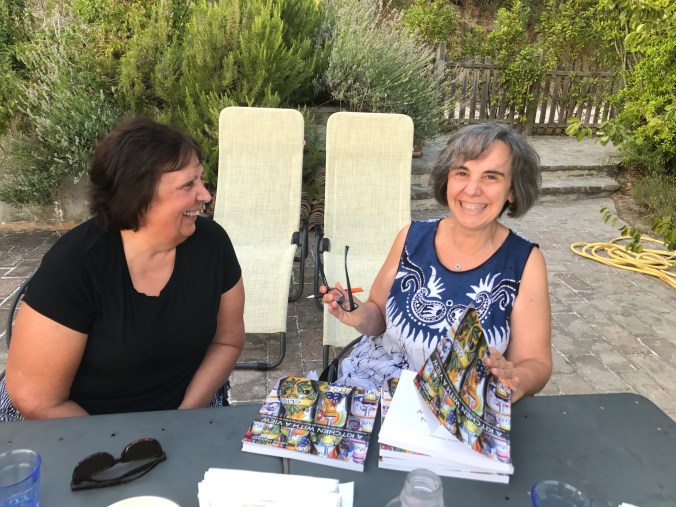
Letizia (right) is having way too much fun signing her cookbook.

Letizia may be warm and welcoming, but she also has strong opinions (and I agree with most of them when it comes to food in Italy). She mentioned that a lot of her American students found the orange liqueur to be too strong—”that’s because they’re so used to watering down their drinks with ice!” In a recent column on an English language Italian website, she weighs in on celebrity chefs altering such culinary icons as carbonara and passing them off as the real thing.

We ended the evening by driving into Assisi for dinner at one of the family’s favorite places, Trattoria degli Umbri, right on the central piazza. We had a table dead center on a very crowded night, and had a simple meal, the best thing to do when you’re in Umbria. Assisi’s an amazing place; it caters ways too much to the pilgrim/Catholic tourist trade with lots of tacky souvenir shops selling statues of St. Francis and the like. Yet at night, after the day trippers have gone, it’s got a party vibe, especially on a warm summer night.

IMG_1979.jpg

Francesco Was Here

IMG_1926.jpgOne of the selling points of this house was its proximity to the Sentiero Francescano, a trail from Assisi to Gubbio that San Francesco (St. Francis of Assisi) took hundreds of years ago. The trail happens to pass through Valfabbrica and, happily for us, through and around the hills near the house.
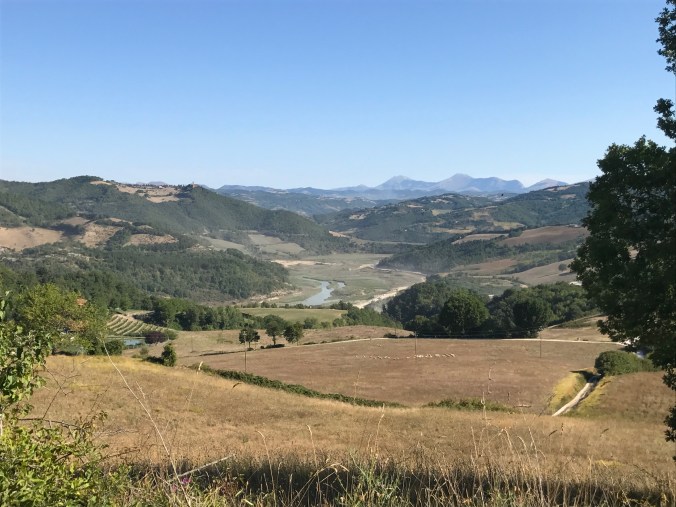
We were sitting around having coffee and I got restless (hmm, coffee, restlessness, connection?). “Let’s go for a walk,” I told The Spartan Woman. For once, now that it was safe to walk without having a stroke, she agreed. We got in the car, just to avoid the boring walk to the trailhead, ditched the car, and set off.

And oh.my.god. It’s just stunningly beautiful. The views, the blue sky, the ruins, the little country church, the olive trees, the sound of rustling leaves. See for yourself:

IMG_1930.jpg

The trail is actually a “strada bianca,” or white road at this point, fairly wide with some gravel. There’s a steep incline to start, but it levels off somewhat and there are enough vantage points to take in the view. This was our first exploratory walk, so we weren’t sure how far we’d go. We did it on a lark, so no water, etc. But every corner urged us to go further.

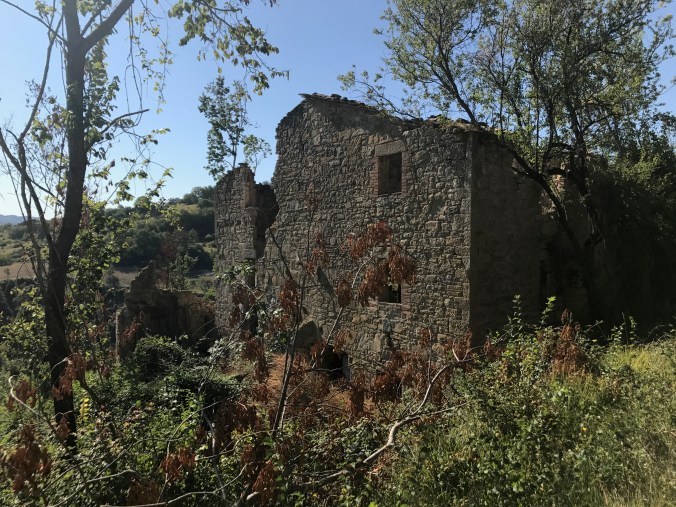
At one point, we got a closer view of a ruin that we’d seen from across the road from our house. I was wondering what it was—from afar it could’ve been another farmhouse on a ledge. Of course we had to climb the hill and round the curve to check it out.

IMG_1943.jpg

We met hikers coming from the opposite direction, one of whom seemed nervous about the sheep further down the path and the sheepdogs. We had to assure him that the dogs were harmless and they were only interested in guarding their charges. Their human is Luciano of our neighboring agriturismo, Ca’Mazzetto.

IMG_1948

The Sentiero, we’ve learned, is just part of a network of trails that run through this area. The trails are well-marked, and there are periodic info signs that tell you what you’re seeing—even in English.

IMG_1947One of the trails, the Via Francigena is actually a long series of trails that, incredibly enough, connect Canterbury, England, to Rome, and onward to Puglia. We decided that that was a tad too ambitious for this Wednesday morning. Its site looks pretty good, and offers all sorts of advice for those who want to tackle at least part of the route. Eric Sylvers, a reporter who wrote freelance pieces for my old magazine, actually followed the route through much of Italy 10 years ago. You can see some of his videos here.


A Long Day of Doing Nothing Much at All

IMG_0946

We’ve been running around a lot. The first month, for me, was a whirl of flying, metro trains and a small hotel room in Milan, meetings and meeting friends. Then home to Perugia, where I rented a car and drove right away out to the house in Valfabbrica, where a small army of workers was practically camping out. They were rushing to finish a pool because they knew we were coming, and the weather was just getting hotter and hotter.

I practically have to look at the pictures I took to remember July. I vaguely remember driving to Rome to pick The Spartan Woman (TSW) up from the airport, and the next day we drove out to Ancona to the big IKEA store there. We had a deadline: Our daughter and her cousin were coming in soon and needed beds to sleep in, and we needed tables to sit at and cooking utensils.

Most people come here to sightsee or to sip Aperol spritzes while watching the sun set. We got to know the local big box hardware store, the French furniture store and various housewares emporia. One of these days, if I have the stomach for it, I’ll tell you about cisterns, water pumps and hot water heaters.

Then the young ones came (and so did a bunch of friends to play in the pool and have dinner and…etc.)

Phew. So here, finally, a day of nothing much at all. We did get out to buy a lawnmower, but that was a quick run (to another French retailer, no less). Otherwise, nothing. Feeding the feral cats who come by for food. One likes spaghetti; the other potato chips. We give them cat food, too. Wine for me. Maybe we’ll fix some dinner in a couple of hours.

52510995666__F41D24BB-7C4A-4911-95AB-B40D86240AF8.jpg

We’re sitting at our patio table watching stupid bugs fly into citronella candles and listening to planes occasionally land and take off somewhere over the mountains, where there’s a gently used regional airport. If I were in New York, I wouldn’t even notice, but the noise disturbs the rustling of the leaves on one of the few temperate days we’ve had this summer. I’m playing with Siri, summoning her—it?—with the command, “hey, Siri” and telling her/it what song to play (So far, Bowie, Travis, R.E.M.’s “Wichita Lineman” cover, Daft Punk).

Oh, and we passed up being at a party at Sting’s estate in Toscana, sorry, Tuscany. A big part of me wanted to go. No, really. I’ve seen previous years’ videos, where he does a killer acoustic version of “Message in a Bottle.” But it would’ve meant dressing like a grownup, getting into the car, driving a couple of hours. (Plus, I had to think to about mowing the lawn, maybe tomorrow. Exhausting!) Sally, I’d love to do it next year, but today just didn’t feel right.

It’s taking me awhile to get used to this relative quiet. I’ve been on the go for decades, going to an office every day or working at home and staying in contact for fear of being forgotten. Living with TSW has always been akin to being near the eye of a hurricane: not always frantically spinning around but being sucked into the vortex often enough.

Italians have a word for it: La dolce far niente, the sweet do-nothing. I guess I’m not just doing nothing. I’m sitting here writing about doing nothing, which I’ll admit is a contradiction. While I’m writing this, TSW is reading me news headlines about this exotic land across the ocean run by, get this, a failed real estate developer. She chortles at words like “fake news” and “Bannon.”

In the back of my mind, it’s all a prelude to going back to what some think is the real world. I’ll be getting back to work, and some home improvement back in New York. We’re having visitors from here in October, and we’d like to show them more than our usual chaos. But first, I’ll do some more travel writing. I wanted to write something today, but I didn’t want to put much energy into it.

Tourists Wanted

There’s been a spate of stories in places like The New York Times and the Guardian about anti-mass tourism demonstrations and laws to curb tourism in European cities like Barcelona, Venice, and Rome. I can’t say that I blame the local authorities and demonstrators. Large groups of selfie-stick wielding tourists take a toll on a place and its inhabitants, who have to move around and get to work and home. Plus, mass tourism deforms the local economy: If you go to the popular haunts in a city like Florence, you’ll see that nearly every shopfront is either a pizzeria, gelateria, currency exchange, or snack bar. These businesses push out the tailors, bars, and bookstores that cater to residents.

But I’ll make an exception to the anti-tourism mood. Come to Umbria. We need you. Not all of you, and we’d prefer that you don’t travel in large packs. But last year’s earthquakes in the mountainous zones in the Valnerina scared a lot of people away from Umbria. It’s hard to get an exact count, but I saw estimates immediately post-quake of as much as 30-to-40 percent.

The ground has stayed solid lately, and, as a friend said, traveling in Umbria no more risky than going to California or Japan. And it’s a lot more relaxed. Sure, the Catholic faithful mob Assisi, but otherwise, it’s cool runnings. And I’ll tell you that you’ll have a more authentic Italian experience. Why? Here’s the thing: You can find pictures of monuments everywhere. But it’s really easy to have chance encounters with really nice, warm people here, people who haven’t been made cynical by an onslaught of visitors.

In the next few posts, I’ll show you why. First up, Isola Maggiore (“big island”) in Lago Trasimeno. “Lago” means “lake.” It’s the largest lake on the Italian peninsular, and it’s where Hannibal met his defeat during the Punic War in 217 BC. The place can fool you; it looks as big as an ocean from certain vantage points, and it’s a cool shade of turquoise on a sunny day.

IMG_1777It’s got islands, too. One of them, Isola Polvese, is an environmental research center. If you want to see what they’re up to, you have to sign up for a walking tour. Isola Maggiore (big island) is an easier experience. Go to Tuoro’s marina and take the ferry.
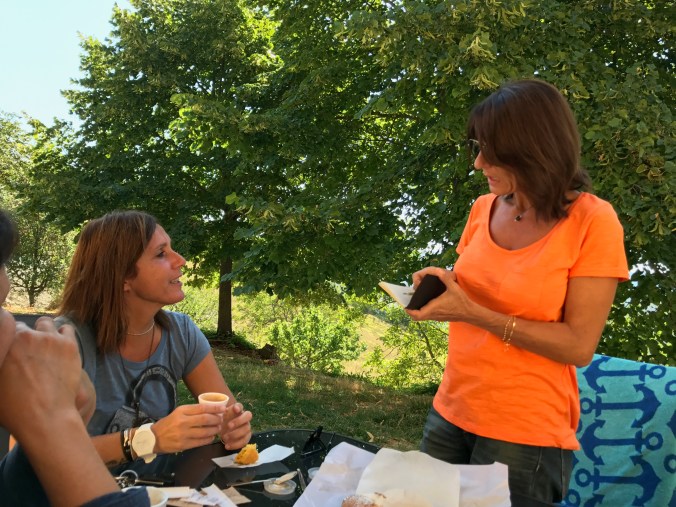
Isola Maggiore is hilly and has lots of well-marked hiking trails. There’s one big climb, but it’s not a hard slog. You won’t have to climb any rock faces. And once you’re up there, you’ll encounter an ancient church with frescoes and a friendly guide. Groves of olive trees fill the island, and you can’t really get lost. If you want to get back near the ferry landing, just head down the hill. The views of the lake from up there are pretty stunning, as you can see.

In a way, being there reminds me of an Italian version, in miniature form, of hiking on Mt. Desert Island in Maine. You’ve got a neat combo of water, trees and hills, with decent hiking and great views.

And just like Mt. Desert Island, there’s a payback: a good meal at the end of your hike. Isola Maggiore has the same lazy hedonistic feel to its big Maine counterpart, and pleasure is part of the experience. We always head to Da Sauro, a hotel/restaurant near the ferry dock. There’s a dining deck and room as you get into the little village, but walk a bit further and there’s a garden on the right. The garden has a splendid view of the lake, and friendly pheasants come to visit.

The food’s pretty good. There’s a bargain lake fish menu, featuring, for the most part, lake perch, or persico in Italian. We usually embellish the two courses (pasta, second perch skewer or fish stew course, vegetable) with an antipasto, like a mixed fried fish platter to share. Wash it down with cold, local white wine, have a coffee, and relax.

IMG_1803.jpg

They’re really sweet there. Last week, I was talking to one of the owners while paying the tab. I mentioned that we went back every year to Da Sauro and that it’s become a family tradition. She thanked me, and as I started out the door, she ran after me with a chilled bottle of the white house wine. “This is to thank you for coming back with your family. We hope to see you soon,” she said in Italian, as we shook hands.

Now doesn’t that sound better than running from monument to monument on a hot Roman day?


It Takes a Village…

Nope, I’m not writing about HRC’s book way too many years ago, but our little village here. Or I should say, about 4 or 5 kilometers below, the town of Valfabbrica. And more precisely, about the people we’ve met along the way.

IMG_1583

Debora Bazzucchi, left, with Angela Gorietti

First up is Bazzy, real name Debora Bazzucchi. She’s the real estate agent who sold us our  house here, and she’s a full-service friend and businesswoman. (Should you ever want to buy a place around here, I’ll put you in touch, but you’ll have to buy us dinner.)

Debora is energetic to the max, funny, and fierce. She’s a great cook, and we’ve spent a few evenings at her place somewhere up in the mountains across the valley from us. She likes good bubbly, has friends who traffic in black truffles, and drives an Audi cabriolet, usually with the top down. Don’t try to follow her if you want to hold onto your license.

IMG_1556

One country house, three Euro hatchbacks (friends came over)

Here’s the reason for the headline: We bought a house with great bones and an incredible location. But it needed some TLC before we could move in. We aren’t neophytes when it comes to Italian real estate, having a little apartment in the city. But having a house on a mountaintop is a whole ‘nother deal. Okay, so some of the work is self-inflicted. We wanted a pool, which is, I’ll concede, completely optional, if not irresponsible and decadent. Sue me. (By the way, with Debora in the photo above  is Angela, her pal who supplied the stone surrounding the pool. It’s amazing to look at and walk on, and it comes from a local quarry. It’s a family company, and she came every couple of days for quality control.)

When Italians move, they take their kitchens and light fixtures with them. Kitchens in the land of great food are, oddly enough, not a big deal in terms of installation. They’re plug and play, and not as big a project to design as they are in the U.S. We bought ours at Mondo Convenienza, which is sort of like IKEA, except that they don’t do flat pack, and deliver and install the stuff as part of the deal. Debora came into this by supplying the necessary guys to do the plumbing and electrical work. Plus, she watched the installation like a hawk. Installations, actually; the house has two kitchens, one upstairs in our living quarters, and one in the ground floor guest quarters, which serves as our summer kitchen since it opens onto the garden.

I won’t bore you with the wonders of places like Mondo Convenienza. Suffice it to say that they translate high design for popular consumption. We sat with someone who went through the dimensions we had to work with and we came up with the designs. They sent someone to measure and figure out whether it would work.

So back to the village. Simone was our plumber in this, and I suspect he will be forever. The guy just figures things out and makes it work. That included modernizing a manual water cistern/pump system (don’t ask) and making it so we really don’t have to think about how the water gets to the house.

Then there’s Luigi and his assistants. We bought a bunch of lighting fixtures. The previous owner, a good guy but a chef who works too many hours, did a lot of the electrical work himself in between shifts as a professional chef. Luigi, a pro, cleaned it up and installed all sorts of clever lights and switches around the house. I’m still trying to memorize what controls what, but it all works and I keep being struck by the thoughtful touches.

We can’t forget Enrico, who is Debora’s ex. He’s an incredibly kind and sweet guy who came in, patched up walls and painted. The place looks like new and without Enrico’s help (and his and Debora’s son, Nicolò, pitched in), I wouldn’t be sitting in my office here writing this. And there’s Gianni, a stonemason who worked through the hottest days to get the pool border done. Many hot days; the guy’s an incredible perfectionist.

Our village here wouldn’t be complete with mentioning Marco Ferramosche, who is our architect. He started the work on the pool on a dare, and served as the general contractor. He sent us almost daily photos when we were in New York, and coordinated the work of Simone, Luigi, the excavators, geologists, environmentalists, town officials, concrete workers, pool suppliers, etc., etc. He nagged me (nicely) when I had to do something like pay a bill, be there to make a decision, or talk to the pool guy about how to do things.

IMG_1409

The Spartan Woman, ricotta from Pasquale

Wait. I’m almost forgot our neighbor, Pasquale. He’s one of the brothers and their mother who sold us the place. He owns the agriturismo next door, Ca’Mazzetto. It’s certified organic, and they raise sheep, grow olives, and make cheese and fabric from the sheep milk and wool. He drops by to say hi regularly. And when we first started sleeping over here, he brought us a plate of delicious fresh sheep’s milk ricotta.

Phew. You can come visit now.

[Copyedited by Judy Lopatin]

Parla Svedese?

Three tanks of expensive gasoline, many kilometers in a clapped-out rental Panda and thousands of steps later, we may actually we able to do normal things like sit on chairs, cook in a kitchen, and take showers in a country house we closed on last November.

Version 2

“You know, I’ve been thinking….”

My first weekend here, I pretty much hid out from the heat in the city, did some work, took some naps, and in general did nothing much at all in glorious solitude. I did drive up here a couple of times because I wanted to get acquainted with the house, but because of Perugia’s compact size, and the fairly strict land-use rules, it’s a quick run from city to country. You’re in the country almost as soon as you leave the city limits. And I took walks to take in some free music and cheap, good “artigianale” beer.

Besides, I needed to conserve some energy for the arrival of The Spartan Woman.

I did miss her. But I knew that once she arrived, it would be nonstop activity. She always claims that she’s a low-energy person, but I have yet to see much evidence of that. And I’ve known her for decades. Sure, she will sit and do crossword puzzles on her Mac for hours, but I suspect it’s so that she 1—can conserve some energy  for her next move (see above) or 2—she’s plotting her next move.

It began with me racing to Rome’s airport to pick her up. She was carrying household items in one big bag, and a few clothes in another. I chivalrously gave her the chance to avoid buses and trains, and she took me up on on it.

But then…What does one do on the first full day in Italy? You might think some time to get acclimated, to have a good meal, to stroll, have an aperitivo, to wind down from the pre-trip craziness of getting the pets settled and the bills paid, etc.

You would thinIMG_1072k wrong. We raced across the center of the country to Ancona, on the Adriatic. Not to go to the beach. No, IKEA, that most fiendish of Swedish inventions. We had a deadline: Young people are coming next month, and they might want a bed to sleep in and some furniture to perch upon.
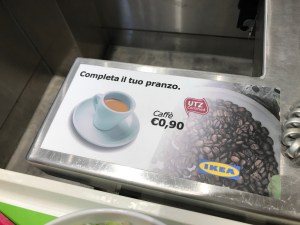
But it’s in Italy. Exotic, no? No. It’s exactly the same, bar some Italian items in the restaurant. The same goofy names, the same maze that drives you crazy. What is different is the kindness and helpfulness of customer service. We found someone who, knowing we needed some stuff fast, worked really hard to get good

IMG_1070delivery and assembly dates. (I’m too old for performing the dark assembly arts of IKEA.)

When Tina, the customer service person, saw that I was getting antsy, she told me to go and play, and gave me a voucher for the restaurant’s bar. An espresso and pastry later, I was a happy guy.