Eat like a peasant—and enjoy it

Staten Island, where we spent three weeks and some, has this image of being a sort of Sopranoland, its residents a larger version of the cast of Jersey Shore. That’s only partly true, and applies only to some neighborhoods. Our daughter lives on the North Shore, which is a multiethnic paradise. And after a few months of mostly “Italian food”—I dislike the term because there really is no unified cuisine here—we were craving the offerings of our former Japanese, Chinese, Mexican, Vietnamese, Sri Lankan, and Turkish haunts.

Maybe we overindulged. But our kid has a baby, and trying to be good guests, we thought we’d make it easier by ordering out. It was a nice change from Umbria, even if this area is increasingly cosmopolitan, with sushi and Chinese food fairly commonplace. But one thing we didn’t miss: American (or is it New York) price tags. For one Saturday lunch, we order four banh mi, three bubble teas, and a Vietnamese coffee. Total bill, $115. That would have bought a fancy meal here.

SO BACK IN OUR HILLTOP RETREAT, we prepare a lot of wintertime comfort food. That pretty much means soups and pasta. We don’t eat meat, but with such a huge variety of vegetables, legumes and grain products, that doesn’t cramp our style.

Note: The dishes described here are vegetarian, not vegan. If meat is a must, you can serve these dishes as first courses, or read another post and come back next week. I don’t give recipes per se, so you won’t see exact quantities or cooking times. Anyone who cooks regularly can probably come up with something good. I don’t usually follow recipes; I use techniques my mother taught me as a teenager when she broke her arm, and I had to step in to cook family dinners.

After years of propaganda about the superiority of “Northern Italian” food, the South here is rising again, at least when it comes to culture. Maybe it’s down to TV shows here like Mare Fuori (The Sea Beyond) which portrays the lives of a bunch of photogenic kids in juvenile detention in Naples. One of our favorite Neapolitan dishes is pasta e patate. Yes, you can mix starches.

You can look up recipes here and here. While there are various versions, you basically make a soffrito—onions, celery, carrots—and sauté it. Add diced potatoes. When they’re halfway soft, add water or vegetable broth and a squirt of tomato paste (a couple of canned tomatoes or some purée will work too). Let that cook awhile, and then, making sure there’s enough liquid to boil pasta, toss in a couple of good handfuls of mismatched pasta, all those odds and ends that you’ve accumulated when you haven’t cooked the whole package. Improvise if not. Then, at the end, add cubes of provola cheese. This last bit may be hard to come by in the U.S., so I’d suggest diced hard (not fresh) mozzarella.

Beans and greens might be an easier combo to get behind. We make lots of variants of this basic comfort dish. It’s easy. Take good beans, whether they’re borlotti (cranberry), cannelini, or ceci/chickpeas. Cooking them from scratch is best, but canned beans are fine, too. Sauté a clove of garlic and a little hot pepper flakes in olive oil. Add the beans, stir. Add cleaned and chopped greens, like escarole, kale, chard, or even spinach. Make what’s in the pot as dry or soupy as you wish. If there’s a fair amount of water or broth, cook some soup pasta (orzo, ditalini, small elbows, etc.) directly in that pot or cook the pasta separately and add for a drier dish.

It’s best to keep to the basics with this, but you can optionally add a Parmigiano rind to the cooking liquid, or mix the beans or add another grain like farro. Add grated cheese if you want, but the soup/pasta dish should be able to stand on its own.

A post like this wouldn’t be complete without lentils. They’re an Umbrian staple. For example, it’s traditional to cook lentils for New Year’s, the pot of lentils symbolizing the riches that you hope the new year brings. Umbrian lentils are really small and don’t break down into brown mush. When in New York, I found that Trader Joe’s vacuum-packed French lentils are a pretty good substitute.

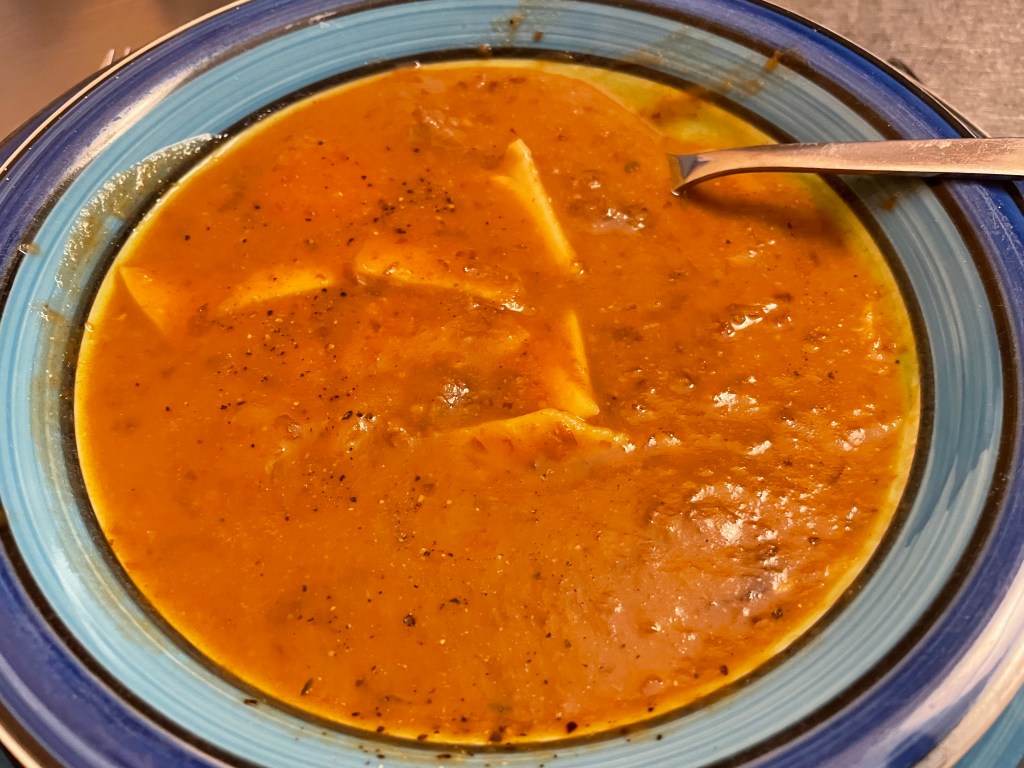
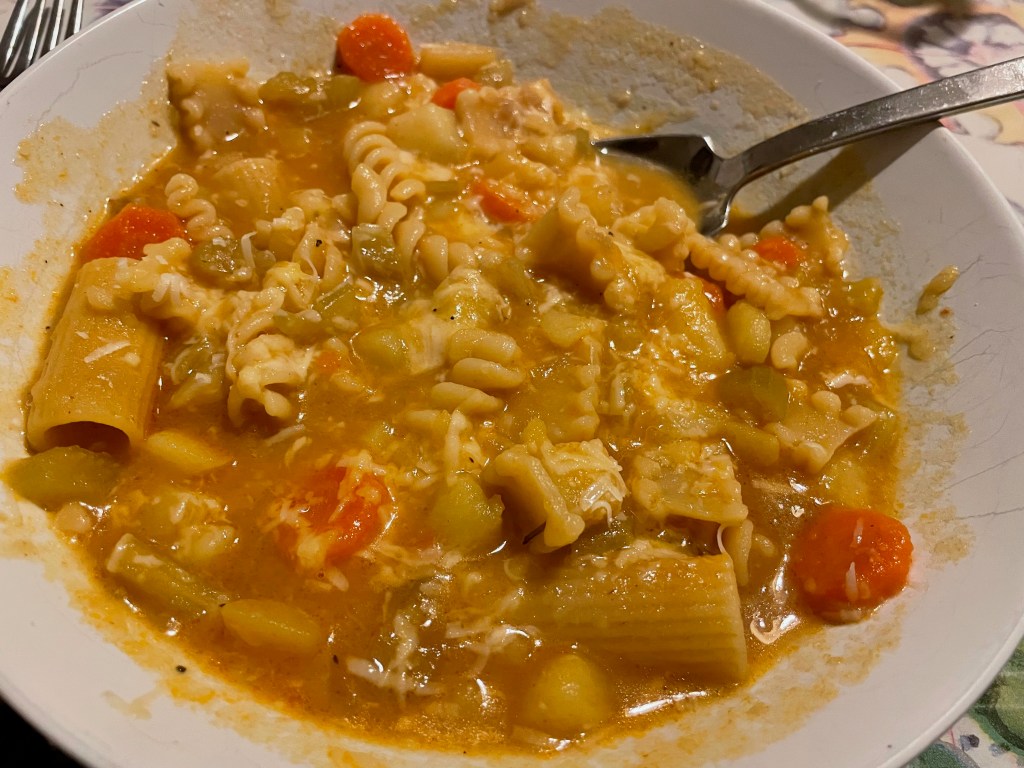
This dish won’t break the bank and is really easy to prepare. Do that soffrito thing again. It’s onion, celery, carrots. Add about half a pound of raw and rinsed lentils after the vegetables are soft. Stir around then add about 500 ml/a pint of water. Add a squeeze from a tube of tomato paste, or a dollop from a can of paste. Let the lentils cook until they almost done. At this point check how much liquid is in the pot. You’ll be adding a cup of ditalini or similar pasta so, if necessary add some water, keeping things on the boil. Add the pasta and cook until al dente. Serve with grated Parmigiano, Grana Padana, or even Pecorino cheese. And this is the result:

Job no. 1: Stay warm

This heating thing triggers my after-all-this-time-I’m-a-semi-newbie reaction. Getting basics down, like food, shelter, transportation, and language is at the heart of the immigrant—or reverse immigrant—experience. It’s what makes living here different from taking a vacation here. Travelers only have to figure out how to feed themselves, and it’s pretty easy in Italy. And they’ll figure out how to get around, unless they’ve taken a tour that comes with a big bus and lots of company. Living in another country forces you to relearn basic life skills; it’s like learning to walk again. I’m pretty good with most basics, but I’m only learning the central heating basics because we haven’t been here much before in the dead of winter.

I think about central heating a lot during the winters on our mountain because we have a high-maintenance kind of central heating, and tending to it and using it takes up more mind space than where to set the thermostat. Sure, we have the essentials: thermostats, pipes going around the house that end up in radiators. We even have a couple of dee-luxe radiators, the kind bathrooms houses have here that look like laundry racks and warm up the bath towels. There’s a furnace, too, a pretty new one from Germany that my friend Ruurd told me was the best brand. I’ll take his word for it.

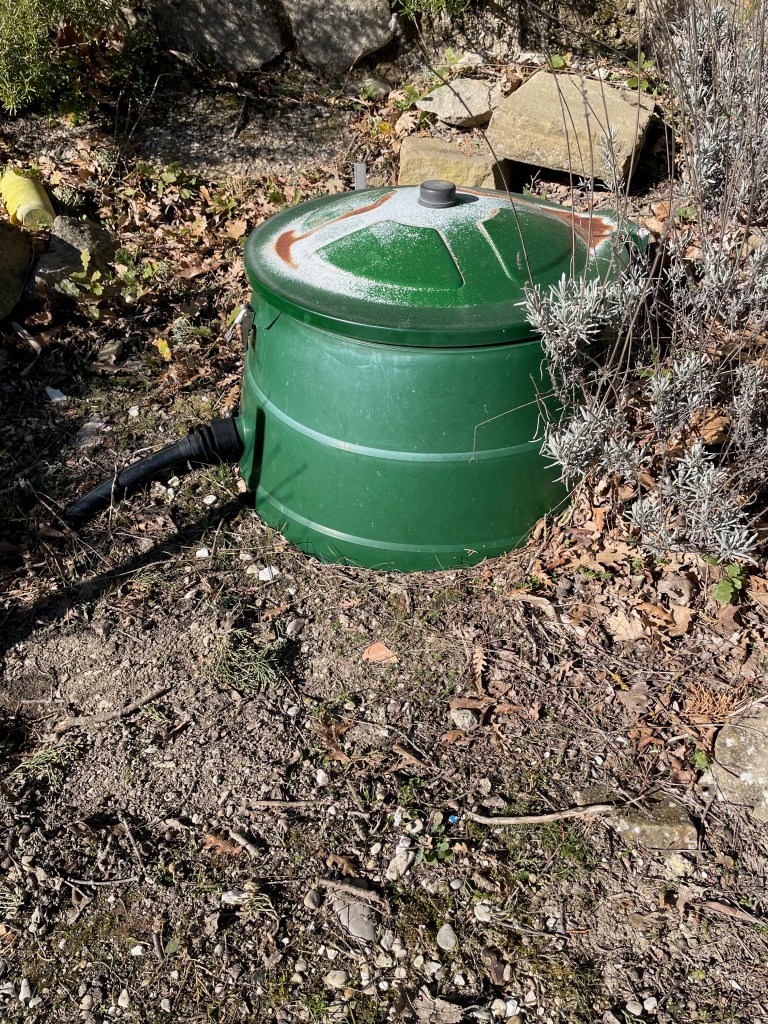
What our central heating setup lacks is a steady source of natural gas. Instead, we have a tank. it’s a big tank for sure, though I’m not exactly sure how big because it’s buried in the yard right next to the lavender bush. It looks like the entrance to one of those bunkers in Albania that the paranoid ruler Enver Hoxha installed thoughout that once-repressed country. Only our lid conceals a receptacle and a gauge telling us, usually, that we need to buy more gas.

That should be easy enough, right? Not so fast. (And trust me, this was almost a shock to me, a confirmed urbanite, who never had to worry about how to supply life’s basics.) Luckily, it hasn’t been the coldest of winters. But these stone houses don’t hold the heat easily, a boon in the summer but not so much right now.

I have a contract with a large Umbrian provider of propane, or GPL as it’s called here. Theoretically I call and they deliver. Only their operators seem to think that their job is to protect the delivery drivers from actually making deliveries, and at the very least to keep delivery dates a secret. Right before leaving Italy to spend the holidays in New York I called the company. When I dared to ask when I should expect the delivery because it’s Christmastime and we need to buy gifts for the fam, I got “next week.” When? Next week. What day? Next week. You get the idea.

No one came that week. So the following week, I called again and ask that same nosy question. I should mention at this point that we were down below 10 percent, a percentage that according to my agreement with the company should trigger an immediate delivery. What I got on the other end was the Italian equivalent of “la la la la” to avoid hearing the question. But then shortly afterward, my mobile phone rings and a delivery driver asked for directions to the house.

At this point life was looking really good. The guy found us, hooked up his hose and delivered the gas for a princely sum of about €800, or $870, give or take. I paid with a card tapped on his portable card reader, and for awhile it looked as though my perfectly good Visa card was rejected. Happily, I learned later via a call from the gas company that the charge went through.

GAS ISN’T THE ONLY FUEL we burn. Like a lot of people here who have to deal with high gas and electricity rates, we have a fireplace that’s hooked into the heating system. In theory it’s an elegant thing. We build a fire and once the chamber heats to 50 degrees Celsius (122 degrees F) a pump switches on a takes over from the gas furnace. If we get a good enough fire going, the house gets toasty and we aren’t burning expensive natural gas, just expensive wood. And we can bake potatoes in the ashes, which is something you can’t do with a gas furnace.

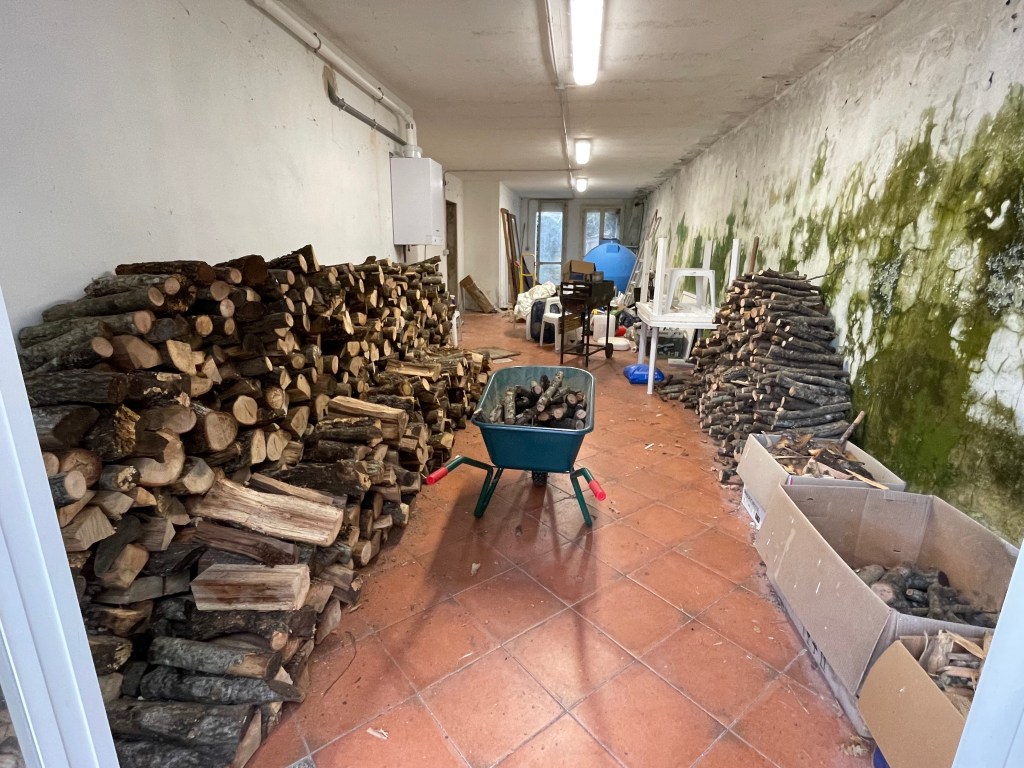
But that requires us to start a fire. And fire requires wood. There are lots of wood vendors around these parts, because utilities cost so much here. You can buy wood stacked in neat boxes, and you can buy lots of wood from guys who drive up with a dump truck and leave a huge pile for you to deal with. We chose the latter, trying to be 1-frugal and 2-forward thinking enough when it came to quantity. We were running low on wood, so I made a call and to our usual supplier a town away, unlike the gas company, the wood dude said he could deliver in about 10 minutes. Sold. The guy came as promised, and since he’s a local and has delivered to us before, we gossiped about the neighborhood characters.

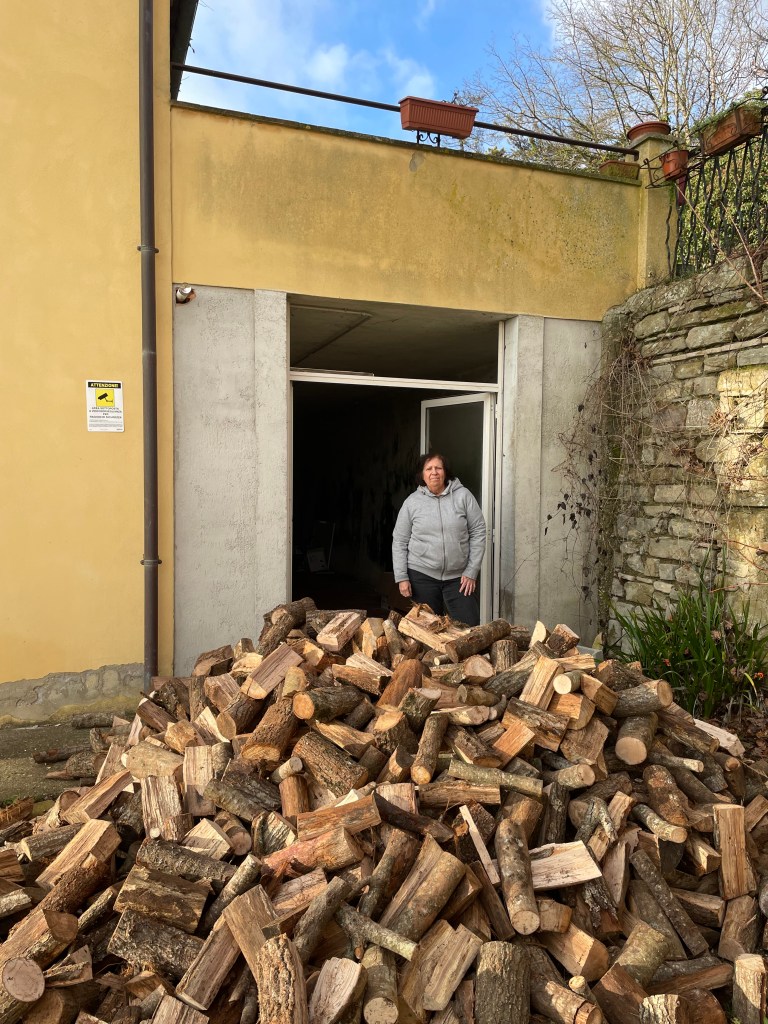
Take a look though—we received a huge pile and had to move all that into the house in organized bundles. The te Spartan Woman lived up to her nickname, organized how we were going to tackle the pile and hauled tons of wood. Literally. In all, the two of us carried and stacked 25 quintales, or 2500 kg. That’s over 5,500 pounds.

Not bad for old people.

Winter sucks. But it sucks a little less here

Brrr. It’s a little chilly here in Studio AP, where I put together these little dispatches from Italy’s version of Vermont. I could blame Vladimir Putin for the lack of heat, but that’s too easy. Besides, we have lots of propane right now. But the fact is, this is Europe in the Italyland province, and houses were built more to shield us from the heat of summer than the cold of winter.

I shouldn’t complain anyway. It’s January, and this month has been fairly benign. And it’s leagues better than the typical New York January, which I hear and my iPhone’s weather app tells me hasn’t been so bad this month for a change. And how’s this for role reversal? We had a real, actual, white, wet snowstorm earlier this week. It gave us lazy sods an even better excuse to build a fire and drink hot liquids and not do much else except for reading and finding good cooking videos on YouTube.

When people hear that you’re going to Italy, that usually conjures up a whole bunch of images. Golden sun, sports cars roaring along a curvy beach road, high fashion, great wine, and pasta. So much for high fashion: Most of the young and cool this week seemed to be wearing sweats, NorthFace puffy jackets, and Timberland boots. Yes, Timberland. The brand is huge here and there are Timberland stores everywhere, from the local upscale mall, er, sorry, centro commerciale to the main street in town where everyone walks up and down between 18:00 and 20:00 (6 pm-8 pm to you nord americani) to window shop, meet friends, and have a drink before dinner.

You might notice that there isn’t much of that here. Despite an app that told me it was almost springlike in Perugia, it was blustery and freezing and no one was lingering over anything, much less a cold alcoholic libation. In warmer weather, this pedestrian street is filled with tables and chairs and 20-somethings hoping to get lucky.

And how about the main piazza? Ditto.

We had to run a couple of errands in town. That usually means the aforementioned drinks while lingering at an outdoor table—a table set in the middle of the Corso Vannucci, for example, where that first picture was taken. We might meet friends walking around. And we like to go to the end of the street where there’s a nice cool green spot with a view of the Tiber Valley below. Instead, we rushed up the escalators from the Minimetrò (we parked the car in the big parking lot at the base of the hill) and headed straight to a clothing store to look for gifts. I was bundled up, but it didn’t keep me from looking longingly at some warm hats, I remembered that my coat has a down-lined hood and resisted temptation.

Then we ran to another shop. I can’t say anything about that because the thing we bought will be someone’s surprise. And we don’t want to spoil that, do we?

All good boys and girls get a treat at the end of this. I’d been jonesing for some Italian hot chocolate, and yesterday was the perfect time for it. We found our favorite bar to have it, and found a table. The waiter smiled when we told him yes please, with whipped cream on top. Italian panna, or whipped cream, isn’t sweet at all but it’s intensely milky. It balanced the luscious deep chocolate, which really is more like molten dark chocolate pudding. How could we not?

Otherwise, it goes. After a brief bureaucratic tussle over a supposedly unpaid bill for propane, we got a delivery. So now we old folks don’t have to build a fire if we want to stay warm. Turning on the gas will cost us, but when you stumble out of bed and need coffee and to stare at the walls and/or the scenery, the last thing we need is to empty out the fireplace, stack some wood in it again and set it on fire.

Alienated in New York: a trip through my unpublished archives

It’s snowing today and our region is, as we say in Italian, “in tilt.” It’s more than the gentle flakes or even the short blizzard of flurries, if there can be such a thing. So for awhile we were out of power. I didn’t have an unread book handy, so I got my trusty laptop, which I can use for days without charging, and looked through old files on my hard drive.

Scrolling through my digital detritus, I found this essay that I’d written pre-Covid pandemic. I have no idea why I wrote it, what, if any, audience I was thinking of—whether, for example it was for this blog or not. It looks as though I wrote it quickly, right after the dinner I’d gone to. And boy, it rings even truer today than back in 2019. So I hope you don’t mind if I recycle it here, slightly edited to fit my current writing style:

—————-

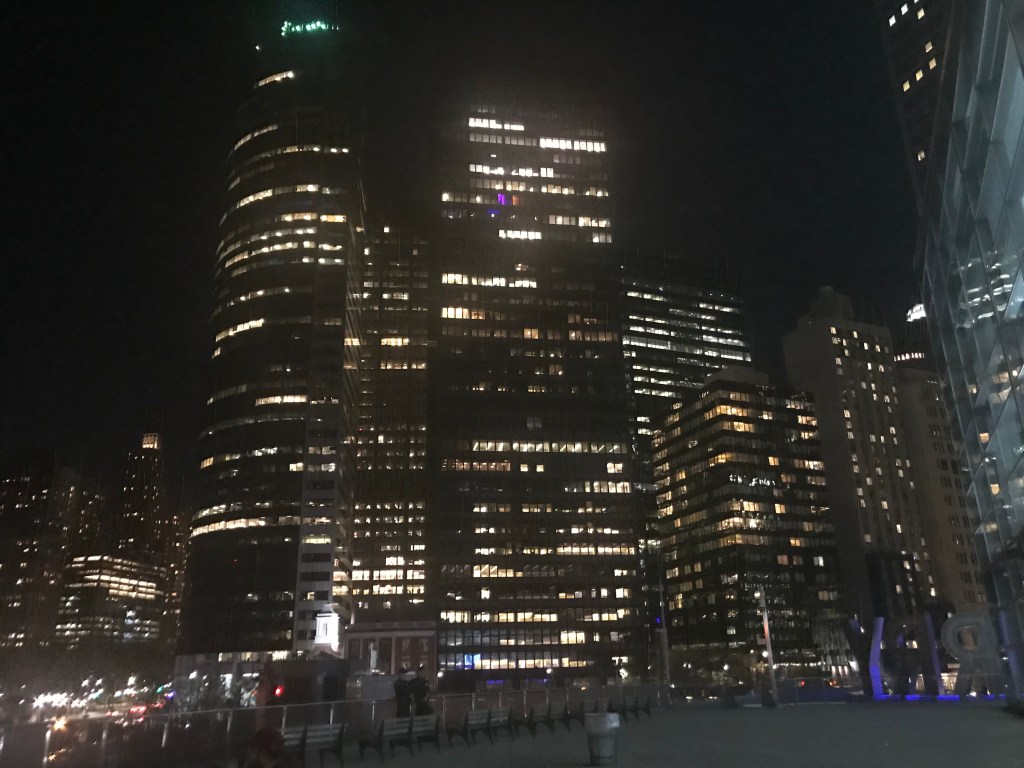
I HAD DINNER WITH friends the other night in Lower Manhattan near the South Street Seaport. Dinner was at Barbalu, the successor to a place I’ve been going to for almost ten years; the original version of the chic restaurant/Italian market was flooded during Hurricane Sandy in 2012. It’s a friendly place; I know the owners and this later version features authentic modern Italian food in a rustic yet sleek setting. 

I live on Staten Island, so I took the ferry across the harbor and walked about 20 minutes up to Barbalu. As far as commutes go in New York City, it’s painless and even scenic. When I had a regular day job, I took that ferry nearly every workday for some 30 years. In my last decade of trudging to a newsroom, my daily commute tracked my trip to the restaurant, except that the walk to work from the ferry was a little shorter. I’m a native New Yorker and have lived in the city just about all my life.

But that night, I felt like a tourist.

I can explain. I’m in New York for what seems like a fleeting visit. My wife, now retired, and I bought a country house in the Italian region of Umbria a couple of years ago. We’d planned to stay there sporadically, whenever I could get away. We were thinking of retirement, and retirement at the time seemed like something that would happen in the future. A couple of years away at least, in fact.

But our staying in the house for more than a quick week or two at a time came much sooner. Like many media professionals, I was excessed a couple of years ago along with about 20 of my colleagues. I’m not really supposed to talk about it, but the move supposedly was part of a sweeping redesign of our news operation, and as one corporate officer told me during what was surely a scripted phone call, “Your position has been eliminated.” (It wasn’t; they merely changed the name of it for a few months, then back to the original after we’d signed our severance agreements.)

So I, along with my comrades in words, had to reinvent ourselves. I became a freelance writer, and I don’t need to be anywhere in particular physically to do my work. Hence, Italy for at least a few months a year, in my spare euro-modern office or, better, at a garden table watching the view as I procrastinate.  

Inevitably, our country stays got longer and longer, and now amount to half the year. We can do this because of a precious gift from my immigrant father: an Italian passport. So we’ve been busy integrating ourselves into our little community. It’s a big change for a city boy like me. We live in a mountainous area in the foothills of the Apennines, the mountain chain that forms the spine of the Italian peninsula. Our neighbors are some 125 sheep and the people who own and care for them. When we take a walk, we amble down our road, waving to the hardy old—and retired—people who’ve lived in the town all their lives, and I’m sure their families have been there for centuries. Or, since we’re located in the middle of a network of hiking trails, we go exploring the hills when I’m done with my work, trudging up and down mountain paths and occasionally finding a ruin or wild asparagus in the woods.

But we’re in New York now [OK, I was in April 2019], and I have to say that I’m shocked that I feel so odd walking around my city. I was on the ferry that night, and I watched the tourists and the orthodox Jews and their families enjoying the ride during the week of Passover. And I realized that I’m a tourist too these days, here in town for only a few weeks.

The realization hit me viscerally, and this strange feeling of psychological distance stayed with me as I navigated streets that I’ve walked thousands of times. For one thing, since I stopped working in the neighborhood two years ago, a lot has changed. There’s a Hilton Garden Inn on Water Street, a truly strange name for a bland building that’s nowhere near a garden.

There are lots of new restaurants and lunch takeout spots, something normal in a town where eateries fold and open at a rapid clip. There’s something odd about the new places. They advertise their wares in their simple names, like Greens and Fresh. I’m an addicted menu reader, and their food seems to come from nowhere but some Californian notion of “natural” food: lots of kale, grains, an Asian overlay in the flavorings, bowls. The word “bowl” makes me smile; in four letters it manages to connote a lively lifestyle, clean living—lots of bike riding and yoga classes.

I SUPPOSE THAT I’m an old curmudgeon. But curmudgeons aren’t necessarily alienated from a place—just from a period of time. Walking through the oldest part of New York that’s busy remaking itself, I felt conflicting emotions, happiness that I would escape to my mountaintop soon, but a kind of sadness for feeling somewhat uncomfortable in the city where I was born. The contradiction actually made me feel queasy, as though I weren’t just pulled in a couple of directions emotionally, but physically.

That feeling stayed with me over dinner with my friends. I worked with them some 20 years ago and that alone probably contributed to the weirdness. Seeing them made me think of a time when New York was my city, my hometown. I had a part-time restaurant reviewing gig on the side back then, and it meant hanging out at hot new places, tasting everything. Now I was a part-time interloper, listening to people talk about their current jobs, their current president. I’m an American, but I also have another country’s politics to think about, and to fret over. While I participated in the conversation, I couldn’t help but think that I can just get on a flight and not spend much time thinking about Donald Trump’s latest escapades. 

And the prices…really, people, restaurants, even places I love, are ridiculous. My tablemates, knowing I’m a wino, sorry, make that someone who knows a thing or two about wine, especially those from Italy, had me choose. I looked at Barbalu’s list, and it’s a good, selective one. But the prices sent me into alienation mode again, when the cheapest bottle is around $40, and I know that I can go to a decent restaurant in Umbria and pay a few euros for a nice carafe of whatever’s local. I know that restaurateurs have to price drinks like that in New York; it pays the rent. I suppose that when people are using corporate cards it doesn’t matter much, but how can regular people afford to go out?

The kids were alright.

They don’t. They take the ferry and the subway back and forth every day and night. And that night, the weather was clear and warm. I sat on the back of the boat and watched the tourists take snapshots of the skyline as we sailed across the harbor. Soon they got tired of the view and went over to the side to see the Statue of Liberty. Right about then, an African-American girl with a distinct city kid accent sat next to me. Two boys, somewhere around 14, stared at the harbor view, which is nice enough during the day, but truly stunning at night. They laughed, they joked, they wisecracked like the city kids I’ve known all my life. They danced around, obviously flirting with the girl and competing for her attention and approval.

I’ll miss the place when I finally leave.

Vlad made us do it

Life here on our hill ain’t all sunsets and spritzes. Maybe it would be if we had servants. But we don’t; we’re just two retirees trying to have a little fun and adventure. Gotta say though, in the week since our arrival, life hasn’t been much of an adventure. It’s been pretty dull in a nice way, in fact, after a way too busy holiday run-up. Call us happy stay-at-homes, at least until tomorrow, because we’re planning a run into the big city of Perugia (pop. 170,000). And we’ve had to catch up on our lives here before we can descend from our lofty patch of land.

First things first: After a day or so of traveling packed like sardines into two Lufthansa flights—a wide bodied A 340 and a narrow body A320, then a ride in our man Angelo’s van, we got here with just a touch of jet lag. More importantly, and unlike our return to New York in the fall, we didn’t bring Covid with us, or catch it in an airport or while aloft.
Did I mention it’s winter here too? That means no lolling around at the café in the piazza, definitely no beach day trips and no dinners on the patio. It’s not as cold as it is in a Northeast U.S. winter, but the days are short, the nights long and chilly, and we’re greeted every morning with a sea of fog in the valley which, I have to say, is pretty stunning. People jokingly call it the Umbrian sea and these shots give a good idea why.

We still have to heat the house. As we were leaving back in October, the price for propane was going through the roof as fears of a long, cold, natural gas-less winter took hold. We have huge buried tanks to hold said gas, but even when Vlad the Ukraine Invader isn’t doing his genocidal mischief, prices are high—about 80 cents a litre—and it costs hundreds of euros to fill the tanks.

Please heat up. All we need is 50 deg C. That’s not too much to ask.

Luckily, the previous occupants of our house put in these clever Klover fireplaces. They’re hooked into the house’s heating system, so all we have to do is start a fire. A big fire—the pump that drives the fireplace’s heat into the radiators starts pumping at 50 degrees Celsius—that’s 122 degrees F. for the metric-challenged—and that takes awhile, and quite a few pieces of wood. The Spartan Woman, living up to her nickname, managed to stack most of our remaining wood next to the living room fireplace. Thanks to her our nights have been toasty and only a little smoky.

But that wood. Before we left, we’d pass our supplier on our way to the supermarket. He had great mountains of wood in anticipation of a gasless cold winter. I called a couple of times and he assured me about the supply. But then he added that he was so busy that he wouldn’t couldn’t guarantee delivery before we left. And so we looked at our dwindling supply warily, treading a line between staying warm and making sure we wouldn’t be left to freeze on later nights.

Last week, the wood dude and I made contact before we left. We texted each other, he said just call or write when we arrive, happy holidays, etc. I did, and he promised a delivery yesterday morning. It didn’t happen. We waited and worried. Should I call? After years of editing other people’s writing, I’m tired of being a nag, so I waited without nagging until after night fell. “I’ll be there tomorrow morning.” “Can you tell me when?” “Around 10.” Phew.

He was good at his word. This morning a little dump truck arrived and tipped almost 19 quintali—that’s 1800+ kilograms or nearly 4,000 pounds of the stuff near our garage door. It was not a little pile, nor was it all stacked in a pretty box. If it were packaged nicely, it would have cost a lot more than €340, which is a fraction of what propane would’ve cost us to heat the house for the same period. TSW, with her superior logistical skills, designated areas for big pieces, kindling, and in-between annoying pieces, and we went to work. I must confess that she did more; a bad back, the result of my Summer of Coughing, made me take breaks after every dozen of chunks of wood stacked.

It wasn’t a bad way to spend a couple of hours. At least we weren’t shut-ins staring at computer/phone/TV screens. Fresh air! Clouds! And that Umbria sea just below us, shifting its shape as the breeze and sun played games with one another. What we didn’t especially like, but can’t do anything about, were the shouts of men in the land surrounding ours. They were hunting for wild boar, and every now and then shouts, the barks of hunting dogs, and rifle shots rent the air. That’s the kind of stuff they don’t put in the tourist websites. But that’s winter in the Umbrian countryside, and I wouldn’t trade it in for anywhere else right now.

But there’s more.

TODAY IS JANUARY 6, SO IT WAS TIME, we decided, to descend from our aerie. The sun was bright, the sky blue, the “ocean” floating around in the valley, and our Covid tests negative. So we get in the car and drive the 20-something kilometers (about 12 miles) into Perugia. Not a big distance physically, but psychologically, it’s a big gulf.

Especially today—this is the last weekend of the holiday season in Italy. We say “buone feste” here—happy holidays—not necessarily to be caring and sharing with our non-Christian sisters and brothers across the world. The season literally consists of three big holidays, and a fourth, December 8’s immaculate conception (or something like that), which kicks off la stagione Nataliza (the Christmas season). We wanted to how Perugia looks before they take away all the lights and trees and decorations.

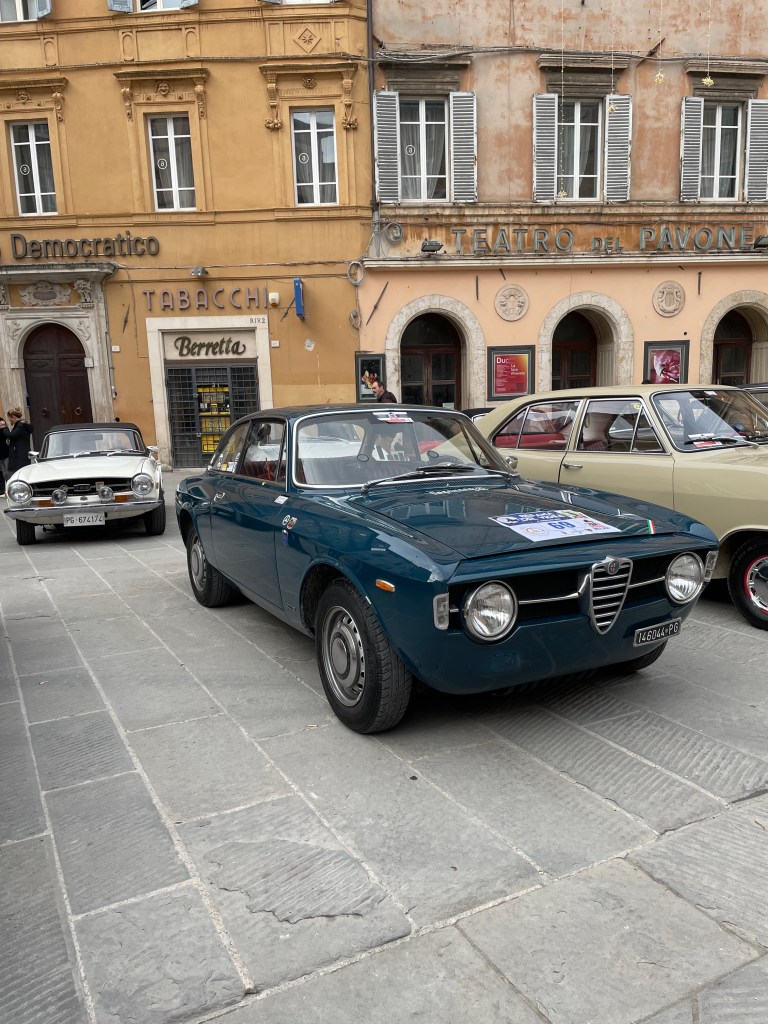
The roads were nearly empty as we headed into town, but the Minimetrò system was packed. A 10-minute ride from the outskirts of town to the historic center and we were in the middle of a cast of thousands. Even better was a parade of antique cars. I’m not sure what a prewar Lancia or Fiat has to do with Epiphany—gifts to the Magi (us)? perhaps? Who knows. It was fun to watch these old beauties parade slowly by as people reminisced about their father’s or grandmother’s car that took them on beach holidays or to school.

One thing I wanted to do but forget on the way out was to get a hot chocolate. Italian cioccolato caldo is nothing like the thin, insipid stuff sold in the U.S. Think warm, intense, slightly less thick chocolate pudding. Next time…

Someone even brought a vintage Mustang.

Bean there, done that

My mother was endlessly inventive in the kitchen. Married to a guy from Palermo, Sicily, she had to come up with a “primo” for dinner most nights. We didn’t have the traditional meat and two sides on one plate. My dad insisted on our following the typical Italian meal progression: a “primo,” either pasta asciutta (with sauce), soup, or rarely, rice. The meat or fish or frittata (omelette, Italian-style) followed. At the end of dinner, my father peeled and cut up pieces of fruit, which he doled out to us on the tip of his paring knife.

Those primi stick in my mind the most. I always preferred pasta to the second course. Twice a week we had spaghetti or some other pasta with tomato sauce—what most people back then thought was the only way to eat “macaroni.” But in between were pastas with broccoli or cauliflower, either in dry form or as a soup, escarole soup, spaghetti with clams…the list goes on. Having this first course made us less ravenous when the secondo came around, and I’m sure that it helped stretch the food budget, too. And at least once every couple of weeks, pasta e fagioli, which on the U.S. is often rendered in some obsolete dialect as “pasta fazool.”

Pasta e fagioli is the star of this post. It’s cheap, nutritious and can be fun to cook, and is delicious too. The variations can make your head explode. I’m going to tell you how to make my favorite version, which is an adaptation of what I first had one long afternoon, way too long ago.

Some culinary history: Mom usually used kidney beans, specifically canned kidney beans, for pasta e fagioli, because back in the dark ages of American grocery stores, kidney beans were everywhere, mostly to the exclusion of every other bean. Sure there might be navy beans, which are almost tasteless and resemble the canellini bean’s little brother. And you could buy lentils and split peas. But back then, there wasn’t much choice. Angie/Mom made it palatable by injecting a fair amount of garlic and some tomato broth to the mix. If she had some lying around, she’d chop parsley.

You can all them cranberry beans or borlotti. Either way they’re creamy and sfiziosi.

Years later, Perugian friends took us to an agriturismo (working farm with restaurant and/or rooms) over the border in foreign Toscana—Tuscany in English. The folks at the Castello di Sorci supplied a multicourse meal with two primi, one of which was an amazing puréed bean soup with homemade tagliolini, or thin homemade egg noodles. This was new to me; I’d never thought to purée the beans for the soup. Back home in New York, I made my own versions, one of which stuck. I love fennel and will sneak it in wherever I can. I did it with the bean soup and found that the addition of the fennel mellowed the soup out. At the same time, you wouldn’t know it was there if you didn’t look for it—just like chefs now use anchovies to increase the umami in a dish.

The supporting star

We’re starting to make soups like this as the weather turns cooler. So far this November it hasn’t cooled that much, but with the long nights this soup feels right somehow. You can put it together in 40 minutes or so using canned beans, or plan ahead, soak some good beans overnight and cook them before making soup out of them.

HERE’S THE NON-RECIPE RECIPE. I don’t measure anything, and this soup has endless variations in quantity and what you put into it. The orthodox version is pretty straightforward, though I have no idea whether anyone in Umbria ever purees fennel along with the beans.

You’ll need a package of canellini or borlotti beans. If you can’t find them, navy or kidney beans of whatever color will work. If you’re using dry beans, you’ll need to soak them overnight and cook them ahead of time. Otherwise, a couple of cans of white or borlotti (cranberry) beans will work.

A bulb of fennel—if you can’t find or don’t like fennel, you can use celery

One onion

2-4 cloves of garlic

One carrot

Tomato paste or a couple of peeled canned whole tomatoes (mainly for color adjustment; otherwise the soup can be way too beige)

Wine to deglaze. Or white vermouth.

Short soup pasta, or broken up spaghetti, or sheets of egg pasta cut into strips or irregular shapes. Quantity is up to you. About a cup works but it really depends on how soupy or solid you want the final version to be.

How to start:

Dice a small head of fennel, saute in good olive oil. Add a diced onion (red, yellow, or white, it doesn’t really matter). Dice a carrot. All of this doesn’t have to be perfect; you’re going to purée this toward the end. Add 2-4 smashed garlic cloves, and, optional, a pinch of hot pepper flakes or a little hot pepper—what we call “peperoncino” in Italian. Get the vegetables past soft and translucent; you’ll want a bit of golden color because it will taste better.

Add a splash of white wine or dry vermouth and get all the toasty bits off the pot. Add a squeeze of tomato paste or a peeled tomato or two. Add two liters/quarts of low salt vegetable stock or water. Add the cooked/canned beans. Bring to a boil and then let it settle into a simmer. At this point you’ll want the flavors to come together, so let it simmer for about 30 minutes.

Take the soup off the heat. Using an immersion blender, purée until smooth. You can keep some beans out and leave them whole if you want. It’s your soup. If you don’t have an immersion blender, a normal standalone blender or even a food processor will work.

Turn the heat back on. Add pasta. There are two schools of thought here. I’ll usually cook the pasta in the soup, but a lot of people will cook it separately and then bring the pasta and soup together just before serving. Cook the pasta until just before being al dente–it will continue cooking as you serve it.

The finished product

Serve the soup in bowls, drizzle good olive oil on top.

Variations

Possible additions: Greens. You can even just tear some rucola (arugula) up and it will wilt in the bowl and give the soup a peppery note. Finely chopped Tuscan (black) kale, escarole, or chicory are good additions.A pinch of red pepper flakes or chili oil will satisfy those who like things spicy.

You can also choose not to purée the soup. In that case, make sure you dice the supporting cast of vegetables finely and uniformly; it’s all got to fit on a spoon. Or you can ease up on the water or broth and make the dish semi-solid.

Photo at top of page: Jeremy Keith from Brighton & Hove, United Kingdom

500 hours of solitude (give or take): All the pretty colors

I overestimated. Those 500 hours I thought I’d spend alone seem rather less, and that’s probably a good thing. While I’m talking to myself a fair amount, it’s not any more than usual. And I keep bumping into people I know, or they or I make appointments to meet. I forgot that I have more of a social life here than in New York,

Part of the difference is location. Our house in New York is in an outer borough-—the outermost borough, in fact: Staten Island. It’s a pain to meet people for lunch when they’re in Brooklyn or Manhattan. I either have to drive over a bridge or take a ferry and probably the subway. Up here on the mountaintop, we’re only a few kilometers from the town and an easy 20-minute drive to the nearest city. Plus Italians are more spontaneous. Chances are if you say let’s have lunch or a drink, they’ll say yes. New Yorkers, and Americans in general, have to check their calendars first. It’s the cult of busy-ness. If you ain’t busy, you’re a loser.

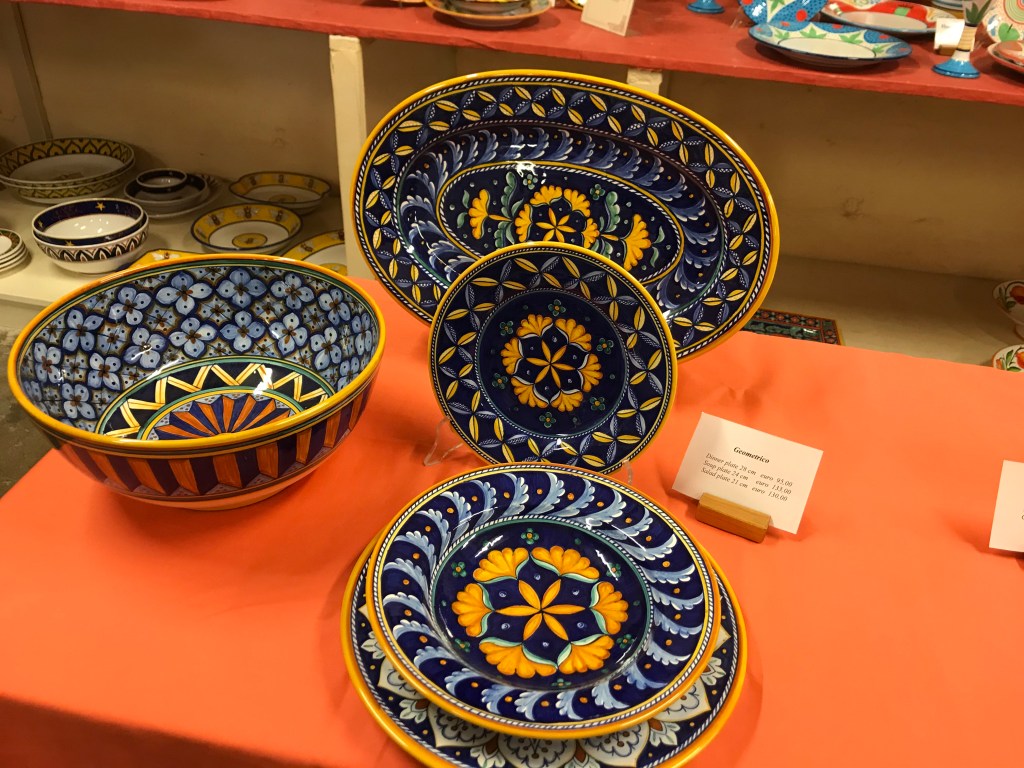
Anyway, I was reminded of Staten Island’s outer outer borough status by a friendly gentleman who sells ceramics. He’s Ubaldo Grazia, and his family’s company has been selling this beautiful stuff for, like, forever. I met him because a friend of mine visits him every year. She comes to Perugia most winters for a few months and take a language course, but this year her visit was a short one because she and her husband just moved into a house they built. But Grace, a semi-retired lawyer from Pennsylvania, wanted to get some kitchen accent tiles, and since she and I planned to get together, she asked if I could drive her to see Ubaldo. He likes to know his visitors and asked me where I was from, in English. “New York” “But where?” “New York City.” “But where in New York City?” “Staten Island.” “You’re not from New York,”

Ubaldo at the doorway of his workshop

Yeah, right. Just listen to my accent. I think the way I write has a New York City kid accent too. But anyway I promised in the first of these posts that if I didn’t have a lot to say I’d just post pictures. So here they are. They look great on my Mac laptop, I hope the colors pop on whatever you’re using, These are all Grazia ceramics, from the capital of ceramics around here, Deruta,

That was hard work, looking at all that eye candy. So we went off to Torgiano, mostly famous these days for the Lungarotti winery/Relais & Chateau hotel. But the Lungarotti family isn’t the only game in town. Our friend Letizia, of the cooking school and bed & breakfast La Madonna del Piatto said we should try out Siro for its rootsy Umbrian food. I’m glad we did.

It still may be winter, but artichoke season is upon us here, a few weeks early. So how could we not indulge? First, some fried small ones:

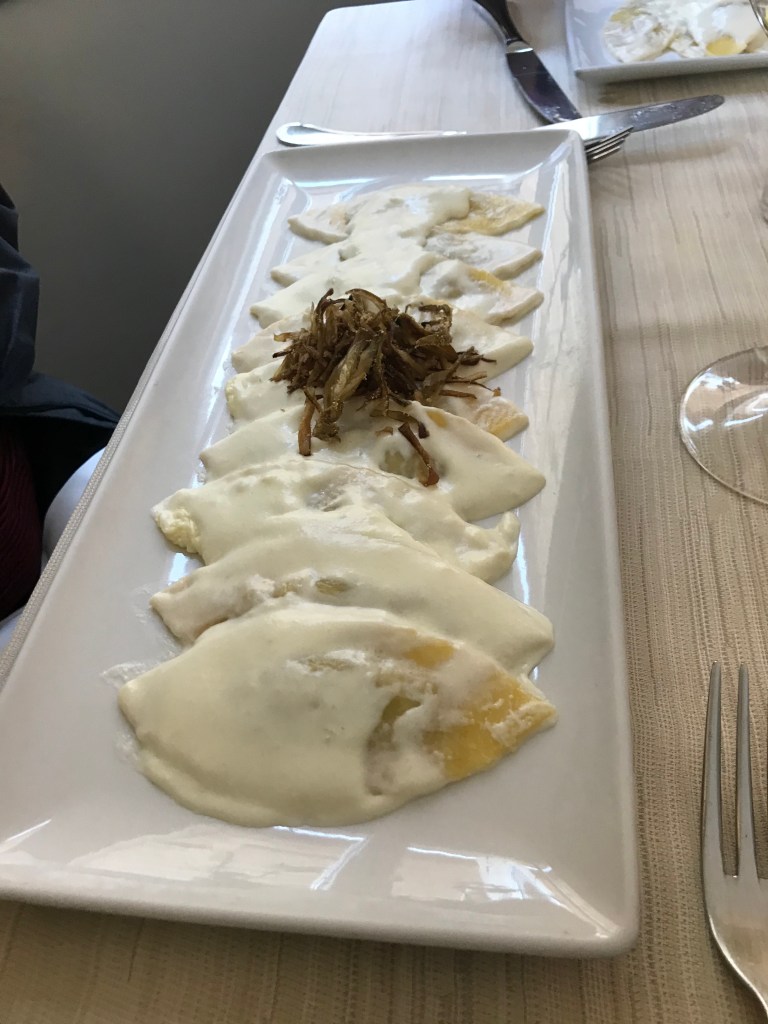
And my lunch companions had this pasta, olive leaf-shaped packets of artichoke cream.

It was all washed down with a bottle of my latest favorite white wine, Trebbiano Spoletino. In particular, Adarmando from the producer Tabarrini from Montefalco. If you can find it, grab it.

This winter I went swimming

(with apologies to Loudon Wainwright III)

This winter I went swimming 
This winter I wouldn’t have drowned 
I held my breath and I kicked my feet 
And I moved my arms around
I moved my arms around

We’ve been back in New York for a few months, which has been bad for the waistline. And so it was time to get back into some kind of shape. The holiday season was blissfully over. No more béchamel, truffles, cocktails, cookies, pies, wine, more cocktails, more wine. No more avoiding the pool because, you know, I had things to do—like visiting a friend on the Upper West Side for cocktails and seeing friends who were holed up in a Times Square hotel for, you guessed it, cocktails.

I’ve had a YMCA membership before Kid no. 1 was born, some 35 years ago. I used to hit the pool at 9:30 pm every weeknight. I was in my twenties and super fast. The pool, in fact, was filled with people who were super duper extra fast, all young like me. We’d goad each other to go faster. I learned how to do flip turns. “You should make it snap more,” one of my partners counseled. I did. I kept it up for years, which was relatively easy to do when you’re young and didn’t have to get to the office until 10 or so. And as the kids grew up, I started going less and less, in spurts more than a steady routine.

I love the water. Unlike the experience of some friends of mine, for whom swimming was a structured, oppressive series of lessons in an indoor pool, swimming for me always meant freedom and escape. I learned to swim at the beach. My father was a really strong swimmer, and when I was only four or five, he’d sit me on the beach and tell me not to move. Then he’d swim way out, waving to me and calling me. Then it was my turn. I learned by riding the waves, and soon being buoyant was as natural as breathing.

Later, we had a backyard pool and my siblings and our friends spent most of our summers in it. We played elaborate hide and seek games that involved swimming stealthily underwater to evade who was “it.” In high school, I took swimming instead of gym a couple of times. Mostly it was to avoid the Marine drill-sergeant gym teachers and the stupid militaristic calisthenics. But it soon turned into a soothing respite from Brooklyn Tech classes. Most of the class (gym classes were single-gender) would play pool volleyball unless the swimming coach decided to actually teach a lesson. But I was nearsighted and hated games like that. And I realized that I could just be a loner, and float around the deep end. I’d make sure to get high before class and spend a very pleasant hour mostly underwater pretending to fly.

As a college kid, I’d go upstate with friends to explore swimming holes. We’d jump from cliffs into ice-cold pools of water. One drop was about 35 feet and, well, you can’t slow down once you step off the ledge. Didn’t stop us though. Those beautiful swimming holes—I barely remember where they were—were a great foil to a series of boring summer jobs.

So it was back to the Y pool this month. Only now, not having a regular office job means I can go to the 11 am lap swimming session, where I’m actually one of the younger people in the pool.

I’m sometimes alone in the lane, which is great. But more often than not, I split the lane with Chris, a retired fire captain about my age. Chris is tall and lanky, and he gets to the deep end with what seems like five strokes. He’s just so quick and quiet about it. He told me he was a high school swimmer and has been swimming in the Y pool since he was three years old.

I was inclined to hate Chris. Early on, I heard him talking with someone about how Trump was driving liberals crazy. They were giggling like little boys who snuck a frog into a girl’s lunchbox. I avoided talking to him or even really acknowledging his presence. Eventually, though, we got to talking, starting with the usual “want to split the lane?” question. And I found out that he’s a curious and smart guy and somewhat of an amateur historian. We still avoid politics, and that’s okay. Can you say “cognitive dissonance”?

Going back and forth in an indoor water tank does get tired, but I do things to make it interesting. The Spartan Woman gave me an Apple Watch a couple of years ago and I can wear it in the pool. It’s got a workout tracker for swimming in a pool, so I’m always tracking how much I swim in how many minutes. My baseline distance is 1,000 meters; I figure that that’s pretty good for an old guy. If I can do it in a half hour, so much the better. Besides, with the watch, I don’t have to count laps, which always tripped me up. I always lost count before.

It’s pretty amazing what swimming a few times a week will do. I have muscles again; they seemed to go into hiding once the summer swimming season ended. I’m incredibly relaxed post-swim, especially if I spend some time in the sauna afterward. And it gives me an excuse to get out of this little prison of a home office.

I can’t wait for the summer.

The old grind

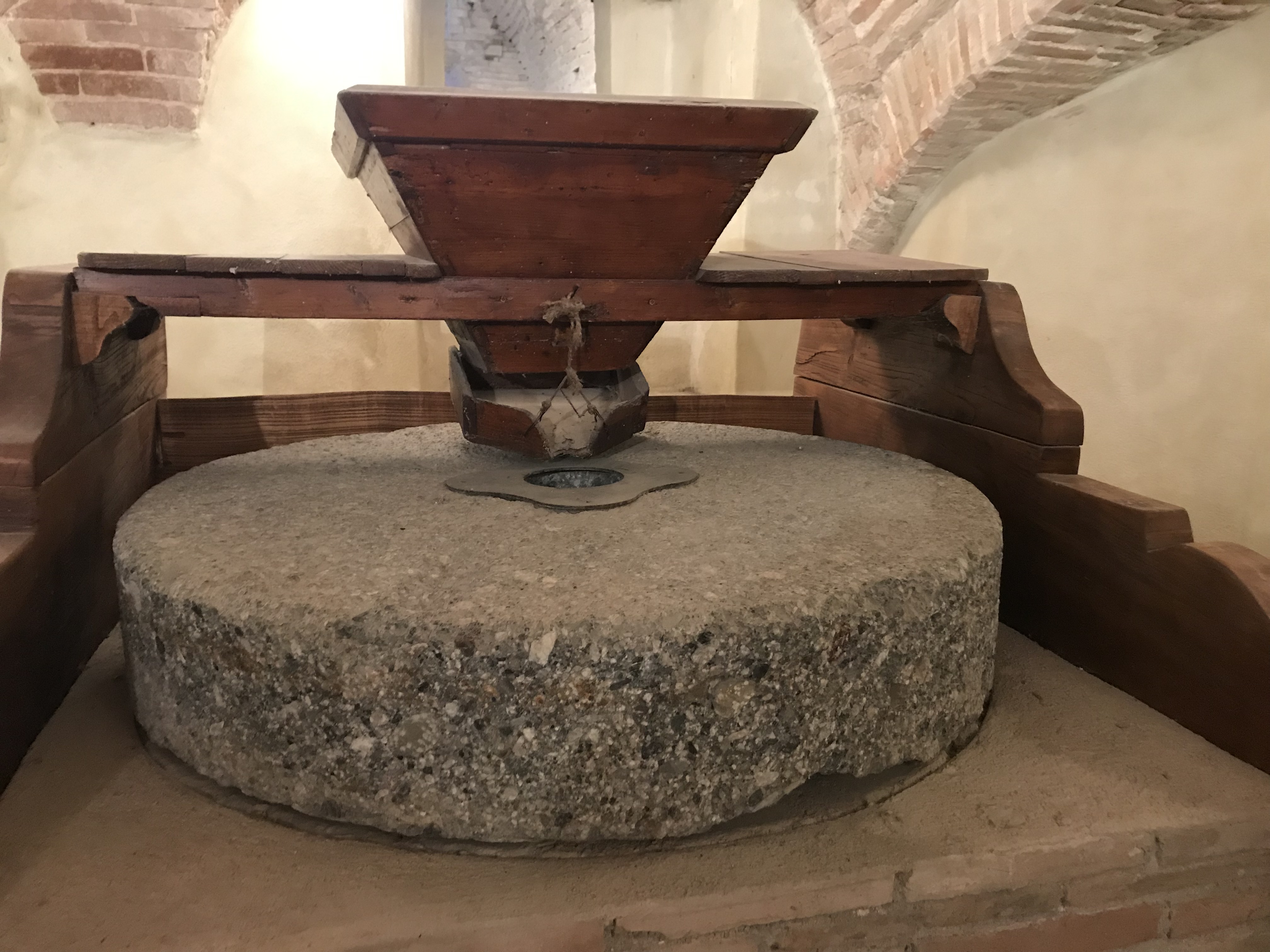
I whined a couple of weeks ago about the dark, grey, rainy weather we’d been having and how it sent me wandering around the local Centro Commerciale (somehow “mall” sounds better that way). One of our friends here had a suggestion: She said we should visit the Antico Molino Bordoni, an old-fashioned flour mill outside Foligno, a few towns south of us. They use millstones, they’re powered by water, and their wheat and corn—for polenta—flours are better than anything you can buy in the supermarket.

Our friend, Letizia Mattiacci, was right. And she should know. Letizia is the Madonna del Piatto, a cooking school and B&B outside of Assisi. She gives great classes and puts up students, if they wish, in her beautiful old farmhouse up in the hills. She’s often quoted in the U.S. press whenever American travel writers somehow manage to wander from neighboring Tuscany to see what this little region next door is like. If you’re in Umbria and you like to cook, you should take a class from her. (In fact, you should make a special trip here to cook with her; it’s worth it.)

Of course, being my usual procrastinating self, we didn’t get around to visiting the mill until the weather turned sunny and springlike. No matter—it was a splendid way to spend President’s Day. We pointed the Renault’s nav system to the address, and off we went, dodging the usual maniacal black Audi drivers on the highway.

When we got near to the mill, we found a main road under construction. The exit we saw in real life didn’t match the exit on the navigation map; they apparently are turning a minor road into a limited access highway-type thing. So we breezed right by it. “Recalcolo percorso,” the female robot voice said. “Fate un inversione a U.” (Recalculating route…make a u-turn.) Ms. Renault was going apoplectic and I couldn’t stop giggling every time I heard “a U,” which sounds sort of like “ah-oooh!”

We doubled back, found the right way off, and drove down the street. It all looked unassuming, and we found a spot right out in front. You wouldn’t know by looking at it that there’s been a mill on this site since the 14th century. There was a little storefront with a few sample bags out on a shelf, along with a multilingual poster about the place. People were obviously at work in the workshops in back and off to the side, but it seemed like no one was taking care of the retail end. Or so we thought until the owner’s son came over to greet us. We told him that Letizia sent us, which brought a smile and an offer to show us around.

Our guide for the morning

And what a show. I loved this stuff, being a food geek and a manufacturing geek. I love watching videos of assembly lines, and my father worked for a company that made electronic connectors, and I used to love going to work with him and watching the big presses and molding machines do their thing.

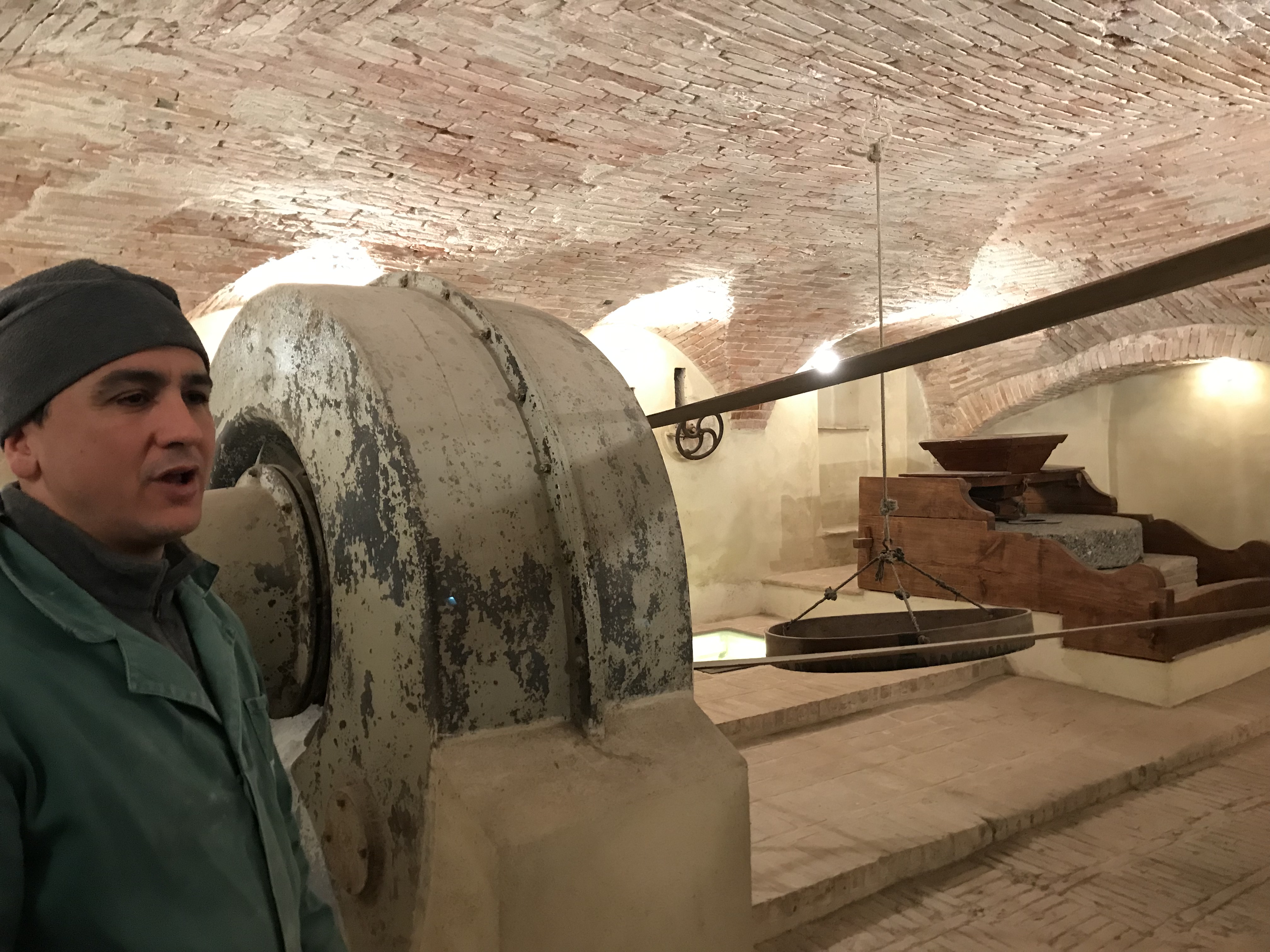
“Everything is run with renewable energy,” our guide started off. Being a mill, there’s a river nearby. It used to turn the turbines that turned the stones, and it still can all work that way. But they combined new electric mills with old-fashioned, real stones, and all the power is generated by the water rushing by. They rerouted the water to run their generators–a pretty neat trick.

The real thing
A river ran through it.

They still have all the old stuff though. We walked out to the street and down a stairway that looks like your typical New York City stairs to an apartment house boiler room and found ourselves in an stone and arch wonderland. The old millstones stood by waiting for another batch of farro or red corn, and the old water channel stood mute, waiting for the river to run through it. To be honest, the place would make a terrific party or dance venue, with some decent lights.

What really impressed though, is something I’ve seen time and again here: pride in the craft. Our guide obviously buys into the whole operation; it’s provided his family’s livelihood for a century. He knew everything about the place and its history and how everything works. We learned about the difference between what they do and what big producers do, from the texture of the millstones to the grains they use. These people use strictly local grain—he had a couple of ears of dried corn to show us what goes into the polenta. It was dark red and yellow, “more nutritious than the lighter corn the mass producers use.”

That pride isn’t limited to Italy, though it seems easier to run across small producers in this part of the country that’s dominated by small producers and artisans. You see it in New York City’s greenmarkets, too. You can spend hours talking to a farmer or cheesemaker if that’s your thing. Mass produced food may be cheaper, but it’s usually less intense. I find myself adding hardly anything to vegetables I buy at the greenmarket or in the local markets here, because the food doesn’t travel far to get here, so you get a more developed flavor.

Decisions, decisions…impossible. So we bought one of each.

We bought a bunch of different flours at the mill. We’re trying the polenta tomorrow. It’s not the instant, add hot water and stir kind. I’ll be stirring for about 45 minutes. I take Letizia’s word that it’s worth it. In fact, she stopped by yesterday with some handmade treats, one of which is the most intense orange marmalade I’ve ever tasted.

The road taken

A few days ago, we were doing our usual morning walk up the road when we bumped into a neighbor, who introduced himself as Claudio. He was out for a walk, too, telling us that he just retired. He told us about his walk, which involves walking down the road and making a turn into a “strada sterrata,” which is an unpaved road. He said that he makes a loop and comes around after being on the Sentiero Francescano. This trail is a series of trails that trace the steps of St. Francis of Assisi when he left his family home and riches, and walked to Gubbio through the woods. A mystical, rebirth ritual walk, in other words.

Curious, we wanted to see if we could replicate Claudio’s walk. (Francesco’s walk is well-marked and in warmer weather, sees waves of pilgrims.) A few days ago, we walked on some of the Franciscan path, and I was looking at the map on my iPhone. I saw as we were walking back down the hill another road that, if you looked uphill, veered left. Hmm, we didn’t remember that. But as we descended, we saw an opening and yes, a path that was carved into the side of the hill. That’s one of winter’s advantages; without the overgrowth and weeds, it’s easier to make out the paths that wind all around here. We took it and saw that it followed a higher trajectory than the Sentiero and then sort of curved around the hill. That must be Claudio’s route, we figured, and made plans to come back the next day.

The turnoff, not that you’d know it. Apple Maps showed it; Google didn’t. But for some other stuff, Google shows details Apple doesn’t. Guess you need both.

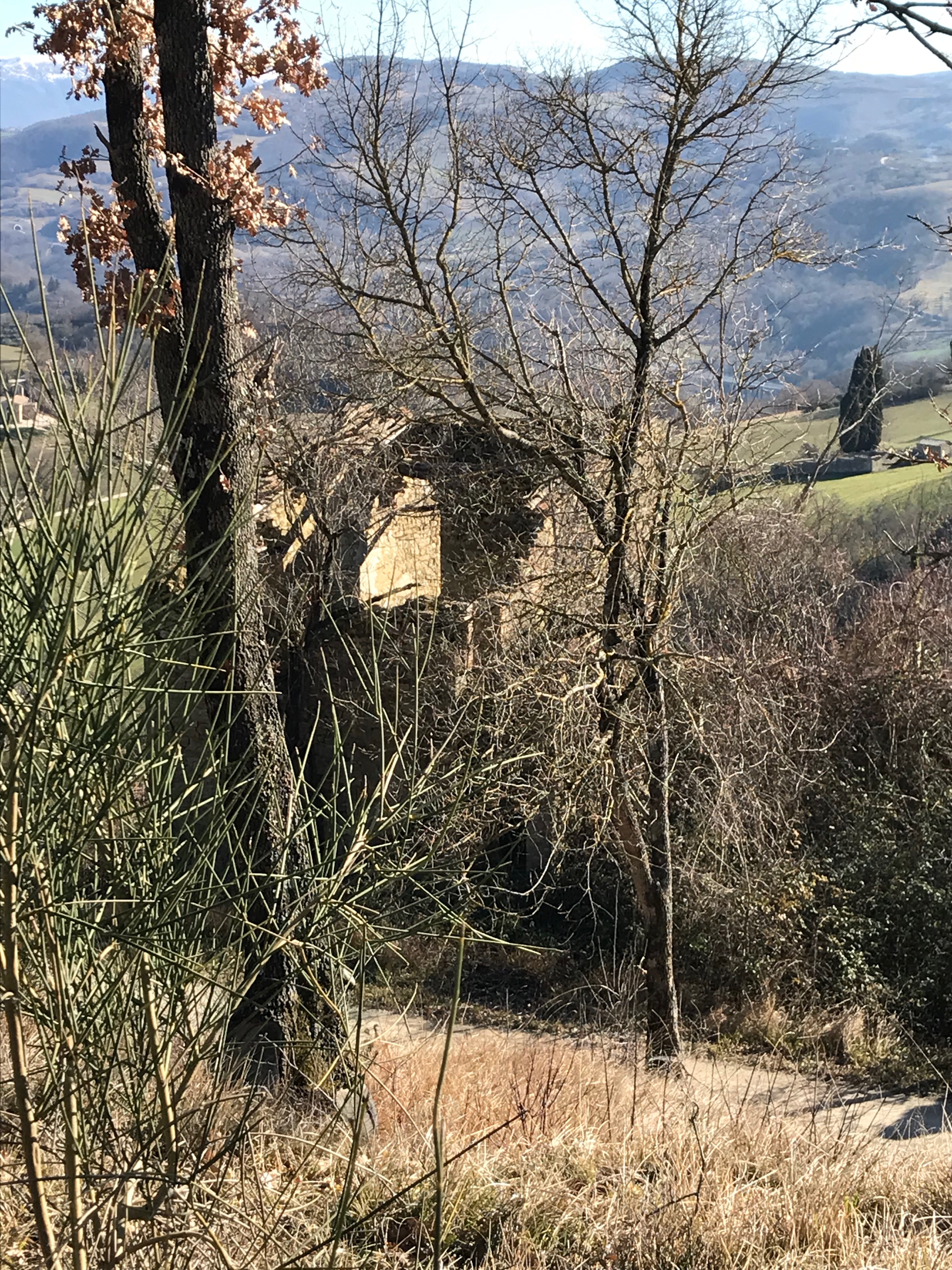
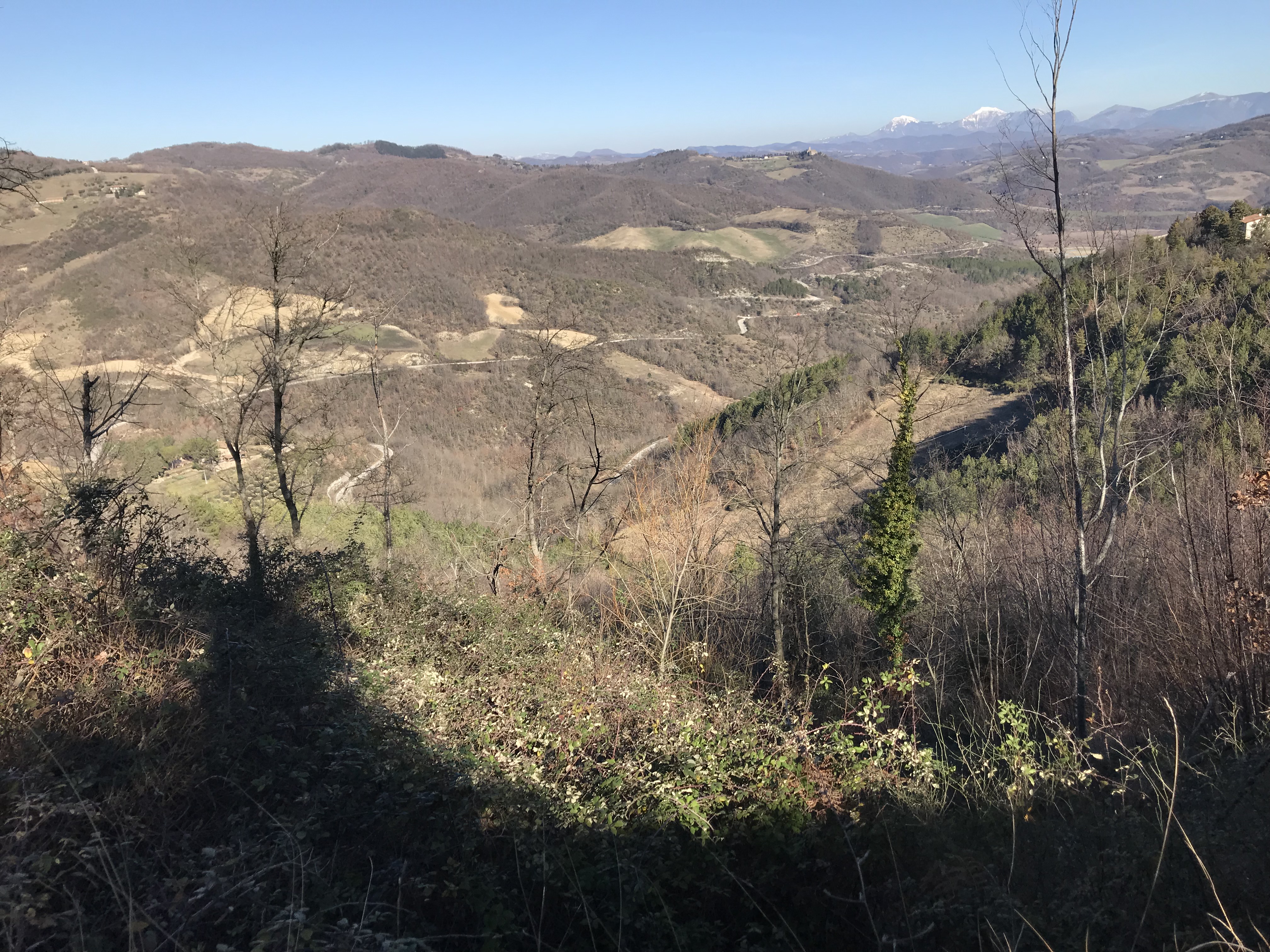
So we did. And O.M.G. We’re suckers for a good view and on this path, they just kept coming. Unlike on the Sentiero, you don’t really plunge into deep woods. The path—it must have been a road of some kind at some point—just hugs the hill, carved into it as it follows the basic path of the Sentiero, but about a tree higher. So we got to look into the ruin that we’ve passed many times (we hear that it’s for sale, if anyone out there is interested). As the path curves to the left and westward, the views are pretty stupendous.

Looking into the ruins of a farmhouse. An old timer neighbor told us that the family that lived there farmed the area until the 1960s. Their olive trees are nearby, still producing fruit.
On top of the world! Those are the snow-capped Apennines in the distance.

And then, we thought we hit a road block. Or, at least, a gate shutting us off from the rest of it. Luckily, though, as we got closer, we saw that the path veered left then curved around a large house with a pool and gardens that we soon realized was the Agriturismo Val di Marco. An agriturismo is supposed to be a working farm that welcomes guests, but this one does not look remotely farm-like. It’s just a big comfortable house in the Umbrian tradition that happens to be in the country.

Agriturismo Val di Marco, waiting for summer’s guests

Enough fun, though. What went down had to go back up. Our road, which we knew was south, or to the left, follows a high ridge. And the path did indeed go up. And up. And up. We were panting, okay, I was panting as we neared the top.

There was a payoff, though. We were met at the crest by our usual canine welcoming and escort service. But we disappointed them–The Spartan Woman had forgotten to pack the doggie biscuits. I guess they forgave us, though, and followed us most of the way home.

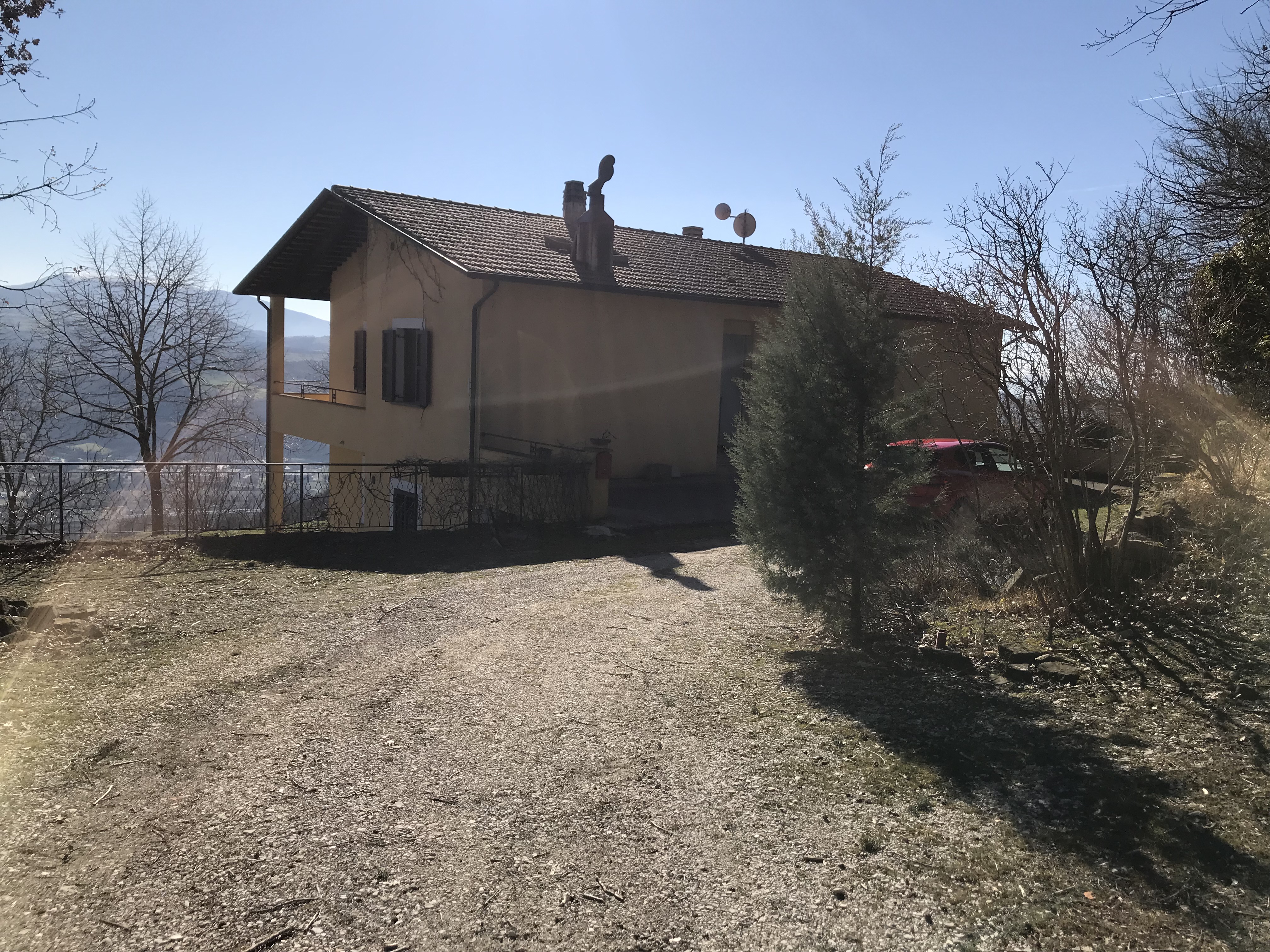
Casa, dolce casa (home sweet home)