Call me a convert

I was not about to go near The Spartan Woman. She was just a few meters away cursing at the food processor and Martha Stewart last week. It’s not that she had beef with Martha—quite the contrary. It’s just that she was trying to bake one of Martha’s recipes, a lime tart, and had to convert such quantities as “one stick of butter” or “half a cup of …” into the metric measurements we use in Europe. [TSW hastens to tell me that it’s not just the system of measurement but how recipes in the U.S. are written, often giving less accurate volumetric quantities rather than the weights professional chefs and Europeople use.]

 Photo: Cmh at the English-language Wikipedia

She wasn’t alone. Expat message boards are full of posts with people having trouble either converting measurements or finding ingredients that may be common in the United States—vanilla extract, for example—but hard to find in Italy. And measurements? Fuhgetaboutit.

As someone with a foot on both continents, I think about these differences a lot. And language, though it’s often a big barrier for newbies in a new country, isn’t the only one. I’m talking about measurements, more specifically, the metric system. The difference between the American version of Imperial measurements and the metric system might be harder to get over. Think about it: An American’s whole frame of reference to the world around us involves measurement of some kind. Two miles, 30 feet, 5,000 feet altitude, 45 degrees, 14 inches, a pint.

The United States is almost alone in the world in clinging to this obsolete and strange system. The other countries? Those progressive nations of Liberia and Myanmar. I call the system strange because, well, it is. Think about it: 5,280 feet equals a mile.Thirty-six inches, a yard; 12 inches, a foot. The only halfway sane one is the ton—at least 2,000 pounds is an easy number to remember.

Talk about American exceptionalism.

Seriously, though, one of the biggest barriers to improving life in the United States is the general refusal to learn much from the rest of the world in a conscious way. There’s almost always the assumption that Americans do it better, have it better, know more. And the U.S. way of measuring and perceiving the world is almost unique, and makes Americans nervous when they venture abroad. Or even over the borders to Mexico and Canada. I’m sorry, but Liberia isn’t exactly leading the way, and Myanmar is currectly ruled by a vicious and genocidal military dictatorship. Not great company to keep.

Inertia to change certainly plays a part. And so does math. When I was a kid in the 1960s, the U.S. made baby steps toward metrification. But instead of instilling in schoolchildren the system from scratch, teachers and texts taught equivalents. One pound equals 454 grams; to convert Celsius to Fahrenheit degrees, follow the formula temp Celsius X 1.8+32′ degrees=temp F. Lunacy, Why bother?
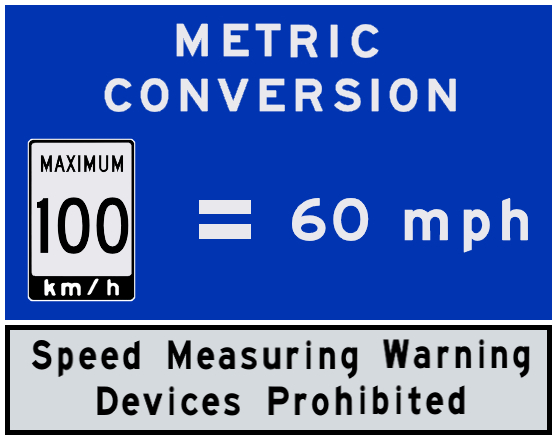
Ontario helps U.S. drivers with this sign as they cross the border. (It’s a little off: 100 kph is actually 62.5 mph.)

Maybe this sounds trivial, but think about it. You’re on your first trip abroad, to, say, Paris. You look at the TV weather channel in your hotel room, trying to figure out how to dress, and you see that it’s 12 degrees outside. What’s better? Plugging in the variables? Or knowing that 12 degrees is a chilly spring or autumn day? Sure, now you just look at your phone, but doing so isn’t teaching you anything, or making your more comfortable with how the rest of the world perceives temperatures.

BUT CLINGING TO THE OLD SYSTEM ISN’T just about inertia. Radical right wingers have made it one of their causes. Check out this video by that great intellectual Tucker Carlson. Back in 2019 he interviewed New Criterion editor James Panero about “the tyranny of the metric system.” I love how Panero calls U.S. measurements natural, metric ones abstract—and then dismisses the fact that we have 10 fingers and 10 toes, and how the metric system is based on….well, 10.

Despite this know-nothing astroturf nonsense, and popular fears, American industry knows better. Have you looked at a bottle of wine or soda recently? You’ll see 750 ml, 1 liter. Buy a car, or even a big American SUV lately? Your engine is 2.0 liters, 3.5 liters, etc. The dependably capitalist economic system has already made the change and I’ll bet Carson and Panero would call our leaders of industry woke socialists.

Getting with the program may be hard at first, but it’s not impossible. Canada switched from Imperial measurements to the metric system on April 1, 1975, and within a generation Canadian young people are fully immersed in metrics. A friend of mine from Toronto says she’s confused when she sees Fahrenheit degrees, and while she lived in the U.S. for a few years, she finds feet, yards, and miles to be impossibly strange.

So what do you do to get in synch with the rest of the world? I’m not saying that you should live in a metric bubble when everyone around you is in a real-life Flintstones episode. Just get acquainted with what everyone else uses, so that if you venture past the U.S. borders you won’t be lost. Start simply. Change the settings on your phone to metric measurements. You’ll get used to a kilometer and the Celsius scale. Or just remember that a kilometer is a little more than half a mile, give or take. And Celsius is easy, especially for landmarks of 0 degrees and above. Zero is freezing; 10 is a cool spring day; 20 is room temperature; 30 is a nice but not sweltering day at the beach. And 37 is body temperature—and a sweltering day at the beach.

Public domain via Wikicommons

The system of measurement isn’t the only thing keeping Americans in a bubble. In the rest of the world when it comes to politics, red means left wing, blue is conservative/right wing. But that’s another post. Be brave, America! You have nothing to lose but your disorientation. And you’ll know that when your phone tells you that it’s going to be 31 degrees this afternoon, it’s a great day to head out to that beach.

Winter sucks. But it sucks a little less here

Brrr. It’s a little chilly here in Studio AP, where I put together these little dispatches from Italy’s version of Vermont. I could blame Vladimir Putin for the lack of heat, but that’s too easy. Besides, we have lots of propane right now. But the fact is, this is Europe in the Italyland province, and houses were built more to shield us from the heat of summer than the cold of winter.

I shouldn’t complain anyway. It’s January, and this month has been fairly benign. And it’s leagues better than the typical New York January, which I hear and my iPhone’s weather app tells me hasn’t been so bad this month for a change. And how’s this for role reversal? We had a real, actual, white, wet snowstorm earlier this week. It gave us lazy sods an even better excuse to build a fire and drink hot liquids and not do much else except for reading and finding good cooking videos on YouTube.

When people hear that you’re going to Italy, that usually conjures up a whole bunch of images. Golden sun, sports cars roaring along a curvy beach road, high fashion, great wine, and pasta. So much for high fashion: Most of the young and cool this week seemed to be wearing sweats, NorthFace puffy jackets, and Timberland boots. Yes, Timberland. The brand is huge here and there are Timberland stores everywhere, from the local upscale mall, er, sorry, centro commerciale to the main street in town where everyone walks up and down between 18:00 and 20:00 (6 pm-8 pm to you nord americani) to window shop, meet friends, and have a drink before dinner.

You might notice that there isn’t much of that here. Despite an app that told me it was almost springlike in Perugia, it was blustery and freezing and no one was lingering over anything, much less a cold alcoholic libation. In warmer weather, this pedestrian street is filled with tables and chairs and 20-somethings hoping to get lucky.

And how about the main piazza? Ditto.

We had to run a couple of errands in town. That usually means the aforementioned drinks while lingering at an outdoor table—a table set in the middle of the Corso Vannucci, for example, where that first picture was taken. We might meet friends walking around. And we like to go to the end of the street where there’s a nice cool green spot with a view of the Tiber Valley below. Instead, we rushed up the escalators from the Minimetrò (we parked the car in the big parking lot at the base of the hill) and headed straight to a clothing store to look for gifts. I was bundled up, but it didn’t keep me from looking longingly at some warm hats, I remembered that my coat has a down-lined hood and resisted temptation.

Then we ran to another shop. I can’t say anything about that because the thing we bought will be someone’s surprise. And we don’t want to spoil that, do we?

All good boys and girls get a treat at the end of this. I’d been jonesing for some Italian hot chocolate, and yesterday was the perfect time for it. We found our favorite bar to have it, and found a table. The waiter smiled when we told him yes please, with whipped cream on top. Italian panna, or whipped cream, isn’t sweet at all but it’s intensely milky. It balanced the luscious deep chocolate, which really is more like molten dark chocolate pudding. How could we not?

Otherwise, it goes. After a brief bureaucratic tussle over a supposedly unpaid bill for propane, we got a delivery. So now we old folks don’t have to build a fire if we want to stay warm. Turning on the gas will cost us, but when you stumble out of bed and need coffee and to stare at the walls and/or the scenery, the last thing we need is to empty out the fireplace, stack some wood in it again and set it on fire.

Alienated in New York: a trip through my unpublished archives

It’s snowing today and our region is, as we say in Italian, “in tilt.” It’s more than the gentle flakes or even the short blizzard of flurries, if there can be such a thing. So for awhile we were out of power. I didn’t have an unread book handy, so I got my trusty laptop, which I can use for days without charging, and looked through old files on my hard drive.

Scrolling through my digital detritus, I found this essay that I’d written pre-Covid pandemic. I have no idea why I wrote it, what, if any, audience I was thinking of—whether, for example it was for this blog or not. It looks as though I wrote it quickly, right after the dinner I’d gone to. And boy, it rings even truer today than back in 2019. So I hope you don’t mind if I recycle it here, slightly edited to fit my current writing style:

—————-

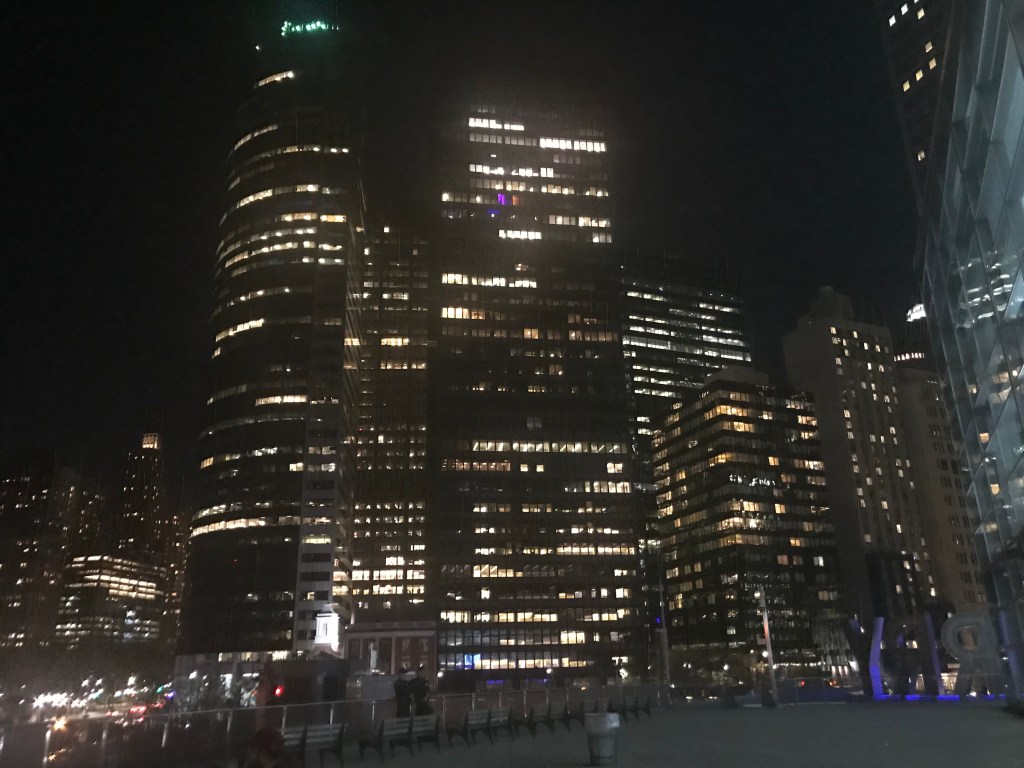
I HAD DINNER WITH friends the other night in Lower Manhattan near the South Street Seaport. Dinner was at Barbalu, the successor to a place I’ve been going to for almost ten years; the original version of the chic restaurant/Italian market was flooded during Hurricane Sandy in 2012. It’s a friendly place; I know the owners and this later version features authentic modern Italian food in a rustic yet sleek setting. 

I live on Staten Island, so I took the ferry across the harbor and walked about 20 minutes up to Barbalu. As far as commutes go in New York City, it’s painless and even scenic. When I had a regular day job, I took that ferry nearly every workday for some 30 years. In my last decade of trudging to a newsroom, my daily commute tracked my trip to the restaurant, except that the walk to work from the ferry was a little shorter. I’m a native New Yorker and have lived in the city just about all my life.

But that night, I felt like a tourist.

I can explain. I’m in New York for what seems like a fleeting visit. My wife, now retired, and I bought a country house in the Italian region of Umbria a couple of years ago. We’d planned to stay there sporadically, whenever I could get away. We were thinking of retirement, and retirement at the time seemed like something that would happen in the future. A couple of years away at least, in fact.

But our staying in the house for more than a quick week or two at a time came much sooner. Like many media professionals, I was excessed a couple of years ago along with about 20 of my colleagues. I’m not really supposed to talk about it, but the move supposedly was part of a sweeping redesign of our news operation, and as one corporate officer told me during what was surely a scripted phone call, “Your position has been eliminated.” (It wasn’t; they merely changed the name of it for a few months, then back to the original after we’d signed our severance agreements.)

So I, along with my comrades in words, had to reinvent ourselves. I became a freelance writer, and I don’t need to be anywhere in particular physically to do my work. Hence, Italy for at least a few months a year, in my spare euro-modern office or, better, at a garden table watching the view as I procrastinate.  

Inevitably, our country stays got longer and longer, and now amount to half the year. We can do this because of a precious gift from my immigrant father: an Italian passport. So we’ve been busy integrating ourselves into our little community. It’s a big change for a city boy like me. We live in a mountainous area in the foothills of the Apennines, the mountain chain that forms the spine of the Italian peninsula. Our neighbors are some 125 sheep and the people who own and care for them. When we take a walk, we amble down our road, waving to the hardy old—and retired—people who’ve lived in the town all their lives, and I’m sure their families have been there for centuries. Or, since we’re located in the middle of a network of hiking trails, we go exploring the hills when I’m done with my work, trudging up and down mountain paths and occasionally finding a ruin or wild asparagus in the woods.

But we’re in New York now [OK, I was in April 2019], and I have to say that I’m shocked that I feel so odd walking around my city. I was on the ferry that night, and I watched the tourists and the orthodox Jews and their families enjoying the ride during the week of Passover. And I realized that I’m a tourist too these days, here in town for only a few weeks.

The realization hit me viscerally, and this strange feeling of psychological distance stayed with me as I navigated streets that I’ve walked thousands of times. For one thing, since I stopped working in the neighborhood two years ago, a lot has changed. There’s a Hilton Garden Inn on Water Street, a truly strange name for a bland building that’s nowhere near a garden.

There are lots of new restaurants and lunch takeout spots, something normal in a town where eateries fold and open at a rapid clip. There’s something odd about the new places. They advertise their wares in their simple names, like Greens and Fresh. I’m an addicted menu reader, and their food seems to come from nowhere but some Californian notion of “natural” food: lots of kale, grains, an Asian overlay in the flavorings, bowls. The word “bowl” makes me smile; in four letters it manages to connote a lively lifestyle, clean living—lots of bike riding and yoga classes.

I SUPPOSE THAT I’m an old curmudgeon. But curmudgeons aren’t necessarily alienated from a place—just from a period of time. Walking through the oldest part of New York that’s busy remaking itself, I felt conflicting emotions, happiness that I would escape to my mountaintop soon, but a kind of sadness for feeling somewhat uncomfortable in the city where I was born. The contradiction actually made me feel queasy, as though I weren’t just pulled in a couple of directions emotionally, but physically.

That feeling stayed with me over dinner with my friends. I worked with them some 20 years ago and that alone probably contributed to the weirdness. Seeing them made me think of a time when New York was my city, my hometown. I had a part-time restaurant reviewing gig on the side back then, and it meant hanging out at hot new places, tasting everything. Now I was a part-time interloper, listening to people talk about their current jobs, their current president. I’m an American, but I also have another country’s politics to think about, and to fret over. While I participated in the conversation, I couldn’t help but think that I can just get on a flight and not spend much time thinking about Donald Trump’s latest escapades. 

And the prices…really, people, restaurants, even places I love, are ridiculous. My tablemates, knowing I’m a wino, sorry, make that someone who knows a thing or two about wine, especially those from Italy, had me choose. I looked at Barbalu’s list, and it’s a good, selective one. But the prices sent me into alienation mode again, when the cheapest bottle is around $40, and I know that I can go to a decent restaurant in Umbria and pay a few euros for a nice carafe of whatever’s local. I know that restaurateurs have to price drinks like that in New York; it pays the rent. I suppose that when people are using corporate cards it doesn’t matter much, but how can regular people afford to go out?

The kids were alright.

They don’t. They take the ferry and the subway back and forth every day and night. And that night, the weather was clear and warm. I sat on the back of the boat and watched the tourists take snapshots of the skyline as we sailed across the harbor. Soon they got tired of the view and went over to the side to see the Statue of Liberty. Right about then, an African-American girl with a distinct city kid accent sat next to me. Two boys, somewhere around 14, stared at the harbor view, which is nice enough during the day, but truly stunning at night. They laughed, they joked, they wisecracked like the city kids I’ve known all my life. They danced around, obviously flirting with the girl and competing for her attention and approval.

I’ll miss the place when I finally leave.

I will dance on Noma’s grave

This being January with pretty lousy, cloudy, I don’t go out much weather, I’ve had a lot of time to read the early obituaries of Noma, which is closing late next year. In case you don’t follow “fine dining,” Noma is a restaurant in Copenhagen that appears on every best-restaurants-of-the-world list. The place and its owner/genius chef René Redzepi have inspired a whole bunch of creative chefs who go out and pick odd plants in the forest or in tide pools, do something transformative with the stuff, and then charge scenester diners a few hundred bucks for the privilege of ingesting what they foraged and tortured. A night at Noma, for example, costs around $500 a person.

Noma will follow El Bulli and Del Posto to the big food court in the sky. To which I say: no great loss. It’s not jealousy—I was a part-time restaurant critic back in the 1990s, when the big deal restaurant scene hadn’t yet metastasized into the monster it has become. Still, there were previews of what was to come in multi-course tasting menus in a breed of French restaurants that, looking back, served as a bridge between the snooty old French establishments and brave rich-hippie vibe of Noma. Not to put too fine a point on it, you can think of a Noma fan as the foodie equivalent of an investment banker who collects Grateful Dead concert tapes.

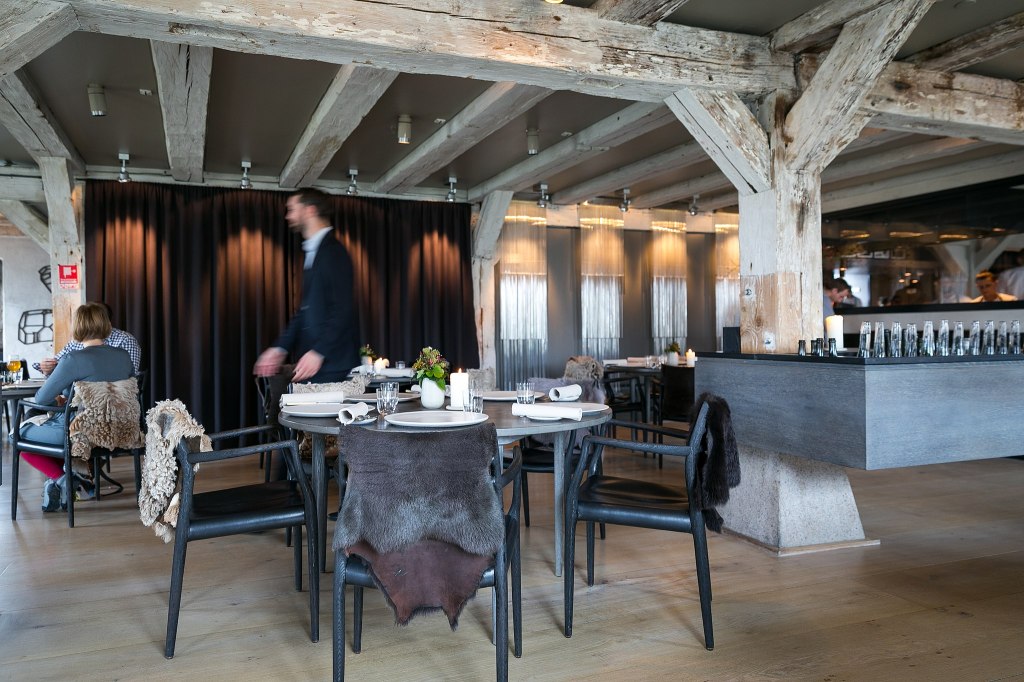
The rustic charm of Noma for an elite few. Courtesy of Wiki Commons

I’m not going to lie. I thoroughly enjoyed my decade of dining at my newspaper’s expense. It made me really popular, because The Spartan Woman and I usually invited a couple of friends to come along so that we could sample enough dishes. We ate at the new wave of Spanish/Catalan restaurants, fancy French eateries, aristocratic Italian establishments, as well as the occasional Hong Kong style of Chinatown palaces that were just beginning to establish a beachhead in New York. The review pace was gentle—I was on the hook every four weeks for a review, so it was just enough to be fun and not enough to be routine and boring. And when our girls were old enough, we often took them along. (They were tougher critics than our friends, who were just thrilled to have a free meal at a hot restaurant.)

After 10 years, though, we’d had enough. By then we just wanted to hang out with friends and family, either at home or in a local ethnic restaurant where we’d like the food but wouldn’t have to pay homage to it. I remember a colleague once went to El Bulli, the restaurant in the Catalan region of Spain, which had pioneered “molecular” cuisine. I asked him how it was. “Tiring,” he said. I’m paraphrase, but he said something like, “It was so exhausting. Open this lid, inhale the fumes three times, then pour the contents onto this plate and stir counterclockwise 4.5 times, then eat using these tweezers.” Sorry, that ain’t food, that’s entertainment for a very small cult audience.

Move over stove, we’re making foam—from a Barcelona exhibit about El Bullì and its owner. Kippelboy, CC BY-SA 3.0 https://creativecommons.org/licenses/by-sa/3.0, via Wikimedia Commons Ferran Adri

And then there was Del Posto in New York. Its owner sought to elevate (so they thought) Italian food to the same rarified altitude of classic French cuisine. Talk about flawed concepts from the get-go—”Italian” food (a term I have trouble with because this country’s eating habits are hyper-regional) isn’t supposed to be the snobby refuge of the wealthy. My neighbors on our hill, who tend sheep and have an organic farm, make ricotta that would make you cry it’s so good. But there are a lot of people like them here and they’ll insist that good food is their birthright, not just a boasting point for the bourgeoisie.

EATING IN ITALY ENCOURAGED my move away from culinary preciousness. For one thing, the dominant characteristic of food here is to find really good ingredients and prepare them in a way that lets them shine. There’s little torturing of plants or animal bits to make them something else. And with the exception of a few Michelin-starred places, there are fewer celebrity chefs lording over everyone. Hey, this is Italy, where everybody is a star, and no one cooks better than Nonna (grandma) or your mother.

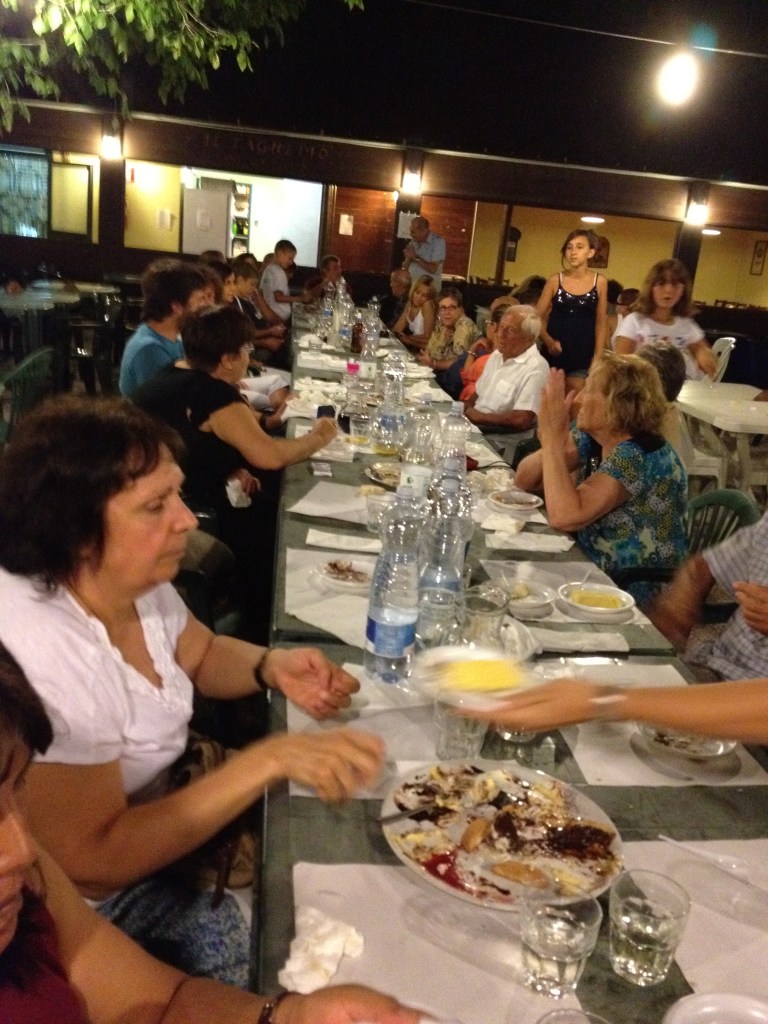
A clan gets together outdoors at a popular restaurant. Twenty-eight wouldn’t fit in the kitchen.

I know I’m lucky; as a teenager I stayed with relatives my first times in this country. I had a front-row seat to the food culture, which basically was just as my mom cooked back in New York, although mom, being a native New Yorker, pretended to be a normal American every so often and would give us steak and potatoes or peanut butter sandwiches in our lunchboxes.

But it’s interesting to see the differences between the cultures of my two countries when it comes to eating out. In cities like New York, Boston, and San Francisco, it’s become a high-stakes scene (and is bouncing back post-pandemic). Rents are high, food and liquor and wine prices are through the roof, so in an attempt to squeeze some profit restaurateurs pay their staff peanuts. Noma’s Redzepi himself said that fine dining has become economically unfeasible, and his complaints mirror what thoughtful American restaurant chefs and owners have been saying. In the U.S., the handful of successful celebrity chefs expand their operations into empires. The Bastianich group, headed by matriarch Lidia Bastianich and run by her son, has 30 eateries spread across the world. Thirty!

This craziness is fueled by a media and PR machine that glorifies celebrity cooks and runs competitions on TV instead of showing people how to cook. And there’s a definite high/low culture thing going on. The well-heeled eat at one of the Bastianich or Jean-Georges Vongerichten restaurants; normal people eat at the Olive Garden, which cuts corners by not salting pasta water in an attempt to cut down on spending for pots. The well-heeled use their experiences as conversations starters, and they love to spend big.

It’s different here. Sure there are TV competitions; in fact Joe Bastianich is one of the stars of MasterChef Italia. But beyond that things tend to be more democratic. One of the biggest complements Italians give to a restaurant is “si mangia bene e si spende poco” (you eat well but spend a little). Restaurants are basically extensions of the small kitchens that many Italians have (most of the country lives in apartments; think of New York but better designed). Often, clans or groups of friends will go out because they can’t fit everyone into the kitchen or day room, but they know that their outing will lead to a great meal that won’t wreck their bank account.

It’ll be interesting to see what Redzepi comes up with next. He says he’s turn Noma into a “food lab” and try to figure out new models for feeding people creatively. El Bullï’s Ferran Adria said the same thing when he closed his legendary restaurant more than a decade ago. Maybe I haven’t been paying attention, but I haven’t heard much of what his lab has done. I’ve subscribed to his newsletter to see what’s up there. In the meantime, buon appetito, enjoy what you eat, and don’t think about it too much.
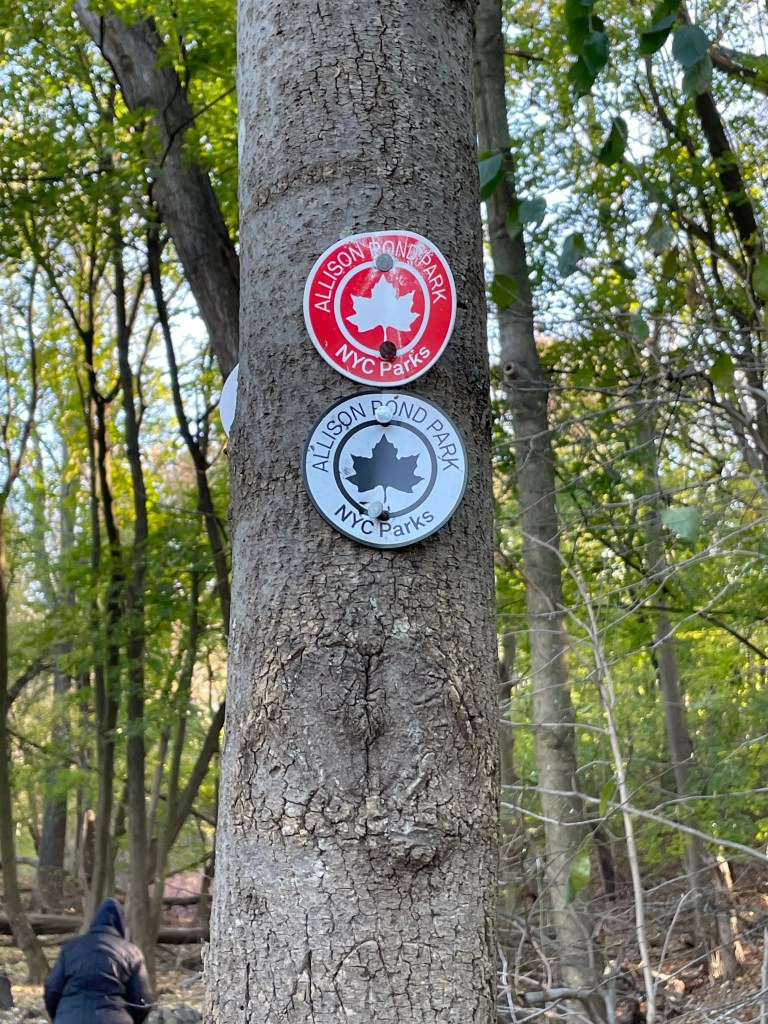
Illustration at top of page courtesy WikiCommons

Vlad made us do it

Life here on our hill ain’t all sunsets and spritzes. Maybe it would be if we had servants. But we don’t; we’re just two retirees trying to have a little fun and adventure. Gotta say though, in the week since our arrival, life hasn’t been much of an adventure. It’s been pretty dull in a nice way, in fact, after a way too busy holiday run-up. Call us happy stay-at-homes, at least until tomorrow, because we’re planning a run into the big city of Perugia (pop. 170,000). And we’ve had to catch up on our lives here before we can descend from our lofty patch of land.

First things first: After a day or so of traveling packed like sardines into two Lufthansa flights—a wide bodied A 340 and a narrow body A320, then a ride in our man Angelo’s van, we got here with just a touch of jet lag. More importantly, and unlike our return to New York in the fall, we didn’t bring Covid with us, or catch it in an airport or while aloft.

Did I mention it’s winter here too? That means no lolling around at the café in the piazza, definitely no beach day trips and no dinners on the patio. It’s not as cold as it is in a Northeast U.S. winter, but the days are short, the nights long and chilly, and we’re greeted every morning with a sea of fog in the valley which, I have to say, is pretty stunning. People jokingly call it the Umbrian sea and these shots give a good idea why.

We still have to heat the house. As we were leaving back in October, the price for propane was going through the roof as fears of a long, cold, natural gas-less winter took hold. We have huge buried tanks to hold said gas, but even when Vlad the Ukraine Invader isn’t doing his genocidal mischief, prices are high—about 80 cents a litre—and it costs hundreds of euros to fill the tanks.

Please heat up. All we need is 50 deg C. That’s not too much to ask.

Luckily, the previous occupants of our house put in these clever Klover fireplaces. They’re hooked into the house’s heating system, so all we have to do is start a fire. A big fire—the pump that drives the fireplace’s heat into the radiators starts pumping at 50 degrees Celsius—that’s 122 degrees F. for the metric-challenged—and that takes awhile, and quite a few pieces of wood. The Spartan Woman, living up to her nickname, managed to stack most of our remaining wood next to the living room fireplace. Thanks to her our nights have been toasty and only a little smoky.

But that wood. Before we left, we’d pass our supplier on our way to the supermarket. He had great mountains of wood in anticipation of a gasless cold winter. I called a couple of times and he assured me about the supply. But then he added that he was so busy that he wouldn’t couldn’t guarantee delivery before we left. And so we looked at our dwindling supply warily, treading a line between staying warm and making sure we wouldn’t be left to freeze on later nights.

Last week, the wood dude and I made contact before we left. We texted each other, he said just call or write when we arrive, happy holidays, etc. I did, and he promised a delivery yesterday morning. It didn’t happen. We waited and worried. Should I call? After years of editing other people’s writing, I’m tired of being a nag, so I waited without nagging until after night fell. “I’ll be there tomorrow morning.” “Can you tell me when?” “Around 10.” Phew.

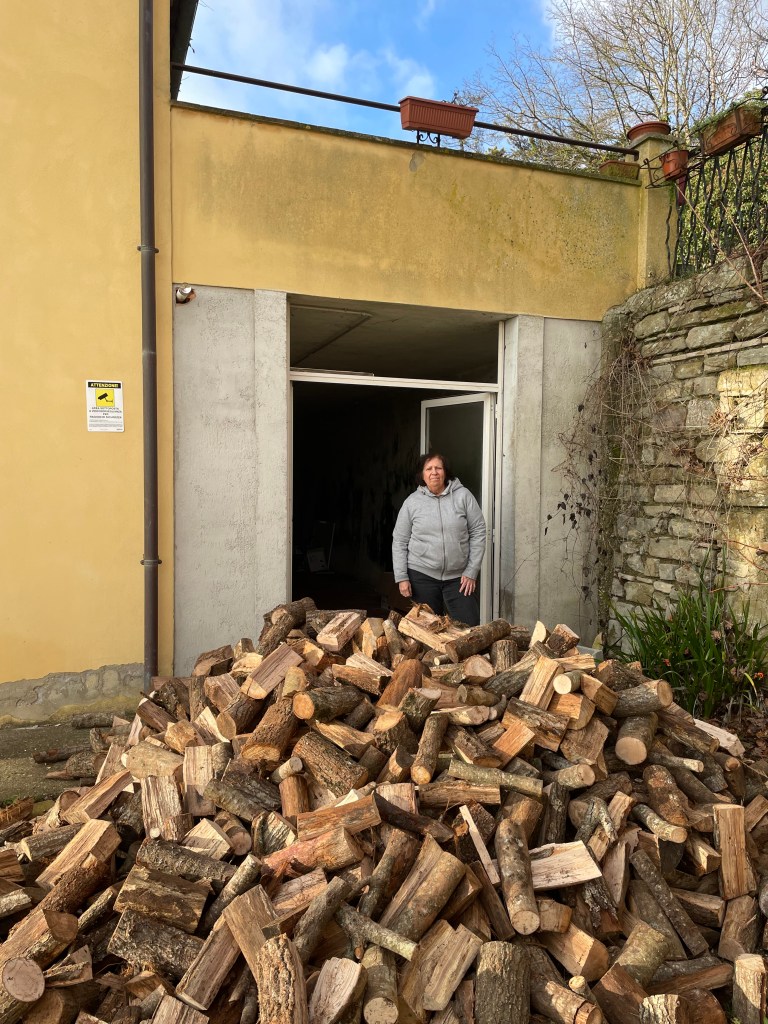
He was good at his word. This morning a little dump truck arrived and tipped almost 19 quintali—that’s 1800+ kilograms or nearly 4,000 pounds of the stuff near our garage door. It was not a little pile, nor was it all stacked in a pretty box. If it were packaged nicely, it would have cost a lot more than €340, which is a fraction of what propane would’ve cost us to heat the house for the same period. TSW, with her superior logistical skills, designated areas for big pieces, kindling, and in-between annoying pieces, and we went to work. I must confess that she did more; a bad back, the result of my Summer of Coughing, made me take breaks after every dozen of chunks of wood stacked.

It wasn’t a bad way to spend a couple of hours. At least we weren’t shut-ins staring at computer/phone/TV screens. Fresh air! Clouds! And that Umbria sea just below us, shifting its shape as the breeze and sun played games with one another. What we didn’t especially like, but can’t do anything about, were the shouts of men in the land surrounding ours. They were hunting for wild boar, and every now and then shouts, the barks of hunting dogs, and rifle shots rent the air. That’s the kind of stuff they don’t put in the tourist websites. But that’s winter in the Umbrian countryside, and I wouldn’t trade it in for anywhere else right now.

But there’s more.

TODAY IS JANUARY 6, SO IT WAS TIME, we decided, to descend from our aerie. The sun was bright, the sky blue, the “ocean” floating around in the valley, and our Covid tests negative. So we get in the car and drive the 20-something kilometers (about 12 miles) into Perugia. Not a big distance physically, but psychologically, it’s a big gulf.

Especially today—this is the last weekend of the holiday season in Italy. We say “buone feste” here—happy holidays—not necessarily to be caring and sharing with our non-Christian sisters and brothers across the world. The season literally consists of three big holidays, and a fourth, December 8’s immaculate conception (or something like that), which kicks off la stagione Nataliza (the Christmas season). We wanted to how Perugia looks before they take away all the lights and trees and decorations.

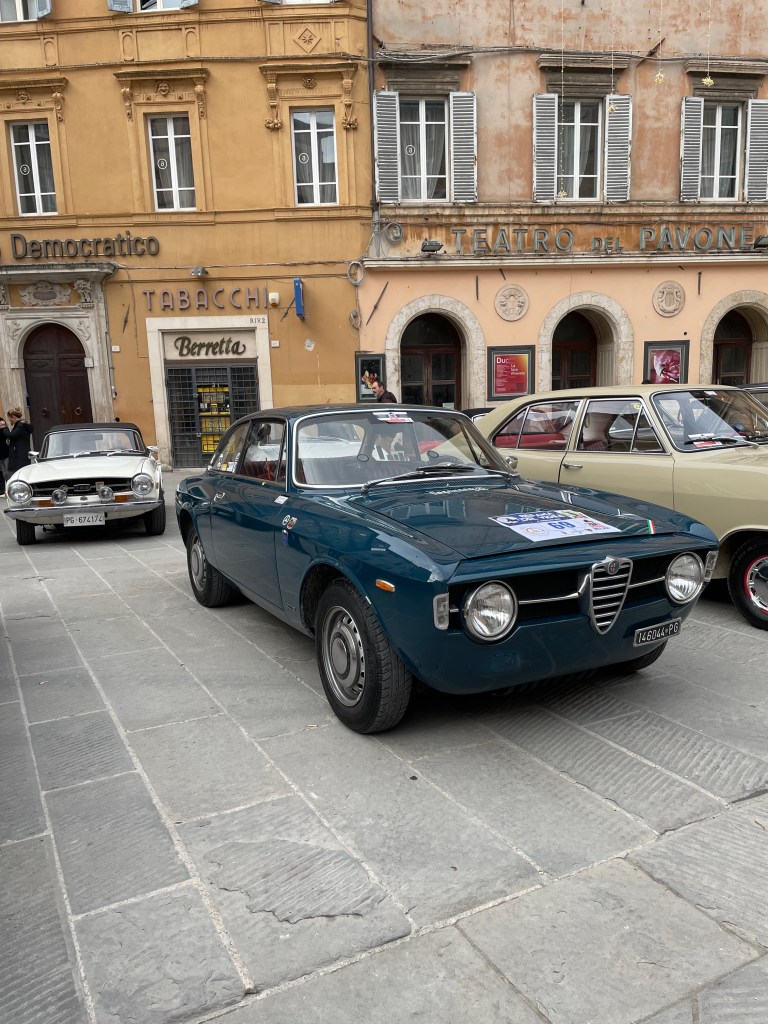
The roads were nearly empty as we headed into town, but the Minimetrò system was packed. A 10-minute ride from the outskirts of town to the historic center and we were in the middle of a cast of thousands. Even better was a parade of antique cars. I’m not sure what a prewar Lancia or Fiat has to do with Epiphany—gifts to the Magi (us)? perhaps? Who knows. It was fun to watch these old beauties parade slowly by as people reminisced about their father’s or grandmother’s car that took them on beach holidays or to school.

One thing I wanted to do but forget on the way out was to get a hot chocolate. Italian cioccolato caldo is nothing like the thin, insipid stuff sold in the U.S. Think warm, intense, slightly less thick chocolate pudding. Next time…

Someone even brought a vintage Mustang.

In with the old, in with the new

I’ve been lazy. Uninspired? Bored? Had writer’s block? Nah. It’s just that living in an outer borough of New York and not going out much can be, well, not the stuff I want to write about. So I didn’t. I was struggling to do something profound, either about differences between Europeople and Americans. Or maybe about technology, or taking a quick road trip. I could show you the unfinished drafts in my queue. But that way you’d see my tortured thought process.
At one point, I even got a bot—the now famous ChatGPT—to write about driving from New York to the Boston suburbs. Then I thought maybe I’d critique what the bot did. Okay, I’ll give you a peek:

On a chilly weekend, we took a 400 km ride to the Boston suburbs in our Volkswagen Golf. Four of us traveled comfortably in the spacious car, but we had to make a couple of stops along the way for our pregnant daughter, who is in her last trimester. Despite the stops, the ride was generally smooth and we were able to make good time. One thing that struck us on the American highways was the lack of lane discipline. People would frequently pass us on the right and zig zag dangerously through traffic.

Kind of workmanlike, no? I gave the bot no instructions as to style or my attitude. I wonder how it decided that the car is spacious—in Europe it’s a midsize thing, in the U.S., the land of SUVs, like a matchbox. I’ve read worse copy in my way too long editing career, but at this point I’m not exactly scared that it’s going to take my place.

The Matalas coven takes over the living room.

Anyhow, then Christmas came, and three days later, we transferred to our Umbrian hill, so, yes! I have something to write about. First of all, the holiday. We’re not really subscribers to religion, but we’re culturally a tiny bit Catholic, and for years we’ve had The Spartan Woman’s Jewish cousins over for the day, as well as her parents and sister, etc. This year’s get-together was bittersweet for a couple of reasons. It was the first one post-Covid onset. And it could be the last one we do, because we may not be living in the U.S. this time next year.

All the same, it was terrific to see our kids and their second cousins hanging out together. We jokingly call them the coven; for years, hardly anyone in TSW’s extended family gave birth to males. I’m not the only one calling them a bunch of witches, they themselves encourage it and, well, it’s just funny. But in the next couple of months, that should end. Our number 1 kid, who got married this past March, is expected to actually bring a male infant into this world. “I don’t know what to do with a little boy,” TSW said at one point. I think she’ll manage somehow, she seems to have no trouble with grownup boys.

AFTER THE HOLIDAY, we had to scurry and clean up and get ready to spend a few weeks in Italy. Obviously, this isn’t our first time around the block for this. Still, we have to make sure stuff is taken care of there and that we remember to take what we need in terms of tech stuff and meds, weird food substances we use in the U.S. but impossible to find in Italy. [Tip: Cheddar cheese powder is really, really good on popcorn.]

The trip over was something else. Not that we were delayed or anything, like thousands of holiday travelers in the U.S. But for the first time since early 2020 airports and flights were jammed. I never saw so many people crowding JFK Airport’s bars/restaurants/shops. It was hard to find a place to sit at the gate. When I went to the least-crowded bar to get my by-now traditional preflight Martini, the bartender apologized for having to use a plastic glass because all the Martini glasses were being used.

The flights, first to Munich, then to Rome, were similarly jammed. Lufthansa kept texting us begging us to check our carryon bags (for free even!). We had huge bags anyway, and only knapsacks as carryons. Lufthansa in general is one of my favorite airlines. Its staff treat people like humans, the food and entertainment are halfway decent, as are drinks, and the Airbuses are pretty comfortable, at least in premium economy (and upward, though I can’t shell out for that).

I’d nervously been looking at flight stats; we had 1.5 hours between flights and with the chaos in the United States, our first flight was late on the days leading up to our departure. That had me looking at how often Lufthansa and affiliates flew between Munich and Rome. Happily, it didn’t come to pass. We left on time and arrived early. Since we’re EU citizens, we breezed through passport control. And somehow we landed at a different terminal, the same one as our second flight, so we even had time for a cappuccino and snack.

I’ve crossed the Atlantic countless times and I usually sleep through most flights. But I was so happy to be traveling that I pretended to be a tourist from my window seat. Long Island looked colorful and even a little glamorous as night had fallen. Germany looked tiny and modern, at least from the buildings I could see. And the Alps? Mozzafiati! (Breathtaking in Italian)

I never get tired of flying over the Alps.

So here we are. And yeah, it’s a nice place. But it’s more than liking the place and having nice scenery and food. Our friend Angelo picked us up at the airport and knowing that we didn’t have much fresh food at the house, gave us a big bag of fantastic oranges (there is nothing like Italian citrus). This morning, I walked next door to our neighbors Marjatta and Pasquale at the agriturismo Ca’ Mazzetto to pick up our car; they’d been car-sitting while we were away. They used it every now and then and returned it with a full tank and cleaned inside and our. Later, Pasquale dropped by to say hi and give us a tin of their fantastic organic olive oil. It’s great to be home.

We’re getting ready for a quiet and decadent New Year’s Eve dinner here with our old friend Doug and his trusty sidekick Georgia the dog. Shopping for it was like being at JFK, way too crowded but instead of making me crabby, the IperCoop near Perugia had a party vibe, with sales of good Champagne and Franciacorta (Prosecco’s upscale cousin, fermented in the bottle like Champagne). Since this is Italy, we’ll take Franciacorta—to go with some scallops in the shell from France.

Thanks for reading this year, and happy New Year! See you here after the holidays.

Act like you fit in

On my friend Mick’s first day of kindergarten, his father gave him some good advice: “Act like you fit in.” I guess even back then, his dad knew that Mick was an artist and a gentle sweet soul who’d have a rough time navigating a sometimes hostile world. Funny how his advice seems really valid now to us. I’m looking at boxes and stacks of books and a guitar case, thinking about how we’re finally close to reversing the moves made by my father and my mother’s parents decades ago to the United States.

The Spartan Woman and I were driving around the other day doing some errands, and we talking about people we know who’ve become expatriates in Italy. And in a way we felt a little, I don’t know, pleased with ourselves that we were raised in New York in immigrant families and communities. “If I had to pin down my nationality,” said TSW, “I’d say New Yorker.”

But that’s almost too easy. After being in Italy almost six months, and after two years of pandemic-driven isolation, we’re realizing that our New York doesn’t exist any more, except in pockets where recent immigrants live and work. Still, whether New York has morphed into something different, we’re still a different breed from Those People Out There and we’re proud of it. Growing up in New York makes you—us—citizens of the world. And that has prepared us for our little adventure in reverse immigration.

Here’s how. I’ve told you about Holly Street before, where I grew up. The street was populated by a mix of recent European immigrants (Italian, German, Irish, Scottish) and old-time Staten Islanders. The Spartan Woman has an immigrant past, too—all four grandparents were born elsewhere, her paternal grandparents from in and around Palermo, Sicily, and her maternal grandparents from Sparta in Greece. Combine that with the local dialect, where Yiddish syntax influences how we speak English, and you get a native New Yorker of a certain age. Our certain age.

And while the immigrants’ native lands change, it’s heartening to know that our kids had similar experiences. Their friends from childhood into adulthood either came from or are the first generation of people who came from Argentina, Slovakia, Chile, and the Caribbean. Oh, Italy too—it’s Italy’s lasting shame that each generation seemed to send some of their best people away.

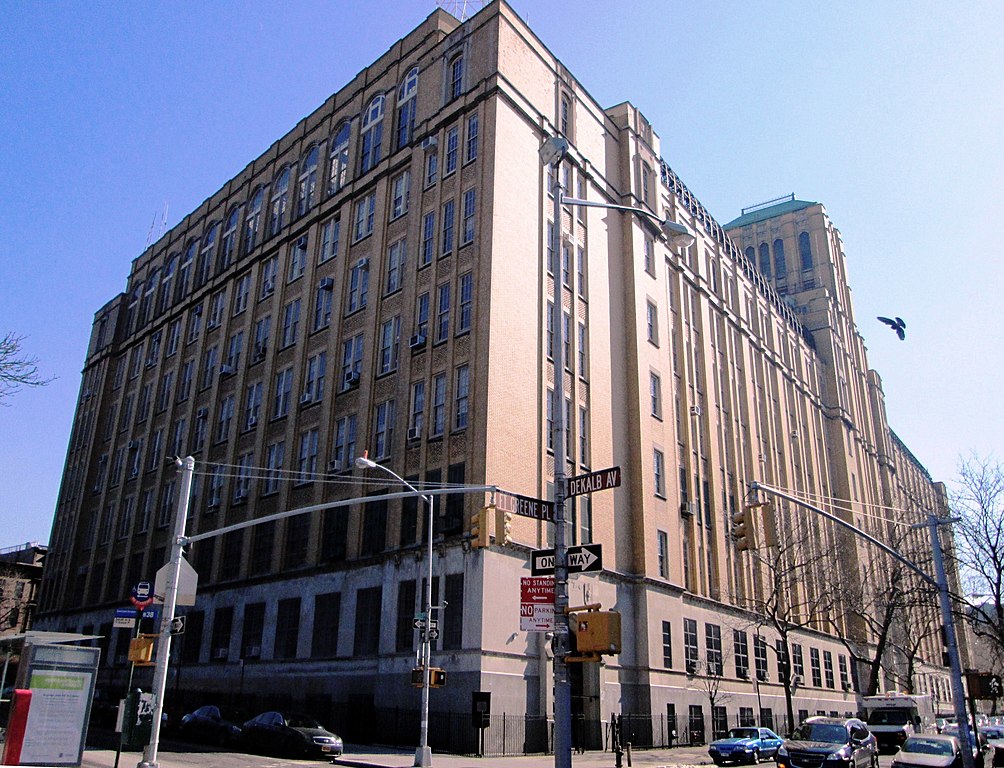
I could bore you with an autobiography here—my high school, Brooklyn Tech (left), for example, was a hotbed of recent immigrant kids from around the world. But it’s enough to say that growing up around here meant we literally had the world at our feet. (Please let me be snarky here—these trustafarians that we saw colonizing Brooklyn pre-pandemic. Can they please go home now? Gentrification is bad enough, but do they have to turn this city into the suburbs they crawled out of?) I knew Polish, Dominican, Greek, Russian, Chinese, and Jamaican kids, among others.

But I won’t. Back to fitting in and if we do or not. When I think of a permanent or long-term move to Italy, I’m grateful for the good training I had for the jump across the pond. One side of my family was made up of recent immigrants who hadn’t yet been assimilated into America. And TSW grew up hearing Greek and eating the Greek-inflected food her mom cooked. We both were used to a tight family structure and traditions that carried over.

The result? We’ve had it easier than the classic expat with no Italian background or citizenship. But even for us, it’s not always smooth sailing to become integrated into a country where you didn’t grow up though. I may be fluent in the language and get most of the social norms, but I didn’t go to Italian schools. I didn’t serve in the Italian military, for which there was a draft when I was of draftable age. So I’m missing the backstory, as journalists like to put it. (The guy on the right—my dad—had the opposite experience. He went to Italian schools and served in the army, and moved to the U.S.)

Whatever. We made our choice, now we have to live with—through?—it. I don’t know if I’m trying to convince myself or not, but being here temporarily in my native city feels strange these days, as though those five months here and there made me miss some development and it’s impossible to catch up. I can’t wrap my head around $30 cocktails, bad espresso in expensive restaurants, and the crazy drivers in unstable trucks.

Plus, the pleasures of living in Italy are undeniable, especially if you’re semi-retired and don’t have to deal with actually going to a workplace. Cheap, delicious food, the aperitivo hour (happy hour on steroids), easy access to kilometers of breathtaking hiking trails, good friends. Okay the bureaucracy sucks, but tell me where it doesn’t.

Cheap drinks may not be enough to convince someone to move to Italy. But they make dealing with the bureaucracy less painful.

I just wish I could take with me my fast Internet connection, Flushing’s Asian food courts, and my daughter’s dachshund, which we raised from puppyhood while Liv was in school. Hope she’s not reading this in case I plan a dognapping…

Our pre-Thanksgiving country life in the big, big city

I could whine, but I won’t. I was driving to a Trader Joe’s one recent morning. It’s on the other side of Staten Island—just another boring day in New York’s outer boroughs, right? As I approached a traffic light, the light turned yellow, then red. A law abiding guy, I came to a stop. But in my rear view mirror, I saw that a Honda Accord was tailgating. Thankfully, the driver didn’t smash into my car, but he or she plainly objected to my stopping, so the car whipped around my car and charged through the light. Luckily, no one was coming through the intersection.

But I avoid most of that by not going out much, or at least not to that side of the island much. Instead, we’ve stuck to our neighborhood. Unlike whole swathes of this island and New York City in general, it’s just beautiful. We’re surrounded by parks and woods and, a little further away, the harbor and a historic fort. So we can take walks that resemble those sun-dappled pharmaceutical commercials.

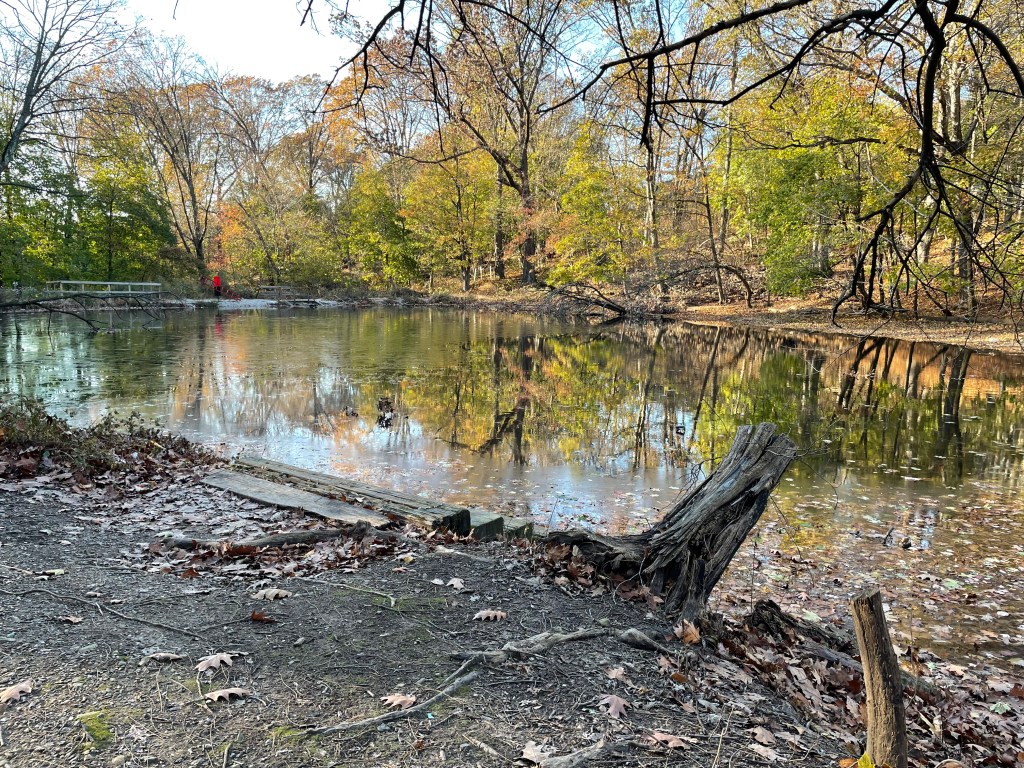
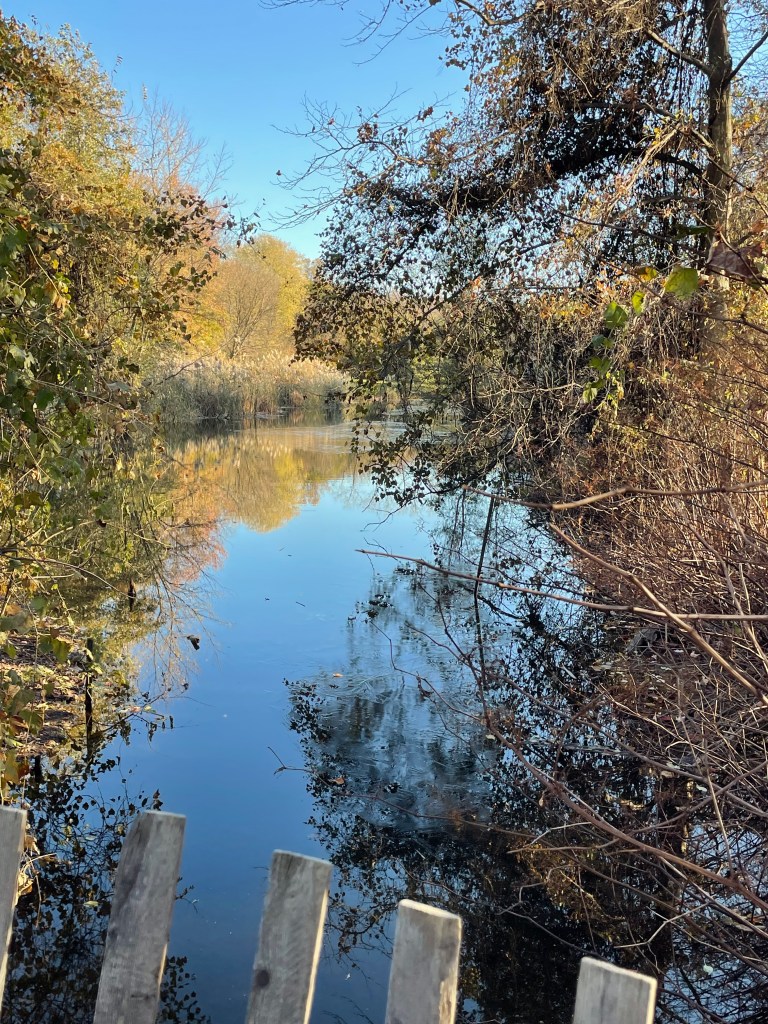
Today we went for a hike. Being a little lazy and wanting to maximize the pup’s off leash (shhh!) time, we drove to Allison Pond down the hill. There’s a pond, no surprise. But behind it are acres of woods. The pond was named after the daughter of George A. Outerbridge, an engineer who owned the property and designed the Outerbridge Crossing that connects Staten Island with Perth Amboy, New Jersey. One of the many Staten Island oddities is the bridge’s name. Looking at a map you might think that the bridge is so named because it’s out there, near the southern tip of Staten Island and, really, New York State. But no. It was named after its designer, Outerbridge, and instead of calling it the Outerbridge Bridge they had to use the word “Crossing,” a word that about 10-15 years ago came into vogue in the names of shopping malls.

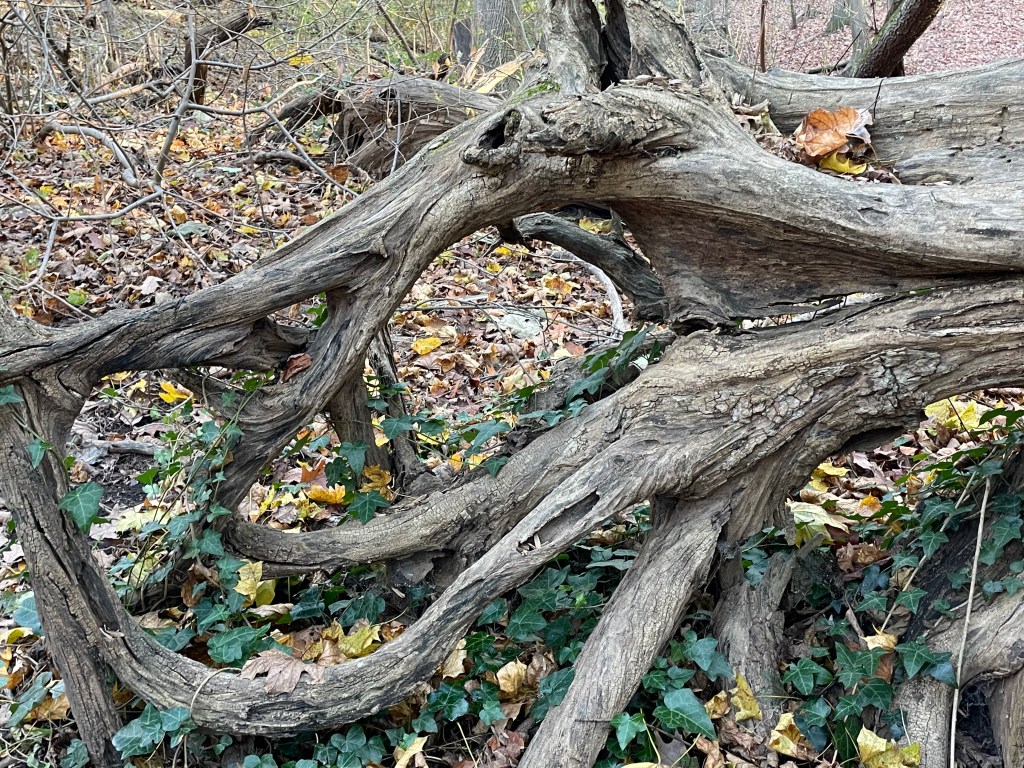
But I digress. Take a look at the gallery below. This is November, and the light on sunny days is beautiful and golden. It’s such a contrast to what I usually think of November, gross windy rainy days and the only outdoor colors seem to be black, brown, and gray.

Here and below, click on photos to enlarge.

YESTERDAY’S AFTERNOON WALK WAS slightly more urban. We took Lola to her usual morning place, the Snug Harbor Cultural Center. I’ve probably posted dozens of photos of the place to Instagram/Facebook and bored everyone I know. But the place is really special. And it’s where our neighborhood here began. Trader Robert Randall traded what became the area around Washington Square for acres of land on Staten Island’s north shore. He established a home for retired seamen on the land fronting the Kill Van Kull, the strait that separates Staten Island from Bayonne, New Jersey. He built a beautiful campus full of Greek Revival buildings, and the establishment was self-sufficient, with its own farm, livestock, chapel and cathedral, dormitories, and sadly, a cemetery. The land uphill of the home became Randall Manor in the 1920s—where we live in New York.

The old guys were shipped to South Carolina some decades ago, and hungry developers wanted the land for condos and the usual horrors visited on this island. But Jackie Kennedy Onassis, among others, campaigned to save the historic buildings and beautiful grounds.

Today, it’s a art center that boasts studios for artists, museum spaces, and a gorgeous botanical garden that includes one of the few Chinese scholar’s gardens in North America.The administration does what it can with a severely limited budget. A few years ago a visiting cousin from Switzerland was shocked at what she saw as neglect of a beautiful place. It’s better now, if not up to Swiss standards, and Greg, the botanical garden’s chief, does an incredible job of rotating plants through the year.

So most mornings we walk Lola through the grounds. We have dog friends, and so does Lola. The Harbor in general has a low-key hippie vibe that fits in perfectly with that part of the island, which boasts a historic district and scores of gracious 18th and 19th century homes. It’s been cold the past few mornings, so we’ve waited until the sun warms things up a bit. The reward has been this golden light that makes me look like a better photographer than I am.

Bean there, done that

My mother was endlessly inventive in the kitchen. Married to a guy from Palermo, Sicily, she had to come up with a “primo” for dinner most nights. We didn’t have the traditional meat and two sides on one plate. My dad insisted on our following the typical Italian meal progression: a “primo,” either pasta asciutta (with sauce), soup, or rarely, rice. The meat or fish or frittata (omelette, Italian-style) followed. At the end of dinner, my father peeled and cut up pieces of fruit, which he doled out to us on the tip of his paring knife.

Those primi stick in my mind the most. I always preferred pasta to the second course. Twice a week we had spaghetti or some other pasta with tomato sauce—what most people back then thought was the only way to eat “macaroni.” But in between were pastas with broccoli or cauliflower, either in dry form or as a soup, escarole soup, spaghetti with clams…the list goes on. Having this first course made us less ravenous when the secondo came around, and I’m sure that it helped stretch the food budget, too. And at least once every couple of weeks, pasta e fagioli, which on the U.S. is often rendered in some obsolete dialect as “pasta fazool.”

Pasta e fagioli is the star of this post. It’s cheap, nutritious and can be fun to cook, and is delicious too. The variations can make your head explode. I’m going to tell you how to make my favorite version, which is an adaptation of what I first had one long afternoon, way too long ago.

Some culinary history: Mom usually used kidney beans, specifically canned kidney beans, for pasta e fagioli, because back in the dark ages of American grocery stores, kidney beans were everywhere, mostly to the exclusion of every other bean. Sure there might be navy beans, which are almost tasteless and resemble the canellini bean’s little brother. And you could buy lentils and split peas. But back then, there wasn’t much choice. Angie/Mom made it palatable by injecting a fair amount of garlic and some tomato broth to the mix. If she had some lying around, she’d chop parsley.

You can all them cranberry beans or borlotti. Either way they’re creamy and sfiziosi.

Years later, Perugian friends took us to an agriturismo (working farm with restaurant and/or rooms) over the border in foreign Toscana—Tuscany in English. The folks at the Castello di Sorci supplied a multicourse meal with two primi, one of which was an amazing puréed bean soup with homemade tagliolini, or thin homemade egg noodles. This was new to me; I’d never thought to purée the beans for the soup. Back home in New York, I made my own versions, one of which stuck. I love fennel and will sneak it in wherever I can. I did it with the bean soup and found that the addition of the fennel mellowed the soup out. At the same time, you wouldn’t know it was there if you didn’t look for it—just like chefs now use anchovies to increase the umami in a dish.

The supporting star

We’re starting to make soups like this as the weather turns cooler. So far this November it hasn’t cooled that much, but with the long nights this soup feels right somehow. You can put it together in 40 minutes or so using canned beans, or plan ahead, soak some good beans overnight and cook them before making soup out of them.

HERE’S THE NON-RECIPE RECIPE. I don’t measure anything, and this soup has endless variations in quantity and what you put into it. The orthodox version is pretty straightforward, though I have no idea whether anyone in Umbria ever purees fennel along with the beans.

You’ll need a package of canellini or borlotti beans. If you can’t find them, navy or kidney beans of whatever color will work. If you’re using dry beans, you’ll need to soak them overnight and cook them ahead of time. Otherwise, a couple of cans of white or borlotti (cranberry) beans will work.

A bulb of fennel—if you can’t find or don’t like fennel, you can use celery

One onion

2-4 cloves of garlic

One carrot

Tomato paste or a couple of peeled canned whole tomatoes (mainly for color adjustment; otherwise the soup can be way too beige)

Wine to deglaze. Or white vermouth.

Short soup pasta, or broken up spaghetti, or sheets of egg pasta cut into strips or irregular shapes. Quantity is up to you. About a cup works but it really depends on how soupy or solid you want the final version to be.

How to start:

Dice a small head of fennel, saute in good olive oil. Add a diced onion (red, yellow, or white, it doesn’t really matter). Dice a carrot. All of this doesn’t have to be perfect; you’re going to purée this toward the end. Add 2-4 smashed garlic cloves, and, optional, a pinch of hot pepper flakes or a little hot pepper—what we call “peperoncino” in Italian. Get the vegetables past soft and translucent; you’ll want a bit of golden color because it will taste better.

Add a splash of white wine or dry vermouth and get all the toasty bits off the pot. Add a squeeze of tomato paste or a peeled tomato or two. Add two liters/quarts of low salt vegetable stock or water. Add the cooked/canned beans. Bring to a boil and then let it settle into a simmer. At this point you’ll want the flavors to come together, so let it simmer for about 30 minutes.

Take the soup off the heat. Using an immersion blender, purée until smooth. You can keep some beans out and leave them whole if you want. It’s your soup. If you don’t have an immersion blender, a normal standalone blender or even a food processor will work.

Turn the heat back on. Add pasta. There are two schools of thought here. I’ll usually cook the pasta in the soup, but a lot of people will cook it separately and then bring the pasta and soup together just before serving. Cook the pasta until just before being al dente–it will continue cooking as you serve it.

The finished product

Serve the soup in bowls, drizzle good olive oil on top.

Variations

Possible additions: Greens. You can even just tear some rucola (arugula) up and it will wilt in the bowl and give the soup a peppery note. Finely chopped Tuscan (black) kale, escarole, or chicory are good additions.A pinch of red pepper flakes or chili oil will satisfy those who like things spicy.

You can also choose not to purée the soup. In that case, make sure you dice the supporting cast of vegetables finely and uniformly; it’s all got to fit on a spoon. Or you can ease up on the water or broth and make the dish semi-solid.

Photo at top of page: Jeremy Keith from Brighton & Hove, United Kingdom

No, Big Tech isn’t going to save the world. But it’s made our little world a little easier

If you’ve ever worked with me, you’ll know that I have distinct geek tendencies. Back in the late 1990s I took a break from being a full-time editor to play with machines. The project involved bringing a few newsrooms up to modern standards. One newsroom went from an archaic and incredibly strange Windows PC and Mac setup with no way to track files, to what was then the standard for publishing, the Quark Publishing system. But it was pretty no-frills at the time, with the first project not having direct Internet access until a year or two after the system was in use.

I think about technology a lot, although at this point I don’t earn a living by sharing those thoughts. But with our weird one foot in each place life, I have to say that tech has smoothed the way, making it easier to stay in touch with family and friends, and—sometimes I’m not completely convinced this is a good thing—it’s made it easier to live similar lives on both sides of the pond when it comes to music and video. I guess that I’m writing this because I get tired of the constant drone of negativism about where we are in 2022 when it comes to humans and machines. Yeah social media can be a menace. But the emphasis is on “can.” It doesn’t have to be and the fact that it’s easy to misuse makes it more important for us to be vigilant.

I’ll come clean right away: We’re in the Apple ecosystem; we trade a little more expense for fewer complications. The Spartan Woman started it years ago when she brought a Mac home from school one summer. Her school’s principal figured that the computers would be safer living with teachers than stored in the school over the long holiday. Back then I was taken immediately by how easy the Mac made it to do stuff like move files around, rename them, duplicate them, etc. I was a convert, and the following year, we bought our first Mac. I actually used it to gather wire copy and send it into the publishing system at work.

SO WHERE DOES TODAY, AND THIS BLOG come in? Well, when you think about it, we’ve got the digital equivalent of an RV—we carry our media home around, as long as we’ve got an internet connection. Only it weighs a little less and uses a lot less energy.

Our approach: We only buy laptops as computers, and we have iPhones; they like to work with each other. iPads are optional. We have little HomePod mini speakers, so we can have our music in both places without carrying around CDs (remember them?). All of our devices work with both U.S. and European voltages. I bought some Apple plugs that fit right into the AC adapters, so there’s no bulky and problematic adapters. We’ve laid in a supply of European rechargers, too, so that we don’t have to cart everything around. The only time things get complicated is when we aren’t going from one home to another directly. In that case, we need a couple of rechargers with Euro or American plugs to work in hotels and rented apartments.

Casa, dolce casa, discreetly high tech

In Italy, we don’t watch broadcast TV; we have a smart TV with an Apple TV. I know that’s redundant, but the Apple TV interface is much easier to use, and it gives us access to more services. The setup gives us Italian public TV stations via the app RAI Play, plus all the streaming services that we use, like Netflix and Mhz Choice. By the way, the latter is terrific, featuring European programming with subtitles, just in case you’re challenged by, say, Icelandic.

I guess that I wouldn’t be writing this post if we just vacationed for a week or two. Back then, we somehow managed to live without our music collection for a couple of weeks. But we’re older and spend a lot of time at home, especially in the winter, when Umbria is usually dark, cold, and wet. And thinking back further, The Spartan Woman and I wrote each other nearly every day that we were apart. Yeah, it was sweet.

Now, though, I can do remote work when it happens. Our hilltop Italian ‘net connection isn’t the fastest, but it gets the job done. And when it wigs out, we use our phones as hot spots. So what if a video chat is grainy or freezes every so often? It’s better than paying through the nose for a 3-minute phone call, like in the old days.

Some practical tips:

• You’ll need a lot of rechargers, recharging cables, adapters, dongles, etc. Put them all in a big Ziploc bag and carry that bag in hand luggage. Make sure your devices are fully charged; USB ports on planes aren’t the most powerful. Buy a portable battery pack or two just in case. (My bag of tricks on the right.)

• Put your laptop in a padded case. Because of airport security, make sure it isn’t a pain to haul it out and open the case. The faster you can get stuff in and out, the faster you’ll get through security. European airports seem to have more sophisticated scanners and the more polite security folks don’t make you take everything out of a knapsack or computer bag.

• If you have a choice, buy what you can in the U.S. Italian value-added tax (sales tax in Amurrican) is 22 percent, versus 8.something in New York. The weakening Euro means higher prices in Europe in general. There are negligible differences between U.S. and Euro models, but you might be disoriented by the laptop keyboards on European models. They typically have a bigger “return” key, and have keys for letters with accents, such as è and á.

• Don’t expect to find wifi everywhere. In fact, if you’re a frequent traveler, you might notice fewer hotspots than before. Why? European mobile plans cost a lot less than plans in the U.S., and typically have tons of high-speed data included. So Europeans these days have less of a need to hook up to a wifi network when what the speeds they get on cellular networks is perfectly adequate.