Eat like a peasant—and enjoy it

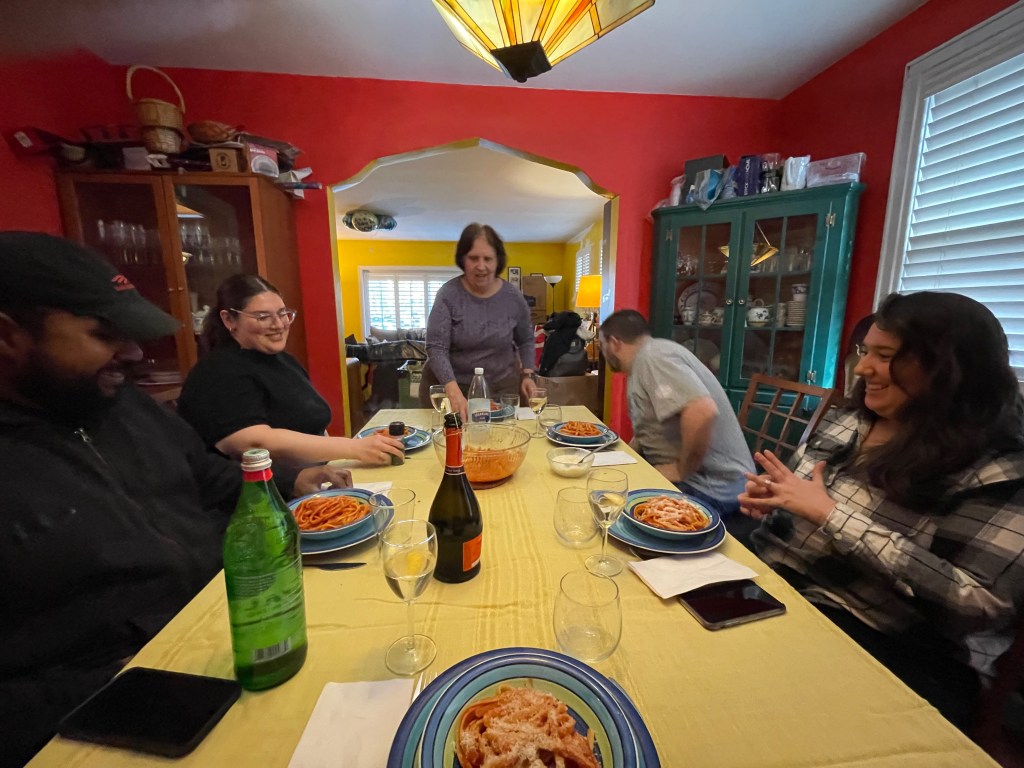
Staten Island, where we spent three weeks and some, has this image of being a sort of Sopranoland, its residents a larger version of the cast of Jersey Shore. That’s only partly true, and applies only to some neighborhoods. Our daughter lives on the North Shore, which is a multiethnic paradise. And after a few months of mostly “Italian food”—I dislike the term because there really is no unified cuisine here—we were craving the offerings of our former Japanese, Chinese, Mexican, Vietnamese, Sri Lankan, and Turkish haunts.

Maybe we overindulged. But our kid has a baby, and trying to be good guests, we thought we’d make it easier by ordering out. It was a nice change from Umbria, even if this area is increasingly cosmopolitan, with sushi and Chinese food fairly commonplace. But one thing we didn’t miss: American (or is it New York) price tags. For one Saturday lunch, we order four banh mi, three bubble teas, and a Vietnamese coffee. Total bill, $115. That would have bought a fancy meal here.

SO BACK IN OUR HILLTOP RETREAT, we prepare a lot of wintertime comfort food. That pretty much means soups and pasta. We don’t eat meat, but with such a huge variety of vegetables, legumes and grain products, that doesn’t cramp our style.

Note: The dishes described here are vegetarian, not vegan. If meat is a must, you can serve these dishes as first courses, or read another post and come back next week. I don’t give recipes per se, so you won’t see exact quantities or cooking times. Anyone who cooks regularly can probably come up with something good. I don’t usually follow recipes; I use techniques my mother taught me as a teenager when she broke her arm, and I had to step in to cook family dinners.

After years of propaganda about the superiority of “Northern Italian” food, the South here is rising again, at least when it comes to culture. Maybe it’s down to TV shows here like Mare Fuori (The Sea Beyond) which portrays the lives of a bunch of photogenic kids in juvenile detention in Naples. One of our favorite Neapolitan dishes is pasta e patate. Yes, you can mix starches.

You can look up recipes here and here. While there are various versions, you basically make a soffrito—onions, celery, carrots—and sauté it. Add diced potatoes. When they’re halfway soft, add water or vegetable broth and a squirt of tomato paste (a couple of canned tomatoes or some purée will work too). Let that cook awhile, and then, making sure there’s enough liquid to boil pasta, toss in a couple of good handfuls of mismatched pasta, all those odds and ends that you’ve accumulated when you haven’t cooked the whole package. Improvise if not. Then, at the end, add cubes of provola cheese. This last bit may be hard to come by in the U.S., so I’d suggest diced hard (not fresh) mozzarella.

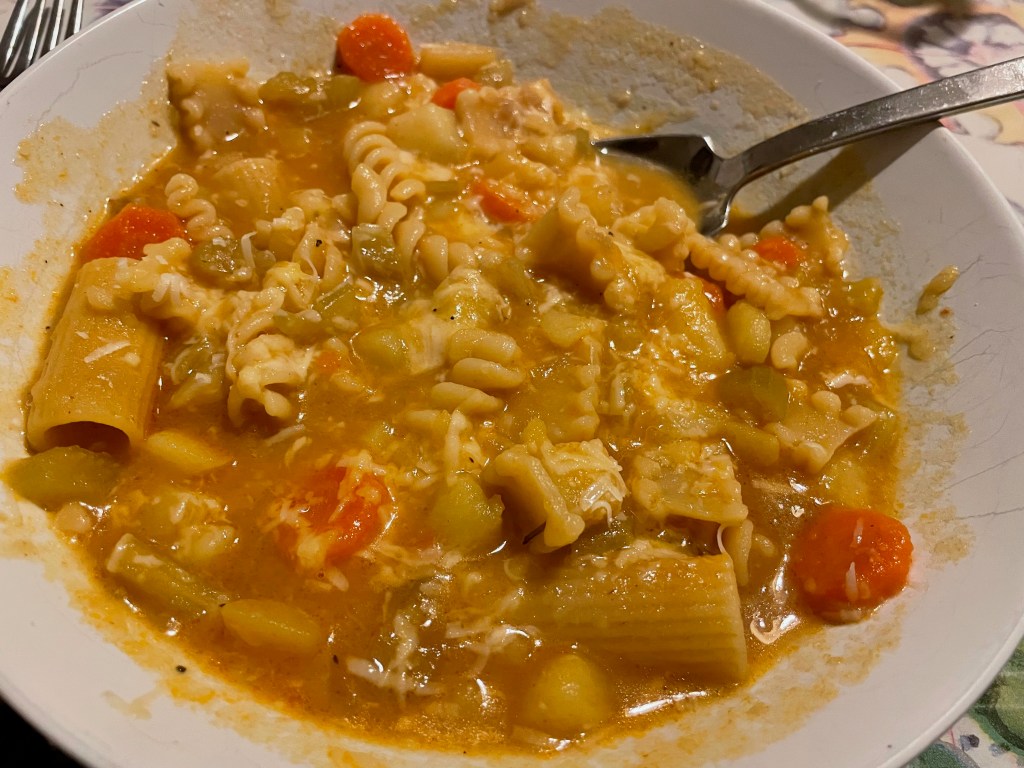
Beans and greens might be an easier combo to get behind. We make lots of variants of this basic comfort dish. It’s easy. Take good beans, whether they’re borlotti (cranberry), cannelini, or ceci/chickpeas. Cooking them from scratch is best, but canned beans are fine, too. Sauté a clove of garlic and a little hot pepper flakes in olive oil. Add the beans, stir. Add cleaned and chopped greens, like escarole, kale, chard, or even spinach. Make what’s in the pot as dry or soupy as you wish. If there’s a fair amount of water or broth, cook some soup pasta (orzo, ditalini, small elbows, etc.) directly in that pot or cook the pasta separately and add for a drier dish.

It’s best to keep to the basics with this, but you can optionally add a Parmigiano rind to the cooking liquid, or mix the beans or add another grain like farro. Add grated cheese if you want, but the soup/pasta dish should be able to stand on its own.

A post like this wouldn’t be complete without lentils. They’re an Umbrian staple. For example, it’s traditional to cook lentils for New Year’s, the pot of lentils symbolizing the riches that you hope the new year brings. Umbrian lentils are really small and don’t break down into brown mush. When in New York, I found that Trader Joe’s vacuum-packed French lentils are a pretty good substitute.

This dish won’t break the bank and is really easy to prepare. Do that soffrito thing again. It’s onion, celery, carrots. Add about half a pound of raw and rinsed lentils after the vegetables are soft. Stir around then add about 500 ml/a pint of water. Add a squeeze from a tube of tomato paste, or a dollop from a can of paste. Let the lentils cook until they almost done. At this point check how much liquid is in the pot. You’ll be adding a cup of ditalini or similar pasta so, if necessary add some water, keeping things on the boil. Add the pasta and cook until al dente. Serve with grated Parmigiano, Grana Padana, or even Pecorino cheese. And this is the result:

A stranger at home for the holidays

I’m still finding it a little astonishing that I took my first vacation in my native New York. We’ve been buying round trip flights from here for awhile, ever since the airline Alitalia folded its wings. But then we stayed back in NY for a few months. This time it was for a scant few weeks and we definitely were visitors this time, staying at a relative’s home and borrowing a car we’d given up. 

One of the things that happens during the holiday season (and pre-trip) is that you have to eliminate items from your to-do list. We started out with an ambitious to-do-before departure list and had to cull as we went along. I’ll get into that later, but the process led to our spending more time getting stuff done in New York. Unpleasant but necessary tasks, that is. 

With all that in mind, I’ve been trying to figure out how to organize this so it’s not just a rant about reverse cultural shock. There’s too much of that floating around online. (Hey, I’ve had feet planted in two places for so long I’m immune.) The Spartan Woman suggested the following approach:

THE GOOD

REMEMBER WHEN PASSPORT agents were surly and acted as though you were a criminal for daring to leave the country? That’s changed, at least in our experience. Maybe it’s down to our being old? I don’t know, but suddenly ICE is hiring friendly people. Or, just maybe, we’re of a certain age now and don’t look like the kind of people US immigration wants to keep out.

In any event, it was a good way to ease into the U.S. Better still was seeing our grownup kids again. Daughter no. 1 gave us a new addition to the family, a bouncing (literally) baby boy. No pictures, sorry. We’re keeping the child out of social media, at least for now. I may be a proud nonno (grandpa), but The Boy is objectively really good looking, and appears to have inherited some of his mom’s impishness. You’ll have to take my biased word for it. And though we moved, it was good to see some neighbors, and comical to see others, like the wild turkeys that have taken over the island.

One thing we miss when we’re in our Umbrian mountain retreat is multiethnic food delivery. Even on Staten Island, which is often depicted as a bigoted white people hellscape. The truth is more subtle than that, and the island’s North Shore is a paradise of ethnic restaurants. In our short time there, we ordered from Chinese, Vietnamese, Turkish, Thai, and Mexican places. We didn’t have time to have the Sri Lankan food we love.

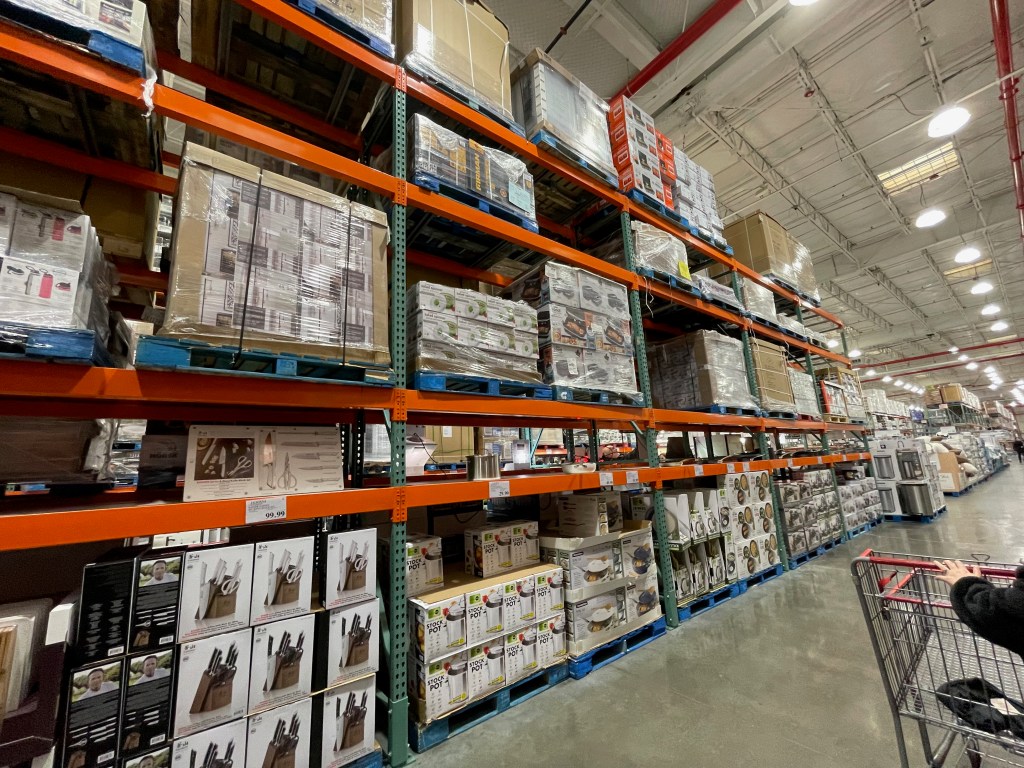
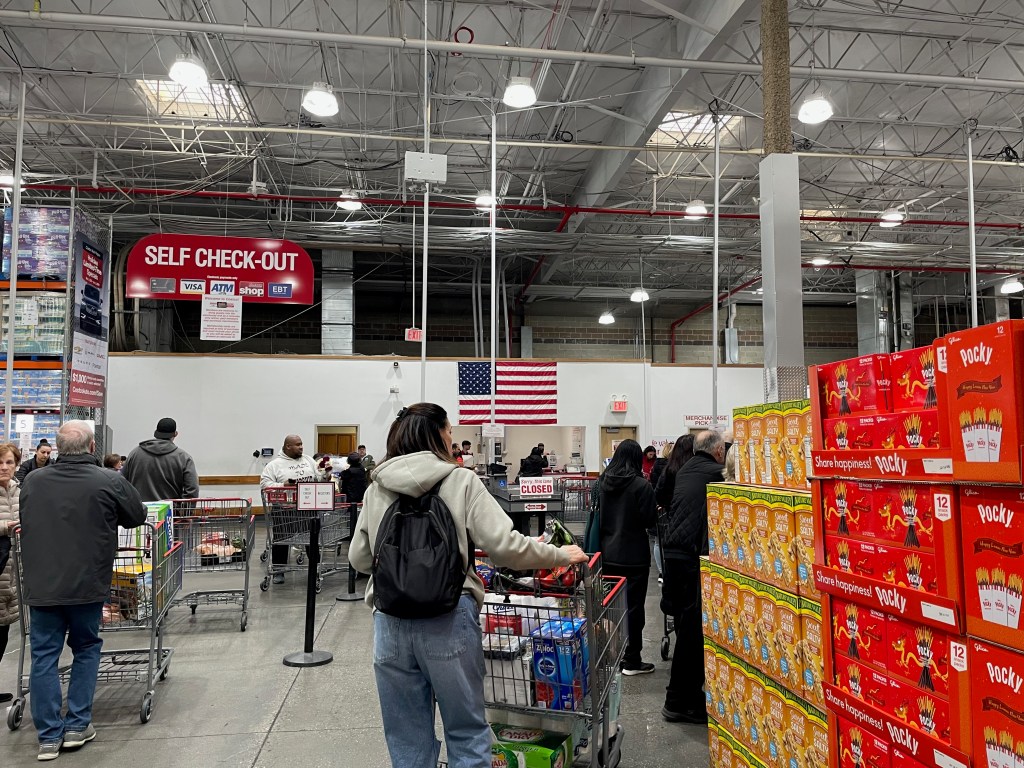
While we’re on the subject of crazy choice, Costco? I know, I know, where have I been? I finally was initiated into the cult by Daughter No. 1, just for one visit. I was overwhelmed. Not that we bought that much—we had specific goals. It wasn’t so much the crazy amount of merch for sale, even though I saw everything from espresso machines to solar panels to yoga pants to flats of every household item imaginable. But wow, in the space of less than hour I heard at least half a dozen non-English languages. That the company is fairly humane in its personnel practices compared to other giants of commerce added to my not hating it. Buon lavoro, Costco. 

I did notice one other thing immediately. As soon as we cleared customs and were in a taxi headed to our kid’s home, I pulled out my phone and wow, this 5G thing. I’d forgotten how fast it is, at least the T-Mobile version of it, and later tested it to be, in some places, a 600 mb/s download. That’s fast. And our kid has, like we did, 1 gigabyte/second fiber. Fast fiber internet has made it to Italy in general, and our town of Valfabbrica specifically. But not in the rural areas. We use a local provider here, which gives us download speeds of around 30 mb/s, which isn’t bad considering it’s wireless. But a guy can get spoiled. Still, I wouldn’t trade my life for fast downloads. Yet.

THE BAD

OH BOY, THIS. Before we left for New York, we’d wanted to get a Covid booster shot, since the latest one covers the latest known variants. Here in Umbria, you go onto the public health website and look for a location and convenient time and hit the send button and show up for the shot. But we ran out of time and figured we’d get the shot at our former local pharmacy in New York.Unfortunately, Nick up the street wasn’t handling the vaccine. So we had to look at the local megaeverythingwithpharmacy places like CVS and Walgreen.

The closest CVS told us they were out of the stuff and maybe were getting some in the future. But Walgreen’s website said make that appointment. I went through the online scheduler and completed the online medical history/consent forms for the two of us.

The day arrives, we drive a couple of miles. There’s a woman ahead of us in the vaccine line. She’s filling out the history form. “We did ours online,” I said. “I did too but they want me to fill it out here again.” The staff behind the counter is obviously overwhelmed, answering phone calls, taking in prescriptions and giving out meds to other customers. We wait and wait and wait. The nice woman in front of us was finally frustrated and disappears. They call her name, finally, to get her shot, and no one answers.

Finally, the harried clerk asks us to fill out the damn history/consent form. “I did it online,” I respond. “We’re asking people to do it here,” she says without giving me a reason. I refuse. “Sorry, I did it online and I’m not going to fill it out again. Look in your system.” There’s a standoff. Finally the overworked pharmacist tells her to dig it out of the computer. More waiting–at this point we’d been there an hour past our appointment time. We weren’t giving up. At last, the pharmacist come out and administers the shot: 75 minutes after our appointment time. We note that they have lots of people restocking the shelves with stuff like Doritos and deodorant, while the pharmacy workers look like hunted animals. American free enterprise at work.

As for this little pharmacy item (left), really?

 Finally we drive back. The main drag through that part of the island is a two lane road that was built in the 1920s and ’30s, with small shops and converted houses hosting insurance agencies and the like lining the street. But something’s out of whack. Big hulking SUVs and pickup trucks like Ford F150s dominate. It’s like the hippo dance in the Disney movie Fantasia. If the giants aren’t being driven like drunken Romans are behind the wheel, they’re creeping along because I’m sure their drivers can’t see out of them. Why do Americans need a tank to go to the drug store?

Another time I stop at a traffic light to make a left turn. One of the misplace macho drivers doesn’t think I’m moving fast enough (I am not a slow driver) and charges over on the right and without caring makes the left, causing oncoming drivers to hit their brakes. This happens over and over. All of a sudden driving in Italy seems sane.

THE MEH

LET’S TALK ABOUT prices, okay people? The U.S., once you’re been away, just seems like a giant machine designed to drain its people of their money. For instance, we buy Royal Canin dog food for our little prince Niko. It’s produced in plants around the world, but it’s a French subsidiary of the giant Mars Inc. In the U.S., a little over one kilo costs $21. The same food, but almost double the quantity, costs €21 in Italy, or about $23. The common excuse, er, rationalization is that wages are higher in the U.S. and so are fixed costs. But double? If you know, tell me why.

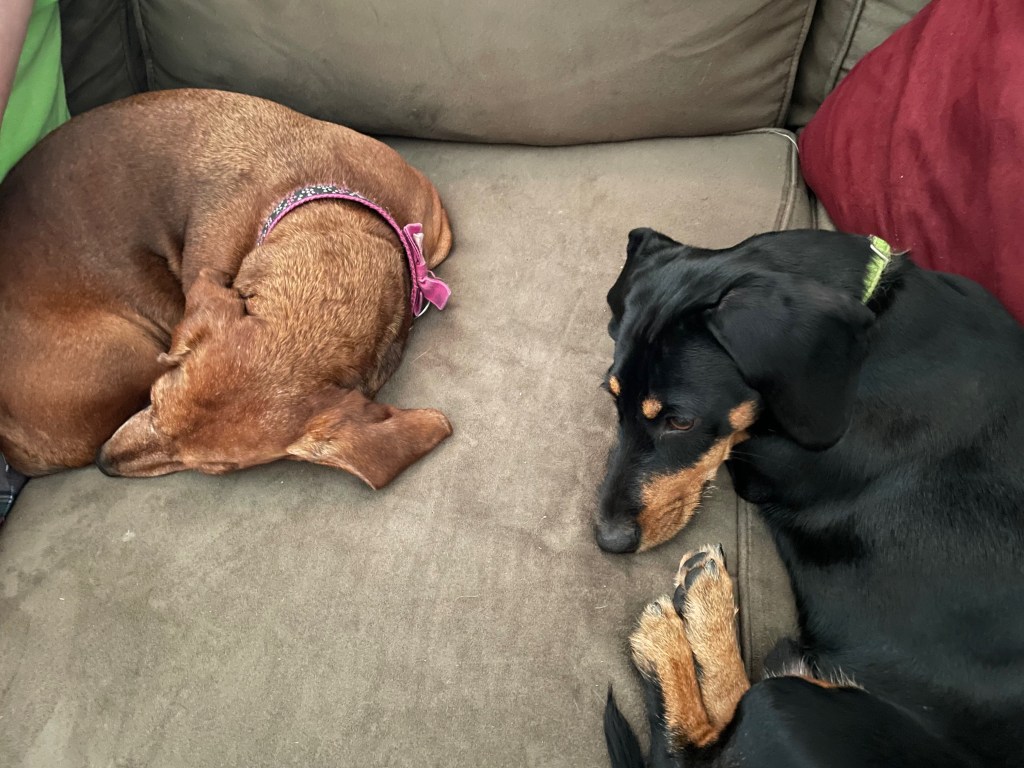
Gratuitous puppy picture: It costs twice as much to keep Lola from the U.S. (left) in Royal Canin than it does our little Niko from the suburbs of Rome.
While I’m on the subject of allocating funds….I get it. New York is constantly being rebuilt. But sorry, what’s there can be so crappy. I traipsed about the Financial District for the best part of a day to take care of a bureaucratic matter. An Italian matter. (Don’t ask.) I used to work in the neighborhood and didn’t really notice before, but the streets are in crappy condition. Sidewalks are broken up, there are shoddy barricades everywhere and in general the place doesn’t look like one of the financial and media capitals of the world. I guess I’d taken the crappiness for granted before.

/rantover. Back to Italy after this.

Liv breezed in for a bit, and everything moved faster

So it’s great when a kid or two comes by for a visit. This time it was Liv a/k/a Olivia, our younger daughter, and her partner Al. We got their room ready and stocked some of the foods we knew they’d like or need. So, big bunch of small hot peppers? Check. Oat milk, ditto. Restock coffee supply? Done. We took mercy on them and picked them up at Rome’s Fiumicino Airport instead of making them take the train. It’s a haul from “Alta Umbria,” but for a Monday morning just after rush hour, we just breezed in.

A lot of any visitor’s stay naturally involves food. I don’t really have to say it, but it’s pretty incredible ’round these parts. A visit to a regular supermarket is like going to an Eataly in the U.S., except that everything is half price, if that much. Back in ‘Merica, our offspring have developed some food intollerances, or so they thought. In Liv’s case, U.S. market pasta and wheat products give her a stomach ache, so she thought she’s got that fashionable gluten problem. But no. She can eat pasta and bread and pizza here, no problem. And she’s not alone—an anecdotal survey of people who live here but go to the U.S. regularly brought out a lot of the same reactions. Anyone have an idea why?

Liv and Al took two weeks of their valuable time off, so instead of sitting at home admiring the view we had to put on our tour guide hats and see stuff around this splendid little region. Not that it’s their first time around this block. Al said to me “Being here is, like, what I do now. It’s my alternate reality life.” First they had to return to Perugia, Liv’s first love and where Al has developed certain rituals. I dropped them off so they could wander around without us old people slowing them down. Despite the nasty weather, they dropped into their favorite places, Al at the porchetta stand on Piazza Matteotti, and the two of them for artisanal gelato (with flavors like gorgonzola and honey) at Lick (closed for vacation until 7 December).

ONCE THEY GOT PERUGIA OUT OF THEIR SYSTEMS, we tried to get away from the too familiar. Last year we spent a rain-drenched day in Foligno. Until then that small city was just a railroad station where we had to change for the Perugia branch line. But we discovered it’s a lively place and unlike most towns in Umbria, flat and really walkable. The window shopping is terrific, and there are tons of cafés and restaurants, many of the latter looking as though they dropped in from Williamsburg.

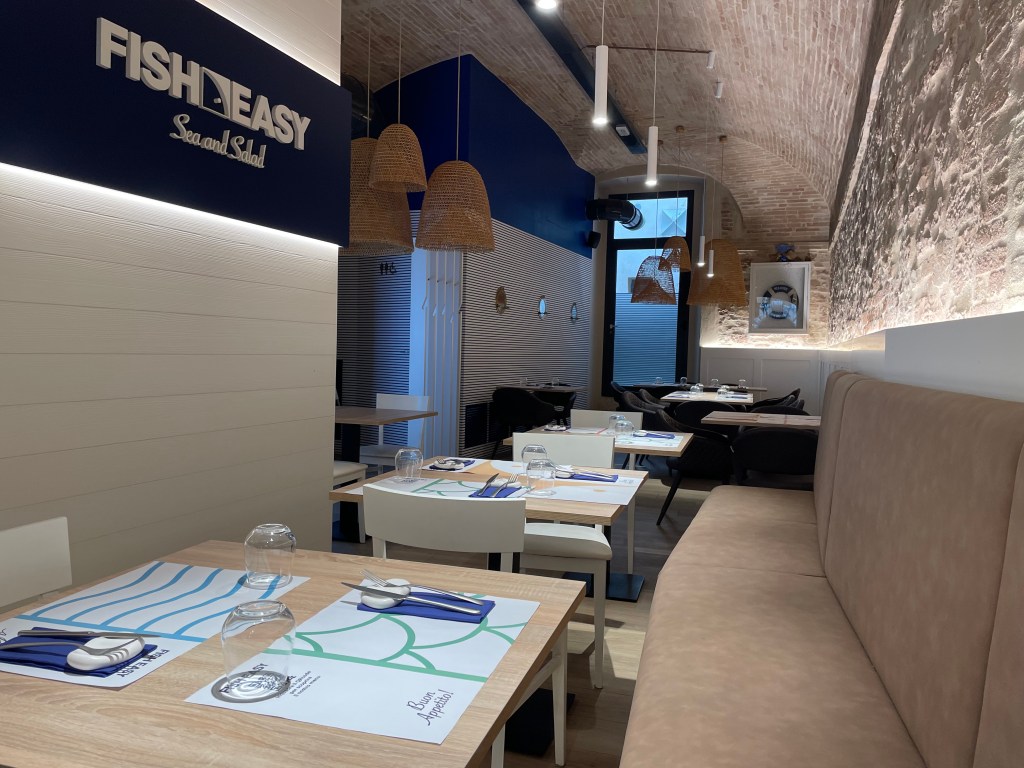
Knowing that we were going to be in Foligno long enough to have lunch, I started to surf the Web for suggestions, and ran into the service The Fork. It’s like Open Table and Resy in the U.S., but it points to places off the main tourist squares and, if you reserve a table through the site, you often get a discount. I looked through the service and got us a table at Fish Easy (that’s really its name). You can leave a note for the restaurant when you reserve, and I asked if it was okay to bring our dog. Most restaurants here are dog-friendly, but it never hurts to ask. I got a quick reply—sure, we’ll be happy to have him around. (Below, lunch at Fish Easy, with Niko hoping something falls off the table.)

The proprietor made good on his promise. Niko was our calling card, and as soon as he saw Niko leading the way, he knew it was our party of four. The place, like a lot of Foligno eateries, didn’t trade on the Olde Worlde thing, the decor and the menu was sleek and up to date.

Another day, we took advantage of the fine weather and drove across the region to the city of Orvieto, famed for its delicious white wine and its incredible Italian Gothic cathedral. I used The Fork again to find a place to eat, and it led us to Caffè Ristorante Capitano del Popolo, on, logically enough, the piazza of that name. After a funicular ride up from the train station (with plenty of free parking), we admired the Duomo, including the stunning frescoes by Luca Signorelli, before walking a few minutes away from the tourist crowds to the piazza. The market there was shutting down as we walked between stalls to the restaurant. I’d warned them, too, that we had a dog and they not only let Niko in, but gave him a plush chair, pillow, and water bowl. (Below, the Signorelli panels and a modern capolavoro.)

Like more and more restaurants here, the menu was creative but rooted in Umbrian tradition. So some familiar dishes has interesting twists, like the addition of ginger. I usually don’t eat meat, but I was pasta-ed out and went with a vegetable-forward version of chicken alla cacciatore, while my stronger-willed wife and kid had trucioli (a short pasta) with artichoke cream and mint.

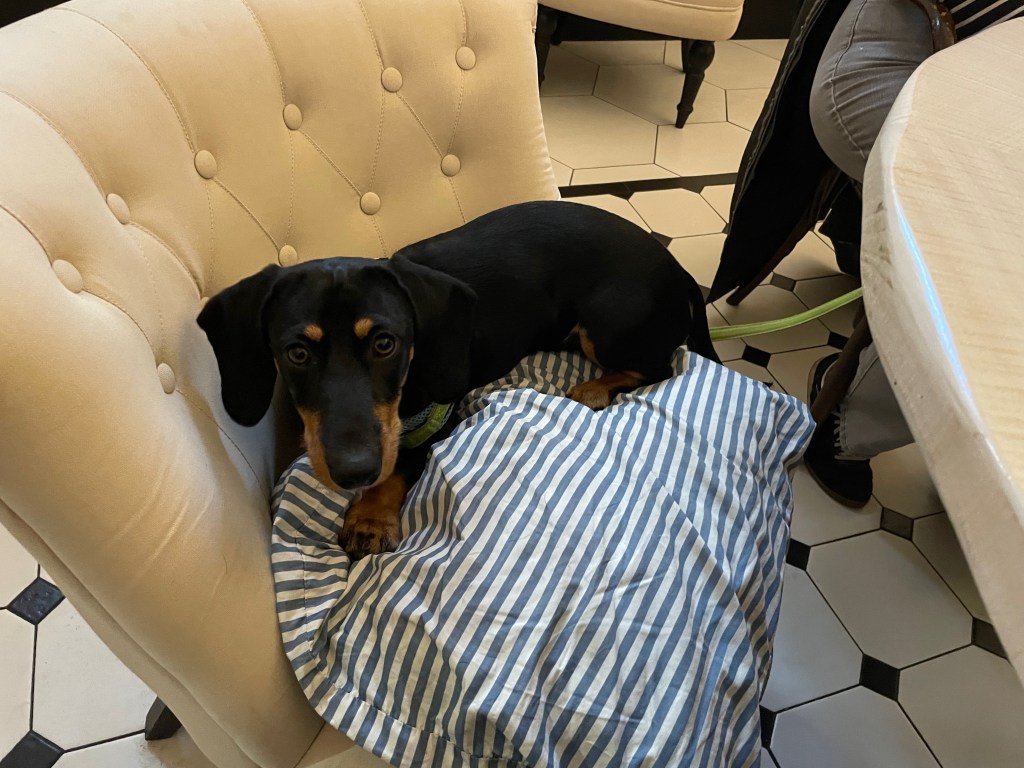
Niko got his own place at the table.

THE SPARTAN WOMAN AND I have this compulsion to show off “the real Umbria” to our guests. That usually means one of the sagras around the region. They’re usually held in the summer, when warm weather means long sultry nights, local food specialties, and kitschy line dancing to live music. Liv and Al were too late for those. But they weren’t too late for Montone’s fall festival. Plus, going there gave us an excuse to check out a different part of our area—after a few months of living here, it’s easy to get stuck in a rut of shopping, home maintenance and occasional hanging out with friends.

So, Montone. It’s said to be one of the most beautiful towns in Italy by the kinds of groups that keep track of that stuff. I can vouch that it’s awfully pretty, though I gotta say that it’s got lots of competition. The festival was fun because it got us out of the house and, with its emphasis on local foods and the chattiness of the vendors, we got an education in local foods. Really, really local foods. The hyperlocal food culture means that local towns have wineries, honey producers, and other local producers just beyond the town walls. For us that day, the nasty November weather broke and we strolled around and talked to people about cheese, pasta, and medicinal herbs and tinctures (the maker of the latter grabbed us for a good long chat).

So much for all that. The Spartan Woman, Niko the pup, and I have returned to everyday life, evading the wild boar hunters, looking at the view, and trying to decide every day what to have for lunch. And one of these days we’ll hang more pictures on the walls and make this place look more lived in—in a good way.

Oh, nothing really.

But that wasn’t the exciting part. We were chatting away when suddenly I hear the twang of an American accent outside in the piazza. You don’t hear it that much around here. I looked out, without my glasses and saw out of focus figures wearing what looked like identical T-shirts and helmets. Francesco was intrigued, too.

—How do you know they’re American?

—The accent.

—There are different accents [I’m guessing he meant in English] ?

—Lots. [translated from the Italian]

He sent me out to interview some of them. The group was on a bike tour from an outfit called Backroads, and came from all over the U.S. One guy was practically my homeboy, coming from New Jersey, right across the Outerbridge. They were all on their way to Gubbio, about 30 km/18 miles away. Up and down big hills away, that is. “Wow, you guys must all be in pretty good shape,” I asked New Jersey. He responded, a little sheepishly, that some tour members had e-bikes to help.

The pause in piazza that refreshes

Okay, so this is not bigly exciting. But it’s all part of the everyday pleasures of life here, and it took me awhile to think like that. When we first arrived in May, I was restless. I felt that I was in this candy store and limited to Skittles. Or something like that. In other words, I was still in this-is-a-long-vacation mode and wanted to wander and even sightsee, and I wasn’t dealing realistically with the fact that we moved here. Like, to live.

And what do you do when you live somewhere? I’ll answer that: You do everyday stuff.

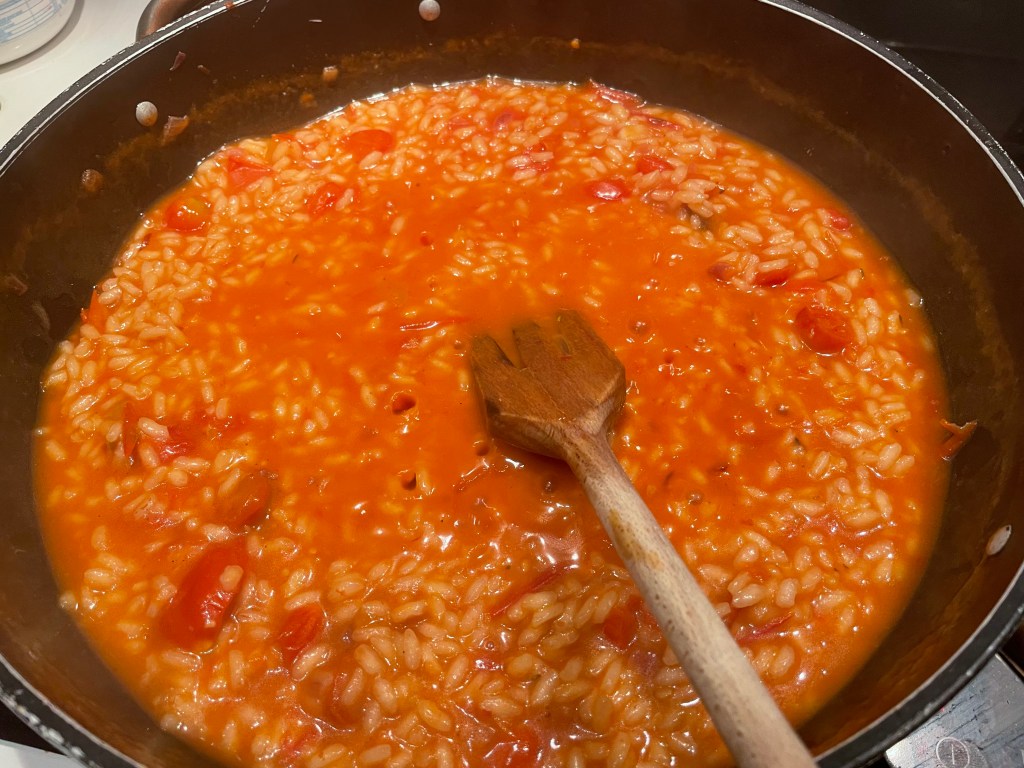
Since the last time we met over roasted tomato risotto, we’ve been in recovery mode, trying to get our lives back on track. August and part of September were like this giant hot blanket pulled over everything. This summer’s blazing heat kept us indoors for hours. Once it broke–somewhat—we had to think ahead. And hot though it was, we have to prepare for the winter.

Alternate fuel? Check.

Doing so is not a big deal if you live in a city—just start wearing sweaters and jackets. And turn on the heat. Here on the mountains, though, we have to lay in supplies and get stuff cleaned out to do that. We have gas heat, but the gas doesn’t come via a convenient pipeline; we have to get a delivery and fill a big underground tank, and take a big hit on our credit card balance. Because of the expense, we have a “termocamino,” or a thermal fireplace that’s hooked into the heating system. It pumps water through the fireplace and once the water reaches 50 degrees C/122 degrees F, we’ve got blaring heat circulating through the radiators. But we’ve also got choking smoke if we don’t call in the chimney cleaner. Hopefully someone will show up in a few days.

Speaking of our lives, 36 boxes of reminders of a former life came the other day. Luckily we have a whole downstairs floor to host them temporarily. And that’s a constant reminder that we’ve got to tell the authorities that we’re living here full-time and thus qualify for the national health service. Then there’s the dog registry and….and…and. Hey, this retirement thing is hard work.

BUT THERE ARE THE PLEASURES of everyday life here to compensate. We walk up the road and see this amazing view. We never get tired of it:

Valhalla, or the Umbrian equivalent

Besides the view, we’ve got neighbors. We can’t actually see them; we’re all spread along this winding road. But a simple 2 or 3 km walk means waving to cars passing by, and someone’s bound to stop and chat and invite us for coffee. A couple of weeks ago, we were doing our walk when a car pulls up. Usually it’s people lost and needing to find one of the nearby hamlets. A guy in accented Italian asks us if we’re the people in the yelllow house. We respond in English, we’ve been anxious to meet you. Seems we’ve got a famous lutenist living in a small house up the road, a fellow refugee from the U.S. If you’re into Renaissance music, look up this name: Crawford Young.

And have you ever had the experience of having a shop, a restaurant, a, I don’t know, a shrine nearby, and you tell yourself you’ve got to go there but you always forget or take it for granted that it’ll be there? Such was the case with the pretty recent addition to our town, Bottiglieria Barbarossa, a terrific enoteca right in the historic center. It opened about a year ago, and it’s a great place to try out local wines and artisanal gins and the like. And the owner Massimiliano is really passionate about his wares and the industry in general. We had a long chat about “natural” wines (he’s not a fan; I’m inclined to agree), the sacrifices restaurant owners make and our careers and life trajectories. The place has the additional benefit of big windows out onto the piazza so you can see the street action without the town’s resident old dudes staring back at you.

Just add wine=the perfect snack

There are other good bits of Italian small town life. We’re looking forward to a fish and seafood lunch this weekend. The menu looks incredible–appetizers, two “primi,” a fried seafood course, dessert, wine, water, and coffee. All of this in our friend’s hamlet for €35 a head, or about $37. It’s not just the food, of course. It’s the communal spirit of it all.

Our town, though, has got that communal thing licked. There are way too many events, walks, lectures, dinners, concerts going on to even start to list them. For a town of maybe 3500 souls, give or take, it’s a lot. And the town fathers and mothers are anxious to promote what we’ve got. Far be it from me to spoil the fun, so I’ll leave you with this video (in Italian), which gives you a good idea of what I’m saying:

Last call (for summer tomatoes)

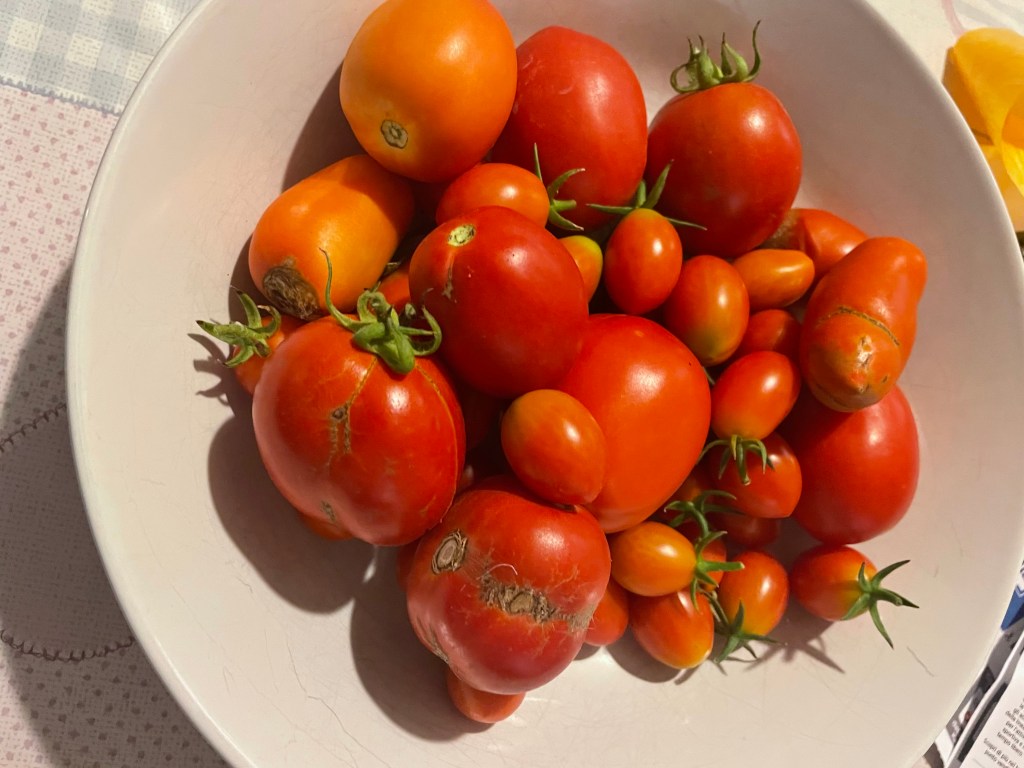
But now those tomato plants look forlorn. They struggle to stay upright as the early autumn winds blow, their leaves turning yellow and brown. Gotta say it’s kind of sad. So instead of petering out, or going out in a gradual fade away, The Spartan Woman gathered all the ripe small tomatoes and a few larger ones, and put them in a bowl. We looked at that red tableau and decided that a late summer roast would end the season with a bang. But what to do with the roasted tomatoes? The dish is a traditional foil for a roasted and/or grilled leg of lamb. But no, we couldn’t. Not when we have little lambs from the neighbor visiting us every now and then and taunting the pup. We could have paired them with pasta and ricotta salata, but that seemed too ordinary a dish to salute their tomato-ness.

In the end, we decided on a risotto, one that would be finished with butter and mascarpone, an appropriate blowout to what had been a decent season.

The “Recipe”

I put the headline in quotes because this is a dish that you feel more than you quantify. The risotto itself should be rigorously orthodox, a blank canvas for the intense tomatoes. We decided not to use saffron, thinking that it would distract from the star attractions. For a risotto for two people, you’ll need a cup of carnaroli rice—arborio works, too—an onion, a liter+ of good vegetable stock (I added wine and water so I’d have enough liquid), enough olive oil and butter to sauté the onion and toast the rice, and a splash of white wine. It’s a two-part process that takes a couple of hours, half of it passive, but it’s worth it.

You first have to roast the tomatoes. This could take up to an hour, depending on your oven. Preheat your oven to 220 deg C., or 425 deg F.

Halve or quarter the tomatoes and put them in a roasting pan. The quantity is up to you; the amount of the red stuff in the photo above was perfect for the two of us. Smash 2-3 garlic cloves and put them in the pan. Add a good amount of both olive oil and white wine. Sprinkly with salt and pepper, and if you’re into it, a bit of chili. Thyme goes really well with this, so a few sprigs. Rosemary sounds good in the abstract but will overpower the dish. Basil is fine, if not great looking when it roasts, and in a pinch you could add some herbes de Provence.

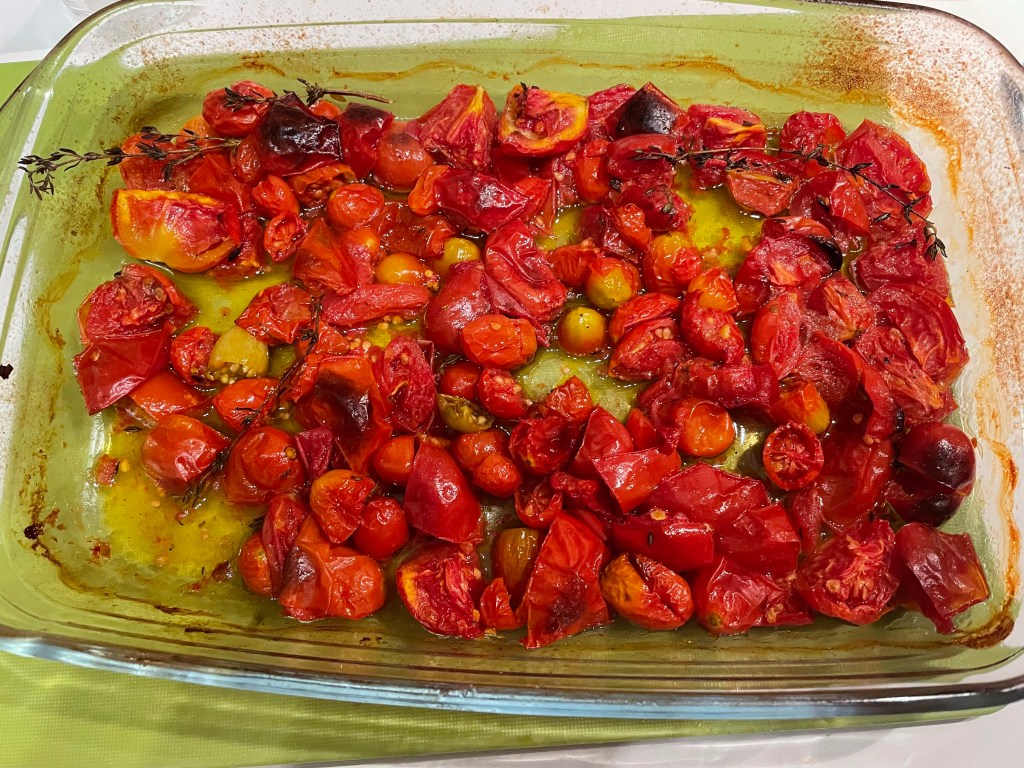
Check the tomatoes every 15-20 minutes. Stir them to judge doneness. When they look like those below, the tomatoes are done.

Set the tomatoes aside for now. It’s time to make risotto. I’m going to go quickly here. I’m assuming you know the basics; By now, you’ve got the stock simmering in a separate pot.

Saute the onion in some mixed olive oil and butter, then add the rice. Stir, toasting the rice. When the onion is translucent and no longer crunchy add a big splash of white wine.

Now, ladle by ladle, add stock and stir. A lot of people say that the regular stirring is unnecessary. I like to stand at the stove and stir. Plus, it gives me an excuse to drink some crisp white wine while laboring over a hot pan.

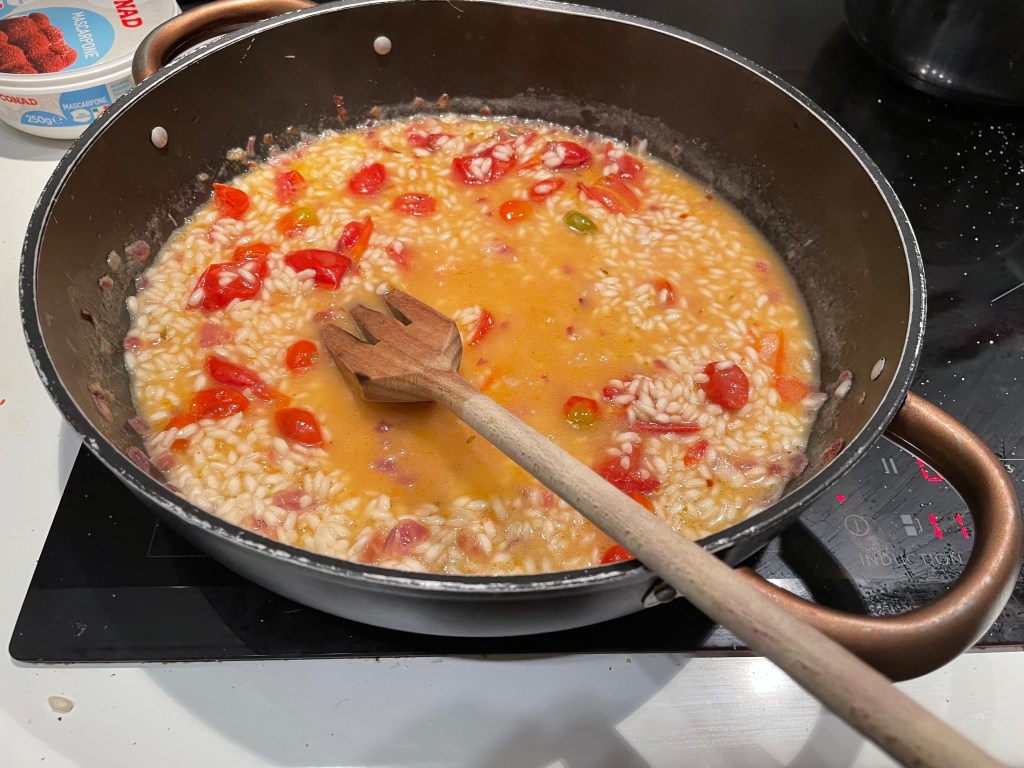
Somewhere in the middle of being done, which will take 25 minutes or so, start adding the tomatoes. You will notice the skins coming off. Some might look at this with horror; we don’t mind. Keep adding stock and tomatoes until the rice is al dente–soft around the edges but with a definite bite at its core.

Now the fun part: Turn off the heat. Stir in a few dollops of mascarpone. The quantity is up to you and your gall bladder. I went for decadence, but that’s me. Stir and dissolve. Now add a nice handful of grated Parmigiano-Reggiano or Grana Padano. Stir some more. If you’re a really sick puppy, you can add a couple of knobs of butter, but that could be way over the top. I won’t tell.

Serve. A small mound per person to start. Seconds for the greedy and/or decadent. Buon appetito e arrivederci summer.

I hear you had a nice time in Italy this summer. Next time come back to fill in the blanks

We have access to webcams, and the hot spots looked very crowded. And from personal experience, we know that touring Italy in the summer is not a good thing for those averse to extremely hot weather. And climate change only ramped up the heat. My phone was pinging me almost every hour about extremely hot temperatures, courtesy of the Italian Meteorological Service, a unit of the national air force (really). And that was here, where we’re surrounded by trees, shrubs, and other flora, and we are not surrounded by other people. I think I worked up a sweat just gazing at the Trevi Fountain crowd on my laptop screen.

You probably ate, too. With any luck, you ate fairly well, although in those tourist traps, I mean popular destinations, the food can be hit or miss. My cousins who didn’t come this way seem to have done pretty well for themselves, judging from their posts on “il social,” as we say ’round these parts. But sorry, I have to say, they were in cities, big cities and/or popular cities. You can only get so far. And restaurant workers in the touristy places have acquired bad habits, like expecting a tip from Americans and other non Italians. We don’t tip out here in the provinces.

I’ll get more serious now. It’s a different world here, with an entirely different culinary culture. In the United States, most decent restaurants are in big cities, which attract the best and most ambitious cooks and restaurateurs. Go outside New York or Boston or Chicago and you’ve got chain restaurants like Olive Garden, with the occasional brave indie that was featured on Guy Fieri’s Diners, Drive-Ins and Dives. I exaggerate, but you get the point. In Italy, sure there are great city restaurants like the Osteria Francescana (I haven’t been, but I’ve seen the YouTube videos). But the really good and funky stuff is in people’s kitchens, and out in the sticks and smaller urban places.

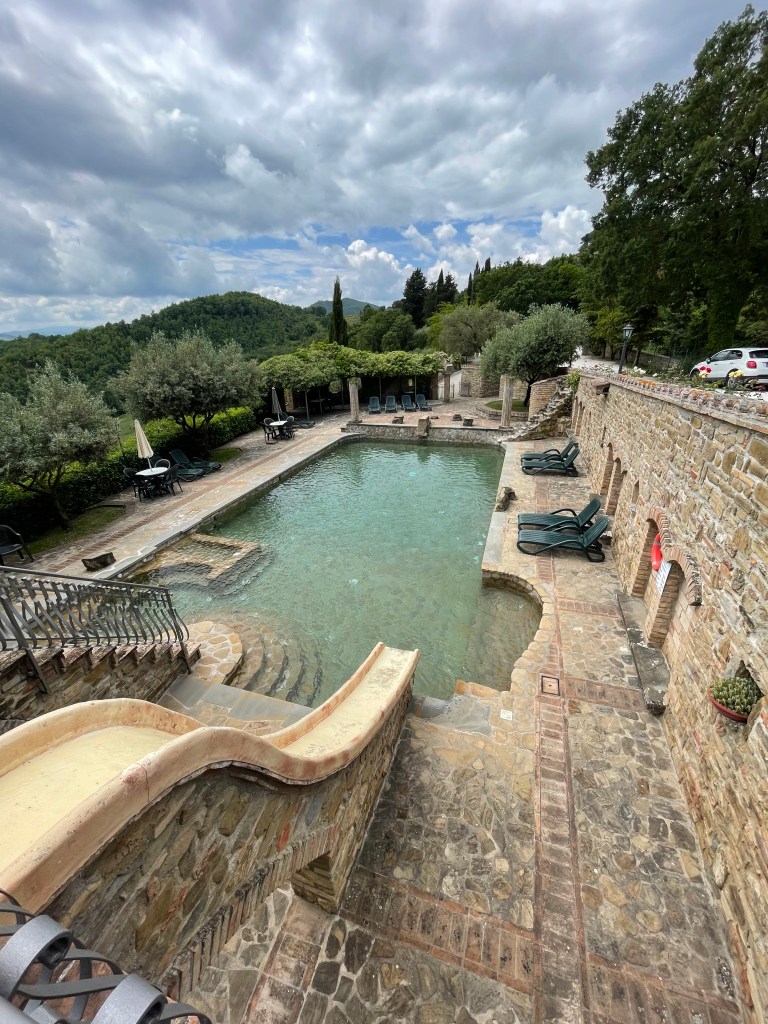
For instance, earlier this summer a friend and I went up a mountain above the town of Gualdo Tadino, just because. We walked around a sanctuary and admired the view. That sure worked up an appetite, so he suggested we go to Villa Dama, a nearby agriturismo his daughter’s in-laws go to for celebratory occasions. I called for a table (they had plenty that day) and 20 minutes later we were walking the place’s beautiful grounds. Nice lunch, too, multi-course with wine, for €40 apiece. And that’s relatively posh for this area (photos below).

Traveling outside the big centers doesn’t limit your tastebuds, either. You might think you’ll have to eat “Italian food.” The towns near us (the biggest being the small university city of Perugia) feature Greek, Japanese, Chinese, and African food, and even an ersatz American barbecue chain. (But us mostly vegetarian types haven’t tried it.)

I’M LUCKY. I KNOW THAT. I have family here, and chosen family, too. Most of my meals before we move to Umbria took place in their kitchens and dining rooms. The day my grandmother turned 90 we had a banquet at a country restaurant that night. The party meal was of a zillion courses and I thought it was pretty good, but the critics at home (one uncle was a chef) had issues. I’ve watched my brilliant Perugian mamma create simple delicious meals in a half hour in her small kitchen. When I started peeling a ripe pear she motioned for me to wait a sec and broke off a piece of Parmigiano-Reggiano to go with it. Simple. Perfect. My Venetian aunt invited us over once and she and her daughters created an amazing 10-dish array of cicchetti—think Venetian tapas. And so on.

You don’t need a Venetian aunt, though. You do need to be a little adventurous. Get away from RFV. Get on a train or rent a car—it’s not scary driving out in the countryside, I promise. Find an agriturismo, a working farm that puts people up and feeds them. We’re surrounded by them here, and they aren’t hard to find. Go to the website With Locals and set up dinner or a cooking class with real live Italians. Even in restaurants, though, the feeling is different away from the aforementioned RFV. Service is casual and really friendly and the tab is a fraction of what it would be in RFV. You’ll find yourself chatting with the proprietor once they realize you’re from elsewhere. You might end up exchanging recipes, too.

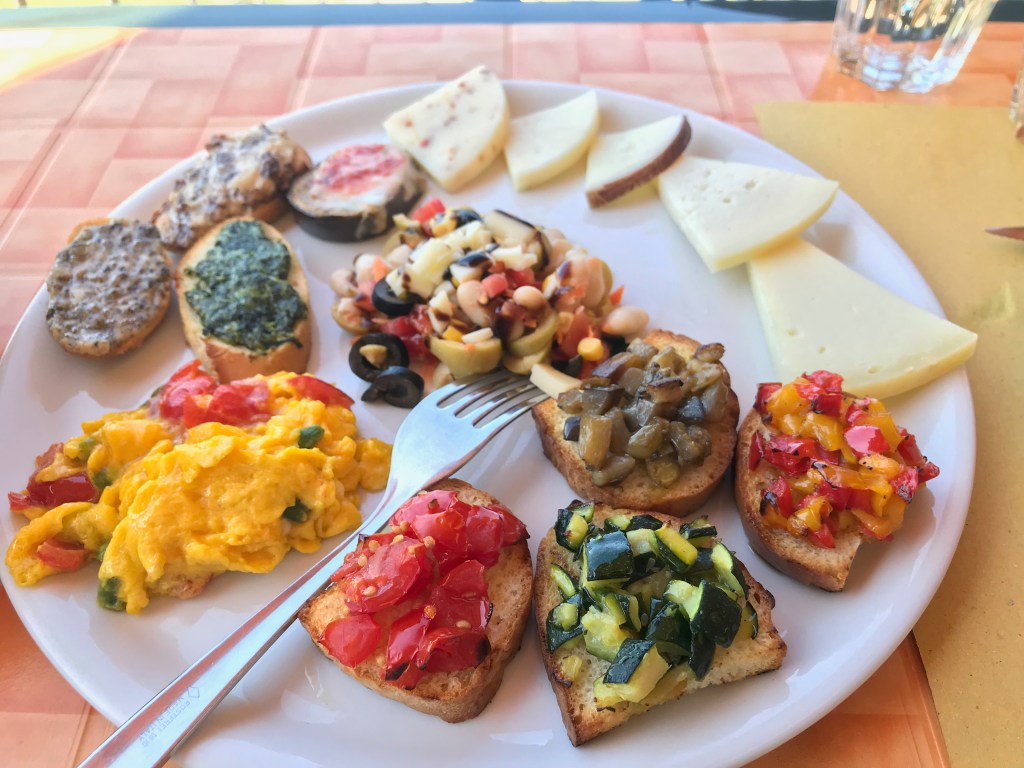
Above, the out in the sticks experience. Clockwise, the first two photos are at Osteria del Cambio in Palazzo di Assisi. And we had the antipasto plate and the truffle lasagne at La Terrazza di San Guido, a laid-back restaurant in the hills above the town of Gualdo Tadino.

For the ultimate in getting down with the peeps, seek out local sagras and festivals. You can get a good start here. I’ve written about them before, but to sum up, it’s how a town might raise money for the school’s gym, but in reality it’s a celebration of people’s towns, local culture and produce. The other night we went to the shindig in our town; the week before we went up in the mountains to a town that grows fantastic potatoes. Of course, almost every dish featured the spuds. (Text continues below photo.)

Waiting in line for the spuds fest

Here’s the thing. Travel like this and you’ll get to know what the real treasure of this country is. Not the Coliseum, not the Vatican or Florence’s art treasures. You’ll likely get to hang out with the people, who despite bad governments, annoying bureaucracy, and anemic economic growth somehow manage to be kind, generous of spirit, and a pleasure to be around.

I do like Sundays, they’re my fun days

Sunday is still a big deal here. unlike the U.S. where it usually feels like just another day. Sure, American banks are closed, but you can pretty much do everything else. Even in New York, which still has ridiculous liquor laws, banishing meal stapes like wine to the liquor store. Unlike pretty recently, liquor stores were closed on Sunday, so if you forgot to buy wine to go with dinner you were either out of luck or making a trip over the bridge to New Jersey. That changed a few years ago, but still, store hours are limited. 

It’s true that commerce doesn’t shut down completely here in Italy any more. Supermarkets and malls (yeah, we have ’em here, too) are open. A lot of it is out of necessity, because just as in the U.S. and elsewhere, it takes two incomes to support a household. (I bet European Union rules enter into it too.) Being able to load up on groceries is a big help to harried parents. Still, Sunday has a more relaxed vibe and most people treat it as their day to hang out, have a long afternoon meal with family and friends, and maybe take a walk or a dip afterward. Just like it used to be when I was a kid in New York. 

While the sabbath obervance started as a religious thing, that’s not necessarily the case here any more. You always see on American news sites that Italy “is a Catholic country,” but it’s a much less religious place than you’d think. Anecdotally it seems that only older women and their son/husband-drivers attend Sunday mass. And surveys show that about 25 percent of Italians attend mass at least once a month; about 30 percent of Americans can say the same.

Anyway, I like Sundays. And now that I’m no longer a wage slave, I don’t have to dread Sunday evening, when thoughts of work used to cloud my mind and I’d try to distract myself by watching something good on TV. I guess it all goes back to my roots. When I was really little we’d go to my grandparents house in Brooklyn most Sundays, when my grandmother held court in her dining room filled with heavy, wood-inlayed dark furniture. My parents kept it going long after my grandparents passed on. My father would play operas on the stereo, usually Aida or Cavalleria Rusticana while my mom put together what is now usually called “Sunday sauce,” a ragù filled with various pieces of meat and meatballs.

Before dinner, my father would make whisky sours for himself and mom and maybe our neighbor Joe, a Bavarian immigrant who kept up the European habit of making the rounds of neighbors, to say hi and maybe get a drink. Sunday afternoon dinner—pranzo in Italian—was always in the dining room, except in summer when it got a lot less formal and moved out to the backyard picnic table.

WE KEPT IT UP WITH OUR KIDS, even as they became adults. I won’t bore you with details, but in the past few months before we moved here, The Spartan Woman devised the most labor-intensive Sunday meals that left the kitchen a wreck. She usually made bread or focaccia and a dessert. A couple of times, we went informal and made a few pizzas. I was assigned to primo duty, including multiple step risotti. My daughters and I drank a fair amount of wine and we took walks after dinner to work it off. Those Sundays were a good time to unwind and talk with my splendid daughters and their partners. I wish I could somehow pop into New York and do that once a week. 

But I can’t—our private jet’s in the shop for awhile—so we do what we can here. Generally we make a more involved pranzo (the main midday meal) than usual. I’ll bring out better wine. And we invite friends. It’s great when our local friends come over, because then we have a total immersion in Italian day. Living in the country, we have less one-on-one talking time. 

And I treasure the summer Sundays we’ve been having with our old friend from New York, M. Chasse. In a lot of ways, these Sundays are like our old days in New York. When our paper went out, a group of us that I like to call the Gang of Four would repair to Restaurant Florent in the meatpacking district and spend a dissolute afternoon eating and drinking, French-New York style, for hours. Except that now we have the Umbrian countryside and a couple of sweet dogs to amuse us while we relax over an hours-long meal.

Guess who came to dinner?

We’re mostly vegetarian—we’ll have fish or seafood as a decadent treat—and so is our friend. At the same time, we have no strictures on wine, coffee, after-dinner drinks, aperitifs, whatever. So last Sunday dinner was tagliatelle with zucchine cream (see my post on Italian-English veggie sex-change operations), Prosecco, seitan in the form of cutlets (I’ve yet to set down the loose recipe The Spartan Woman follows to do this) and a fresh summer salad. We had melon and limoncello for dessert. 

An afternoon dinner isn’t the only Sunday game in town. For some reason, Sunday morning’s a good time to do some hiking. We live in an area criss-crossed by trails. And we can get in the car and drive to mountaintops and parks up in the Apennines, which we did today. Sure, it was crowded—it’s a holiday weekend here, with ferragosto coming up on Tuesday. We’d usually go up to Valsorda, above the town of Gualdo Tadino, on a weekday. But sometimes it’s good to mix it up with the crowd of nature lovers and observe our fellow Italians on holiday. Plus, the pup loves to meet other dogs, and being a cute little one, he’s a women magnet.

I somehow managed to get a people-less shot. There’s a cool bar up here that’s got the best cornetti—the Italian version of croissants.

I’m always asking myself why do I do certain things—it’s in my nature to second guess everything I do, and I’ve thrown out a lot of stuff that I eventually found silly or meaningless. You know, meetings, material striving, telephone landlines, listening to Kanye West. Sunday is a keeper. We all need a commerce-free day of hedonism, whether it’s walking around a mountaintop or feeding my favorite people and keeping that connection to an increasingly distant past.

NOTE: Notayearnotintuscany is doing the Italian thing and taking the rest of August off. See you next month.

We went to a truffle dinner and ended up getting to know a dentist

Summer in Umbria: festivals, swallows putting on an air show for us, cool hikes in the mountains, and dinners with friends, old and new. Hey I know it sounds impossibly idyllic, but hey, after commuting to a packed newsroom for 30 years and pretending to care what corporate lawyers do, I deserve it.

I’ve written before about the sagra (think of a town festival, usually featuring an ingredient the town is or would like to be known for) of truffles in Ripa, two towns down the road from us. Ripa has a tiny circular fortified historic center and otherwise sprawls across some suburban development and farms. The sagra is going on as I type, but a few nights ago the town held a preview dinner with a few of the dishes that would later be served to the crowd.

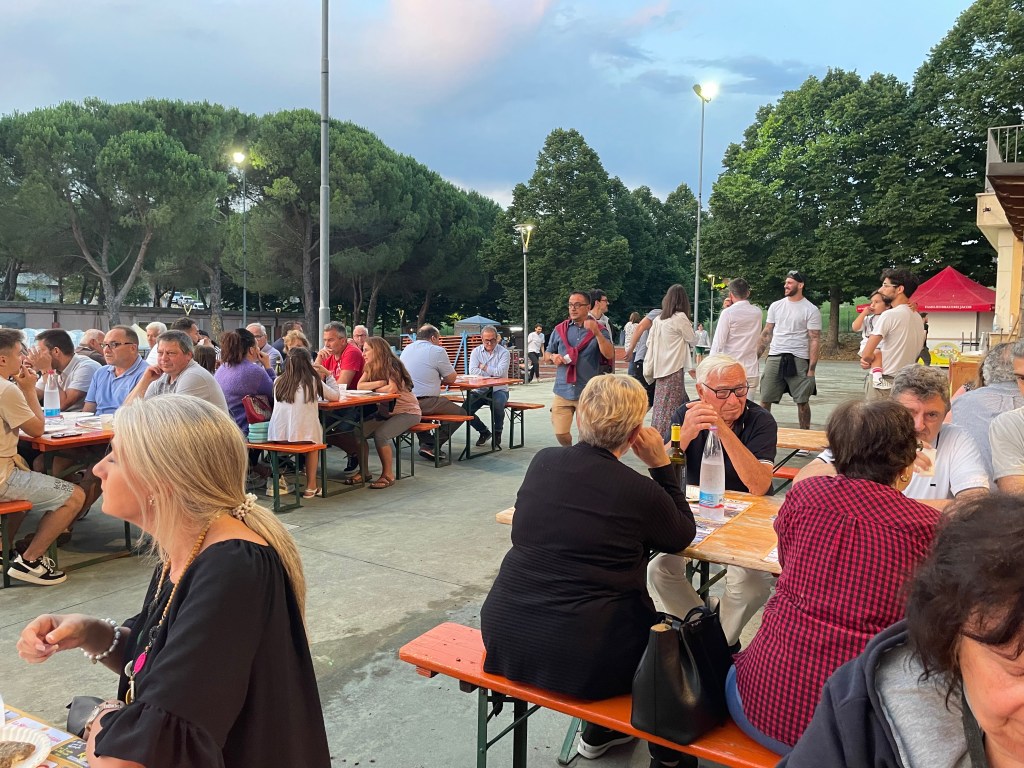
We figured what the hell, let’s try the dinner. At €20 each, or about $22, it seemed a bargain, with four courses and water and a coffee included (wine was extra, but at prices that beat retail in the U.S.). Besides, it’s always great to go to these communal dinners. Our town holds them every so often, and they’re terrific, with good food, interesting tablemates, and, often, a DJ.

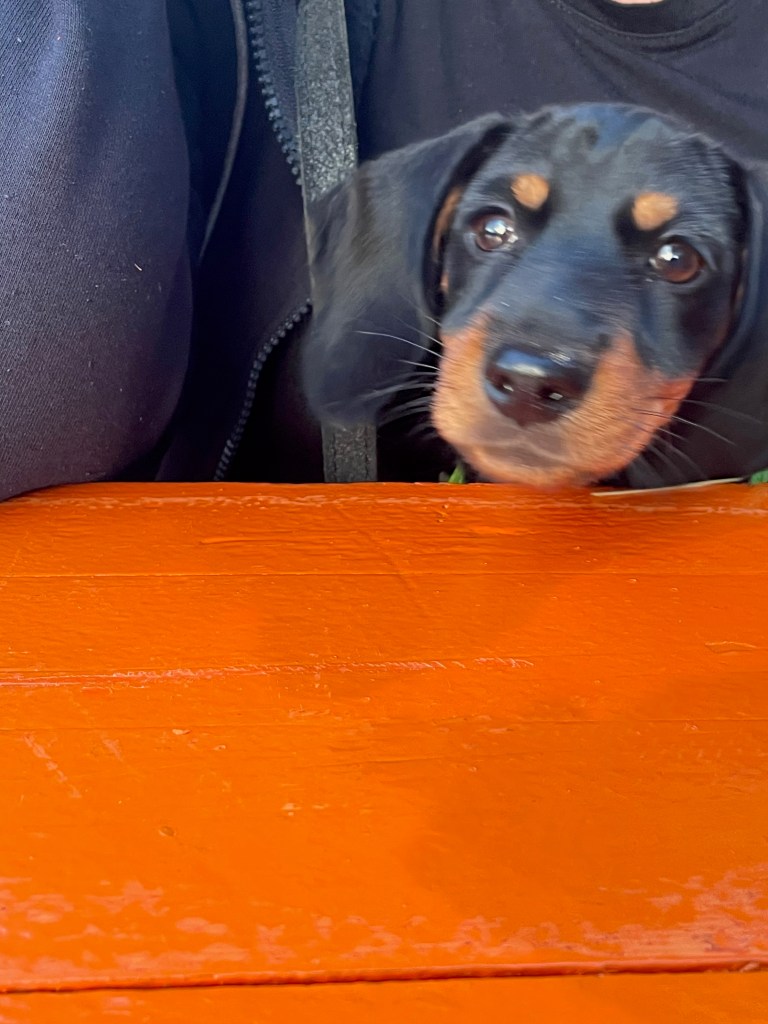
Niko gets a seat at the table.

We had a big life event in between reserving our places and the dinner itself: the addition to our family of a scrappy dachshund puppy we named Niko. Dogs go everywhere with their people here in Italy. We’ve eaten at Michelin-mentioned places and seen big dogs sitting placidly under the table. Should we take Niko? In just a few short days he’d grown attached to us, so we gave it a try.

We shouldn’t have even debated it. Niko turned out to be our passport to conversation. While waiting on line to pay at the start of the evening, he obligingly looked cute for the people around us. And he was pretty mellow as the crowd around our table got louder and more boisterous as food was served by Ripa’s kids and teenagers.

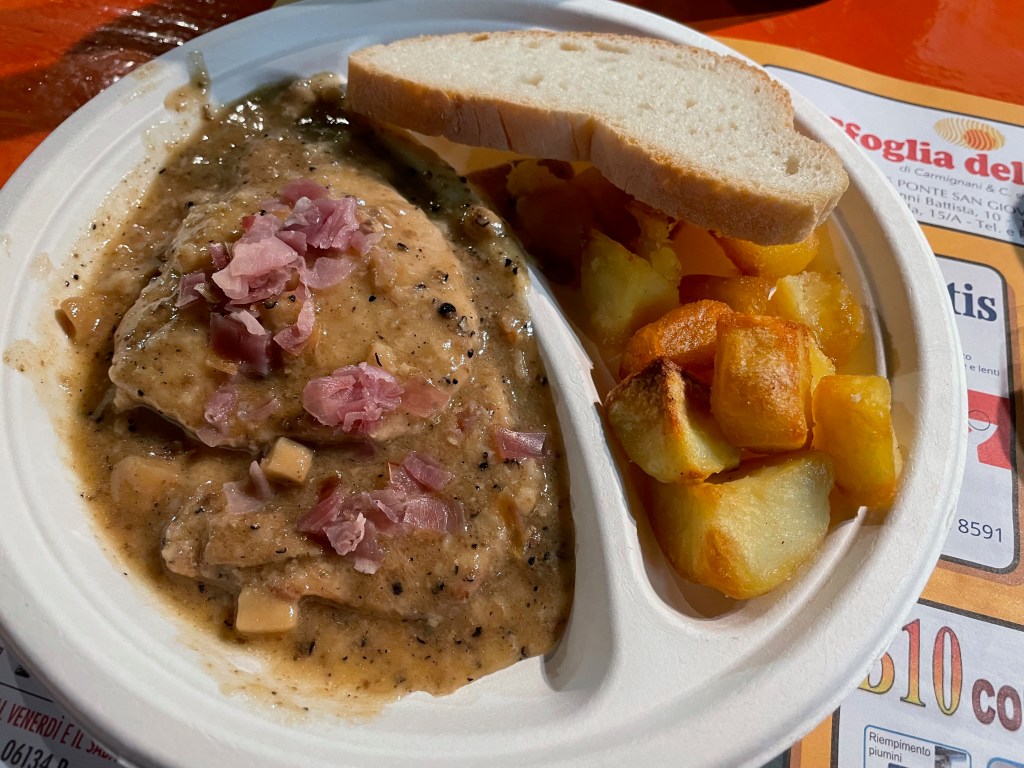
Foodies, here’s what we got for our €49 (2 x 20 + €9 for a bottle of local white Grechetto wine): Truffle bruschetta, gnocchetti (little gnocchi) with truffle sauce, tagliatelle with truffles (a bit too salty we told someone who asked on behalf of the town), pork scallops with truffles nd roast potatoes, and chocolate gelato with truffles [see photo gallery below].

Dinners like this are pretty rustic, even if the star is the local black truffle. Plates are biodegradable plastic, as are drinking cups for both water and wine. You sit at picnic tables and if you don’t fill the table, you’re going to get to know others who find seats at the table.

The good people of Ripa served about 300 dinners that night.

Or not. At least at first. We sat alone for awhile, one of the few couples not part of a jolly family or friends group. It was okay, because the people watching is always good. But then a couple came up to ask if there were empty seats at our table. There were.

The two couples, us and them, sat for awhile mostly ignorning each other. They apparently know everyone because most people passing the table stopped to greet them. We were happy just to sit and enjoy the warm summer night, and eavesdrop every now and then on people’s conversations.

Enter Niko once again. He wanted to see who dared to sit near us, so we held him up and predictably, our tablemates asked us about him in a way that would be familiar to parents of cute babies. They picked up on our New York-inflected Italian. Where are we from? We gave our town here, which usually elicits a chuckle. Then we came clean. Why here? We like it. We’re Italian, too, we add. We tell them about NYC’s high prices, which always comes as a shock to those who haven’t been. Within a few moments, they knew our life story.

I had to turn the tables and get them to tell us who they are. As it turns out, he’s a local dentist. Being nosy and needy, I asked him how much implants cost. (It’s less than a third what a NY dentist would charge.) The wife gave us his business card. We talked about different towns, schools, etc. Then dessert came—a Dixie cup of chocolate gelato with truffle shavings. It was getting chilly, so we all decided to leave, another communal event under our belt.

Who knows, if I have a toothache….

It’s not just a glass of Chianti in the sunset

Quick! When you think of Italy and its food and drink, what springs to mind? Pasta, sure. Pizza, definitely. Maybe gelato, and of course, a glass of wine to go with the meal. In fact, Italy is the biggest wine producer in the world, flooding shops and supermarkets globally with gallons of Prosecco, mass market Pinot Grigio, and fine reds and minerally whites.

But Italians are also beer drinkers. It’s not to the extent that Germans, Brits or Americans are—you don’t see Italians having keggers, and they tend not to wander around the cities in a beer-drunk haze. But historically, people here drink beer when it’s hot, or if they’re having a pizza night out.

Up until recently, mass market beers ruled Italian supermarket shelves and restaurant menus. But the micro/artisanal brew trend came to Italy too, and people appreciative of good beer have a wide selection of often local, interesting brews to choose from. Restaurateurs have picked up on the trend, too. Not from our house is a place called Umami Beer, whose owner has scanned the world for interesting brews for his patrons. The menu is eclectic too, with a wide selection of snacks, burgers and more traditional local dishes. It’s all part of the general loosening up of the culture, as more Italians travel abroad and acquire a taste for a wider palette of flavors.

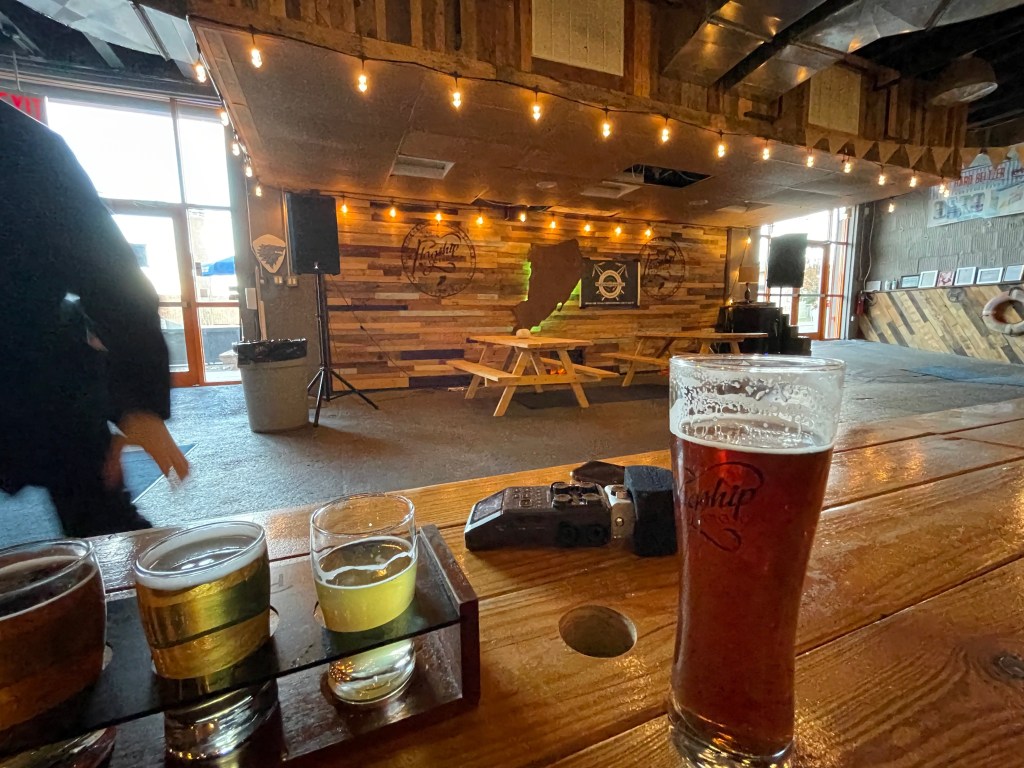
The taproom of Staten Island’s finest

Before leaving New York, I paid a visit to one of Staten Island’s two local small breweries, Flagship. The good people there like to name their brews after local places and people. The island’s population is about 37 percent Italian-American, so in recognition of that, they named a Pilsener-style beer (popular here) Birra Locale. (You should be able to figure it out, but if not, it means “local beer.”) My slightly perverse mind thought it would be fun to bring that Birra Locale to an Italian artisanal brewery.

My target: the brewers of Birra Flea. In this case, “flea” is not the pesky little bug infesting the cat and your carpets. The name derives from a local river. I thought it might refer to a family, but no. I took minutes—minutes, I tell you!—of intense online research to learn this. The beer is definitely one of the shining lights of artisanal brews. The big Coop supermarket here places it in its cantina of good wines and small-producer beer, and Roman celebrity chef Max Mariola drinks it regularly as he shows his YouTube following another recipe. Flea comes from Gualdo Tadino, a town about a half-hour from our house that nestles in the foothills of the Apennine Mountain chain.

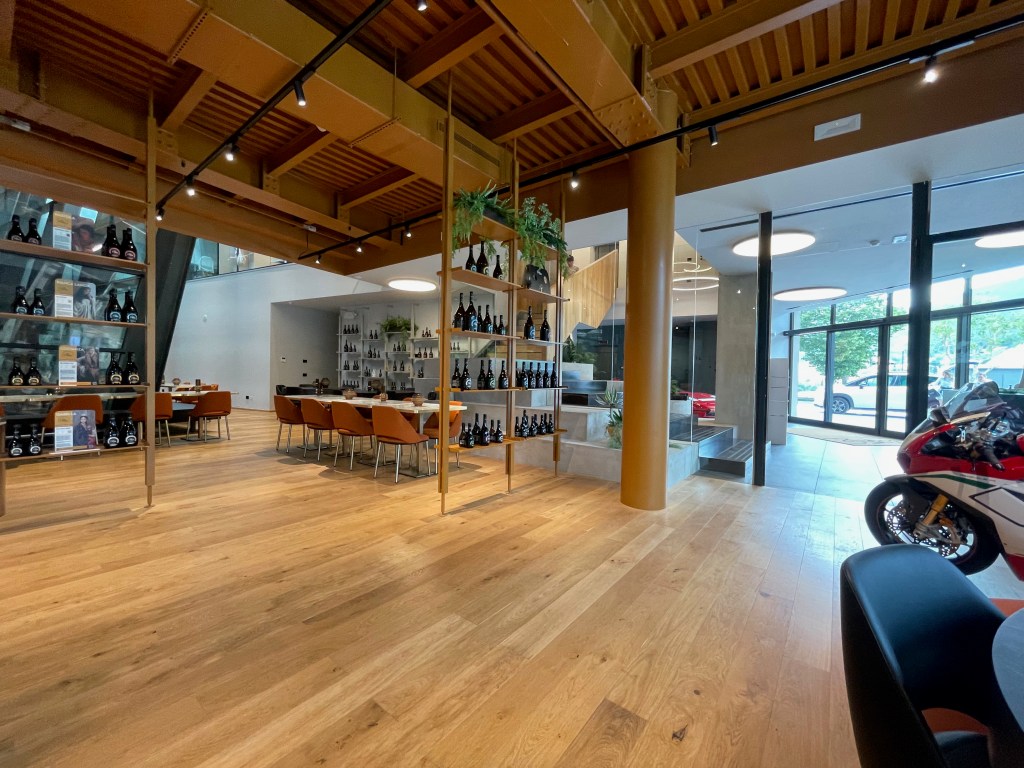
OFF I WENT THIS MORNING. Flea’s headquarters and brewery is located outside Gualdo on an isolated road. I had serious doubts that anything except a farm might can exist there. But I asked a couple on the road if I was on the right track and they assured me that the brewery was, in fact, down the road. Of course, it ended up being hard to miss, a modern charcoal gray-to-black edifice dominating the area. To emphasize its importance, the outside sign reads “Universo Flea.” I thought, well, this is more than a folksy little brewery.

However imposing the building is, the reception was the typical friendly greeting that’s pretty universal in this part of Italy. As soon as I stepped through the doors, they knew who I was and why I was there. (It wasn’t a mystery; you reserve a tour and sampling on Flea’s website.) The decor is modern yet warm. And for some reason, they have a historic red (what else?) Ferrari parked near the reception desk.

Sara poses with a birra that is definitely not locale.

My handler Sara soon greeted me. I won’t bore you with the details of brewing, but I can say that I was impressed by the tranquil atmosphere, not to mention the huge fermentation tanks. Trashing a stereotype a lot of people have about Italy and artisans, Flea’s operation is decidedly high tech and as sustainable as it can be. They grow a lot of their own malt at a farm not far from where I live. The farm animals that came with the land supply them with milk, which they’ve turned into a cheesemaking operation. I’ve been fascinated by production lines ever since I was a little kid, and the bottling, tapping and packing machinery gave me tons to stare at and admire.

I’ll confess that I love conscientious food and drink producers. And breweries have a special scent, the sweet malt that perfumes the place. It kind of humanizes the assembly lines and the high-tech fermentation tanks. Beer, like wine, has a long history. Sara told me stuff I had no idea about, like how hops isn’t there just for flavor, but also acts as a natural preservative. And centuries ago, nuns figured out how it preserves but also balances the flavor. Before then, most beer was sweet, a natural result of the yeast reacting with the malt or other grain used to brew the beer.

By now, you probably realize that Flea may make artisanal beer, but it’s not a hole in the wall operation. They’re looking toward the future. Much of their electricity comes from solar panels. (In fact Italy leads Europe in solar-derived energy.) And now they’re going to try to brew beer from the air; they’re experimenting with a technology that pulls humidity from the air. They’ll pilot test that water for brewing.

Who needs lunch when you’ve got this to go with the tasting?

At the end, I had a taste test. I chose three beers from their list; I tried to pick different colors and strengths. “Margherita,” a wheat beer, was crisp, not too hoppy, and just right for a hot summer day, or a nightcap. Their golden ale, dubbed Federico II, was fruity and just assertive enough. And a Belgian style ale named Violante was, just as the label said, powerful and just right for a cold night and stew. Because we’re in Italy, food soon appeared in front of me, so I didn’t have to think about lunch—the cheeses on the tray come from their cheesemaking operation.

Flea turns a decade old this weekend. If the next decade resembles the past ten years, they may have to reassess that artisanal tag. In any event, this afternoon was a great way to see a bunch of mostly young people making a terrific product in a beautiful space.

Where everybody knows your name

Way back, late in August between my freshman and sophomore college years, I felt devastated. I’d come home after spending most of the summer in Sicily with my extended family. And there were no bars where I lived in New York. Okay sure, there were lots of places where you could get drunk and maybe, get lucky. But no bars in the Italian sense, and that made me feel lonely. I could joke about how most of my life since then has been a way to get back to the local bar.

But maybe it’s not a joke. So allow me to offer a tribute to the Italian bar. For those who haven’t been here, or haven’t paid much attention, a bar here isn’t like the American kind. Maybe in spirit like a British pub? Whatever. It’s sort of like a café, except that that word doesn’t quite capture the bar’s essence. Maybe, in the American context, it’s like the old small-town diners or cafés, where locals would gather, hang out, get anything from coffee to a meal, and share local gossip.

Bars are everywhere in Italy, from the big cities to small hamlets like Casacastalda, a 20-minute drive from Casa Sconita up a twisty country road. That bar has an amazing location overlooking northern Umbria’s hill-mountains. But they can be on a residential street, on a piazza, or even in the parking lot of a gas station. The toll roads through Italy, the autostrade, have amazing bars, some of them inside buildings that look like retro ’60s spaceships straddling the highway. The thing is, if it’s Italy, there’s a bar nearby.

You can get everything you want at the Autogrill—including an espresso or drink at the bar.

Basically, the bar serves most of your needs throughout the day. In the morning it’s the place for a cappuccino and a cornetto, or mid-morning, for office workers to have a booster shot of coffee (espresso mostly) before tackling some more emails. One of our friends here never makes coffee at home—he gets dressed and heads out to his favorite bar for breakfast, which here is usually coffee and a pastry. (His is the place in the gas station parking lot.) If you aren’t into sweet, there are little panini—my favorite is tuna and artichoke. Later in the day people stop for another pick me up, and around 6, an aperitif or cocktail, always served with a little snack, because here in the land of La Bella Figura, being obviously drunk in public is a faux pas.

It doesn’t take much to be a local. If you’re renting an apartment in Italy, even for a few days on vacation, one of the first things you should do is visit the local bar. Go two or three days in a row and you’re a regular. One barista in Perugia remembered us from getting coffee with our daughters in the morning. When we returned a few months later, he asked us why the girls weren’t with us.

We live in a small town here, yet I can think of at least five bars within a 20 minute drive. Three of them are down the hill from us. They all have their own style. The bar on our local piazza looks like it’s from the 1980s, but the real deal is to sit outside in the morning or late afternoon and soak up the sun and the murmur of the fountain combining with the sound of the local accent. And they serve addictive fried sage leaves with your Aperol spritz in the afternoon. Another, housed in a local shopping strip along with the main pharmacy and town supermarket, is Italian sleek modern. Even the spoons look like no spoons you’ve ever seen, and it takes a few seconds to figure out how to use them. Still, if I’ve been away, on my first visit we have to catch up with the barista and show pictures of the grandchild.

Breakfast in the piazza post-hike
Vian contemplates the view.

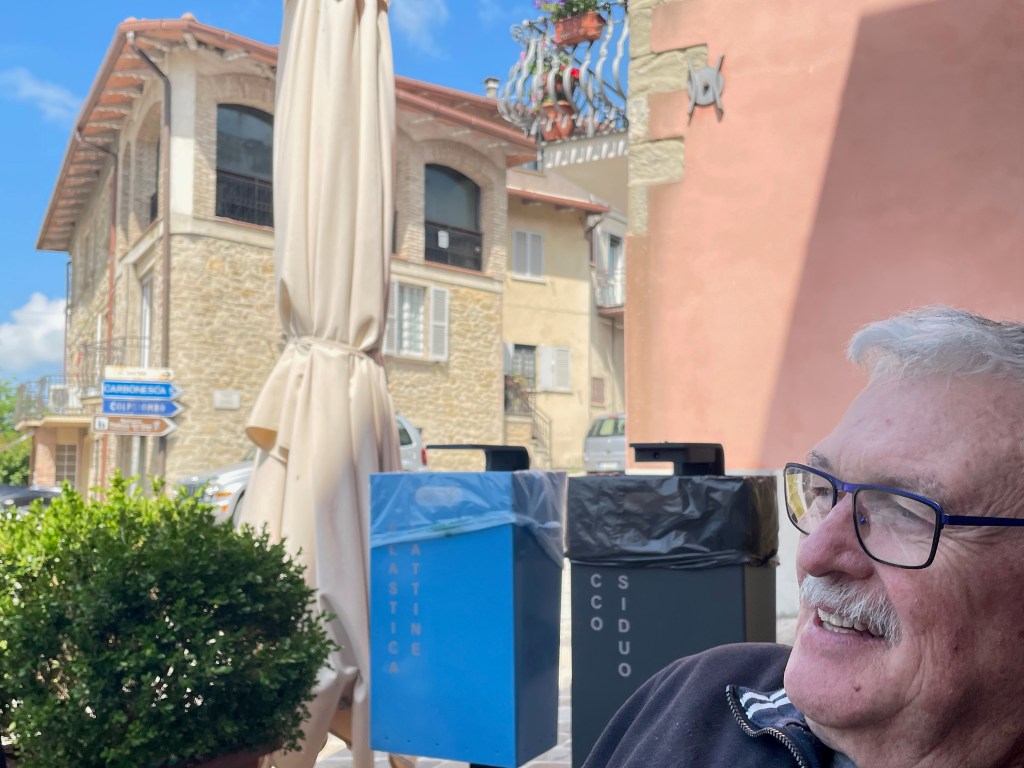
Come to think of it, we assign these watering holes to different occasions and frequent them with different sets of friends. Yesterday, for example, I met my friend Vian, a transplanted Canadian who moved to Umbria with his wife so that they could be near their daughter and grandchildren. He lives outside a town called Gualdo Tadino, a place with eccentric architecture that snuggles up against the Apennine Mountains. Vian and I like to meet for a mid-morning coffee and pastry, and we do it midway between our houses—that bar in the hamlet of Casacastalda. The place has a great view, and Vian, a sociable guy whose Italian improves every time I see him, is besties with the owner and always has conversations going with some old guy who hangs out there.

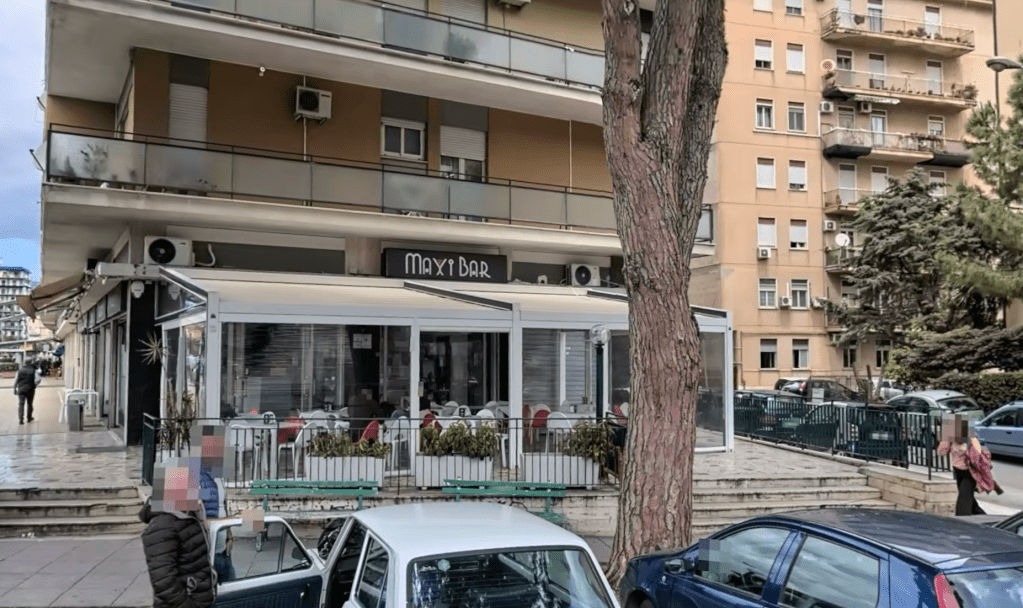
Uncle Ignazio’s hangout in Palermo

My Uncle Ignazio probably frequented his local bar every morning until he was taken to the hospital for the final call (he was in his nineties). A few blocks from his apartment, the bar was the focus for the pensioners, people on their way to work, parents taking their kids to school, and even groups of motorcyclists headed to western Sicily—his place was on the ring road around Palermo. A visit with him almost invariably involved a stop at the bar. He smoked (if outside) argued politics with his cronies, argued politics with his cronies, and did I mention that he argued politics?

I could go into coffee etiquette, what to order, when to pay and when to wait (Ok, big cities and the road stops are pay first, go to counter and get your stuff; here in the sticks, it’s whenever you feel like it.). But that’s for another morning. Right now, it’s about 23:00—11 p.m. in US-speak—and I’m thinking about this little bar in Perugia that whips its own cream and fills pastries with it for breakfast. Sweet dreams….

[Update: I went to that little bar.]

Finally, a great maritozzo at the Antica Latteria in Perugia

Credit for Autogrill photo: qwesy qwesy, CC BY 3.0 https://creativecommons.org/licenses/by/3.0, via Wikimedia Commons