Don’t worry, it’s still safe to visit us

When I was 18 I was shipped off to my grandmother and aunt in Sicily. I didn’t have a summer job, it was in the middle of a bad recession, and my parents didn’t want me hanging around. It was terrific; my Italian cousin and I spent a good part of that summer hitchhiking around Palermo, going to the beach, getting a good buzz on in the local bars, and going to parties. Even as a 17-year-old, he was an excellent tour guide, and I got to know my father’s city.

Why am I telling you this? Back in 1975, Italy’s communist party typically got about a third of the vote in national elections, and the American press was sounding the alarm that the country “would go communist.” As I got ready to leave for Italy, people kept asking me if it was safe to go to a place that was really about to turn, you know, communist. I was a smarmy college kid then and dismissed all the talk. And when I got to Italy, I saw that things hadn’t changed much since the last time I’d been there, except that the developers’ rape of Palermo continued apace. And that was definitely not a commie plot.

In other words, after this last election, which will bring the right to power, don’t sweat it too much. I am not dismissing its importance, however. I am not a fan of Giorgia Meloni and her fascist-descended Fratelli d’Italia (Brothers of Italy) party. The tone of Italy will change. But life will go on, as it did a couple of years ago when the Matteo Salvini’s Lega right wing party dominated the news with its hostility toward refugees sailing across from Libya. The tone of the country will change in ways that matter most to foreigners in government and media, and locals who pay attention to government machinations. But you’ll be able to visit the Vatican, have an Aperol spritz at aperitivo time, and do the things that most people do when they visit Italy.
I’m not trying to trivialize things. But at my age, I’m trying to be less hysterical about everything, and definitely less hysterical than Americans tend to be. And I’ll try to explain why 40 percent of Italian voters (about a third didn’t bother to vote) chose the right wing coalition.

First of all, you can argue that the outgoing government headed by “SuperMario” Mario Draghi (left) was illegitimate—it’s a fact that he wasn’t elected. The outgoing parliament, elected in 2018, had two leading parties, the 5 Stelle (5 Star) rebel party and the right wing Lega. The first government (in parliamentary systems, the term “government” means administration featuring one or more parties) was a coalition between those uneasy partners. 5 Star is a weird, populist group composed of disaffected people, techies, environmentalists and libertarians that tries to evade the usual left-right definition. (When it comes down to it, it’s a volatile sort of left-ish party that doesn’t know how to effectively govern.) The Lega’s Salvini, who was interior minister in that administration, decided that he’d rather be prime minister and spent the summer playing DJ and flirting with the ladies on the beach. Campaigning, in other words.

Salvini brought down that coalition of convenience, but got fucked: The Democratic Party (PD) and 5 Stelle got together and did an end run around him. He and his party were cast out of government, while the previous losers (the PD) became part of a governing coalition. (When I say cast out of government, I mean the ruling coalition. They stay on as members of parliament.) After a PD-5 Stelle coalition fell, Italy’s president during the Covid pandemia got most major parties to play nice and unite under Draghi; Meloni kept her party out of it.

SO, WAS “DEMOCRACY” SERVED by this? The end run pissed a lot of people off—a lot of conservatives, but also people who thought that the will of the people, as expressed in the election, had been subverted. And it wasn’t the first time; back about 10 years ago during the Euro crisis, investor speculation led to the fall of Silvio Berlusconi’s regime and the installation of a technocratic administration. And the dissatisfaction wasn’t just among people on the right. A lot of people who might have voted for the center-left felt that the PD left them out in the cold, that, basically, the PD and its allies were basically supporting governments that were more anxious to satisfy institutional investors rather than people. (This all begs a bigger question: What does the left stand for anyway? That’s another blog post. Or ten,)

So where are we now? First of all there’s none of the weird histrionics that characterized American transitions of late. The winning coalition partners are jockeying for position. Meloni and her male partners are negotiating and probably arguing over cabinet posts. Given the bad showing of Salivini’s Lega, you can probably bet that he isn’t going to call the shots in her government.

What won’t and will change? Unfortunately, they’ll be restrictions on immigration and probably more rhetoric directed at preserving the traditional family. A lot of the latter will fall on deaf ears. Lots of Italian couples don’t bother to get married, even after they’ve had kids. Unlike what happens in the U.S., I don’t think the incoming government will dismantle Italy’s terrific public healthcare system and other features of this fairly modern welfare state. We’ll still have fast trains, a decent amount of public transit and most of what makes Italy’s quality of life so good. We’ll also probably see more demonstrations as unpopular programs are introduced. Meloni now owns whatever happens and won’t be able to stand in opposition.

A word about the democratic process. Much of the press coverage of the election asked, through an American filter, whether Meloni and her crew are “a danger to democracy.” It’s really too early to tell but I have a couple of thoughts on that score: First of all, Hitler was elected. Both George W Bush, first term, and Trump were “elected” despite having lost the popular vote. And both U.S. presidents ruled as though they’d been given a mandate. I think we as Americans confuse procedure with substance. There’s more to governments and nations than whether people voted or not—there’s substantive issues, and whether governments are responsive to what their citizens need.

The U.S., even before this recent crisis of democracy, has pretty much screwed its populace for the past 40 years. Workers lost most protections, healthcare still remains a pay as you play game, as does most of politics. Millions of jobs were shipped overseas, and Americans aren’t guaranteed paid time off, as are Italians and citizens of the European Union. So ask yourself whether Americans can really say that before the advent of a wannabe strongman like Trump, that their democracy was really working anyway.

Image credit for chart at the top: CC-by-SA 4.0 (Wikicommons)

Meloni photo: Vox España, CCO, via Wikimedia Commons

The others by author

It’s something we think about all the time here

Let’s talk about food, shall we? And where you consumed said food? (Sorry if the headline led you to think I was going to write about that other obsession.) I’m thinking about food in Italy these days, since I’m here. It really is an obsession, and not just with “sovrappeso” [overweight] me. I’ve overheard chic saleswomen talk about what they were going to have for lunch in tones that were, well, erotic. And if you happen to be in Italy and happen to get onto YouTube, your feed will soon be blitzed with food videos. I don’t think it’s just mine.

First off, most Americans without the good luck (or misfortune. It depends.) of having relatives living in Italy don’t get the full-on experience. They–you?–have to go to restaurants. And that’s a shame, especially if you’re in the big tourist cities. Why? Because restaurant food may be ok, but eating in an urban restaurant in Italy doesn’t come close to the real deal, and in big cities and touristy locations, many restaurants serve a kind of national “Italian” food that doesn’t reflect what people really eat in this intensely regional country. Plus they miss the vibe, where people loosen up and sit with friends, family, lovers, kids, dogs, whatever, just enjoying the moment. Or a town festival. Or, in the case of our town, any excuse to get together. Any.

First, friends and/or family. One of my most memorable “meals” here, if you can call it that, happened before we had a place of our own. My magazine astoundingly let me come to Italy on a reporting trip. My assignment was to make the rounds of lawyers and business analysts and give American lawyers an idea of what to expect if their companies or clients tried to buy an Italian company. I cannily scheduled interviews for the latter part of the week in Milan, and the early part of the week in Rome. Oh, dear, what to do in between? Live in a lonely hotel room? Eat meals by myself?

Nope.

I visited friends who happened to live in Perugia, about two-thirds of the way south to Rome. After a couple of train rides, my Italian papà Franco picked me up at the station. “We have to hurry,” he said. “Giovanna’s in the middle of a surprise for you.” Franco, never a quiet pensive kinda guy, gunned it, shouting at anyone who dared to drive any slower. “Figlio di puttana! Bastardo!” he shouted. After holding on for dear life—Perugia doesn’t know from straightaways—we got to their house. “Hurry! Just leave your bag. You can keep you jacket on. We have to do this NOW!” Franco told me.

What was the fuss all about? Artichokes. Glorious crunchy salty hot just from the fryer pieces of artichoke. “I’m squeezing lemon on these, ok?” said Giovanna in Italian (these two didn’t speak English; this is all translated), more as a statement of purpose than a question. “Eat with your fingers.” She had put the freshly fried artichokes in a paper lined basket and shoved it at me. “Eat with your fingers.” The three of us didn’t even sit; we just stood there eating, blowing on our fingers between bites.” When we weren’t wolfing down the artichokes, we were drinking and smiling at each other. It was one of the best food events I’ve ever been at. I know we sat down to a regular lunch after that, but for the life of me, I can’t remember it. Can you blame me?

If you don’t have an Italian friend or relative, the next best thing is probably eating at an agriturismo, or at least a country restaurant. If it’s the right season, eat outside. Yeah, there’s an Under the Tuscan Sun thing going at these places. But you’ll see what makes it all worth it. Some years before that reporting trip, we’d gone to an agriturismo high above Lago Trasimeno, the big almost ocean-like lake around here. I can still taste the pasta course, with an eggplant purée (no tomatoes) and bits of sausage. But what I really remember was the vibe. There we were, our family, plus our Perugian surrogate parents and their dog, just relaxing around a table with a view of the lake below for the whole afternoon. And it cost maybe a half of what a city restaurant would’ve charged. Maybe less.

ANOTHER WAY TO ENJOY NON-RESTAURANT food is at a sagra or a festival. They’re held all over Italy, and here in Umbria there seems to be one every day or so somewhere. They serve as fundraisers for the town’s pro-loco associations, which support soccer teams, after school activities for working parents, and the like. But they’re also a way to get the whole town involved in something—and, for people to connect with their history. Local volunteer cooks take care of the food, sometimes, but only sometime, under the guidance of professional chefs. Of course, doing so often involves getting done up in medieval drag, which seems to happen for any excuse, but I digress.

After the Covid shutdown, the region came alive this year. We’ve been to a few. The first was for the food, in Ripa, two towns down the main road here. The town itself is a tiny hamlet, with a circular historic center, and various memorials to Gino Bartoli. He was a heroic figure, a Tour de France bicyclist who smuggled citizenship documents for Jews during World War II by stuffing them in his bike’s tubes and delivering them. Ripa holds a truffle sagra, and the food’s pretty good if you’re a fan of the underground fungus. (We are; Ripa sagra shown below.)

There’s a biggie around here, too. The small town of Cannara, near Assisi, is known for its onions. They’re sold in all the grocery stores and to be honest, we’re spoiled. I won’t say you haven’t lived until you’ve had a really fresh onion—but like a lot of produce, being grown locally makes a real difference. Cannara puts on a pretty big show, with various “stands” (yes, in English), really kitchens/outdoor restaurants, with each producing dishes that feature, yes, onions. Cipollamisu, anyone? It was a lot better than you’d think, with the typical tiramisu ingredients topped with a compote of sweet onions.,

Valfabbrica, where we live, goes all out. It’s bigger than Ripa, as far as towns and hamlets go around here, but smaller (population around 3,400) than the surrounding towns. There’s a week-plus celebration of being a valfabbricheso, with pageants, jousting tournaments, and, of course, food. The town’s historic center turns into a restaurant, and the town has a communal kitchen that churns out tons of dishes based on local produce and history. Gotta say, it was pretty good.

But the most charming event involving food was last weekend. Our town likes its parties, and the old medieval tower was restored recently. Most places would have the mayor cut the ribbon and leave it at that. Valfabbrica? Uh-uh. It got Italy’s only all-female jazz marching band to escort the mayor to the tower, playing Stevie Wonder’s Sir Duke and The Beatles A Hard Day’s Night. The women walked up the tower with Enrico (we’re all on a first-name basis here)

We don’t have dull ribbon-cutting ceremonies in Valfabbrica.

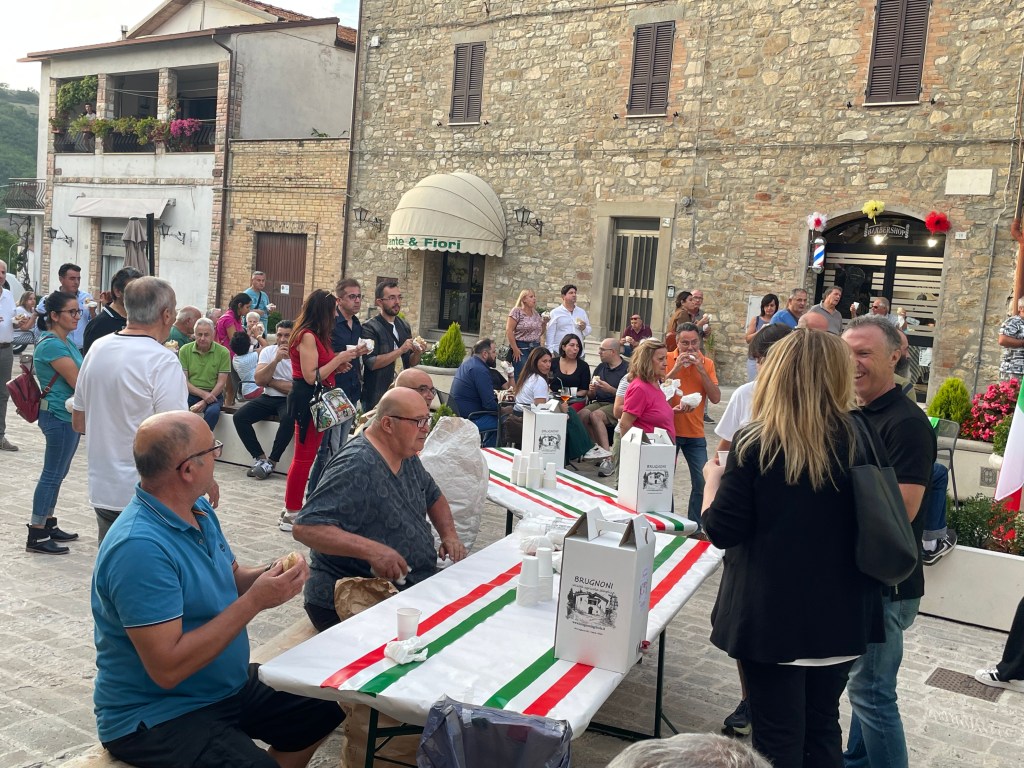
I know, this is supposed to be about food. Sure enough, after the music and the ribbon-cutting and the speeches about the historic importance of the tower, there was a free aperitivo* in the piazza. Older guys sat behind tables with loaded with decent boxed local red wine and porchetta panini* and doled it all out. I haven’t eaten much meat in a decade, but one of the guys shoved a panino at me after I poured myself a healthy glass. It seemed churlish to say no—and it was great to be hanging out in the main piazza on a beautiful late summer night with our fellow townspeople.

Vino and a panino, anyone?

*”Aperitivo” refers not only to a pre-dinner drink, but food to go with it. Places like Milan and even good bars elsewhere elevate it to the point where it can substitute for dinner. At that point you can all the meal an apericena—aperitivo and cena, which is what the nighttime meal is called.

* The word is “panino” for a single sandwich. “Panini” is plural. More than 1 sandwich. Ok? I get a little nuts when I hear “I’ll have a panini .” It’s like nails on a blackboard.

Addio, Alitalia. It’s been sometimes good to know you. Still, we hate to see you go (because you owe us).

I flew for the first time on July 4, 1971, when I was 14 years old. My family took an Alitalia flight from New York City to Rome, and I was on vacation with my parents and my younger sister and brother. The trip was a big deal for us; it was my father’s first time back to his native Italy in 16 years, and it was our first trip abroad. I remember a lot of the details. The plane was a new Boeing 747, and even in economy class they gave us slippers to wear. The dinner’s centerpiece was a filet mignon in a red wine and mushroom sauce. Excited to be on a real vacation, my 11-year-old sister and I explored the plane. “Maria, come here!” I called to her as I peered beyond the curtain toward the first-class cabin and its spiral staircase. “No, go there,” the mustachioed flight attendant told me, pointing us back toward steerage.

Ever since that first flight, I’ve taken Alitalia a couple of dozen times. The Italian flag carrier was historically generous with its mileage loyalty programs, and its direct flights to either Rome or Milan were a godsend to people who dislike changing flights and going through security more than once. It served as the unofficial carrier of the postwar Italian diaspora, and was the pope’s official airline. 

But Alitalia is about to taxi back to the big hangar in the sky, joining other defunct airlines like Sabena, TWA and Pan Am. Years of bad management, wildcat strikes, patronage staffing levels, and indifferent service took their toll. Alitalia has been in receivership since 2017, and the Italian government of Mario Draghi and the European Union finally pulled the plug. Sure, successive Italian governments tried to keep Alitalia aloft, but after billions in bailouts and repeated, unsuccessful efforts to find it a suitor, everyone called it quits. 

Sorry, your flight’s been canceled and there isn’t much that you can do.

There’s a psychological element to the carrier’s end. Although a lot of Italians had become tired of its hijinks, Alitalia remained one of the last cornerstones of Italy’s postwar boom, which saw the mostly rural, war-torn country become a modern economic and social power. Indeed, Alitalia’s fate echoes the fate of other big Italian companies, like the auto giant Fiat, which once stood for that postwar economic miracle and is now just a part of a French-led conglomerate, Stellantis. This hollowing out of Italy’s big companies has taken a big toll on Italian pride, no matter how many soccer championships the national team wins. This psychological toll is one of the reasons for the ascendancy of populists like the Lega’s Matteo Salvini, and the right wing party Brothers of Italy. The latter is led by the photogenic Giorgia Meloni, who can be thought of as the Italian equivalent of the French politician Marie Le Pen.

Taking Alitalia’s place will be ITA, or at least a company called ITA at this moment, which may or may not use the Alitalia brand and aircraft livery when it takes to the skies this month. A public sale of the old company’s assets will be held soon. Think of the change as something akin to the bailout of General Motors back in 2009, when the U.S. government severed the automaker’s assets from its debts and let the “new,” debt-free GM continue to operate. Only this time, the EU specified that there’s to be less continuity between the old and new companies. Ticketholders for flight’s after Alitalia’s October 14 demise have been told, basically, tough luck, file for a refund. 

Despite all the bad times, some of us will be sad to see Alitalia land for good. Sure, thousands of people complained about bad service. Booking agents could be impolite or even hostile; delays were, for a time, legend. But the airline served as a cultural bridge and a symbol of the stylish, dolce vita Italy. When you boarded an Alitalia flight at JFK—an often-chaotic ritual, to be sure—you felt as though you were already in Italy, for better or worse, between the Italian announcements and the proper, rather snobbish attitude of the designer-attired cabin crew.

You could feel almost human in premium economy.

For one thing, Italy’s humanity in all its glory seemed to be embodied by the flight attendants. I once watched a female attendant watch with concern as a very young couple tried to soothe their screaming infant. “Give to me,” she told them in accented English. Putting a napkin on her shoulder, she walked up and down the aisle with the infant, rocking it softly and cooing to it. The baby fell asleep within minutes and she gave it back to the parents. “See?” she asked them. “It’s not so hard. Be calm.” 

Alitalia’s premium economy service was a terrific medium between the lay-flat luxury of “Magnifica” class and the awful, cramped economy cabin. Flight attendants brought us glasses of prosecco and swag bags by designers like Dolce & Gabbana and Diesel. The cabin was intimate, with only 17 seats. For a small premium, budget-minded travelers could feel cosseted and a little special. 

Often, though, those good moments were punctuated by less-happy times. The cabin crew wasn’t always interested in keeping flyers happy, retreating to the back of the plane and telling people they could serve themselves from the cart if they were thirsty mid-flight. The meals declined in quality—a recent Covid-19 compliant meal consisted of a few overcooked, stuck-together ravioli and two bottles of mineral water. Italian speakers often got much better treatment than non-Italians. Forget about it if a celebrity boarded and headed to first class; most of the crew would migrate to the front, leaving the other passengers to fend for themselves.

The final indignity, at least for my wife and me, came recently with an email canceling our flight back to New York. We’ve been here in Umbria a few months now, and have to get back to New York for the holidays. And I’ve filed for a refund from the €100 million the government has set aside for people like us,  and rebooked on another airline. It seems that under the agreement with the European Union creating ITA, the new entity doesn’t have to honor our tickets nor does Alitalia have to find us flights on other carriers—which is the usual procedure here in Eurolandia  

So farewell, Alitalia, it’s been a tempestuous affair between you and me. But I’ll still miss you. Now where’s my refund?

Photo up top: Andrea Tavoni, CC BY-SA 4.0 https://creativecommons.org/licenses/by-sa/4.0, via Wikimedia Commons

Other photos are by author.