Digital photography saved my life. Or at least it helped me remember a lot of it

I miss the telephone. I really do. I don’t mean my iPhone, or I guess any smartphone. Those aren’t phones, they’re pocket computers that allow you to make telephone calls. No, I mean the old-fashioned, bakelite telephone. I spent hours on it as a teenager talking to friends. And then later, as an editor and writer, I spent a lot of time every day talking to writers, sources, friends who worked elsewhere.

Apart from the conversation, something that’s turning into a lost art, I loved the spontaneity of phone calls. You didn’t have to arrange a time to chat unless you wanted to. You just called, or picked up the “receiver” and talked. If it was a bad time—the universal excuse during my day job days was “sorry, I’m on deadline”—you just said so and talked another time. Easy as pie. I kinda laugh now when I’m working on a freelance piece and my clients won’t make normal phone calls. They email invitations with complicated instructions. Then you click on something and the allotted time pops up on your computer’s calendar, and it involves using an app on your computer or phone. Kludgy, no?

But I’m not a Luddite. I keep our home network reasonably up to date and recently made sure that The Spartan Woman replaced her 9-year-old MacBook Air with a new model. We’re about to jump ship and live most of the year as Italian residents, and computers and similar devices are a lot more expensive there.

I save my reverence, though, for digital photography in general—and my iPhone specifically. I have at last count some 37,000+ photos and videos on my little MacBook, and they’re easily accessible and fun to look at on a bright colorful screen. And to do that I don’t have to set up a slide viewer and sit in the dark, boring friends with my narratives. And having an iPhone—that non-phone phone—with a decent camera doubled the pleasure because I rarely forget important events or good times, or places I’ve visited.

Yeah, I take a lot of pictures.

The point was made clear by my weeks of scanning family snapshots. Most of them were stored in boxes in the basement gathering dust and who knows what else. Thousands of precious photos in envelopes were casually piled up in boxes, with no organization, and I’m racing to scan in decades worth of snapshots. I had to guess when certain events took place. It was relatively easy with my kids, because I mostly remember what they looked at during different stages of their lives. But the specifics were fuzzy–great t-shirts, where we had drinks in Montreal, my younger one running around on a Cape Cod beach. Our hairstyles. You get the idea.

Welcome to my laboratory.

The best part of the mass scanning was getting to reconquer my memory and my life. It was mainly a blur for almost two decades, as we went to grad school, partied, had our kids while working long hours (me) or dealing with disadvantaged kids as work (The Spartan Woman) and taking care of our charming young women while I coped with late night deadlines and headline inspiration that came on late night walks with the dog. Before scanning some 6 GB of snapshots, those two decades were in soft focus in my mind, a blur of newsrooms punctuated by vacations and big life events.

By contrast, everything from 2001 is crystal clear. That’s when I bought a decent digital camera, and I imported nearly every shot. (Importing photos even sounds archaic now. When I take a shot with my phone, it magically pops up on my Mac.) It’s fun to see the differences from the fairly drab digital shots 20 years ago taken by a Nikon or Canon point and shoot, and the near-pro quality of photos from my last two iPhones.

The quality, too. Here we have a tale of two families. TSW’s childhood and early adulthood was pretty well documented in film-based photo prints. Her father was a photographer, and a good one especially when his subjects were people. So there are good portraits and spontaneous action shots that are well-lit and framed. My family, on the other hand, used a bunch of nasty little Instamatics with their tiny film. So there’s hardly any detail in the shots to begin with. That flaw was compounded by the fact that my parents, sweet souls that they were, happened to be lousy photographers. My mother was better at it, but she was usually too busy cooking or looking after us to be bothered with pictures. My father was just indifferent and not that good at it.

Luckily, there’s Photoshop. Every now and then I’ll come across a photo that’s worth fixing. My mom’s teenage photo album in particular has a lot of gems, from rollerskating with her sisters on the streets of East New York, to my Uncle Tommy’s homecoming from fighting in Europe in World War II.

Soldier boy Tommy comes home to East New York Brooklyn in 1945.

Come to think about it, going through these shots and fixing them using modern photo editing software is the perfect marriage of old and new tech. I’ll share some more shots as I do that.


EDIT: My gear: A Plustek ePhoto scanner with ePhoto software—easy to use, you just feed the snaps through the front plate and they appear on your screen. Then you can edit, save or send the scans.

MacBook Air M2: I updated my computer gear. I do some video editing on it, too, nothing really intense but the new M chip MacBooks are really fast and the battery life is unbelievable. I’ve never plugged mine in because I had to, in 4 months

LaCie portable external hard drives. One is the primary location for the scans; I don’t want to fill up my computer’s hard drive with them. I back this up to another external drive, just because I’m superstitious about backups and lack of.

Adobe Photoshop: Apple’s system Photo software is pretty good with edits, but for real fun and games, Photoshop and its companion Lightroom are peerless for quick and accurate color correction and for teasing pixels out of faded photographic prints.

Some terrific photos, the “larky life,” and a clown parade

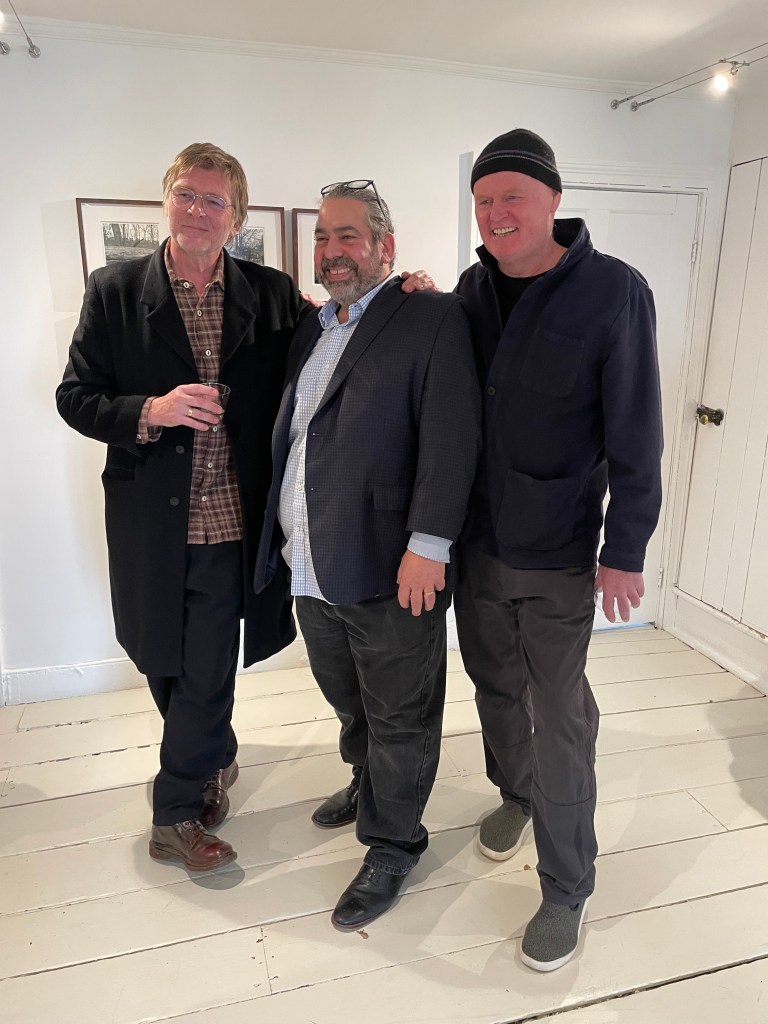
We aren’t the only weirdos in our neighborhood who live abroad for part of the year. I present Gerard, who lives down the hill from The Spartan Woman’s and my Staten Island home. He’s a photographer who has a business making beautiful photographic prints. If you’ve been to any photo exhibit in the recent past, most likely you’ve seen his exhibition prints.

Gerard, a first generation American of Italian parents, also has a family home in the hills south of Rome and north of Naples. He and his father bought the house back; it had been out of the family for some time. So he and his wife and family spend some time there each year. It was fun a couple of years ago to see Gerard in Perugia. He and his wife Toni Ann were driving around Central Italy and for a few hours, Perugia had a contingent of Randall Manor residents wandering around—we’re good tour guides—and having a terrific lunch at Il Cantinone.

Last weekend, Gerard’s photos featured in an opening of an exhibit of local photographers. His photos depict the woods in our neighborhood. I’m still amazed after nearly 30 years of moving here that we have a forest in the middle of what is a fairly dense North Shore Staten Island neighborhood. For an hour or so, you can wander past a pond and into the forest, following trails that scale a couple of hills and wind up at another pond. You’d never know that you’re in New York City.

But back to the exhibit. It was held, appropriately enough, at the Alice Austen House. Now a museum, the gracious estate was once the home of one of Staten Island’s stars, the photographer Alice Austen. When she lived there, the place was called Clear Comfort, and it’s in a beautiful spot right at the edge of New York Harbor. From the rolling lawn that descends to the bay, you can see Brooklyn, the Verrazano-Narrows Bridge, Manhattan, and New Jersey.

Austen, who died in 1952, was an intriguing character. A member of Staten Island’s upper class, she got a camera from her uncle and was immediately hooked. She photographed her friends and family playing tennis, mugging for her on the beach, and attending fashionable parties. She also ventured into Manhattan and photographed people on the streets, many of them poor immigrants scrambling to make a living. Try to imagine a young woman more than 100 years ago hauling cumbersome cameras around and the heavy glass plates that she used as film. (Remember film?)

She and her friends called their doings “the larky life.” And there was something else about Austen that until recently, the prissy Staten Island Advance (the only local daily in New York) never mentioned: Austen was gay. She had a long relationship with another woman and because of her social standing and personal wealth, she broke free of the constraints that women of her time had to live under.

I WAS THINKING OF Alice earlier this week when Staten Island’s St. Patrick’s Day parade took place. It’s earlier than the bigger city parade, presumably so underage alcohol abusers could have an extra day to get wasted. The parade is notorious for another reason: It’s the only St. Pat’s parade that every single damn year bars the local Pride Center and the police gay group from marching as groups. It’s straight out of the Taliban’s playbook. Every year our friend Carol Bullock, the genial and all-around cool head of the Pride Center applies to march in the parade. And every year, parade committee chief Larry Cummings turns her down.

Carol Bullock of the Pride Center of Staten Island

Cummings hides behind what he maintains are Catholic teachings about homosexuality. Yet his boss in religious matters, Pope Francesco, in an interview in January with The Associate Press said: “Being homosexual isn’t a crime.” Noting that some prominent clergy back anti-gay laws, he added, “These bishops have to have a process of conversion,” and they should apply “tenderness, please, as God has for each one of us.”

The situation reached a head this year. When Carol tried to submit her application, there was a physical altercation at a church where Cummings was taking parade applications, with that brave man Cummings shoving a press photographer. The police had to be called to calm things down, and Cummings remained a bigoted little soul who kept those nasty LGBTQ people out of his ever-shrinking parade.

Because of his stance, the island’s public high school marching bands won’t participate, and their youthful exuberance made the parade fun to watch. It seems that most of this year’s participants were motorcycling groups and guys with old cars. We can’t forget three local Republican politicians, including the borough president Vito Fossella, who achieved notoriety when, as a U.S. congressman, he kept another family in the D.C. area and it emerged only when he was arrested for DWI. Cummings is in great company.

I’m sure Austen would have appreciated, if not actually relished, the irony of how she became, as a fairly open gay woman, a Staten Island icon as a few 21st century Staten Islanders tarnish the reputation of her beloved hometown.

Another life, another planet

When I “lost my job” a few years ago, one of my deputies very kindly packed everything up in my cubicle and shipped it to me using the company’s cash. It was a terrific gesture, and to make it complete, he handed in his resignation the following day. Good work, JW. (He now covers the White House of Mad King Donald every now and then for a large media company, which shows that being good pays off sometimes.)

I took a look at the boxes back then, put the lids back on and promptly forgot about them. Back then, I was too busy wandering the city, riding the new Second Avenue subway, and meeting friends in bars (remember?) to deal with the detritus of too many years.

But now we’re in purge mode, with an eye to escaping KD’s failed state eventually. And The Spartan Woman found the boxes and suggested very nicely that I scan what I need onto a backup disk and discard the hard copy. She also found a trove of family photos from when our kids were little. We switched to digital cameras early on; I’d been given one in the late 1990s. It was a terrible, low-resolution thing, but it got me used to the idea of saving pixels, not paper. So I thought that spending some hours with the scanner and the laptop was a splendid idea, because doing so keeps me in my back of the house refuge, which is equipped with decent speakers and is out of the hearing range of HGTV/MSNBC/Guy’s Grocery Games.

Reading the magazines was a forced trip down memory lane, to use a cliché. I was an editor, so I don’t have tons of article clips, although when I did act like one of the peeps to report and write, I think I acquitted myself pretty well. What I do have in abundance are editor’s notes. I was the editor in chief of a scrappy little magazine (and later, website) for lawyers who worked in companies, nonprofits, etc. Basically it was a business magazine in which we inserted lawyers to make it relevant to the audience. It worked occasionally.

While scanning, I realized that I said the same thing multiple ways, and smirked at the different ways I snuck noncorporate messages and anecdotes into a business magazine. After a couple of years, I became bored of the sacred Editorial Calendar, with the same features turning up the same months year after year, so I made the editor’s note about me, me, me. I’d write about a personal experience and somehow make it relevant to the articles in the magazine. I’d also make fun of business jargon, slipping it into asides to see if our copy editor would notice. (She did, and was in on the joke,)

We—okay, The Spartan Woman—has also unearthed a trove of photos. I knew they were in the basement somewhere. But from 2001 or 2002, with some earlier scanned stuff, our family photos were mostly digital. There’s a whole analogue couple of decades that I’d been missing. So finally I got to remember how our kids looked when they were little. We have a lot of them—TSW’s dad was a photographer and he’d toss me a few rolls of film every now and then and the mailers to have them processed. So taking photos of dinner parties, kids just being kids, etc., vacations are there. Now I’m wondering whether to scan them, like I scanned my father-in-law’s photo scrap book and a bunch of pictures from TSW’s childhood.

This all has just a little to do with the usual subject of the blog, which is about showing what real life in Umbria is like, and our experience straddling that green Italian region and life on the periphery of New York City. I’ll get back to that soon. But we’ve been trapped in NYC by the Covid-19 pandemic and frustrated in our attempts to leave. Still, I guess that getting ready for a big change inevitably brings up memories. Gotta say, as I looked at what we did at that little magazine, I respected the craft and passion we brought to subjects that feel irrelevant to me now. And those kids were super cute, no? (They still are.)