Well, this definitely feels different

After years of slowly, glacially, indecisively moving over, we’re finally doing it. The old house in New York is mostly empty and being renovated by its soon-to-be occupants (we’re keeping it in the family), while a few dozen boxes of personal effects are somewhere in a warehouse awaiting shipment to us here. This house has been ready for years, even if there are features here and there that we’d like to put in. My ex-editor used to tease me about my commitment issues, so take that, boss.

This old (by American standards) house will soon have new occupants.

Call it procrastination, call it circumstance, call it Covid-19, whatever. Up to now our stays here on the Umbrian hilltop have felt like really long vacations, even if we had to do everyday stuff like renewing the car registration. Not to mention taking the garbage and recyclables to the “tip,” as Brits would say. (We’re talking about a few plastic bins down the road. More on this last bit later.)

All that’s left is some bureaucratic stuff It also means that we’ll be back in the U.S. less, and in some ways that’s a relief.

Let me explain. I don’t usually like to do the we have this, they have that game, but to understand something, or a place, you often have to stand outside of it. Such is the case with the country of my birth. Our four- or five-month stays away have given me some perspective. And I gotta say I don’t like what I’ve been seeing. After one absence a few years ago, for example, we suddenly saw monster gas-guzzling pickup trucks everywhere. In New York City. Driven to the supermarket and on the school run. Really?

Relax, it’s just an induction cooktop, not a culture war. And water boils real fast.

More recently, and especially after Covid, there’s a palpable feeling of anger on the streets. Maybe we’ve gotten too used to the easy sociability here in Italy, where every encounter is a potential long conversation, but our fellow Americans seem sullen and angry. You feel it even when driving, when every SUV and pickup surrounding us seems to be driven by a lunatic. People do stuff that Americans used to accuse Italians of doing, ignoring stop signs, passing on the right only to make a left turn, driving at ridiculous speeds on local streets. No wonder there are speed cameras everywhere. It’s not just driving; shop clerks are nasty and ‘net bulletin boards are full of snarky comments.

What makes me really sad, though, is how the U.S. seems stuck in the past. Sure, this Mac I’m writing this on is up to date, and companies are always updating products and services. But every single change, even trivial ones like cooktops, has become a political and cultural minefield. Meanwhile, the Old Continent moves on. Not everyone likes it, I’m sure. But the feeling that this is 2020-something and we have to deal with climate change is palpable, even here where a right-wing government was elected last fall. (Never mind that the prime minister is a relatively young woman, who isn’t married to her partner, the father of her child.)

LET’S GO FOOD SHOPPING, just to make a few points. Here we are at the garbage bins. We drove here with our pint-sized Renault, which is due to be replaced by an electric model in a couple of years. You can argue about the ultimate merits of recycling, but for now we have to sort our garbage. One bin gets plastic, and almost everything plastic counts. Another is for paper, another for regular garbage. And the final, smelly one is for organic food waste. There’s a glass bin down the hill; we love the sound, as Nick Lowe once wrote, of breaking glass.

The Clio encounters some garbage bins on the way down the hill.

I’ll cop to the fact that we shouldn’t have driven so long to get to a supermarket. But in landlocked Umbria, just the occasional store has fresh fish, and these former seaside people gotta get our fix. Notice that there’s something different about the parking lot. Those panels shading the cars aren’t just pieces of plastic and steel; they’re solar panels. And these panels supply a big part of the shopping center’s electricity.

Those panels aren’t just there for the shade.

A lot of people, and especially Italians, criticize this country for being fossilized. And I can see that when it comes to some bureaucrats (let me tell you about the woman at the water board…). At the same time, we have a decent infrastructure, fiber Internet is being rolled out across this region, and, especially since Covid, most people just tap their phones or cards to pay everything from a coffee at the bar to induction cooktops at the Italian version of Best Buy.

And our prime minister and the opposition leader are both women.

We had no power, so we went out for coffee. And to look for castles, run an errand, and eat lunch.

It was awfully nice of the power company to warn us of upcoming work and an outage this time. Power outages here in the country are usually of the unplanned kind. The last time it went out, we got back home to a dark house, and a phone call to report the problem let me know that they were working on it and we’d be back online in a few hours. This time, for planned work, the power company posted notices up and down the road and stuffed our mailbox with one.

So we woke up early enough to use the espresso machine and to make sure our devices were charged. We sat around wondering if they really were going to cut the juice at 8:30 because it was a rainy morning. And at 8:32 the music stopped and the wifi cut out. We started to read novels but after awhile thought instead of waiting around, we’d go check out the borgos in the area that we always see from the road and say “we’ll have to check out XX one of these days.” Finally, it was one of those days.

If you’re new to this blog, a brief explanation. This region is called the mystical heart of Italy for a good reason. It’s densely wooded, hilly and mountainous, depending on where you are, and it’s dotted with castles, both adapted for modern use or abandoned, lonely testaments to the days of chivalry and bloody battles between city-states.

But first up was coffee. We had some at home, but we needed booster shots. And we had all the time in the world. We have a bunch to choose from and this morning we went to the next town, which has a sweet bar with lots of outdoor seating—perfect for a pandemic. Unlike bars (cafes in the U.S.) in touristy areas, in these local spots you don’t pay extra to hang around. Sure, you can grab a quick one standing at the bar, but in this area you tell the barista what you want and bring it to a couch or table and hang out until you need to go. First stop, then, was the Bar Dolce Vita in Pianello, behind a gas station. So what if it’s not romantically located? Good coffee, terrific outdoor seating, friendly baristas—it’s a genuine neighborhood hangout.

The first borgo on the list was Castel d’Arno (apologies for the outdate and weird-looking website). It’s a hamlet that’s part of Perugia and is up a narrow winding road. Yeah, you can describe most of the roads around here that way. We saw some workmen, and a guy supervising their work told us he rented out apartments in the hamlet. He told us to walk under an arch to an overlook and wow, even on a day full of threatening clouds and mists, the view was pretty fantastic.

It was raining down there, but not at Castel d’Arno.

Next up? Sterpetto, another tiny borgo, this time part of neighboring Assisi. Sterpetto is bigger than Castel d’Arno and looked in better shape. In general, Assisi seems to maintain its outlying hamlets better than Perugia, whose “frazioni” often seem to suffer in favor of the jewel-like historic center. Sterpetto has a working church and buildings that people actually live in. Its site is comparable in that wow factor, but Sterpetto just feels less like the 21st century has passed it by. Our gardener told me a funny story involving the borgo. A local businessman, a big man in every way, decided he’d lose weight by walking from the neighboring Pianello up the hill to Sterpetto and back. Sounds like a plan, right? Problem is, a guy works up an appetite on a long walk like that, and this man ate a couple of pizzas on the way back. Pizzas in Italy are individually sized, but still….

Would The New York Times call Sterpeto “tidy and well-kept”?
New desk lamp, meet old worry beads.

Speaking of the 21st Century, we next dropped into it by stopping at the megastore Leroy Merlin. It’s a French chain of big box stores that’s sort of like Lowe’s or Home Depot. Only L-M, or as The Spartan Woman pronounces it, “Lee-Roy,” is more stylish. With time to waste until pranzo (lunch), we looked at the light fixtures—I needed a new desklamp—and the tiles. We picked up some strong brackets to hang an amazing poster a friend sent us of the Spolete “Due Mondi” music festival, and took mental notes for a not-happening bathroom renovation.

Finally, lunch. We figured we still had some time to waste before the juice came on. We debated most of the morning off and on where to go. We could have gone north, back to our area to, perhaps, Il Panaro near Gubbio. Terrific torta al testo and rootsy homemade food. But there’s a strange waiter who may or may not pretend that he doesn’t understand our order and who once offended a diminutive but not too small friend of our kid’s by giving her a tiny wine glass.

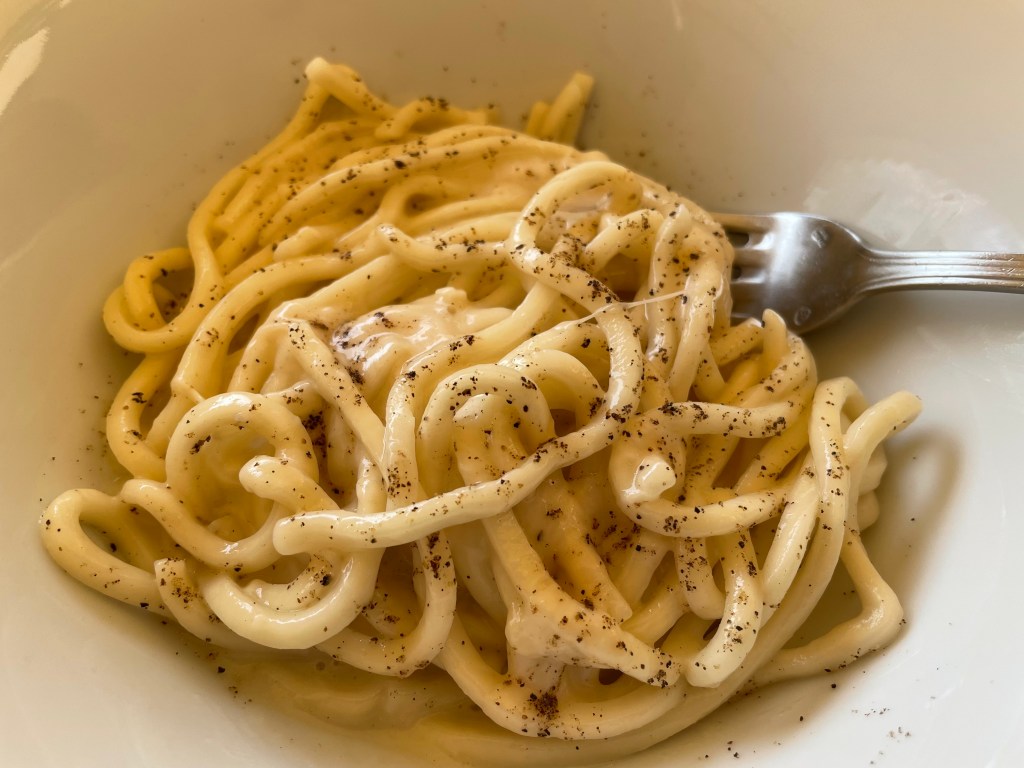
We were almost in Assisi anyway. We normally avoid the place during the day, especially in summer, because it’s crawling with tourists and pilgrims and nuns and monks and souvenir vendors and….you get the idea. But on the off season and at night, it’s just a really pretty hilltown. The Spartan Woman remembered having really good stringozzi cacio e pepe at a restaurant right on the main piazza, the Taverna dei Consoli, which sounded good to me. We had equally decadent antipasti, little onion tartlets with a creamy truffle sauce for me, and a fonduta of pecorino and truffle for her. We spent a bit more than we normally would for an impromptu lunch, but it was worth it. Besides, we took the really long way back to the car, so we worked it off.

Even better, the lights came on an hour before they promised.

Image up top: the piazza outside the Basilica di San Francesco in Assisi, as seen from above and in black & white