I might go for a drive today. Not because I want to go anywhere, but I can turn up the air conditioning and be almost sweat-free for a half hour or so. Until my conscience gets the best of me: Fuel for our economic little Renault costs €1.70 a litre, or $7 and change a gallon. Not bad, and probably a decent price to pay so that my brain doesn’t fry.
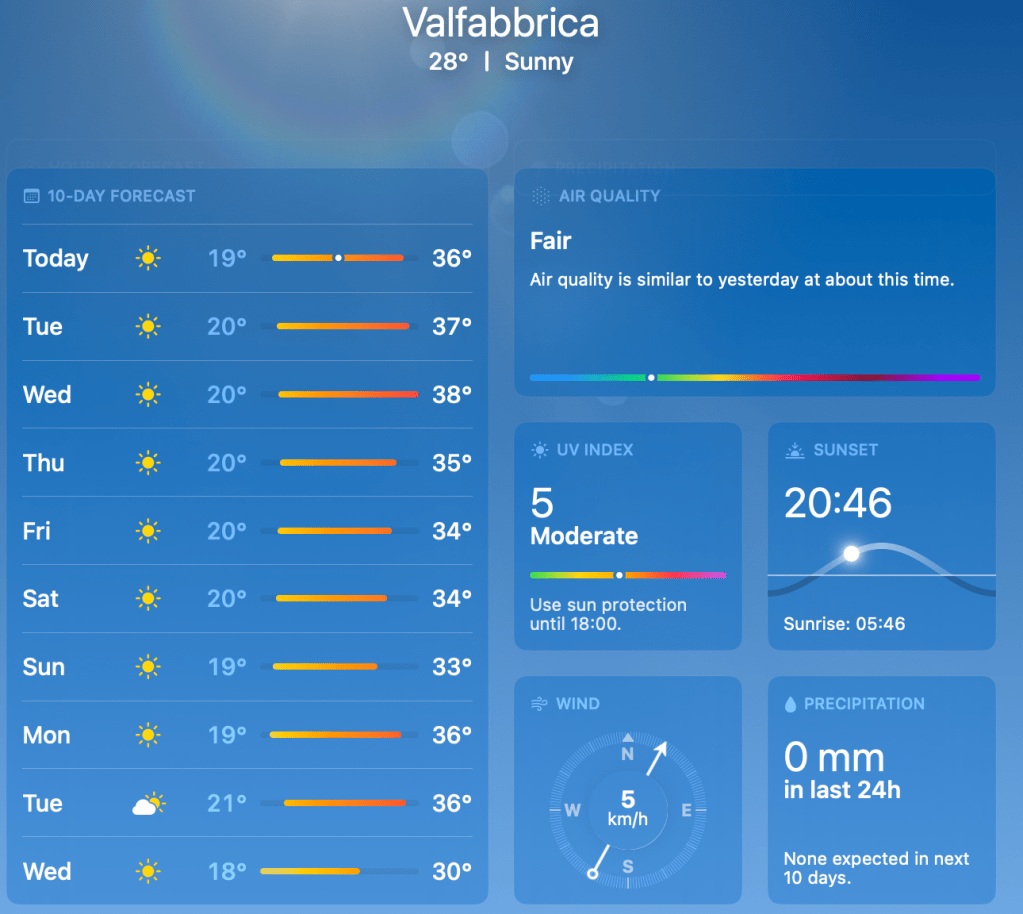
In case you’ve been offline or not paying attention, Southern Europe is in the midst of a heat wave. I forgot the heatwave’s name this week—yeah, they started naming them in Europe. Maybe Cerberus? Anyway, it’s hot. Really hot. Go out the door and flinch hot. Here’s a screen shot from my weather app:
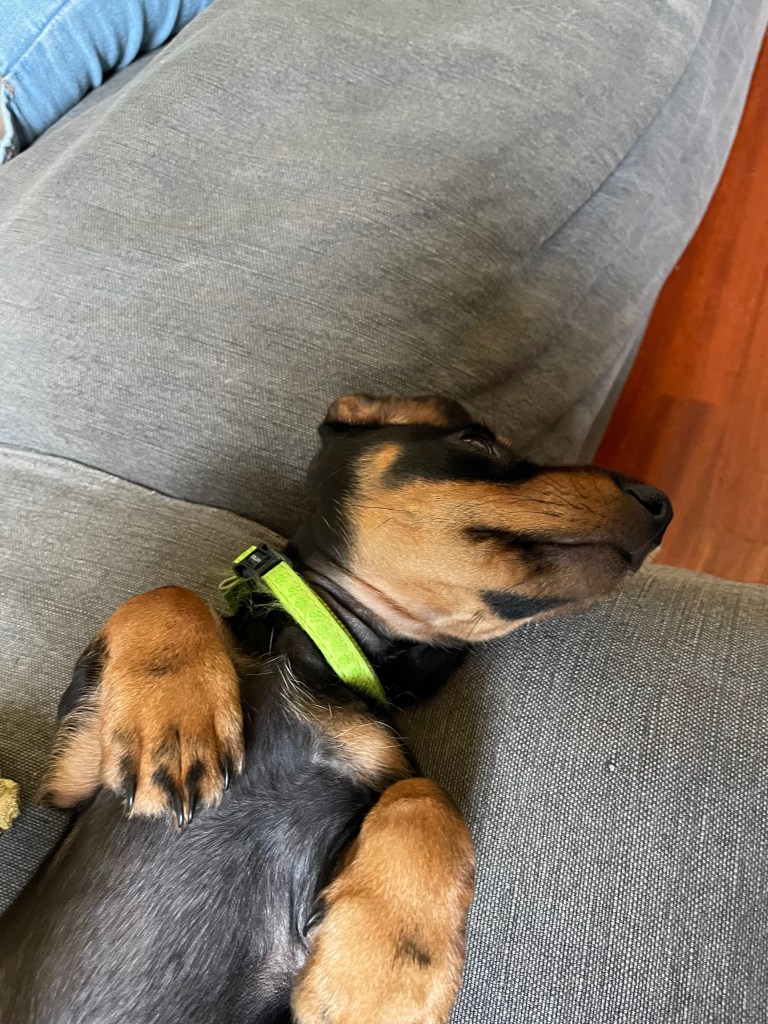
Dog days: Niko being sensible
For the Celsius-challenged of you, 37 is body temperature; each degree C is almost 2 degrees Fahrenheit, so 38 is 100.4F. Ugh. Serves me right. A couple of years ago I boasted that we could live without air conditioning up here on our hill. My bad. Even our hyperactive puppy (and new addition to the fam) Niko has taken to sleeping in the dark during the day. Actually, all three of us do. We try to bottle the cool morning air by opening up overnight. Then in the morning, we close the shutters and lock the windows shut. Then while inside we live in the dark like vampires, trying to avoid too much movement. We make it outside to swim as the sun starts to descend late in the afternoon.
Problem is, people gotta eat. The Spartan Woman did make a supermarket run yesterday morning—lucky her, she got to turn on the A/C. Old Perugian friends were coming over and we had to feed them and us. But instead of the typical mid-day meal, we had cold stuff: cheese, a Caprese salad (tomatoes, mozzarella, and basil), and salumi (Italian charcuterie, or cold cuts). We drank cold liquids and ate in our cool (literally) downstairs kitchen.
A/C alternative. Can we get deliveries while we float?
Luckily, we were able to go swimming. We built a pool when we bought this house and it’s the best investment ever. Silly me, after last month’s endless rain, dark cool cloudy days and general low temperatures, I thought we’d hardly get any use of the “cee-ment pond,” as they called the pool in that stupid TV series The Beverly Hillbillies. Wrong! I’d live in it if I could, except that I have to swim underwater to keep the sun from overheating my head. Yeah, I know, first world problem.
So, splashing around. That’s what we did all weekend. Friends and ex-colleagues of TSW were due to arrive in Perugia on Thursday, and we were going to show them the town. But a train strike put an end to that. They rebooked for Saturday, but instead of trekking around the hilly city and dying of heat stroke, we brought them to our lair and we spent a good part of their few hours here in the pool. It was a nice change for them from touring; the videos and photos from tourist favorites like the Trevi Fountain are horrifying for this crowd-averse blogger. Take a look:
Summer in Umbria: festivals, swallows putting on an air show for us, cool hikes in the mountains, and dinners with friends, old and new. Hey I know it sounds impossibly idyllic, but hey, after commuting to a packed newsroom for 30 years and pretending to care what corporate lawyers do, I deserve it.
I’ve written before about the sagra (think of a town festival, usually featuring an ingredient the town is or would like to be known for) of truffles in Ripa, two towns down the road from us. Ripa has a tiny circular fortified historic center and otherwise sprawls across some suburban development and farms. The sagra is going on as I type, but a few nights ago the town held a preview dinner with a few of the dishes that would later be served to the crowd.
We figured what the hell, let’s try the dinner. At €20 each, or about $22, it seemed a bargain, with four courses and water and a coffee included (wine was extra, but at prices that beat retail in the U.S.). Besides, it’s always great to go to these communal dinners. Our town holds them every so often, and they’re terrific, with good food, interesting tablemates, and, often, a DJ.
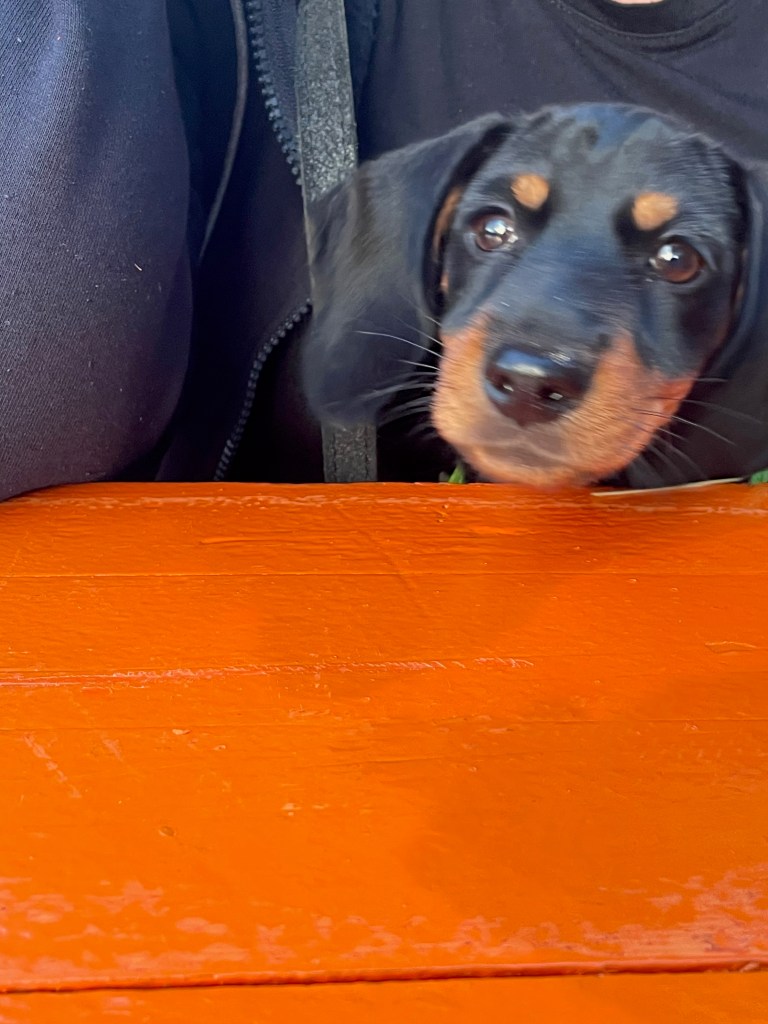
Niko gets a seat at the table.
We had a big life event in between reserving our places and the dinner itself: the addition to our family of a scrappy dachshund puppy we named Niko. Dogs go everywhere with their people here in Italy. We’ve eaten at Michelin-mentioned places and seen big dogs sitting placidly under the table. Should we take Niko? In just a few short days he’d grown attached to us, so we gave it a try.
We shouldn’t have even debated it. Niko turned out to be our passport to conversation. While waiting on line to pay at the start of the evening, he obligingly looked cute for the people around us. And he was pretty mellow as the crowd around our table got louder and more boisterous as food was served by Ripa’s kids and teenagers.
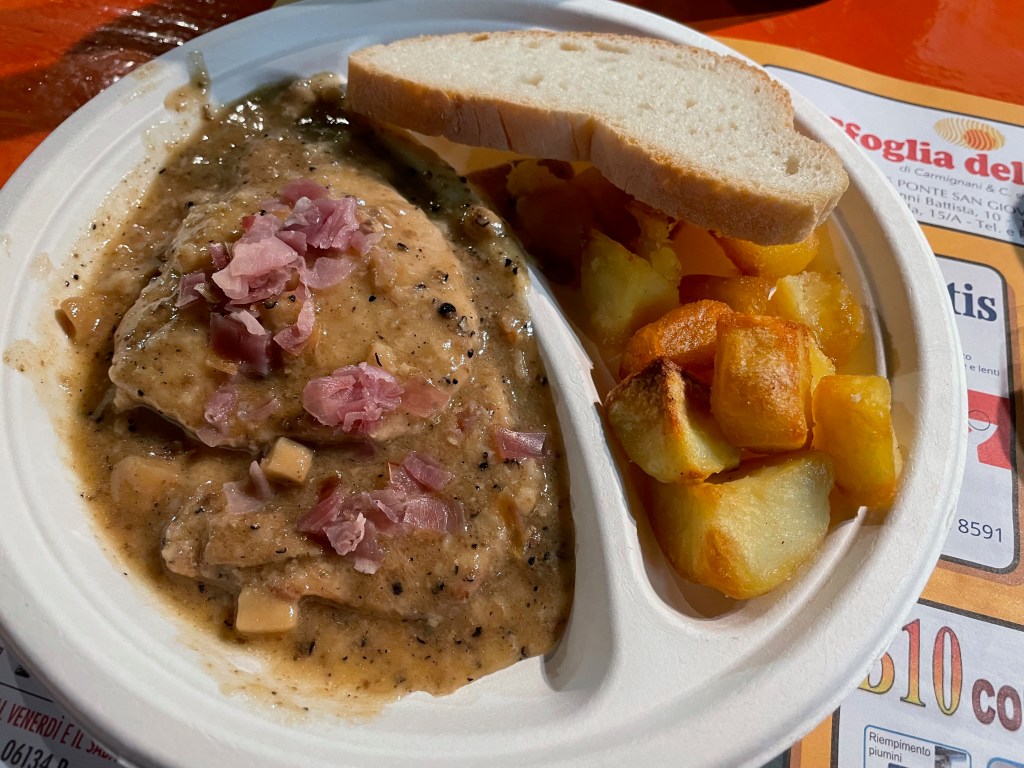
Foodies, here’s what we got for our €49 (2 x 20 + €9 for a bottle of local white Grechetto wine): Truffle bruschetta, gnocchetti (little gnocchi) with truffle sauce, tagliatelle with truffles (a bit too salty we told someone who asked on behalf of the town), pork scallops with truffles nd roast potatoes, and chocolate gelato with truffles [see photo gallery below].
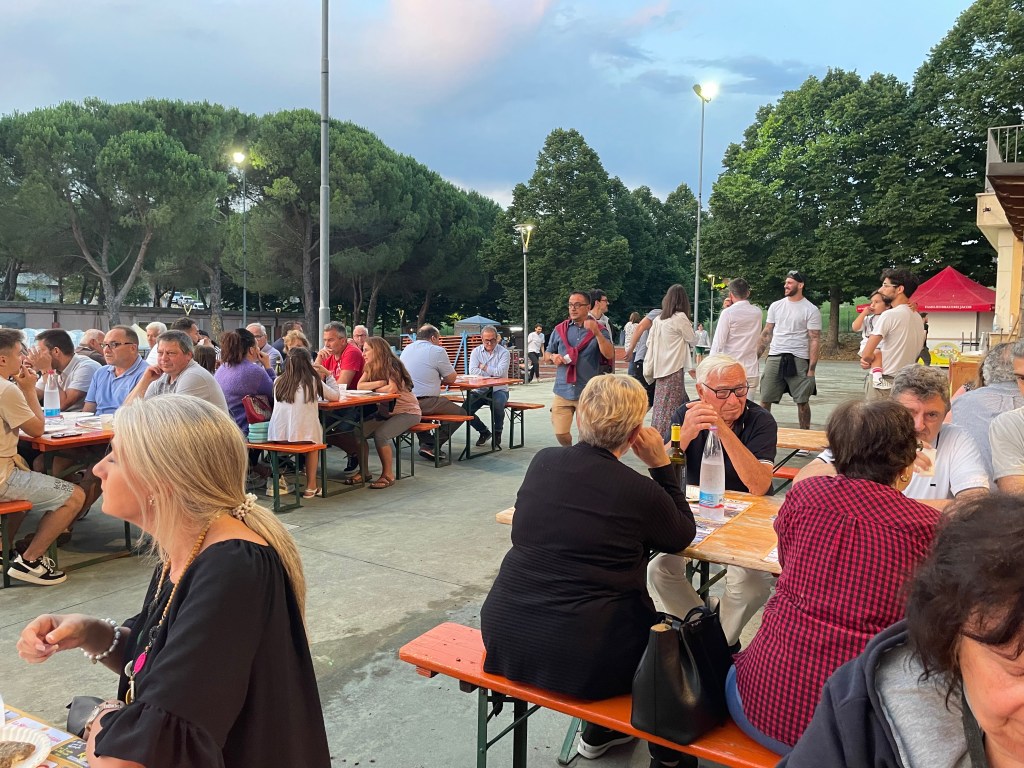
Dinners like this are pretty rustic, even if the star is the local black truffle. Plates are biodegradable plastic, as are drinking cups for both water and wine. You sit at picnic tables and if you don’t fill the table, you’re going to get to know others who find seats at the table.
The good people of Ripa served about 300 dinners that night.
Or not. At least at first. We sat alone for awhile, one of the few couples not part of a jolly family or friends group. It was okay, because the people watching is always good. But then a couple came up to ask if there were empty seats at our table. There were.
The two couples, us and them, sat for awhile mostly ignorning each other. They apparently know everyone because most people passing the table stopped to greet them. We were happy just to sit and enjoy the warm summer night, and eavesdrop every now and then on people’s conversations.
Enter Niko once again. He wanted to see who dared to sit near us, so we held him up and predictably, our tablemates asked us about him in a way that would be familiar to parents of cute babies. They picked up on our New York-inflected Italian. Where are we from? We gave our town here, which usually elicits a chuckle. Then we came clean. Why here? We like it. We’re Italian, too, we add. We tell them about NYC’s high prices, which always comes as a shock to those who haven’t been. Within a few moments, they knew our life story.
I had to turn the tables and get them to tell us who they are. As it turns out, he’s a local dentist. Being nosy and needy, I asked him how much implants cost. (It’s less than a third what a NY dentist would charge.) The wife gave us his business card. We talked about different towns, schools, etc. Then dessert came—a Dixie cup of chocolate gelato with truffle shavings. It was getting chilly, so we all decided to leave, another communal event under our belt.
After years of slowly, glacially, indecisively moving over, we’re finally doing it. The old house in New York is mostly empty and being renovated by its soon-to-be occupants (we’re keeping it in the family), while a few dozen boxes of personal effects are somewhere in a warehouse awaiting shipment to us here. This house has been ready for years, even if there are features here and there that we’d like to put in. My ex-editor used to tease me about my commitment issues, so take that, boss.
This old (by American standards) house will soon have new occupants.
Call it procrastination, call it circumstance, call it Covid-19, whatever. Up to now our stays here on the Umbrian hilltop have felt like really long vacations, even if we had to do everyday stuff like renewing the car registration. Not to mention taking the garbage and recyclables to the “tip,” as Brits would say. (We’re talking about a few plastic bins down the road. More on this last bit later.)
All that’s left is some bureaucratic stuff It also means that we’ll be back in the U.S. less, and in some ways that’s a relief.
Let me explain. I don’t usually like to do the we have this, they have that game, but to understand something, or a place, you often have to stand outside of it. Such is the case with the country of my birth. Our four- or five-month stays away have given me some perspective. And I gotta say I don’t like what I’ve been seeing. After one absence a few years ago, for example, we suddenly saw monster gas-guzzling pickup trucks everywhere. In New York City. Driven to the supermarket and on the school run. Really?
Relax, it’s just an induction cooktop, not a culture war. And water boils real fast.
More recently, and especially after Covid, there’s a palpable feeling of anger on the streets. Maybe we’ve gotten too used to the easy sociability here in Italy, where every encounter is a potential long conversation, but our fellow Americans seem sullen and angry. You feel it even when driving, when every SUV and pickup surrounding us seems to be driven by a lunatic. People do stuff that Americans used to accuse Italians of doing, ignoring stop signs, passing on the right only to make a left turn, driving at ridiculous speeds on local streets. No wonder there are speed cameras everywhere. It’s not just driving; shop clerks are nasty and ‘net bulletin boards are full of snarky comments.
What makes me really sad, though, is how the U.S. seems stuck in the past. Sure, this Mac I’m writing this on is up to date, and companies are always updating products and services. But every single change, even trivial ones like cooktops, has become a political and cultural minefield. Meanwhile, the Old Continent moves on. Not everyone likes it, I’m sure. But the feeling that this is 2020-something and we have to deal with climate change is palpable, even here where a right-wing government was elected last fall. (Never mind that the prime minister is a relatively young woman, who isn’t married to her partner, the father of her child.)
LET’S GO FOOD SHOPPING, just to make a few points. Here we are at the garbage bins. We drove here with our pint-sized Renault, which is due to be replaced by an electric model in a couple of years. You can argue about the ultimate merits of recycling, but for now we have to sort our garbage. One bin gets plastic, and almost everything plastic counts. Another is for paper, another for regular garbage. And the final, smelly one is for organic food waste. There’s a glass bin down the hill; we love the sound, as Nick Lowe once wrote, of breaking glass.
The Clio encounters some garbage bins on the way down the hill.
I’ll cop to the fact that we shouldn’t have driven so long to get to a supermarket. But in landlocked Umbria, just the occasional store has fresh fish, and these former seaside people gotta get our fix. Notice that there’s something different about the parking lot. Those panels shading the cars aren’t just pieces of plastic and steel; they’re solar panels. And these panels supply a big part of the shopping center’s electricity.
Those panels aren’t just there for the shade.
A lot of people, and especially Italians, criticize this country for being fossilized. And I can see that when it comes to some bureaucrats (let me tell you about the woman at the water board…). At the same time, we have a decent infrastructure, fiber Internet is being rolled out across this region, and, especially since Covid, most people just tap their phones or cards to pay everything from a coffee at the bar to induction cooktops at the Italian version of Best Buy.
And our prime minister and the opposition leader are both women.
Quick! When you think of Italy and its food and drink, what springs to mind? Pasta, sure. Pizza, definitely. Maybe gelato, and of course, a glass of wine to go with the meal. In fact, Italy is the biggest wine producer in the world, flooding shops and supermarkets globally with gallons of Prosecco, mass market Pinot Grigio, and fine reds and minerally whites.
But Italians are also beer drinkers. It’s not to the extent that Germans, Brits or Americans are—you don’t see Italians having keggers, and they tend not to wander around the cities in a beer-drunk haze. But historically, people here drink beer when it’s hot, or if they’re having a pizza night out.
Up until recently, mass market beers ruled Italian supermarket shelves and restaurant menus. But the micro/artisanal brew trend came to Italy too, and people appreciative of good beer have a wide selection of often local, interesting brews to choose from. Restaurateurs have picked up on the trend, too. Not from our house is a place called Umami Beer, whose owner has scanned the world for interesting brews for his patrons. The menu is eclectic too, with a wide selection of snacks, burgers and more traditional local dishes. It’s all part of the general loosening up of the culture, as more Italians travel abroad and acquire a taste for a wider palette of flavors.
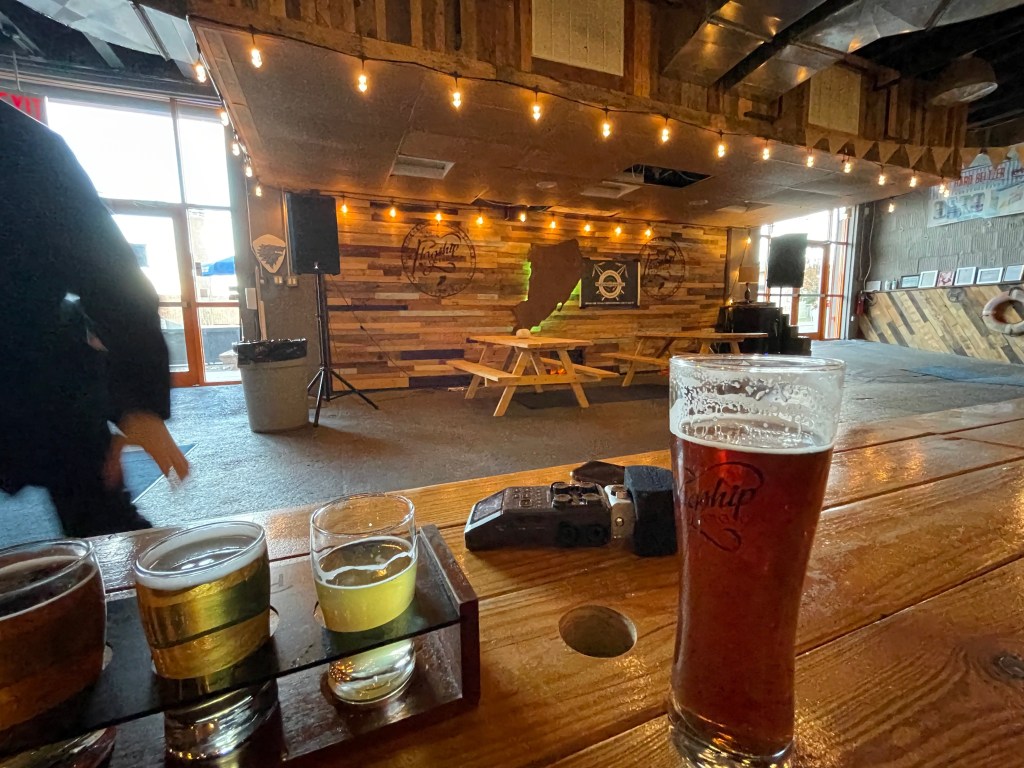
The taproom of Staten Island’s finest
Before leaving New York, I paid a visit to one of Staten Island’s two local small breweries, Flagship. The good people there like to name their brews after local places and people. The island’s population is about 37 percent Italian-American, so in recognition of that, they named a Pilsener-style beer (popular here) Birra Locale. (You should be able to figure it out, but if not, it means “local beer.”) My slightly perverse mind thought it would be fun to bring that Birra Locale to an Italian artisanal brewery.
My target: the brewers of Birra Flea. In this case, “flea” is not the pesky little bug infesting the cat and your carpets. The name derives from a local river. I thought it might refer to a family, but no. I took minutes—minutes, I tell you!—of intense online research to learn this. The beer is definitely one of the shining lights of artisanal brews. The big Coop supermarket here places it in its cantina of good wines and small-producer beer, and Roman celebrity chef Max Mariola drinks it regularly as he shows his YouTube following another recipe. Flea comes from Gualdo Tadino, a town about a half-hour from our house that nestles in the foothills of the Apennine Mountain chain.
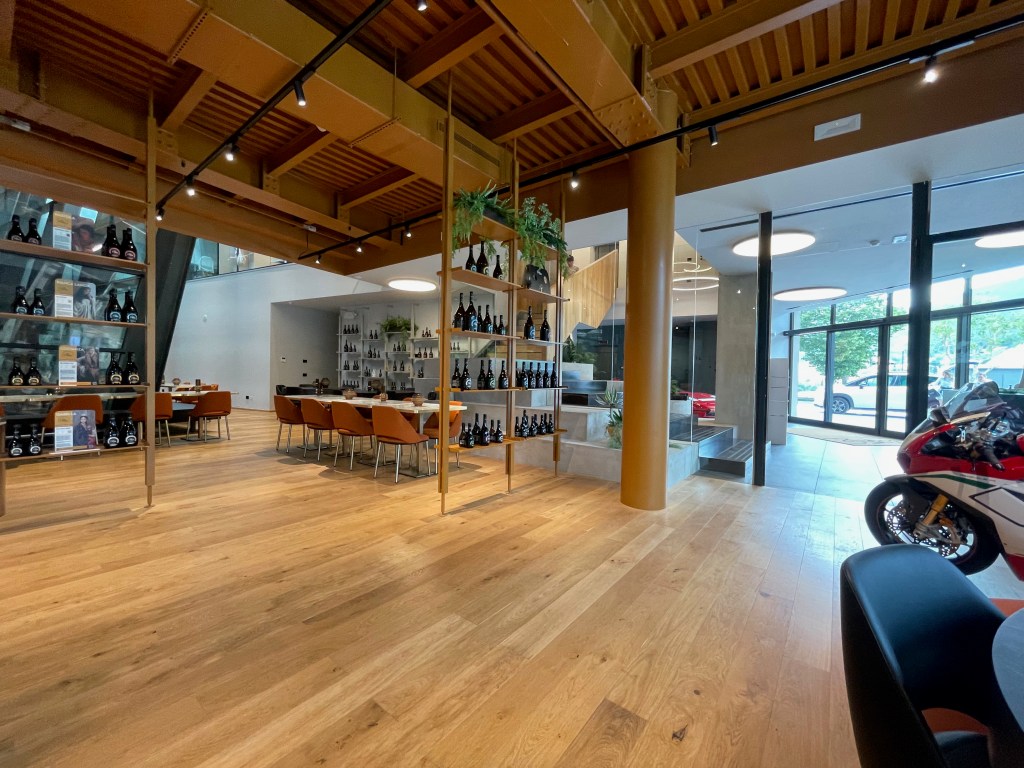
OFF I WENT THIS MORNING. Flea’s headquarters and brewery is located outside Gualdo on an isolated road. I had serious doubts that anything except a farm might can exist there. But I asked a couple on the road if I was on the right track and they assured me that the brewery was, in fact, down the road. Of course, it ended up being hard to miss, a modern charcoal gray-to-black edifice dominating the area. To emphasize its importance, the outside sign reads “Universo Flea.” I thought, well, this is more than a folksy little brewery.
However imposing the building is, the reception was the typical friendly greeting that’s pretty universal in this part of Italy. As soon as I stepped through the doors, they knew who I was and why I was there. (It wasn’t a mystery; you reserve a tour and sampling on Flea’s website.) The decor is modern yet warm. And for some reason, they have a historic red (what else?) Ferrari parked near the reception desk.
Sara poses with a birra that is definitely not locale.
My handler Sara soon greeted me. I won’t bore you with the details of brewing, but I can say that I was impressed by the tranquil atmosphere, not to mention the huge fermentation tanks. Trashing a stereotype a lot of people have about Italy and artisans, Flea’s operation is decidedly high tech and as sustainable as it can be. They grow a lot of their own malt at a farm not far from where I live. The farm animals that came with the land supply them with milk, which they’ve turned into a cheesemaking operation. I’ve been fascinated by production lines ever since I was a little kid, and the bottling, tapping and packing machinery gave me tons to stare at and admire.
I’ll confess that I love conscientious food and drink producers. And breweries have a special scent, the sweet malt that perfumes the place. It kind of humanizes the assembly lines and the high-tech fermentation tanks. Beer, like wine, has a long history. Sara told me stuff I had no idea about, like how hops isn’t there just for flavor, but also acts as a natural preservative. And centuries ago, nuns figured out how it preserves but also balances the flavor. Before then, most beer was sweet, a natural result of the yeast reacting with the malt or other grain used to brew the beer.
By now, you probably realize that Flea may make artisanal beer, but it’s not a hole in the wall operation. They’re looking toward the future. Much of their electricity comes from solar panels. (In fact Italy leads Europe in solar-derived energy.) And now they’re going to try to brew beer from the air; they’re experimenting with a technology that pulls humidity from the air. They’ll pilot test that water for brewing.
Who needs lunch when you’ve got this to go with the tasting?
At the end, I had a taste test. I chose three beers from their list; I tried to pick different colors and strengths. “Margherita,” a wheat beer, was crisp, not too hoppy, and just right for a hot summer day, or a nightcap. Their golden ale, dubbed Federico II, was fruity and just assertive enough. And a Belgian style ale named Violante was, just as the label said, powerful and just right for a cold night and stew. Because we’re in Italy, food soon appeared in front of me, so I didn’t have to think about lunch—the cheeses on the tray come from their cheesemaking operation.
Flea turns a decade old this weekend. If the next decade resembles the past ten years, they may have to reassess that artisanal tag. In any event, this afternoon was a great way to see a bunch of mostly young people making a terrific product in a beautiful space.
Way back, late in August between my freshman and sophomore college years, I felt devastated. I’d come home after spending most of the summer in Sicily with my extended family. And there were no bars where I lived in New York. Okay sure, there were lots of places where you could get drunk and maybe, get lucky. But no bars in the Italian sense, and that made me feel lonely. I could joke about how most of my life since then has been a way to get back to the local bar.
But maybe it’s not a joke. So allow me to offer a tribute to the Italian bar. For those who haven’t been here, or haven’t paid much attention, a bar here isn’t like the American kind. Maybe in spirit like a British pub? Whatever. It’s sort of like a café, except that that word doesn’t quite capture the bar’s essence. Maybe, in the American context, it’s like the old small-town diners or cafés, where locals would gather, hang out, get anything from coffee to a meal, and share local gossip.
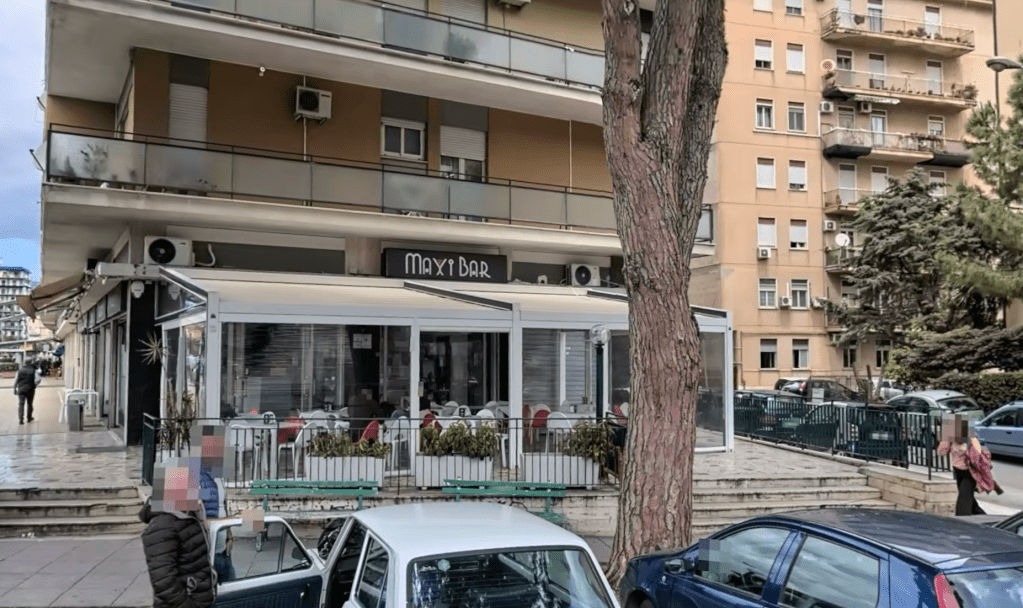
Bars are everywhere in Italy, from the big cities to small hamlets like Casacastalda, a 20-minute drive from Casa Sconita up a twisty country road. That bar has an amazing location overlooking northern Umbria’s hill-mountains. But they can be on a residential street, on a piazza, or even in the parking lot of a gas station. The toll roads through Italy, the autostrade, have amazing bars, some of them inside buildings that look like retro ’60s spaceships straddling the highway. The thing is, if it’s Italy, there’s a bar nearby.
You can get everything you want at the Autogrill—including an espresso or drink at the bar.
Basically, the bar serves most of your needs throughout the day. In the morning it’s the place for a cappuccino and a cornetto, or mid-morning, for office workers to have a booster shot of coffee (espresso mostly) before tackling some more emails. One of our friends here never makes coffee at home—he gets dressed and heads out to his favorite bar for breakfast, which here is usually coffee and a pastry. (His is the place in the gas station parking lot.) If you aren’t into sweet, there are little panini—my favorite is tuna and artichoke. Later in the day people stop for another pick me up, and around 6, an aperitif or cocktail, always served with a little snack, because here in the land of La Bella Figura, being obviously drunk in public is a faux pas.
It doesn’t take much to be a local. If you’re renting an apartment in Italy, even for a few days on vacation, one of the first things you should do is visit the local bar. Go two or three days in a row and you’re a regular. One barista in Perugia remembered us from getting coffee with our daughters in the morning. When we returned a few months later, he asked us why the girls weren’t with us.
We live in a small town here, yet I can think of at least five bars within a 20 minute drive. Three of them are down the hill from us. They all have their own style. The bar on our local piazza looks like it’s from the 1980s, but the real deal is to sit outside in the morning or late afternoon and soak up the sun and the murmur of the fountain combining with the sound of the local accent. And they serve addictive fried sage leaves with your Aperol spritz in the afternoon. Another, housed in a local shopping strip along with the main pharmacy and town supermarket, is Italian sleek modern. Even the spoons look like no spoons you’ve ever seen, and it takes a few seconds to figure out how to use them. Still, if I’ve been away, on my first visit we have to catch up with the barista and show pictures of the grandchild.
Breakfast in the piazza post-hike
Vian contemplates the view.
Come to think of it, we assign these watering holes to different occasions and frequent them with different sets of friends. Yesterday, for example, I met my friend Vian, a transplanted Canadian who moved to Umbria with his wife so that they could be near their daughter and grandchildren. He lives outside a town called Gualdo Tadino, a place with eccentric architecture that snuggles up against the Apennine Mountains. Vian and I like to meet for a mid-morning coffee and pastry, and we do it midway between our houses—that bar in the hamlet of Casacastalda. The place has a great view, and Vian, a sociable guy whose Italian improves every time I see him, is besties with the owner and always has conversations going with some old guy who hangs out there.
Uncle Ignazio’s hangout in Palermo
My Uncle Ignazio probably frequented his local bar every morning until he was taken to the hospital for the final call (he was in his nineties). A few blocks from his apartment, the bar was the focus for the pensioners, people on their way to work, parents taking their kids to school, and even groups of motorcyclists headed to western Sicily—his place was on the ring road around Palermo. A visit with him almost invariably involved a stop at the bar. He smoked (if outside) argued politics with his cronies, argued politics with his cronies, and did I mention that he argued politics?
I could go into coffee etiquette, what to order, when to pay and when to wait (Ok, big cities and the road stops are pay first, go to counter and get your stuff; here in the sticks, it’s whenever you feel like it.). But that’s for another morning. Right now, it’s about 23:00—11 p.m. in US-speak—and I’m thinking about this little bar in Perugia that whips its own cream and fills pastries with it for breakfast. Sweet dreams….
[Update: I went to that little bar.]
Finally, a great maritozzo at the Antica Latteria in Perugia
That’s the phrase that came into my mind as I boarded Iberia flight 6252 for Madrid last week. It was the start of a journey to Umbria in Central Italy, where I’ll register as a full-time resident. In doing so, I’m moving in the opposite direction of Carlo Ancona, my maternal grandfather, who tried to escape a second stint as a conscript in the Italian army during the incredibly stupid European conflict that we call World War I. (He failed and was drafted to fight in the trenches in the U.S. Army.) I’m also reversing the direction his wife, my grandmother Rosa traveled a few years after Carlo, sailing to New York in steerage with two young children. And finally, I’m canceling out what my father did in 1955, the year before my birth, sailing from Palermo, Sicily, to New York to join his bride, my mom Angelina Ancona.
All of them fled economic bad times. My mother’s parents were tenant farmers leaving the crushing poverty of the seacoast and agrarian town of Castellammare del Golfo, in northwest Sicily. “They ate pane e cipudda, bread and onions,” my mom would tell me. My father, from a middle class family in the big city, wasn’t starving. But when he left the Italian army, there was precious little opportunity for a restless young man in mid-’50s Palermo, the island’s largest city and capital.
What am I fleeing? Eh, nothing that affects me personally except, perhaps, boredom and endless HGTV programs like Love It or List It. I was involuntarily retired by Covid, when a lot of work I did dried up. A few years ago I did have a day job as a working journalist. I loved the job until it was turned into a soul-crushing exercise in scaring up website clicks by a bunch of Catalan consultants and dull-witted corporate executives.
I’m not alone in doing this reverse migration. Some 20 to 30 percent of the millions who left Italy during the great migration of the late 19th and early 20th centuries returned permanently to their homeland. In my own family, my grandparents and one of my aunts lived in the U.S. for a few years and then decided to return.
My Aunt Pia’s wedding on July 4, 1964. She and her new husband eventually moved back to Italy. (I’m the ring bearer up front.)
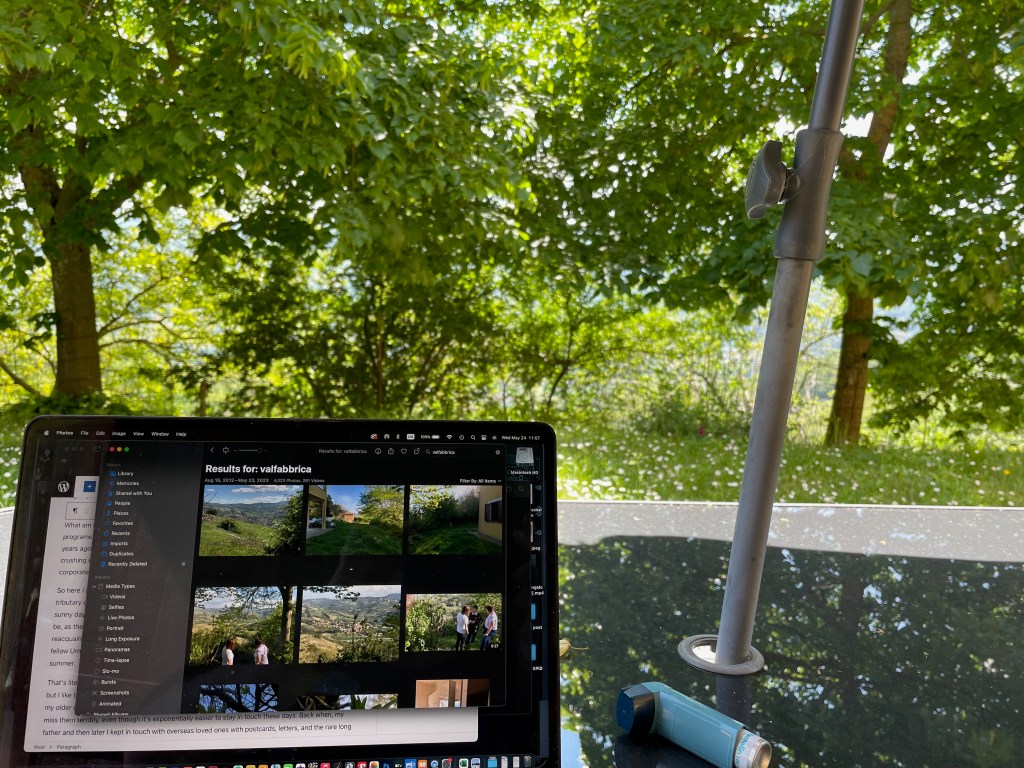
So here I am. I’m sitting on the patio of our house looking down into the valley of the Chiascio River, a tributary of the Tiber that runs to and through Rome 192 kilometers (about 120 miles) away. It’s a breezy sunny day, coming after a few days of leaden clouds and periodic cloudbursts. To call it pleasant would be, as the cliché goes, damning it with faint praise. We walked up and down our road earlier, getting reacquainted with the human and canine neighbors. Last night, we along with what felt like dozens of fellow Umbrians, ate gelato at a popular place a few towns away, signaling the start of a lazy Italian summer.
That’s literally and figuratively the sweet part. The bitter? Leaving my babies. Okay, they’re adults now, but I like to think that even though they’ve grown into terrific young women, they’re still my babies. And my older daughter gave birth to (this is grandpa saying this) The Most Beautiful Baby in the World. I’ll miss them terribly, even though it’s exponentially easier to stay in touch these days. Back when, my father and then later I kept in touch with overseas loved ones with postcards, letters, and the rare long distance (!) phone call. Even the baby responds to the screen when I use FaceTime to videochat with the fam.
And the in-between? Leaving the city where I was born, raised, educated, had a career, and raised a family. Either purposely or by accident, The Spartan Woman and I avoided what a lot of educated class Americans do. We didn’t let internships and college take us away from our hometown of New York. A big reason came down to economics: Coming as we did from families just getting their feet on the American ground, we couldn’t really afford to go away to school. Later on it was a conscious choice, that New Yorker snobbishness that considers every other American place to be, simply, not good enough for us. Hey, we had free university, great museums to wander around in, incredible hangouts and backdrops for romance. Did I ever tell you about the rehearsal show for Kid Creole and the Coconuts we were at? When my sister danced on stage with August Darnell? Or when as young adults we’d catch a Ramones show at 3 a..m. in a seedy bar and then head to work with impaired hearing?
Can you hear the ships’ horns?
For better or worse, I have the foghorns of New York Harbor embedded in my brain. And the clickety clack of an elevated train making its way to Coney Island. Hell, it took me years to orient myself here, a place on a landmass with lots of what looked like identical towns at first. A New York kid, I knew that if lost, I’d end up at a shoreline eventually. I walk fast, even as an old guy. It’s what we’re trained practically from birth to do. Skyscrapers don’t faze me, and I’m frankly bored of upscale restaurants where the chef is so hell-bent on innovation that he or she forgets to actually feed people.
I don’t think I’ll miss the rest of the United States. Still, there’s nothing like a lobster shack in Maine, or the honky tonk Jersey Shore. I do miss our summers on Cape Cod, where we’d rent little cottages with the kids when they were little and eat way too much seafood.
Living here in Central Italy feels natural. It’s not as intense as Sicily yet not as proper as the north of the country; it’s somewhat of a halfway house between the Latin and Anglo-Saxon worlds. I didn’t have to go through any cultural acclimation, since I grew up in an immigrant family full of relatives who moved back and forth between Italy and the U.S. for vacations or to live. I spent my first times in Italy at relatives’ homes, the first time a lazy beautiful summer in a beach town just outside Palermo and got first-hand lessons in how to shop and get an espresso or beer at a bar.
I’m going to go back and restate the original point of this blog, besides my having the urge to write every so often. I aim to show what living here is like in a realistic way, without the romanticism of silly stuff like Under the Tuscan Sun or A Room With a View. Italy is a modern, vibrant, sometimes infuriating place to live. If I’m successful, I’ll smash some stereotypes, yet leave you with an occasional smile.
Brrr. It’s a little chilly here in Studio AP, where I put together these little dispatches from Italy’s version of Vermont. I could blame Vladimir Putin for the lack of heat, but that’s too easy. Besides, we have lots of propane right now. But the fact is, this is Europe in the Italyland province, and houses were built more to shield us from the heat of summer than the cold of winter.
I shouldn’t complain anyway. It’s January, and this month has been fairly benign. And it’s leagues better than the typical New York January, which I hear and my iPhone’s weather app tells me hasn’t been so bad this month for a change. And how’s this for role reversal? We had a real, actual, white, wet snowstorm earlier this week. It gave us lazy sods an even better excuse to build a fire and drink hot liquids and not do much else except for reading and finding good cooking videos on YouTube.
When people hear that you’re going to Italy, that usually conjures up a whole bunch of images. Golden sun, sports cars roaring along a curvy beach road, high fashion, great wine, and pasta. So much for high fashion: Most of the young and cool this week seemed to be wearing sweats, NorthFace puffy jackets, and Timberland boots. Yes, Timberland. The brand is huge here and there are Timberland stores everywhere, from the local upscale mall, er, sorry, centro commerciale to the main street in town where everyone walks up and down between 18:00 and 20:00 (6 pm-8 pm to you nord americani) to window shop, meet friends, and have a drink before dinner.
You might notice that there isn’t much of that here. Despite an app that told me it was almost springlike in Perugia, it was blustery and freezing and no one was lingering over anything, much less a cold alcoholic libation. In warmer weather, this pedestrian street is filled with tables and chairs and 20-somethings hoping to get lucky.
And how about the main piazza? Ditto.
We had to run a couple of errands in town. That usually means the aforementioned drinks while lingering at an outdoor table—a table set in the middle of the Corso Vannucci, for example, where that first picture was taken. We might meet friends walking around. And we like to go to the end of the street where there’s a nice cool green spot with a view of the Tiber Valley below. Instead, we rushed up the escalators from the Minimetrò (we parked the car in the big parking lot at the base of the hill) and headed straight to a clothing store to look for gifts. I was bundled up, but it didn’t keep me from looking longingly at some warm hats, I remembered that my coat has a down-lined hood and resisted temptation.
Then we ran to another shop. I can’t say anything about that because the thing we bought will be someone’s surprise. And we don’t want to spoil that, do we?
All good boys and girls get a treat at the end of this. I’d been jonesing for some Italian hot chocolate, and yesterday was the perfect time for it. We found our favorite bar to have it, and found a table. The waiter smiled when we told him yes please, with whipped cream on top. Italian panna, or whipped cream, isn’t sweet at all but it’s intensely milky. It balanced the luscious deep chocolate, which really is more like molten dark chocolate pudding. How could we not?
Otherwise, it goes. After a brief bureaucratic tussle over a supposedly unpaid bill for propane, we got a delivery. So now we old folks don’t have to build a fire if we want to stay warm. Turning on the gas will cost us, but when you stumble out of bed and need coffee and to stare at the walls and/or the scenery, the last thing we need is to empty out the fireplace, stack some wood in it again and set it on fire.
Life here on our hill ain’t all sunsets and spritzes. Maybe it would be if we had servants. But we don’t; we’re just two retirees trying to have a little fun and adventure. Gotta say though, in the week since our arrival, life hasn’t been much of an adventure. It’s been pretty dull in a nice way, in fact, after a way too busy holiday run-up. Call us happy stay-at-homes, at least until tomorrow, because we’re planning a run into the big city of Perugia (pop. 170,000). And we’ve had to catch up on our lives here before we can descend from our lofty patch of land.
First things first: After a day or so of traveling packed like sardines into two Lufthansa flights—a wide bodied A 340 and a narrow body A320, then a ride in our man Angelo’s van, we got here with just a touch of jet lag. More importantly, and unlike our return to New York in the fall, we didn’t bring Covid with us, or catch it in an airport or while aloft.
Did I mention it’s winter here too? That means no lolling around at the café in the piazza, definitely no beach day trips and no dinners on the patio. It’s not as cold as it is in a Northeast U.S. winter, but the days are short, the nights long and chilly, and we’re greeted every morning with a sea of fog in the valley which, I have to say, is pretty stunning. People jokingly call it the Umbrian sea and these shots give a good idea why.
We still have to heat the house. As we were leaving back in October, the price for propane was going through the roof as fears of a long, cold, natural gas-less winter took hold. We have huge buried tanks to hold said gas, but even when Vlad the Ukraine Invader isn’t doing his genocidal mischief, prices are high—about 80 cents a litre—and it costs hundreds of euros to fill the tanks.
Please heat up. All we need is 50 deg C. That’s not too much to ask.
Luckily, the previous occupants of our house put in these clever Klover fireplaces. They’re hooked into the house’s heating system, so all we have to do is start a fire. A big fire—the pump that drives the fireplace’s heat into the radiators starts pumping at 50 degrees Celsius—that’s 122 degrees F. for the metric-challenged—and that takes awhile, and quite a few pieces of wood. The Spartan Woman, living up to her nickname, managed to stack most of our remaining wood next to the living room fireplace. Thanks to her our nights have been toasty and only a little smoky.
But that wood. Before we left, we’d pass our supplier on our way to the supermarket. He had great mountains of wood in anticipation of a gasless cold winter. I called a couple of times and he assured me about the supply. But then he added that he was so busy that he wouldn’t couldn’t guarantee delivery before we left. And so we looked at our dwindling supply warily, treading a line between staying warm and making sure we wouldn’t be left to freeze on later nights.
Last week, the wood dude and I made contact before we left. We texted each other, he said just call or write when we arrive, happy holidays, etc. I did, and he promised a delivery yesterday morning. It didn’t happen. We waited and worried. Should I call? After years of editing other people’s writing, I’m tired of being a nag, so I waited without nagging until after night fell. “I’ll be there tomorrow morning.” “Can you tell me when?” “Around 10.” Phew.
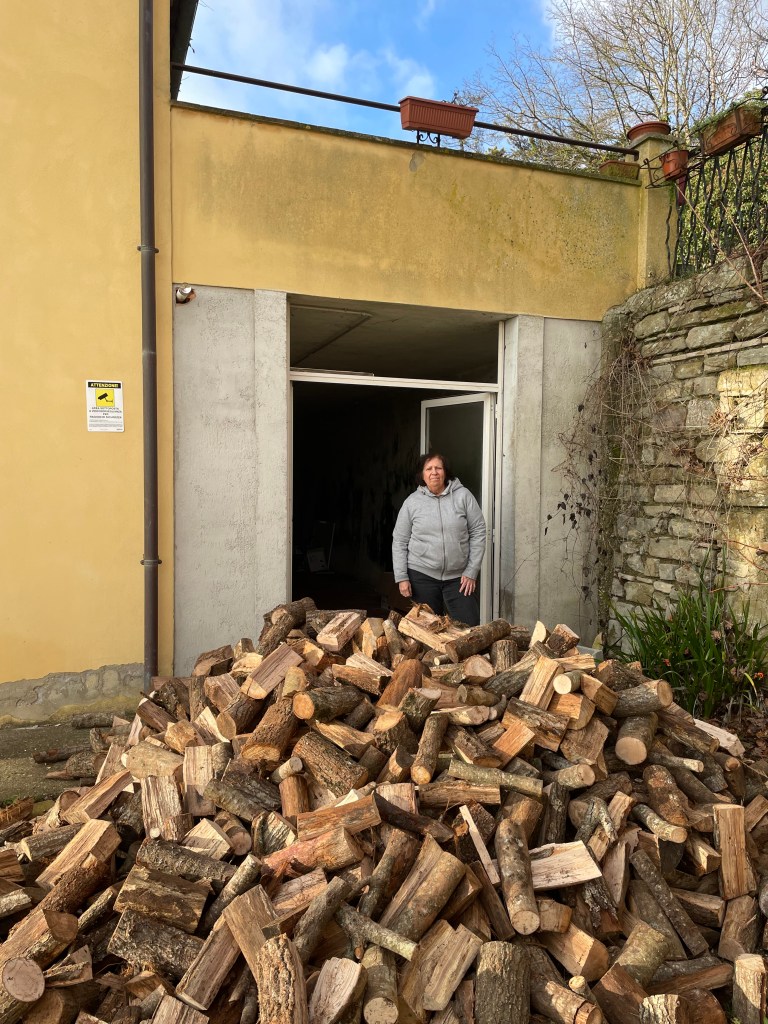
He was good at his word. This morning a little dump truck arrived and tipped almost 19 quintali—that’s 1800+ kilograms or nearly 4,000 pounds of the stuff near our garage door. It was not a little pile, nor was it all stacked in a pretty box. If it were packaged nicely, it would have cost a lot more than €340, which is a fraction of what propane would’ve cost us to heat the house for the same period. TSW, with her superior logistical skills, designated areas for big pieces, kindling, and in-between annoying pieces, and we went to work. I must confess that she did more; a bad back, the result of my Summer of Coughing, made me take breaks after every dozen of chunks of wood stacked.
It wasn’t a bad way to spend a couple of hours. At least we weren’t shut-ins staring at computer/phone/TV screens. Fresh air! Clouds! And that Umbria sea just below us, shifting its shape as the breeze and sun played games with one another. What we didn’t especially like, but can’t do anything about, were the shouts of men in the land surrounding ours. They were hunting for wild boar, and every now and then shouts, the barks of hunting dogs, and rifle shots rent the air. That’s the kind of stuff they don’t put in the tourist websites. But that’s winter in the Umbrian countryside, and I wouldn’t trade it in for anywhere else right now.
But there’s more.
TODAY IS JANUARY 6, SO IT WAS TIME, we decided, to descend from our aerie. The sun was bright, the sky blue, the “ocean” floating around in the valley, and our Covid tests negative. So we get in the car and drive the 20-something kilometers (about 12 miles) into Perugia. Not a big distance physically, but psychologically, it’s a big gulf.
Especially today—this is the last weekend of the holiday season in Italy. We say “buone feste” here—happy holidays—not necessarily to be caring and sharing with our non-Christian sisters and brothers across the world. The season literally consists of three big holidays, and a fourth, December 8’s immaculate conception (or something like that), which kicks off la stagione Nataliza (the Christmas season). We wanted to how Perugia looks before they take away all the lights and trees and decorations.
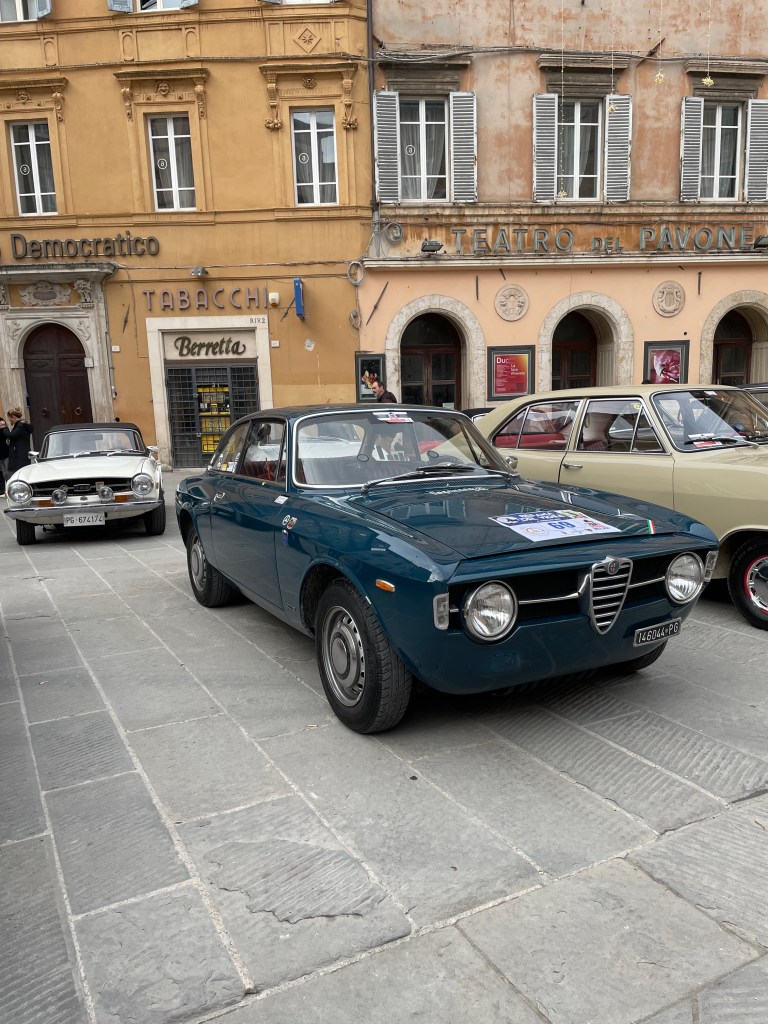
The roads were nearly empty as we headed into town, but the Minimetrò system was packed. A 10-minute ride from the outskirts of town to the historic center and we were in the middle of a cast of thousands. Even better was a parade of antique cars. I’m not sure what a prewar Lancia or Fiat has to do with Epiphany—gifts to the Magi (us)? perhaps? Who knows. It was fun to watch these old beauties parade slowly by as people reminisced about their father’s or grandmother’s car that took them on beach holidays or to school.
One thing I wanted to do but forget on the way out was to get a hot chocolate. Italian cioccolato caldo is nothing like the thin, insipid stuff sold in the U.S. Think warm, intense, slightly less thick chocolate pudding. Next time…
I’ve been lazy. Uninspired? Bored? Had writer’s block? Nah. It’s just that living in an outer borough of New York and not going out much can be, well, not the stuff I want to write about. So I didn’t. I was struggling to do something profound, either about differences between Europeople and Americans. Or maybe about technology, or taking a quick road trip. I could show you the unfinished drafts in my queue. But that way you’d see my tortured thought process.
At one point, I even got a bot—the now famous ChatGPT—to write about driving from New York to the Boston suburbs. Then I thought maybe I’d critique what the bot did. Okay, I’ll give you a peek:
On a chilly weekend, we took a 400 km ride to the Boston suburbs in our Volkswagen Golf. Four of us traveled comfortably in the spacious car, but we had to make a couple of stops along the way for our pregnant daughter, who is in her last trimester. Despite the stops, the ride was generally smooth and we were able to make good time. One thing that struck us on the American highways was the lack of lane discipline. People would frequently pass us on the right and zig zag dangerously through traffic.
Kind of workmanlike, no? I gave the bot no instructions as to style or my attitude. I wonder how it decided that the car is spacious—in Europe it’s a midsize thing, in the U.S., the land of SUVs, like a matchbox. I’ve read worse copy in my way too long editing career, but at this point I’m not exactly scared that it’s going to take my place.
The Matalas coven takes over the living room.
Anyhow, then Christmas came, and three days later, we transferred to our Umbrian hill, so, yes! I have something to write about. First of all, the holiday. We’re not really subscribers to religion, but we’re culturally a tiny bit Catholic, and for years we’ve had The Spartan Woman’s Jewish cousins over for the day, as well as her parents and sister, etc. This year’s get-together was bittersweet for a couple of reasons. It was the first one post-Covid onset. And it could be the last one we do, because we may not be living in the U.S. this time next year.
All the same, it was terrific to see our kids and their second cousins hanging out together. We jokingly call them the coven; for years, hardly anyone in TSW’s extended family gave birth to males. I’m not the only one calling them a bunch of witches, they themselves encourage it and, well, it’s just funny. But in the next couple of months, that should end. Our number 1 kid, who got married this past March, is expected to actually bring a male infant into this world. “I don’t know what to do with a little boy,” TSW said at one point. I think she’ll manage somehow, she seems to have no trouble with grownup boys.
AFTER THE HOLIDAY, we had to scurry and clean up and get ready to spend a few weeks in Italy. Obviously, this isn’t our first time around the block for this. Still, we have to make sure stuff is taken care of there and that we remember to take what we need in terms of tech stuff and meds, weird food substances we use in the U.S. but impossible to find in Italy. [Tip: Cheddar cheese powder is really, really good on popcorn.]
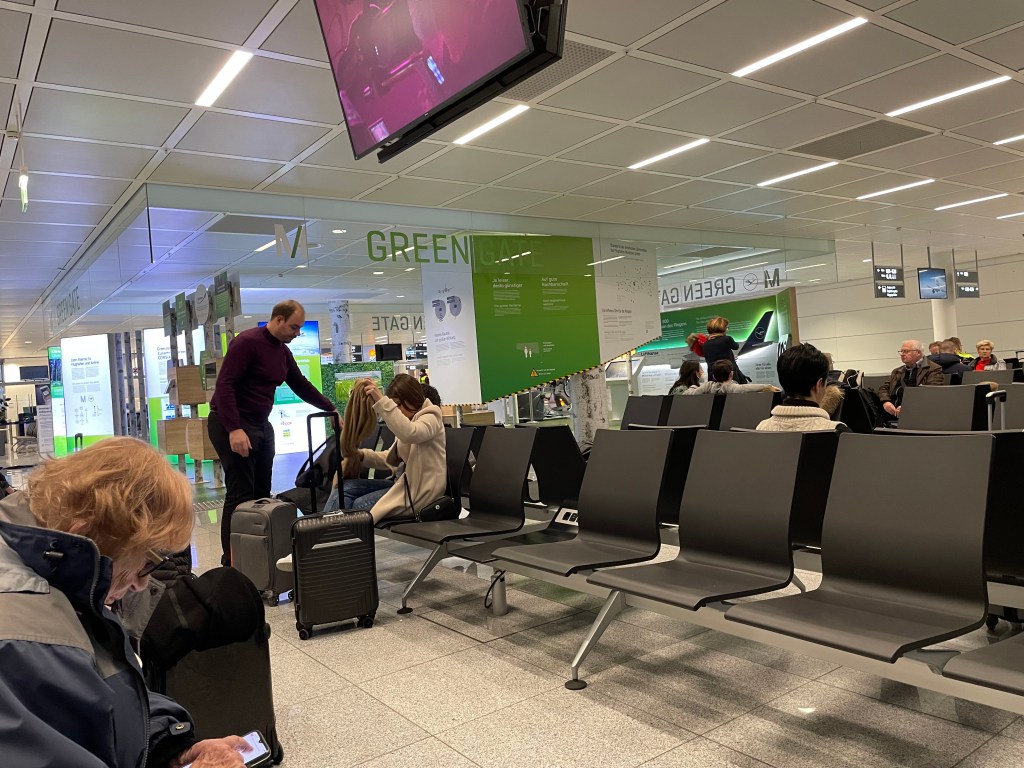
The trip over was something else. Not that we were delayed or anything, like thousands of holiday travelers in the U.S. But for the first time since early 2020 airports and flights were jammed. I never saw so many people crowding JFK Airport’s bars/restaurants/shops. It was hard to find a place to sit at the gate. When I went to the least-crowded bar to get my by-now traditional preflight Martini, the bartender apologized for having to use a plastic glass because all the Martini glasses were being used.
Tradition!Munich’s Franz Josef Strauss airport wants us to know it’s got green cred.I can’t help it, I’m a map freak.
The flights, first to Munich, then to Rome, were similarly jammed. Lufthansa kept texting us begging us to check our carryon bags (for free even!). We had huge bags anyway, and only knapsacks as carryons. Lufthansa in general is one of my favorite airlines. Its staff treat people like humans, the food and entertainment are halfway decent, as are drinks, and the Airbuses are pretty comfortable, at least in premium economy (and upward, though I can’t shell out for that).
I’d nervously been looking at flight stats; we had 1.5 hours between flights and with the chaos in the United States, our first flight was late on the days leading up to our departure. That had me looking at how often Lufthansa and affiliates flew between Munich and Rome. Happily, it didn’t come to pass. We left on time and arrived early. Since we’re EU citizens, we breezed through passport control. And somehow we landed at a different terminal, the same one as our second flight, so we even had time for a cappuccino and snack.
I’ve crossed the Atlantic countless times and I usually sleep through most flights. But I was so happy to be traveling that I pretended to be a tourist from my window seat. Long Island looked colorful and even a little glamorous as night had fallen. Germany looked tiny and modern, at least from the buildings I could see. And the Alps? Mozzafiati! (Breathtaking in Italian)
I never get tired of flying over the Alps.
So here we are. And yeah, it’s a nice place. But it’s more than liking the place and having nice scenery and food. Our friend Angelo picked us up at the airport and knowing that we didn’t have much fresh food at the house, gave us a big bag of fantastic oranges (there is nothing like Italian citrus). This morning, I walked next door to our neighbors Marjatta and Pasquale at the agriturismo Ca’ Mazzetto to pick up our car; they’d been car-sitting while we were away. They used it every now and then and returned it with a full tank and cleaned inside and our. Later, Pasquale dropped by to say hi and give us a tin of their fantastic organic olive oil. It’s great to be home.
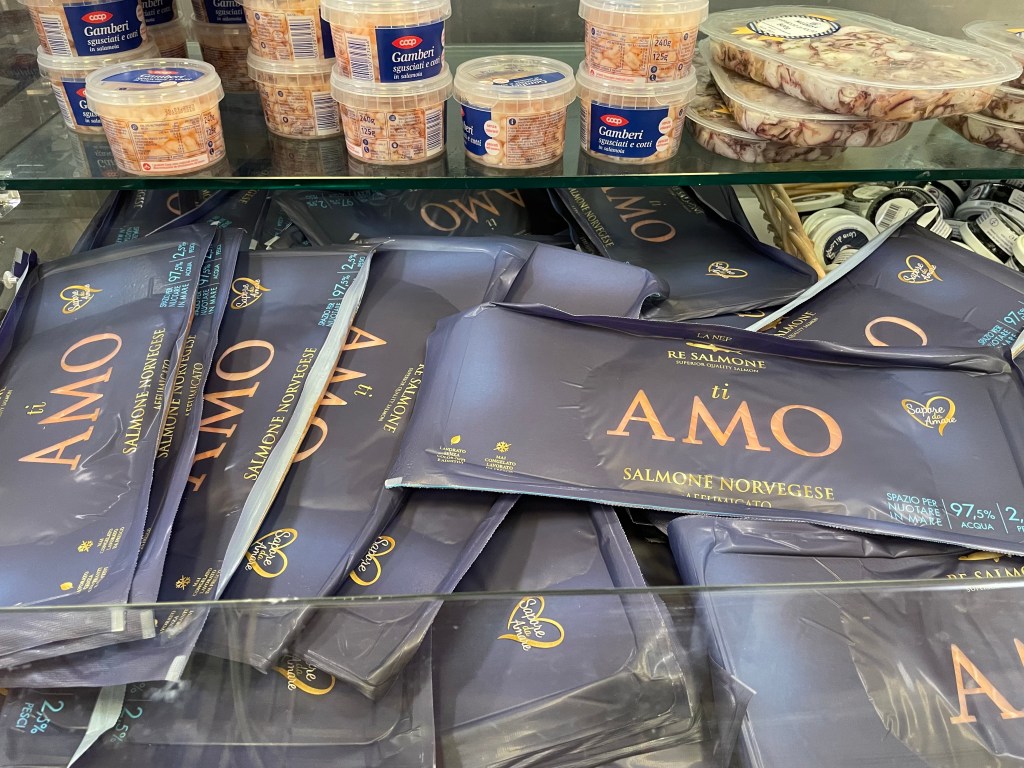
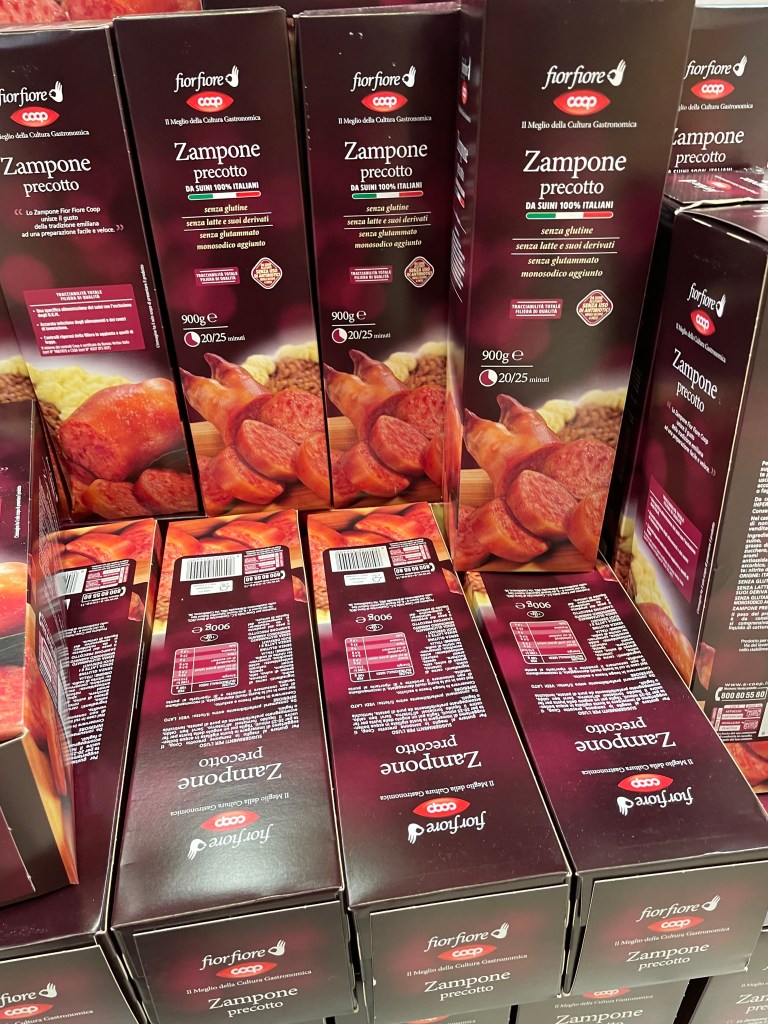
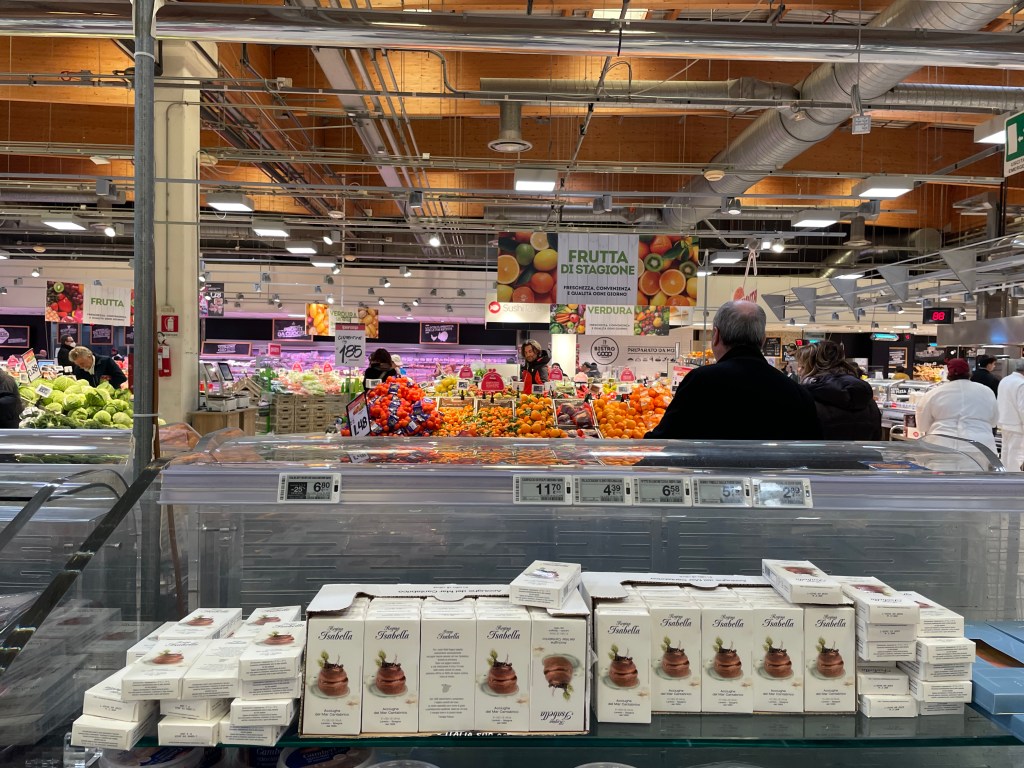
We’re getting ready for a quiet and decadent New Year’s Eve dinner here with our old friend Doug and his trusty sidekick Georgia the dog. Shopping for it was like being at JFK, way too crowded but instead of making me crabby, the IperCoop near Perugia had a party vibe, with sales of good Champagne and Franciacorta (Prosecco’s upscale cousin, fermented in the bottle like Champagne). Since this is Italy, we’ll take Franciacorta—to go with some scallops in the shell from France.
Thanks for reading this year, and happy New Year! See you here after the holidays.





















 (Not) A Year (Not) in tuscany