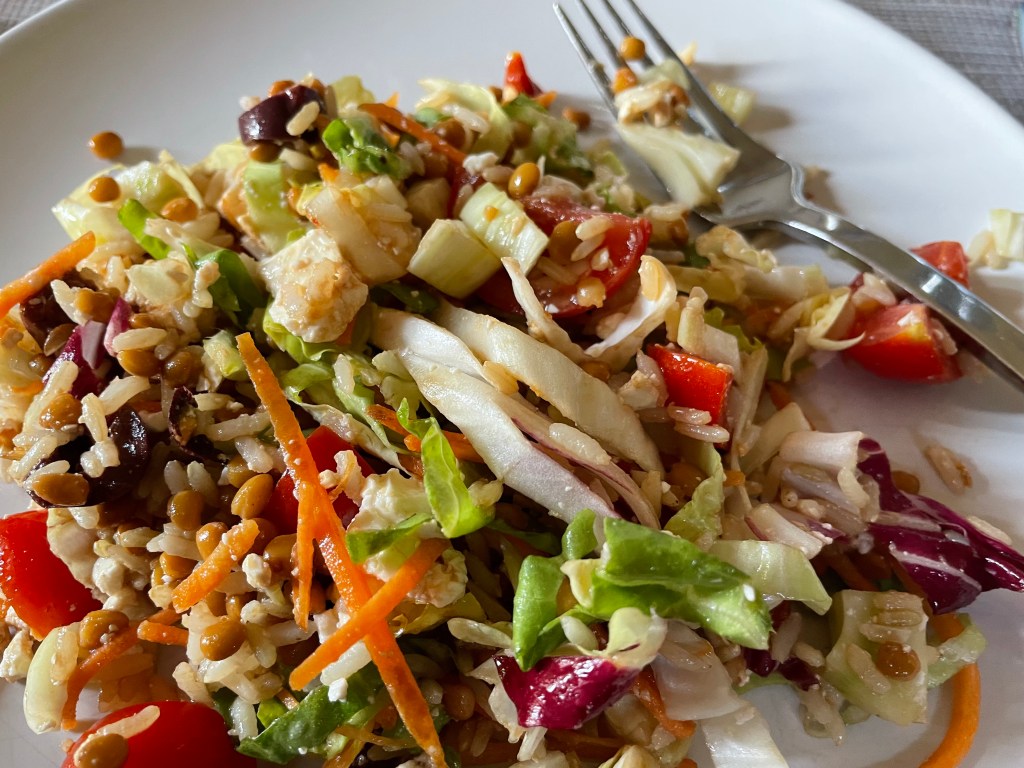
Somehow we’ve managed to fill the void of having fewer guests this summer

We have a new guest this week, someone from the neighborhood. Or so it seems—it’s a horse, apparently a mare. She’s super skinny and she’s ravenous. This is good for one thing; it means I don’t have to mow the lawn which, after a heatwave and drought-induced slumber, is suddenly alive, green and growing. But it means occasionally dealing with the digestive results of her buffet. I just texted a neighbor who might know who her humans may be. [UPDATE: She belongs to our neighbors, who came by to encourage her to go home. She apparently likes our grass better.]

Howdy, neighbor!

Such is life in the Umbrian countryside. People ask me “what do you do all day?” Sometimes I ask myself the same question. But these few months have gone by way too quickly, and part of the reason is probably that it’s never dull around here, even without the parade of guests we’ve had in pre-Covid summers.

I mentioned a neighbor. Our house was part of a working farm that takes in guests. The owners sold us this house and almost two acres of their land. The business is called an agriturismo, and this one specifically is named Ca’Mazzetto. It’s certified organic and it produces olive oil and wool from a flock of about 125 Sardinian sheep.

Ca’Mazzetto also produces interesting people. One of them is Joonas Sotgia, a young guy about the age of our younger daughter. Joonas is half Finn and half Italian, though to look and listen to him he’s 100 percent Italian; his mother is from northern Finland. He got back about a week ago from Afghanistan, where he was working for the Italian NGO Emergency in the southern city of Lashkargah. Joonas isn’t a doctor, he took care of logistics and hiring of the nonmedical staff at the group’s hospital there.

Joonas relaxes with a drink the Taliban don’t approve of.

I did a formal interview with him the other day, which I’ll release soon. But that evening we sat out in the yard and updated each other about our lives; it’s been two years since he, The Spartan Woman, and I were in the same place. We talked about how we handled this pandemic, his last job in Slovakia for Amazon (key takeaway—he won’t buy from them, ever), and how the Taliban left the Italians alone, and when they came into the hospital they left their guns at the gate.

We don’t just sit around and talk. Like I’ve written before, The Spartan Woman and I walk. We walk up and down hills, we follow trails, rutted roadways, cow paths up mountains, etc. We continue to do it; doing so is part of The Spartan Woman’s boot camp for the nearly elderly. This is contagious, and we’ve taken to judge our guests by whether they like to hike with us or not.

For example, an America friend from our Staten Island neighborhood stayed with us for a bit. TSW and she do take walks through Staten Island’s Botanical Gardens at Snug Harbor. But those are level and not that long. Wendy (the friend) was craving escape and Italy, but when we told her about our morning routine, she said she’ll stay by the pool and read a book and let us have all the fun. Fat chance. She was addicted the first time up the road. Maybe it’s the vistas. Maybe the neighborhood dogs, which are impossibly cute and impossibly addicted to the biscuits we give them. By the end of her stay, Wendy was charging up hillsides and goading us to walk further. Now back in the U.S., she’s, um, strongly encouraging her husband to get vertical and move.
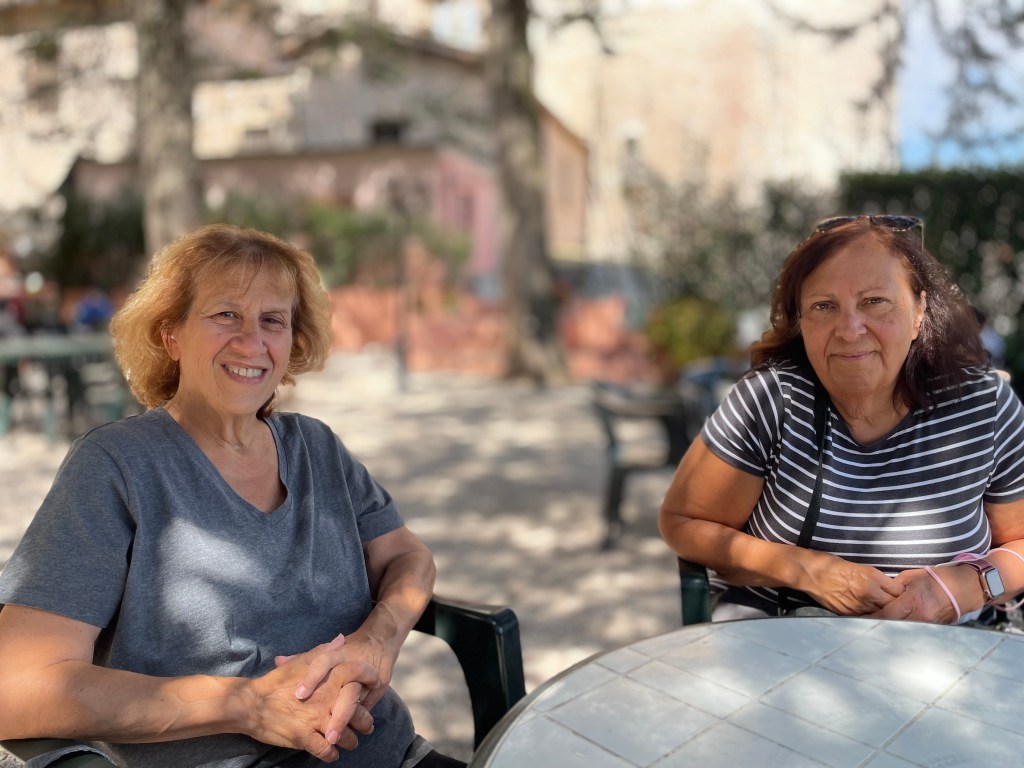
TSW and Wendy enjoy a break in Spello from climbing up steep hills.

So if you visit us, you’ve been warned.

We tried to find good places for Wendy to practice her new favorite hobby. We drove around the region, keeping in mind that because of Covid-19 we didn’t want to hang around with too many people. So we drove up into the Valnerina to visit one of our favorite places, the Piano Grande di Castelluccio, and on the way back we stopped to eat in Norcia, the gastronomical capital of Umbria. While we had a terrific lunch, it was heartbreaing to see that much of the town is still in ruins as a result of the devastating earthquakes of 2016.

What’s left of Norcia’s duomo.

What else? Gelato! Okay, I’ve been eating the stuff since I was a kid. It’s different from American ice cream in being made mostly from milk rather than cream. Plus it’s less aerated and the flavors are more intense, possibly because it’s servied a bit warmer than ice cream.

We’ve got our spots in the big cities. Well, okay, in Perugia (population about 170,000). And it’s terrific. But our friend Angelo pointed us to the Oxy Bar in the hamlet of Palazzo di Assisi, and we’re hooked. Great flavors, terrific service—all the standard stuff is terrific. What Oxy adds is its location. It’s right in the center of the small town, across the street from a castle that’s become a warren of restaurants and apartments.Oxy is next door to the town’s church, which conveniently has lots of places in front to perch.

If it’s a summer night, it’s time for a gelato.

There’s nothing quite like a summer night in Italy when the gelateria is one of the only games in town. The older folks sit at the tables in front, while everyone else is either standing in groups, walking around saying hello, or finding a spot in front of the church to hang out. You hear that flowing babble that characterizes the Umbrian accent when you’re not paying attention to what people are saying. And everyone’s united in the easy pleasure of a sweet treat on a summer night.

I’d be negligent not to mention the trattoria across the street from Oxy, Not the hipster-vibed “Gnocco e gin” place in the castle, but the friendly, family run Osteria del Cambio. Food like it serves up would be an expensive night out in New York, but here it’s mom’s home cooking. Or grandma’s. It’s Angelo’s favorite hangout, and he calls it by the proprietor’s name, Catia. When I came alone last year, Angelo and I had lunch once a week there. TSW, Angelo, and I recently had dinner at Catia’s and we didn’t hold back–antipasti, tagliatelle with black truffles, a “secondo,” wine and coffee, and the damage was all of €48, or about $56. You might get a pizza and a couple of drinks for that at Ribalta in New York.
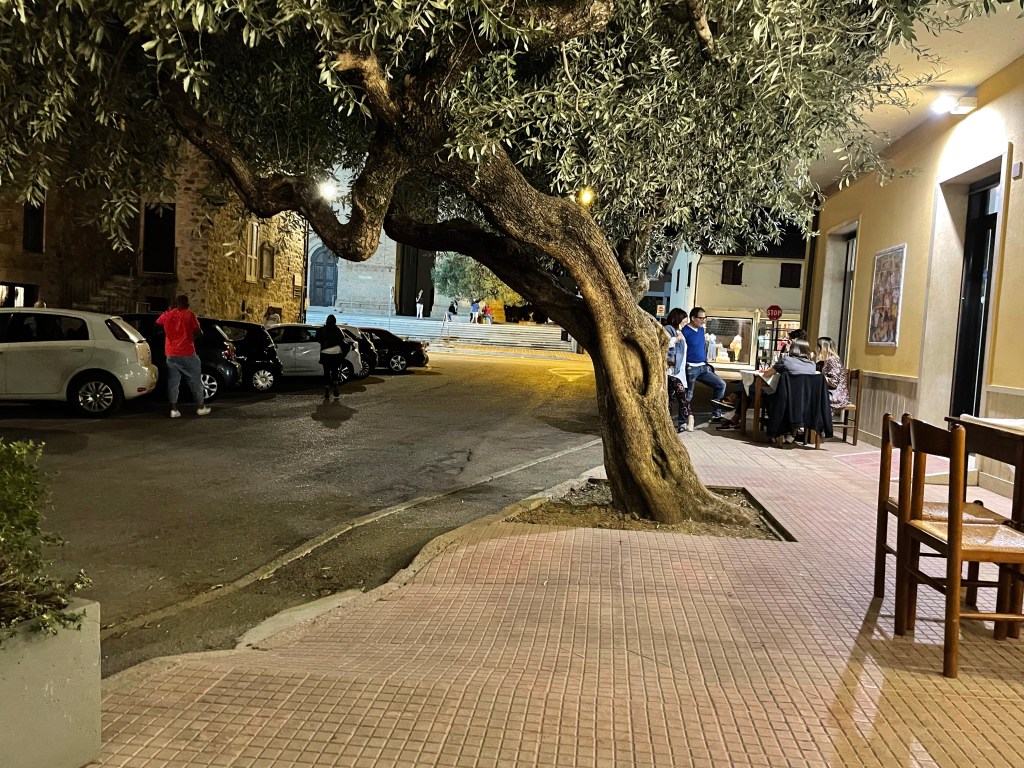
For best results, combine Catia’s and Oxy.

We’re heading into autumn now. The weather’s changing, alternating between brilliant dry days and cloudy changeable ones. It’s time to close the pool, wear long pants when we go into the city, and to think of more ambitious hikes. Our aim is to tackle the uphill path to Assisi with a reward at the end in town: a decadent lunch.

Is this what they mean by fusion cuisine?

If you wander around food-related sites on the interwebs, you might notice a strange little trend: Italian cooks reacting to the horrors visited on Italian dishes by non-Italian cooks. Some of those non-Italians might even be pretty famous, like the British restaurateur and TV personality Gordon Ramsay. You’ll see the Italians wincing as Ramsay and others put cream in spaghetti carbonara, or cook pasta in jarred tomato sauce. One of my favorites is the couple Harper and Eva (he’s American, she’s Calabrese) who good naturedly explore Whole Foods and Domino’s Pizza. Eva’s reactions alone are worth the time suck.

Eva does not like Ramsay’s “carbonara.” Not at all.

Here on our mountaintop getaway, we manage to visit other horrors on the food of this region. You see, there really is no such thing as “Italian food” because the cooking in Italy is so regional. No, hyper-regional, because dishes can change even from town to town. Get a local nonna (grandma) to show you how to cook a local dish and she’ll give explicit directions and mention what is absolutely forbidden: no onion and garlic together in X, put celery in Y and you’ve dishonored all your ancestors, etc.

We’re in Umbria, a small, mostly rural, landlocked region tucked between Lazio (Rome’s region) and Tuscany in Central Italy. For a region with a population just shy of 900,000, it’s sure got a distinctive cuisine. it’s a land of black truffles, legumes, mushrooms, pork products, and grains. Try to picture all that and you realize that mostly of this food is brown or black. A typical snack is chicken or goose liver paté on toast—I was served that along with a drink the other day.

If you’ve grown up with that, it’s fine. Our Perugian “mother,” Giovanna, shunned most vegetables and compensated by having huge bowls of fruit on hand for dessert. (Her idea of health food was to bake eggplant slices with lots of crumbled sausage on top.) But The Spartan Woman and I have Sicilian (100 percent for me; 50 percent for her) and Greek ancestry. Both Sicilian and Greek cuisines are colorful, vegetable-friendly, bright flavored and citrusy, while Umbrian food tends to be heavier, more comfort-food like. Add to the mix the fact that we’re native New Yorkers, and therefore entitled to eat any kind of food we like that exists on the planet, and you’ve got the makings of either interesting contrasts or a disaster. Having relatively good taste, we’ve managed to avoid most disasters.

Oh, and we don’t eat meat, which keeps a big part of the food here off-limits to us. We do eat fish when we feel decadent or lazy Plus us native New Yorkers (sorry copyeds, but I’m using NYC dialect here) grew up eating seafood. A couple of decades ago this would have probably cramped our style big-time, because Umbrians didn’t eat much fish and you could hardly find any in the markets. Lately, though, they’ve embraced seafood and supermarkets have huge fish departments.

Two years ago, pre-Covid, our town of Valfabbrica got together for a multicourse seafood dinner.
An Asian market in Perugia

In good weeks, we’ll get gifts from our neighbors and friends. When Angelo picked us up at Rome’s airport, he gave us a care package, the fixings for a Sicilian blood orange salad, complete with olive oil that his friend produced. And our neighbors at the agriturismo Ca’Mazzetto occasionally show up at the door with freshly made sheep’s milk ricotta.

So what do we cook? Let’s call it Umbria-Sicilian-New York fusion. We pay homage to Umbrian food—I haven’t met a truffle I didn’t like—while at the same time keeping it light and bright with lots of different colored vegetables and spicier/brighter flavors. Luckily, the olive oil here is incredible, green and a little spicy, and enobles simple dishes like borlotti beans stewed with garlic and tomatoes. The markets carry tons of fruits and vegatables, and Italians have embraced healthier food between, you know, a morning Nutella-filled cornetto and an afternoon gelato.At the same time, being Americans generally and New Yorkers in particular, we occasionally crave Asian food. Our area is pretty well served by sushi restaurants and Chinese markets, so it’s not that hard.

But here are some examples of how we feed ourselves and others.

Farro tagliatelle with zucchine, shrimp and tomatoes with Greek egg and lemon sauce
Whole wheat rigatoni with a mushroom ragù
Salad with farro
A Sicilian classic: fried eggplant to put atop spaghetti
Sheet-pan roasted vegetables and feta, a variation of a NY Times recipe

They run a tight ship

I’m always amused when I hear people say that Italy is chaotic. Sure, it can be, but it’s not as random a place as many think it is. Like anywhere, it comes down to priorities.

Let’s look at the United States: it’s got Apple and Google and Amazon (and even Microsoft). All big companies that Get Things Done. But then let’s go down below the ground to New York’s poor excuse of a transit hub, Penn Station. It’s just plain gross. It’s early morning and time for another Acela train to Washington. The crowd mills, looking anxious, looking at the board to give some hint of which track their train will be on. Things are getting ugly, folks, as the anxiety level rises. Finally, the board lights up. People make a mad dash to Track Whatever and to get on the allegedly fast train, they line up. They have to show a ticket to get to the track–oh, and to get to that track you’re riding down a narrow dark escalator. And there are no assigned seats.

So, Italia. We were invited one Sunday to see what goes down on Lago (lake) Trasimeno at the Triathlon Club Perugia. Our friend Federico is Mr. Marathon Man, and he and his friends have set up this place to practice swimming moves in the lake, and there’s a decently level place to run and ride bikes.

The habitués of the TCP think that torturing themselves running/swimming/biking great distances is fun. So that Sunday they had the first big exhibition of the season. And anyone who thinks that Italians are disorganized should’ve seen this. Everything started on time. Federico enlisted most of his family to work the event, and there were lots of others on hand to guide the competitors from swim to run to their bikes. They even had a kids’ event which also went without a hitch, and started and ended on time.

A few days later, work took me to Milan, where the company I work with (the great people at LC Publishing Group) held four days of discussions, dinners, concerts, a run, working lunches and workshops, all spread throughout Milan, Italy’s second-largest city and its business hub. To get there, I took a combination of bus and train. Fast trains here are called the Frecciarossa—red arrow—and the bus to the train a Freccialink. The bus left on time, got me to Florence’s main train station. Then to find my train. It took a few minutes before the track number came up on the screen, but there was no long line, no scramble for seats. My ticket listed the car number and my assigned seat, and the platform tells you where, for example, car number 7 stops.

Big week, lots happening, hardly a hitch
The New Yorker’s Fabio Bertoni presents an award.

Once there, tons of events, lots of attendees. All on time, and the substantive sessions rarely ran late. Part of the reason is there were few interruptions for questions. It may be a cultural thing for Italian lawyers not to stop and challenge the speaker. Then, the final awards ceremony and party. I forgot how many awards to law firms and department were doled out, but it happened quickly, in about 38 minutes, give or take. No ponderous speeches, no praise of the Glorious Legal Profession. We all got through it, then it was time for a party.

Fresh mozzarella, worth waiting on line for

One more example. Last Saturday night our hometown, Valfabbrica, held a neighborhood fish dinner in one of the old town’s main squares. There were, we figured, some 150-200 attendees. The dinner was supplied by one of the best seafood shops in Perugia, L’Angolo del Pesce. We all reserved and paid days ahead, at either the bar in town or the smoke shop. We show up, give our receipt in, they check us in. We found a few seats at a picnic table, and minutes later, fizzy water and wine show up. What followed was a parade of courses, from mixed antipasto to pasta to a mixed fish grill, to a fish fry. Water and wine refreshed when necessary. Efficient without fuss.

Big night in a small town
Just the beginning….

What that doesn’t tell you is how much fun it is. And that’s what this place adds—you never know exactly how much you’ll enjoy the show, but you will enjoy it, in the company of warm people who are compulsively social. And usually warm and kind.

So what am I saying? I’m not dissing one culture or the other. But when you look at another one, try not to bring your prejudices along with you. (And if you’re in Italy, go with the flow.)

Fruity

Enough seriousness. Here’s our friend Enrico pointing out the fruit trees alongside our house in Valfabbrica earlier this month. I wrote enough English subtitles to give you the gist of what’s going on, but I didn’t translate everything.