Eat like a peasant—and enjoy it

Staten Island, where we spent three weeks and some, has this image of being a sort of Sopranoland, its residents a larger version of the cast of Jersey Shore. That’s only partly true, and applies only to some neighborhoods. Our daughter lives on the North Shore, which is a multiethnic paradise. And after a few months of mostly “Italian food”—I dislike the term because there really is no unified cuisine here—we were craving the offerings of our former Japanese, Chinese, Mexican, Vietnamese, Sri Lankan, and Turkish haunts.

Maybe we overindulged. But our kid has a baby, and trying to be good guests, we thought we’d make it easier by ordering out. It was a nice change from Umbria, even if this area is increasingly cosmopolitan, with sushi and Chinese food fairly commonplace. But one thing we didn’t miss: American (or is it New York) price tags. For one Saturday lunch, we order four banh mi, three bubble teas, and a Vietnamese coffee. Total bill, $115. That would have bought a fancy meal here.

SO BACK IN OUR HILLTOP RETREAT, we prepare a lot of wintertime comfort food. That pretty much means soups and pasta. We don’t eat meat, but with such a huge variety of vegetables, legumes and grain products, that doesn’t cramp our style.

Note: The dishes described here are vegetarian, not vegan. If meat is a must, you can serve these dishes as first courses, or read another post and come back next week. I don’t give recipes per se, so you won’t see exact quantities or cooking times. Anyone who cooks regularly can probably come up with something good. I don’t usually follow recipes; I use techniques my mother taught me as a teenager when she broke her arm, and I had to step in to cook family dinners.

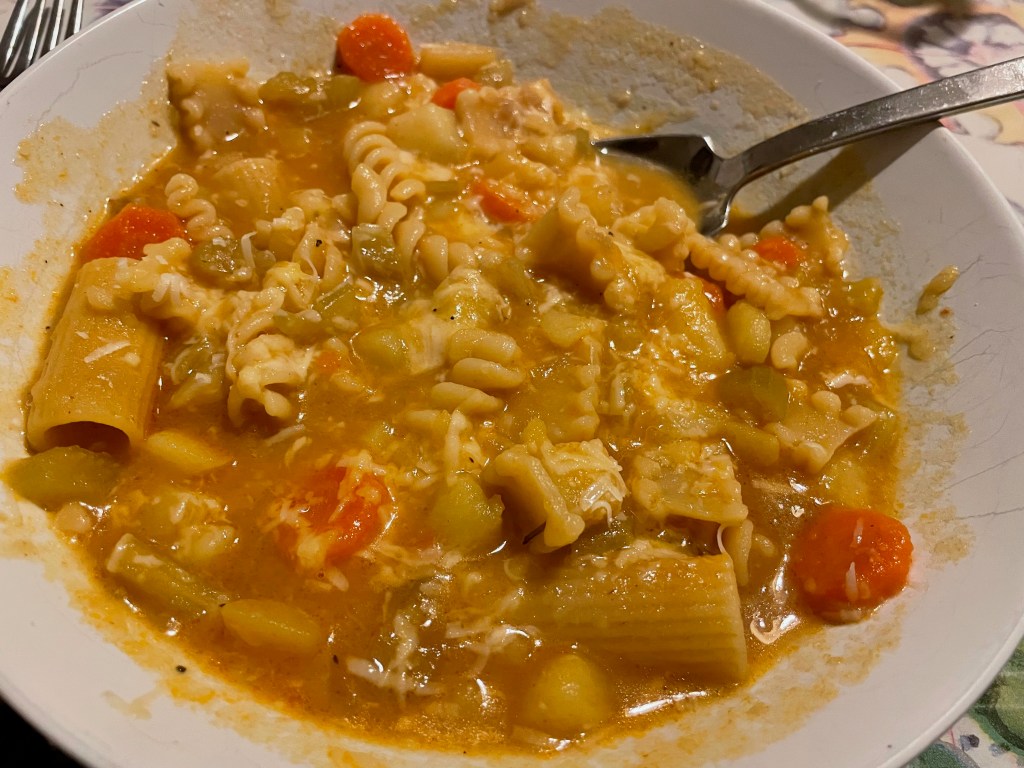
After years of propaganda about the superiority of “Northern Italian” food, the South here is rising again, at least when it comes to culture. Maybe it’s down to TV shows here like Mare Fuori (The Sea Beyond) which portrays the lives of a bunch of photogenic kids in juvenile detention in Naples. One of our favorite Neapolitan dishes is pasta e patate. Yes, you can mix starches.

You can look up recipes here and here. While there are various versions, you basically make a soffrito—onions, celery, carrots—and sauté it. Add diced potatoes. When they’re halfway soft, add water or vegetable broth and a squirt of tomato paste (a couple of canned tomatoes or some purée will work too). Let that cook awhile, and then, making sure there’s enough liquid to boil pasta, toss in a couple of good handfuls of mismatched pasta, all those odds and ends that you’ve accumulated when you haven’t cooked the whole package. Improvise if not. Then, at the end, add cubes of provola cheese. This last bit may be hard to come by in the U.S., so I’d suggest diced hard (not fresh) mozzarella.

Beans and greens might be an easier combo to get behind. We make lots of variants of this basic comfort dish. It’s easy. Take good beans, whether they’re borlotti (cranberry), cannelini, or ceci/chickpeas. Cooking them from scratch is best, but canned beans are fine, too. Sauté a clove of garlic and a little hot pepper flakes in olive oil. Add the beans, stir. Add cleaned and chopped greens, like escarole, kale, chard, or even spinach. Make what’s in the pot as dry or soupy as you wish. If there’s a fair amount of water or broth, cook some soup pasta (orzo, ditalini, small elbows, etc.) directly in that pot or cook the pasta separately and add for a drier dish.

It’s best to keep to the basics with this, but you can optionally add a Parmigiano rind to the cooking liquid, or mix the beans or add another grain like farro. Add grated cheese if you want, but the soup/pasta dish should be able to stand on its own.

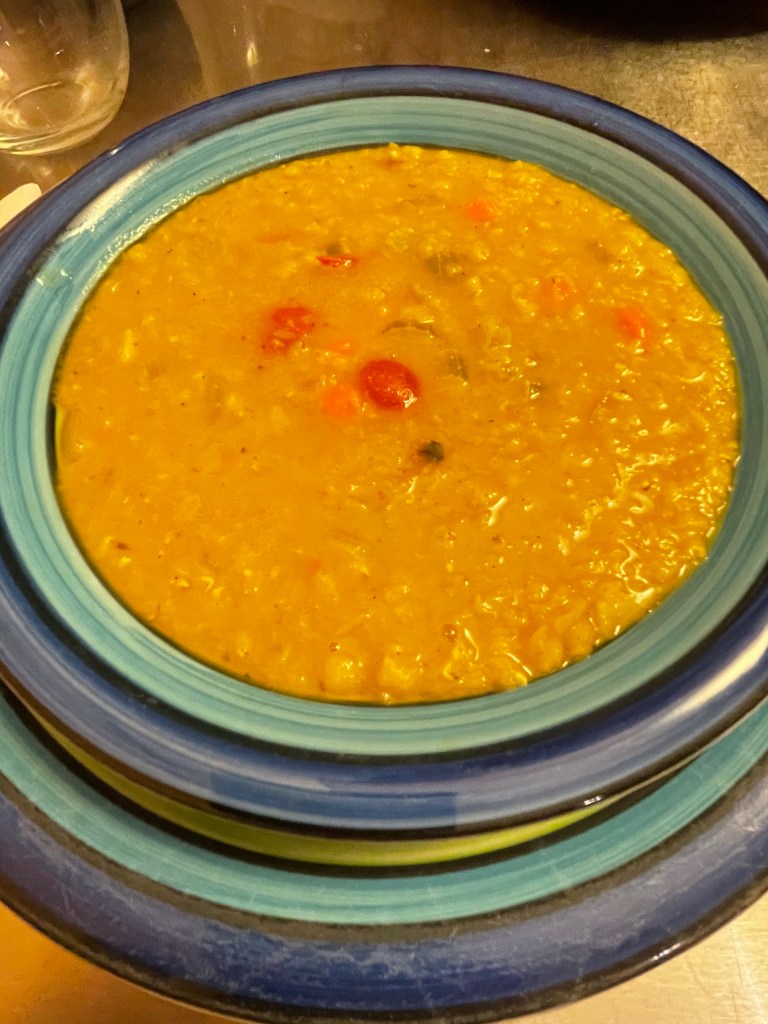
A post like this wouldn’t be complete without lentils. They’re an Umbrian staple. For example, it’s traditional to cook lentils for New Year’s, the pot of lentils symbolizing the riches that you hope the new year brings. Umbrian lentils are really small and don’t break down into brown mush. When in New York, I found that Trader Joe’s vacuum-packed French lentils are a pretty good substitute.

This dish won’t break the bank and is really easy to prepare. Do that soffrito thing again. It’s onion, celery, carrots. Add about half a pound of raw and rinsed lentils after the vegetables are soft. Stir around then add about 500 ml/a pint of water. Add a squeeze from a tube of tomato paste, or a dollop from a can of paste. Let the lentils cook until they almost done. At this point check how much liquid is in the pot. You’ll be adding a cup of ditalini or similar pasta so, if necessary add some water, keeping things on the boil. Add the pasta and cook until al dente. Serve with grated Parmigiano, Grana Padana, or even Pecorino cheese. And this is the result:

“Anyone can do steamed broccoli”

We were bad. Lots of people were. Still are. This thing that’s kept us home alone also contributed to our gross domestic girth. We’d watch a cooking show or tutorial on YouTube. “I can make pâte à choux,” she’d say, and later we’d have creampuffs. Or Montréal-style bagels. Or a baguette. Or steamed bao.

The Spartan Woman wasn’t the only offender. I began to like how butter added an extra sheen to the tagliatelle with a mushroom ragù. Or risotto. And you need to use a fair amount of olive oil for spaghetti with clams to taste right. Right?

I was getting into ridiculous rationalizations, too. If I was going to be cooped up for months at a time, I sure as hell wasn’t going to drink ordinary wine. Hello, Honor Wines! They delivered in a funky blue vintage truck. I’d call Laurie, and she and I would talk about what I feel like drinking. It was like visiting a shrink, except instead of more self-awareness, I’d know more about rosé wines from the Trentino-Alto Adige region of northern Italy. Which is not a bad thing, but when you’re habitually drinking 2/3 of a bottle every night, those calories pile on.

I started to avoid wearing jeans. Even my big boy jeans. She wasn’t too happy, either. Our usual exercise outlet, the local YMCA pool, was closed. And it didn’t feel right to take long walks. Besides, winter. Yuck.

Finally, with a last toast and blowout New Year’s Eve dinner for two, we decided to do something about it. I’d dry out in January. Let me tell ya this was not easy, if you can think back to the days when the orange lunatic was braying about a supposedly stolen election and his deplorables attacked the Capitol. I ended up extending the drying out into April, with exceptions for Joe Biden’s inauguration and Easter with one of the kids.

Ciao for now

So, a diet. But not a diet. It was winter, we were depressed, and TSW said she couldn’t live on steamed broccoli and tofu. That’s her usual way of dissing over-virtuous regimens. We’re also almost-vegetarians. We eat fish and seafood as a naughty treat, although I’m beginning not to like the fish part so much. So planning meals posed an extra challenge. But we’ve been down that road before, and we resolved that this would be it.

I’ve mentioned before how TSW likes systems, but also likes to game those systems. She applied that to our food. (Note: I do cook; we usually split the chore. But this time I let her drive, since rightly or wrongly, I’m to blame for our gastronomic excess. Plus, after living alone in Italy last fall, and feeding myself almost every day, I was happy to take a break. Plus, I threw out my back sometime in January…)

With this in mind, I’ll set out how we managed to lose about 20-25 pounds so far and actually enjoy it. This will just be the intro. Like obsessed, annoying Instagramers, we take photos of almost every meal, so I have a lot of material.

First, this is an adoption of the WW points system. TSW chose the version that’s most restrictive in points, because it’s extraordinarily permissive when it comes to stuff we like to eat: vegetables, fruit, whole grains, more vegetables, fruits, and whole grains. Fats are limited (think a couple of tablespoons of olive oil between us at dinner), as are simple carbohydrates and sugar.

We do adapt what we used to eat to this routine—we’ll sub out white pasta for whole wheat in a dish, for example. But the past few months have unleashed TSW’s creativity and ingenuity. She’ll use silken tofu to make decadent banana-mango puddings, and we’ll reduce broth and wine for sauces instead of relying on the butter/oil crutch.

I guess the best thing at this point is to show you what we eat. And as I write more, I’ll be explicit with recipes and simple cooking tips.

First of all, up top is a tray bake of vegetables and feta cheese. There’s asparagus, grape tomatoes, striped sweet peppers, red onions, cremini (supermarkets insist on calling them baby bellas or some such) mushrooms, shishito peppers, and slices of feta cheese. It’s simple to make, fun to eat. Spray it all with olive oil–do yourself a favor and buy either a good non-aerosol brand or get a spray bottle and fill it with decent oil that you like. Toss with salt and pepper, maybe some chilis if you like. Roast at 375F/180C for 35-40 minutes. Pair it with farro, brown rice, or whole wheat orzo or couscous.

Color-adjusted bean soup

Beans are a vegetarian’s (or a wimpy semi-vegetarian’s) best friend. This soup, Central Italian style, got us through a lot of cold nights. Cook some dry navy, cannelini, or cranberry (borlotti) beans yourself, or for a quick lunch or dinner, use good canned beans. Using a spritz or, if you’re feeling decadent, a tablespoon of oil, saute diced fennel, an onion, and a carrot until they’re translucent. Add the beans and either water or vegetable stock. Let it all come together, about 15 minutes-half an hour. Use a hand immersion blender or pour the solids and some of the liquid into a blender and purée it. Return to the pot and heat, add some small soup pasta. If it looks too gray, add some tomato paste or puree, and season it.

It doesn’t have to be cold out to enjoy this. You can let it cool down a bit, and, if you like, add a drizzle of fresh olive oil.

Finally, Asian-style food suits this thing pretty well, too, and TSW spent a lot of time working on various ways to put great mock-Chinese meals together. She’s like an alchemist in the kitchen, and over the past few months has figured out how to make seitan, a meat substitute that’s make of wheat gluten and a few other ingredients, depending on how and where you want to use it. In the meal shown below, she paired mock duck with broccoli and other vegetables, and on the right, there’s a silken corn dish over soft tofu. I’ll update this page with a recipe.