Years ago when I was a 14-year-old teenage boy, I learned that my father had another name. In the United States, he’s known as Tony, and all my cousins—I have lots of cousins—call him Uncle Tony. But when we went to Palermo as a family, all my cousins there called him “Zio Nuccio.” (He’s the guy on the right at the top; the other man is his brother Ignazio.)

Gotta love the feathers: Nuccio in full bersaglieri regalia.
Nuccio a/k/a Tony’s real first name is Antonino, and Nuccio is a diminutive. He lived in Italy until he was 25, in the mid-fifties. It was a very different Italy. Think neorealism films. Think in black and white. The postwar economic miracle hadn’t yet taken hold. Nuccio had been in the army, first in school, then as part of the Bersaglieri, an elite brigade. They wore funny hats with big feathers. Dad kept the feathers in this sort of fez-looking container and when I was a little kid, he’d show them to me every now and then.
He returned from the military to a city still suffering from the war. Allied bombers took out a lot of the historic center, and the ruins still stood as constant reminders. (In fact, they stuck around quite a bit longer, and Palermo’s core is still in recovery mode after a mass exodus to the outskirts in the 1960s and ’70s.) If you look at photos of the time, you’ll see the major streets leading out of the core empty and desolate, with a stray dog, maybe a car and a few people walking. It looked forlorn, a far cry from the vibrant and often chaotic Palermo of today, with its luxury shops and metro construction.
I’m writing about this because every time I drive around here in Umbria, I think of my dad. I FaceTimed him last night, and told him we’d done some shopping in Ancona, on the Adriatic coast, about an hour and a half from home. “I was there,” he told me. “For a few weeks. We shot canons into the sea, pretending that we were bombing Yugoslavians who were invading our country.” For him, mainland Italy was an assortment of places he’d gone for training, or drills, or just to carouse like any young guy.
Nuccio didn’t go back to Italy for 16 years after he’d emigrated. And he returned a few times, the last with me about 14 years ago. It was a changed country, but he, in the embrace of a loving family, didn’t really interact with modern Italy except for the drink or meal outside or an occasional ride somewhere. So these days when I drive around, I wonder what he’d think of this strange life his elder son was living.,
I know that he approves. He gave me his U.S. immigration papers so that I could obtain an Italian passport—I had to show the consulate in New York that I was born before my father became an American citizen. My former colleague Alexander Stille wrote a book about his parents, writing at length about his father, a Russian Jew who ended up in Italy pre-World War II and eventually became the New York correspondent of the Milan-based paper Corriere della Sera. Alex wrote that not having grown up speaking Italian, he learned it and immersed himself in Italian culture as a way of understanding and getting closer to his dad.

Meet just a tiny part of the Paonita clan circa 1964. I’m the shirtless kid on the left with my nonno Ignazio, with whom I walked almost every day after school. Nuccio is top, center, and my mom is with my glum-looking sister up in front.
I think I had the some of the same motivation, though I didn’t realize it at the time. Being able to speak Italian to my father when I need to make something clear makes communication easier. Plus, it’s fun. I was always jealous of some of my Paonita cousins in New York who grew up bilingual. I’d heard Sicilian dialect and Italian through most of my childhood and understand a fair amount (and pretended not too, the better to eavesdrop), but I hadn’t learned the language formally until I was in college. But once I picked up the language, it was fun to talk to my father in his native tongue, and of course he had to correct me when I slipped up. It was good for both of us.
So now I do my errands, visit friends, and do the occasional interview for an article in Milan or on the phone, and I just wonder what Nuccio would make of it. I’m in a different part of Italy, and a lot of people would joke that Sicily isn’t part of the same country. (That’s for another post, or maybe never,) He’s reluctant to travel; he uses oxygen and worries that his portable machine would quit mid-flight. He’s a nervous traveler anyway; on our last flight together to Rome, I slept while he sat bolt upright and awake, arms folded. So much has changed since he last lived in this country, and, to be honest, a lot has changed in the past decade.
For better or worse, Italy seems to be the Italian-language province of Eurolandia. Multinational store outlets dot the suburbs, even here in Perugia. The same names familiar to most Americans fill the local centro commerciale (a mall, in other words): Zara, Benetton, McDonalds. Our local big supermarket has a big sushi bar right next to the deli counter. In fact, sushi’s a thing here; a new restaurant in central Perugia specializes in sushi and French oysters. It used to be that you went to a trattoria and had a first course of pasta, rice, or soup, then a meat or fish course. If you didn’t, you’d get looks and attitude from the waiter. Now, it’s pretty much do what you want, anddo you need gluten-free pasta? The youth here have their iPhones and use the same apps their counterparts in Billyburg use, and they lo ok pretty much the same, too.
The only way to tell Italians and their hipster American friends apart? When it goes below about 20 degrees C, or 68 degrees F, the scarves come out here, while a lot of American guys will go out in the snow wearing flip flops and shorts. Some things will probably never change, and for good reason.
 I signed up on Quora.com awhile ago. I was intrigued by the mixture of questions, from genuinely wanting to know something, to clueless, to trolling. So I thought hmm, maybe I’ll use that format here. In the absence of real questions (feel free to ask me some via email), I’ll make up some of my own.
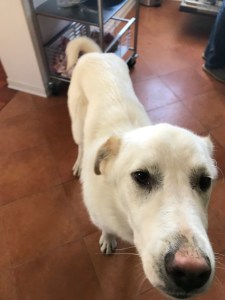 Retu belongs to Ca’ Mazzetto, our neighboring agriturismo. Supposedly. But I’m getting the feeling that the dogs along our road don’t belong to anyone. Or, they belong to everyone. I’m trying to figure that one out.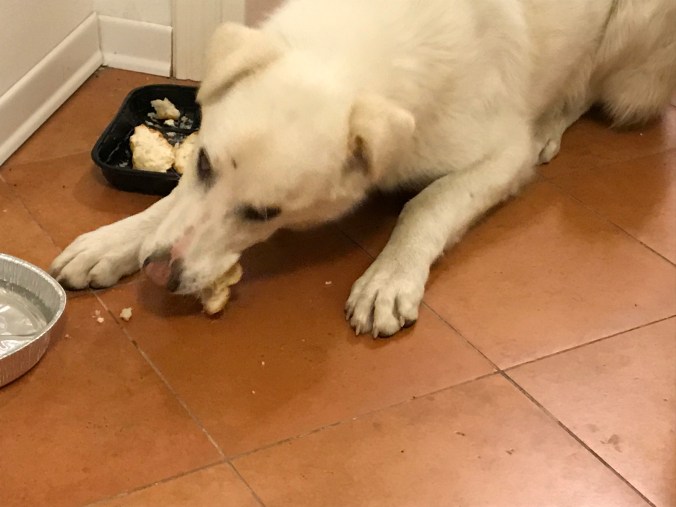
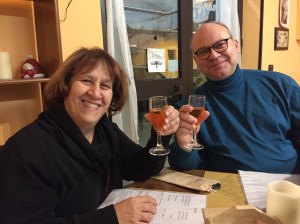
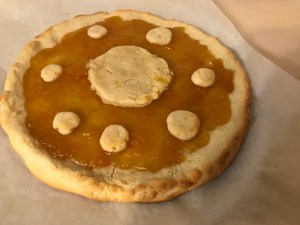

 Wendy had a couple of goals. To drink—she’s basically a teetotaler. To see what it’s like to live in Italy. And to learn to drive a stick shift—she was sick of paying extortionate rental rates here for automatics. Well, two out of three ain’t bad; by staying in the place downstairs and going food shopping, she got a taste of everyday life here, as opposed to being a tourist. We did ply her with alcohol in the form of wine as much as we could. Goal number three, though, didn’t pan out. The only stick shift was in our rental Renault Clio. With only 4800 kilometers on it, we didn’t think that Europcar would have liked it if we unleashed a newbie on the poor Clio.
 (Not) A Year (Not) in tuscany