Davy Brooks is wrong just about everything

Some of you may know about my on-again, off-again obsession with New York Times columnist David Brooks. You might even wonder why, other than his sheer laziness and obviousness. I’ll let you in on my eternal shame: I once shared a byline with him, in the now-defunct women’s magazine More. The piece was a feature about “Alpha Women.” Brooks wrote the intro; I did the write-ups of the women themselves. We never spoke to each other.

But I have another reason for the headline. It’s about Brooks’ periodic praise for American innovation, or what he sees as innovation. The narrative goes like this: The United States is a tougher place to live than Europe, where people enjoy things like universal healthcare, long vacations, and a decent safety net. But the United States gives us something that they can’t—the freedom to dream and innovate and be like Steve Jobs and Elon Musk. All this cool stuff like iPhones and Amazon’s Echo comes from the U.S., not those sclerotic old soft countries across the pond.

Sigh. I’ve been trying to figure out what’s wrong with this way of looking at the world, and The Spartan Woman and I have been batting around ideas. Living in both the dynamic, young inventive USA and tired old Europe, I try to resist the kinds of comparisons a lot of people do. I hear it all the time; Sentences that begin with “We have xxx,” or “Ours are different” or “How come they….” You get the drift. Both regions are what they are.

Then again, let’s talk about innovation. In American terms, it’s almost always a synonym for “technology.” When Brooks and his brethren (they’re almost always guys) gloat about American inventiveness, they invariably bring up the iPhone, or Google, etc., and boast about how they dominate the world. Okay, fine. But are they everything? Is computer-related technology the only way people can innovate, or think of new or more useful ways to live?

I’d say no. Let’s talk about how people move around in their environment. The U.S., for all the buzz about autonomous cars, is way behind the rest of the world. Stubbornly and proudly dumb about it. Highways are jammed, in the older cities, public transport is falling apart; here in New York it’s a battle to keep the subways and trains in any kind of working order. New York is still struggling to start building a new rail tunnel to link it to the rest of the country as the one in use crumbles and soon will be dangerous to use. Smaller cities are car-only, with maybe a rudimentary bus system. (Those cities out west that are building and expanding light rail systems are a noble exception.) In a way, the autonomous car thing is a perfect metaphor for the U.S.—high tech will come to the rescue of a way of life that’s stubbornly holding on and killing the planet.

Way faster than the Acela

In Europe–and even in Italy, which isn’t usually thought of being ahead of anything modern–you can zip around on fast trains. It takes just an hour and a half to go from Florence to Milan; the Rome-Milan trip, which is about 500 km or about 300 miles, takes under 3 hours.

There are lots of other examples where “innovation” doesn’t necessarily mean computers or online anything. As an American, have you remodeled a kitchen recently? How long did it take, and how much did it cost? We put in a kitchen in our Italian mountain house, with sleek white and grey laminate cabinets and the usual appliances. It took a couple of visits to a store, a little plumbing and electrical work, and then the kitchen was done in a day. The innovation came in the form of design; the manufacturer has a bunch of modules, with some custom work. It sends a “geometra,” someone who measures everything, looks at where the outlets and gas lines are, etc. Two guys and a truck later, it was all there. (And it came to about $5,000.)
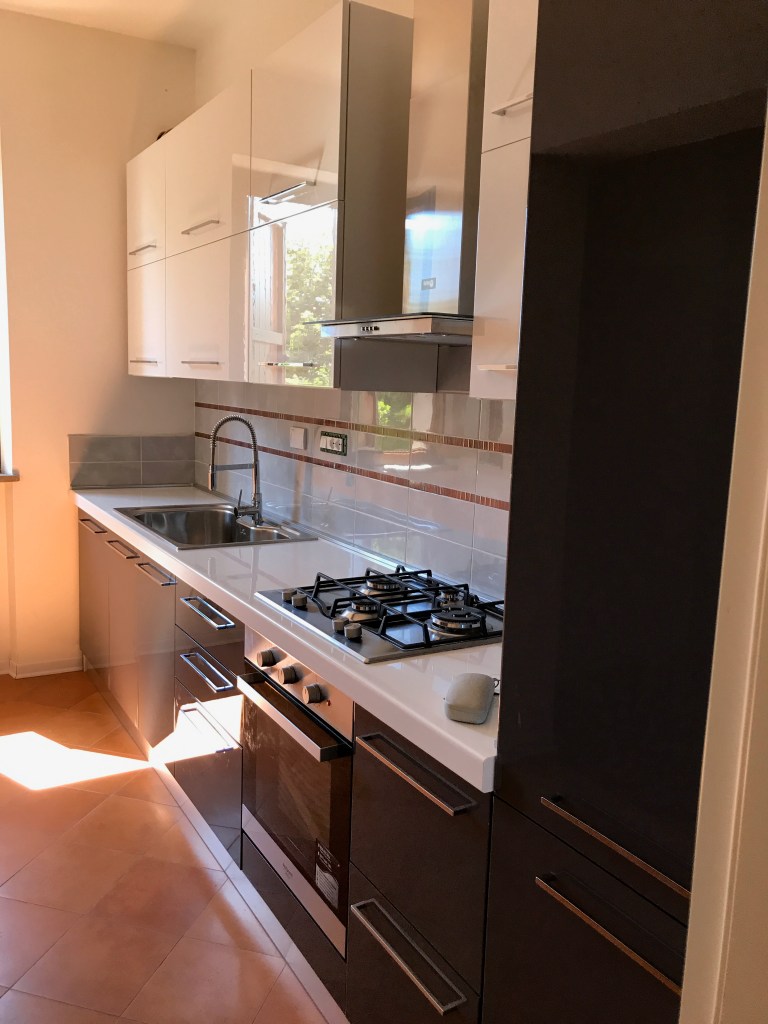
All in less than a day’s work

And then there’s the espresso machine. At least for me, it’s improved my life more than, say, digital internet (sorry FIOS, you’re not my first love). So, once again, my usual disclaimer: I’m not saying that one place is necessarily better than the other–well, okay, in nonmaterial quality of life, one is better, but you might not agree. It’s just that there are other ways of looking at what’s important, and how life should be lived. We as Americans should look around some more.

And, er, Davy’s wrong.

Photo of the semi-hidden visage of Brooks at the top: By PBS Newshour – Flickr, CC BY 2.0, 0

Somehow I forgot to write a single word

Okay, I lied. I’ve just been too busy to write here. Besides, life wasn’t all that interesting. Wake up. Walk the dog. Have breakfast. Work. Watch MSNBC because The Spartan Woman is an addict (I’m trying to cure her of this habit, or at least limit it to an hour a day, since they just keep repeating the same thing all day, just with different people).

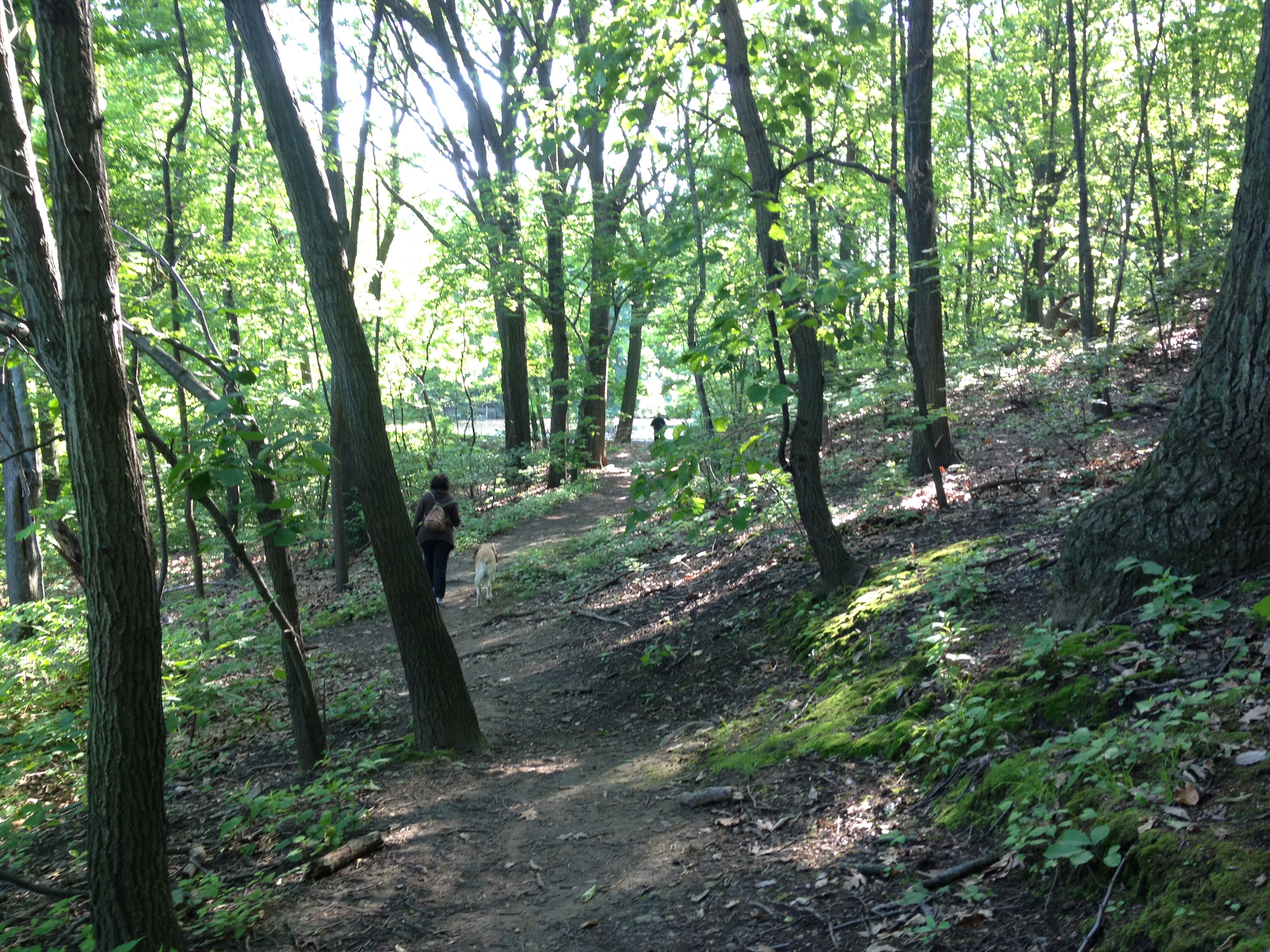
Walking the dog ain’t bad—the Snug Harbor women and their dogs (all female, too).

We’re up on the mountaintop in Umbria for awhile now, and we had to open the house and get things going again in general. Plus, cobwebs. So I’m going to just update with some random stuff.

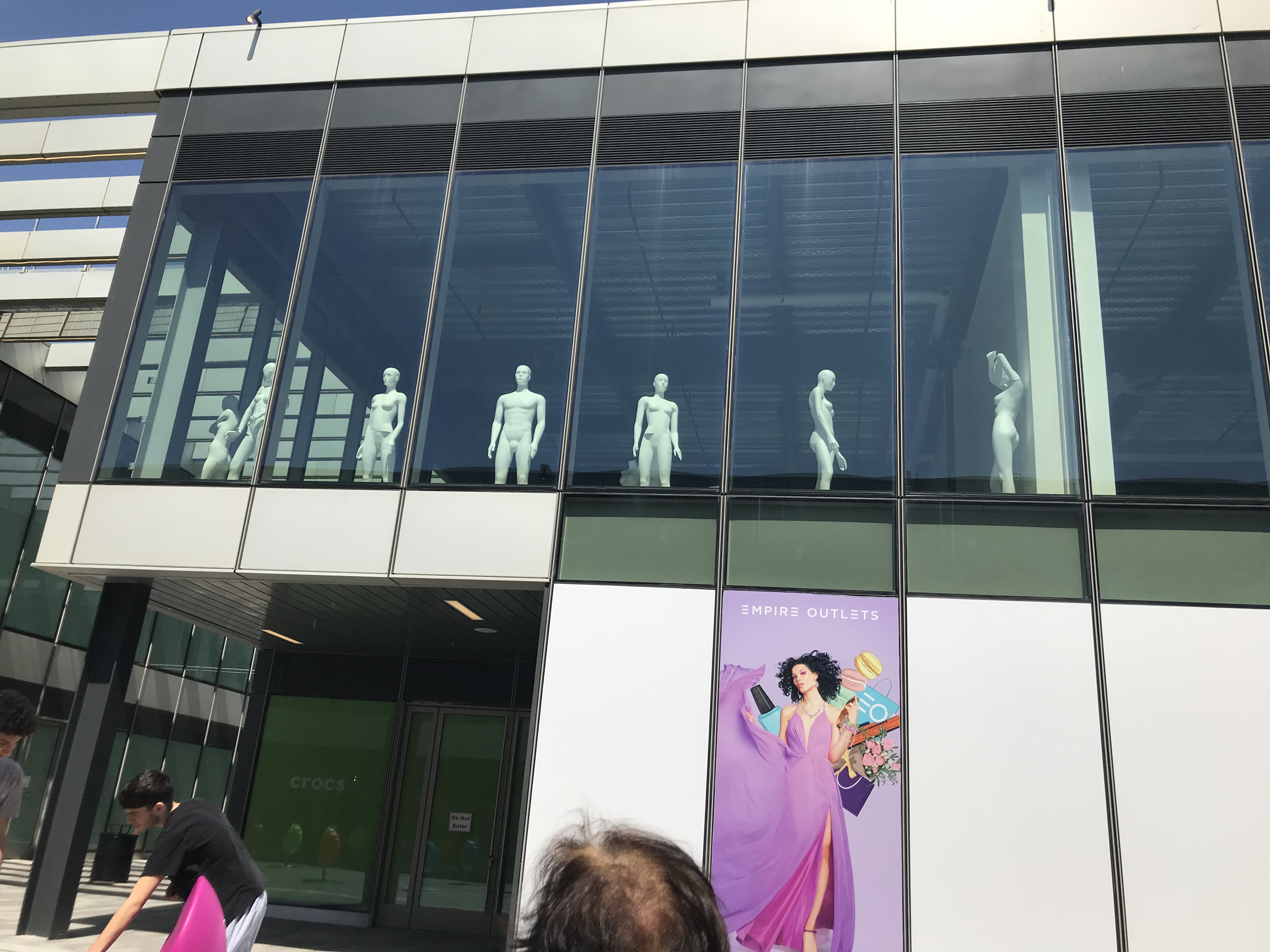
First, the Empire Outlets on Staten Island. You may remember my rant about the Wheel of Misfortune, er, The New York Wheel. Well, what a surprise, the Wheel is dead, its part gone to auction, a detritus of lawsuits in its wake, and the Empire Outlets. The thinking was that tourists would finally have a reason to get off the Staten Island Ferry, head for a $30 ride on the wheel, and then go shopping. European tourists, in particular, see clothing and tech stores here as an insane bargain, since the Euro is trading at about $1.12 and Euro sales tax can be 20 percent or more.
If you build it, will they come?

Italians, in particular, go nuts for stores like Abercrombie and Old Navy, hence, the outlet mall. Of course, being on Staten Island, you gotta wonder, since the mall lost its main draw, the Wheel. We’ve watched the construction of the mall with a combination of amusement and horror. The part that faces the street looks like some weird robotic contraption, while the public spaces—outdoor—aren’t too bad. There’s a big underground parking lot for Staten Islanders to drive in and, this is important, NOT HAVE TO STEP FOOT ONTO THE STREETS OF THE DREADED NORTH SHORE. That’s where diversity lives, not to mention that’s where the Wu Tang Clan burst out of Shaolin (aka Staten Island).

Not quite ready for prime time.

Next up: Memorial Day. We spent it with the kids and our friend Marsha. And we grilled Beyond Meat burgers, which are scarily like chop meat. Not having eaten much meat for most of a decade, it definitely felt a little strange. Not that it stopped us.

So real. Surreal.

Then off to Umbria. We shop around for airfares, not having any particular loyalty to one airline. The Spartan Woman is long limbed and so insists on flying premium economy, and we’ve had decent experiences. The roster so far: Alitalia, Norwegian, Iberia, and Lufthansa. Do not take Norwegian. Premium on the 787 “Dreamliner” is fine, if you manage to fly on one. But Norwegian’s flights are invariably late and they love to cancel flights. Plus, the engines on those planes had problems, so they’ve pulled some out of service and have used chartered, old, disgusting, do not do this, aircraft. The other three are fine. Alitalia’s Premium is pretty cosseting, Iberia cheerful and fun, Lufthansa kind and generous when it comes to drinks and food.

The friendly skies of Lufthansa

So here we are. The two of us speak a weird mix of Italian and English to each other, and have done fun stuff like taking the car for an oil change and getting the brush cleared. We take walks, watch Turkish shows on Netflix, and take walks. Did I mention that we take walks? I work, too, in a cool office with a view of the mountains. Non c’è male…(not too shabby)

Polish dulce de leche and a serendipitous wedding

I haven’t written much since we’ve been back in New York—and I haven’t posted what I wrote. Too busy with the usual stuff, work and (ugh) taxes. Truth is, it’s been kind of dull, except for good things like seeing the kids and having the dog around.

But this past week was different. Nope, not talking about the Mueller report. This is about me, remember?

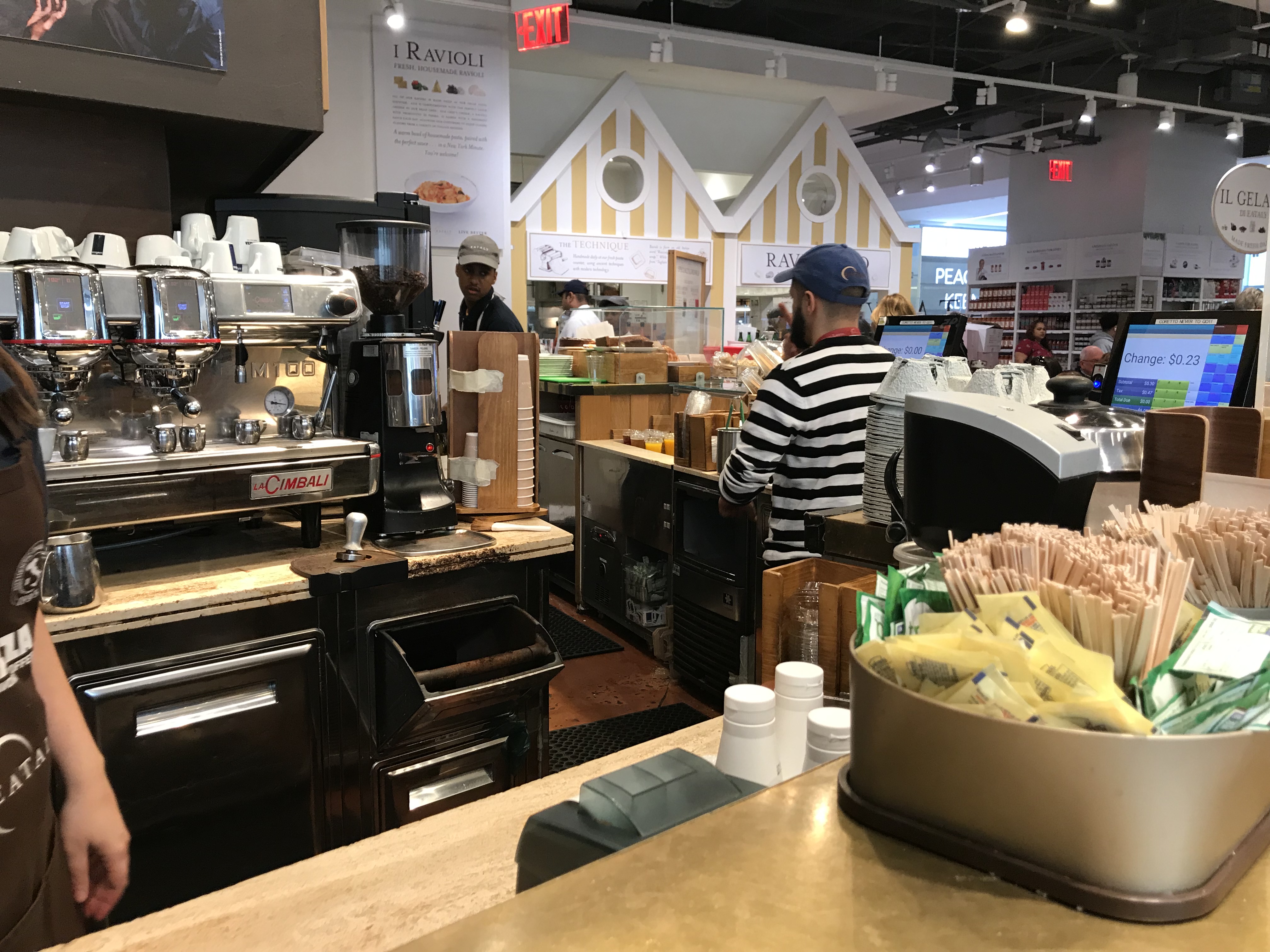
First up: The Spartan Woman had to go to a teacher’s union meeting near Wall Street. She’s retired, but they keep the alums in the fold. I tagged along, having nothing better to do and wanting to get out of the house. I used to work in the neighborhood, so I have my favorite walks. One of them took me to Eataly, where I used to enjoy a mid-afternoon espresso with one of my deputies most days. It may be a semi-pretentious temple of Italian gastronomy, but they actually make good coffee there and it’s not ridiculously priced. Then I walked through the Oculus, which I love in spite of the $4 billion price tag. The passageway under West Street took me nearly out to the river, where I started to head downtown along the Battery Park Promenade. The harbor’s my thing. After living on a mountaintop, the crush of people on the street is a bit much.

One of the few places to get a decent espresso in the city.

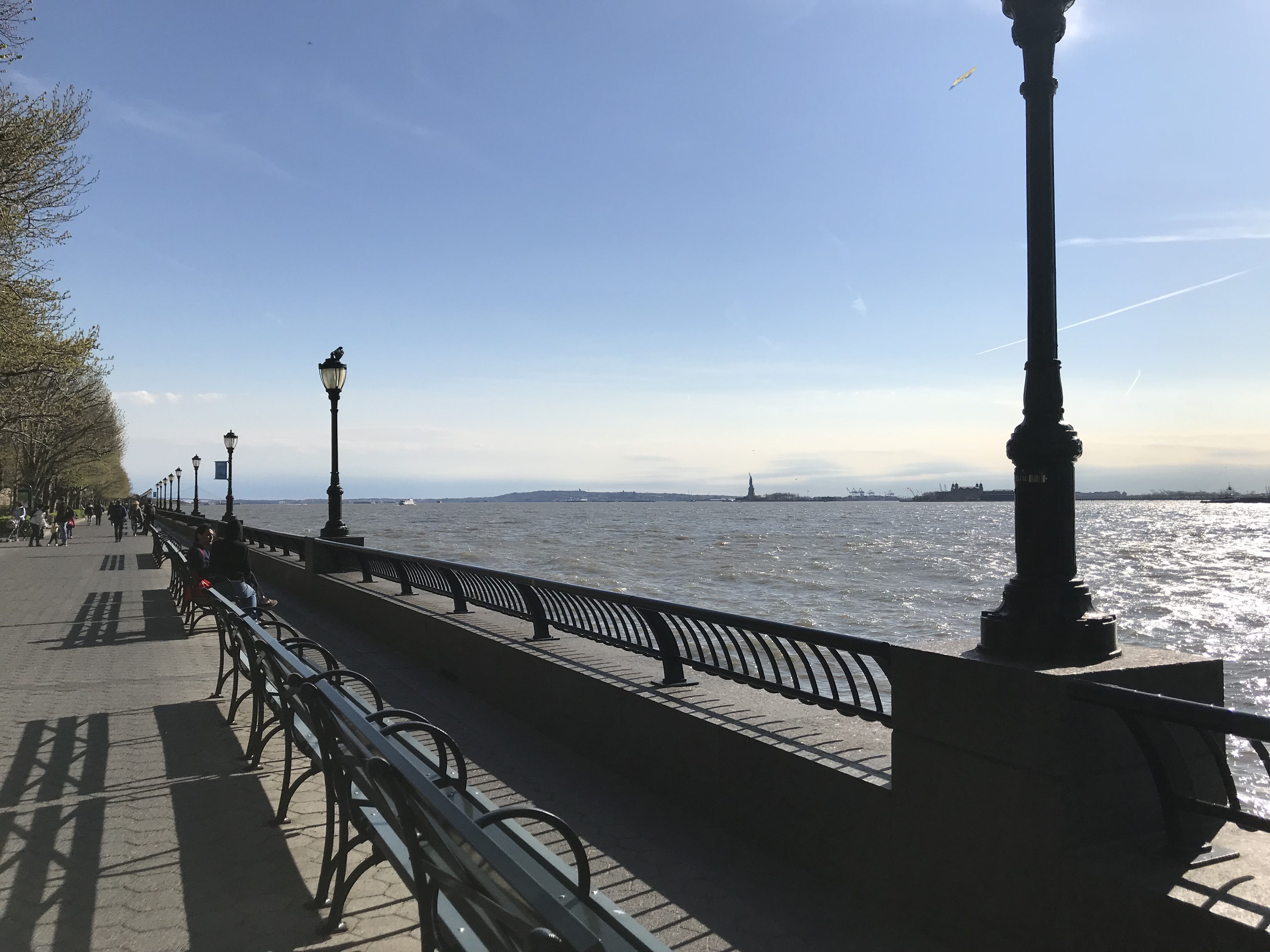
So I walk, and I see a tent. There’s a party going on, apparently thrown by the I Love Poland Yacht. People have gathered, but it’s not a huge crowd. “Help yourself to the buffet,” someone told me. I was tempted, but I wasn’t into sausages, sausages and huge balls of stuffed cabbage. But the drinks stand called me. “Some vodka or beer?” Yes, please, the vodka being herb flavored and delicious over ice. A young woman was walking around with a tray, while kids were getting helium-filled balloons. “This is a traditional Polish pastry,” the woman said. “It’s filled with something like dulce de leche.” Thus fortified, I continued my walk and saw views like this:

New Yorkers sometimes forget that they live on a beautiful harbor.

The next day, we walked the Avenue. We live a few houses up from Forest Avenue, the neighborhood’s commercial strip. A few months ago, I walked up and down it with one of the kids, who, looking around, said something like “When did this go all Brooklyn on you?” It’s true–we always had bars, but now we’ve got cafés, cool restaurants, including my favorite local Syrian place, hipster barbers, a bakery that has a gelato stand when it gets warm…you get the idea. We stopped in for breakfast at the On Your Mark Café, a breakfast and lunch place that employs people with special needs. The servers are super-attentive and food’s decent. I’m not a breakfast person but I couldn’t resist the chocolate chip pancakes, made with chocolates the organization makes next door in its chocolatier.

Chocolate, the breakfast of champions

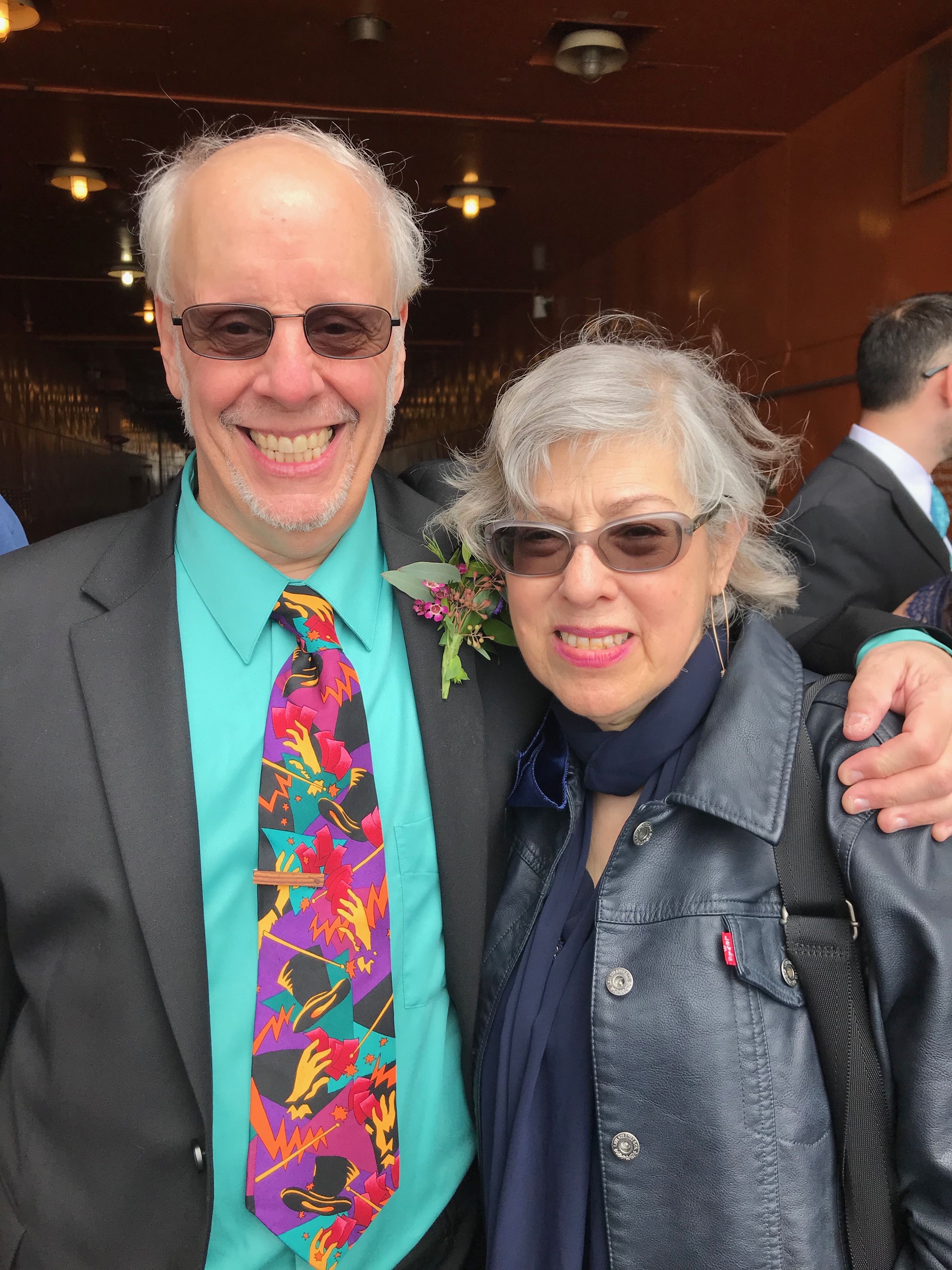
The best adventure, though, was on Friday. I was heading into Manhattan to have lunch with an old friend who was in town the same time I was. We’d been missing each other for the past couple of years when it came to being in New York at the same time. The bus to the ferry was slow and I started to hustle to get the 11:30, just to have a little walking around time in Union Square. But another friend, Joan, intercepted me. “Want to see a wedding on the boat?” she asked. What? Her son was going to tie the knot on the next boat. I guessed that that explained the young woman running around the terminal in a wedding gown. We went over where the other guests were hanging out; I saw another old friend and a former co-worker from 20 years ago.

Making a vow or two.
Meet Gary and Joan, parents of the groom

We boarded, went downstairs and, yeah, this was an official wedding, with a bridal party decked out (and sporting similar retro sneakers). The officiant gave a little speech, saying he didn’t have many profound things to say, but that we were all gathered there because of love. “And that’s a good thing, right?” Right.


Dining Finely

I wrote restaurant reviews for a decade, back (way back) in the 1990s. It was a great part-time gig. I wrote a column every four weeks, sharing the space the other times with a friend/colleague and a semi-famous reviewer whose prose made me flinch. We invited friends and family along so that I got to taste enough dishes to get a sense of what the kitchen could do.

Best of all, my company paid for it. My only limit was $500—I think that above that, the CFO had to go into more detail to the IRS about the charge. Back then, it was no problem; once we went to one of New York’s most exalted restaurants and for three, paid the princely sum of $450. I think that’s about what you’d pay for one person these days at places like Del Posto, Masa, Blanca, or any of the other ridiculously priced New York temples of gastronomy.

I think about this stuff because I like to go out and see what cooks are up to. But at the same time I flinch at what it costs. In New York and, I guess, London and San Francisco and similar places, the cost of going out even to an okay restaurant has skyrocketed, with entrées typically in the $35-45 range. That’s just nuts. Sorry, but it is. We’re paying for real estate. And don’t get me started about wine prices, with just-okay restaurant wine lists started at $50, and the wines at that price aren’t exactly transcendent. And $5-7 for an espresso? No. At that point, it’s just food fetishism and, yeah, pay to play for being part of the scene in a world city.

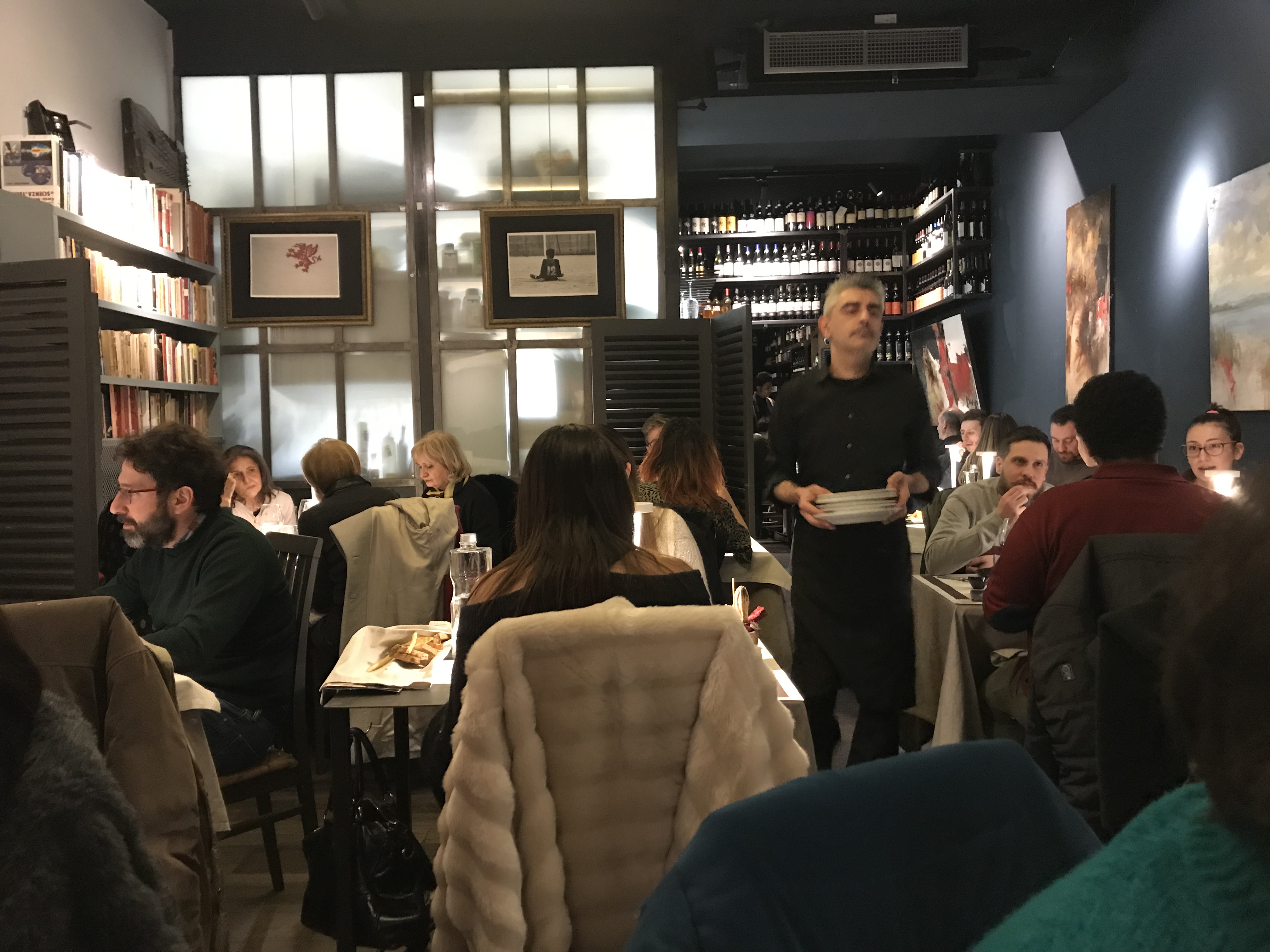
The Spartan Woman and I were talking about this the other night when we went out. Our favorite “fancy” restaurant in Perugia had a vegan night with a guest chef, Angelo Belotti. The restaurant, L’Officina Ristorante Culturale, has a mission, and I’m on its mailing list. It features local produce and other fashionable stuff, but it’s done that before hipsters knew where Brooklyn appears on the New York subway map. And it has a lot of special nights. Once, in a nod to someone on staff, it had a Greek night, and the menu featured modern, deconstructed takes on Greek cooking standbys.

We went intrigued by a recent Vegan Wednesday. What would they do? The place is known for beautiful presentation and enjoyable tasting menus. The newsletter contained the menu, but it was just words that wouldn’t convey how it would look, or taste. The menu also said the tasting menu would come with three glasses of wine.

Oh, and all this came at the princely sum of €25. That’s right. At current euro/dollar exchange rates, that’s $28.23. And there’s no additional tax or tip. You just don’t tip in Italy, unless you’re a tourist or really, really want to reward someone for truly special service. But normally, it isn’t done. Wait staff earn a decent wage, and don’t have to grovel to customers. The system upends the power dynamic in an American or Canadian restaurant.

And yeah, I get it. New York vs. a small provincial city in Italy, world capital vs. not a world capital (but a pretty cool international college town), masters of the universe vs. normal people—although if there were a sophistication in food contest, I’d put any Perugian up against a reader of Pete Well’s New York Times restaurant review column.

Anyway, on to the photos. First course:

Carrot “fettuccine” with Jerusalem artichokes and marinated artichokes.

Purée of soybeans soup with five spices
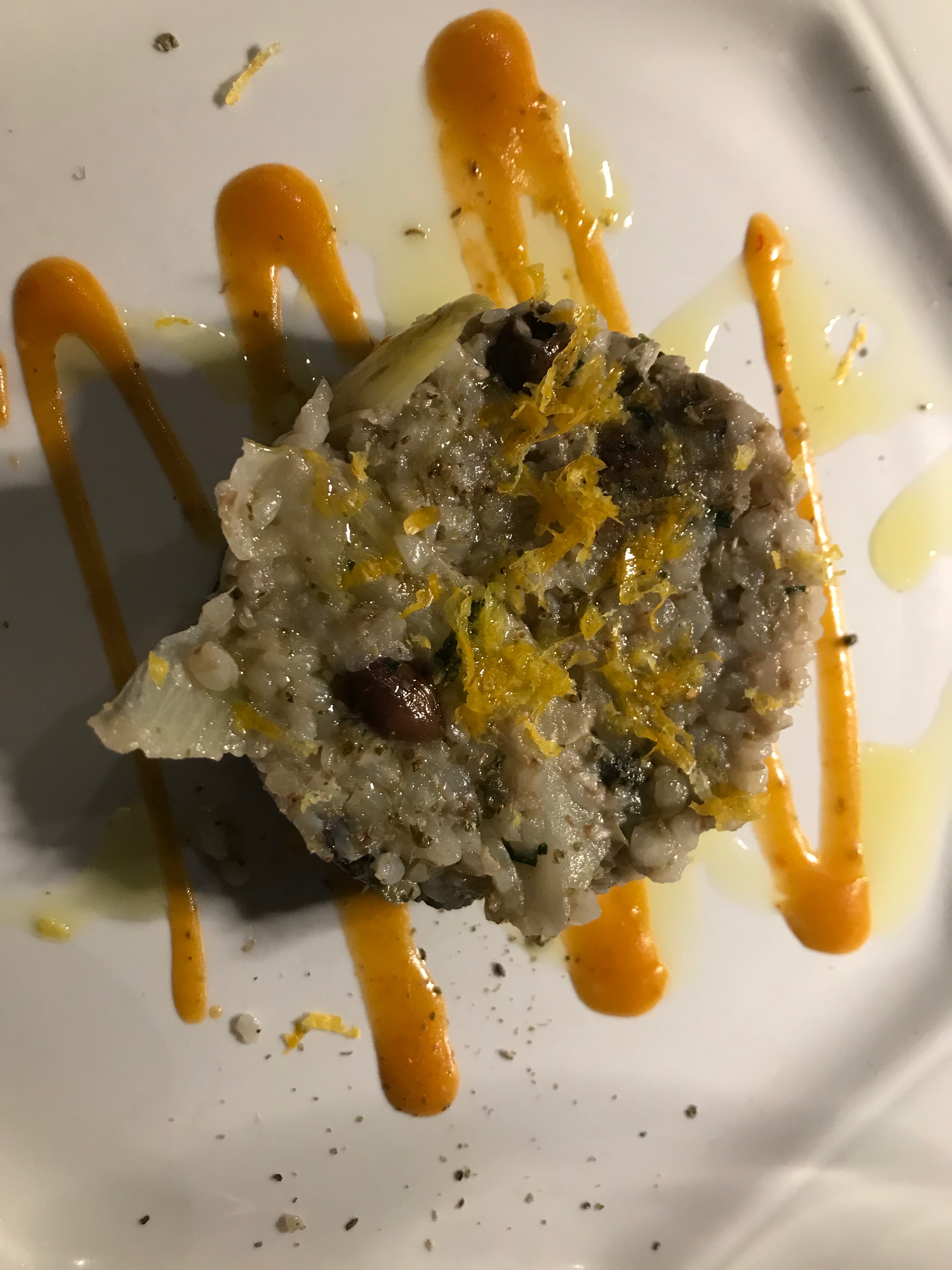
Spicy buckwheat with fennel, Swiss chard and olives
Little phyllo sack with spinach, raisins and sesame with hummus of curried lentils and mango


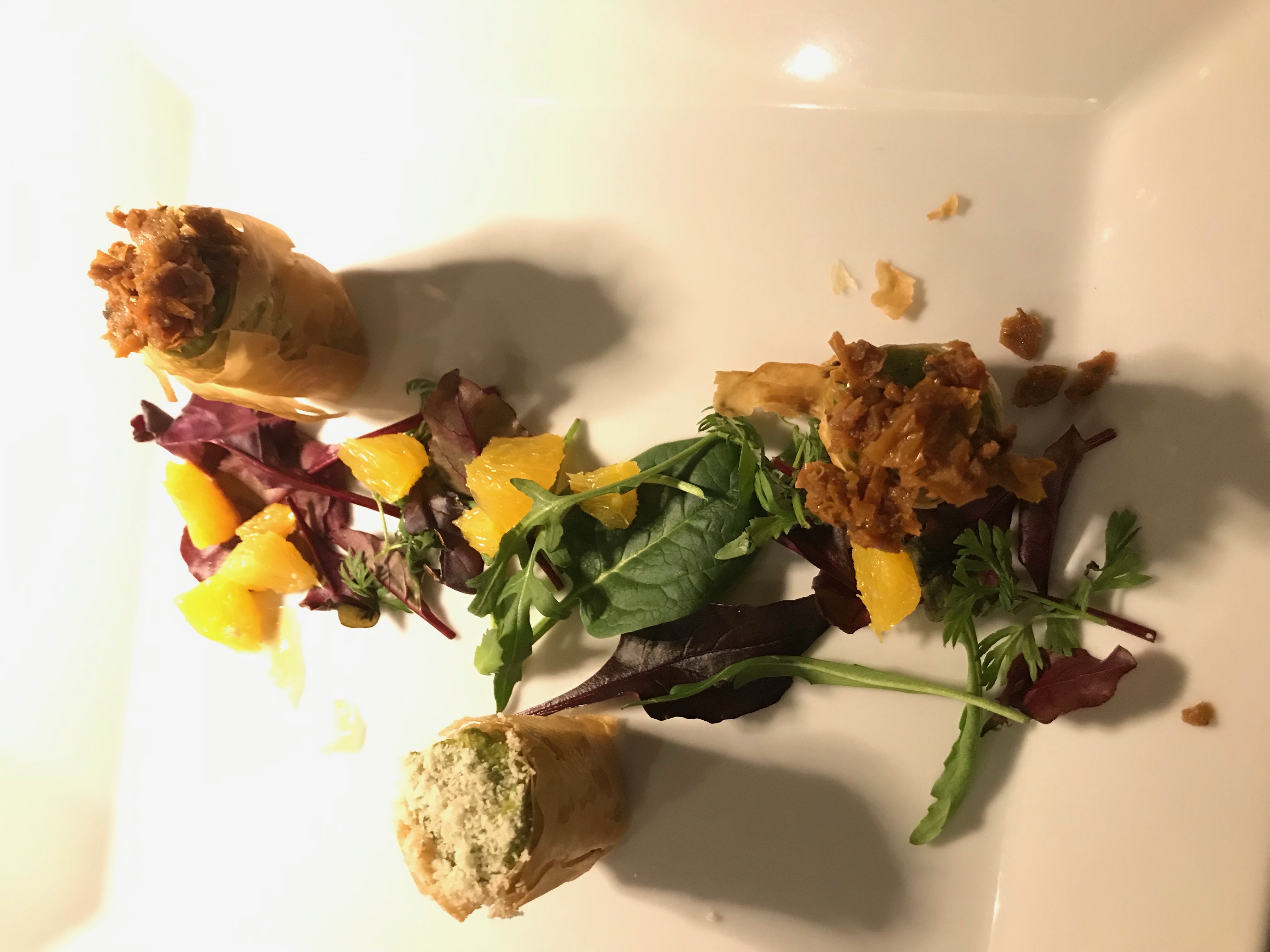
Savory cannoli with broccoli “cream” and sun-dried tomatoes on a bed of mixed oranges

Vegan dessert: Chocolate mousse with caramelized grape tomatoes


If I were reviewing, I’d say the only false step were the tomatoes that topped the chocolate mousse. They weren’t really caramelized. Otherwise, it all tasted as good as it looked, even if everything was understated. The chef came around to every table and explained the menu, and, he said, the spare salting was a deliberate choice.

But Vegan Wednesday accomplished its main task. It showed how vegan food needn’t be a punishment, and instead can be creative, provocative, and enjoyable. We aren’t vegan, or even real vegetarians (when we’re feeling decadent, we eat fish and seafood), but eliminating meat has turned us into more creative cooks. And it looks as though L’Officina was up to the challenge, too. I don’t think I’d ever go vegan—I like cheese on my pizza and honey in my tea—but it’s nice to see that it doesn’t have to mean the virtuous lentil loaves of the vegan past.

The road taken

A few days ago, we were doing our usual morning walk up the road when we bumped into a neighbor, who introduced himself as Claudio. He was out for a walk, too, telling us that he just retired. He told us about his walk, which involves walking down the road and making a turn into a “strada sterrata,” which is an unpaved road. He said that he makes a loop and comes around after being on the Sentiero Francescano. This trail is a series of trails that trace the steps of St. Francis of Assisi when he left his family home and riches, and walked to Gubbio through the woods. A mystical, rebirth ritual walk, in other words.

Curious, we wanted to see if we could replicate Claudio’s walk. (Francesco’s walk is well-marked and in warmer weather, sees waves of pilgrims.) A few days ago, we walked on some of the Franciscan path, and I was looking at the map on my iPhone. I saw as we were walking back down the hill another road that, if you looked uphill, veered left. Hmm, we didn’t remember that. But as we descended, we saw an opening and yes, a path that was carved into the side of the hill. That’s one of winter’s advantages; without the overgrowth and weeds, it’s easier to make out the paths that wind all around here. We took it and saw that it followed a higher trajectory than the Sentiero and then sort of curved around the hill. That must be Claudio’s route, we figured, and made plans to come back the next day.

The turnoff, not that you’d know it. Apple Maps showed it; Google didn’t. But for some other stuff, Google shows details Apple doesn’t. Guess you need both.

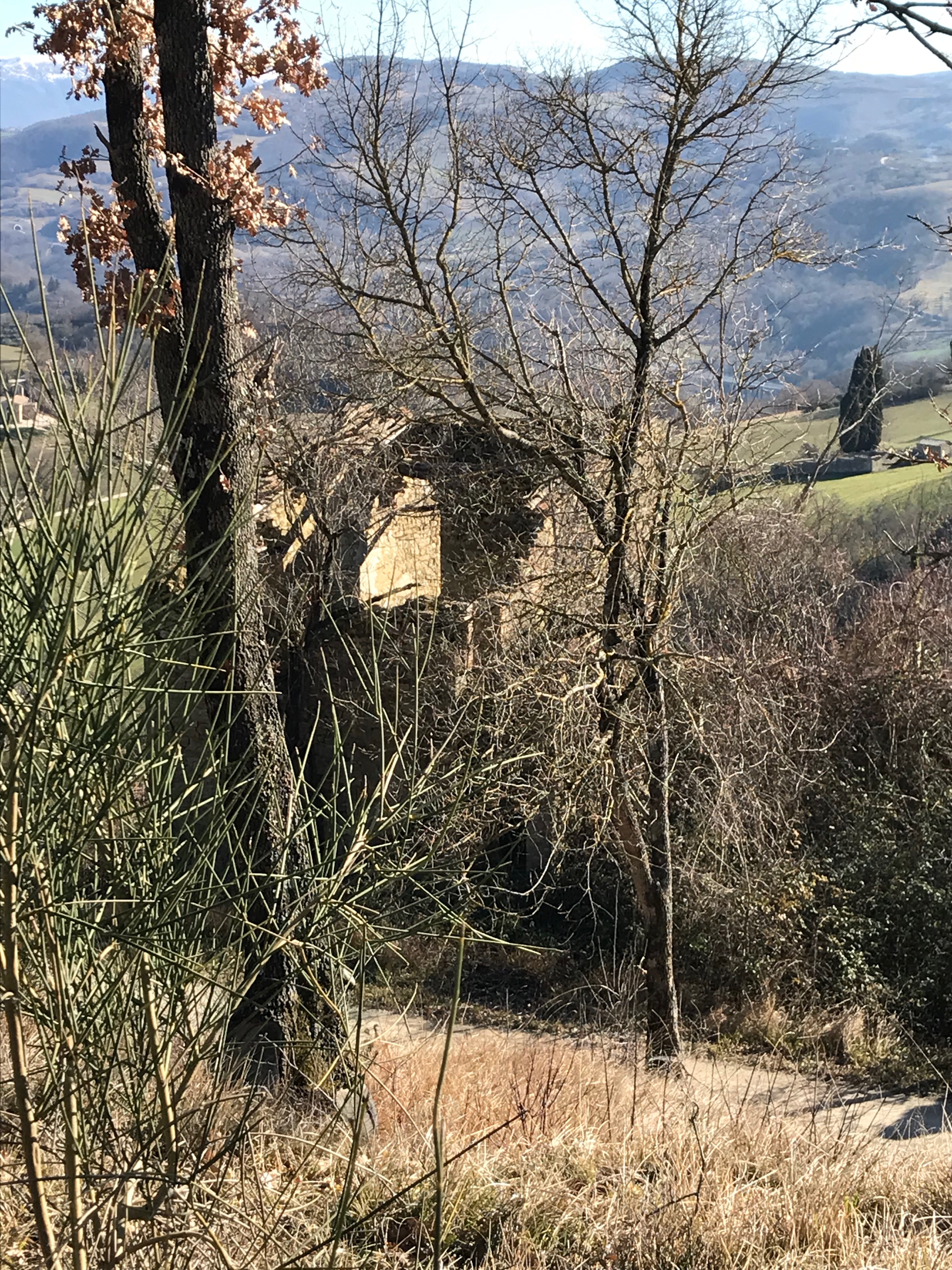
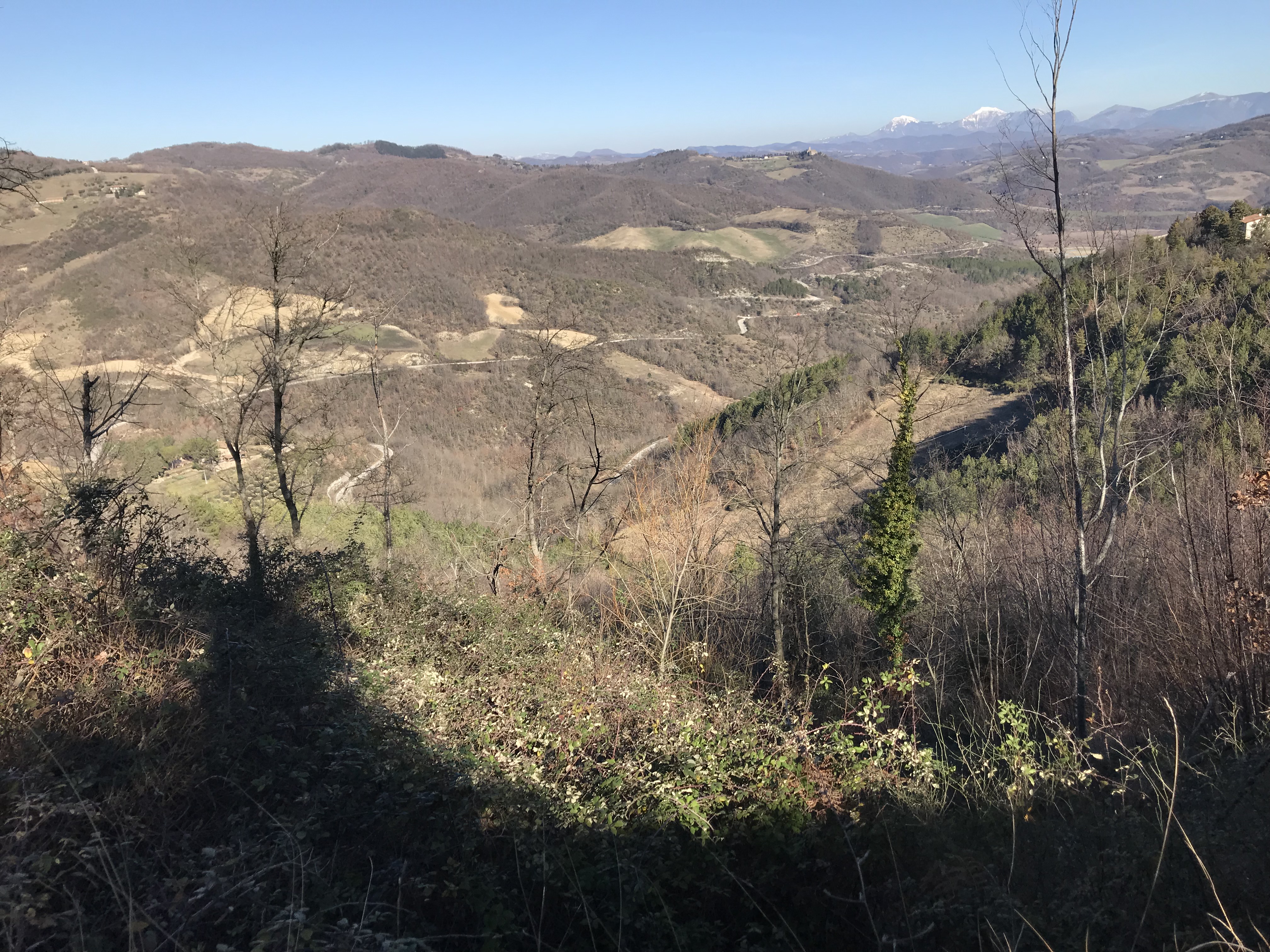
So we did. And O.M.G. We’re suckers for a good view and on this path, they just kept coming. Unlike on the Sentiero, you don’t really plunge into deep woods. The path—it must have been a road of some kind at some point—just hugs the hill, carved into it as it follows the basic path of the Sentiero, but about a tree higher. So we got to look into the ruin that we’ve passed many times (we hear that it’s for sale, if anyone out there is interested). As the path curves to the left and westward, the views are pretty stupendous.

Looking into the ruins of a farmhouse. An old timer neighbor told us that the family that lived there farmed the area until the 1960s. Their olive trees are nearby, still producing fruit.
On top of the world! Those are the snow-capped Apennines in the distance.

And then, we thought we hit a road block. Or, at least, a gate shutting us off from the rest of it. Luckily, though, as we got closer, we saw that the path veered left then curved around a large house with a pool and gardens that we soon realized was the Agriturismo Val di Marco. An agriturismo is supposed to be a working farm that welcomes guests, but this one does not look remotely farm-like. It’s just a big comfortable house in the Umbrian tradition that happens to be in the country.

Agriturismo Val di Marco, waiting for summer’s guests

Enough fun, though. What went down had to go back up. Our road, which we knew was south, or to the left, follows a high ridge. And the path did indeed go up. And up. And up. We were panting, okay, I was panting as we neared the top.

There was a payoff, though. We were met at the crest by our usual canine welcoming and escort service. But we disappointed them–The Spartan Woman had forgotten to pack the doggie biscuits. I guess they forgave us, though, and followed us most of the way home.

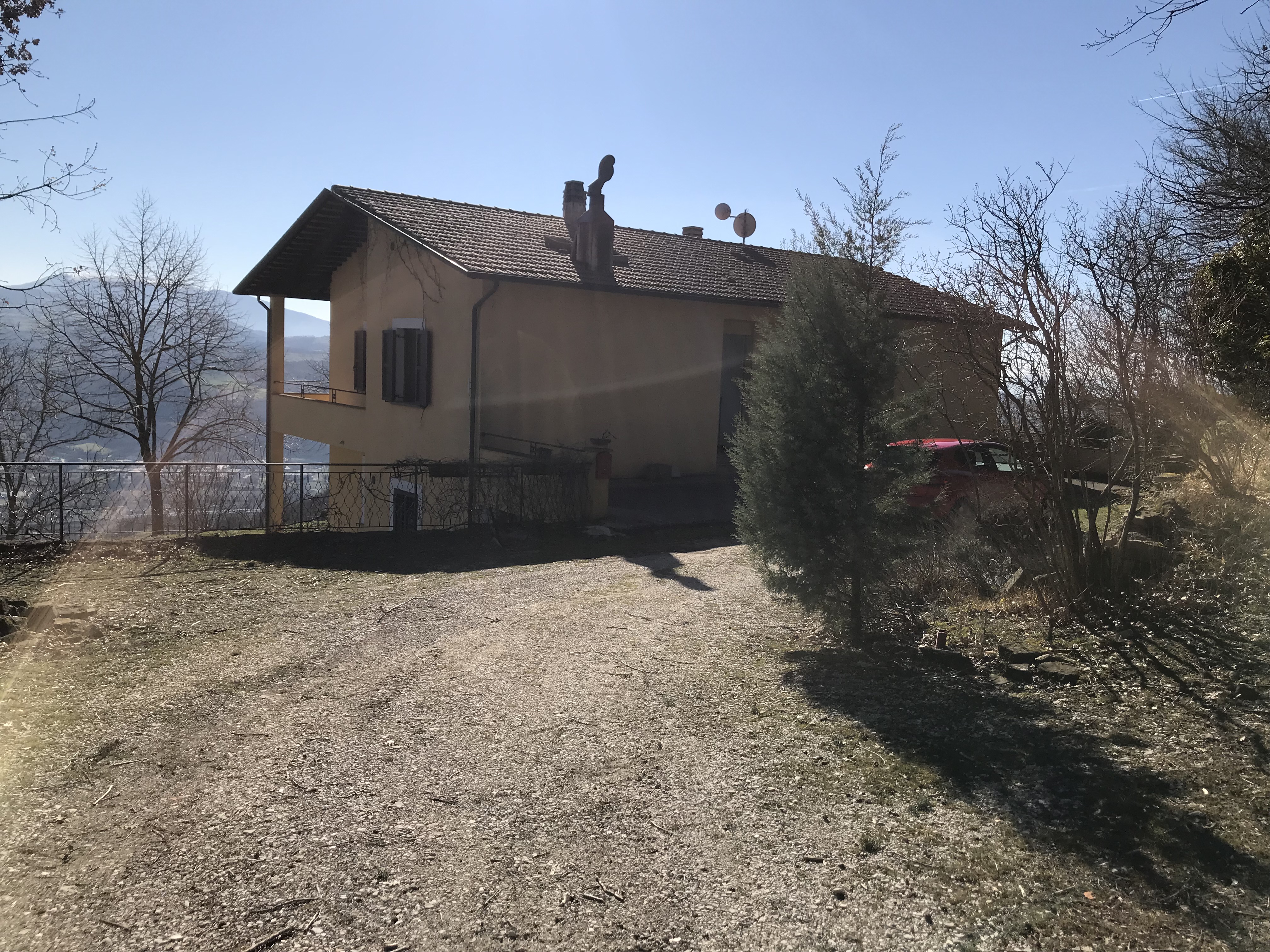
Casa, dolce casa (home sweet home)


My hometown

I caught up with Bruce Springsteen’s Broadway show on Netflix the other day. It must have been a great experience to be in the theater with him. But it wasn’t too bad on the flatscreen. I was pretty amazed with the whole thing, especially his stamina and the details he remembers about his childhood.

That brings me around to the headline of this post, and it’s the title of one of Springsteen’s songs. He manages to imbue Freehold, New Jersey, with a mythical status. The Catholic Church and school, the Ford factory, the bars, his father, working men in general. I started to wonder why so much of my childhood is a blur. “He’s a poet,” said The Spartan Woman. He can mythologize his memories. Of course, in my mind, it came back to me, me, me. Am I just insensitive by not thinking too much about where I came from? Brain damaged by some of my old habits? Was it all just too long ago? Wait, Bruce is older than I…

I think part of the difference, apart from the obvious disparity in artistic ability, is that Springsteen came from a small town that was pretty well self-contained. I may have grown up on a hill on Staten Island, but our neighborhood was always part of a bigger whole: the island in particular, and New York City in general. So we, or at least I, didn’t have that sense of local-ness. Sure, we had our candy store and deli and bars, and there were places we kids went in the woods, at first for innocent play, and later for not-so-innocent partying, but we always knew that we were part of a really big place and that it didn’t just belong to us. Or at least it seemed when I first compared my memory to Springsteen’s.

Then again, Springsteen early on in his show says he made it all up. It’s his magic trick. And while he exaggerates, there’s some truth to his perceptions.

In any event, it got me thinking about the peculiar place I grew up in. It’s gotten a bad rap, often unfairly. Sure, there are jerks like the cast in MTV’s Jersey Shore and a lot of it is a badly developed wasteland of high ranches and strip shopping centers and bad Italian-American restaurants. But it’s also where the first tennis games were played in the U.S., where prohibitionists established a colony where they could be uplifted by concerts and lectures. It’s where the Catholic Worker Dorothy Day chose to live out her last days, and where Hair composer Galt McDermott lived and brought up his family–right in my neighborhood, in fact.

So I’m trying to remember details, if and why it’s a special place. I’m not going to get into a sweeping mythology like Springsteen does, but my Staten Island friends and relatives will probably agree that it’s quirky and molds its inhabitants—at least those with half a brain and some ambition—in certain ways.

Now, some geography, which shapes a place’s destiny: Compared to the rest of the city, Staten Island’s got a certain natural beauty that’s lacking in much of the city, from the Lower East Side to the high-rise sprawl of Queens. We’ve got hills, a whole chain of them from the northeast tip throughout the central spine. The master builder (and destroyer) Robert Moses met his end on Staten Island. The man who rammed destructive highways through outer borough neighborhoods didn’t do his due diligence: He drew a highway straight through miles of woodland and, coincidentally, one of the city’s most affluent neighborhoods. That neighborhood, Todt Hill, rose up, enlisted celebrity aid, and put an end to his fevered highway dreams.

The hills are one thing; the other big feature is, for want of a better term, its island-ness. There’s a certain sense of isolation, of self-containment. (Like Freehold? Hmm…) Island dwellers around the world feel it. You know in a way that you can’t get lost. Go long enough in one direction and you’ll hit a natural barrier—the water. It’s what makes Manhattan Manhattan, too. Look across a crosstown street and you see where the land ends and the Hudson or East Rivers flow. You know you’ve got limits. When I first started to drive around in Umbria, I was disoriented because I could go for hours in one direction and not hit the water. I had to learn how to tell where I was by looking at the mountains and hills.

Staten Island is defined by its island-ness.

On the micro level, I grew up on one of those hills. Staten Island, like everywhere around it, was originally made up of small towns. Our was Dongan Hills, now grandly called Dongan Hills Colony, to distinguish the hilly part of town from the plebeian lowlands. Back in my childhood, though, it wasn’t full of McMansions, it was a place with some old colonial-type houses, the odd farmhouse, and a bunch of new houses that gradually took over from the thick woods. And those woods were where we kids spent most of our time outside. We knew every footpath, probably dating from the Native Americans who lived there hundreds of years ago. We’d just go hiking, or play hide and seek, or imagine we were partisans in the hills resisting invaders.

Meet Joe. He’d love to have a beer with you.

Back on the street, it was a hill full of recent European immigrants, from Italy, Ireland, Germany, and Scotland. We got used to hearing people with accents—my own father spoke, and still speaks with an Italian accent and often wonderfully fractured syntax. They brought their habits across the ocean with them. The guy across the street, a big man named Josef, was a devoted practitioner of the European aperitif hour. At about 6 every evening, he made the rounds, checking into his friends’ and neighbors’ houses, accepting a drink, or a bite. We saw it as totally normal that Joe would drop by. Later on when I was a teenager coming home from some revelry, he returned the favor. He’d be sitting on his screened in front porch late in the evening, with a cooler full of beer. “Anthony,” I’d hear, “come over for a nightcap.” He’d offer me a weiss bier, something light he’d say, and we’d sit around and talk about…I don’t know, honestly. It didn’t matter; it was always a grace note to a night of fun.

And then, my parents’ house. It’s funny to hear how my cousins remember it. To us, it was just where we lived. But my parents were the young ones in my mother’s extended family, and we were, relatively speaking, the hipsters. While my aunts and uncles strictly oversaw their kids’ interests and habits, we were like wild animals, free to do what we wanted to do. My poor cousin Noel had to play the accordion; I got a guitar and Beatles sheet music. My parents had a New Year’s Eve open house and invited everyone they knew. It was a big raucous party spread throughout the house, with people dancing downstairs to Motown on my sister’s dance floor (my father built it for her, complete with barres along two sides). After midnight, my father would channel his father and fry up sfingi, or what Neapolitans call zeppole–fried dough to soak up the night’s alcoholic overindulgence. When I turned 16, my parents gave me what would probably get them arrested now, a pizza and beer blast, complete with a keg. They invited all my friends and our extended family. (They also gave me a gold watch, which I soon lost. Nice things are mostly a lost cause for me.)

So, was how we lived a product of the geography that surrounded us? I think so. We liked to think of ourselves as special, or at least different. And the hills and self-containment of the island back that supported that feeling. Maybe it was just that back then, a few decades back, people were just more interesting, and not mere manipulators of what’s on the screen in front of them. We had to move around in the space we were in, or we’d die of boredom. Or, I like to think, we had more of an opportunity to wander and to dream, and to imagine the kind of person we’d like to be and the life we wanted to live. And the surroundings, as well as the tolerance shown by parents and other figures of authority, let us do just that without much interference.

Hey, maybe we’ve all got an interesting life story to tell, if only we stopped to think about it. Whatdya think, Bruce?


Italianese

When we’re in Italy (which we aren’t right now), what do you think we miss most about living in the United States? (Hint: It has nothing to do with language, shopping, movies, or our city.)

It’s the food, but not hamburgers or anything else typically American. We miss the easy access to Asian food. Gotta say first that Italy in general and Umbria in particular is getting better. Sushi (spelled “susci”) is a thing, from just-okay sushi in the nearby IperCoop (hyper Coop in English) supermarket, to really good, inventive sushi at Perugia’s Crudo (in the photo below). And it’s not only Japanese food. At the end of our inner city street, there’s a Taiwanese takeout, a Chinese noodle shop and another Chinese place whose focus I’m not quite sure about.

An expensive lunch for two on the Corso Vannucci

So we aren’t totally deprived. As far as I can tell, though, we don’t have much in the way of Thai food.

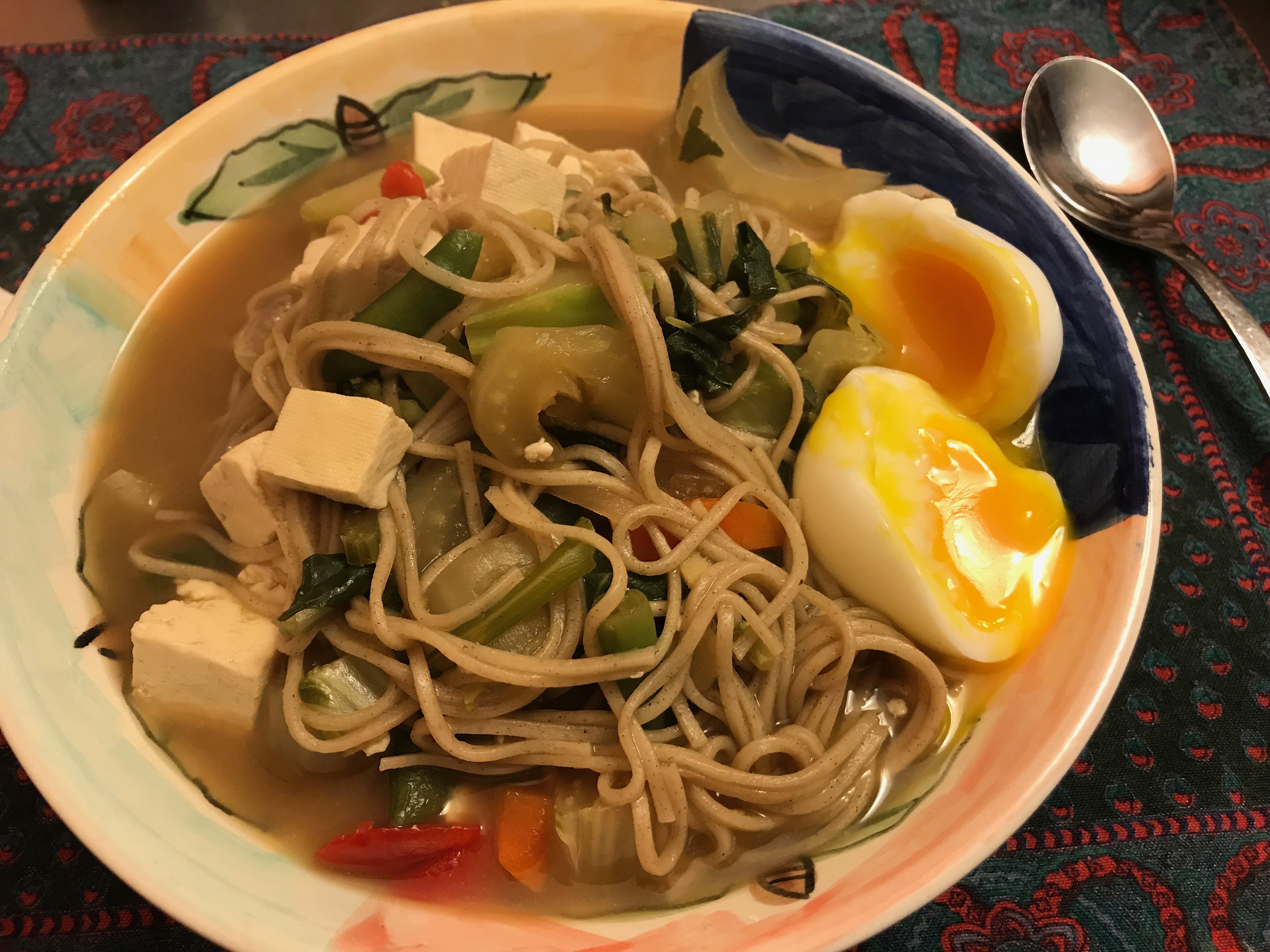
In any event, when we come back to New York, we eat less Italian-type food and more Asian, either out or at home. It’s gotten cold pretty quickly this November—the weather here seems to have gone from a prolonged, extended summer into a cold, grey and brown pre-winter. Luckily, the Spartan Women has become pretty adept at making Japanese-type big soups. With our current we-must-reduce regimen, she’s the main cook in the house (she doesn’t quite trust me to wield an easy hand with the olive oil, and my preference for a big spaghettata for lunch is something to be avoided for at least a few months.) So I’ve been treated to big miso ramen-type soups. I never know quite what I’ll find, whether it’s buckwheat noodles, a soft-poached egg, tofu in various forms, bok choy, etc.

Like this:

I do go out, too. Lately, I’ve managed to avoid most business meetings and lunches and instead meet up with friends or one of our kids. Daughter No. 2 works where the eastern reaches of Soho start to blend with the northern border of Chinatown and Asian stuff in general. “We have to go to Cocoran,” she told me when I mentioned that I needed to escape the house one day to avoid terminal cabin fever. She was right. It’s a smallish place, painted black inside, and quite eccentric. In a good way. Most of the seats are at the counter or at long, high communal tables, and the menu promises health and satisfaction. It delivers. (Beware, though, the menu also admonishes that it’s cash only and there’s no takeout and no doggie bags.)

This Japanese soup fanatic could not resist the spicy vegan soup, while the more spice-shy Liv opted for the unspicy vegan version.

I know this sounds strange, but sometimes when we get back to New York after a long day of flying across the ocean, the first thing we do is call the local Chinese takeout joint. When I was a kid, we’d only go out to Chinese restaurants. My father said it only made sense to go to a place that served food you couldn’t really cook at home, but I thought it was mainly because they were cheaper than most of the other restaurants in town.

Whatever. Following in dad’s footsteps, I opted for Chinese food for my birthday a few weeks ago. We have this family tradition–the birthday boy (me) or girl (The Spartan Woman, two kids) gets to pick a restaurant to celebrate. The birthday boy/girls usually pick an expensive place. But eh, I’ve had enough. Plus, I’d become really curious about this huge Chinese place on the Sunset Park/Bay Ridge border that I’d driven past a few times, East Harbor Seafood Palace. It looked good nosing around on the usual sites, so one blustery Saturday morning (I broke another rule, that the meal should be dinner), we convened the fam, including the boyfriends. And boy was it fun. 

We managed to beat the crowd, luckily. Within a half hour after we got there, people were lining up outside. The cart ladies are a riot there, pretty aggressive in a self-aware, humorous way. “You want this! You want this!” We did. The food was definitely a couple of levels above the usual dim sum dumpling experience, and service, even to us non-Asians, was friendly and efficient. You should go.

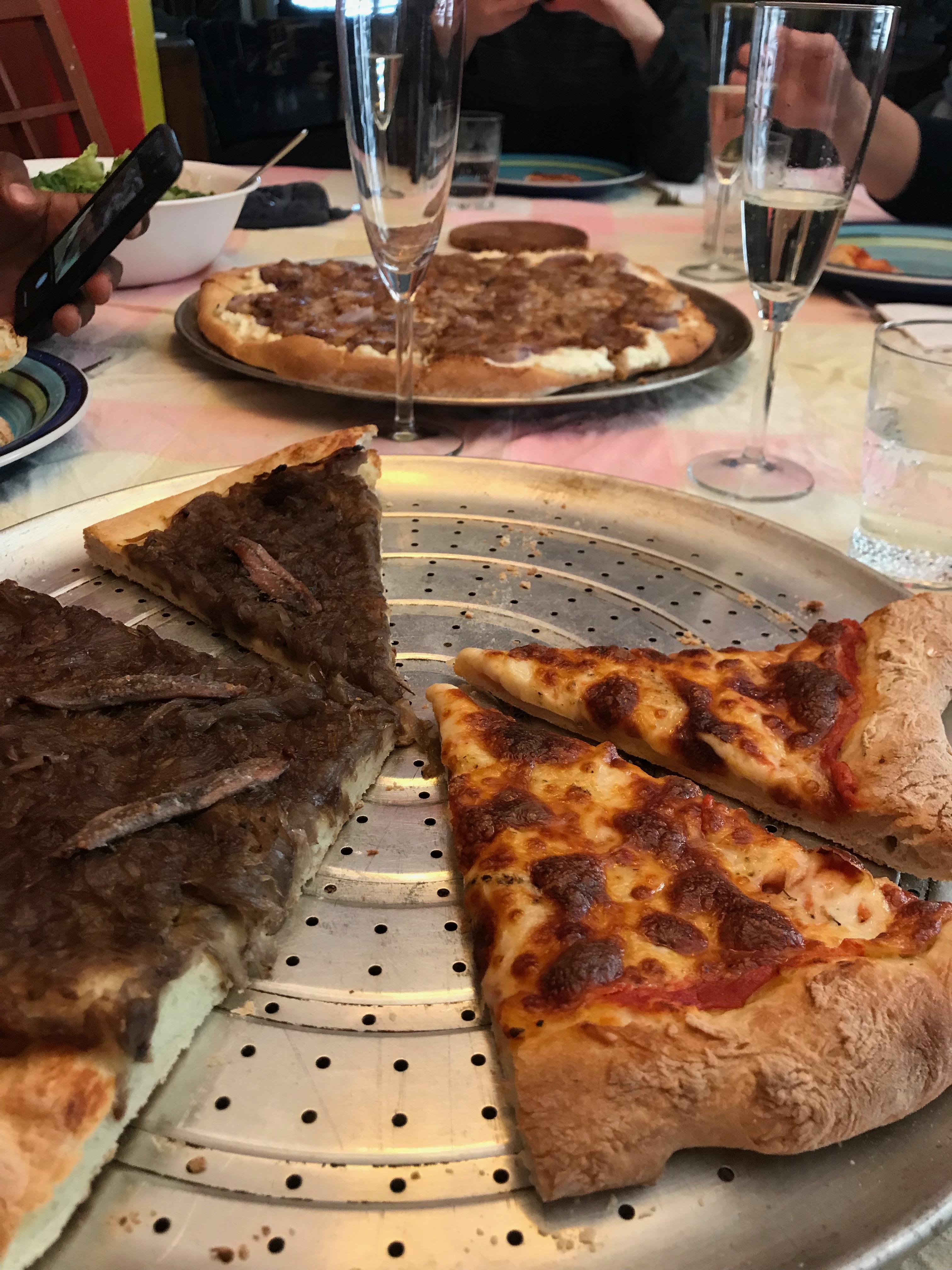
Anyone feel like pizza? We do all go back to where we’re from, right? I actually didn’t like pizza much until I was well into adulthood. But now….Amid the Asian food, we had a home pizzathon. The Spartan Women, a pretty good bread baker, invited the family and again, it was good times. One with onion, zucchine, or if you prefer, zucchini, an orthodox Margherita, and an unorthodox purple potato and truffle one. Talk about a nice way to spend a Sunday afternoon.

We must reduce

If you have a native-born American, English-as-a-mother-tongue father, you have my sympathy. It’s so boring. Having an Italian-born dad has its advantages. An outsider’s perspective on a bewildering country? Check. Interesting friends and relatives? Check. A place to stay in other countries? Ditto. Better food? Yup. Mangled but humorous colloquialisms in English? You got it.

This last couple of bits gave me the idea for this post. Nuccio, my dad, sometimes gets English expressions just a little wrong. “You must cry the consequences,” he once told me. I honestly don’t remember why he said that, but boy would it make a great country or Elvis Costello song title. And, “you must reduce.” He meant diet. And he’s right.

I never realized how active an office job could be. Or, at least, one based in Manhattan. And how not going to the office can affect your wellbeing. I walked a lot when I had a day job. To get there, I took a ferry, most often with friends, after which I took a .6 mile, or the more sexy 1 kilometer walk to the newsroom. The building was huge and occupied an entire city block. You had to walk a block to get to the bathrooms. When I got bored or sleepy in bad weather, I’d just take a walk around the block indoors. At lunchtime I did eat most often at my desk, but that was to save time for a brisk walk around lower Manhattan. And my web editor and I often took a mid-afternoon coffee break that involved a few blocks’ walk.

Now, not so much. I work out of my home office. My commute to my home office involves taking a few steps from the espresso machine and fridge in the kitchen. Slowly but surely, even when I managed to get out for exercise, I was packing on the pounds. It was like the proverbial frog in a pot of water. I didn’t notice I was cooked until it was too late. Almost.

Enter The Spartan Woman. She’d seen a similar gain, partly from stress, partly from an ear infection that kept her from her aquacise class. So she looked around, found the Weight Watchers app on her iPhone, updated it, and we were off. Only we’re talking about The Spartan Woman. She is decidedly not into plain steamed broccoli and tofu. We’re talking about someone who all her life has tried to game the system. (Don’t play cards with her if you aren’t a card shark. You will lose. Trust me.) Rather than limiting our diet, the regime brought forth an explosion of creativity. We usually split cooking duties, but for this, I was all too happy to just watch (and eat). She probably didn’t trust me anyway to use a light hand with the olive oil…

Can I share some of what she’s come up with? All of this is legit according to WW, and low in points. (I’m sure some of you know what I’m talking about.) And it’s working pretty well. (Downsides? I miss having wine with dinner every night, or having to earn it. But if it’s made the local liquor store sad, it’s had a good effect on our checking account balance, and I manage to be more alert most of the time. I’m not sure yet whether that’s a good thing.)

Here’s a lighter version of the Turkish classic imam bayildi. It’s slow cooked eggplant stuffed with tomatoes, onions and mint. The classic is cooked in lots of olive oil. This one isn’t, but manages to be pretty sensual.

IMG_3652

Next up is a riff on ramen. This version has tofu, lots of vegetables and a soft-boiled egg.

IMG_3584.jpg

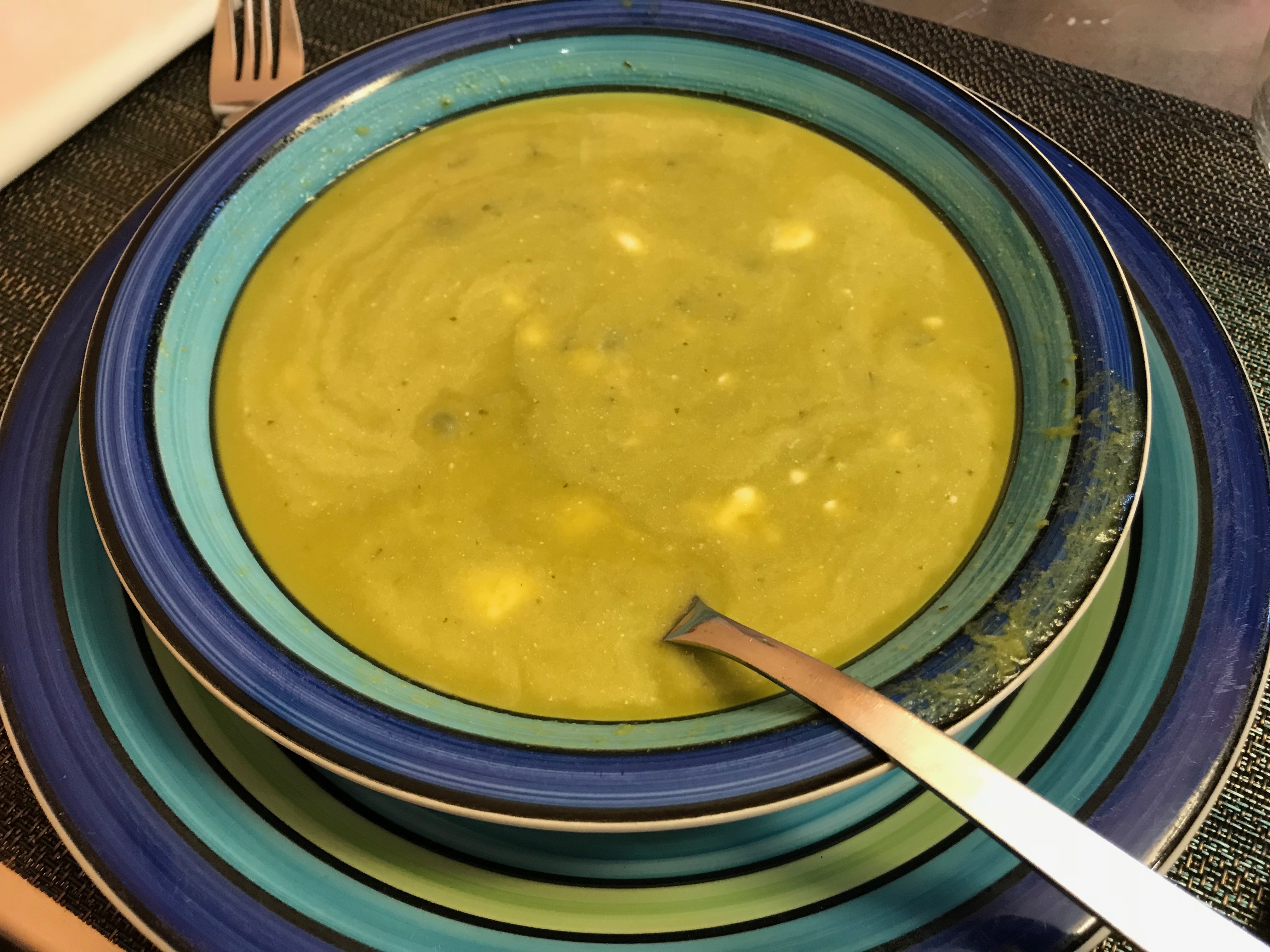
Here we’ve gone for something a bit Brit (and something I put together): cold spring pea and leek soup with lemon and a dollop of (light) sour cream:

IMG_3711.jpg

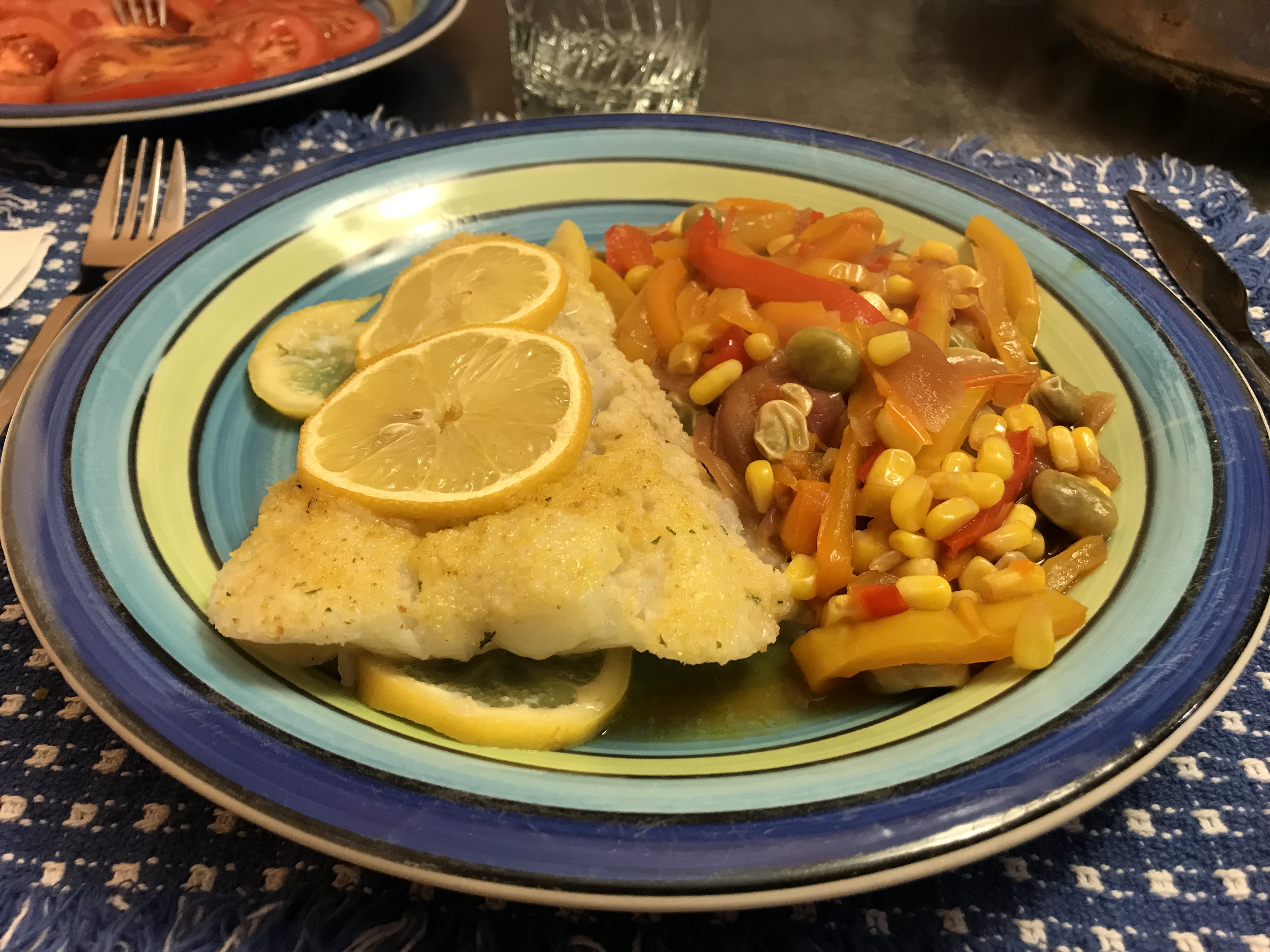
Next up, baked cod with sort of an Italian version of succotash—fava beans, corn, peppers, and I forgot what else. But it looks good, and it tasted good, too.

IMG_3650.jpg

Gotta have dessert. Phyllo cups filled with chocolate flavored ricotta and chocolate chips.

IMG_3678.jpg

Not bad, huh? I’ll keep this going. It’ll be a challenge over the summer to do it in Umbria, where temptations are everywhere. Gelato, anyone? And then there’s the aperitivo hour….

Sex Change Operations, Zucchine/i, and Lasagne. Or Lasagna?

IMG_3363.jpg

A friend of mine moved to Spain some years ago. She and I used to speak Italian to each other every so often, but once she was getting ready to head over, she forbade any Italian. “Please,” she said, “learning Spanish is confusing enough. I can’t have the two languages blending together in my head.”

So let’s talk about Englitalian. Or Italish? The mashups occurred to me as we got Sunday dinner together today. First, let me describe the day. It’s gross. We thought we’d escaped the New York winter, and we did for the most part. But today into Tuesday, we’re facing il gran gelo (deep freeze to Anglos). It’s been snowing in a half-ass way, not really piling up but with the wind blowing, it stings your face and makes for general misery. Looking out my studio window, I can barely see beyond the fruit trees outside the house.

IMG_3366.jpg

It’s starting to stick and look like an outtake from an early R.E.M. album cover photo.

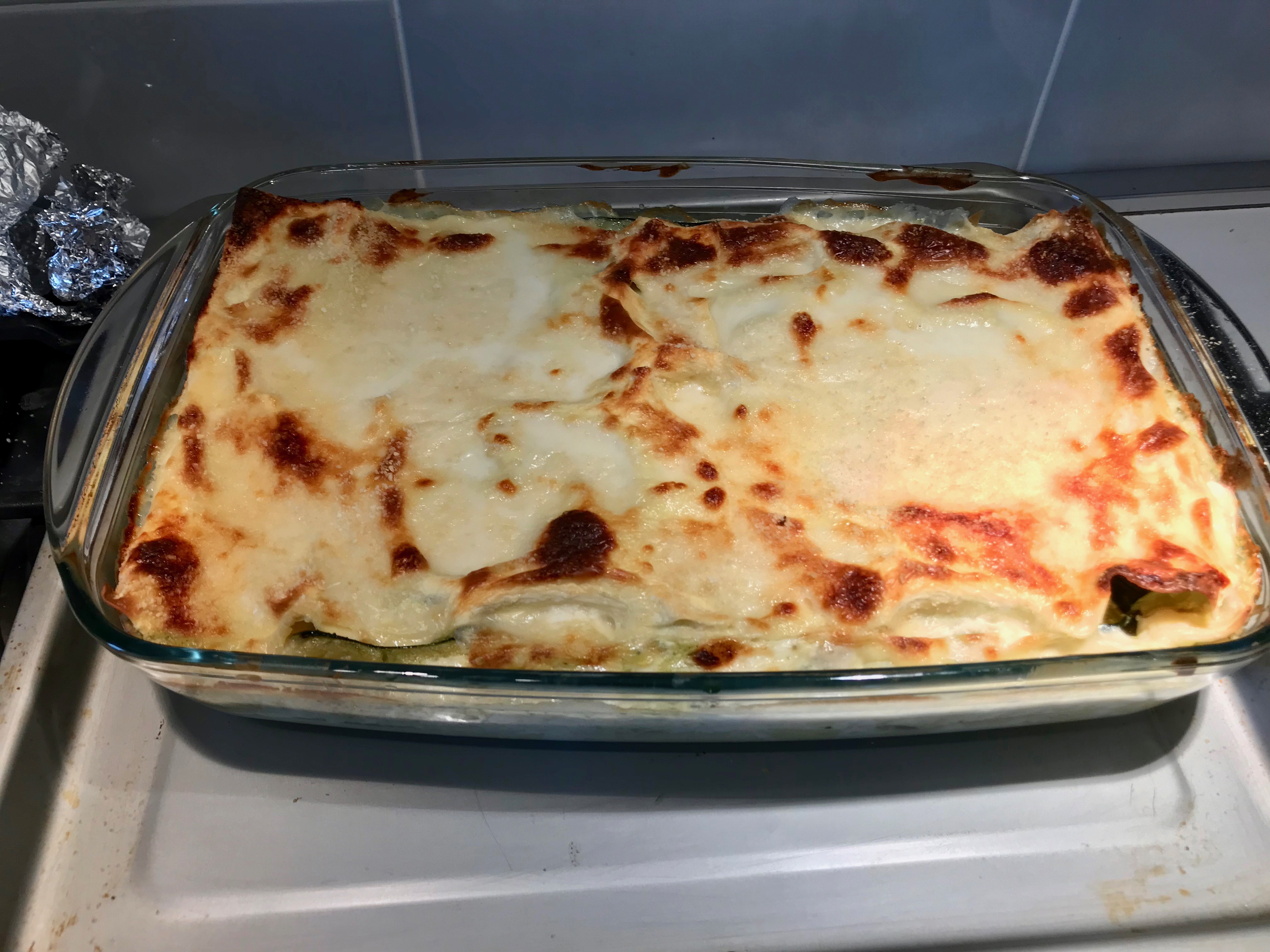
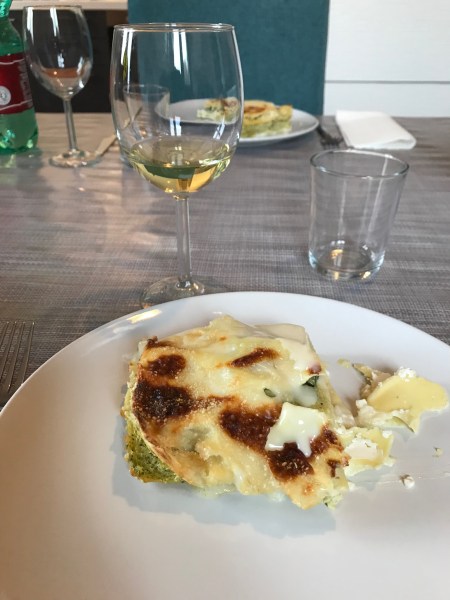
That means we’re housebound, at least today. And dinner—we do the Italian or French thing on Sundays and the midday meal is the star. I thought I’d try to replicate the flavors of a pizza that the terrific pizzeria Ribalta in Manhattan puts together. It’s got the usual mozzarella, but they add what I’d call zucchini cream, and grilled zucchini. It’s sweet and nutty and creamy at the same time. Only this time I thought it would make a terrific lasagne. Or lasagna, if you prefer, but Italian Italian style, with thin layers and béchamel on top with some crispy bits.

Lasagne. Lasagna. Zucchine. Zucchini. That’s where my linguistic confusion comes in. There are a lot of words, mostly food related, that differ in the Italian spoken in Italy, and the supposedly Italian words, or names of dishes, in the U.S. “Lasagna” is one of them. In the Italian-American (and, I guess, the Olive Garden) canon, it’s a layered pasta dish with tons of ricotta, mozzarella, meat sauce. In Italian, “lasagna” means one single, solitary noodle. Hence “lasagne,” or the plural. The feminine plural, to be precise.

“Zucchini” is another odd duck. When this green summer squash crosses the ocean, it gets treated to a sex-change operation from the original plural feminine “zucchine.” To say “squash” in Italian, it’s “zucca”—feminine singular. The -ina or -ina suffix means a little one.

Don’t get me started on the poor panino, masculine singular. One sandwich, and it doesn’t have to have melted cheese and squished in a sandwich press. “Panino” means a little bread, or a roll. In the U.S. and other English-speaking countries, you hear people saying “I’ll have a prosciutto and mozzarell’ panini” and I cringe.

So the dilemma: When in Rome, so to speak? It just sounds weird to say “zucchini lasagna.” The poor dish gets one gender wrong, and one quantity wrong, leaving us with a transgendered vegetable accompanying a singular noodle. Or something like that. But if I did go around saying the proper Italian pronunciation to an English speaker it would come across as possibly confusing and definitely pretentious.


The Non-Recipe Recipe

In any event, here’s how to put it together. However you say it, it’s delicious. We managed to transfer the flavors of Ribalta’s pizza to a gooey, decadent, perfect-for-a-snowy day pasta dish. Disclaimer: I am not a professional recipe writer, and this presupposes you have some cooking chops and can figure it out where I’ve messed up.

Preheat oven to 375F/200C. Take 7 or 8 medium zucchine/i. Slice fairly thin lengthwise. Place on oiled baking sheet. Season with salt and pepper, sprinkle liberally with olive oil. Roast for about 40 minutes, until they’ve given up all their liquid and some may be a little browned.

Take 1/3 of the squash (gotcha!) and place in a blender or food process. Zap with about 250 ml or a cup of heavy cream or Italian cooking cream (panna). Add a good handful of grated parmigiano or grana cheese. Do NOT use pecorino; it’s too sharp for this dish.

Have some ricotta and béchamel lying around. If you’re lucky enough to be near an Italian gourmet shop, you can get prepared béchamel. Otherwise, make it yourself.  You’ll also need no-cook lasagna sheets.

IMG_3365

In a baking pan, spread béchamel on the bottom. Add some milk. Layer the first pasta sheets. Spread with ricotta and grated cheese, and a layer of squash.

Layer 2: pasta sheets, your zucchini cream.

Layer 3: Like layer 1.

Layer 4: Pasta sheets, bechamel, grated cheese, and some bread crumbs.

Cover with foil, place in hot oven for 30 minutes. After that, remove the foil and let it brown. Remove from oven, let it rest for 15 minutes. It’ll be easier to cut and portion out., Serve with a green salad.

Gone to the Dog

IMG_3260.jpgI signed up on Quora.com awhile ago. I was intrigued by the mixture of questions, from genuinely wanting to know something, to clueless, to trolling. So I thought hmm, maybe I’ll use that format here. In the absence of real questions (feel free to ask me some via email), I’ll make up some of my own.

What the hell do you do up in the country?

I had no idea watching the color of the hills change by the hour, sometimes by the minute, could take up so much of my time. And in an unaltered state of consciousness, no less.

Seriously, what do you do?

We serve Retu. It is our job to feed him, praise him, get him to sit, teach him other languages, and did I mention feed him?

Whose dog is he?

IMG_3187Retu belongs to Ca’ Mazzetto, our neighboring agriturismo. Supposedly. But I’m getting the feeling that the dogs along our road don’t belong to anyone. Or, they belong to everyone. I’m trying to figure that one out.

What is an agriturismo?

Are you trying to confuse me by changing the subject? Well, ok. An agriturismo is a working farm that takes in paying guests. Ca’ Mazzetto has a few apartments, a pool, about 125 sheep and a bunch of olive trees. They produce cheese, fabrics (wool, of course) and olive oil. I may be missing something, and, hey, Joonas, did I? (Joonas is the son of the proprietor and sits on our town council, too.)

What kind of dog is Retu?

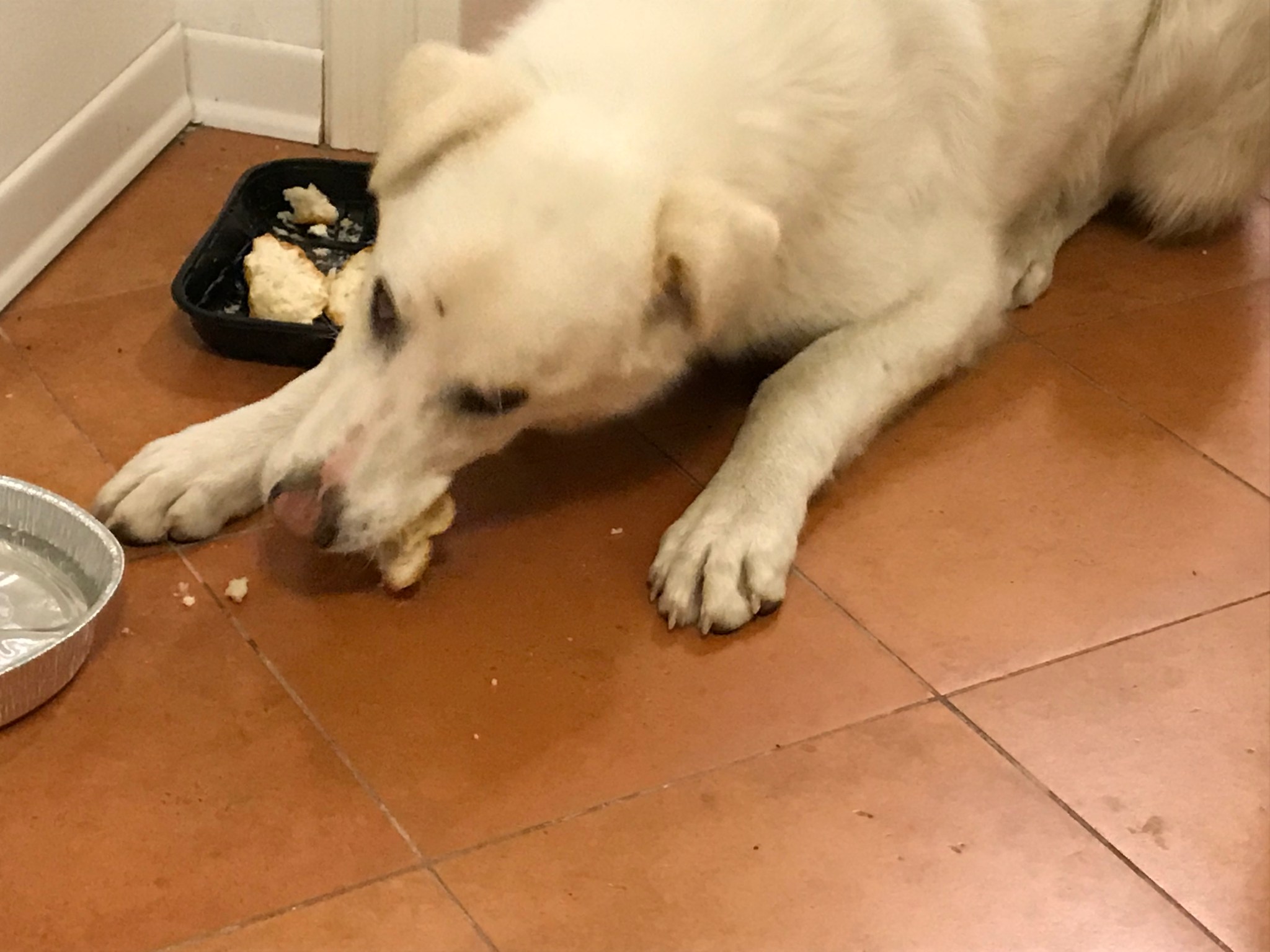
He’s a relatively rare breed that is native to these parts, called a Maremmano. According to Wikipedia, the Maremmano is “a breed of livestock guardian dog indigenous to central Italy, particularly to Abruzzo and the Maremma region of Tuscany and Lazio.” The breed is known to be intelligent, loyal, protective, and friendly. He definitely was smart enough to find a sucker in The Spartan Woman, who actually buys dog food for him and, this evening, fed him tagliatelle with truffles.

How is that breed used?

Again, from Wikipedia: “Maremma used as livestock guardian dogs are introduced to sheep flocks as puppies so they bond to the sheep. Some ranchers place Maremma puppies as young as 3–4 weeks old with young lambs, but beginning this bonding process at 7–8 weeks is more typical.[19] Although it is easiest to bond Maremma to sheep and goats, cattle ranchers have found that the dogs bond with cows and Maremma are increasingly used to protect range cattle.”

IMG_3282

Does Retu live up to his breed’s reputation?

He’s a splendid young dog. But if he has bonded to the 125 sheep that live next door, it remains to be seen. One of his owners said that Retu has decided to take early retirement. Whatever sheep guardian attributes he may lack, Retu is definitely good at bonding with humans and bending them to his will.