Umbria=Vermont (Sort of)

IMG_2364.jpg

We’ve been asked more than once, why Umbria/Perugia? A lot of American friends assume it’s where our families come from, and a lot of Italians, knowing that it’s not where our families come from, ask why there. To the second part, it’s nothing personal, people, it’s all about accessibility. Well, a lot of it is.

My father’s Sicilian, born and raised in Palermo. It’s a fantastic city, full of art, life, great food, a beautiful setting, and tons of my cousins, aunts, and uncles. I love to go there and I’m sure that when we live an EasyJet or Ryanair flight away, we’ll do it more often.
IMG_1459

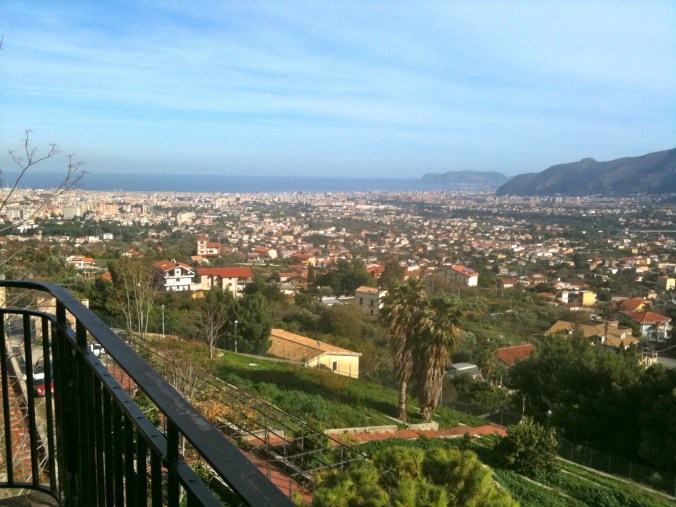
Palermo, as seen from the town of Monreale

But it’s a port city—done that, being a New York City boy. And it’s in Sicily, which is wonderful, but it’s far. To get anywhere else in Italy and Europe is a bit of a schlep and at our age, we want to get in the car, or hop on a train, and be somewhere else.

Then there are the charms of Umbria, the only landlocked region on the boot. Italians often call it the “cuore verde,” or green heart, of Italy. It’s relatively uncrowded, with a population of under 900,000. Its capital city of Perugia has only about 170,000 inhabitants, but it’s a pretty sophisticated place, being a college town and possessing a long, proud, and often bloody history. The countryside for the most part is rolling hills, and is very, very green, from blindingly bright kelly green to the silver green of olive groves.

I sometimes compare it to Vermont, which is also landlocked, green, and full of rolling hills. Vermont’s got even fewer people, 626,000 and its biggest city has only 42,000, so you can’t go strictly by population as a comparison. But you when in terms of being highly agricultural, mountainous, green and, last but not least, being progressive politically.

But enough of these facts and descriptions. There are other reasons we’re there, the people we know, love, and have met along the way, for one thing. But a dog-walking friend of mine asked for more pictures this morning, so here goes.

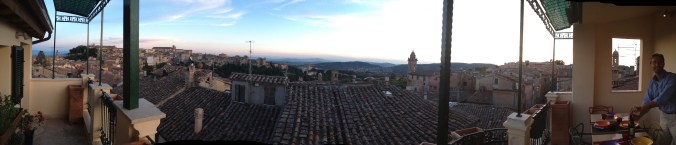
IMG_1933.jpgHere’s Perugia, from the roof of the Mercato Coperto (covered market). Until the recent construction, it was a great place for an aperitivo. New Yorkers, eat your hearts out: Aperol spritzes for €5, or about $5.25.
IMG_3521.jpg

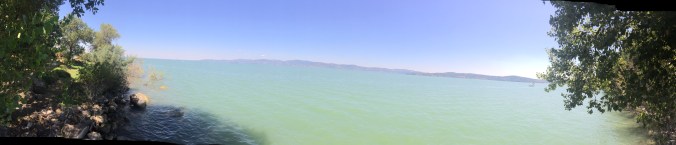
Lago Trasimeno, the largest lake on the peninsula. Towns on the lake, islands in it, ferries to take you to them. There’s great hiking on the islands; one, Isola Maggiore, is really hilly and gives you a great workout, not to mention views and restaurants for decadent post-hike lunches; the other one, Isola Polvese,  is a working environmental research center.


IMG_5619.jpg

And the mountains… This is up in the Apennines, past the renowned gustatory center of Norcia, above the Piano Grande di Castelluccio. A sad note: This area was severely damaged by last year’s earthquakes, so we were lucky to get up there a couple of times last year, when the wildflowers on the plain were on full display in a riot of colors (I never thought that I would ever write that).

IMG_5454 IMG_5449

Can’t forget the sagre. This may look like a fast food court, but it’s a big town gathering place, outside of Perugia. The feast is ostensibly to celebrate the frog, but most of the attendees were there to eat the Umbrian specialty umbricelli. It’s a thick hand rolled pasta with, usually, a sauce strong enough to go with it.

IMG_4782.jpg

We do like our festivals in Perugia. The biggest of the Big Three is Umbria Jazz in July. (The organizers have a pretty loose idea of “jazz,” suffice it to say it’s mostly jazz with a lot of other good stuff thrown in). Mid-spring brings the International Journalism Festival (above, Amazon’s Jay Carney and Mario Calabrese, editor of the Italian daily/site La Repubblica, last year). I’m plugging this because I’m doing a session there next month, with my pal Fabio Bertoni of the New Yorker, and Richard Samborn, a British journalism prof. And October brings Eurochocolate. I haven’t been yet, but it sounds insane. Why chocolate? Because Perugia is the home of the Bacio, the Italian version of the Hershey Kiss. Being Perugian, the Bacio is a lot more decadent.

Next: But it’s really about the people.
Unraveling the Stereotypes

Can I take a break from the travelogue? One of the issues I said I’d tackle is what we can learn from others. In my case, it’s two halves of my brain trying to live together. Maybe they can figure something out.

I’ll get the stereotypes out of the way first: Americans are brash, individualistic yet friendly (have a nice day!), swaggering, big, loud. But efficient. Italians are passionate, family-oriented, clever, chaotic to the point of anarchy, happy.

Even if we say that we don’t believe in the stereotypes, they linger in the back of the brain somewhere, and, like it or not, they inform how we approach certain situations.

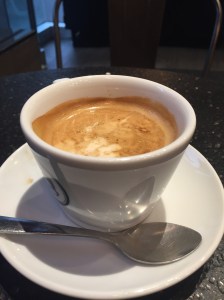
So I’ll dissect some of these. First, Italians and chaos. No—it just looks that way. When an American, or indeed, any North American or Northern European lands in Rome, he or she can be forgiven for thinking that the place is a mess run by lunatics. But look closer. Go to the bar—what Italians call a café. Watch the choreography at work. Someone takes your order. Another, the barista, is juggling a dozen coffee orders, and produces an array of drinks in seconds.img_4380

Every day in Italy, baristas serve up about 70 million espressos. And most of the bars are not chains. There’s no Six Sigma espresso academy, no corporate efficiency expert timing every move that every barista makes, or should make.

Another example? Go to an Italian gathering, say, a large dinner party among family and friends. People will gather and stand around and chat, and maybe get a drink. They’ll talk about where to sit, perhaps, but the whole arrival thing is just the preliminary it’s-nice-to-see-you-again ritual. Then at some point, everyone will sit, seemingly at prearranged spots. They’ll give their orders to the waiters, if the meal hasn’t been preordered, and the whole thing will proceed smoothly and efficiently.

IMG_0915.JPG

On the other side of things, Italians have this fascination with, if not jealousy toward,  Anglo-Saxon countries. They think they’re organized. They’ll even say they’re “normal,” in contrast to their own street-level chaos—you know, the buzzing Vespas, the animated conversations. To a lot of the colder European types, Italy seems loud and like a big beehive.

But look at the boarding ritual at New York’s Penn Station or Washington, D.C.’s Union Station. Efficient? “Northern,” to use an adjective Latins use frequently to apply to the Anglo-Saxon and Germanic tribes? No.

First of all, for these premium, fast (not really) trains, there are no assigned seats, which injects no small amount of anxiety into the wait. People line up waiting for the train to arrive and for boarding to happen. They start to complain. Some may try to get ahead. Some ask the Amtrak person when can they board. At some point, the passengers on the incoming run troop out of the door. Then those waiting start to move, getting their tickets checked as they go slowly and obediently through the door, then there’s a mad scramble for a seat. So much for efficiency.

In Italy, land of supposed chaos, you get an assigned seat on the fast trains. The train’s track shows up on a board in time for you to walk there, and the platforms have signs telling you which car stops where, so you can just hop on board and find your reserved seat.

Of course, both Italians and Americans think the others have it better. Americans think life in Italy is a series of golden sunsets and Chianti. (But not always: There’s that meme about economic chaos abetted by revolving door governments.) And Italians think living in the U.S. is a dream. I’m pushing it a bit, not all of them do. But they see the wide streets, the absence of graffiti in most places, the wood-frame suburban houses, or the heritage of Bob Dylan, Jack Kerouac and Patti Smith and think that Americans have it made.

Italians complain all the time; Americans seem to take daily annoyances in stride. Commuting gives us good examples. If a bus or train is late in Italy (this is not unusual), people will commiserate, and probably will launch into a denunciation of the government, ending with a shrug and the comment “Questa è l’Italia” (this is Italy). Americans will just stand there mute looking at their phones. You can look at it two ways—either Americans are sheeplike or just more realistic about how things work. And Italians just like to generate noise; it’s part of the landscape. I once wrote a piece for National Geographic Online about Perugia’s policy of limiting cars and its then-new mini metro system. The comments were blistering. I’m happy that the editors there deleted most of them (I had to resist mightily from responding).

Point is, they both have their virtues and demerits. Americans are less tribal, less bound by familial ties. That can be liberating—or alienating. Maybe that explains why they find comfort in identical suburbs, with the same malls, gas stations and shops. It’s what James Howard Kunstler calls “the geography of nowhere.” Italians, if they haven’t emigrated, usually for economic reasons, tend to live near their birthplaces. They have a greater sense of belonging, but for some, that can be oppressive.

In any event, we’ve seen enough of both places to know to look beyond the stereotypes. They might help organize your thinking at first, but they’re woefully inadequate once you get to know a place. So…hmm, where is this going? I was just having fun thinking about this stuff.

An Almost Perfect 10

Used to be, I couldn’t just sit and do nothing. I had no patience for waiting. I’d always want things done, like, yesterday. Or if I had to wait for something, I made damn sure that I had something else to do while I sat around, something that I wanted to do.

Living in Italy, even part-time, cured me of the impatience bug. Bigly, as a certain orange government official might say.

The apartment was still not completely finished when we closed on it. I guess we were naive. So we issued ultimatums to the builder. And finally, we told him we were coming over to set the place up.

It was a chilly February when we got there. We had hardly any furniture, so we still had to sleep and eat at Giovanna’s place. But we’d spend days in the apartment—we did have a kitchen table and chairs. And power, so we could play music.

So what did we do? We waited for hours. We waited for days. The builder didn’t quite finish on time. So we had tacky (literally, sticky) newly varnished wooden floors, no real lighting fixtures, just suspended light bulbs. And a shower without any kind of enclosure. One of the first things we demanded of him was a “cabina doccia,” or shower enclosure. It took a few days, but a plumber showed up and we had one. (The builder, bless his black soul, tried to charge us for something we should’ve had from the start.)

IMG_2696.JPG

The apartment was a new space, so old utility accounts couldn’t be carried over. So that meant getting an account for electricity, telephone/Internet and gas. And gas. Did I say gas? That one took, wait for it, a year and a half. Why? The builder didn’t file the right kind of filing, missed appointments, pipes that were too short, you name it. For the first year or so, we had an arrangement with our downstairs neighbor and tapped into her account. At one point after another delay, my Perugian friend Antonio said “this is war.” Happily, that last step involved a short war and in a month we had our very own gas meter and connection.

Then, shopping. We needed furniture. We needed household stuff. You usually accumulate stuff over the years. We did a crash course. At that point, I was still in a relatively romantic phase, and I was still impatient to get on with life there. Who wanted to go shopping for cooking utensils and a TV? So a trip to the IperCoop, a huge supermarket/everything store in the suburbs in, of all things, a shopping mall.IMG_2722.JPG

After that, bliss. We spent big chunks of the next summers in Italy. Sometimes we’d take advantage of cheap European flights and go off the Barcelona, Paris, Greece. But most of the time, we’d hang out in Perugia and Umbria, rent a car, wander, visit friends, sleep, read all night. If we wanted to swim, there’s a big municipal pool in Perugia. Or we’d drive an hour and a half or two and go to the Adriatic coast.img_2707img_5814

Nicer than the cave, right? This was early on, before nightstands and a desk and the seemingly zillions of chargers so necessary to daily life. And we had a mantle for the fireplace. It looks so clean and unused now…we still don’t use it for fires, because it’s a handy place for potatoes, bottles of wine and mineral water, various implements, stuff like that. Plus I, er, broke the flue chain.

Next: Umbria: Think of it as Italy’s Vermont, but not as cold


How Do You Say “Training Wheels” in Italian?

To continue the story….

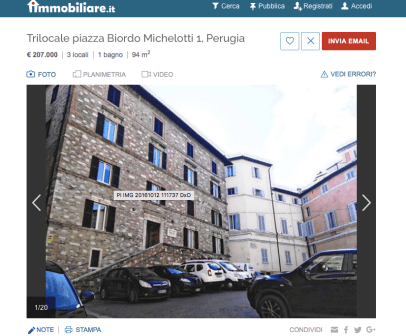
Our Perugian friends, as I said (over a month ago. Yikes) were getting on in years. And Kathy’s got a real estate obsession—she looks at house floor plans for fun—and she started to browse Italian real estate sites. At the same time, a friend of mine who’s an accountant and a business consultant who works with Euro-people, told me if I wanted to buy something, now (we’re talking late 2005/early 2006) was the time.Screen Shot 2017-02-28 at 17.21.37.png

The quest took a few months. Kathy “saw” dozens, if not hundreds of apartments. I had to winnow them down; I was assigned reconnaissance duty at the end of the online quest. To tell you the truth, I had no idea whether this was going to work at all. So I arranged via email to meet with a few real estate agents, leaving my Italian mother Giovanna’s number. Giovanna took her assisting duties very seriously, acting as my scheduler and go-between.

IMG_1652.JPG

And off I went, with a limited budget. I saw apartments that appeared to be converted storefronts. In one place, in a fairly modern building, the current occupant was clearly not having it. The place was an absolute mess of dirty dishes, crap all over the place, and the woman who lived there chain smoking and muttering under her breath. I saw one place that was owned by an interesting, “artistic” (the agent’s word) woman. Bright colors, strange fixtures—fish shaped sconces, anyone?—and with a bonus cantina in the basement. But that one was on the outskirts, on one of the main roads heading out of town.

Then I visited a cave. Or something that looked like one. It was in an old building that had been partly occupied by squatters. The city moved in, evicted the squatters and sold the spaces to a builder, who divided up the space into a few apartments.

IMG_1693.JPG

The unit I saw was in an early phase of renovation, and the walls were scraped down to the stone. It did, indeed, look like a cave. Cables and pipes ran through conduits in the floor, and cinder blocks demarcated some new spaces. There was a partly deconstructed fireplace, and what looked like a big hole in the bedroom wall. A medieval door, studded with nails, opened to the alleyway. There were no windows. It looked a wreck.

I fell in love immediately.

I guess I have a vivid imagination, and I could picture myself living there, in a finished little jewel of an apartment. It was a good space, in the neighborhood I wanted to live in, right around the corner from our friends. Students and student hangouts gave the place a hip vibe. And the zone was starting to gentrify.

I called Kathy right away, told her I found The One. I arranged to see it again, after looking at some other places that didn’t measure up, and asked my big brother Antonio to come with me the second time around. I trust him in all matters. He’s a combination big brother, friend, fixer…more about him later.

We went back. He asked questions of the real estate agents. He talked to the workmen buzzing around doing stuff. He told me “buy it.” We did. I won’t go into the specifics of buying real estate in Italy. If you’re really interested, go here.

So, why “training wheels”? Well, I’d been to Italy a lot, but most of the time I stayed at the homes of relatives and friends. I rarely shopped for food, did laundry, got utilities connected, got a mobile phone, bought Internet service—in short all of the things you need to live in a place. And I got quite an education. I’ll describe what we did with the apartment and our lives there in later posts. But looking back, the past decade was just training for what might be the real thing, year-round living in Umbria, in a house in the country no less.

Next up: 10 years, summers and whenever we could get away

I Met a Girl

img_6896Not recently. This was awhile ago. Decades.
I’d spent the summer hitchhiking around Sicily with my cousin Giorgio. It was 1975, the middle of the OPEC-sparked recession, and I didn’t have a summer job. My parents, for whatever reason, decided that I’d be better off shipped to Palermo, where my father’s from. I wasn’t going to say no. I’d live with my relatives, and get to know the city and Sicily in a way that only 18-year-old kids can.

I did. I rode a delivery truck with my uncle, hitched to the beach, hung out with Swiss cousins there (speaking a combination of Italian, French, and English), went to a sagra (feast) up in the mountains where a local band shredded the lyrics to “Smoke on the Water,” but did a credible job of playing it. I learned how Palermitan kids my age partied—and had a thing for Tina Turner records. I can hear “Nutbush City Limits” playing in my head even now.

But back to the girl.

I met her in a college Italian class. I understood the language okay, but I didn’t know things like verb conjugations, how to read it, etc. And after a couple of months in Italy, it was frustrating. I’m a language freak anyway, so I thought I’d learn Italian properly. So did this girl named Kathy. (I call her The Spartan Woman on Facebook, which comes from her half-Greek background and the moniker dates back to when I wrote a column for my law school’s newspaper.)

Kathy was in her senior year, and was going to go to veterinary school in Perugia, Italy. So she, too, wanted to pick up the language. We met because she took the seat I wanted in class. It was empty, actually, but her friend saved it for her, and I decided that I didn’t like her because of that.

I changed my mind quickly. We got to be friends, then we got to be a thing. She went away, though. I felt lonely, played a lot of guitar with a degenerate crazy man, and wrote her obsessively. She came back after a year, deciding she liked me more than she liked studying veterinary medicine in Italy for a few years. (Yes, we’re married, had a couple of kids, etc.)

But she couldn’t give up Italy, and neither could I. A couple of things made it easier to go back regularly over the years. We have friends who put us up. And I have relatives. It meant that we didn’t sightsee in the normal tourist way. But it also meant that we lived in Perugia when we were there, and we had the added bonus that our friends were great cooks and didn’t speak English. Total immersion, in other words.

As our friends got older, we didn’t want to be such a burden. So 10 years ago, we bought a little place in their neighborhood, on a narrow street with a long history, up the hill from Perugia’s Univesità per Stranieri, or University for Foreigners, which teaches Italian language and culture.

A cousin called us “complotti”—co-conspirators. I got lucky, in a lot of ways. Like me, Kathy doesn’t care about driving flashy cars, having a posh house, or wearing jewelry. (In fact, I never bought her a diamond ring because, you know, blood diamonds. She would’ve probably thrown it at me.) What she does like is to wander, to hang out, to be somewhere else. We’re basically the same when it comes to politics, food tastes (though she has a thing for okra, which I’m not totally down with), and being smart alecks.

So in the following posts, I’ll tell a little about our past, and we’ll explore what it’s like to get ready to move. We have that little apartment in Perugia, and now, a big house in the countryside outside of Perugia. And for those of you not having a great day today as Orange Man is sworn in, we’ll give you a place to hide out, at least temporarily.


A Foreigner in my Own City

img_6956

I just got back from a walk around the neighborhood. We live in a pretty place—it’s the northeast tip of Staten Island, New York. The general zone, area code 10301, is like a triangle that includes the neighborhoods of St. George, Tompkinsville, Silver Lake, Randall Manor, New Brighton, and Grymes Hill. I was getting antsy, so I walked up the hill from our local commercial strip, Forest Avenue, and did the loop around the lake in Silver Lake Park.

I felt like a sightseer. It’s been awhile since I was around much in the daytimes. For the past few decades, I had a full-time editorial job in “the city,” or Manhattan, and when I had much free time I took a trip. But since I left the company that must not be named (a small, struggling “information” company), I’ve been getting reacquainted with the ‘hood.

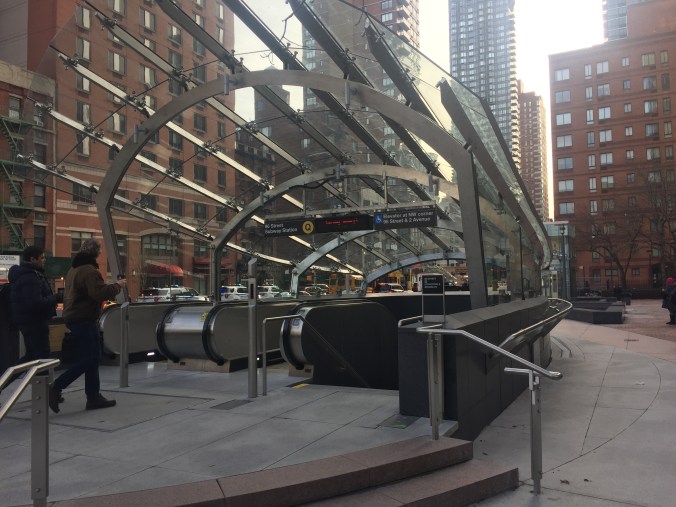
I’ve also been getting to know the city of my birth a little better. When you’re spending 40 or so hours a week moving copy, there isn’t much time to enjoy what tourists come to see, and what ladies and gentlemen of leisure get to do. So I took a long subway ride up  to the new Second Avenue subway (three stops, four if you include the closed section of a stop already in use by another line, after a century of planning) and walked down Second Avenue, surveying the scars left by years of construction. That was on a weekday, and at the moment, I felt incredibly liberated. My ex-colleagues may have been sitting in their sad, library pod-like cubicles, but not me. In a way, then, I was a tourist in my own city.img_6866But I was, and have been, a tourist in another way. My father is an immigrant from Palermo, Sicily (Italy, if you insist), and I’m just beginning to realize what a profound effect his otherness has had on me over the years. Language, for one thing. I grew up used to hearing accents, some heavy, some not. I figured out that my father thinks in English, but it doesn’t always come out right. He’ll say, for example, that “you must cry the consequences.” I always thought that that phrase would make a great title for a country song.

Another way, and this is common to immigrants’ kids, is feeling like an outsider. My father (and even my mom, who was first-generation Sicilian-American) didn’t really know to to navigate in U.S. society. Part of that is cultural—Italians in general, and Sicilians especially, are notoriously tribal. Anything outside the family is viewed with suspicion and sometimes fear. But it’s also being in the early stages of acclimation to a new place. I pushed myself out of the nest a bit, but once out, it was alien turf.

So you get to react a couple of different ways. You can turn your back on it, refuting the old ways. You can be culturally bilingual, existing in the tribe, but adapting outside of it. My wife and I did some of that. Or, you can embrace a new version of the old country. And that’s pretty much what we did. I feel more at home in modern Italy than I do in most of the U.S. outside New York. Business conferences, in particular, turn me into an amateur anthropologist, looking at these alien beings for clues of what makes them what they are. “Do you realize you talk about Americans in the third person?” my Italian friend Federico once asked me.

I’m still trying to figure it out. I joke that Umbria is a kind of halfway house between Palermo and New York. It’s cleaner, more efficient, more civic-minded than Palermo, while still being Latin. So maybe I’ll work it out in this blog, while I share our adventures of living in two places, always comparing (but doing that less and less because we know where we want to be) and always feeling just a little out of place.

Allora…

Benvenuto tutti, or welcome all. Let’s see if this works. I started this blog as a joke, a riff on all the “A Year in…” and “Under the Tuscan Sun” type memoirs. You know, the books that simultaneously peddle a romantic fantasy of life in those great places, while making fun of the colorful locals.

As it turns out, my wife and I did buy a place 10 years ago in a nice college town, Perugia, with the eventual idea of moving there. But there were a few differences: It was a small apartment, and we’re Italian. My wife went to school in Perugia, and I’m the son of an Italian immigrant to the United States. So little or no culture clash there—my family’s gone back and forth between New York and Italy a lot for vacations and family gatherings, and Kathy and I spent a fair amount of time in Perugia with friends and our adopted family.

But we’re pretty clear-eyed about both places we live in, New York City and Umbria, and I thought I’d start this blog as a counter to the likes of Frances Mayes and the others. And maybe give people a better idea of what’s terrific about the cities and regions we love, and what their real challenges are, too. The press is always portraying Italy as both an economic and political basket case, and a place where Anglo-Saxon fantasies about the good life play out. It’s more nuanced than that.

So bookmark this page, and I’ll try to write coherently about our experiences, and what Americans and Italians can learn from one another.