Job no. 1: Stay warm

This heating thing triggers my after-all-this-time-I’m-a-semi-newbie reaction. Getting basics down, like food, shelter, transportation, and language is at the heart of the immigrant—or reverse immigrant—experience. It’s what makes living here different from taking a vacation here. Travelers only have to figure out how to feed themselves, and it’s pretty easy in Italy. And they’ll figure out how to get around, unless they’ve taken a tour that comes with a big bus and lots of company. Living in another country forces you to relearn basic life skills; it’s like learning to walk again. I’m pretty good with most basics, but I’m only learning the central heating basics because we haven’t been here much before in the dead of winter.

I think about central heating a lot during the winters on our mountain because we have a high-maintenance kind of central heating, and tending to it and using it takes up more mind space than where to set the thermostat. Sure, we have the essentials: thermostats, pipes going around the house that end up in radiators. We even have a couple of dee-luxe radiators, the kind bathrooms houses have here that look like laundry racks and warm up the bath towels. There’s a furnace, too, a pretty new one from Germany that my friend Ruurd told me was the best brand. I’ll take his word for it.

What our central heating setup lacks is a steady source of natural gas. Instead, we have a tank. it’s a big tank for sure, though I’m not exactly sure how big because it’s buried in the yard right next to the lavender bush. It looks like the entrance to one of those bunkers in Albania that the paranoid ruler Enver Hoxha installed thoughout that once-repressed country. Only our lid conceals a receptacle and a gauge telling us, usually, that we need to buy more gas.

That should be easy enough, right? Not so fast. (And trust me, this was almost a shock to me, a confirmed urbanite, who never had to worry about how to supply life’s basics.) Luckily, it hasn’t been the coldest of winters. But these stone houses don’t hold the heat easily, a boon in the summer but not so much right now.
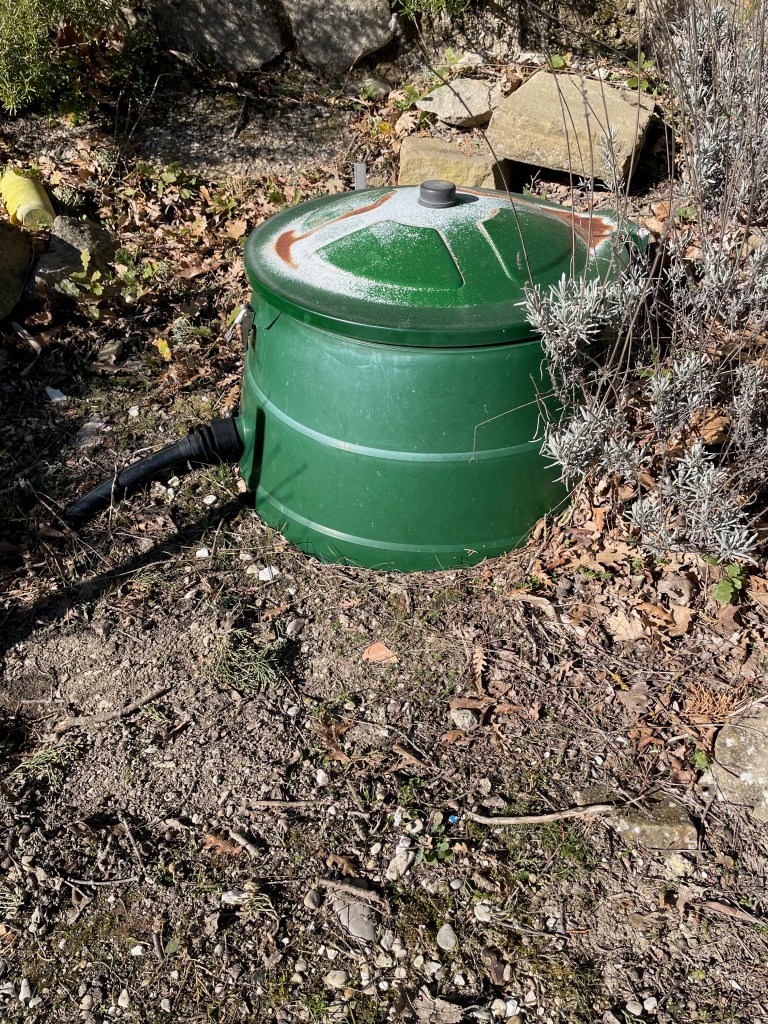
I have a contract with a large Umbrian provider of propane, or GPL as it’s called here. Theoretically I call and they deliver. Only their operators seem to think that their job is to protect the delivery drivers from actually making deliveries, and at the very least to keep delivery dates a secret. Right before leaving Italy to spend the holidays in New York I called the company. When I dared to ask when I should expect the delivery because it’s Christmastime and we need to buy gifts for the fam, I got “next week.” When? Next week. What day? Next week. You get the idea.

No one came that week. So the following week, I called again and ask that same nosy question. I should mention at this point that we were down below 10 percent, a percentage that according to my agreement with the company should trigger an immediate delivery. What I got on the other end was the Italian equivalent of “la la la la” to avoid hearing the question. But then shortly afterward, my mobile phone rings and a delivery driver asked for directions to the house.

At this point life was looking really good. The guy found us, hooked up his hose and delivered the gas for a princely sum of about €800, or $870, give or take. I paid with a card tapped on his portable card reader, and for awhile it looked as though my perfectly good Visa card was rejected. Happily, I learned later via a call from the gas company that the charge went through.

GAS ISN’T THE ONLY FUEL we burn. Like a lot of people here who have to deal with high gas and electricity rates, we have a fireplace that’s hooked into the heating system. In theory it’s an elegant thing. We build a fire and once the chamber heats to 50 degrees Celsius (122 degrees F) a pump switches on a takes over from the gas furnace. If we get a good enough fire going, the house gets toasty and we aren’t burning expensive natural gas, just expensive wood. And we can bake potatoes in the ashes, which is something you can’t do with a gas furnace.

But that requires us to start a fire. And fire requires wood. There are lots of wood vendors around these parts, because utilities cost so much here. You can buy wood stacked in neat boxes, and you can buy lots of wood from guys who drive up with a dump truck and leave a huge pile for you to deal with. We chose the latter, trying to be 1-frugal and 2-forward thinking enough when it came to quantity. We were running low on wood, so I made a call and to our usual supplier a town away, unlike the gas company, the wood dude said he could deliver in about 10 minutes. Sold. The guy came as promised, and since he’s a local and has delivered to us before, we gossiped about the neighborhood characters.

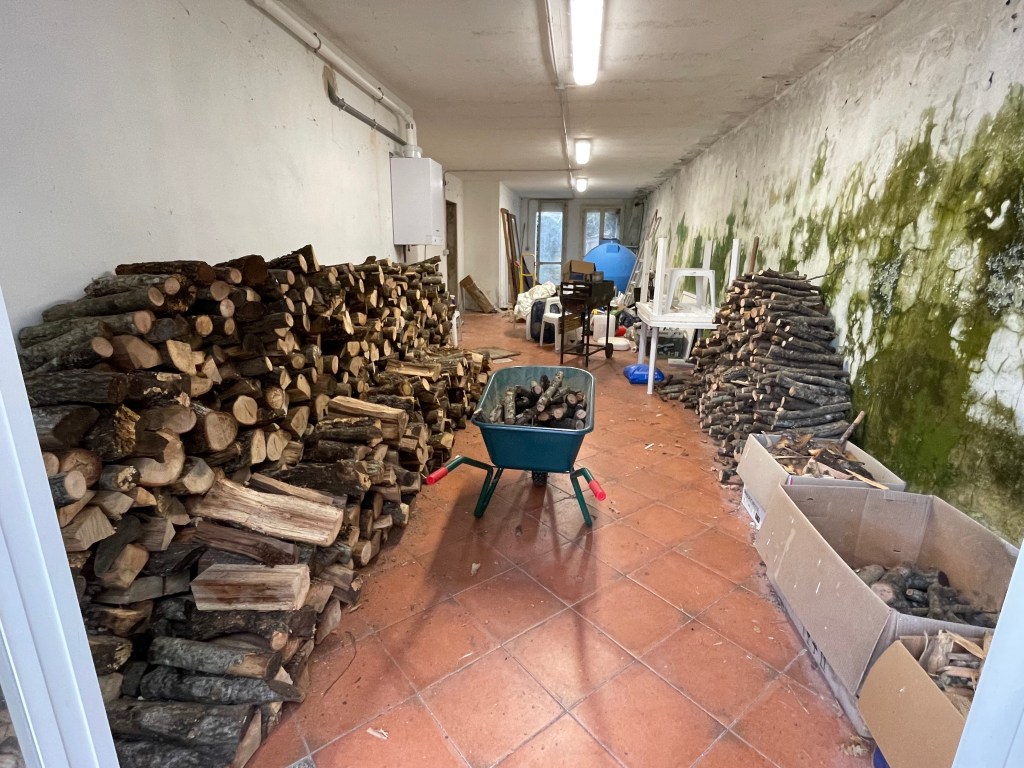
Take a look though—we received a huge pile and had to move all that into the house in organized bundles. The te Spartan Woman lived up to her nickname, organized how we were going to tackle the pile and hauled tons of wood. Literally. In all, the two of us carried and stacked 25 quintales, or 2500 kg. That’s over 5,500 pounds.

Not bad for old people.

Commitment issues, resolved. Kind of.

Okay, like so what? It was a big deal to me. When I stand waiting for the cashier back in New York, I’m usually horrified at my fellow shoppers’ food choices, like boxes of crappy frozen meals, big bags of Doritos, chop meat, lots of meat in fact, and bottles and bottles of Coke and other soda. Call me elitist, but it’s more of a cultural gap. I was always bad at being a mainstream American because of my upbringing. I guess it’s a first-generation thing, but I always felt like I was straddling two continents, where I was born, and where my father and my maternal grandparents came from. (I love peanut butter and gochujang, though, so I’m not 100 percent Italian when it comes to food.)

Welcome to the neighborhood supermarket, Conad.

We used to come here to Italy as a sort of refuge. At first it was a couple of stolen weeks in a busy summer, then that time away got longer as I managed to do a lot of work remotely. I remember being at a P-Funk All Stars Umbria Jazz concert and looking at my phone to approve a magazine cover photo. Then when we bought a house in the country, and I didn’t have a day job to go to, we’d stay here a few months at a time. But it was always less than six months, and under the limit beyond which we’d be official Italian residents, like it or not.

I’m trying to decide whether that arrangement was either having the best of both worlds, or merely not being in either place. A certain lack of commitment, to be sure. We had lots of good reasons for waffling, like family, friends in the U.S., and there were tax implications, too. By staying in Italy for fewer than 183 days a year, but having our income sources in the U.S., we were full-time American tax residents. There’s not much to choose from in actual taxes when you total up everything you’re charged for in the U.S., but it’s definitely simpler to be a tax resident in just one place. (The United States considers you a tax resident wherever you live, forever, or until renunciation.)

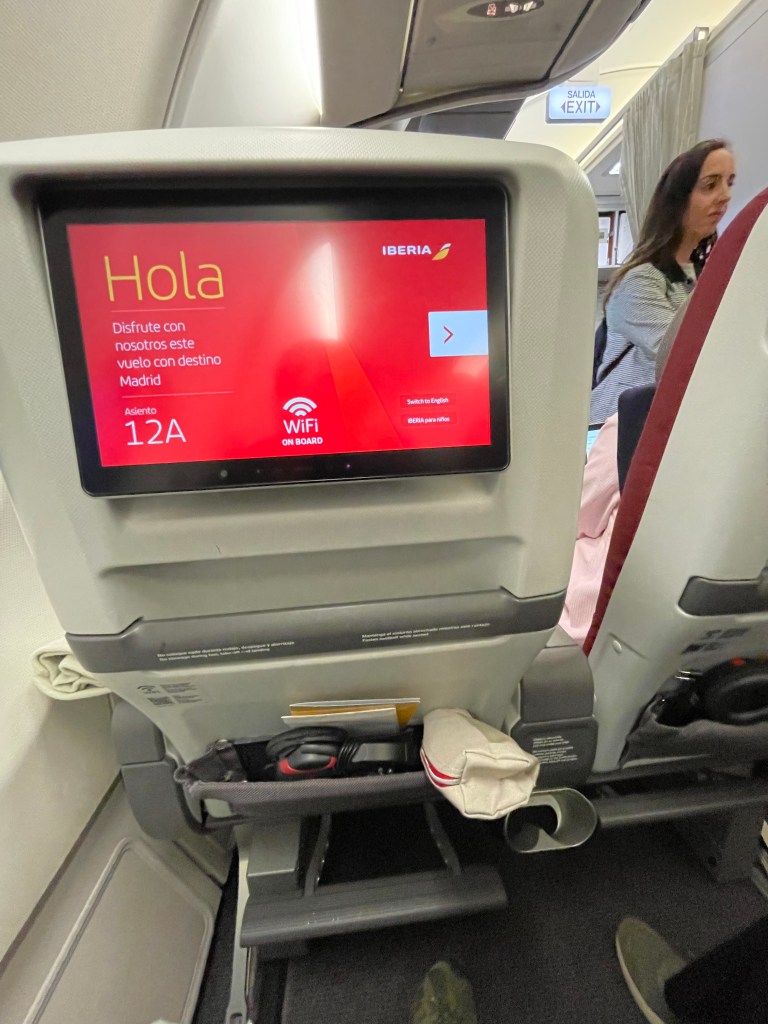
Our normal aircraft seat. Iberia, bless its corporate heart, upgraded us to business class a couple of times, for free, unrequested too.

There are disadvantages, too, to living in a couple of countries. It’s expensive. We flew more often that we really wanted to, and while being experts on which airlines have the lowest premium economy fares may be worth something, the back and forth back and forth was getting to be too much. Plus even though we’re Italian citizens, we couldn’t take full advantage of being Italian/European Union citizens. We have to carry our passports as ID instead of a simple digital ID card. We have to pay doctors privately here, rather than being full-time enrollees in Italy’s public healthcare system. (It’s not as expensive as it is in the U.S., but still….) And full-time residents don’t have to pay real estate taxes on their main dwelling.

So after years of noncommittal, not to mention 2020, The Year of Covid, we marched ourselves to our town hall and declared residency. I was nervous about doing so. The Italian consular officials in New York aren’t always the kindest, most helpful public officials. And the declaration form was detailed—to get the real estate tax exemption, it looked as though they wanted me to enumerate every square meter of our house and yard here. After realizing that it was impossible to get it all on the page, I simply printed out our property sale document and wrote in Italian, “see attached.”

We kept putting our trip into town off for mostly dumb reasons, but finally it was put up or shut up time. So a few days ago, we marched ourselves up the stairs to the demographics office window. The official took our paperwork, skimmed through it, and said, “fine. Go downstairs to the Protocol office, and tell him that I already approved the documents.” We did so, spending a few minutes while the second guy typed our info into the database. The other guy came downstairs to see how things were going, and after a short time spent chatting, they were done and we walked out into our official new town.

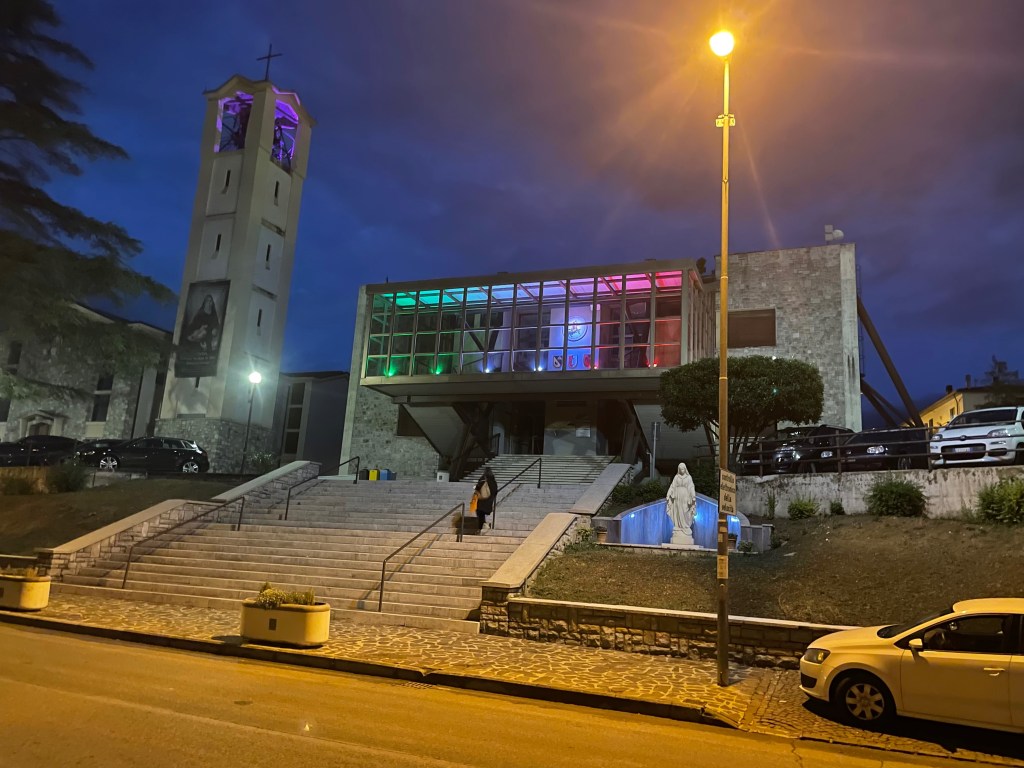
Our town hall, lit up for a fall festival

There’s more. We’ll have to convert our driver’s licenses. We have to enroll in the health system, and the local police will pay us a visit to make sure that we really live here. But things already feel more settled. I’ll tell you in later posts what makes this town so special (random photos below just for the hell of it). For now I’m just happy to be anchored in one place.

Oh, nothing really.

But that wasn’t the exciting part. We were chatting away when suddenly I hear the twang of an American accent outside in the piazza. You don’t hear it that much around here. I looked out, without my glasses and saw out of focus figures wearing what looked like identical T-shirts and helmets. Francesco was intrigued, too.

—How do you know they’re American?

—The accent.

—There are different accents [I’m guessing he meant in English] ?

—Lots. [translated from the Italian]

He sent me out to interview some of them. The group was on a bike tour from an outfit called Backroads, and came from all over the U.S. One guy was practically my homeboy, coming from New Jersey, right across the Outerbridge. They were all on their way to Gubbio, about 30 km/18 miles away. Up and down big hills away, that is. “Wow, you guys must all be in pretty good shape,” I asked New Jersey. He responded, a little sheepishly, that some tour members had e-bikes to help.

The pause in piazza that refreshes

Okay, so this is not bigly exciting. But it’s all part of the everyday pleasures of life here, and it took me awhile to think like that. When we first arrived in May, I was restless. I felt that I was in this candy store and limited to Skittles. Or something like that. In other words, I was still in this-is-a-long-vacation mode and wanted to wander and even sightsee, and I wasn’t dealing realistically with the fact that we moved here. Like, to live.

And what do you do when you live somewhere? I’ll answer that: You do everyday stuff.

Since the last time we met over roasted tomato risotto, we’ve been in recovery mode, trying to get our lives back on track. August and part of September were like this giant hot blanket pulled over everything. This summer’s blazing heat kept us indoors for hours. Once it broke–somewhat—we had to think ahead. And hot though it was, we have to prepare for the winter.

Alternate fuel? Check.

Doing so is not a big deal if you live in a city—just start wearing sweaters and jackets. And turn on the heat. Here on the mountains, though, we have to lay in supplies and get stuff cleaned out to do that. We have gas heat, but the gas doesn’t come via a convenient pipeline; we have to get a delivery and fill a big underground tank, and take a big hit on our credit card balance. Because of the expense, we have a “termocamino,” or a thermal fireplace that’s hooked into the heating system. It pumps water through the fireplace and once the water reaches 50 degrees C/122 degrees F, we’ve got blaring heat circulating through the radiators. But we’ve also got choking smoke if we don’t call in the chimney cleaner. Hopefully someone will show up in a few days.

Speaking of our lives, 36 boxes of reminders of a former life came the other day. Luckily we have a whole downstairs floor to host them temporarily. And that’s a constant reminder that we’ve got to tell the authorities that we’re living here full-time and thus qualify for the national health service. Then there’s the dog registry and….and…and. Hey, this retirement thing is hard work.

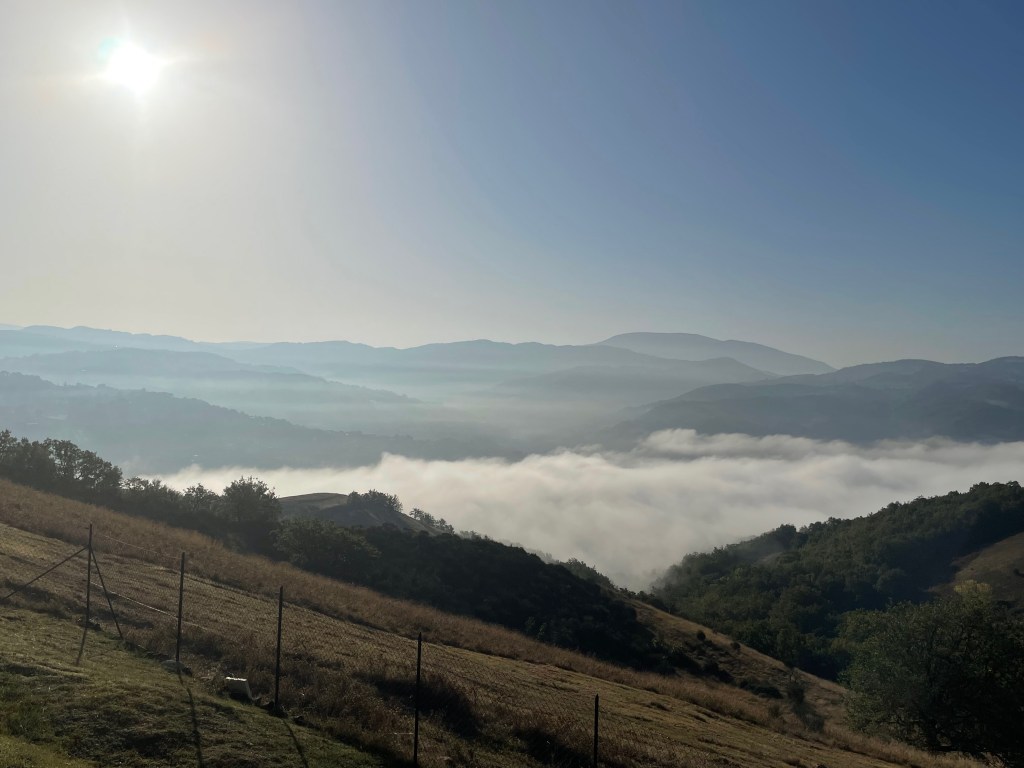
BUT THERE ARE THE PLEASURES of everyday life here to compensate. We walk up the road and see this amazing view. We never get tired of it:

Valhalla, or the Umbrian equivalent

Besides the view, we’ve got neighbors. We can’t actually see them; we’re all spread along this winding road. But a simple 2 or 3 km walk means waving to cars passing by, and someone’s bound to stop and chat and invite us for coffee. A couple of weeks ago, we were doing our walk when a car pulls up. Usually it’s people lost and needing to find one of the nearby hamlets. A guy in accented Italian asks us if we’re the people in the yelllow house. We respond in English, we’ve been anxious to meet you. Seems we’ve got a famous lutenist living in a small house up the road, a fellow refugee from the U.S. If you’re into Renaissance music, look up this name: Crawford Young.

And have you ever had the experience of having a shop, a restaurant, a, I don’t know, a shrine nearby, and you tell yourself you’ve got to go there but you always forget or take it for granted that it’ll be there? Such was the case with the pretty recent addition to our town, Bottiglieria Barbarossa, a terrific enoteca right in the historic center. It opened about a year ago, and it’s a great place to try out local wines and artisanal gins and the like. And the owner Massimiliano is really passionate about his wares and the industry in general. We had a long chat about “natural” wines (he’s not a fan; I’m inclined to agree), the sacrifices restaurant owners make and our careers and life trajectories. The place has the additional benefit of big windows out onto the piazza so you can see the street action without the town’s resident old dudes staring back at you.

Just add wine=the perfect snack

There are other good bits of Italian small town life. We’re looking forward to a fish and seafood lunch this weekend. The menu looks incredible–appetizers, two “primi,” a fried seafood course, dessert, wine, water, and coffee. All of this in our friend’s hamlet for €35 a head, or about $37. It’s not just the food, of course. It’s the communal spirit of it all.

Our town, though, has got that communal thing licked. There are way too many events, walks, lectures, dinners, concerts going on to even start to list them. For a town of maybe 3500 souls, give or take, it’s a lot. And the town fathers and mothers are anxious to promote what we’ve got. Far be it from me to spoil the fun, so I’ll leave you with this video (in Italian), which gives you a good idea of what I’m saying:

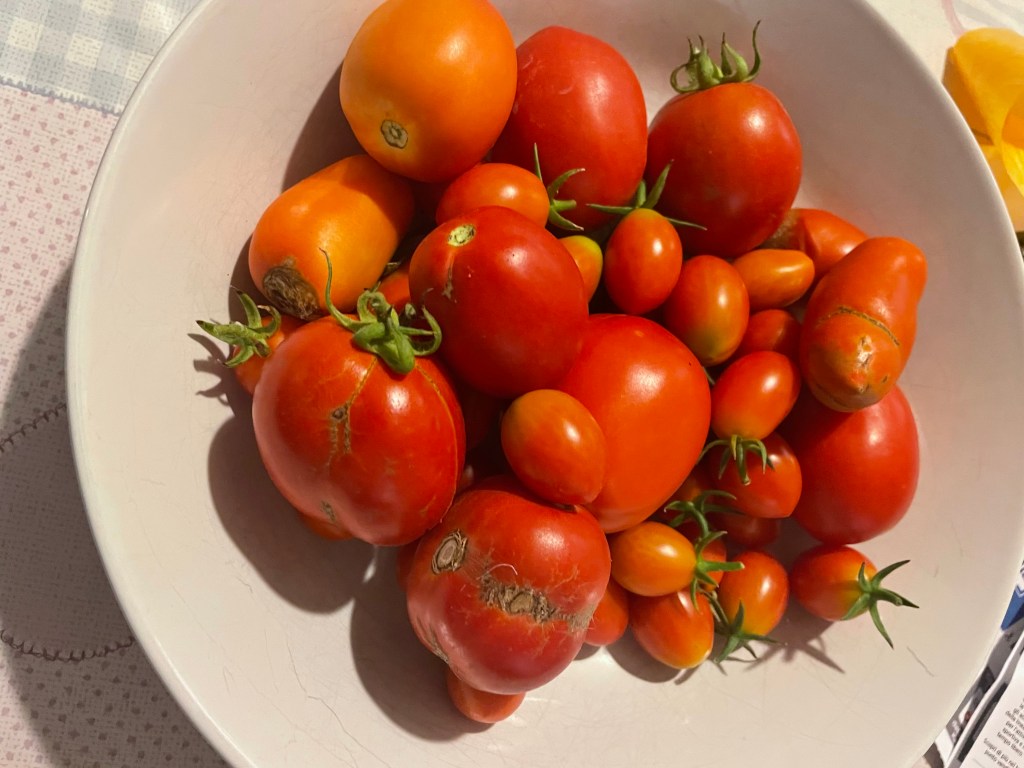
Last call (for summer tomatoes)

But now those tomato plants look forlorn. They struggle to stay upright as the early autumn winds blow, their leaves turning yellow and brown. Gotta say it’s kind of sad. So instead of petering out, or going out in a gradual fade away, The Spartan Woman gathered all the ripe small tomatoes and a few larger ones, and put them in a bowl. We looked at that red tableau and decided that a late summer roast would end the season with a bang. But what to do with the roasted tomatoes? The dish is a traditional foil for a roasted and/or grilled leg of lamb. But no, we couldn’t. Not when we have little lambs from the neighbor visiting us every now and then and taunting the pup. We could have paired them with pasta and ricotta salata, but that seemed too ordinary a dish to salute their tomato-ness.

In the end, we decided on a risotto, one that would be finished with butter and mascarpone, an appropriate blowout to what had been a decent season.

The “Recipe”

I put the headline in quotes because this is a dish that you feel more than you quantify. The risotto itself should be rigorously orthodox, a blank canvas for the intense tomatoes. We decided not to use saffron, thinking that it would distract from the star attractions. For a risotto for two people, you’ll need a cup of carnaroli rice—arborio works, too—an onion, a liter+ of good vegetable stock (I added wine and water so I’d have enough liquid), enough olive oil and butter to sauté the onion and toast the rice, and a splash of white wine. It’s a two-part process that takes a couple of hours, half of it passive, but it’s worth it.

You first have to roast the tomatoes. This could take up to an hour, depending on your oven. Preheat your oven to 220 deg C., or 425 deg F.

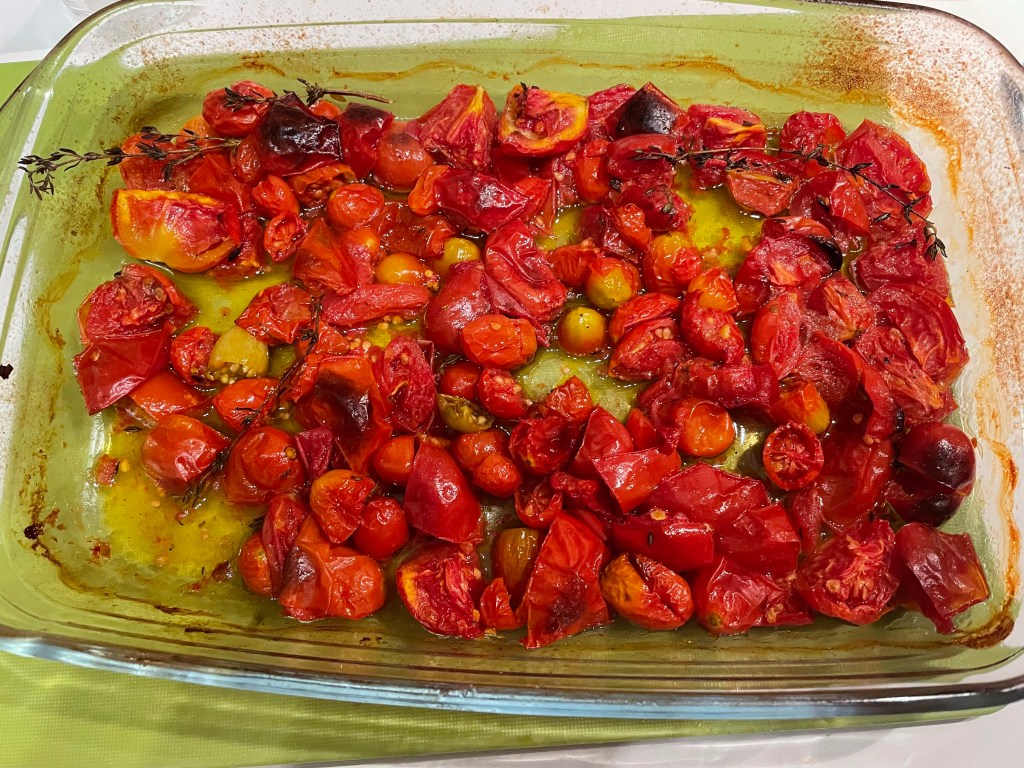
Halve or quarter the tomatoes and put them in a roasting pan. The quantity is up to you; the amount of the red stuff in the photo above was perfect for the two of us. Smash 2-3 garlic cloves and put them in the pan. Add a good amount of both olive oil and white wine. Sprinkly with salt and pepper, and if you’re into it, a bit of chili. Thyme goes really well with this, so a few sprigs. Rosemary sounds good in the abstract but will overpower the dish. Basil is fine, if not great looking when it roasts, and in a pinch you could add some herbes de Provence.

Check the tomatoes every 15-20 minutes. Stir them to judge doneness. When they look like those below, the tomatoes are done.

Set the tomatoes aside for now. It’s time to make risotto. I’m going to go quickly here. I’m assuming you know the basics; By now, you’ve got the stock simmering in a separate pot.

Saute the onion in some mixed olive oil and butter, then add the rice. Stir, toasting the rice. When the onion is translucent and no longer crunchy add a big splash of white wine.

Now, ladle by ladle, add stock and stir. A lot of people say that the regular stirring is unnecessary. I like to stand at the stove and stir. Plus, it gives me an excuse to drink some crisp white wine while laboring over a hot pan.

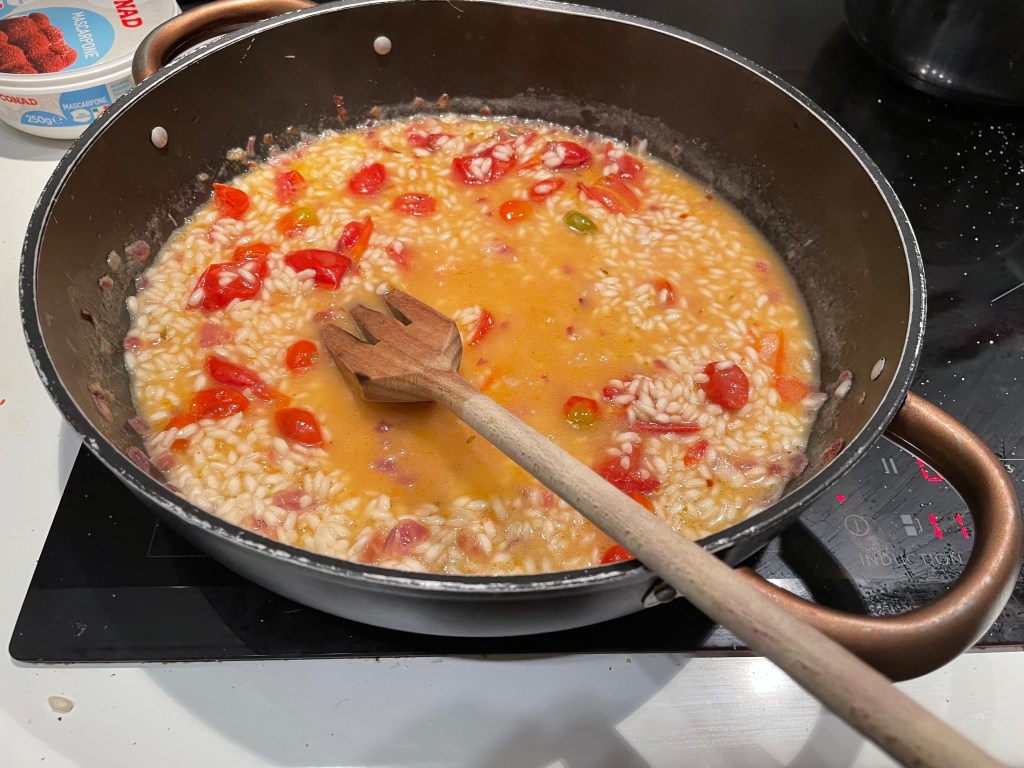
Somewhere in the middle of being done, which will take 25 minutes or so, start adding the tomatoes. You will notice the skins coming off. Some might look at this with horror; we don’t mind. Keep adding stock and tomatoes until the rice is al dente–soft around the edges but with a definite bite at its core.

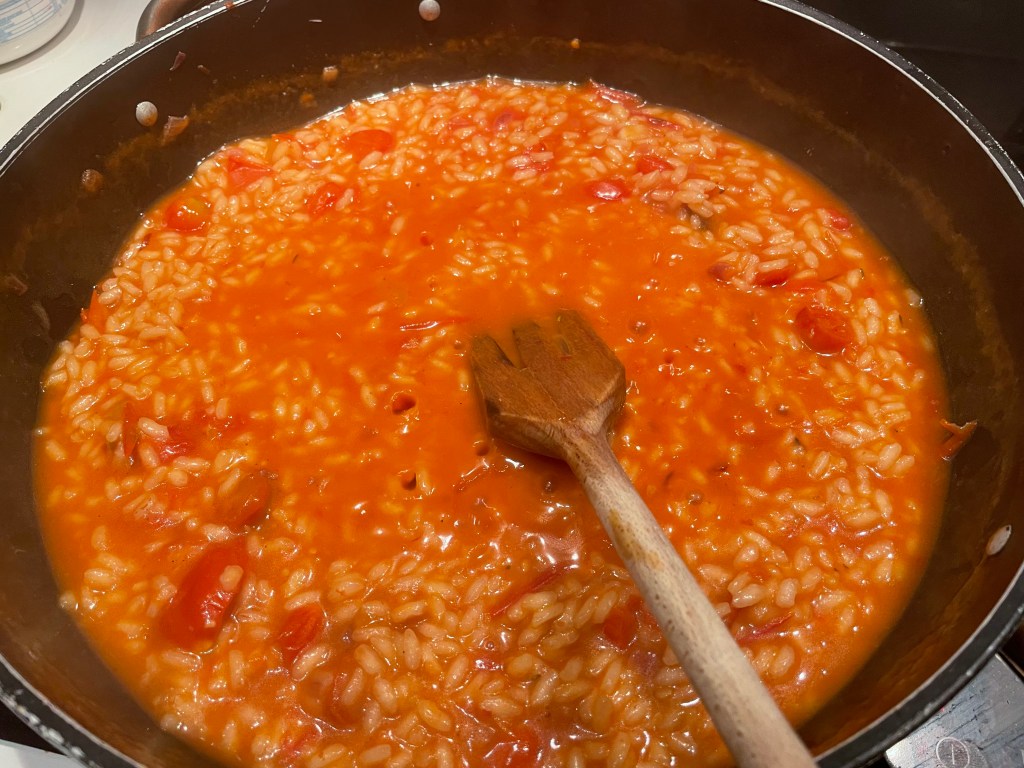
Now the fun part: Turn off the heat. Stir in a few dollops of mascarpone. The quantity is up to you and your gall bladder. I went for decadence, but that’s me. Stir and dissolve. Now add a nice handful of grated Parmigiano-Reggiano or Grana Padano. Stir some more. If you’re a really sick puppy, you can add a couple of knobs of butter, but that could be way over the top. I won’t tell.

Serve. A small mound per person to start. Seconds for the greedy and/or decadent. Buon appetito e arrivederci summer.

Niko in love

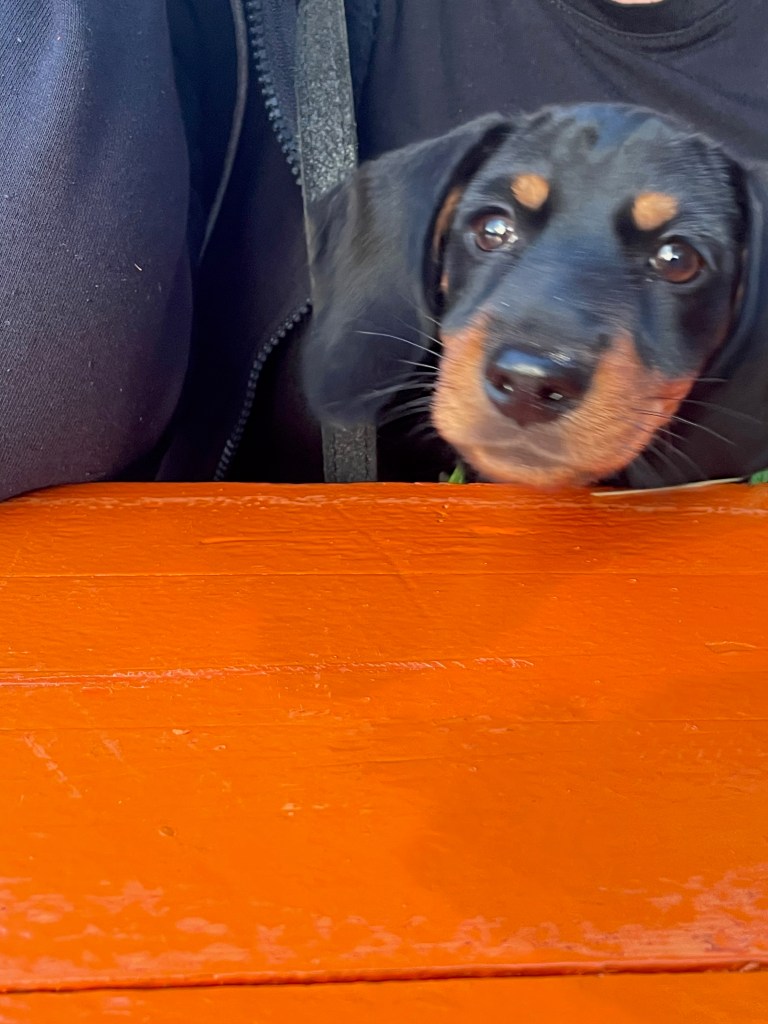
Meet Niko. He’s a three-month old dachshund and the latest addition to our family. He likes to chew, and he likes to chew. But most of all, he loves Georgia, our friend Doug’s dog. When Georgia is around, Niko becomes a good little student, following her around as well as doing dachshund-like things like charging her in attempt to make her play with him. It usually works. There’s another benefit when Georgia is around; Niko doesn’t wander off our yard, which is at the crest of a hill and beyond that it’s straight down into a gulley.

Georgia (left) and Niko commune over some blades of grass and weeds.

While we like to think that we, the people who brought him home, feed him, and indulge most of his whims, have a place in Niko’s heart, he is also very women-friendly. While he has his puppy holy-terror spells at home, when we take him on errands, he becomes the perfect little gentlepup. With his good looks and puppy size, he’s a natural (sorry about this–>) babe magnet. It’s true; I could safely say that most if not all of the people who react to his cuteness are women. And he likes them back, licking their hands and acting like the sleepy little puppy that he isn’t most of the time.

Okay, I exaggerate. A little. As I write this sentence, he’s tugging at my shoelace.

Niko surveys his kingdom from his living room couch perch. He is the boss of us.

We haven’t had a puppy around in more than a decade. But this house needed a dog. We’d seen a listing for him online from a family in the neighboring region of Lazio (near Rome). It was an almost two-hour drive but worth it. We met a young woman in her small town, and she was actually holding sleepy little Niko. After talking about what he eats and looking at his libretto—his medical record of vaccinations, etc.—we were off, back to Umbria. The Spartan Woman hung out with him in the back seat and he slept most of the way.

You gotta fill out the form…..

Getting a dog was a good repeat lesson in Italian bureaucracy, as though we needed a refresher course. Italy, and Europe in general, have a thing for knowing how many we are and where we live. And it’s not only for humans. Dogs, too, are registered with their local comune, or municipality. Little Niko has a microchip imbedded in his shoulder that contains his info–birthdate, how many born in his litter, place of birth, and owner’s vital data. Right now he’s registered as C’s dog. We had to fill out a change in ownership form, and that form is being sent from his birthplace to our town’s healthcare center so that his chip can be updated to reflect his being part of our family. Then he can get, yes, a passport, which will permit him to travel with us.

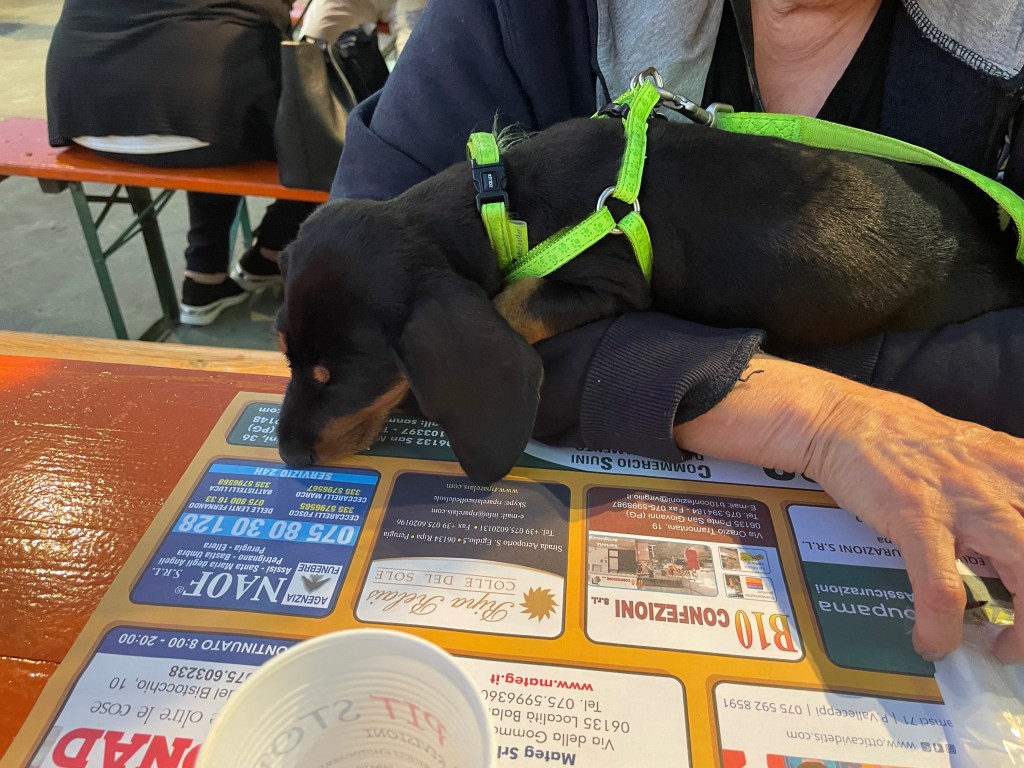
And that’s one of the good things about having a dog here. Niko has a lot more freedom here than most of his America cousins. He can come with us almost everywhere. Naturally, we take him to the pet store. He likes to choose his chew toys. But he’s also gone to the supermarket and to bars. He’s spent aperitivo time people-watching and eating prosciutto. He’s only been with us a few weeks and with the heatwave here, we haven’t gone out much. But otherwise, we’ve seen dogs on trains, in bookstores and museums, and even in pretty ritzy restaurants on a chilly winter day, happily resting under the table. We plan to take him on road trips, and the continent’s pet-friendly practices will make it pretty easy to do so.

Niko gets around. When he’s not examining menus or being admired, he likes to hide under the table.

We live in a small town, so maybe our experience is different from others. Niko needs a series of vaccines, so we looked up the town’s vet. We always passed a sign pointing to an “ambulatorio veterinario,” so it was easy to find him. The vet, a man with a mellow, kind demeanor, just smiled at Niko and murmured flattering things while giving him a deworming pill. I’m so used to going to a vet’s office, checking in, giving billing info, etc., that the informality of our visit was almost a shock. When I asked the doc what I owed him, he said no charge, first visits are free.

IN A LOT OF WAYS, dog ownership pretty much sums up life here in our little town and region. Official encounters can be stiff and encumbered by rules and procedures. Yet everyday life is punctuated by small kindnesses and a gentleness that’s hard to explain if you haven’t experienced it. Some years ago I subscribed to Quora, and my feed lately is dominated by Americans (real or bots, I can’t say) comparing their great freedoms to the horrors experienced by us in Europe. Like universal healthcare.

A very silly question.

A lot of the questions are silly. But they make me think about how people in my country of birth live and perceive the rest of the world, if they do at all. When I go back to New York for a visit, it seems very stiff and cold, and I start paying attention to people’s status—not to mention that it’s ridiculously expensive. Driving around the U.S. is weird, you have to be on guard for cops monitoring your speed and crazed pickup drivers treating their trucks as though they were Porsches. Being pulled over can be a life-threatening situation. When it comes to driving here in Italy, the onus of staying under the speed limit is on the driver; speed cameras are everywhere. Go too fast and a ticket arrives in the mail.

Here in heavily rural Umbria, there’s more of a we’re in this together feeling that I find appealing. In general, too, there’s a looser vibe. And that’s pretty recent. Italians used to be more rules-bound and have more hangups about, for example, what to wear, and when. One of our recent guests from across the pond wore jeans on a hot day because he read that Italians never wear shorts outside of beach towns. Wrong! We’re adapting to climate change here and shorts are everywhere.

Oops. I have to run after the dog. He’s got my shoe.

Well, this definitely feels different

After years of slowly, glacially, indecisively moving over, we’re finally doing it. The old house in New York is mostly empty and being renovated by its soon-to-be occupants (we’re keeping it in the family), while a few dozen boxes of personal effects are somewhere in a warehouse awaiting shipment to us here. This house has been ready for years, even if there are features here and there that we’d like to put in. My ex-editor used to tease me about my commitment issues, so take that, boss.

This old (by American standards) house will soon have new occupants.

Call it procrastination, call it circumstance, call it Covid-19, whatever. Up to now our stays here on the Umbrian hilltop have felt like really long vacations, even if we had to do everyday stuff like renewing the car registration. Not to mention taking the garbage and recyclables to the “tip,” as Brits would say. (We’re talking about a few plastic bins down the road. More on this last bit later.)

All that’s left is some bureaucratic stuff It also means that we’ll be back in the U.S. less, and in some ways that’s a relief.

Let me explain. I don’t usually like to do the we have this, they have that game, but to understand something, or a place, you often have to stand outside of it. Such is the case with the country of my birth. Our four- or five-month stays away have given me some perspective. And I gotta say I don’t like what I’ve been seeing. After one absence a few years ago, for example, we suddenly saw monster gas-guzzling pickup trucks everywhere. In New York City. Driven to the supermarket and on the school run. Really?

Relax, it’s just an induction cooktop, not a culture war. And water boils real fast.

More recently, and especially after Covid, there’s a palpable feeling of anger on the streets. Maybe we’ve gotten too used to the easy sociability here in Italy, where every encounter is a potential long conversation, but our fellow Americans seem sullen and angry. You feel it even when driving, when every SUV and pickup surrounding us seems to be driven by a lunatic. People do stuff that Americans used to accuse Italians of doing, ignoring stop signs, passing on the right only to make a left turn, driving at ridiculous speeds on local streets. No wonder there are speed cameras everywhere. It’s not just driving; shop clerks are nasty and ‘net bulletin boards are full of snarky comments.

What makes me really sad, though, is how the U.S. seems stuck in the past. Sure, this Mac I’m writing this on is up to date, and companies are always updating products and services. But every single change, even trivial ones like cooktops, has become a political and cultural minefield. Meanwhile, the Old Continent moves on. Not everyone likes it, I’m sure. But the feeling that this is 2020-something and we have to deal with climate change is palpable, even here where a right-wing government was elected last fall. (Never mind that the prime minister is a relatively young woman, who isn’t married to her partner, the father of her child.)

LET’S GO FOOD SHOPPING, just to make a few points. Here we are at the garbage bins. We drove here with our pint-sized Renault, which is due to be replaced by an electric model in a couple of years. You can argue about the ultimate merits of recycling, but for now we have to sort our garbage. One bin gets plastic, and almost everything plastic counts. Another is for paper, another for regular garbage. And the final, smelly one is for organic food waste. There’s a glass bin down the hill; we love the sound, as Nick Lowe once wrote, of breaking glass.

The Clio encounters some garbage bins on the way down the hill.

I’ll cop to the fact that we shouldn’t have driven so long to get to a supermarket. But in landlocked Umbria, just the occasional store has fresh fish, and these former seaside people gotta get our fix. Notice that there’s something different about the parking lot. Those panels shading the cars aren’t just pieces of plastic and steel; they’re solar panels. And these panels supply a big part of the shopping center’s electricity.

Those panels aren’t just there for the shade.

A lot of people, and especially Italians, criticize this country for being fossilized. And I can see that when it comes to some bureaucrats (let me tell you about the woman at the water board…). At the same time, we have a decent infrastructure, fiber Internet is being rolled out across this region, and, especially since Covid, most people just tap their phones or cards to pay everything from a coffee at the bar to induction cooktops at the Italian version of Best Buy.

And our prime minister and the opposition leader are both women.

Bitter. Sweet. And something in between

Never mind.

Soldier Carlo

That’s the phrase that came into my mind as I boarded Iberia flight 6252 for Madrid last week. It was the start of a journey to Umbria in Central Italy, where I’ll register as a full-time resident. In doing so, I’m moving in the opposite direction of Carlo Ancona, my maternal grandfather, who tried to escape a second stint as a conscript in the Italian army during the incredibly stupid European conflict that we call World War I. (He failed and was drafted to fight in the trenches in the U.S. Army.) I’m also reversing the direction his wife, my grandmother Rosa traveled a few years after Carlo, sailing to New York in steerage with two young children. And finally, I’m canceling out what my father did in 1955, the year before my birth, sailing from Palermo, Sicily, to New York to join his bride, my mom Angelina Ancona.

All of them fled economic bad times. My mother’s parents were tenant farmers leaving the crushing poverty of the seacoast and agrarian town of Castellammare del Golfo, in northwest Sicily. “They ate pane e cipudda, bread and onions,” my mom would tell me. My father, from a middle class family in the big city, wasn’t starving. But when he left the Italian army, there was precious little opportunity for a restless young man in mid-’50s Palermo, the island’s largest city and capital.

What am I fleeing? Eh, nothing that affects me personally except, perhaps, boredom and endless HGTV programs like Love It or List It. I was involuntarily retired by Covid, when a lot of work I did dried up. A few years ago I did have a day job as a working journalist. I loved the job until it was turned into a soul-crushing exercise in scaring up website clicks by a bunch of Catalan consultants and dull-witted corporate executives.

I’m not alone in doing this reverse migration. Some 20 to 30 percent of the millions who left Italy during the great migration of the late 19th and early 20th centuries returned permanently to their homeland. In my own family, my grandparents and one of my aunts lived in the U.S. for a few years and then decided to return.

My Aunt Pia’s wedding on July 4, 1964. She and her new husband eventually moved back to Italy. (I’m the ring bearer up front.)

So here I am. I’m sitting on the patio of our house looking down into the valley of the Chiascio River, a tributary of the Tiber that runs to and through Rome 192 kilometers (about 120 miles) away. It’s a breezy sunny day, coming after a few days of leaden clouds and periodic cloudbursts. To call it pleasant would be, as the cliché goes, damning it with faint praise. We walked up and down our road earlier, getting reacquainted with the human and canine neighbors. Last night, we along with what felt like dozens of fellow Umbrians, ate gelato at a popular place a few towns away, signaling the start of a lazy Italian summer.

That’s literally and figuratively the sweet part. The bitter? Leaving my babies. Okay, they’re adults now, but I like to think that even though they’ve grown into terrific young women, they’re still my babies. And my older daughter gave birth to (this is grandpa saying this) The Most Beautiful Baby in the World. I’ll miss them terribly, even though it’s exponentially easier to stay in touch these days. Back when, my father and then later I kept in touch with overseas loved ones with postcards, letters, and the rare long distance (!) phone call. Even the baby responds to the screen when I use FaceTime to videochat with the fam.

And the in-between? Leaving the city where I was born, raised, educated, had a career, and raised a family. Either purposely or by accident, The Spartan Woman and I avoided what a lot of educated class Americans do. We didn’t let internships and college take us away from our hometown of New York. A big reason came down to economics: Coming as we did from families just getting their feet on the American ground, we couldn’t really afford to go away to school. Later on it was a conscious choice, that New Yorker snobbishness that considers every other American place to be, simply, not good enough for us. Hey, we had free university, great museums to wander around in, incredible hangouts and backdrops for romance. Did I ever tell you about the rehearsal show for Kid Creole and the Coconuts we were at? When my sister danced on stage with August Darnell? Or when as young adults we’d catch a Ramones show at 3 a..m. in a seedy bar and then head to work with impaired hearing?

Can you hear the ships’ horns?

For better or worse, I have the foghorns of New York Harbor embedded in my brain. And the clickety clack of an elevated train making its way to Coney Island. Hell, it took me years to orient myself here, a place on a landmass with lots of what looked like identical towns at first. A New York kid, I knew that if lost, I’d end up at a shoreline eventually. I walk fast, even as an old guy. It’s what we’re trained practically from birth to do. Skyscrapers don’t faze me, and I’m frankly bored of upscale restaurants where the chef is so hell-bent on innovation that he or she forgets to actually feed people.

I don’t think I’ll miss the rest of the United States. Still, there’s nothing like a lobster shack in Maine, or the honky tonk Jersey Shore. I do miss our summers on Cape Cod, where we’d rent little cottages with the kids when they were little and eat way too much seafood.

Living here in Central Italy feels natural. It’s not as intense as Sicily yet not as proper as the north of the country; it’s somewhat of a halfway house between the Latin and Anglo-Saxon worlds. I didn’t have to go through any cultural acclimation, since I grew up in an immigrant family full of relatives who moved back and forth between Italy and the U.S. for vacations or to live. I spent my first times in Italy at relatives’ homes, the first time a lazy beautiful summer in a beach town just outside Palermo and got first-hand lessons in how to shop and get an espresso or beer at a bar.

I’m going to go back and restate the original point of this blog, besides my having the urge to write every so often. I aim to show what living here is like in a realistic way, without the romanticism of silly stuff like Under the Tuscan Sun or A Room With a View. Italy is a modern, vibrant, sometimes infuriating place to live. If I’m successful, I’ll smash some stereotypes, yet leave you with an occasional smile.


Alienated in New York: a trip through my unpublished archives

It’s snowing today and our region is, as we say in Italian, “in tilt.” It’s more than the gentle flakes or even the short blizzard of flurries, if there can be such a thing. So for awhile we were out of power. I didn’t have an unread book handy, so I got my trusty laptop, which I can use for days without charging, and looked through old files on my hard drive.

Scrolling through my digital detritus, I found this essay that I’d written pre-Covid pandemic. I have no idea why I wrote it, what, if any, audience I was thinking of—whether, for example it was for this blog or not. It looks as though I wrote it quickly, right after the dinner I’d gone to. And boy, it rings even truer today than back in 2019. So I hope you don’t mind if I recycle it here, slightly edited to fit my current writing style:

—————-

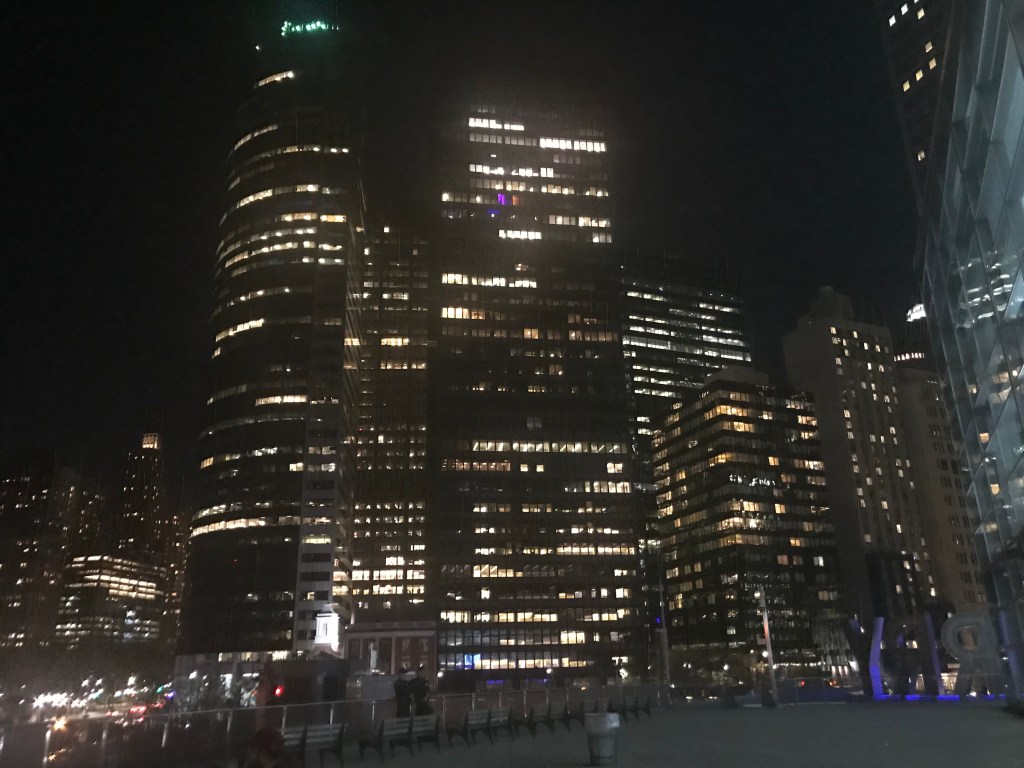
I HAD DINNER WITH friends the other night in Lower Manhattan near the South Street Seaport. Dinner was at Barbalu, the successor to a place I’ve been going to for almost ten years; the original version of the chic restaurant/Italian market was flooded during Hurricane Sandy in 2012. It’s a friendly place; I know the owners and this later version features authentic modern Italian food in a rustic yet sleek setting. 

I live on Staten Island, so I took the ferry across the harbor and walked about 20 minutes up to Barbalu. As far as commutes go in New York City, it’s painless and even scenic. When I had a regular day job, I took that ferry nearly every workday for some 30 years. In my last decade of trudging to a newsroom, my daily commute tracked my trip to the restaurant, except that the walk to work from the ferry was a little shorter. I’m a native New Yorker and have lived in the city just about all my life.

But that night, I felt like a tourist.

I can explain. I’m in New York for what seems like a fleeting visit. My wife, now retired, and I bought a country house in the Italian region of Umbria a couple of years ago. We’d planned to stay there sporadically, whenever I could get away. We were thinking of retirement, and retirement at the time seemed like something that would happen in the future. A couple of years away at least, in fact.

But our staying in the house for more than a quick week or two at a time came much sooner. Like many media professionals, I was excessed a couple of years ago along with about 20 of my colleagues. I’m not really supposed to talk about it, but the move supposedly was part of a sweeping redesign of our news operation, and as one corporate officer told me during what was surely a scripted phone call, “Your position has been eliminated.” (It wasn’t; they merely changed the name of it for a few months, then back to the original after we’d signed our severance agreements.)

So I, along with my comrades in words, had to reinvent ourselves. I became a freelance writer, and I don’t need to be anywhere in particular physically to do my work. Hence, Italy for at least a few months a year, in my spare euro-modern office or, better, at a garden table watching the view as I procrastinate.  

Inevitably, our country stays got longer and longer, and now amount to half the year. We can do this because of a precious gift from my immigrant father: an Italian passport. So we’ve been busy integrating ourselves into our little community. It’s a big change for a city boy like me. We live in a mountainous area in the foothills of the Apennines, the mountain chain that forms the spine of the Italian peninsula. Our neighbors are some 125 sheep and the people who own and care for them. When we take a walk, we amble down our road, waving to the hardy old—and retired—people who’ve lived in the town all their lives, and I’m sure their families have been there for centuries. Or, since we’re located in the middle of a network of hiking trails, we go exploring the hills when I’m done with my work, trudging up and down mountain paths and occasionally finding a ruin or wild asparagus in the woods.

But we’re in New York now [OK, I was in April 2019], and I have to say that I’m shocked that I feel so odd walking around my city. I was on the ferry that night, and I watched the tourists and the orthodox Jews and their families enjoying the ride during the week of Passover. And I realized that I’m a tourist too these days, here in town for only a few weeks.

The realization hit me viscerally, and this strange feeling of psychological distance stayed with me as I navigated streets that I’ve walked thousands of times. For one thing, since I stopped working in the neighborhood two years ago, a lot has changed. There’s a Hilton Garden Inn on Water Street, a truly strange name for a bland building that’s nowhere near a garden.

There are lots of new restaurants and lunch takeout spots, something normal in a town where eateries fold and open at a rapid clip. There’s something odd about the new places. They advertise their wares in their simple names, like Greens and Fresh. I’m an addicted menu reader, and their food seems to come from nowhere but some Californian notion of “natural” food: lots of kale, grains, an Asian overlay in the flavorings, bowls. The word “bowl” makes me smile; in four letters it manages to connote a lively lifestyle, clean living—lots of bike riding and yoga classes.

I SUPPOSE THAT I’m an old curmudgeon. But curmudgeons aren’t necessarily alienated from a place—just from a period of time. Walking through the oldest part of New York that’s busy remaking itself, I felt conflicting emotions, happiness that I would escape to my mountaintop soon, but a kind of sadness for feeling somewhat uncomfortable in the city where I was born. The contradiction actually made me feel queasy, as though I weren’t just pulled in a couple of directions emotionally, but physically.

That feeling stayed with me over dinner with my friends. I worked with them some 20 years ago and that alone probably contributed to the weirdness. Seeing them made me think of a time when New York was my city, my hometown. I had a part-time restaurant reviewing gig on the side back then, and it meant hanging out at hot new places, tasting everything. Now I was a part-time interloper, listening to people talk about their current jobs, their current president. I’m an American, but I also have another country’s politics to think about, and to fret over. While I participated in the conversation, I couldn’t help but think that I can just get on a flight and not spend much time thinking about Donald Trump’s latest escapades. 

And the prices…really, people, restaurants, even places I love, are ridiculous. My tablemates, knowing I’m a wino, sorry, make that someone who knows a thing or two about wine, especially those from Italy, had me choose. I looked at Barbalu’s list, and it’s a good, selective one. But the prices sent me into alienation mode again, when the cheapest bottle is around $40, and I know that I can go to a decent restaurant in Umbria and pay a few euros for a nice carafe of whatever’s local. I know that restaurateurs have to price drinks like that in New York; it pays the rent. I suppose that when people are using corporate cards it doesn’t matter much, but how can regular people afford to go out?

The kids were alright.

They don’t. They take the ferry and the subway back and forth every day and night. And that night, the weather was clear and warm. I sat on the back of the boat and watched the tourists take snapshots of the skyline as we sailed across the harbor. Soon they got tired of the view and went over to the side to see the Statue of Liberty. Right about then, an African-American girl with a distinct city kid accent sat next to me. Two boys, somewhere around 14, stared at the harbor view, which is nice enough during the day, but truly stunning at night. They laughed, they joked, they wisecracked like the city kids I’ve known all my life. They danced around, obviously flirting with the girl and competing for her attention and approval.

I’ll miss the place when I finally leave.

It’s something we think about all the time here

Let’s talk about food, shall we? And where you consumed said food? (Sorry if the headline led you to think I was going to write about that other obsession.) I’m thinking about food in Italy these days, since I’m here. It really is an obsession, and not just with “sovrappeso” [overweight] me. I’ve overheard chic saleswomen talk about what they were going to have for lunch in tones that were, well, erotic. And if you happen to be in Italy and happen to get onto YouTube, your feed will soon be blitzed with food videos. I don’t think it’s just mine.

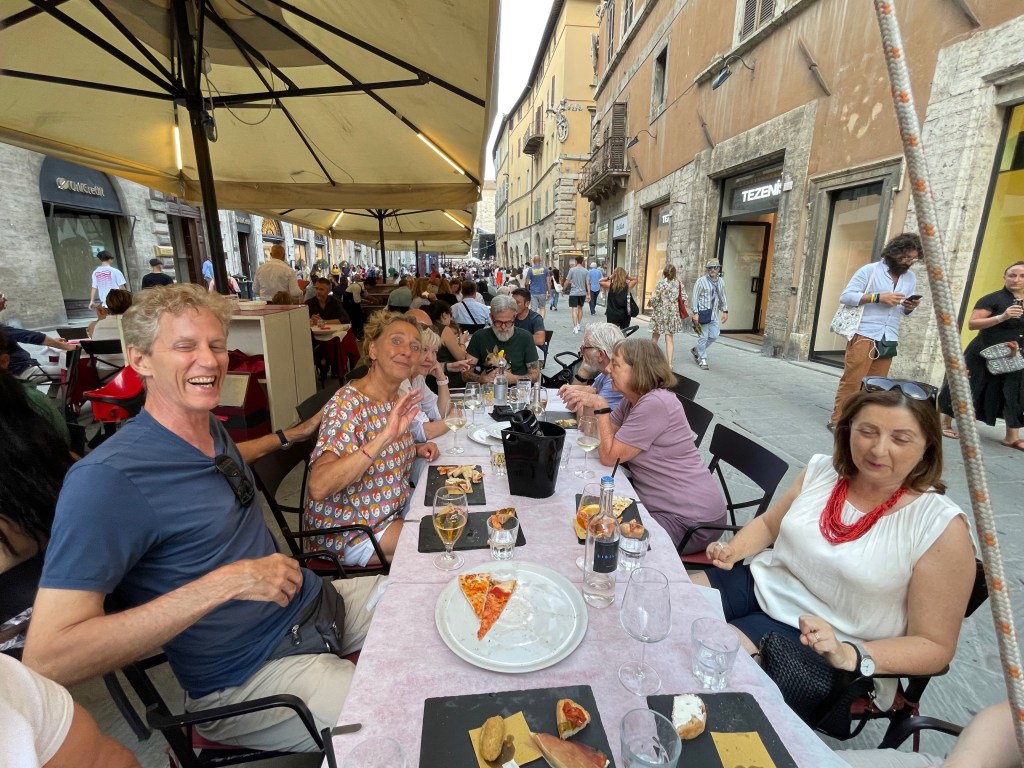
First off, most Americans without the good luck (or misfortune. It depends.) of having relatives living in Italy don’t get the full-on experience. They–you?–have to go to restaurants. And that’s a shame, especially if you’re in the big tourist cities. Why? Because restaurant food may be ok, but eating in an urban restaurant in Italy doesn’t come close to the real deal, and in big cities and touristy locations, many restaurants serve a kind of national “Italian” food that doesn’t reflect what people really eat in this intensely regional country. Plus they miss the vibe, where people loosen up and sit with friends, family, lovers, kids, dogs, whatever, just enjoying the moment. Or a town festival. Or, in the case of our town, any excuse to get together. Any.

First, friends and/or family. One of my most memorable “meals” here, if you can call it that, happened before we had a place of our own. My magazine astoundingly let me come to Italy on a reporting trip. My assignment was to make the rounds of lawyers and business analysts and give American lawyers an idea of what to expect if their companies or clients tried to buy an Italian company. I cannily scheduled interviews for the latter part of the week in Milan, and the early part of the week in Rome. Oh, dear, what to do in between? Live in a lonely hotel room? Eat meals by myself?

Nope.

I visited friends who happened to live in Perugia, about two-thirds of the way south to Rome. After a couple of train rides, my Italian papà Franco picked me up at the station. “We have to hurry,” he said. “Giovanna’s in the middle of a surprise for you.” Franco, never a quiet pensive kinda guy, gunned it, shouting at anyone who dared to drive any slower. “Figlio di puttana! Bastardo!” he shouted. After holding on for dear life—Perugia doesn’t know from straightaways—we got to their house. “Hurry! Just leave your bag. You can keep you jacket on. We have to do this NOW!” Franco told me.

What was the fuss all about? Artichokes. Glorious crunchy salty hot just from the fryer pieces of artichoke. “I’m squeezing lemon on these, ok?” said Giovanna in Italian (these two didn’t speak English; this is all translated), more as a statement of purpose than a question. “Eat with your fingers.” She had put the freshly fried artichokes in a paper lined basket and shoved it at me. “Eat with your fingers.” The three of us didn’t even sit; we just stood there eating, blowing on our fingers between bites.” When we weren’t wolfing down the artichokes, we were drinking and smiling at each other. It was one of the best food events I’ve ever been at. I know we sat down to a regular lunch after that, but for the life of me, I can’t remember it. Can you blame me?

If you don’t have an Italian friend or relative, the next best thing is probably eating at an agriturismo, or at least a country restaurant. If it’s the right season, eat outside. Yeah, there’s an Under the Tuscan Sun thing going at these places. But you’ll see what makes it all worth it. Some years before that reporting trip, we’d gone to an agriturismo high above Lago Trasimeno, the big almost ocean-like lake around here. I can still taste the pasta course, with an eggplant purée (no tomatoes) and bits of sausage. But what I really remember was the vibe. There we were, our family, plus our Perugian surrogate parents and their dog, just relaxing around a table with a view of the lake below for the whole afternoon. And it cost maybe a half of what a city restaurant would’ve charged. Maybe less.

ANOTHER WAY TO ENJOY NON-RESTAURANT food is at a sagra or a festival. They’re held all over Italy, and here in Umbria there seems to be one every day or so somewhere. They serve as fundraisers for the town’s pro-loco associations, which support soccer teams, after school activities for working parents, and the like. But they’re also a way to get the whole town involved in something—and, for people to connect with their history. Local volunteer cooks take care of the food, sometimes, but only sometime, under the guidance of professional chefs. Of course, doing so often involves getting done up in medieval drag, which seems to happen for any excuse, but I digress.

After the Covid shutdown, the region came alive this year. We’ve been to a few. The first was for the food, in Ripa, two towns down the main road here. The town itself is a tiny hamlet, with a circular historic center, and various memorials to Gino Bartoli. He was a heroic figure, a Tour de France bicyclist who smuggled citizenship documents for Jews during World War II by stuffing them in his bike’s tubes and delivering them. Ripa holds a truffle sagra, and the food’s pretty good if you’re a fan of the underground fungus. (We are; Ripa sagra shown below.)

There’s a biggie around here, too. The small town of Cannara, near Assisi, is known for its onions. They’re sold in all the grocery stores and to be honest, we’re spoiled. I won’t say you haven’t lived until you’ve had a really fresh onion—but like a lot of produce, being grown locally makes a real difference. Cannara puts on a pretty big show, with various “stands” (yes, in English), really kitchens/outdoor restaurants, with each producing dishes that feature, yes, onions. Cipollamisu, anyone? It was a lot better than you’d think, with the typical tiramisu ingredients topped with a compote of sweet onions.,

Valfabbrica, where we live, goes all out. It’s bigger than Ripa, as far as towns and hamlets go around here, but smaller (population around 3,400) than the surrounding towns. There’s a week-plus celebration of being a valfabbricheso, with pageants, jousting tournaments, and, of course, food. The town’s historic center turns into a restaurant, and the town has a communal kitchen that churns out tons of dishes based on local produce and history. Gotta say, it was pretty good.

But the most charming event involving food was last weekend. Our town likes its parties, and the old medieval tower was restored recently. Most places would have the mayor cut the ribbon and leave it at that. Valfabbrica? Uh-uh. It got Italy’s only all-female jazz marching band to escort the mayor to the tower, playing Stevie Wonder’s Sir Duke and The Beatles A Hard Day’s Night. The women walked up the tower with Enrico (we’re all on a first-name basis here)

We don’t have dull ribbon-cutting ceremonies in Valfabbrica.

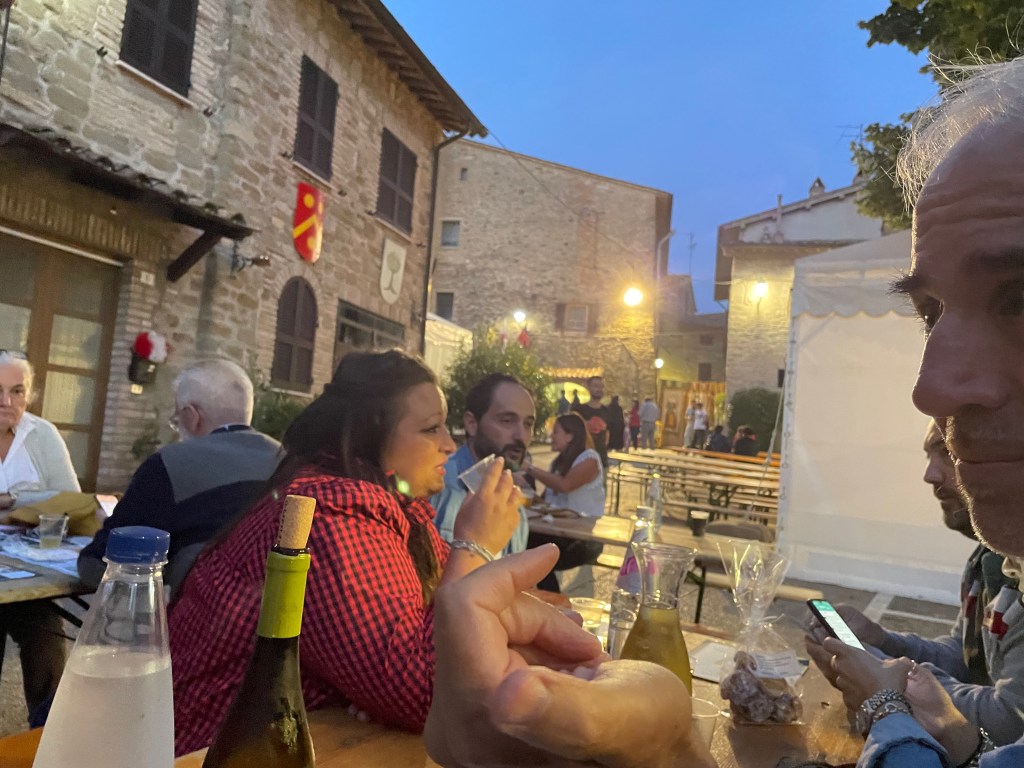
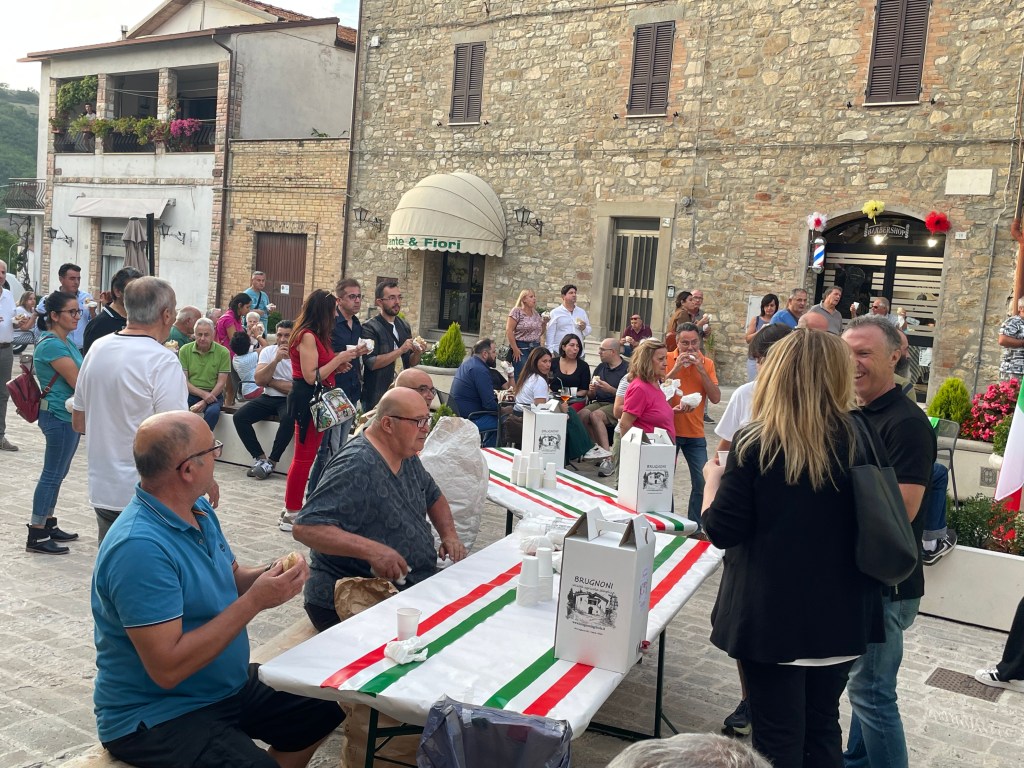
I know, this is supposed to be about food. Sure enough, after the music and the ribbon-cutting and the speeches about the historic importance of the tower, there was a free aperitivo* in the piazza. Older guys sat behind tables with loaded with decent boxed local red wine and porchetta panini* and doled it all out. I haven’t eaten much meat in a decade, but one of the guys shoved a panino at me after I poured myself a healthy glass. It seemed churlish to say no—and it was great to be hanging out in the main piazza on a beautiful late summer night with our fellow townspeople.

Vino and a panino, anyone?

*”Aperitivo” refers not only to a pre-dinner drink, but food to go with it. Places like Milan and even good bars elsewhere elevate it to the point where it can substitute for dinner. At that point you can all the meal an apericena—aperitivo and cena, which is what the nighttime meal is called.

* The word is “panino” for a single sandwich. “Panini” is plural. More than 1 sandwich. Ok? I get a little nuts when I hear “I’ll have a panini .” It’s like nails on a blackboard.

Positively negative: The sequel

What a difference a few months make. You may remember this post and this one. If you don’t and haven’t clicked on the links, I’ll give you the quick version: Flying internationally then was fraught with bureaucracy. Lots of papers to fill out, lots of document checks and Covid testing and an added soupçon of fear and weirdness.
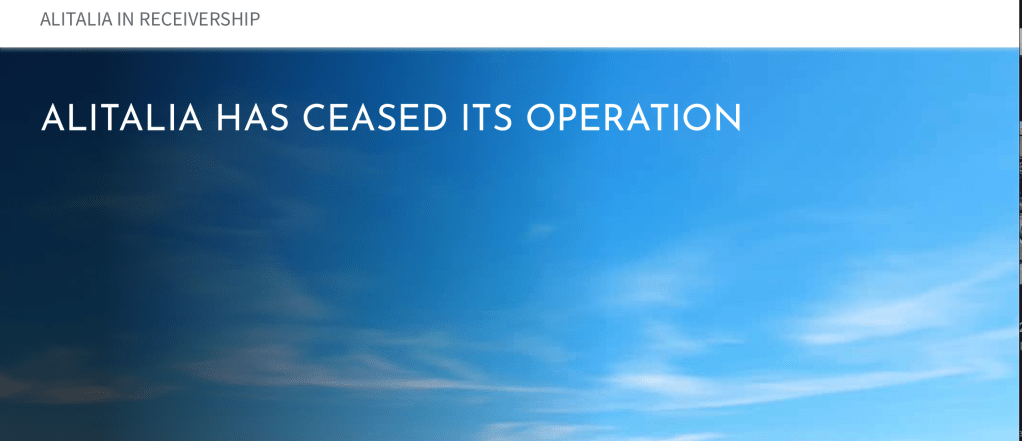
This time, a transatlantic flight was almost normal. But first, a little more backstory. We had return to New York trips booked on Alitalia, airline of the pope, Italian jet set types, and ladies from Bensonhurst. But as of October 14, Alitalia’s out of business, supplanted in Italy by something called ITA Airways, which apparently is supposed to exorcise the bad old ghosts of Alitalia and lead us Italians into a glorious, leanly staffed but full-service, digital (whatever that means) aviation future.

Move along, nothing to see here.

The problem for us was that ITA wouldn’t honor our tickets; under the deal with the European Commission that created the new entity, ITA was explicitly barred from doing so. In a mad scramble online, we bought new tickets, round trip from Rome, on the German airline Lufthansa. We’d flown Lufthansa before and liked its in-flight service—because of flight attendants’ propensity to pour a lot of wine I think of the carrier as the Riesling Express–and thought that it would be interesting to see if and how Covid-19 concerns changed that service.

In a few words, this time around it was pretty much the same,

Once we booked a return date and as that date approached, we had to do the usual stuff to gradually close the house: using up perishable foods, and not buying much either. We decided not to go out to eat that often, either, to reduce our chance of contracting Covid, even as a so-called breakthrough case. We saw that we needed a negative Covid test, 48 hours if it was a rapid preflight test, 72 hours for a PCR test—this is the phrase I loathe, “the new normal.” Our neighborhood pharmacy, Pagliacci in our town, could do the test and give us a two-day “green pass.”

We were poked up the nose here.

About that green pass—for Italian residents, it’s a digital QR code that’s stored in a smartphone app. But for us nonresidents, a paper document worked, although I could have downloaded a digital version from Italy’s health ministry. One of these days I’ll write about Italy’s newfound digitalization. Later.

We made an appointment to get the “tampone”—the Covid test and literally, a swab, and when Monday afternoon rolled around, we went down the hill to the pharmacy. Unlike testing in NY, tests in Italy aren’t free; we had to pay €22 apiece, with €44 coming to abouit $51. A short wait and we got our passes. We were negative. The odds favored this; the entire region of Umbria has about twice the population of Staten Island (which is about 500,000), but it has about half the number of new daily Covid cases.

Then we headed into the trip vortex. The next day we went through our closing down the house checklist. Gas off, furnace off, security system engaged, etc. At least we had something pleasant after that. When we dropped our car off at our neighbors’ place, they invited us in for some bruschetta so we could taste the new olive oil. It’s always a pleasure–their two friendly Maremmano sheep dogs greeted us near the door and then we sat around talking, eating the delicious oil on the bread, and talking some more. Finally, we had to leave; our friend and man with a van Angelo would soon be arriving to drive us to the airport, where we planned to stay overnight for an early morning flight to Munich, and then change for one bound for JFK.

The next 18 hours or so are a blur. Angelo arrived, we loaded our bags, bade a sad ciao! to the house and hills. We stayed in a funky boutique airport hotel called Hello Sky–it had a great, very blue, very very blue bathroom. We’d planned to go into the town of Fiumicino for a seafood dinner, but we were exhausted and ate some paninos in our room. Sad!

Up early the next day, we hustled our bags and sorry bodies across the skybridge to Fiumicino’s Terminal 3, found the Lufthansa area and expected to be grilled and checked and documented. But, pleasant surprise number 1, nope. No line. The Lufthansa woman smiled (!), scanned our passports (American ones–EU people weren’t allowed into the U.S. just yet), and looked at our green passes. Security was just as quick.

If you haven’t been through Rome’s main airport lately, you’re in for a surprise. It’s actually pleasant. No, really. There are cool bars everywhere, the food is good, as we were able to enjoy a last bar-made cappuccino and cornetto. Sure, there’s the usual GucciPucciFerragamoArmani silliness, but there are also nice long soft bench-couch places on which to relax, subtle lighting and, I am not kidding, a sushi bar. But it was too early for sushi.

Munich’s airport: Decent food, easy to get around, straight simple lines

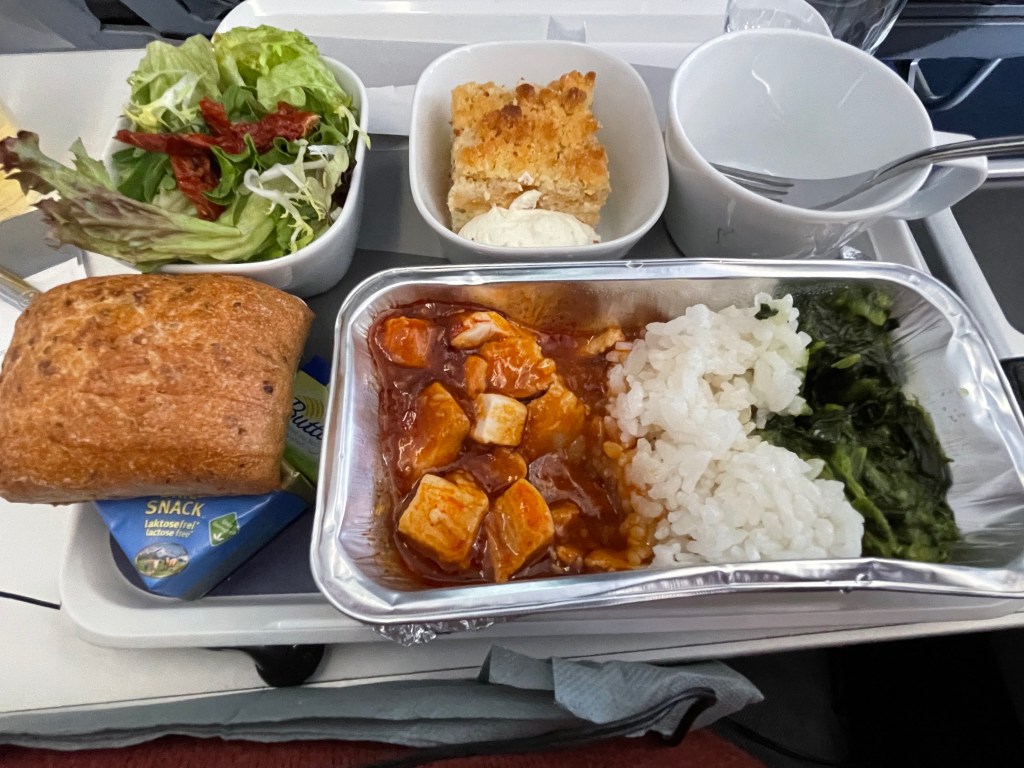
We had to go through Munich, and we had to wear masks for both flights. So, short crowded flight there with minimal service. A couple of hours in Munich’s Bauhaus-y airport, complete with sticker shock (Italian prices spoiled us.) We then, in an orderly way, boarded our Airbus A350 for the ride to New York. We fly premium economy so we can take more bags and stretch out some. (It also means a gentler reentry.) Lufthansa’s inflight service is pretty terrific compared to US based carriers. I’ll just show you the meal, etc., rather than describe them. An early rise and a few glasses of German bubbly meant that I conked out and didn’t get to see the ending of the Elton John biopic Rocketman,

At this point you probably expect me to diss JFK, US immigration and customs. But you would be wrong, A combination of a nearly empty flight, no other flights landing at the same time, and a glitch in the matrix means that we sailed through all of it. We didn’t have to scan our passports, the passport dude was semi-friendly. Our bags came out quickly—hey, with maybe 40-50 people on board, there wasn’t much luggage on that plane—and we were outta there. Neighborhood friend Wendy was there to welcome us and drive us home and…well….the Belt Parkway. But we were too tired to care.

That said, JFK’s Terminal 1 felt awfully shabby. The moving sidewalks didn’t move, there was ratty carpeting everywhere. It doesn’t feel like a gateway to a world capital city, much less a country that holds itself up as the world’s standard bearer. In general, it feels kind of decrepit around here after being away for so long.

I’ll write more later about what it feels like to be back in New York after more than five months of being on an Umbrian hilltop. But sheesh, people, was this country always so strange and stressed? You can feel it on the road and in the supermarket, where the masked and the unmasked eye one another suspiciously. The political strife. Even our nice morning dog group seems to have split up into factions. It’s as though this invisible hand is pushing us across the ocean,.

But our kids are here. And so is the glorious dachshund Lola. Damn,.

To know her is to love her.